What is a “direct” job?
October 13, 2011 Leave a comment
7/12/2015 UPDATE: I have a more recent post on this topic here: The basics: Regional Center investment structure and direct and indirect job creation
Now for a confession. After all this time working with EB-5 I’m still confused about how to use the word “direct job” in the Regional Center context. Here are the issues to reconcile:
- Most regional center investments do not count job creation at the level of the “commercial enterprise” (the entity that raises EB-5 investment) but at the level of an “investment project” (the entity that deploys the EB-5 investment).
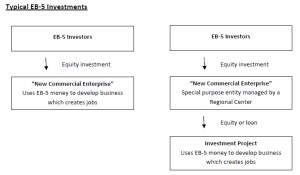
- In discussing “direct” and “indirect” jobs, USCIS sources use “direct” to mean a job at the commercial enterprise level and “indirect” to indicate a job at the project level. USCIS sources also use “direct” to mean an identifiable job that’s verified by payroll records and subject to 8 CFR requirements and “indirect” to mean a job that’s based on calculations by the economist. For example:
“Direct jobs are those jobs that establish an employer-employee relationship between the commercial enterprise and the persons that they employ. Regional centers typically use the RIMS II or IMPLAN economic models to determine the number of indirect jobs that will be created through investments in the regional center’s investment projects.” Adjudicator’s Field Manual Chapter 22.4 (2)(A)
“Direct jobs are actual identifiable jobs for qualified employees located within the commercial enterprise into which the EB-5 investor has directly invested his or her capital.
Indirect jobs are those jobs shown to have been created collaterally or as a result of capital invested in a commercial enterprise affiliated with a regional center by an EB-5 investor.”
June 16, 2010 Stakeholder Meeting PresentationThe concept of what qualifies as a “direct” job for EB-5 purposes can be complicated. 1. For non-RC affiliated capital investments, job creation may only be credited through the creation or preservation of jobs that are directly within the commercial enterprise in which the EB-5 Investor made his or her investment. 2. For RC-affiliated capital investments, job creation may be credited through the creation of jobs directly within the commercial enterprise in which the EB-5 investor made his or her investment, but can also be credited with indirect job creation through equity investments or loans to other organizations, or through indirect job creation based upon an econometric model supported by a detailed business plan and associated economic analysis.3. The concept of a what a direct job is within econometric modeling differs slightly from a direct job described in #1 or #2 above, as a direct job in this context is a job that can be directly attributed to the economic impact of the capital investment in order to derive estimates of indirect job creation.
Dec. 16, 2010 Stakeholder Meeting Presentation - I regularly see USCIS approving economic analyses that treat the Regional Center “investment project” only and use economic methodologies to calculate direct as well as indirect jobs created at the project level. In these analyses, “direct” jobs are part of a total calculation based various methodologies and don’t indicate jobs to be verified by payroll records.

It appears that in practice USCIS accepts that economists have a specialized definition of “direct,” and that the economist’s “direct job” is a subset of USCIS’s “indirect job.” Is this the solution, and does anyone have a clearer statement from USCIS on the issue? Do I dare use the word “direct” in my Regional Center business plans? How can the adjudicators tell when the word “direct job” means “ask for payroll records” and when it doesn’t? Several questions at stakeholder meetings have addressed the question (see particularly the 3/17/2011 meeting), but the published answers are not conclusive. And we need clarity because a lot of Regional Centers out there are counting on theoretical “direct jobs” for their projects, and don’t want to be hit with requests for W-2s and I-9s at the I-829 stage. Can anyone untangle this for me?
2011 UPDATE: Perspectives from other EB-5 commentators.
Joseph Whalen, who has experience as a USCIS adjudicator, writes in his essay on The Business Plan and the Economic Analysis in Support Of the Form I-924:
When the Economic Analysis bases and ties its projection as to indirect job creation on a base level of newly created jobs attributable to the alien’s investment in a particular commercial enterprise rather than simply to the dollar amount of the investment, it is critical to differentiate between “direct employees” on the alien’s payroll vs. “direct employees” of a third party who are “indirect employees” for EB-5 purposes. Third party direct employees used as “direct jobs” in terms of input into the Econometric Model may be termed as “hypothetical” or “base jobs” or some other terminology that clearly distinguishes them as not on the alien’s payroll. This is critical at the I-829 stage as to the evidence that will be required to lift conditions on residence. The classic and easiest example that illustrates this is “mall tenants’ employees” while another could be “factory workers” when the alien is loaning money to an industrialist in order to let that other person or entity build, convert, or expand a factory.
And attorney H. Ronald Klasko includes the following among his Top 10 Lessons Experience Has Taught Me about EB-5:
9. There is a difference between a direct job as defined by USCIS and a direct job as defined by an economist.
–USCIS defines a direct job as being a W-2 employee of the new commercial enterprise in which the investor invests. Economists define direct jobs as direct employees of the job creating enterprise or the construction company, as opposed to indirect or induced employment.
10. It is better to rely on indirect and induced jobs, rather than direct jobs.
–reliance on direct jobs could result in condition removal denial if there are less direct jobs than projected or if some of the employees can’t be proven to be U.S. citizens or permanent residents. Relying on indirect or induced jobs, such as through an economic model that relies on expenditures, may result in the regional center having more control over proving the required facts for condition removal.
2013 UPDATE: The 5/30/2013 EB-5 Adjudications Policy Memo includes the following paragraph (page 17):
Due to the nature of accepted job creation modeling practices, which do not distinguish whether jobs are full- or part-time, USCIS relies upon the reasonable economic models to determine that it is more likely than not that the indirect jobs are created and will not request additional evidence to validate the job creation estimates in the economic models to prove by a greater level of certainty that the indirect jobs created, or to be created, are full-time or permanent. USCIS may, however, request additional evidence to verify that the direct jobs will be or are full-time and permanent, which may include a review of W-2s or similar evidence at the Form I-829 stage.
The confusion continues. When the memo says “direct job,” is it referring to direct jobs as calculated by an economic model, even if such jobs are “indirect” with respect to the EB-5 commercial enterprise and not an input to the model? Since Regional Centers often invest in businesses whose payroll records they have no right to access, this is an urgent question.
Discover more from EB-5 Updates
Subscribe to get the latest posts sent to your email.
 EB-5 Updates