I’m happy to report new USCIS data obtained via Freedom of Information Act by the investor association AIIA (with litigation by Galati Law). See AIIA’s new post AIIA FOIA Series: Updated I-526E Inventory Statistics for July 2025 for the data plus detailed analysis. The FOIA covers I-526/I-526E receipts, approvals, and denials by TEA category, petitioner country, and filing date from April 1, 2022 to July 31, 2025.
The TEA-specific I-526/I-526E approval and denial data through July 2025 is new and particularly interesting to me. I approach the data with two questions at top of mind. Have there been enough total approvals to create qualified applicants for available set-aside visas? (The timing of Visa Bulletin retrogression depends on this.) What does the distribution of approvals by TEA, country, and priority date tell us about how USCIS is choosing to process I-526 and I-526E petitions? (I-526/I-526E processing times depend on this.)
I’ve made three tables below that highlight lessons I take from the AIIA July 2025 data. The first table puts investor petition data in context of visa availability. It highlights the irony of Rural and High Unemployment: that HUA has the greater long-term backlog risk due to high number of investor filings, but lower near-term retrogression risk due to low number of petition approvals.The second and third tables highlight apparent differences in I-526/I-526E processing by TEA and country, and the extent to which the process isn’t FIFO.
I can’t make conclusions for all time based on data through July 2025. (I hope that processing volumes have increased and processing order has become more equitable since then!) But the FOIA data gives a very interesting look at what happened with set-aside investor demand and petition processing through the middle of last year. Once again, Infrastructure was a data blank in the USCIS report as of July 2025. (I guess this reflects a coding problem in the USCIS database, since I’ve heard of a few Infrastructure projects recruiting investors before July 2025. But Infrastructure numbers may indeed have been at least very low last year.) Meanwhile I continue to hit “refresh” daily on the USCIS data page, hoping for another quarterly report, and will support AIIA to pursue another FOIA request/litigation for the next six months of TEA-specific data.
The January 2026 Visa Bulletin has been published. It has no retrogression and no warnings for set-aside categories, and a huge leap forward for India Unreserved.
The lack of Visa Bulletin movement for Rural and High Unemployment must reflect lack of movement by the government in processing visa applications. Rural and High unemployment applicants exist, considering the volume of I-526E approvals. As a reminder, last year’s January visa bulletin concluded with a warning that that: “The Department of State and USCIS note increased I-526E petition approvals, and both agencies see increasing numbers of individuals processing their applications to completion in the EB-5 set aside categories” and that therefore “It may become necessary to establish Dates for Filing and Final Action Dates during the fiscal year to ensure that issuances in these categories do not exceed annual limits.” However, FY2025 ultimately had no set aside cutoff dates. And now the January 2026 bulletin includes no renewed warning. The government stopped publishing monthly visa issuance statistics back in May, so there’s no visibility into their progress and performance. But no surprise if visa processing volumes remain low, considering all the new layers of vetting that have been added. So long as we can count on the government for low and slow set-aside visa processing volume, we can count on the Visa Bulletin staying “Current” for set-aside categories (regardless of applicant volume) and on Rural and High Unemployment backlogs continuing to balloon.
The Visa Bulletin movement for India Unreserved reflects either extremely high India Unreserved visa issuance in recent months, or massive attrition to the number of India-born applicants who appear in data reports to have I-485 pending or be registered at NVC. The January 2026 Visa Bulletin moves India Unreserved dates into post-RIA territory: May 2022 for final action and May 2024 for filing. Could this possibly mean that most pre-RIA India Unreserved applicants already have visas? There were 721 pre-RIA India applicants with pending I-485 alone at the start of FY2026, not to mention however many are waiting abroad, so I doubt. There aren’t even 721 Unreserved visas available to give India this fiscal year, unless the government counts on not issuing visas to Indians in set-aside categories. But the Visa Bulletin movement is extremely interesting. At minimum, it means maximum scope for Indian applicants to get non-FIFO visas, and even for set-aside investors to see opportunity for requesting a visa from the Unreserved category.
TEA Data Change
One of the datasets supporting High Unemployment TEAs traditionally updates annually in December. However, the Census Bureau announced that the 2020-2024 ACS 5-year data release is now deferred to January 29, 2026. This gives another month of validity to current High Unemployment TEA qualifications that depend on ACS data. Once the new data comes up, HUA TEA analyses will need to be updated, and some geographies may gain or lose eligibility based on the new numbers.
More entries have been made in the campaign to make immigration more difficult and unattractive, including slashing the EAD validity period. See the IIUSA blog article USCIS Policy Manual Update EAD Validity Period Change Affects EB-5. More countries face limits, and the State Department is expanding its speech surveillance, even requiring children to make their social media profiles public. The government’s mantra is “a U.S. visa is a privilege, not a right.” One day we’ll wake up and realize that attracting the world’s best and brightest to our shores is a privilege, not a right, and that the privilege wants protecting.
EB-5 Resources
AIIA has refreshed its website and made public an amazing resource library originally developed behind a paywall to encourage membership. Check it out! I frequently refer developers to the series of practical informational articles about how to use EB-5, and investors to resources for EB-5 decisions and problem-solving throughout the immigration process, from investment selection to pursuing capital repayment. Use the resources and still consider supporting AIIA with a membership contribution. The EB-5 world needs our associations to be there for us especially now, as the regional center program faces another sunset and battles over policy and program implementation. It’s worth joining forces for a chance to get voices heard and to maximize our shared resources. IIUSA also continues to be an important center for helpful resources and advocacy.
Gold Card
The administration has now published a half-baked application form and launched a website rife with baseless claims in support of the proposed Gold Card program. I blame ignorance/carelessness rather than any malicious or fraudulent intent, but still, such an embarrassment. The basic unseriousness of the program is reflected in the fact that the official pronouncements don’t even agree about when and to which department the notional millions of dollars in gifts would be made (whether to Commerce or Treasury, and whether before or after the USCIS application). Anyone who tries to use this program will get what he deserves – either (A) loss of capital plus ultimately no green card, since the program is not legal and supported by nothing but a President’s word, or (B) loss of capital plus a visa to a lawless country where a one-time president’s word is indefinitely effective in lieu of immigration law. Ideally, the Gold Card will shortly just disappear from consciousness like the whim it is, unused and forgotten. Ideally, before the whiff of scam and scandal has a chance to contaminate and confuse peoples’ understanding of the very different EB-5 program. (If you really want to read more about it, here’s a good article.)
USCIS has published another pending I-485 inventory report as of October 2, 2025. The December 2025 Visa Bulletin is out, with forward movement for EB-5 Unreserved and no notes about forthcoming Reserved dates. Department of State continues to not publish monthly visa issuance reports, not publish the FY2026 visa limit, and not publish the NVC waitlist. What can we learn? I look for insights into what happened with EB-5 visa issuance in FY2025, and hints for Rural, High Unemployment, and Unreserved outlook this fiscal year.
Rural and HUA Visa Issuance in FY2025
Rural and High Unemployment visa issuance through adjustment of status in FY2025 looks higher than I expected. Drilling down to month-by-month changes in I-485 inventory reports throughout the year, it appears that over 600 HUA and over 1,200 Rural AOS visas could have been issued between October 3, 2024 and October 2, 2025. With these numbers in AOS alone, it’s possible that DOS ultimately managed to issue at least the 1,150 HUA and 2,300 Rural carryover visas available in FY2025. If so, that would mean no transfer of unused FY25 carryovers to Unreserved in FY26 (and no net loss to Reserved, since FY25’s new-issue Reserved visas stay with Reserved in FY26).
Comparing monthly I-485 inventory reports merely shows changes, which aren’t all caused by approvals/issued visas. But the pattern continues to suggest that AOS visa issuance is far from orderly by priority date, and that Indian applicants have enjoyed an outsize percentage of I-485 processing activity. (Thank you to the reader who sent me his spreadsheet with data from each monthly I-485 report entered in tandem, facilitating a more granular analysis than my previous bookend-month comparison approach.)
Rural and HUA Visa Issuance in FY2026
It appears that the pace of Rural and High Unemployment visa issuance through consular processing must remain low in FY2026 to date. Considering the pace of I-526E approvals, there are probably 4,000+ Rural applicants and quite possibly 2,000+ High Unemployment applicants currently qualified and waiting for visas. But three months into FY2026, the Visa Bulletin is not yet warning about forthcoming Rural or HUA cut-off dates. I conclude that slow consulates have been organically controlling the crowd with low-volume interview scheduling, such that DOS currently still doubts the operational feasibility of issuing 2,000 HUA or 4,000 Rural visas this year. Slow-walking the Reserved visa backlogs is good for new U.S.-based investors who can keep using the concurrent filing window. It’s good for any salesmen who rely on lying that backlogs don’t exist until flagged in the Visa Bulletin. The consulate slow walk is bad for EB-5 investors abroad who fall behind U.S.-based applicants, and bad for wait times overall as the backlog can’t advance and dissipate on schedule.
Rural and HUA Demand Trends
Since I-485 are concurrently filed with I-526E, we can get a sense of recent I-526E trends by looking at priority dates in the I-485 inventory. No surprise, the numbers for July to September 2025 priority dates suggest that India-born Rural investors continue to drive U.S.-based EB-5 demand.
India Unreserved Backlog and Outlook
When will pre-2022 India Unreserved applicants finish getting visas? People keep thinking “in about a year” because the Visa Bulletin has been a tease. The India Unreserved Final Action Date moved to 2020 two years ago, and to 2022 last year, only to retrogress back and forth. The history shows that one can’t look at any given final action date and conclude “everyone with priority dates within this final action date can expect to get visas shortly.”
The December 2025 Visa Bulletin moved the Indian Unreserved FAD to July 1, 2021. Does this now mean that all Indians with priority dates before July 2021 could get visas shortly? Consider that FY2026 has a minimum of 470 and possibly up to 600 visas for India Unreserved (with the upside depending on as-yet unknown rollover/carryover visas) — and this allocation has to cover consular processing as well as status adjustment. The October 2025 I-485 pending report shows 475 pending I-485 for Indians with pre-July 2021 priority dates. DOS hasn’t published a recent NVC wait list, but it’s likely not empty. (For the record, 2,019 India Unreserved applicants were reported registered at NVC as of May 2024, and likely <1,200 India Unreserved visas have been issued through consulates since May 2024.)
With over 700 Indians still waiting in the U.S. for Unreserved visas, the pre-RIA India backlog could hardly clear this year even if India Unreserved applicants abroad had disappeared. Considering backlog numbers I think it’s safe to expect that the India FAD will retrogress again to 2019 shortly (November 2019 is the major hurdle to pass), and not permanently progress past 2022 for another couple years. This is a controversial question — if you have a different take, please explain it!
China Unreserved
When will pre-RIA China Unreserved applicants finish getting visas? The December 2025 Visa Bulletin moved the China Unreserved Final Action Date to July 14, 2016 – a leap forward from last month, but only returning to where the Visa Bulletin was a year ago for China. The pending I-485 report does not add much insight for China, since most China-born applicants get visas through consular processing. I will copy in for reference the last available breakdown of NVC applicants awaiting consular processing (as of May 2024).
As illustrated, 2016 priority date are a crowd to work through. (And the table captured only the subset of applicants at NVC, not including applicants on I-485 or I-526 pending at USCIS.) I look forward to the publication of an updated NVC waitlist (which should be significantly reduced following FY25 visa issuance and DOS efforts to cull inactive applicants) and recent numbers for visa issuance in Guangzhou (which might be higher than expected, given Visa Bulletin movement). And I copy for reference my comparison of USCIS I-485 inventory reports for China Unreserved from the beginning and end of FY2025 (though I’m not sure what to conclude from it).
Rest of World Unreserved
For countries other than China and India, when will pre-2022 applicants finish getting Unreserved visas? And are new investors choosing to request Unreserved visas? The I-485 inventory reports reflect what happened with status adjustment in FY2025. As usual, I puzzle over the question of order, and why some recent priority dates leave the inventory while older applicants remain pending. I also notice a small but increasing trend of post-RIA priority dates in the Unreserved I-485 inventory. I assume that the trend reflects Rural and HUA investors who decide to bet that an Unreserved visa might get issued first, considering the Rural and HUA crowds and the low rate of Reserved visa issuance to date. (Or some ROW applicants may be kindly requesting Unreserved to leave space for more Chinese and Indian investors to share the small Rural and HUA allocation). I expect the trend of ROW applicants requesting Unreserved visas to continue to increase, especially once enough HUA I-526E get approved to trigger Visa Bulletin cut-off dates for all countries in HUA.
Is this analysis helpful to you? Consider supporting my work with a contribution through PayPal or Stripe.
I mentioned the new whitepaper EB-5 After the RIA at the end of my last post, but I’d like to highlight it again as an important resource. CanAm organized a set of articles by industry experts to lay a chart over the new EB-5 landscape created by the EB-5 Reform and Integrity Act of 2022 — highlighting opportunities, flagging pitfalls, and discussing navigation. The typical EB-5 resource on the Internet blurs over risks – this whitepaper shines a bright light on them. Step 1 to avoid falling off a cliff is to see it. And then to strategize ways to navigate it, as the articles in this whitepaper strive to do.
Joey Barnett contributed a short must-read article that points out specifically what concurrent I-485 filing does – and does not – mean for legal status. This is essential knowledge for U.S.-based EB-5 investors who want to avoid finding themselves in removal proceedings (and for EB-5 sales agents who don’t want to endanger investors by overpromising the effect of EAD).
Mariza McKee and Mike Xenick contributed must-read articles for regional centers, issuers, and promoters who want to see and avoid the poorly-marked brinks of securities violations, particularly in the new environment where many investors are filing petitions in the U.S. The articles highlight essential (and easily-overlooked) responsibilities of parties in the chain of compliance, flag specific pitfalls to avoid, and point out practical strategies for staying safe and on the right side of SEC rules.
Lee Li, Aaron Grau, and I contributed articles that face the looming need for new legislation to keep EB-5 alive. Grandfathering for regional center program investors currently ends in September 2026, ahead of the 2027 regional center program sunset. High pending demand shows that the path to a timely EB-5 visa has already closed for the major EB-5 markets, only waiting on reserved investor approvals to push across-the-board backlog problems to the surface in the Visa Bulletin. We depend on action from Washington, DC in the coming months to keep the regional center investment window open by providing the necessary authorization and visa relief. Aaron’s article discusses strategies for these imminent life-or-death advocacy challenges, while Lee’s article and data analysis highlight the impressive economic story available to support advocacy.
For additional insight, see the webinar with Aaron Grau and Lee Li that CanAm released today: Navigating the Future of EB-5: Insights from Industry Leaders. The discussion delves into specific advocacy strategies and challenges, resources and data responsive to those challenges, and how we can contribute. I also note AIIA’s post from a few weeks ago One Year Left to Invest in a EB-5 Regional Center Project. The importance and urgency of these conversations cannot be overstated. The EB-5 future depends on today’s advocacy efforts achieving positive results against tough obstacles.
P.S. Notice also that USCIS published a new fee schedule on November 14 with lower EB-5 form filing fees. (11/18 UPDATE: The USCIS Newsroom now also has a post, including the note that: “In accordance with the Nov. 12 order, and effective immediately, USCIS will accept the fees that were in effect until March 31, 2024, which are listed in the ‘Current Fee’ schedule below. Petitioners and applicants should pay fees according to the “Current Fee” schedule, not the higher ‘Previous Fee‘ schedule. However, for items postmarked Nov. 26, 2025 or earlier, USCIS will also accept payment of the ‘Previous Fee.'”) See AIIA’s blog post for discussion of the successful litigation that accomplished this result, and implications for potential future legal actions on behalf of investor interests. We’re now temporarily back to pre-2024-level filing fees (good for applicants, bad for IPO’s budget) until DHS can finalize the pending new EB-5 fee rule based on the required EB-5-specific fee study. (And FYI, for those curious about how DHS calculates form fee levels as a function of its budget and volume projections, I’m sharing my Excel summary of DHS’s calculations in the 2016, 2022, and 2025 fee rule studies.)
The EB-5 Backlog Analysis Excel file linked to my EB-5 Timing Page has received another significant update. I incorporated data now available through June 2025, and adjusted the analysis. As demand grows, so does the need to think creatively about timing. Is there a way to look at the EB-5 inventory numbers and conclude “relax, this is not a backlog problem?” Is it possible to calculate an attractive EB-5 visa path for investors from China and India? This is what I’m thinking as I sweat over Excel, trying to model in complications and nuances and imagine best-case scenarios for visa availability.
The Big Picture
We now know that up to June 2025, over 6,000 Rural investors and over 6,000 High Unemployment investors had started the EB-5 process. How long could it take those investors to finish getting visas, considering about 2,000 Rural and 1,000 HU visas to be shared annually by investors, spouses, and children? If 12,000+ investors become 24,000+ visa applicants going for about 3,000 annual visas, what could happen? What happens if we continue to attract 5,000 investors per year, even if all 10,000 annual EB-5 visas were available to give to new investors plus family? Can the situation be saved by one year of carryover visa issuance, by denial/attrition rates, by government reporting error, by category switching, and/or by extra visas?
The big picture problem is clear, but the details are complicated. I bother copying data into Excel and attempting models because there are a lot of moving parts and possible assumptions between what’s known about the waiting line and what we want to assess: prospective visa wait times. Below, a few comments on my recent revisions to the Excel file linked to my EB-5 Timing Page.
What Changed in the Model – Input Data
EB-5 waiting lines are changing in real time, as more people start the process daily while others move on with visas. The previous version of my Excel model was set up with projections assuming that then-unknown incoming EB-5 demand in 2025 was mirroring demand in 2024. Now with actual I-526/I-526E receipt data published through June 2025, we can start to correct that assumption. As it turns out, demand has been trending upward, with the first 9 months of 2025 already exceeding total I-526/I-526E filings in 2024. Two types of demand have particularly steep spikes this year: demand for Rural investments, and demand from India-born investors. More people getting in a line naturally lengthens expected wait times for that line over previous estimates.
And then there’s the question of queue movement: adjudication rates and visa issuance volume. When I originally set up the Excel model for backlog analysis, I didn’t account for past visa issuance because it had been so low at that point, and I optimistically assumed that Rural and High Unemployment petition approvals and visa issuance would finally reach volume in 2025. With that assumption, I assumed that 2025 carryover reserved visas would not be lost, and that country caps could shortly apply in response to high Rural and HU applicant volume. Those assumptions facilitated some simplified scenarios that I’ve now deleted from the model. Now we know that the Visa Bulletin never moved in FY2025, and that cap limits on China and India could be deferred for an extended time due to low visa issuance volume. Revising predictions in light of low backlog movement means assuming fewer total Rural and High Unemployment visas issued (worse for wait times overall), but more visas issued to China-born and India-born applicants (better for China/India wait time predictions).
What Changed in the Model – Alternate Approach
I’ve noted alternate approaches to backlog analysis: a basic approach that I’ve typically used, and the industry standard approach. The formula is the same, but the approaches solve for different variables.
In the industry standard approach, the result – that EB-5 wait times must be tolerable (i.e. “about 5 years or less”) — is entered as a given, and then one solves for the levels of failure, attrition, double-counting, reporting error, category-switching, and/or extra visas needed to achieve that result. I tried to set up the revised model to facilitate this approach, setting up scenarios where one can assign values to a variety of assumptions to make a quantitative bridge between A (available data on people in line) and D (the conclusion of a tolerable wait time).
The industry standard approach has validity, considering that the variables don’t represent inert data points but people with limited lives and patience who are only going to hold out for a green card for as long as is tolerable/possible/feasible. When my basic approach divides 6,000+ China Rural applicants by the minimum 140 annual Rural visas certainly available to China, the result “43+” can’t mean that anyone in real life will wait 43+ years for a visa. Factors like category-switching and attrition can result in actual visa issuance above the theoretical minimum, and in actual visa applicants below baseline expectation. But let’s not wave hands vaguely in the air over the factors, asserting that variables of unspecified value will add up to a preconceived wait time conclusion. One can start with available data, assign specific values to assumptions so that they’re open to consideration/critique, and show the work that leads to the desirable visa wait time conclusion. I’ve tried to set up my Excel file to facilitate that exercise, and invite others to improve on the attempt. I will highlight two tabs in the revised Excel model: the Unreserved tab, and the 5YR Scenarios tab.
What Changed in the Model – Unreserved Tab
The Unreserved tab is set up to assess when Unreserved visas could become available to post-RIA post-2022 priority dates. This is important, because Unreserved visas are technically available to Rural and High Unemployment investors (according to the codes on I-526E approval letters), but only practically available to applicants in order by priority date. Set-aside investors from China and India, who now face long lines in Rural and High Unemployment, need to know when they could start accessing Unreserved visas as well – i.e., when the Visa Bulletin will finally finish dispensing Unreserved visas to Chinese and Indians with pre-2022 priority dates, and able start moving on to later priority dates in 2022, 2023, 2024, 2025, etc. who haven’t managed to get Rural or HU visas yet.
I expanded the Unreserved tab by copying in the very most granular reported data available for the Unreserved backlog. Then I highlighted cells for adding assumptions about denials/attrition at multiple stages, double-counting, and future visa issuance, and set up formulas to calculate the impact of the entered assumptions. Try adjusting the assumption cells, and see what assumption values are required to reach your conclusion about the remaining size of the legacy Unreserved backlog, and remaining time to clear that backlog. Then consider the plausibility of the assumption values. (To assist the plausibility test, the tab includes data on number of I-526 filed 2014-2022, and the number of EB-5/Unreserved visas issued 2015 to 2024.)
What Changed in the Model – 5YR Scenarios Tab
The 5YR Scenarios tab is another attempt to tackle a top question from Rural and High Unemployment investors from China and India: What will happen with visa issuance in the next five years, and could my turn at a set-aside visa number come in that time? On this tab I first highlighted available data related to Rural and HU supply and demand (I-526/I-526E receipt numbers and visa issuance through mid 2025), set up a section for inputting key assumptions about the future, and built a results section to automatically recalculate conclusions from the assumptions entered.
For the 5YR Scenarios tab assumptions section, I set up cells highlighting the two most significant demand factors factors that I see moving the needle on visa wait times for Rural and HU investors from China and India.
For every one who starts the EB-5 process by filing I-526/I-526E, how many visas will actually get used? Smaller family sizes and higher failure rates mean lower visa demand and shorter queues/wait times, and vice versa. (My default assumption of average 2.0 visas per I-526/I-526E filed is based on combining the historical average 2.63 EB-5 visas issued per investor with my guess at 25% future denial/attrition rate overall. But the future reality could plausibly turn out higher or lower. The model lets you adjust these cells to match your best guess.)
How much will investors from China and India have to compete with Rest of World demand for Rural and High Unemployment visas? Could ROW squeeze China and India down to the 7% country caps, or leave some visas unused on the table to allocate above 7%? The Rest of World prediction in the model has two parts: 1) how many ROW investors will continue to file Rural and HU I-526/I-526E on an on-going basis, and 2) how many of those investors will go on to ultimately request a Rural or HU visa rather than the Unreserved visa for which they also qualify? Less ROW visa usage would mean more visas left for cap-limited China and India applicants, and thus less-bad China/India backlogs. And vice versa. (The problem with being a cap-limited applicant is that I not only wait behind applicants with earlier priority dates, but also behind applicants who will invest later but can still have priority over me for visa issuance thanks to the country limit.) For the ROW demand/usage assumptions I entered a limited set of scenarios in the model — mainly to illustrate how much these assumptions move the needle on future backlogs/timing for China and India. For example, prospective visa availability for current China and India Rural investors increases dramatically due to decreased competition if regional center EB-5 becomes unpopular after the 2026 grandfathering deadline, and/or permanently expires after 2027. Likewise, if many existing Rest of World investors volunteer to take Unreserved visas, that means more Rural and HU visas left for post-RIA Chinese and Indian investors who face wait times in all categories. I hope that laying out some of these “what ifs” in scenarios in Excel helps to clarify these considerations. I don’t know what will happen with future EB-5 demand, but I know that whatever happens will significantly effect wait times for Chinese and Indian investors starting the process today.
There’s quite a large range of possibility for what could happen with visa demand. Less so, I think, for supply side predictions. I entered a best guess at to-date and year-by-year Rural and HU visa issuance in the 5YR Scenarios tab, and highlighted these cells as assumptions that you can change. But I can’t think of dramatically different scenarios for estimating total visa issuance by 2030. We can assume one extra helping of visas thanks to carryover, whether Department of State manages to serve that extra helping in 2026 or 2027. We might get a few visas over average one year thanks to extras from family-based, or a few visas under average one year due to consular constraints. Actual to-date visa issuance might turn out a bit higher or lower than my guess based on data through May 2025. But overall, probably not enough variation over the period to make a great difference — unless DOS continued indefinitely to issue <2000 Rural and <1000 HU visas, thus losing many visas, or unless the law changes visa availability/allocation.
The calculations on the 5YR Scenarios tab are set up to reach a conclusion for this question: how many China-born and India-born applicants with priority dates before June 2025 may not have Rural or High Unemployment visas yet by 2030? The calculation totals up demand that may be competing with these applicants (based on given data and the assumptions that you enter for attrition and ROW demand behavior), then subtracts the estimated total visas issued through 2029. The result is an estimate of the existing Rural and HU visa demand that might not be accommodated this decade by Rural and HU visas.
If you need to conclude that a five-year visa wait is still possible for recent China-born or India-born investors, then you can try adjusting assumptions on the 5YR Scenarios tab until it’s calculating 0 set-aside demand unaccommodated by set-aside visas by 2030. And/or changing assumptions on the Unreserved tab until it’s calculating 0 pre-RIA Unreserved demand well before 2030, which would mean an early date for set-aside investors from China and India to start moving over and requesting Unreserved visas. (When I enter my default assumptions, I am seeing thousands of China-born and India-born Rural and High Unemployment investors who may not be able to get Rural or HU visas this decade, or before Unreserved visas start to become available to Chinese and Indian set-aside investors. But play with the numbers and see what you think.)
Personal Note
The EB5 Backlog Analysis Excel linked to the EB-5 Timing Page is my live internal working tool for thinking about backlog questions – not a complete or comprehensive product. I share the link out of generosity and because EB-5 is full of smart people who can take the work further. Download the file, look at the data, critique the formulas, and add your improvements. Or check back in a few weeks to see what changes have occurred to me. I make frequent edits as I get new info or new ideas or notice errors. If you’d like to discuss visa availability/timing questions one-on-one, my consultation service remains available. If you find the Excel data collection and/or models useful for your own analysis, consider my Stripe or Paypal links as a way to support the effort.
Conclusion
Backing up again to the big picture: Unreserved, Rural, and High Unemployment visa applicants in the pipeline exceed forthcoming visa availability. That’s a fact under any calculation – the questions are how much excess, who’s affected, and when the excess will be felt in the Visa Bulletin. Considering the documented and growing EB-5 demand in excess of forthcoming visa supply, do we face:
(1) discouragingly-long visa wait times, particularly for China and India, or
(2) discouragingly-high failure/denial rates, or
(3) rescue from Washington, D.C. in the form of visa relief?
Those are the three options. Where A*B/C=D, and A is a given number of investors/applicants queued up for visas, the wait time D isn’t coming down except by discounting demand with low success rate B or increasing C visas available. I hope that the industry is ready and able to bet on visa relief rather than applicant failure to underwrite the future. I am happy to see visa advocacy discussions in progress. CanAm highlights the issue in a new whitepaper EB-5 After the RIA (with sections by experts around the industry), and is hosting a webinar with IIUSA’s Aron Grau and Lee Li on November 18 that will address visa advocacy among other topics. And the final article in Fall 2025 IIUSA Regional Center Business Journal is “Wasted Set-Aside Visas and A Call for Urgent Action to USCIS” by Lee Li and Joey Barnett.
The 2025 EB-5 fee rule proposes to LOWER EB-5 form filing fees, primarily based on allowing IPO to keep EB-5 fee revenue instead of also helping to fund other USCIS functions. DHS foresees increased resources and continuing efficiency improvements at IPO, considering RIA goals, but offers no timely processing guarantees. (See below for more detailed discussion.)
The rule proposes a new Form I-527. “An investor may file this form if they filed a Form I-526 before March 15, 2022, and are seeking to retain eligibility under section 203(b)(5)(M) of the INA because their regional center has been terminated or their NCE or JCE has been debarred and they do not otherwise continue to be eligible notwithstanding such termination or debarment.”
The promised “technical amendment” turns out to be about I-829, and “specifies that where the dependent family members cannot be included in the Form I-829 petition filed by the principal investor because that principal is deceased, all dependents (spouse and children) of the deceased investor may be included on a single Form I-829 petition.”
I expect that the liveliest public comments may be on the section of the rule discussing integrity fees, and the fundamental question of whether there’s any compliance distinction between a “previously-approved regional center” and a “regional center designated under (E).” No, suggests the rule. “DHS reiterates that the statutory language is clear in that these new provisions of the INA added by the EB-5 Reform Act, including the required fees and penalties, also apply to previously designated regional centers as of the date of enactment.” The rule also offers detailed discussion (which I couldn’t quite follow) of how to define “investors” for the purpose of calculating integrity fee payments. The rule proposes a minimal inflation-based increase to the integrity fee amount.
The rule is open for public comments until December 22, 2025. And then “After considering comments on this rule, DHS will complete and publish a final fee study that will take effect 60 days after publication.” So we are still months away from new fees, but the proposed rule publication is an important milestone.
Fee Change Discussion
DHS proposes to lower filing fees for most EB-5 forms.
The single major factor in this recalculation is a decision to NOT use EB-5 filing fees to cover non-EB-5 costs. As I pointed out in my analysis of the 2022/2023 fee rule, DHS previously set EB-5 fees to allow collecting over $20 million that would be reallocated to USCIS budget needs outside EB-5, to help cover the cost of no-fee/low-fee benefit processing. The 2025 EB-5 Fee Rule explains “the proposed fees are lower than the current fees because the proposed fees do not include any additional costs for processing benefit requests with no fee or a reduced fee, thus reducing the fees overall.” DHS made this decision because doing cost reallocation outside EB-5 again “would likely result in litigation,” and because the reallocation from EB-5 is a drop in the total USCIS budget that might also be covered by USCIS balances and reserves and new appropriations in the “One Big Beautiful Bill.”
Another factor in the 2025 fee recalculation is that DHS is projecting slightly higher EB-5 receipt numbers than assumed in the 2022/2023 fee review (including remembering to account for all the various I-956 forms) and slightly lower average hours per adjudication than assumed in the previous fee study. If one assumes more form fees and lower time commitment per case, one can afford to consider lower fees.
Basically, the methodology and goal behind the 2025 EB-5 fee study is the same as the general DHS fee-setting methodology, with a focus on cost recovery rather than performance. The goal is “to assess whether the current EB-5 fees meet full operating-cost recovery consistent with the EB-5 Reform Act requirements.” The 2025 fee study does reference RIA timely processing targets, but points out that “Completion Goals Are Not Requirements.” The rule explains that “consistent with the statute, DHS is not proposing to codify any processing deadlines, or any consequences for missing those processing time goals. USCIS will strive to process EB-5 requests as quickly and efficiently as possible to meet the time goals referenced in the EB-5 Reform Act and on which the fees in this rule are based, while keeping the integrity of the program utmost in mind.”
The 2025 Fee Study makes welcome comments about USCIS efficiency improvements, and plans to invest in more staff at IPO. The rule specifies a goal to reach “a total of approximately 334 employees (FTEs) across multiple USCIS offices (237 FTEs in IPO, nine (9) FTEs in Administrative Appeals Office, two (2) FTEs in Office of the Chief Counsel, 86 FTEs in Fraud Detection and National Security Directorate).” For reference, IPO Chief Emmel previously reported that “All told, we have around 180 IPO staff and 36 IPO Fraud Detection and National Security staff for a total of 216 employees on-board as of October 1, 2022.”
Is it possible that DHS will not only lower EB-5 filing fees but also increase IPO resources to the point that we see processing improvements? The fee rule is ambiguous on this point. The rule disclaims responsibility to meet RIA timely processing time goals, and doesn’t formulate a specific plan to meet the goals. But processing should improve in fact, if the IPO budget and personnel are indeed increased as contemplated in the rule. All the better if this can be accomplished simply by letting IPO keep all EB-5 fee revenue, with no increase to EB-5 filing fees.
Is this analysis helpful to you? Consider supporting my work on the blog with a contribution through PayPal or Stripe (Link or credit card).
Quarterly reports at the USCIS Citizenship and Immigration Data page include a confusing report titled “Form I-140, I-360, I-526 Approved EB Petitions Awaiting Visa Final Priority Dates.” I’ll explain how I interpret this report.
I added yellow underlining to the screenshot to highlight key interpretive clues. The data refers to “approved” I-526/E petitions only (not to all filed or pending petitions). It does not cover all approved petitions, but only the subset of approved petitions that are defined as “awaiting visa availability.” And “awaiting visa availability” is defined with reference to a given monthly visa bulletin Final Action Dates chart.
Therefore, to interpret the USCIS report, I turn first to the referenced Visa Bulletin (June 2025, according to Note 6 in the report) and I check the EB-5 Unreserved Chart A dates that month: January 22, 2014 for China, and May 1, 2019 for India. I then interpret the USCIS report to say: “We have approved 30,313 I-526 for 5th Unreserved China investors who have priority dates later than January 22, 2014. We have approved 755 I-526 for 5th Unreserved India investors who have priority dates later than May 1, 2019. Since these priority dates are later than the final action date in the visa bulletin, the cut-off for visa availability, the assumption is that these approved investors don’t have LPR status yet and are still awaiting visa availability. (We’re overlooking the complication that the June 2025 Visa Bulletin retrogressed, so it happens that some approved investors with these priority dates used to be current and thus could’ve already received visas. We are also, by definition, not counting investors who are waiting for visas but whose I-526 we have not approved yet.)”
Compare to the March 2025 USCIS report, which referenced the March 2025 Visa Bulletin to define the cutoff for visa availability.
EB-5 Unreserved Chart A dates in the March 2025 Visa Bulletin were July 15, 2016 for China, and January 1, 2022 for India. I then interpret the March 2025 USCIS report to say: “We have approved 12,117 I-526 for 5th Unreserved China-born investors who have priority dates later than July 15, 2016. We have approved 116 I-526 for 5th Unreserved India investors who have priority dates later than January 1, 2022. We’re not the agency that issues visas but we’re offering the data that we do have – for I-526 approvals — as a hint at the number of petitioners who may still be awaiting visa availability. We are overlooking the complication that in practice approved investors with priority dates BEFORE the visa bulletin final action date may also not have visas yet for for one reason or another. And by definition we’re not counting still-pending I-526, and not counting spouses or children.”
USCIS report numbers between March 2025 and June 2025 are so very different primarily because the two reports are counting a different subset of petition approvals, as defined by different visa bulletin dates. “I-526 approvals for priority dates since June 2016” is a smaller segment than “I-526 approvals for priority dates since January 2014.” A bit of adjudication activity between measurements adds to the difference, but basically the two reports are measuring different things. It’s not that the China backlog abruptly increased in three months from 12,117 to 30,313. The USCIS report numbers are not referring to a total backlog at all, but very specifically to different date-defined segments of approved I-526.
The USCIS report is confusing partly due to the disconnect with what the public wants. The public wants to know how many EB-5 applicants are still waiting for visas. It’s impossible to derive that information from this USCIS report, despite its enticing title. The report simply gives limited information for a segment of the backlog – principals not dependents, approved petitions not pending petitions, and only those approved petitions after a specified Visa Bulletin cut-off date. Furthermore, I judge it impossible that this report actually excludes petitions on behalf of individuals that have obtained LPR status, as Note 8 claims. USCIS isn’t the visa-issuing agency, and how would USCIS know who all of their approved I-526 petitioners went on to LPR? I guess that USCIS has no ready way to judge who exactly is “awaiting visa availability,” except to simply look at a current visa bulletin and take that as a definition of which priority dates might not have visas yet. Finally, the USCIS report numbers make sense when interpreted as a number of I-526 approvals within certain dates (compared against other data for I-526 filings for the same dates and approval volumes), and don’t match up if one expects them to represent still-pending applicants (compared against data for actual pending visa applicants and visa issuance). 30,000 is a plausible number for total I-526 approvals for China Unreserved with priority dates after January 2014, considering about 43,000 China I-526 filed from January 2014 to March 2022. It is not plausible as a number of China-born principal Unreserved applicants still waiting for visas as of 2025, considering that Chinese investors with PD later than January 2014 have in fact been getting visas since 2016, per previous visa bulletins, and data reports showed just over 33,000 total Chinese applicants (principals plus spouses and children) registered at NVC and on pending I-485 as of mid 2024.
Comparing the I-485 pending inventory as of September 2025 with the inventory as of October 2024 gives a hint at the volume and distribution of status adjustment visas issued in FY2025. Only a rough hint, since new receipts and denials also contribute to inventory change, the comparison misses change in intermediate months, and numbers <11 are redacted. But inventory report comparisons at least give some window into visa processing.
Looking at the I-485 inventory report comparisons for High Unemployment and Rural, I’m struck by the low volumes overall, exceptions to FIFO order, and timing differences by country. A wide range of priority date months show a handful of applicants disappear while dozens of others with the same PD remain pending. The lack of visa FIFO presumably originates in non-FIFO I-526/I-526E processing, since I-485 can’t be decided until the I-526/I-526E is approved or denied. I see that India-born applicants have lead the way both in terms of volume and dates for I-485 inventory changes. I assume this is because Indians have been most aggressive with I-526 mandamus actions. But volumes have been so low overall. I assume that the distribution of I-485 decisions will tighten as I-526/I-526E adjudication volumes increase.
For Unreserved, I’m particularly interested to notice a significant number of post-RIA Unreserved applicants. I doubt that many people have invested at the $1.05 million level, so assume that many/most of these post-2022 Unreserved applicants represent Rural or High Unemployment investors who chose to request Unreserved visas. I also note the number of India Unreserved I-485 pending as of September 2025. One would think, looking at the Visa Bulletin alone, that the India Unreserved backlog is on track to clear out this year. That seems less likely when one considers over 600 India Unreserved I-485 still pending as of September 2025, not to mention however many India-born applicants are still registered with NVC for consular processing.
This is the first of a series of posts about USCIS receipt and processing data for FY2025 Q3 (April to June 2025), now published on the Immigration and Citizenship Data page. I’ll start with charts highlighting significant points from the All Forms report.
Overall Processing Productivity
I had been alarmed by the downward trend in EB-5 processing volumes, and happy to see a significant upswing in Q3 — primarily driven by increase to the number of post-RIA I-526 and I-526E processed. It’s good to see the Investor Program Office using the processing resources it evidently has, considering past volumes.
Post-RIA Processing Volume Trend (I-526 and I-526E)
The spike in post-RIA I-526/I-526E processing could well have generated more than enough qualified applicants by now for all 4,000 Rural and 2,000 High Unemployment visas available in FY2026. This is particularly true if high adjudication volume continued into Q4 — and I expect it did, considering that the “net backlog” report indicates over 3,000 I-526E actively in process of adjudication as of Q3. But I’m not certain, because the breakdown of approvals by TEA category is unreported. And we don’t have data yet for the other factor needed to predict retrogression: Has Department of State also increased its processing volume, thus allowing qualified applicants to get matched with visas? So there is not currently a data-based answer to the question of when the Visa Bulletin will have cut-off dates for Rural and High Unemployment.
Post-RIA denial trend
The FY2025 year-to-date section of the USCIS report shows 114 I-526E denials (just 6% of total processed) and 35 post-RIA direct I-526 denials (75% of total processed). Apparently, USCIS is currently mostly processing regional center cases they can approve and direct cases they can deny. Direct EB-5 has always required very careful preparation, and I’m happy to report that two of my business plan clients were among the handful of direct I-526 that got approved in 2025. Regional center adjudications are now divided into two forms, with projects first assessed in I-956F and then investors in I-526E. When projects get denied, I-526E denials will follow for investors in those projects. USCIS reported denying 50 I-956F in FY2024, and 45 I-956F in FY2025 YTD (20% of total projects adjudicated in 24/25). Maybe USCIS is waiting for project denial appeals before pulling and denying the I-526E for investors in those 95 projects.
Post-RIA Processing Trend (I-956 and I-956F)
I-956 regional center application volumes remain low. I-956F project application processing has dipped below receipt numbers as of 2025, causing the backlog to inch up again.
Pre-RIA Processing Trend (Legacy I-526 and I-829) and Processing Times
USCIS has nearly finished clearing the legacy I-526 inventory (with the “net backlog” now down to just 100 forms). The reported legacy I-526 processing time is extremely high only because recent decisions have been on old China I-526 held back by visa availability. For I-829, quarterly processing volumes continue to nearly keep pace with receipts. So the I-829 backlog has been holding steady, neither growing nor shrinking overall. With 7,000+ I-829 pending, how can the median I-829 processing time be only 10.8 months, as reported? Evidently, USCIS has not been processing I-829 in FIFO order. I assume this reflects the impact of Mandamus actions. Reported processing times (which reflect timing for the subset of cases that DID get happen to get adjudicated during the period) should always be looked at in context of the volume and age of pending petitions not getting adjudicated.
Post-RIA Demand Trend
I’ll write a separate post on the TEA-specific new Q3 data and backlog analysis, but I will start with a couple charts to contemplate. Demand from Rural and High Unemployment investors has grown extremely far above the level possible support with timely visas (with 2025 levels proving even higher than 2024). Especially considering that only 38% of EB-5 visas have historically gone to investors, on average, while the remaining get absorbed by spouses and children. Country caps, Unreserved visas, and non-FIFO processing give space for complicated mixing and matching such that some investors won’t have to wait as long as others for visas. But the overall picture shows EB-5 demand so high by June 2025 that visa wait times would exist even if post-RIA investors had access to the full 10,000 or so annual EB-5 visas, not to mention competing for the 32% of visas set-aside. 2026/2027 will have to see either visa relief or a demand crash.
Wonderful news to report: USCIS finally published more quarterly data (for April to June 2025) and preemptively included two new reports with I-526/I-526E receipt detail by country and TEA category! Maybe someone at USCIS wisely thought: we don’t want to see Galati Law’s name one more time — let’s just give the people what they want instead of getting sued. Thanks to AIIA and IIUSA for all the hard work on FOIA requests that helped push this good result of improved data transparency, and to USCIS for listening. You can visit the USCIS Immigration and Citizenship Data page to access the new reports (and appreciate how much work goes into processing the raw data into the kind of analysis you find here). I’m in process of updating my spreadsheets. I will note a couple headlines: over 1,000 I-526E were approved in Q3 (4x more than the previous quarter), meaning that the pool of qualified Rural and High Unemployment visa applicants is very likely large enough by now to trigger Visa Bulletin cut-off dates, if only Department of State can catch up with interview scheduling and visa issuance. And Q3 had another bumper crop of I-526/I-526E receipts, with over 1,700 more investors added to EB-5’s economic benefit and ballooning backlogs. Important knowledge to have!
Fiscal year 2026 begins today, with a promise of new fees, new regulations, denial and termination notice drama, Gold Card drama, data drama, and the deadline for grandfathering under current regional center program authorization. A few notes on developments that I expect in the coming months.
EB-5 filing fee changes
EB-5 filing fees are set to increase. We don’t know yet when or by how much, but we do know that U.S. Citizenship and Immigration Services Employment-Based Immigrant Visa, Fifth Preference (EB-5) Fee Rule (RIN: 1615-AC93) concluded regulatory review on September 25, 2025. This means that DHS could publish a Notice of Proposed Rule-making in the Federal Register any time. After the proposed rule is published, there should be a couple months (at least) before a Final Rule is published and the new fees take effect. The public may get a chance to comment. The proposed fee rule responds to the EB-5 Reform and Integrity Act requirement that USCIS set fees at a level to allow “timely processing” for EB-5 forms. At last report (March 2025), USCIS was processing approximately 10 times fewer forms than they would need to process to achieve the goal of <1 year processing times for everyone (despite already-high form fees, and despite having previously achieved much higher volumes with existing resources). Being in such a hole currently, how much might USCIS say they need to raise fees, to realize timely-processing targets? I also wonder what’s behind this sentence in the rule teaser: “This rule also proposes to codify in regulation certain elements of the EB-5 Reform and Integrity Act of 2022 and make one technical amendment.” We should find out soon. Certainly, timely processing can’t come too soon.
RIA regulations
Major EB-5 policy changes/clarifications are set to emerge when DHS proposes regulations to fully implement the EB-5 Reform and Integrity Act. In sustainment litigation, DHS promised a November 2025 deadline to publish a proposed rule for EB-5 Reform and Integrity Act of 2022; Ensuring the Integrity of the EB-5 Program (RIN: 1615-AC94). Publication of this proposed rule (NPRM) will certainly be followed by a public comment period (as promised in litigation), and then DHS has to review and respond to public comments. So we might still be a year or more away from a final rule. But November will at least bring insight into what DHS is thinking about hot button issues from sustainment to regional center compliance to investor protections, and will give the public a chance to weigh in.
Denial drama
With the low volume of I-956F and I-526E adjudications in 2022-2025, denial rates were also very low. As processing volumes increase and USCIS finds its stride with RIA compliance, the industry will grapple with more denials and terminations. I hear that USCIS finally, last week, started sending out notification letters to investors affected by regional center terminations, thus providing opportunity for investors to test Subsection M good faith investor protections. (Carolyn Lee has written about the notices and will hold a webinar next week.) If only USCIS would start publishing AAO appeal decisions again, to give a window into denial reasoning. (Publication of AAO decisions stopped abruptly in March 2025, and has yet to resume.)
Gold card drama
A Gold Card program will be implemented on December 18, 2025, IF agencies fulfill the Executive Order directive: “The Secretary of Commerce, the Secretary of State, and the Secretary of Homeland Security shall, within 90 days of the date of this order, take all necessary and appropriate steps to implement the Gold Card program.” I personally cannot imagine this actually happening — but even the pending prospect is a hassle for EB-5. What a shame that a 30-year-old program to get a visa for job creation, underwritten by the law, has to watch its back for a proposal to finagle a visa for nothing but some money, underwritten by nothing but a president’s gold-stamped face and an executive order.
Data drama
Backlogs and visa timing are the single most important topic in EB-5 today, as they define the window to keep raising EB-5 funds. I believe that explosive data developments exist to be reported, and I keep hitting “refresh” on government pages to find out. Unfortunately DOS hasn’t updated the “monthly” visa report since May 2025 or the “annual” NVC waitlist since November 2023, and USCIS hasn’t updated its “quarterly” data report since March 2025. So pernicious. IIUSA and AIIA continue to pursue data reports via Freedom of Information Act and litigation, and I look forward to being able to report sooner rather than later on what’s happened to EB-5 waiting lines since early 2025.
Visa bulletin retrogression
In 2026, the conditions for Visa Bulletin retrogression could exist for Rural and High Unemployment. The EB-5 set-aside categories did not have cut-off dates in 2022 to 2025 despite a high volume of Rural and HUA investment, because low-volume I-526E and visa processing held back investors from becoming qualified visa applicants. But the inevitable retrogression announcement gets closer by the day, as I-526E approvals continue daily to add to the pool of qualified visa applicants. For example, USCIS had approved 1,126 Rural I-526(E) by January 2025, and was approving new petitions at an average rate of about 100 per month in the last three reported quarters (with 74% of approvals being for Rural cases). Even if USCIS never improved on that atypically low volume, it is sufficient to have generated over 2,000 Rural I-526(E) approvals by January 2026. And 2,000 approved investors, when joined by spouses and children, could be over 4,000 visa applicants able to maximize the FY2026 quota of about 4,100 Rural visas. When qualified visa applicants exceed available visa supply, then the Visa Bulletin reacts. The actual month of Visa Bulletin movement remains unknown, as it depends on processing productivity and how many visas were ultimately issued at the end of 2025.
Grandfathering deadline
In reauthorizing the regional center program, the EB-5 Reform and Integrity Act stated in Section (E)(e) that “Visas under this subparagraph shall be made available through September 30, 2027.” However, Section (S)(i) “protection from expired legislation” applies to petitions “based on an investment in a new commercial enterprise associated with a regional center that were filed on or before September 30, 2026.” This distinction doesn’t matter provided that the regional center program gets reauthorized once again. (Assuming that program authorization is extended by September 2027, then visa issuance proceeds seamlessly for all priority dates and no one needs protection from expired legislation.) But in case the regional center program does not get another authorization, then the grandfathering deadline of September 30, 2026 becomes significant. In that case, only petitions filed up through this year will still be technically eligible to move forward under the grandfathering protection despite program expiration. Will this fact prompt a surge of EB-5 demand in 2026? Think about it. If you believe that the regional center program will sunset in 2027, then you might question the viability of a regional center investment today — even with the government offering some grandfathering protection on the immigration side. If you’re confident that the regional center program will gain timely reauthorization in 2027, then the grandfathering deadline is not a concern. And regardless of push from authorization deadlines, there remains the concern of visa availability amidst backlogs. Opportunity to beat a deadline is only compelling if opportunity to get a visa also exists. Ideally, the primary effect of the 2026 grandfathering deadline is to supercharge legislative advocacy efforts this year, including for visa relief. IIUSA and AIIA are starting to push the discussion.
Blog future
I continue to contemplate changes in 2026 for my E-2, L-1A, and direct EB-5 business plan service and for my EB-5 reporting service. At minimum, I resolve to switch out this blog’s outdated wordpress theme. If you are familiar with wordpress.com themes and can suggest one that would work for this content, please email suzanne@lucidtext.com.
“For He said and it came about; He commanded and it endured.” This verse is quoted from the Psalms, not from the U.S. Constitution. The “he” in this verse refers to God, not the U.S. President. “By the word of the Lord the heavens were made” — but it happens that by the word of the President is not how U.S. immigration law gets made.
I don’t know how much more than that to say about the executive orders that were dropped on Friday regarding H-1B fees and Gold Card. The release made for effective theater with dramatic audience response, but new immigration requirements and legal options do not instantly come about and endure by word of the President. The reality is more complicated.
The legal immigration system, which does after all exist and control borders, is now trying to sort the confusion around H-1B. (USCIS FAQ here.) The courts will soon be hearing about conflicts between the executive order and established processes and authority for setting immigrant fees. And then there’s the Gold Card. I’m bemused by everyone solemnly reporting on this meme as a live immigration option. The President spoke, and it was so? The President speaking starts a process, and where could the process end up, realistically? How can people be opening https://trumpcard.gov/ and reading it straight, not bursting into a hearty collective guffaw and giving Trump credit for a brilliantly funny troll of immigration?
Can the executive branch executively redefine who qualifies for U.S. visas defined in the law? If the answer is “no,” then the Gold Card executive order has the weight of the paper it’s written on. If the answer is “yes,” then the order can be effective on the President’s word until the next president comes along with his or her different word. If the 47th president can stipulate that giving a money gift qualifies as an extraordinary ability and thus a path to an EB-1 visa, then the 48th president has as much basis to decide, for example, that being a still-living Haitian today clearly reflects extraordinary ability and thus qualifies for an EB-1 visa.
Could President Trump possibly be serious about making the Gold Card a reality, enough to get Congress involved? On the off chance that he truly wants to back up the pitch to “receive U.S. residency in record time with the Trump Gold Card,” then he’ll have to push Congress for more visa numbers. (Otherwise as a practical matter, EB categories are already oversubscribed nearly across the board, with long visa number wait times to offer to incoming new priority dates for EB-1/EB-2 visas, even if new ways to qualify could be created and even if the pre-visa processing steps can be expedited.) What a funny and welcome plot twist if current leadership become the ones who finally raise the employment-based visa limit and increase the overall level of legal immigration, for the sake of making the Gold Card project work. And then future leadership might redefine more dignified bases than unrestricted cash gifts to qualify for the expanded visa limit. For example, what about supporting job creation? So I can sympathize with the lobbying flutter around the proposal. But … it all seems so improbable. But if anyone feels inclined to make an unrestricted cash gift in exchange for a Trump-branded immigration promise, what can I say? Department of Commerce could use the money.
For more discussion of the Gold Card idea, I refer for once to Center for Immigration Studies, and to Carolyn Lee and Joey Barnett. (I also note that immigration lawyers, who would know, are more optimistic than I am that Trump’s word on the Gold Card is effective.)
Today, Department of State announced Annual Limit Reached in the EB-5 Unreserved Category. This is good news overall — meaning that all Unreserved EB-5 visas available for FY2025 (at least 11,229 visas by my count) have been issued and won’t be lost to EB-5. The announcement clarifies that DOS did remember to include carryover of unused FY2023 Reserved visa numbers in FY2025’s Unreserved limit. I’ll be interested to see which countries ultimately benefited from the last-minute flurry of Unreserved visa issuance.
Consular interviews interview scheduling and I-485 adjustments Visa issuance for Unreserved EB-5 will now stop until FY2026 visas become available in October. (“Since all available EB-5 unreserved visas for FY 2025 have been used, embassies and consulates may not issue visas in these categories for the remainder of the fiscal year.”)
Apparently, FY2025 annual limits have sadly not been reached for EB-5 reserved categories, which means harm to the Rural and High Unemployment backlogs but future benefit to Unreserved from unused visas and carryover. For background, see my previous post on the October 2025 Visa Bulletin.
The October 2025 visa bulletin has been published, giving the first indicator for EB-5 visa issuance in FY2026. Spoiler: the October 2025 visa bulletin imposes no filing or final action dates for EB-5 set-aside visa categories, and it has no note warning when such dates may appear in coming months. The bulletin gives Unreserved dates for China and India that are optimistic according to my backlog calculations, but less optimistic than the dates in the October 2024 visa bulletin. This post looks behind the surface of visa bulletin silence on EB-5 set-aside visas, and the retrogression for EB-5 Unreserved.
Rural and High Unemployment Visa Bulletin Silence
Why does the October 2025 visa bulletin still show “C” for all EB-5 set-aside categories? Why isn’t there any note at the base of the visa bulletin warning about cut-off dates coming soon? Because, the visa bulletin only imposes dates when there’s near-term risk of issuing more than the number of visas available in a category. That risk has not yet been triggered for Rural and High Unemployment due to (1) relatively few visa applicants and (2) even fewer visa interviews and adjustments. Reserved visa activity is apparently still low, despite thousands upon thousands of Rural and High Unemployment investors, because USCIS is not creating enough visa applicants by approving enough I-526(E) petitions, and Department of State is not issuing enough visas even to the qualified applicants it does have waiting.
Here’s an attempt to tell the story with a picture. The image shows the EB-5 process – I-526(E) processing followed by visa processing – and the issue: lots of pending and incoming I-526(E) (which aren’t considered in the visa bulletin) but relatively few petition approvals, few qualified visa applicants, and few visas issued (factors that do affect the visa bulletin). The image is more-or-less to scale, with each little ball intended to represent 100 investors, or about 200 current/future visa applicants. (Though it turns out, AI can’t really count.)
The data cited in the image is old now, since USCIS hasn’t published a data report since March 2025 and DOS hasn’t published a report since May 2025. But unless processing volumes magically improved in the unreported last six months, we may still be stuck with little set-aside visa issuance activity — and thus no visa bulletin activity yet — despite the high number of Rural and High Unemployment investors. (By the way, you can find my data collection saved together with source links on the EB5 Timing Page.)
If you’re only wondering when the visa bulletin will announce set-aside retrogression, then you can just look at the base of the image and be comforted by relative lack of activity at the visa processing stage. If you’re wondering how long the green card process will take for a new investor, then you need to consider the entire image. A new EB-5 investor can’t skip straight to visa processing, but first waits in the I-526(E) processing funnel – which, as illustrated in the image, is already very crowded plus continually growing at a high rate and emptying at a low rate. That picture is not good for overall set-aside visa wait times.
The comparison helps flag one wrong way to read the visa bulletin. Don’t look at the dates in one visa bulletin and assume “everyone within these dates is going to get visas soon, and many/most people up to these dates already have visas.”
Any Chinese and Indian EB-5 applicants who got excited back in October 2024 about 2016 and 2022 dates now realize – with Department of State – that those dates were aggressive and needed to be walked back. I am not surprised by the October 2025 visa bulletin dates, because I look at the number of people reportedly queued up within those dates as compared with visas issued and available. As I discussed last year, FY2025 did not have enough visas available to satisfy all pending Chinese EB-5 applicants with pre-2016 dates, or all Indian EB-5 applicants with pre-2022 dates. No wonder that those dates from the October 2024 visa bulletin retrogressed, even after unexpectedly-high Unreserved visa issuance to China and India in FY2025.
I guess that the China Unreserved final action date could advance again to July 2016 shortly, but will not pass September 2016 for another few years — considering that 5,334 Chinese filed I-526 in July to September 2016, and may still be waiting to claim visas with spouses and children. I expect that the India Unreserved final action date will return shortly to November 15, 2019 and stay there, considering that the November 2019 filing surge could take years to work through the system – if most of the 745 Indians who filed I-526 in November 2019 ultimately claim visas with their spouses and children. (For the detail and data behind this analysis, see the Pre-RIA China and Pre-RIA India tabs in the EB5 Backlog Analysis Excel file linked to my EB5 Timing page. I had previously hidden those Pre-RIA tabs because they use old National Visa Center waitlist data – as of May 2024 – and I kept expecting the NVC waitlist numbers to be updated and maybe significantly reduced. I hear that Department of State has been actively culling the NVC waitlist, booting out applicants who registered but then didn’t pursue a visa within a year. If this process eliminates many potential applicants from the backlog reported as of 2024, then my model can be recalculated and wait time estimates will fall accordingly. But, for now I’m working with the data that has been published.)
A benefit (for some) of aggressive visa bulletin dates is opportunity for out-of-order visa issuance. If an Indian EB-5 applicant with a January 2021 priority date had to wait for every Indian with an earlier EB-5 priority date to get visas before his turn came, then he could expect to wait years for a visa. But when the visa bulletin makes final action technically available already to January 2021, maybe that recent investor can skip over the remaining crowd of November 2019 India priority dates and snag a lucky non-FIFO visa shortly. With the disorder in USCIS and consular processing, there’s opportunity to benefit or suffer from queue-jumping. And meanwhile, the visa bulletin is generously letting all Indians benefit from an April 2022 Date for Filing, even though the India EB-5 backlog through April 2022 doesn’t appear on track to clear for several more years.
And finally, here’s an attempt at illustrating the Unreserved EB-5 visa backlog situation in a picture. By contrast with Reserved EB-5, Unreserved has a small and shrinking backlog awaiting I-526 processing but a large crowd of qualified applicants at the visa stage, where they trigger visa bulletin traffic control.
This post provides links to important EB-5 resources and updates that I’ve been collecting to share.
New FAQ on Visa Backlogs (CanAm Whitepaper)
This week CanAm published EB-5 Visa Availability and Allocation: Q&A for 2025 – a set of articles that I wrote to address common visa questions from prospective and current EB-5 investors. Last year I wrote a Q&A that generally reviewed the basics of how visa numbers and allocation work in EB-5. This year’s Q&A addresses 13 more specific and personal questions, and references 2025 data. Most questions came from the CanAm sales team – such as “If I filed a Rural petition to get priority processing, am I required to take a Rural visa?” “How long will it take for the Unreserved category to be current for an India-born investor?” “Is there any scenario where it would make sense for an investor in a Reserved category to choose from the Unreserved pool?” and so on. I contributed questions addressing points of confusion that I’ve encountered in timing consultations, such as “Is my visa wait time longer or shorter depending on my I-526E processing time?” I worked very hard on this Q&A, striving to respond as clearly and justly as I could to a list of tough questions about EB-5 visa availability and allocation. Thanks to CanAm for sponsoring the effort! There are many opportunities to get 1-2-sentence answers to EB-5 questions; this is your chance to get the 1-2-page response to your question.
IIUSA EB-5 Q&A
IIUSA came out with an important and helpful Q&A resource this week for a wide audience. IIUSA’s Frequently Asked Questions (FAQs) about the EB-5 Regional Center Program was developed by IIUSA’s Best Practices Committee as a practical guide for stakeholders involved in EB-5 transactions. The document is just 36 pages long but quite comprehensive – it could be a mini-book with the title “what you need to know to use EB-5.” A total of 78 questions cover a range of topics including investments, job creation, regional centers, projects, financial oversight, marketing and compliance, and the EB-5 immigration process. A lot of work, expertise, and experience obviously went into this document. The answers are clear and solid across a range of disciplines, and I recommend it as a source of general EB-5 knowledge for anyone involved in the project or investor side of EB-5.
USCIS EB-5 Q&A
I’ve been meaning to mention that on May 15, USCIS consolidated its EB-5 Q&A into one EB-5 Questions and Answers document linked to the USCIS EB-5 Resources page. The USCIS Q&A covers a range of questions about USCIS policy application, and particularly questions related to RIA implementation. I keep an eye on this page and save versions, because Q&A changes can quietly disclose revised USCIS policy interpretations. FYI if you track this as well, here’s a link to my redline of the May 15, 2025 version of the Q&A compared with the previous version as of July 17, 2024.
CSPA Policy Change
Last week, USCIS announced updated policy on the CSPA Age Calculation. “We are updating the Policy Manual to clarify that a visa becomes available for the purposes of Child Status Protection Act age calculation based on the Final Action Dates chart of the Department of State Visa Bulletin. The new guidance applies to requests filed on or after August 15, 2025.” Consistent with the administration’s goal to restrict immigration, the new policy will reduce the number of children who qualify to immigrate with their parents. It’s particularly concerning for EB-5 investor families from China and India who face long waits for their priority dates to match Final Action Dates. At least, the policy change applies prospectively to applications filed after the policy takes effect on August 15. Your lawyer can explain how this policy change may affect your children. See also articles on the policy change from Carolyn Lee and WR Immigration. Also note that while you’re asking your lawyer about CSPA bad news, you might also ask about the limits of the status conveyed by having a pending EB-5 I-485, EAD, and Advance Parole — and how to stay safe, especially in case of job change. It’s wise to be informed of potential worst-case scenarios when a hostile administration is interpreting the rules.
September Visa Bulletin and I-485 data
The September 2025 visa bulletin is out, with no changes to EB-5 dates but a note that “Visa Office expects to reach FY-2025 category limits in most employment-based preference categories during August and September. If at any time an annual limit were reached, it would be necessary to immediately make the preference category ‘unavailable’, and no further requests for numbers would be honored.” Reaching limits is good news: better for visas to be fully used than wasted. Considering the low numbers reported through May, however, the “most categories” maxing out FY2025 visas likely do not include EB-5 Rural, High Unemployment, or Infrastructure.
Monthly DOS and I-485 reports haven’t been published yet since May, but here FYI are my summaries of the May 5 pending I-485 inventory report, compared with the corresponding report from the start of FY2025.
EB-5 Webinars (Mandamus, Timing, Visas)
CanAm has been hosting webinars on a variety of hot EB-5 topics. I particularly appreciated the conversation with John Pratt on Avoiding and Addressing Delays in the EB-5 Process: Planning & Litigation (jump to minute 17 to hear John discussing the questions all EB-5 investors have about Mandamus actions) and the conversation with Joey Barnett and Charlie Oppenheim on EB-5 Visa Allocations and FY2026: Why the Numbers Matter More Than Ever. And you can tune in next week to hear more from Joey as well as Nicolai Hinrichsen, Min Wu and me on the topic of EB-5 Backlogs, Strategy, and What Investors Need to Know Now. (As someone with a face for whitepapers, I mainly recommend the written word for my backlog insights — but the other panelists have good insights! And I may be publishing another article soon with some outtakes from my slides.)
Blog support
If you benefit from this blog, just a reminder that I have a Paypal link available to help support the time spent in updates and making new resources. (Thanks Phuong Le for being a supporter and reminding me to make the contribution option visible!)
I had mourned in March when the Administration shut down the CIS Ombudsman, which exists to help resolve problems with USCIS and improve USCIS processes. The Ombudsman committed considerable effort in 2024 to researching and communicating with USCIS about EB-5 issues, and we couldn’t afford to lose them. I rejoiced when a reader brought to my attention that the office has been restored as of May. The Ombudsman website was updated on May 23, 2025 with the note: “The Office of the Citizenship and Immigration Services Ombudsman continues to exist and will perform its statutorily required functions.” I don’t know how many former Ombudsman staff can have returned from administrative leave, but at least the Request Case Assistance function is live again.
Sustainment Litigation
The litigation around the EB-5 sustainment period has reached a good milestone. Yesterday Judge Ana Reyes issued an Order in IUSA vs. DHS et al. that does not revert to the legacy sustainment requirement linked to Conditional Permanent Residence.
In the previous round of filings, Defendant DHS had asked the judge to hold the lawsuit in abeyance pending rulemaking, while Plaintiff IIUSA had asked the judge to vacate USCIS’s 2-year sustainment interpretation pending rulemaking. We waited with bated breath, wondering whether the judge was about to doom the industry to pre-RIA sustainment rules and/or confusion for as long as it takes to complete notice-and-comment rulemaking on RIA.
Thankfully, Judge Reyes did as DHS requested. She notes in the July 29 Order that the law did edit the sustainment requirement (“With the RIA, now immigrant investors’ investment ‘is expected to remain invested for not less than 2 years.'”), that the USCIS guidance on this change is “not (yet) final agency action,” and that a formal rule-making process is forthcoming with a Notice of Proposed Rulemaking slated to be published in November 2025. The NPRM will be followed by a notice-and-comment period, which will eventually be followed by a Final Rule. And after that, if the Final Rule does not address the Plaintiff’s concerns, then “the parties and Court can take up the final rule as necessary.”
I’m particularly happy to see the IIUSA press release celebrating this ruling as a win for IIUSA, which it is. Pushing USCIS to formal rulemaking is the one laudable goal of the IIUSA litigation, and IIUSA is so right to shift its weight to that solid point. The benefits extend beyond the sustainment issue, as we’re overdue for rulemaking to clarify and implement many aspects of RIA. I’m thankful that we finally get a deadline for this proper formal process to start. Some individual regional centers may want to continue to pursue other litigation arguments. But if any want to press the toxic contention that RIA intended to codify the pre-RIA sustainment requirement, let them come out and do so under their own names. With another Regional Center sunset looming, IIUSA needs high ground and a unifying role.
The rulemaking process may be lengthy. The last EB-5 regulation started with an NPRM and notice and comment in 2017, and resulted in a Final Rule in 2019 that was promptly challenged and ultimately vacated by litigation in 2021. I won’t be surprised if we get a new EB-5 law in 2027 before we get a chance to see any final result from the rulemaking process set to start with an NPRM in November 2025. I don’t know what sustainment period nuances will ultimately be defined by a final rule or rewritten in new law. But in the interim, I’m glad that the status quo is the USCIS website guidance on RIA’s 2-year minimum sustainment period, not a complete lack of guidance or the horrors of CPR sustainment.
Good Faith Investor Protections
Subsection (M) “Treatment of Good Faith Investors Following Program Noncompliance” is another positive part of the EB-5 Reform and Integrity Act that needs implementing. Subsection (M) offers some opportunity for blameless investors in troubled regional centers and projects to salvage their immigration process by changing affiliation or moving investment. I wrote about this last year in the article What happens to investors after regional center termination. But the Subsection (M) provisions are confusing and investors have faced difficulty in claiming protections – partly due to USCIS delay in terminating non-compliant regional centers. Now litigation is getting involved, with Galati Law leading the way. See the articles EB-5 Investors Sue USCIS Chief for Failing to Protect their Good Faith Investments as Required by Law and The Fight to Protect Good Faith EB-5 Investors.
FOIA on National Security Checks
I should also note tireless efforts by John Pratt and Ed Ramos to litigate for EB-5 integrity. They recently assisted AIIA to obtain a trove of FOIA documents from USCIS on how the Investor Program Office screens EB-5 petitioners for national security risks, including extreme vetting of Chinese nationals. For a summary of insights from the FOIA response see the article AIIA FOIA Series: Hidden USCIS Adjudication Standards – National Security Checks.
The August 2025 Visa Bulletin has been published with a nice surprise: advanced final action dates for China Unreserved and India Unreserved. These countries had retrogressed back in April 2025, effectively shutting down the flow of Unreserved EB-5 visas for the year to China and India. Now the Visa Bulletin is moving dates forward to allow more visa issuance to these countries in August and September — the last months of this fiscal year. Chart A moved to December 8, 2015 for China and to November 15, 2019 for India.
I’m quoting below the notes at the base of the Visa Bulletin that explain the changes. Basically, when one country/category gets more visas, it means that another is having problems. China EB-5 will get more 2025 visas after all because Department of State has not managed to allocate visas to Rest of World EB-5 applicants. (The Visa Bulletin delicately says: “[rest of world] EB-5 number use has not materialized to the degree that was expected.” This might mean that the thousands of ROW EB-5 applicants registered at NVC have disappeared. But I’m readier to blame consulates for failing to schedule interviews and request numbers for ROW applicants who are ready to go.) Meanwhile, DOS credits low family-based visa issuance for extra visas now being made available at year-end to India EB-5.
The following chart shows how monthly EB-5 visa issuance to China and India dropped after April retrogression, but without any increase to ROW visa issuance. Now we can expect China and India numbers to spike up again for August and September 2025, while Rest of World applicants can look forward to their backlog being punted to 2026. (My previous post discussed how the ROW waitlist as of 2023 mostly did not get 2024 visas but instead pushed into 2025.)
Quoting from the August 2025 Visa Bulletin:
F. VISA AVAILABILITY IN THE EMPLOYMENT-BASED FIFTH PREFERENCE (EB-5) UNRESERVED CATEGORY FOR CHINA
In the April 2025 Visa Bulletin, the EB-5 Unreserved final action date for China was retrogressed due to high Rest of World demand. In the months that followed, EB-5 number use has not materialized to the degree that was expected. Consequently, and in accordance with INA 202(a)(5), the EB-5 Unreserved final action dates for China has advanced to allow continued EB-5 Unreserved number use. Note that if at any time the EB-5 Unreserved annual limit were reached, it would be necessary to immediately make the preference category “unavailable”, and no further requests for numbers would be honored.
G. VISA AVAILABILITY IN THE EMPLOYMENT-BASED FIFTH PREFERENCE (EB-5) UNRESERVED CATEGORY FOR INDIA
In the April 2025 Visa Bulletin, the EB-5 Unreserved final action date for India was retrogressed due to high demand. It is expected that India will have unused family sponsored preference numbers that, under INA 202(a)(2), can fall down for use in the employment-based categories, including EB-5 Unreserved. As a result, the final action date for EB-5 Unreserved has been advanced to use these available numbers. Note that if at any time the EB-5 Unreserved annual limit were reached, it would be necessary to immediately make the preference category “unavailable”, and no further requests for numbers would be honored.
I look forward to hearing what Joey Barnett and Charlie Oppenheim have to say about the August Visa Bulletin in the next episode of WR Immigration’s Chatting with Charlie.
Department of State issued a record 14,501 Unreserved EB-5 visas in FY2024 — even more than technically available under the quota. China, India, and Vietnam did especially well. Vietnam cleared its legacy NVC waitlist with 1,522 Unreserved visas issued, India got 1,323 Unreserved visas (within 7% of the total EB-5 visas theoretically available to India, considering set-asides, but 9% of Unreserved), and China cleaned up with 9,312 Unreserved visas — 64% of visas issued in FY2024. (A few Unreserved visas even got allocated to post-RIA Chinese and Indian applicants — can anyone explain?) Other countries fell behind. Of “other” country EB-5 applicants who were registered at the National Visa Center in November 2023, only 38% got visas in FY2024. The other 62% were not constrained by any cap or quota limit, but by DOS capacity to schedule interviews and USCIS ability to complete I-485.
The answer to the question “who gets a visa” doesn’t only depend on priority date and country limits, but also depends on country-specific processing capacity. I’d like to highlight a helpful new page on the DOS website: IV Scheduling Status Tool. The page explains the visa interview process and factors, and gives timing by post. Post-specific timing differences for immigrant visas generally help explain the differences we see in EB-5 visa issuance. For example, the tool shows that NVC is currently scheduling documentarily complete IV cases with visas available from February 2025 in Ho Chi Minh City, but from March 2023 in Lagos. The page itemizes factors that can affect visa interview times by post, including interview capacity of the embassy or consulate, local conditions that affect operations, staffing levels, volume of cases, and vetting timelines.
Meanwhile at USCIS, the legacy I-526 backlog continues to shrink — but slowly. Fewer than 2,000 I-526 remain pending (and only 300 unassigned), but processing volume dropped from nearly 2,000 in Q2 2024 to only 656 in Q2 2025. Denial rates for old I-526 remain relatively high – 30% in Q2.
I-829 processing volumes in FY2025 Q2 were half what they were this time last year, and not FIFO. The FY2025 Q2 report shows about 1,000 I-829 processed, nearly 7,000 left pending, and a median processing time for completed I-829 of only 8.2 months. This tells me that Mandamus actions are having an impact, causing USCIS to pick out and adjudicate many recently-filed I-829 even as many older cases remain pending.
FY2025 remains on track to issue all available Unreserved visas. ROW should have a good chance at more visas since the Visa Bulletin retrogressed for China in April and India in May. (However, as of May 2025 the effect was to lower visa issuance for China and India without increasing ROW visa issuance.)
Data Insights for Post-RIA EB-5 Investors
The data is not good news from a post-RIA investor perspective. Already-too-large backlogs are getting larger, and an already-too-slow process has been slowing down. Set-aside visa issuance proved low in FY2024 (just 332 Rural and 91 High Unemployment visas issued), and has stalled since March 2025. I-526/I-526E adjudication volume was already low in 2024 and has fallen since then (with just 219 processed in FY2025 Q2). Meanwhile, FY2025 Q2 yielded another bumper crop of new investors with 1,918 I-526/I-526E filings, bringing the post-RIA total to over 10,000 investors. As those 10K investors become 20-30K visa applicants, they’ll overwhelm the 3K annual limit for set-aside visas. Approval rates remain high, which is good for individuals but bad for the backlog. The Visa Bulletin remains current, which is good for people filing I-485 but bad for the backlog. The median processing time for completed I-526E is low (just 11.7 months in Q2) — which is nice for the 3% of I-526E completed in Q2, but no indicator for the 97% of cases not completed. I am interested to note the 31 post-RIA Unreserved visas issued in FY2024 — contradictions/exceptions to what I’d assumed to be the rule: that Unreserved visas get issued in priority date order with the pre-RIA backlog going first.
Data Insights for Regional Centers
Regional centers have facilitated an influx of over 10,000*$800,000=$8 billion dollars from EB-5 investment since 2022. This is great for the U.S. economy and job creation — and also 8x more investment than underwritten by the visa incentive (considering about 3,000 annual set-aside visas able to accommodate about 1,200 annual investors, or about $960M investment).
Slow processing times and low visa issuance are a win for capital raises, because they delay the day of public reckoning with backlogs. The Visa Bulletin can continue to show its encouraging “C” for Rural, High, Unemployment and Infrastructure so long as only a trickle of investors are getting I-526E approvals and becoming visa applicants, while the majority of the backlog stays hidden in I-526E processing. (If I-526E filed through 2024 had all been approved by now, and if DOS were issuing visas, then today’s Visa Bulletin would have final action dates for every country in High Unemployment, and for China and India in Rural.)
Who has to care about the hidden backlog? Or about continuing to accept in three months more investors than could possibly get visas in a year (as happened in FY2025 Q2)? Is it right to offer “immigrant investment” while saying “I honestly have no idea when you’ll be able to immigrate based on this investment”? And even for people who care, what can be done? Could any data milestone make the market/industry collectively decide “this is has gone too far, let’s choose to pause?” Some of us have made this call individually, but there’s no mechanism for the market to regulate itself.
If only EB-5 could get more visas! The program has an outsize economic impact, contributing $184 billion to U.S. GDP from investment in 2016-2019 alone, according to the recent Fourth Economy Economic Impact Analysis. Fourth Economy calculated that EB-5 created an average of 45 American jobs from each EB-5 investor, and has potential to generate 3.1 million American jobs annually if only supported by sufficient visas.
Multiple readers asked me this question about the updated EB-5 backlog analysis I published last week. Why use 2025 as “Year 0” for Rural and High Unemployment visa issuance? Haven’t Rural and High Unemployment EB-5 visas been set aside every year since 2022? Why assume that almost no investors with priority dates since 2022 have visas yet? Is it right to estimate the pipeline visa backlog as of January 2025 as equal to nearly everyone who’s ever filed I-526E, plus their family members?
Unfortunately, TEA visa issuance is indeed only starting to pick up steam as of FY2025. The thousands of Rural and High Unemployment visas available in FY2022, FY2023, and FY2024 are now irrelevant to backlog calculations, because they were mostly not issued. (Indeed most TEA visas theoretically available in FY2025 are also on track to not be issued, but the carryover rule means that FY26 may provide another chance to issue FY25 TEA visas.) The following table summarizes my view of Rural and High Unemployment Visa issuance to date.
Actual FY22-FY23 Visas Issued
Estimated FY2024 Visas Issued via Consulates
Estimated FY2024 Visas Issued via AOS
Estimated FY2025 Visas Issued to date via Consulates (Oct 24-Mar 25)
Estimated FY2025 Visas Issued to date via AOS (Oct-Dec 2024)
Estimated Total TEA Visas Issued 2022 to early 2025
China Rural
0
6
91
31
80
208
India Rural
0
0
32
12
26
70
ROW Rural
0
3
2
244
18
267
Total Rural (RR, NR)
0
9
125
287
124
545
China HU
0
0
14
31
8
53
India HU
0
0
21
12
14
47
ROW HU
0
4
16
84
41
145
Total High Unemployment (RH, NH)
0
4
51
127
63
245
The numbers for FY2022 and FY2023 are actual, according to Annual Reports of the Visa Office. Figures for FY2024 and FY2025 to date are still estimates, since litigation has (reportedly) delayed publication of the 2024 Annual Report. We can estimate consular visa issuance since 2023 by summing up monthly data in the Monthly Immigrant Visa Issuance Statistics reports (currently available through March 2025). And it’s possible to roughly estimate adjustment of status visa issuance by comparing monthly reports for “Pending Applications for Employment-Based Preference Categories” (currently available to January 2025 on the USCIS Immigration and Citizenship Data page.) When the final numbers are published, I expect them to be higher than my estimates from the partial/preliminary reports, particularly for AOS. But the bottom line is clear: we are looking at 100s and not 1000s of Rural and High Unemployment visas issued to date. Which means that we do have to assume most Rural and High Unemployment investors since 2022 are still queued up waiting for visas.
Reserved visa issuance to date has been so low due to processing delay at USCIS and Department of State. People can’t get reserved visas until they can get visa interviews or I-485 processing, which in turn can’t happen until investor I-526/I-526E are approved, which in turn can’t happen until I-956F project applications are approved. With I-956Fs finally getting processed in volume in 2024, we’re starting to see more I-526E approvals and more visa issuance as of 2025. I’m including charts for USCIS processing and consular processing to date, and a table illustrating how monthly I-485 inventory reports can support a rough estimate of AOS visa issuance. For the most comprehensive available view of approval status of Rural and High Unemployment petitions, see the I-526E adjudication data by I-526E filing date and TEA category just published by AIIA “AIIA FOIA Series: Post RIA Petition Approval Statistics for January 2025” (May 16, 2025). As time permits I’ll publish an in-depth post on the USCIS and DOS operational factors that affect EB-5 timing, and prospects for forthcoming processing times. (I regret having more bad news to share about USCIS staffing and resource cuts at the Investor Program Office. And I wish I knew what was preventing consulates from scheduling post-RIA visa interviews for all qualified applicants.)
I’ve updated the Excel files linked to my EB-5 Timing Page. I fixed the first link (which for one day last week linked to an old analysis file instead of to the correct data collection file). And I added Progress and Visa Supply tabs to the EB-5 Backlog Analysis file to help clarify visa supply questions.
My previous analysis foresaw 2025 Rural and High Unemployment investors from China and India potentially getting visas from 2029 to the early 2030s — considering the backlog visibility in mid 2024, and hopes for high visa issuance in 2025.
What has changed? We now know that the pipeline backlog for Reserved visas has been rapidly expanded by new investors, while advancing more slowly than expected through USCIS processing. This adds up to more severe wait time outlook for China and India, which now have more people queued up for fewer visas available. My updated analysis highlights backlogs within each popular EB-5 lane (Unreserved, Rural, High Unemployment), and considers how switching between lanes could optimize visa availability. I also updated the model with a tool to model potential visa number wait times for a variety of priority dates.
The big picture of EB-5 demand shows approximately 60,000 people in the pipeline for visas available at a base rate of 10,000 per year. (“In the pipeline” means people associated with investors who started the EB-5 process by filing I-526/I-526E, and now somewhere in the process between petition filing and receiving a conditional green card.) The EB-5 demand picture is further complicated by multiple TEA and country categories, which affect which applicant could qualify for which visa.
Table 1 summarizes the estimated EB-5 backlog as of January 2025. This includes legacy EB-5 applicants who started the process before RIA passed in March 15, 2022, and now still waiting for Unreserved visas. And the backlog includes nearly all EB-5 applicants with priority dates since March 2022, because Rural and High Unemployment visa issuance is just now finally getting started as of FY2025.
Let’s start with a few incorrect ways to interpret Table 1 above. It’s easy to get confused by these factors: how country caps do and do not limit visa allocation, options for TEA investors to change lanes and choose Unreserved visas, how wait time estimates apply to a variety of priority dates, and whether or not investors born outside China or India need to worry about visa availability.
Incorrect Interpretation of Table 1
Correction
X — The Rural visa wait time is 4 years for a January 2025 investor, because by January there were 4x more pipeline Rural applicants than base annual Rural visas.
Correction — Consider country-specific visa allocation, not only total category supply and demand. The country cap limits affecting China and India EB-5 mean that the expected Rural visa wait would be much longer than 4 years for China and India, and less for applicants from ROW countries.
X — The visa wait time for the last China Unreserved investor is 64 years, because China Unreserved demand exceeds annual Unreserved visa supply under the 7% country cap by 64x.
Correction — The 7% country cap is a base, not a necessarily a ceiling, for high-demand countries. China has been able to count on getting many more than 7% of EB-5 visas because rest-of-world demand is normally never sufficient to use the maximum Unreserved visas available on a priority basis to ROW.
X — The visa wait time for a China Rural investor is 38 years, because China Rural demand exceeds annual Rural visa supply under the 7% country cap by 38x.
Correction — 38-year visa wait times would only be possible if demand continued to grow and all Rural investors ultimately claimed Rural visas. But this is unlikely — given that Rural investors also have access to Unreserved visas that will be available to China in much less than 38 years.
X — If I wasn’t born in China or India, there are no limits on the EB-5 visas available to me. I don’t need to worry about backlogs or retrogression.
Correction — Only China, India, Mexico, and the Philippines are subject to country-specific visa limits — but anyone can still run up against category limits. If 3,000+ High Unemployment Rest of World applicants request HU visas in a year with <1,000 HU visas available, then 2,000+ of those ROW applicants will be stopped by the Visa Bulletin and need to wait for a visa number. This scenario is on track to happen, given pipeline ROW demand for HU.
X — If I’m a Canada-born High Unemployment investor with January 2025 priority date, my visa wait time is 4 years, because ROW demand for High Unemployment visas exceeds maximum annual HU visa supply to ROW by 4x.
Correction — 4-year visa wait times for Rest of World High Unemployment investors would only be the reality if all HU investors ultimately claimed HU visas. But this is unlikely — given that HU investors also have the option to request Unreserved visas, and Unreserved will be available to ROW in less than 4 years.
X — If I’m a Canada-born Rural investor with January 2025 priority date, my visa wait time is 1 year, because all ROW Rural applicants could fit in one year of ROW Rural visa availability.
Correction — Regardless of visa supply, the Canada-born Rural investor will likely wait far longer than a year for a visa due to the separate issue of USCIS and consular processing delay. The real-life wait for a visa is the wait for a visa number (as a function of quota limits) or wait for USCIS/DOS processing (as a function of operational constraints), whichever proves longer.
X — If I’m an investor from China or India since January 2025, I have a chance to get an EB-5 visa in less than four years.
Correction — Considering every option to optimize visa availability across TEA categories and around country limits, I still see no clear path for a 2025 investor from China or India to get an EB-5 visa in less than four years. Except by lucky non-FIFO processing, or unless the as-yet undocumented Infrastructure category proves to have had low demand.
X — If I’m an investor from China or India in 2025, I’ll definitely qualify for an EB-5 visa sooner as a Rural investor than as a High Unemployment investor.
Correction — At some point, the expected wait for an Unreserved visa will be less than the wait for either a Rural or HU visa. When that point is reached, the initial choice between Rural or HU investment becomes less important because the investor may count on ultimately requesting an Unreserved visa regardless of where he invested. This point may already have been reached. (For China and India-born investors in 2025, Unreserved will almost certainly be available earlier than HU visas. Unreserved may or may not be available earlier than Rural visas depending on future Rural demand from ROW.)
X — There’s no demand or backlog yet for Infrastructure visas.
Correction — Infrastructure investors exist, according to anecdotal evidence. Table 1 is only blank for the Infrastructure category because USCIS hasn’t reported data for it yet.
X — Table 1 describes backlogs and wait times that apply to me, regardless of when I started the EB-5 process.
Correction — Table 1 gives a picture of the backlog as of one date – January 31, 2025 – and thus applies specifically to people whose priority date is 1/31/2025. Someone with an earlier priority date faces a shorter backlog/wait time, and someone with a later priority date faces a longer backlog/wait time.
X — Table 1 is not valid, because the Base Annual Visas line does not include extra carryover visas.
Rural and High Unemployment visa availability in 2022-2024 is not counted in the current backlog reduction calculation because — although technically available — those visas were not issued. Reserved visa issuance is getting started as of 2025, though still at a low volume despite high limit. I decided that simply counting base annual visas from 2025 can make sense, because the future above-base visas thanks to carryover may ultimately (approximately) counterbalance initial below-base visa issuance from this year due to processing delays.
(If you’d like a refresher on country caps and options for TEA investors to request Unreserved visas following I-526E approval, see Q5-Q14 from my Q&A published by CanAm last year.)
In revising my backlog analysis model, I tried to account for country caps, consider scope for visa allocation above country caps, account for the possibility of changing lanes between Reserved and Unreserved categories, model scenarios depending on whether applicants elect to change lanes, and then replicate all that for a variety of priority dates. Whew. Here’s a screenshot of summary projections for a January 31, 2025 priority date, showing the very different estimates that result depending on what assumptions one makes about future applicant behavior in choosing between Reserved and Unreserved visas.
Notes on the Scenarios:
“Scenario 1” shows the maximum potential impact of country cap limits. The estimated wait time is the number that results from simply dividing pipeline demand by base annual visa availability in each category. Scenario 1 shows the wait time if all applicants stayed in their TEA lanes, and if China and India were actually limited to 7% of visas in each lane. This scenario could theoretically come true for High Unemployment unless and until many HU investors start selecting Unreserved visas, because HU has enough ROW applicants to limit China and India to 7% long-term. It could come true for Rural if future ROW Rural demand increases, plus all Rural investors ultimately request Rural visas. But this scenario won’t come true in real life, because HU and Rural applicants are free to make the Unreserved switch if desired. And obviously no one’s really waiting 68 years for a visa.
“Scenario 2” models an unlikely but best-case scenario for China and India. What if 100% of Rest of World TEA investors switch to request Unreserved visas, leaving the entire Rural and High Unemployment visa allocations to be shared by China and India? In that case, China and India could get Rural and HU visas in FIFO order, without cap limits. Even in this best case, there could be a 4-year Rural visa wait and 7-year High Unemployment visa wait for January 2025 investors, based on the number of China and India-born applicants in the pipeline at that point compared with annual supply. And this case is unlikely to be fully realized, because ROW investors will (at least initially, before HU retrogression starts) lack personal motivation to request Unreserved visa allocation.
“Scenario 3” models the outlook for China and India Rural if ROW Rural investors do take Rural visas, but the number of ROW Rural investors never grows enough to take all of the Rural visas technically available to ROW. For Scenario 3, I noted that ROW Rural I-526E filings in CY2024 were only high enough to absorb about 70% of the annual base allocation available to ROW on a priority basis. So Scenario 3 shows the “what if” Rural applicants from China and India can count on their own 7% each of annual Rural visas plus 30% of the Rural visas available first to ROW. I consider Scenario 3 relatively realistic, especially for Chinese and Indian investors with early Rural priority dates – but not dependable, given that ROW demand has been trending up. There’s no Scenario 3 for High Unemployment, because ROW demand for High Unemployment already well exceeds maximum visas available to ROW.
“Scenario 4” gives the estimated visa number wait for a January 2025 Rural or High Unemployment investor who takes the first available Unreserved visa. The Scenario 4 estimate starts from quite pessimistic assumptions (about the longest I think the pre-RIA backlog could take to clear, the fewest Reserved visas issued in the meantime, and the most people jumping at an Unreserved switch.) But even with this pessimism, Scenario 4 might be the best visa timing hope for China and India-born investors with 2025 and later priority dates. At least, it’s a potential ceiling to keep in mind. For example as a January 2025 India-born investor looking at the above table, I’d be thinking “So my wait time for a visa number could theoretically be as long as 12 years or as short as 3.5 years in the Rural category, depending on behavior of other Rural investors – but in the worst case I should be able to fall back on the chance for an Unreserved visa in about 7 years.” (We may significantly revise Scenario 4 when the Department of State finally publishes the 2024 NVC Wait List and 2024 Annual Report. I’m told that these reports, which should’ve been published last month, are still pending due to litigation.)
Go ahead and download the EB-5 Backlog Analysis Excel file from the Timing Page to follow the data and formulas behind all these estimates, and to recalculate for different priority dates. You can also experiment with different family size assumptions. (Estimates for priority dates before January 2025 use a xlookup function with the table of historical monthly I-526E filing data. Estimates for dates since January incorporate a guess that future demand will replicate the CY2024 average — but you can change this assumption too if you like.) The model will have to be revised in the future when we get actual numbers after January. The model assumes steady monthly demand for prediction, but real-life demand fluctuation can end up making a huge difference in wait time for applicants with priority dates just weeks apart. If you notice any errors in my Excel, please email suzanne@lucidtext.com. I regularly edit the file as I find mistakes, get new data, or think of additional considerations.
I realize that the conclusions alone don’t look very helpful/actionable. (“My wait time could theoretically be between 4 and 38 years– what?”) And with so many moving parts and future assumptions involved, no one wait time estimate is firmly reliable. For example, the major question for all new China-born and India-born investors is how long it will take the legacy pre-RIA Unreserved backlog to clear. That time could prove years earlier than the pessimistic estimate in this model if on-going ROW Unreserved visa usage proves lower than I currently estimate based on recent trends, or if many legacy applicants recorded in old data reports have actually dropped out by now (or will). But even with the questionable conclusions, I hope that the step-by-step process and calculations that I laid out help to illuminate how wait-time-shaping factors work. And I hope that the bottom line is clear: EB-5 needs more visas.
Please join and donate to AIIA so that we can keep getting data to support ongoing analysis.
You’re invited to join me at a webinar that Carolyn Lee is hosting on May 30 at 2 ET: Latest EB-5 Numbers: What Do They Say About EB-5 Visa Backlog? This topic is so complicated that it’s easy to get lost in the weeds and lose a sense of urgency. I appreciate Carolyn’s efforts to keep EB-5 backlogs in focus as an urgent issue.
And a final caveat: my analysis has to assume FIFO order and average results. In my analysis, “wait for a January 31, 2025 priority date to get a visa” equals “time required for everyone pending in the same queue with PD before 1/31/2025 to get visas.” But real life is not quite FIFO, as illustrated in AIIA’s important new data release: AIIA FOIA Series: Post RIA Petition Approval Statistics for January 2025. The distribution of approvals in AIIA data shows that a few petitions are getting luckily picked out and processed earlier than others. The lucky few who reach the visa stage early/out of order have a chance to snag a visa before others with earlier priority dates, and before the date that would be calculated in my model.
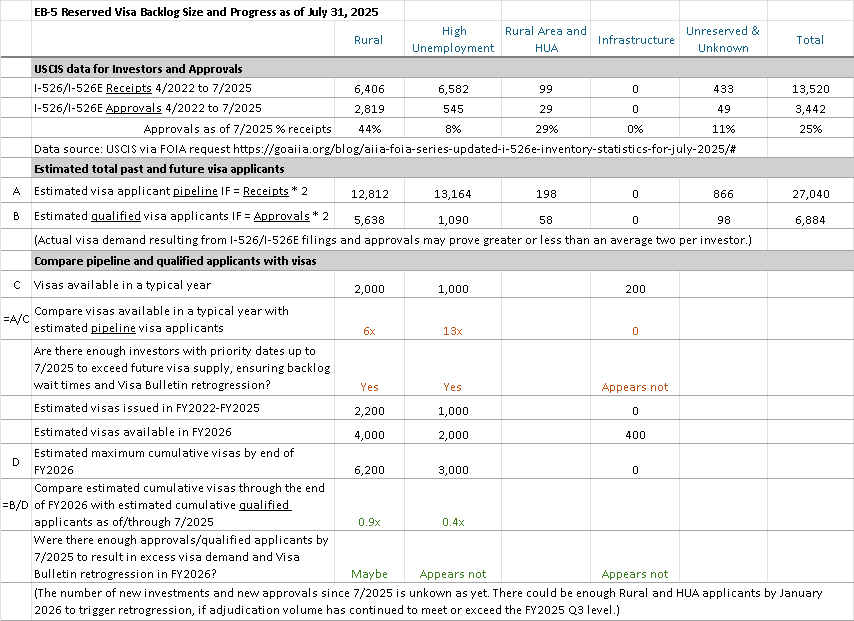
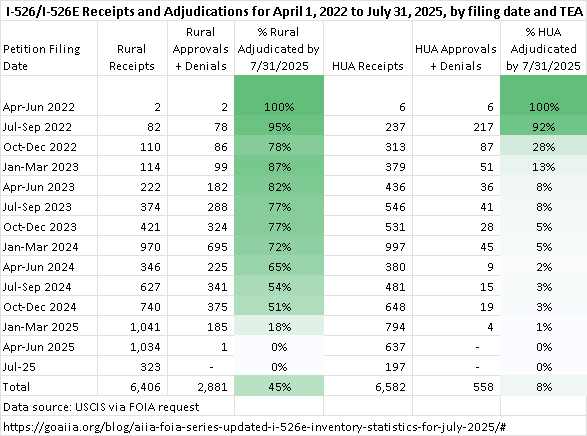
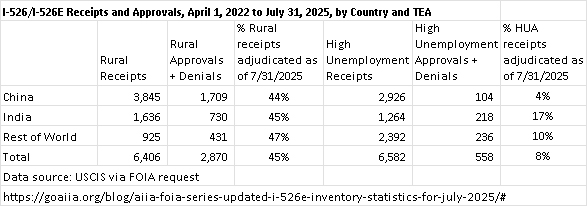
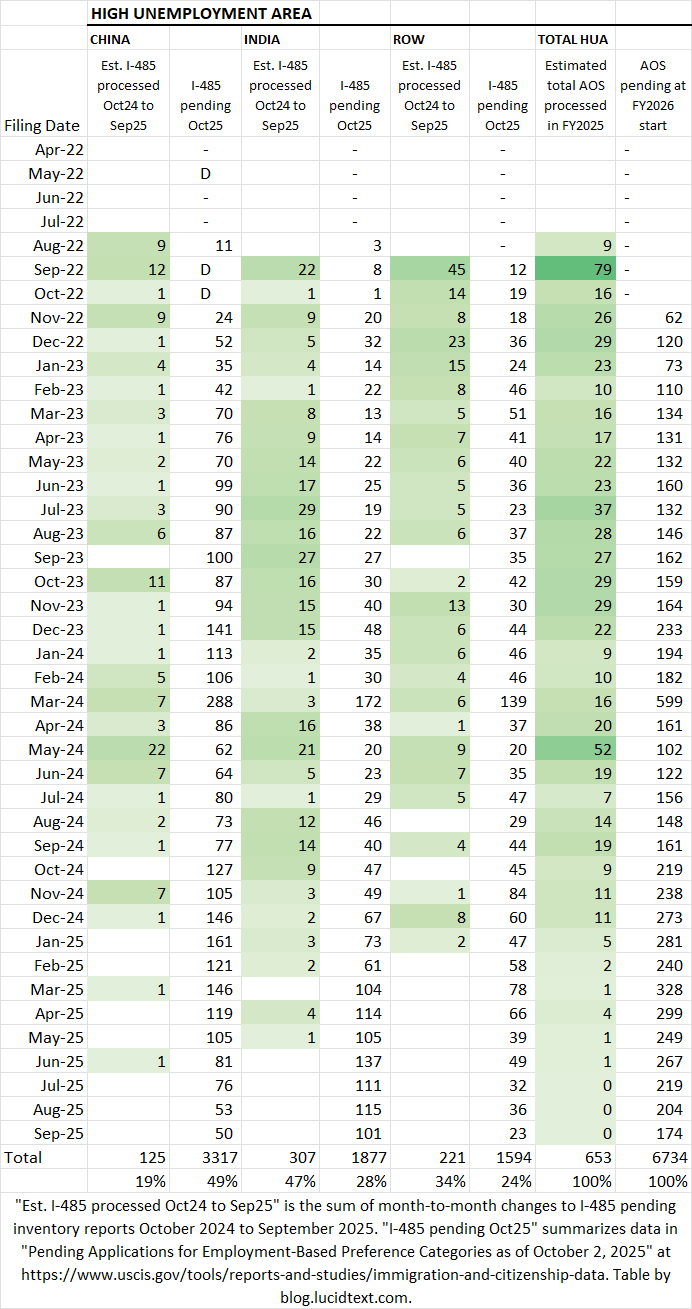

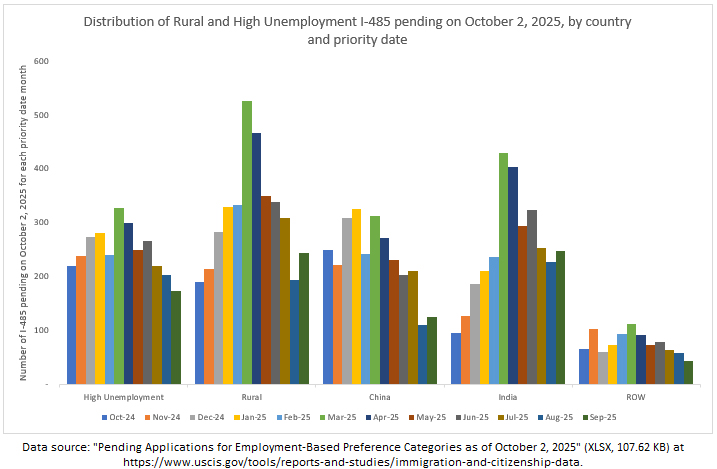
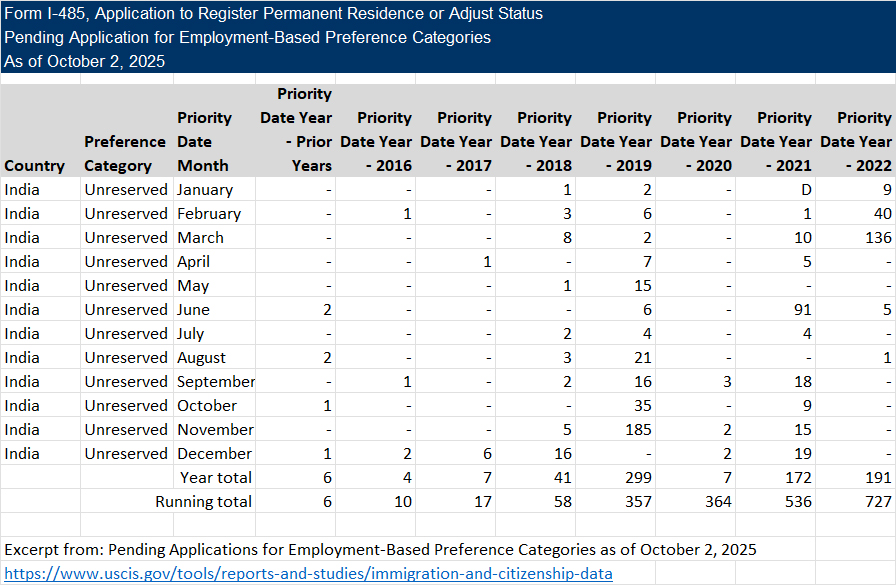
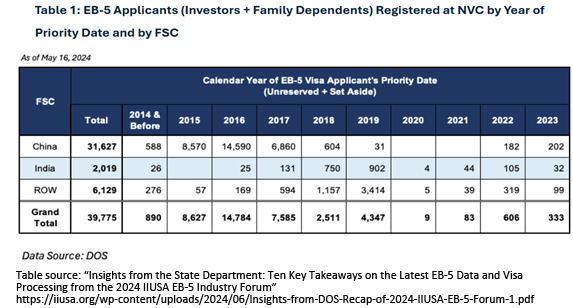

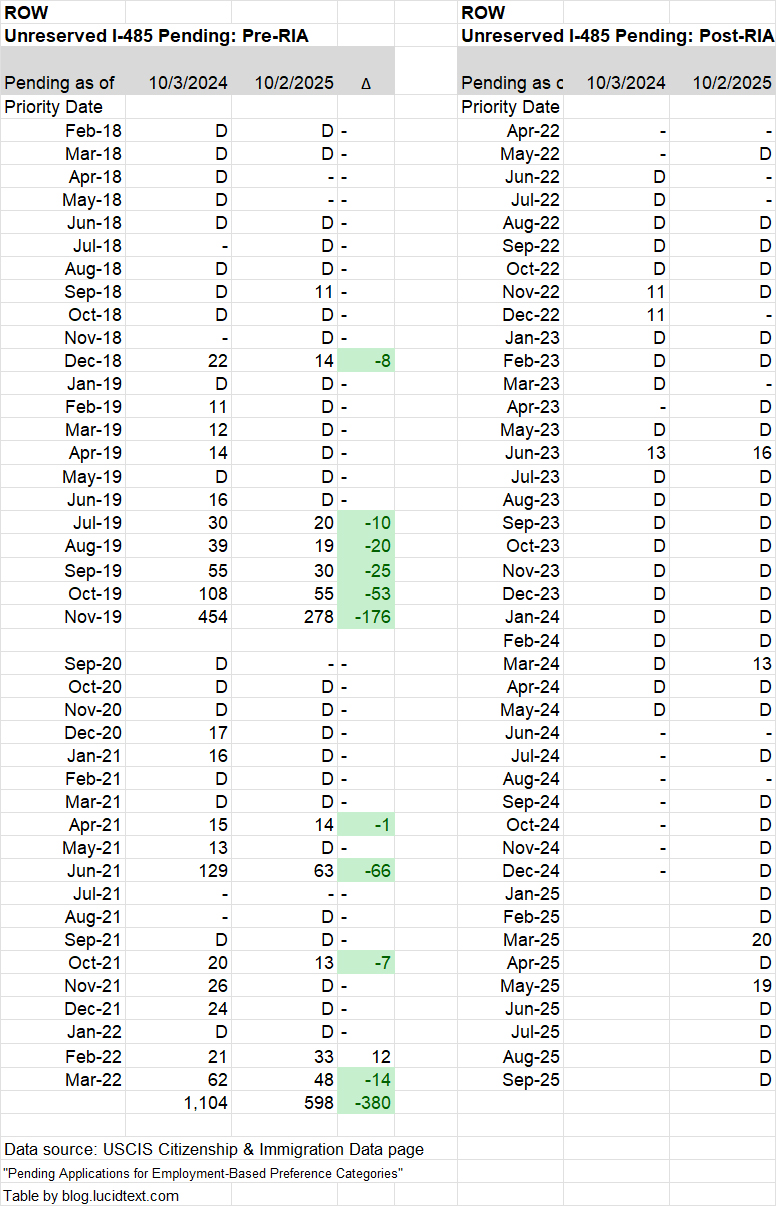


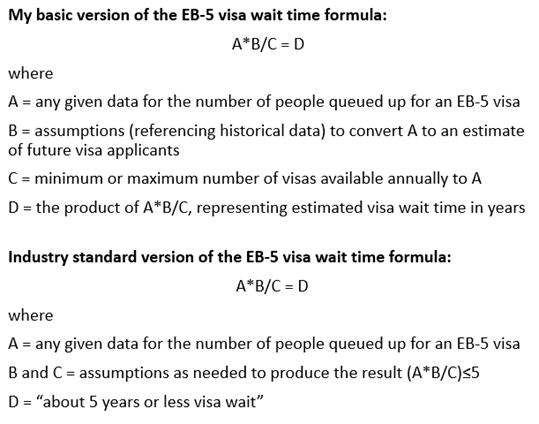

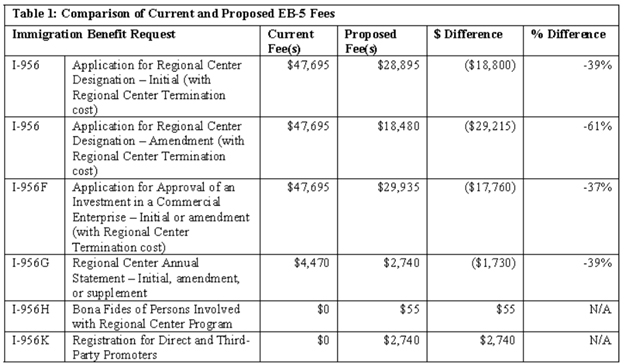
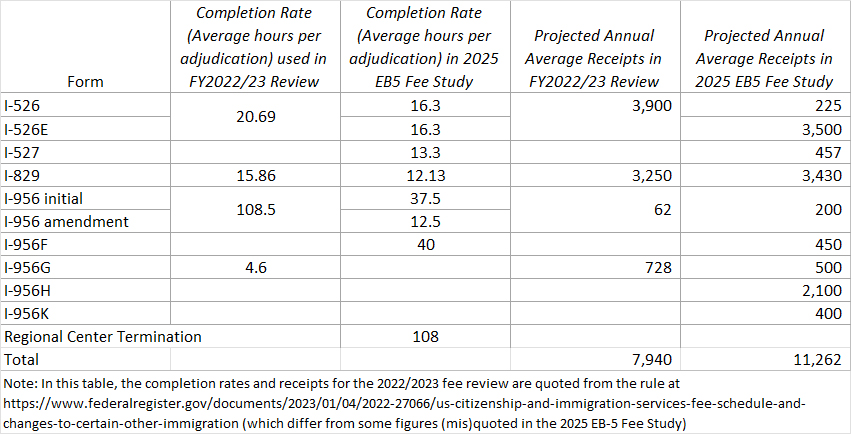


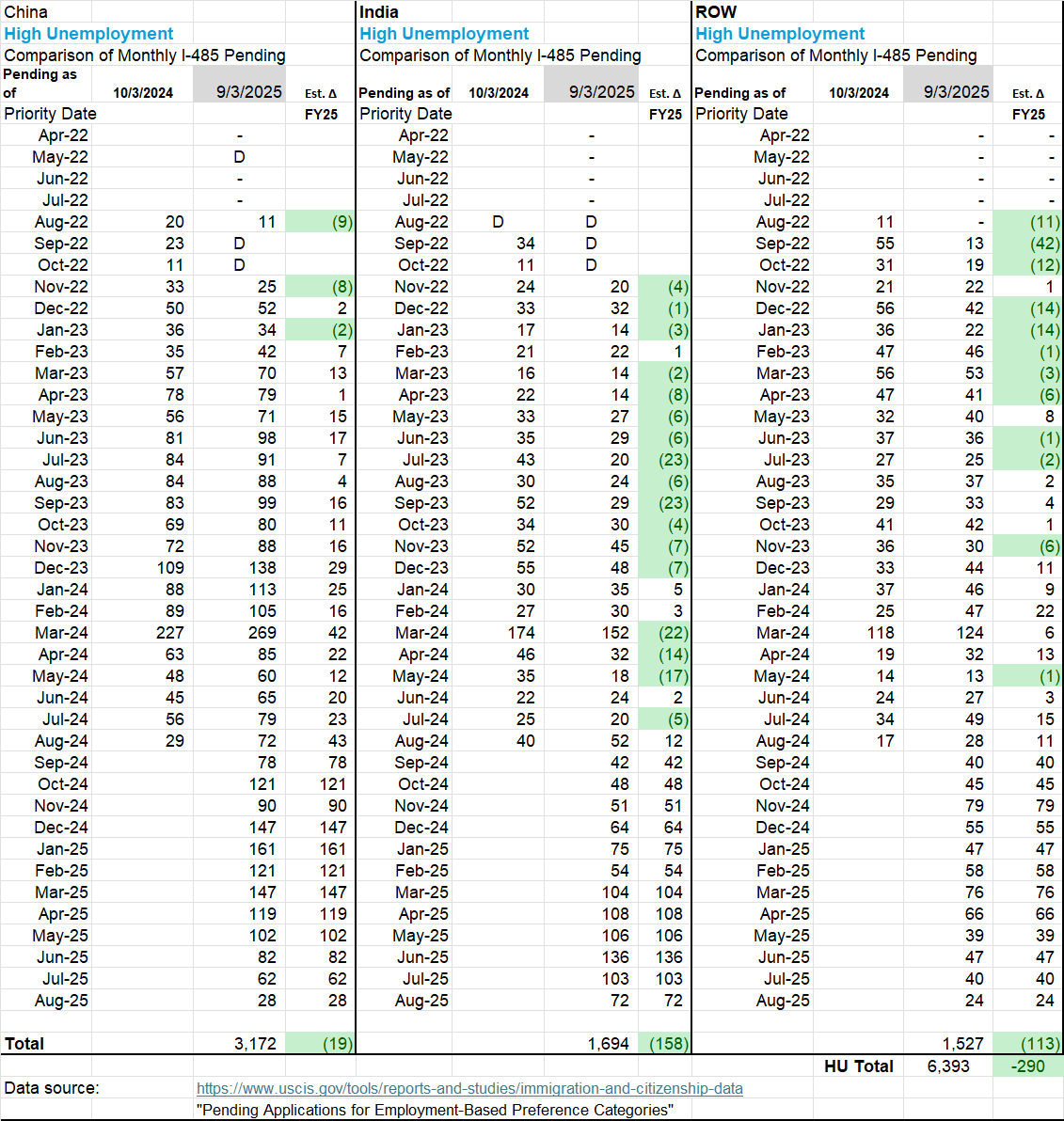


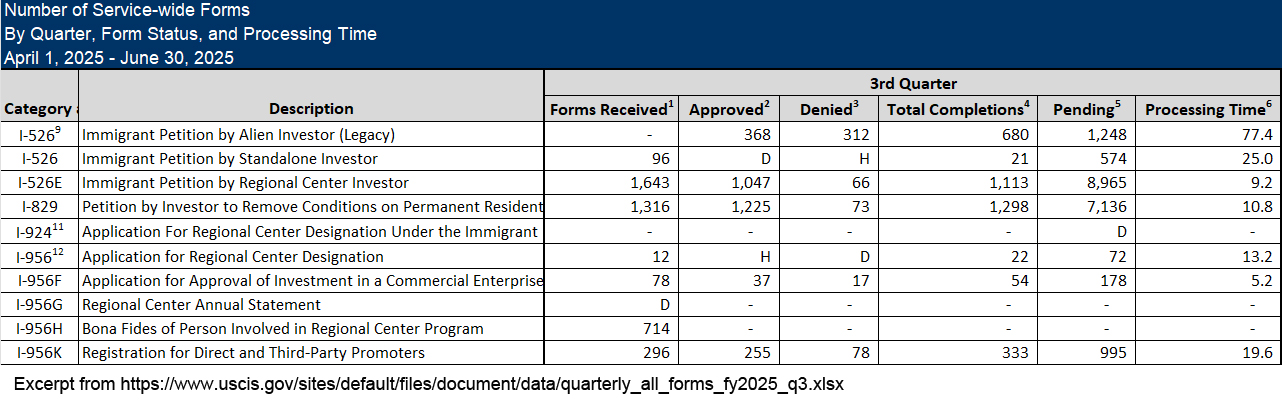
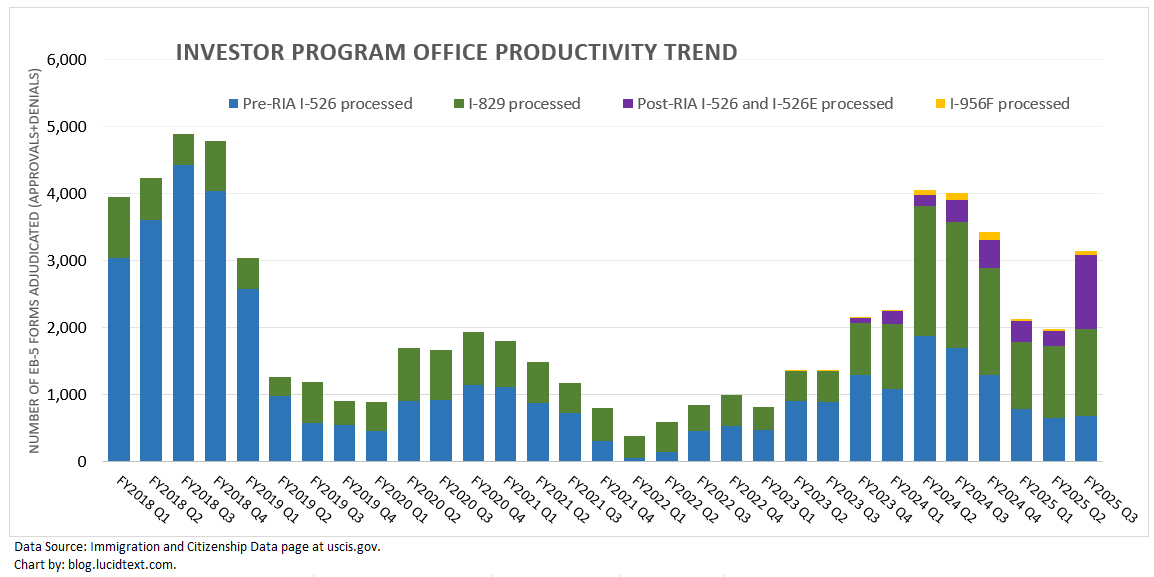

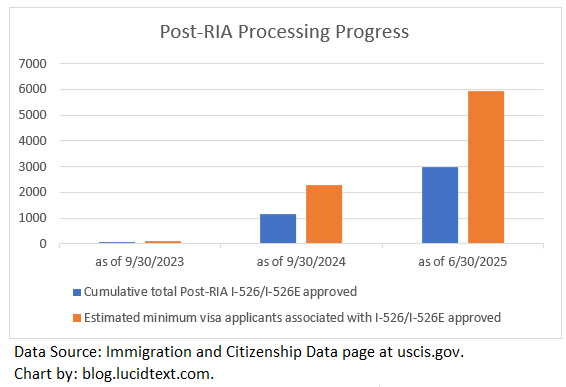

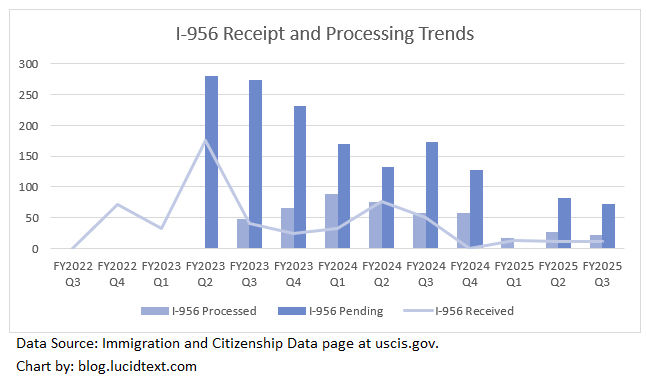
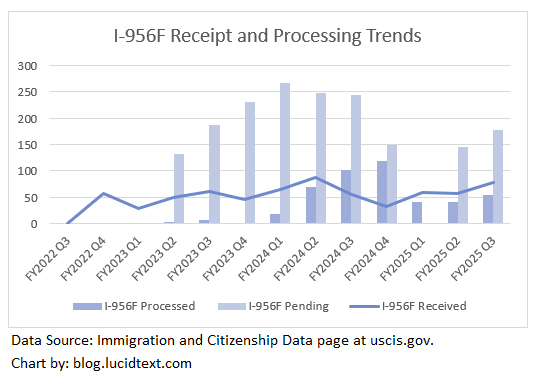
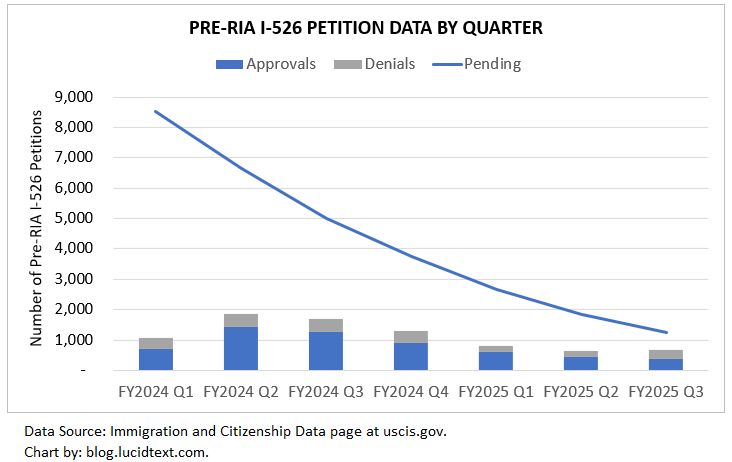
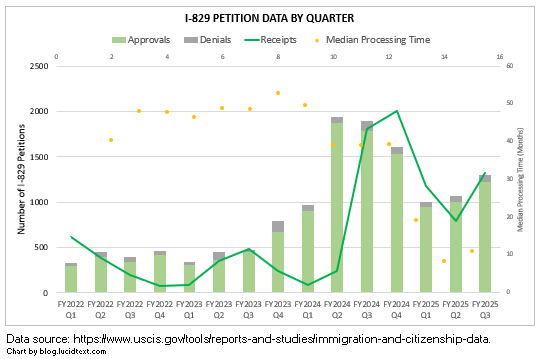
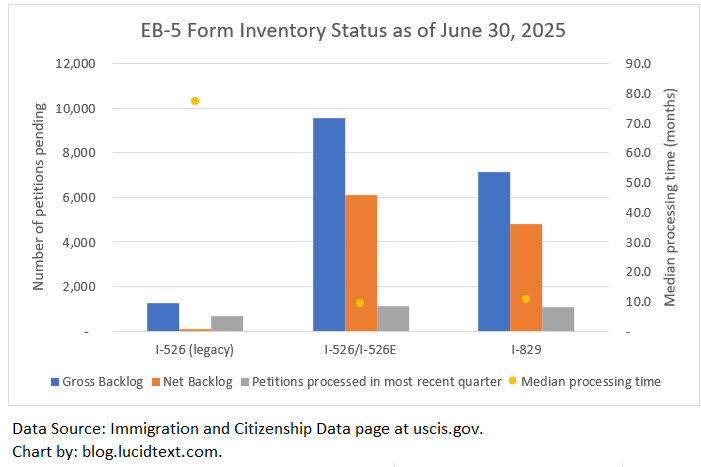
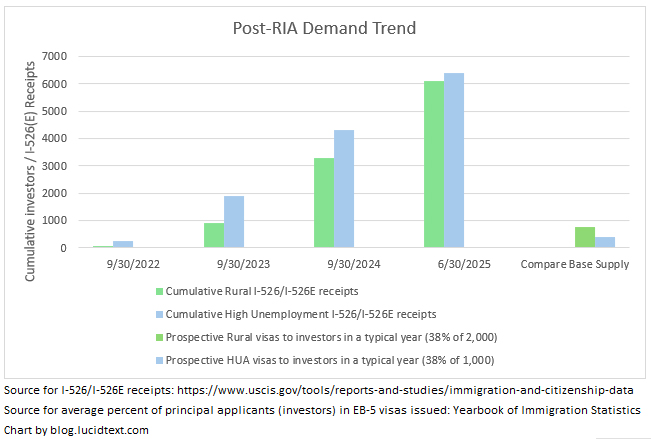
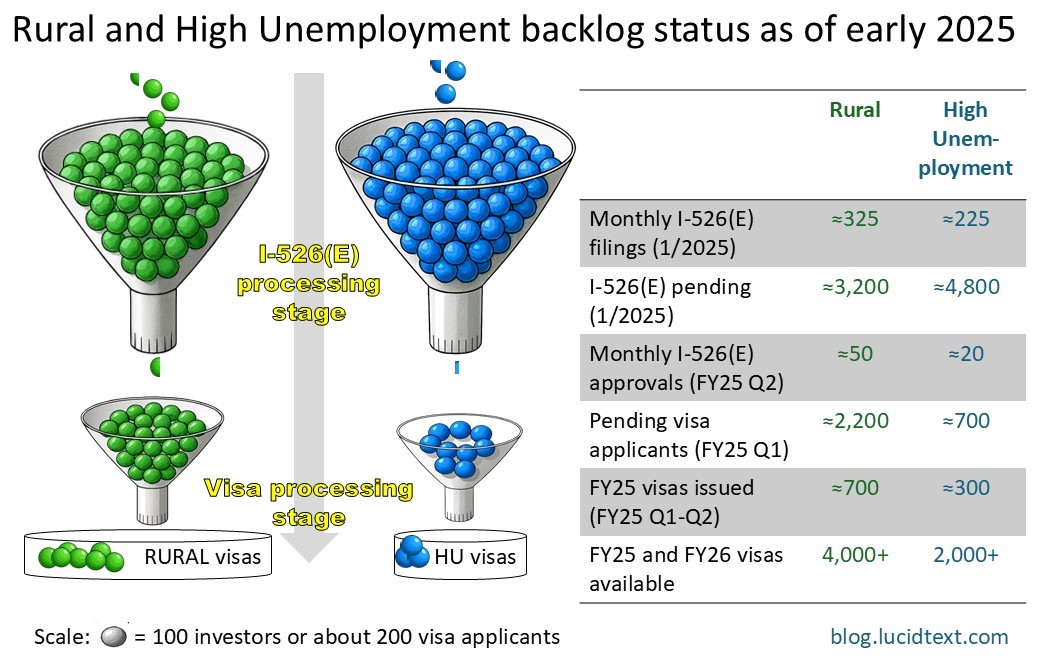

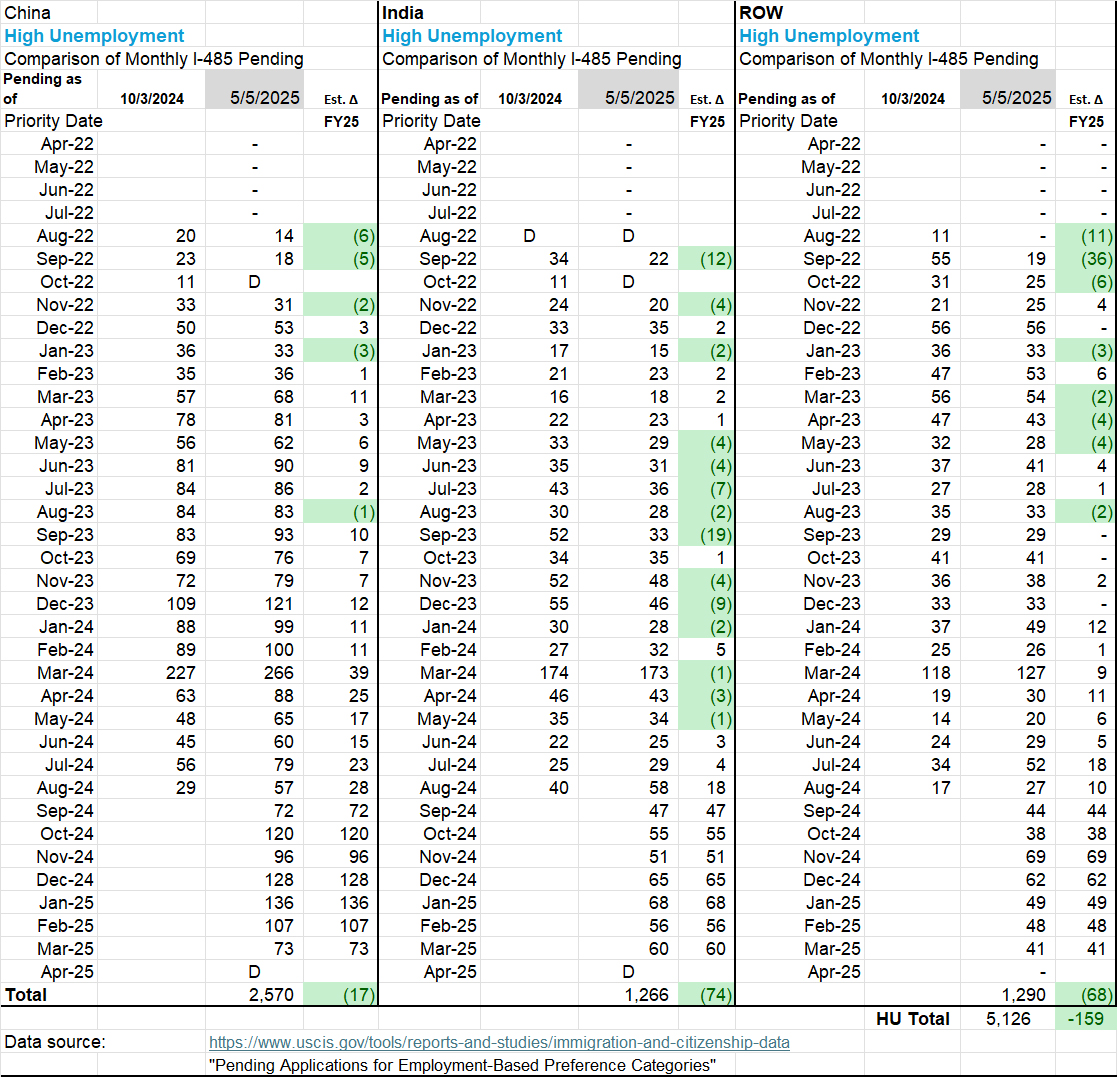
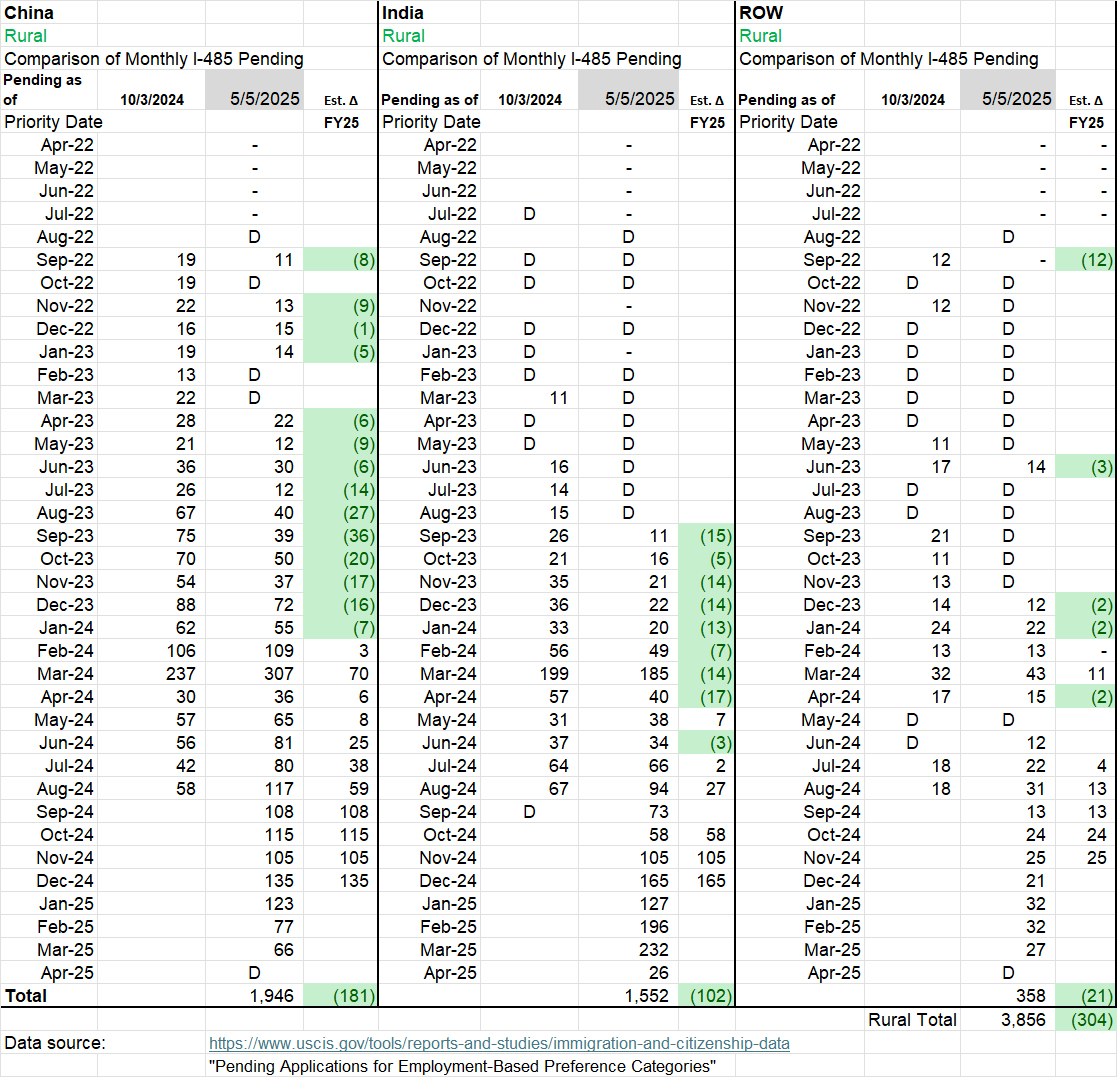
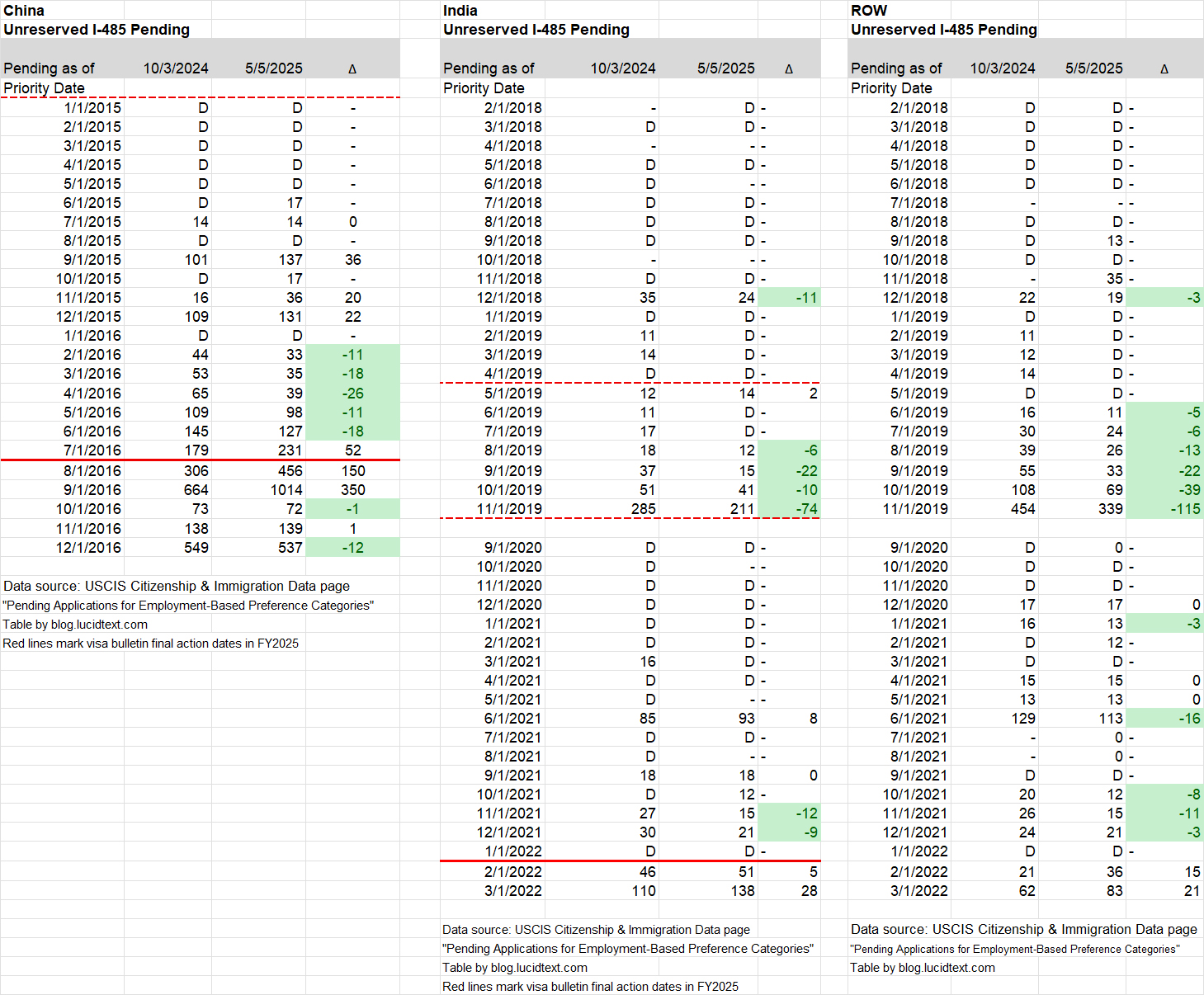

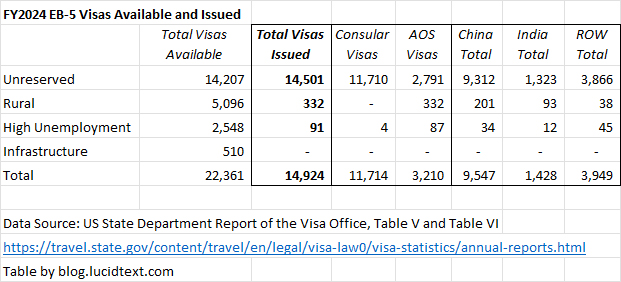

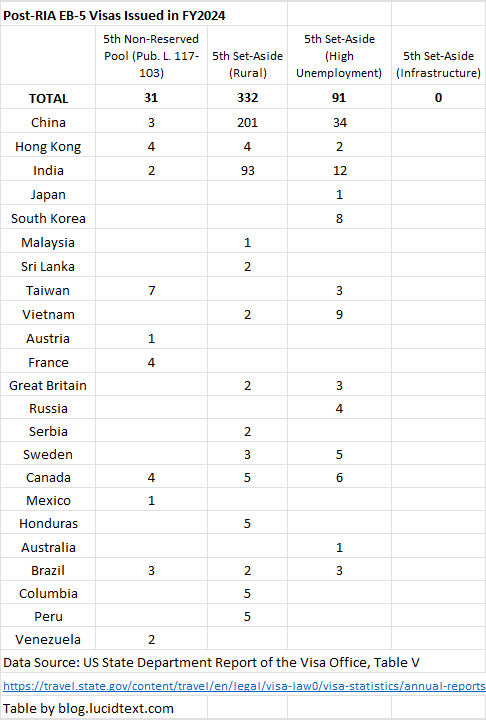


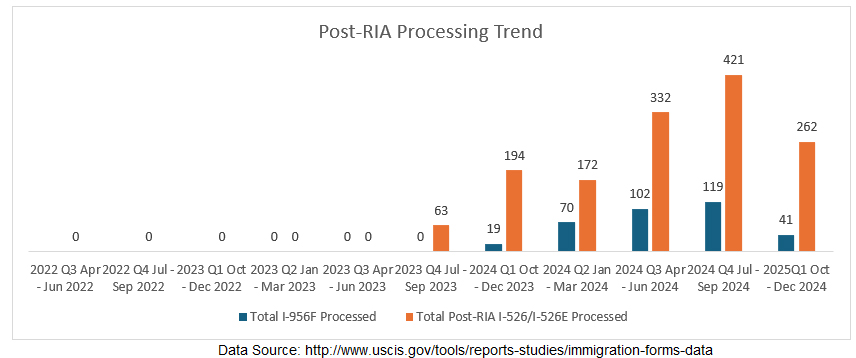


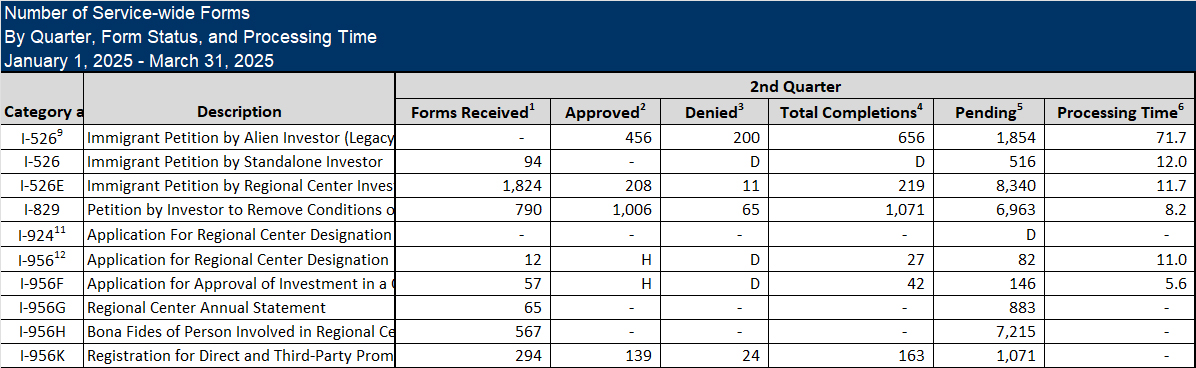

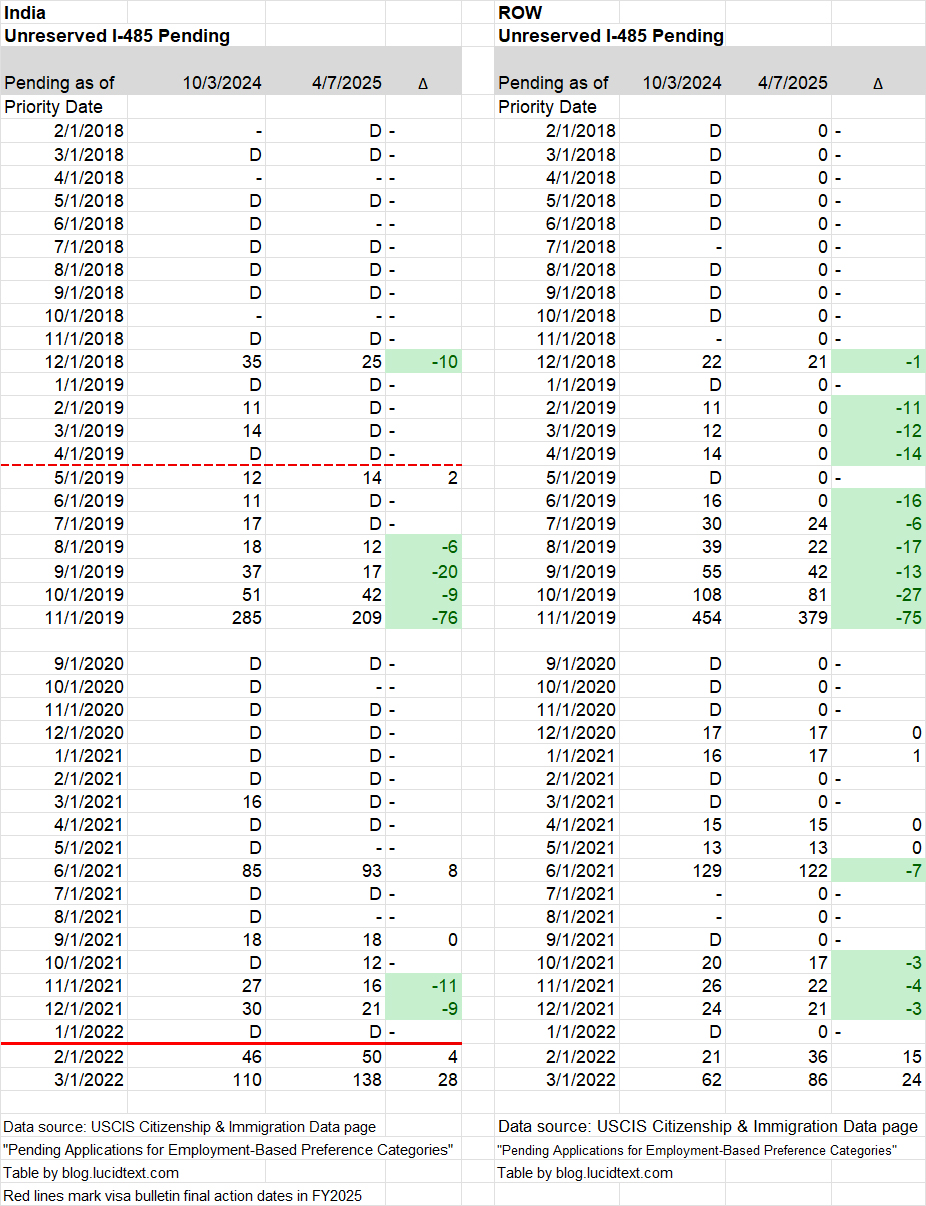

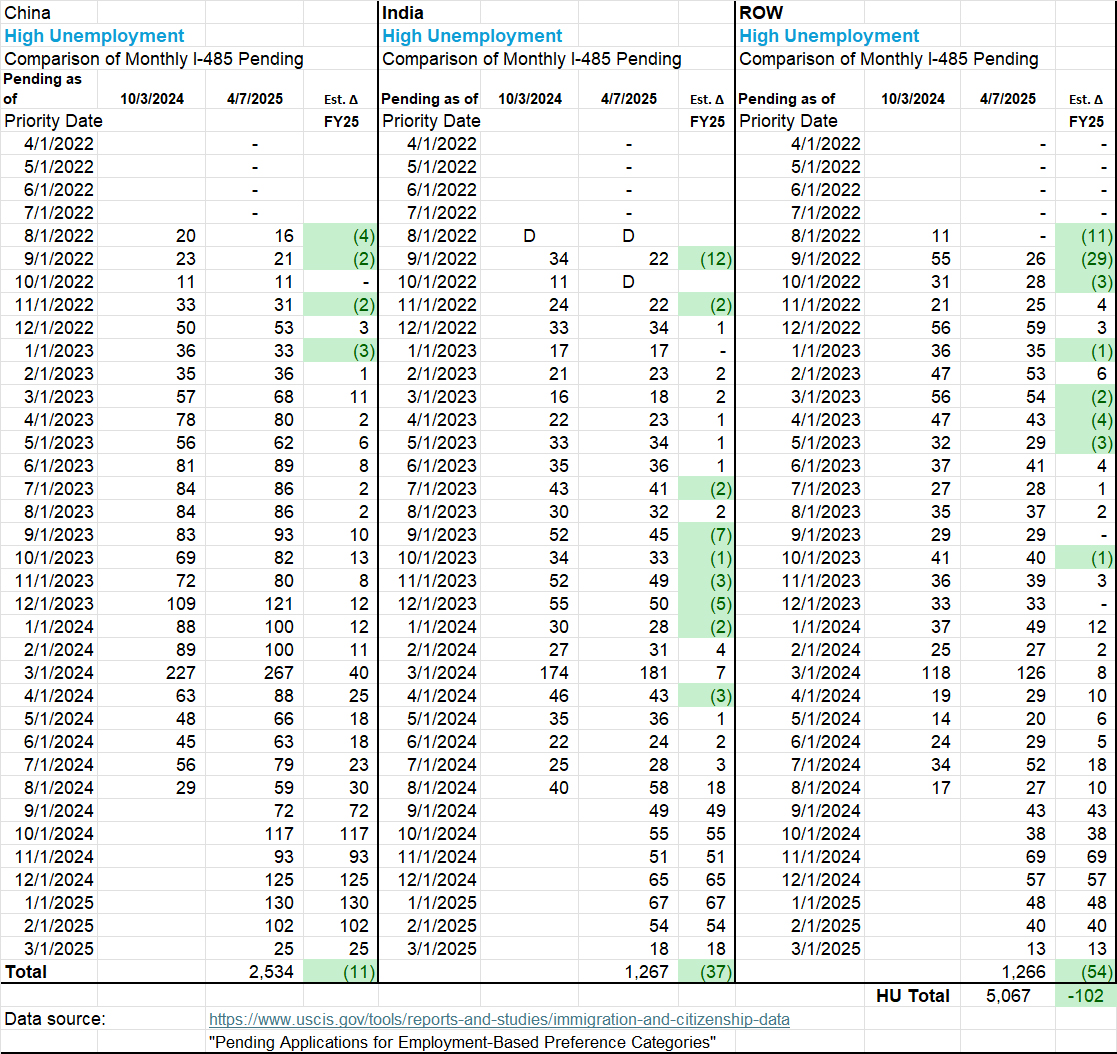


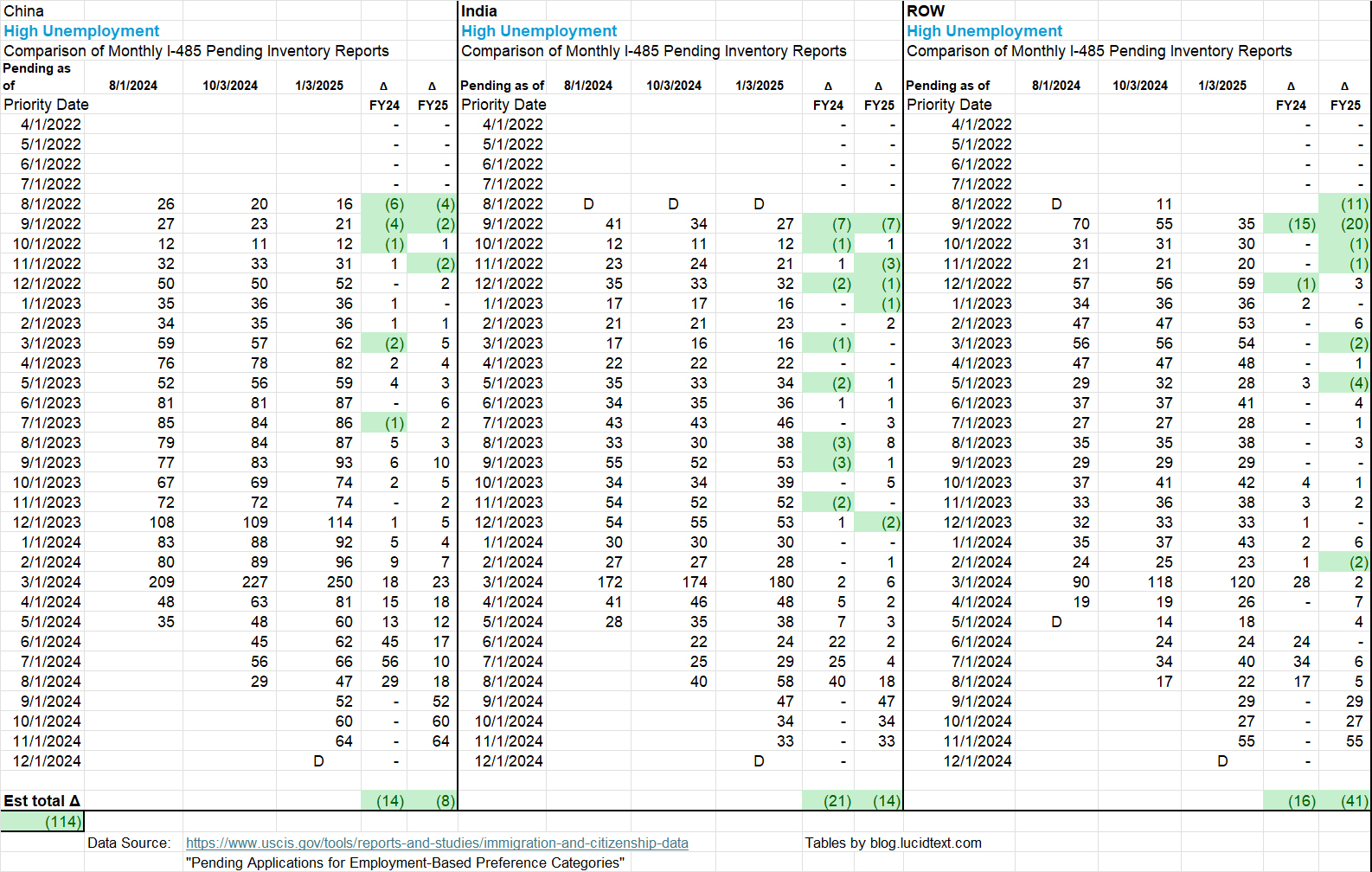

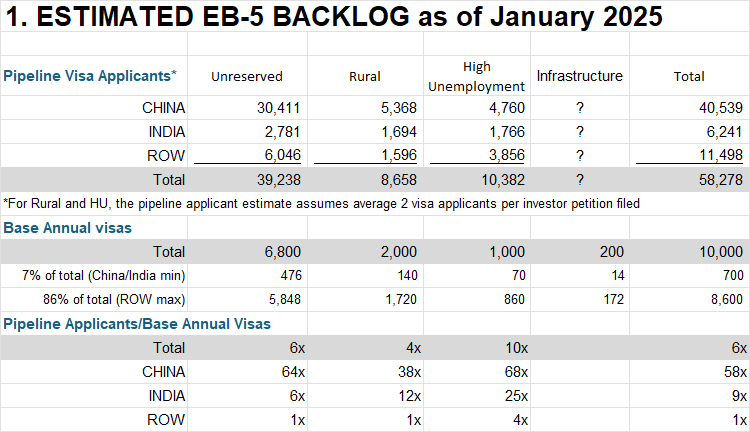

 EB-5 Updates