Many people left the California Service Center disappointed after the Quarterly EB-5 Stakeholder Engagement on 5/1/2012, but now USCIS has made up for telling us little in person by publishing an amazing 17-page Executive Summary that covers what they didn’t say at the meeting. I’ll probably be commenting on this summary for weeks. Particularly note the Q&A on tenant occupancy, which is less ambiguous and more restrictive than the guidance from Chief Economist John Rodgers. I’m copying a few of the hottest new releases below, and I encourage you to download and review the full document.
Selected Q&A from USCIS’s Executive Summary of the 5/1/2012 EB-5 Quarterly Stakeholder Engagement
NAICS Codes
Q: In a regional center application, kindly confirm that two digits of North American Industry Classification System (NAICS) codes are considered sufficient with the industry cluster specified and economic report elaborating the same. The rationale behind this is because in a retail and office setting, three digit code tenants are not ascertained at the time of filing the I-924.
A: This is not acceptable. Even within clusters and projects that incur similarities, USCIS requires four digit NAICS codes at a minimum.
Permissible Expenditures
Contingencies
Q: Any reasonable budget will include line items for “contingencies” and “operating capital” which are required in order to sustain a business successfully during the development process. Some business plans have been approved with such lines (as they should be) while others have been rejected specifically citing these budget lines as “not being job creating activities”. Please confirm that such expenditures are permissible – no business plan is believable without such budget lines.
A: Whether a particular line item in a budget presented in support of an EB-5 petition is appropriate cannot be confirmed in general, but must be analyzed in the context of the instant case. However, USCIS does agree that a credible business plan should contain a reasonable budget that outlines the prospective expenses of the business.
Real Estate Acquisition
Q: One of the most effective ways to attract investors is for the business into which they are going to invest to buy and own the real estate in which they will operate the business, rather than merely lease it. This makes the investor feel that the business is more likely to succeed, or, if it fails, the real estate could perhaps be used to establish a second business. Therefore, where part of the investment expenditure is spent on real estate in which the business is to be operated, is it correct that such expenditure is a job creating expenditure for which appropriate job creation credits can be obtained. For example, if an investor invests $1million to acquire a building for $500,000 and then spend another $500,000 to renovate and equip as well as fund operating capital for a restaurant, would the entire $1million be considered an appropriate EB5 investment, assuming it otherwise qualifies.
A: This is a simple transfer of real estate with renovations occurring subsequent to the purchase. The renovation and outfitting of the facility will create temporary jobs, and it is possible that a trivial number of jobs could be created by the fees charged for the real estate transfer. Summarily, yes—the $1 million could be considered an appropriate EB-5 investment—assuming that the other requirements of the EB-5 regulations are satisfied.
Bridge Financing
Q: Under what circumstances will USCIS approve bridge financing? Will the memo address this? This does not appear to be covered with adequate specificity in the last iteration of the policy memo. Stakeholders are not aware of any written guidance on bridge financing other than am AAO decision on the Victorville case, and this is an extreme example with specific facts. Of the two memos in 2009 (June and December) on construction, the December 2009 memo superseded the June memo, but stakeholders continue to receive RFEs referencing the June memo.
A: Pursuant to 8 C.F.R § 204.6(j)(4)(i), the new commercial enterprise, not the EB-5 investors, must create the requisite employment. As such, it is acceptable for the developer or the principal of the new commercial enterprise, either directly or through a separate job-creating entity, to utilize interim, temporary or bridge financing – in the form of either debt or equity – prior to receipt of EB-5 capital. If the project commences based on the bridge financing prior to the receipt of the EB-5 capital and subsequently replaces it with EB-5 capital, the new commercial enterprise still gets credit for the job creation under the regulations.
This policy will be issued in the forthcoming EB-5 policy memo in Section C, the Creation of Jobs section:
“It is important to recognize that while the immigrant’s investment must result in the creation of jobs for qualifying employees, it is the new commercial enterprise that creates the jobs. This distinction is best illustrated by an example:
Ten immigrant investors seek to establish a hotel as their new commercial enterprise. The establishment of the new hotel requires capital to pay financing costs, purchasing the land, developing the plans, obtaining the licenses, building the structure, taking care of the grounds, staffing the hotel, and the many other types of expenses involved in the development and operation of a new hotel. The immigrant’s investments can go to pay part or all of any of these expenses.”
Verifying RC Job Creation
Q: Can expenditure models based on RIMs II Final Demand Multipliers, if they project adequate number of jobs to satisfy the 10 full time job requirement per investor, satisfy the job creation requirement and proof of such expenditure submitted with the I-829 in accordance with the business plan submitted with the I-526?
A: This is an acceptable methodology if the structure of the business entities precludes the acquisition of tax documents or other evidence of employment for the components projected to be involved in direct job creation. USCIS would require a detailed explanation as to why the use of a model projection as opposed to evidentiary proof is necessary.
TENANT OCCUPANCY!
Q: In a case where the EB-5 business is a real estate development, which leases space to tenant businesses who then hire employees, do the following factors increase the likelihood that those tenant’s jobs can count toward satisfying the job requirements of the development’s EB-5 investors:
a. The tenant business is a new business which did not merely move from another location
b. The tenant business received cash from the development for tenant improvements
c. The tenant business received a loan from the development
d. The tenant received free rent or rent reductions
e. The tenant received an equity investment from the development
A:
a. The tenant business is a new business which did not merely move from another location
This is not acceptable. None of the EB5 capital would be flowing to the jobs created by the tenant.
b. The tenant business received cash from the development for tenant improvements
This is not acceptable. The tenants would still be responsible for creating the jobs. The EB-5 capital would simply be improving/outfitting/customizing the structure already owned by EB-5 capital.
c. The tenant business received a loan from the development
This is acceptable with caveats. This effectively represents the co-mingling of capital. Similar to the quid pro quo expenditure agreement referenced above, however, this will render the agency vulnerable to fraud because the tenants could form an agreement beyond the adjudicative scope of USCIS to funnel the funds back to the developer. In addition, USCIS would need to define the constraints of the loan amounts and duration. Otherwise, the developer could loan $0.01 to a tenant to take credit for any jobs created. Finally, the tenant business must verify that the jobs are new jobs not transferred from elsewhere.
d. The tenant received free rent or rent reductions
This is acceptable with caveats. Similar to (b) above, this effectively represents the co-mingling of capital as the free rent/rent reductions acts as a loan. The same caveats apply here as in (b) above. In addition, this will cause a significant decrease in rental income for the EB-5 NCE, which should be an investment at-risk, not at-loss. USCIS would still need to define the constraints of the rental discount required, which effectively serves as a loan. It is highly unlikely, however, that the free rent or rent reduction over a 2.5-year period would sum to a total amount that could be considered a substantial investment in the tenant business.
e. The tenant received an equity investment from the development
This is acceptable with caveats. Again, this effectively represents the co-mingling of capital as in (b) above. The same caveats apply here.
TEA Designations and Census Tracts
Q: Will a single or multiple contiguous census tracts be considered as a geographic subarea?
A: USCIS encourages that standard Bureau of Labor Statistics (BLS) estimation methodology be used. In the event that subareas for which Local Area Unemployment Statistic estimates are not regularly produced, such as census tracts, the TEA applicant should be aware of the following: (1) the census-share technique be used ONLY where inputs for the preferred BLS methodology are not available and (2) only household-only inputs be used, in order to eliminate the impact of the Census 2000 Group Quarters processing error. More information regarding this answer can be found at the Bureau of Labor Statistics webpage at: http://www.bls.gov/bls/empsitquickguide.htm
Q: Can a qualifying census tract with unemployment 150% of the national rate be certified as a TEA?
A: Yes, but designation will depend on the quality and timeliness of the data used to support the 150% of the national average rate of unemployment claim. Acceptable data sources for purposes of calculating unemployment include Local Area Unemployment Statistics produced by a government agency, U.S. Census Bureau data, and data from the American Community Survey.
Q: Has there been any progress on further defining an acceptable vs. gerrymandered TEA? Will USCIS be providing additional guidance?
A: This issue is being examined in the context of the draft memorandum, which will be posted for comment in the near future.
Profit Requirements
Q: At the end of the two year period, to remove the restriction, does the business created have to make profits? Or can the business lose money as long as the ten job creation requirement is satisfied?
A: There is no “profit” requirement in the statue or regulations. As long as the investment has been made and is at risk of loss and the required jobs have been created there is no additional profitability requirement.
USCIS Staffing
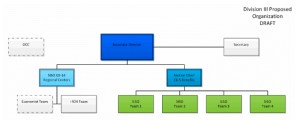
Q: What will the USCIS EB5 unit organizational chart look like once hiring is complete?
A: We can only provide a generalized org chart, without specific staffing numbers.
Non-Profit Organizations
Q: How can non-profits benefit from this program? Can they receive a direct investment from an EB-5 investor or do they need to work through a regional center?
A: An EB-5 investment must be in a for-profit entity, so a direct investment in a non-profit probably does not meet program requirements. EB-5 promoters may be able to advise on structuring specific investment opportunities, but the premise of the EB-5 program is investment in for profit activities. Job creation is the same, but premise of program is for for-profit commercial entities.
EB-5 Sunset
Q: What is the status of the EB-5 “sunset” scheduled for September 30, 2012, and how might this affect current and future applications and projects?
A:
The EB-5 Immigrant Investor Pilot Program is scheduled to end or “sunset” at the end of the current fiscal year, on September 30, 2012.
Without Congressional reauthorization, the Immigrant Investor Pilot Program will end on September 30, 2012. Congress may choose to end or extend the program.
If Congress does not reauthorize the Immigrant Investor Pilot Program, all existing regional center designations will expire automatically.
Following the sunset of the Immigrant Investor Pilot Program, USCIS will no longer possess authority to approve a regional center designation.
USCIS will continue to monitor Congressional actions pertaining to the EB-5 Immigrant Investor program, and will keep stakeholders informed as new information becomes available.

 EB-5 Updates