FY2014 Q2 EB-5 Petition Data, Material Change AAO Decisions, New RCs (AR, CA, CT, DC, FL, ID, IL, IN, MD, MI, NJ, NV, NY, PA, TN, TX, VA, WV, UT, WI)

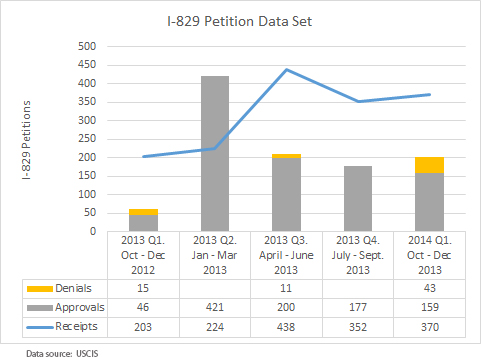
The USCIS Immigration and Citizenship Data page has been updated again with data for I-526 and I-829 Petitions processed in the second quarter of Fiscal Year 2014 (January to March). Once again, here are my little charts illustrating how the numbers compare with previous quarters.
1526q2 I829q2
I-526 processing volumes show modest increase overall, but below last quarter’s spike and still nowhere near Mr. Colucci’s goal of having the number of processed petitions at least exceed the number of petitions received each week. I-829s, on the other hand, flew off the shelf in Q2 – maybe because they’re all the California EB-5 team has to work on as of February? We’ll see how the processing story continues to unfold in coming quarters.

USCIS continues to post 2014 Administrative Appeals Office decisions on EB-5 cases. APR232014_01B7203 and MAY122014_01B7203 are interesting as case studies of the much-misunderstood material change issue. People tend to panic that “material change” means that one can’t at any time deviate from any point of a business plan submitted to USCIS. The May 30, 2013 EB-5 Policy Memo and Matter of Izummi don’t say that, however. USCIS policy focuses on the period prior to I-526 approval and the problem of petitioners who, having filed an I-526 Petition that doesn’t demonstrate eligibility for EB-5 visa benefits, respond to Requests for Evidence with a new set of facts, materially changing the proposal under which the original petition attempted to qualify. The USCIS position is that the petitioner must demonstrate eligibility for the visa petition at the time filing, the petitioner cannot secure a priority date based on future events, and USCIS cannot consider facts that only came into being subsequent to the filing of the petition. For example, the petitioner in APR232014_01B7203 invested through a loan model with indirect job creation, which a non-Regional Center investor may not do, and then, in response to an RFE, tried to change track and present USCIS with a new and different business structure and investment terms. The AAO agreed that: “Purchase and termination of ___ in response to the director’s request for evidence in order to meet the direct job creation requirements reflects a material deviation from the business structure claimed at the initial filing of the petition. The business structure change constitutes an effort to make an apparently deficient petition conform to users and regulatory requirements. Therefore, users must analyze the petition only on the basis of the original claims.” In the MAY122014_01B7203 case, the petitioner’s problem was that “at the time of filing, he had invested only $105,000 and had not, at that time, properly committed the balance of the required investment with a secured note or agreement.” The moral of the material change story is to get your ducks in a row before filing an I-526 Petition. Don’t just throw something together and file it, assuming that the worst case scenario is that USCIS will send Requests for Evidence giving you a chance to go back and forth supplying new information and fixing problems until the petition is finally approvable. The worst case scenario is that the content of that original I-526 would need such material changes to become approvable that USCIS will say (to paraphrase): Forget it. This filing was crap, and if you have new facts and a new story now then you can go back to square one and file a new petition for us to consider. (For the official statement, see pages 24 to 27 of the EB-5 Adjudications Policy memo.)

The USCIS Regional Center list continues to expand by leaps and bounds, reflecting hard work by the USCIS Investor Program Office and adding to a crowded field. We’re continuing to see many multi-state RCs and many RCs associated with operators who control multiple RCs.

Additions to the USCIS Regional Center List 5/6/2014 to 5/27/2014

5/8 Colucci Remarks

USCIS has published the Prepared Remarks of Nicholas Colucci, Chief, Immigrant Investor Program at the IIUSA EB-5 Regional Economic Development Advocacy Conference on May 8, 2014 in Washington, DC. Thank you, USCIS! We really appreciate this transparency. Now everyone can review exactly what Mr. Colucci said regarding economic impact analysis.

Updates from the IIUSA Economic Development Advocacy Conference

This year’s IIUSA annual meeting in Washington DC on May 7-9 was remarkable not so much for what was said but for who spoke. At the IIUSA Washington DC meeting back in 2011, the mood was depressed and we were lucky to get prominent attorneys on the podium. Now in 2014, EB-5 is booming and we were honored by the presence of dignitaries including three members of Congress; top executives from USCIS, the State Department, the SEC, FINRA, the Department of Commerce, and even CBS; and chairpersons from eight of China’s provincial entry-exit associations.

A few things I learned from the conference:

  • USCIS Immigrant Investor Program Office Director Nicholas Colucci did not break any major news in his speech – appropriately, I think, given the private context. But his presence was a generous and appreciated gesture. [UPDATE: You can now read exactly what Mr. Colucci said, as his prepared remarks have been published on the USCIS website.] He reiterated that the Washington DC office is still ramping up on personnel, with a goal to reach 100+ staff by the end of the fiscal year; is investing additional resources in customer service through the immigrant investor program mailbox; and is taking care to provide expert training in areas including business organization and documents, SEC issues, money-laundering, decision-writing, and customer service. One of his new ISOs sat at my table and presented herself very nicely – with just the bright, collected, solicitous manner and edge of East Coast hustle that you’d want in the adjudicator for your case. I have to say that she impressed me much more than the aggrieved-looking examiners lurking at the back of the room at the California Service Center in-person EB-5 engagement in 2010. I suppose that not having to work in a Cold War bunker is good for morale. She is one of the ISOs who is new to EB-5 but not new to DHS. Mr. Colucci noted that his office has developed a 4-6 week certification process for ISOs hired from other departments, with the goal to get adjudications up to speed as quickly as possible – and at least to have the number of decisions exceed the number of receipts each week. Mr. Colucci gave us several things to look forward to: draft regulations revisions by September 15, filing tips based on analysis of RFEs, and – a surprise treat – a FY2014 Annual Report planned. Finally, he offered a few filing tips focused on economic impact analysis. He reminded economists to clearly explain economic model inputs used and to exclude ineligible inputs (e.g. some construction soft costs). He also emphasized a requirement that I haven’t previously heard made explicit by USCIS – that the economist must in all cases distinguish model direct and indirect components, not just provide an aggregate total. Economists are also reminded to break down the number of jobs associated with each distinct model input. We’re not sure how much to make of the fact that Mr. Colucci twice referenced examples of reasonable economic models and each time said “IMPLAN, REMI, and REDYN” and either accidentally or on purpose did not mention RIMS II – a model that’s currently not being updated by BEA but still very popular in EB-5 and still useable for now and being approved by USCIS, so far as we know.
  • Department of State Visa Controls Office Chief Charles Oppenheim discussed the intricacies of EB-5 visa availability and handed down his prediction that China retrogression will likely not occur until Summer 2015, with a May 2013 cut-off date possible at that time. He repeatedly advised the audience to only credit official information in the State Department Visa Bulletin and not to listen to bloggers. Apparently some of my kind have been panicking about immanent multi-year backlogs, so the audience was happy to hear from Mr. Oppenheim that we’re probably only looking at a 2-year backlog for Chinese investors (not too painful, considering that I-526s have been taking 1+ year to process anyway) and that this probably won’t occur until later next year. Mr. Oppenheim said that he would try to give 2-3 month’s notice of any new developments, and that otherwise we may expect news in the June 2015 Visa Bulletin. For those who are still confused about how the visa numbers process works, you may want to read articles on the Visa Office’s Immigration Statistics page and Ron Klasko’s simplified FAQ on the subject. For those who would like this problem to just be eliminated by an increase in the number of visas allocated to EB-5, call your Congressman and advocate.
  • SEC Division of Enforcement Chief Steve Cohen gave a speech that gently but pointedly emphasized the breadth of the SEC’s jurisdiction and enforcement interest in the EB-5 program.  While the SEC’s actions have so far focused on egregious fraud, Mr. Cohen noted that fraud is fraud whether egregious or not, that the SEC is concerned by any kind of misstatement (with its attention particularly drawn by Regional Center websites that state or imply that “approval by USCIS” means that the federal government provides a cloak of integrity to the Regional Center’s activities), and that SEC will attend not only to fraud but also to failure to comply with registration requirements. Rumor at the conference confirmed that some Regional Centers have recently been contacted by the SEC regarding registration issues.   To remind yourself about the requirements involved, you can review materials and posts around the USCIS/SEC joint conference call.  Regarding the SEC’s enforcement philosophy, Mr. Cohen stated that ignorance is not a defense, that the agency will take into account good faith compliance efforts and does not want to eviscerate the program, and that you’re strongly advised to approach the SEC for help to fix problems before the SEC comes to you to tell you that you have a problem.
  • FINRA Directory of Emerging Regulatory Affairs Kavita Jain joined Mr. Cohen and discussed how to get on the right side of registration requirements. Ms. Kavita noted that FINRA has been seeing an increase in applications related to EB-5 players and activities, and listed areas of concern for FINRA including due diligence, risk disclosures, suitability analysis, and finder’s fees.
  • Other notes. See IIUSA’s post on highlights from the Advocacy Conference for a more comprehensive summary and links to resources provided at the conference.
  • Mark your calendars. IIUSA is hosting its annual Trade Mission to China September 6-10, 2014 and the 4th annual EB-5 International Investment & Economic Development Forum in San Francisco on October 22-24, 2014.  Details here.

FY2014 Q1 EB-5 petition data, new RCs (CA, FL, WA)

USCIS has posted EB-5 petition processing statistics for the first quarter of FY2014 (October to December 2013) on the Immigration and Citizenship Data page. I hope that the increasing volume of I-526 decisions reflects operational improvements, and not just California Service Center adjudicators hustling to get files off their desks ahead of the February 2014 hand-off to the new Washington DC Investor Program Office. In any case the I-526 trend is significant, with the number of approvals increasing by around 20% every quarter last year (and the total number of decisions up 41% between the last two quarters).  This is good news for processing times, and also an indicator that we’re accelerating toward the annual EB-5 visa cap. USCIS has cautioned before against reading much into the number of denials that happen to occur in any given quarter, but I’m still intrigued by the recent spike in denied petitions. It will be interesting to see how second quarter statistics look, with new staff handling I-526 and the CSC free to focus on I-829 petitions. I’ve visualized USCIS quarterly data in the following charts.

q12014I-526 q12014I-829

Meanwhile, the IPO is continuing to crank out I-924 decisions.

Additions to the USCIS Regional Center List 4/29/2014 to 5/5/2014

I will be posting from the IIUSA annual meeting this week, and look forward to seeing you there.

Regulatory changes, processing times, retrogression, ELIS, articles, new RCs (CA, CT, DC, FL, GA, IL, MA, MD, NJ, NY, PA, TX, VA, WV)

Highlights of recent EB-5 activity:

  • Feedback on regulatory changes: On 4/23, USCIS hosted a “Regulatory Changes Listening Session” to solicit stakeholder input into the process of revising the EB-5 regulations, and invited the public to contribute additional suggestions through the USCIS Idea Community. You can get a recording of the listening session from IIUSA (post here) and log into the USCIS Idea Community any time through May 8 to provide your feedback and vote on suggestions made by others. Comments made so far include a few informed, constructive recommendations focused on the greater good and many that are either based on basic ignorance about what’s within the scope of regulatory changes or motivated by narrow interests such as trying to reduce competition or divert risk/responsibility or even shut down the Regional Center program entirely. I admit that I fall among those who are not motivated to offer disinterested input and take on some of the sheer hard work of drafting much-needed improvements to the current regulations. But I’m logged into the Idea Community and ready to vote for anyone who is so broadminded and generous with his or her time and expertise!
  • Processing times: USCIS updated IPO processing times (as of 3/31, posted 5/1) that show improvement overall, with 13.2 months for I-526, 8.9 months for I-829, and 10.6 months for I-924.
  • Retrogression: Mr. Charlie Oppenheim of the Department of State’s Visa Office is quoted as saying on April 21 that “retrogression for China EB-5 in the 2015 fiscal year [10/01/2014-09/30/2015] seems almost inevitable, as there are over 7,000 I-526 applications pending and 80% are from China.” For more detail, see “Update on EB-5 Visa Numbers” by Jennifer Hermansky. (For background on the retrogression issue, see FAQs on EB-5 Quota Backlog by H. Ronald Klasko.)
  • ELIS: Martin Lawler has written a useful account of his firm’s experience filing EB-5 petitions through USCIS’s new ELIS system. See “ELIS – Not the Island – Issues with Electronic Filing of I-526 Petitions” on the IIUSA blog.
  • Other articles: AILA and IIUSA have published a glossy report titled “Basic Background About the EB-5 Program” that can be used as an advocacy tool. The EB-5 Insights blog has a couple interesting posts by William Mack on Fee-based foreign finders and SEC/FINRA registration requirements and Suitability and AML Concerns for Broker/Dealers Engaged in the Offering and Sale of EB-5 Investments.

New Regional Centers

Additions to the USCIS Regional Center list 4/3/2014 to 4/28/2014: