RC Hearing, RC List Update

2/2 Hearing on the Regional Center Program
The Senate Judiciary Committee/Senator Grassley have titled next week’s hearing “The Failures and Future of the EB-5 Regional Center Program: Can it be Fixed?” Good heavens! No wonder journalists started calling me yesterday wondering what’s blowing up in EB-5, and disappointed to discover that this insider knows a thousand boring little problems but no big story of pervasive failure to justify such a hearing title. But tis the season for politics, and EB-5 can appear as a golden opportunity to bash immigration plus the wealthy plus real estate developers plus Commies plus New Yorkers all in one rabble-pleasing blow. And Regional Centers may just have to get in line with police officers and Muslim Americans as victims of our politicians’ inclination to profile entire communities based on a few isolated actors. If I were a typical regional center innocently engaged in unremarkable project finance, I’d be worried about a powerful Congressman asking “do you have a future and can you be fixed?” while under the impression that I’m failing and am inherently likely to be facilitating terrorist travel, economic espionage, money laundering, and investment fraud. Hopefully the hearing will call speakers who provide our leaders a more accurate impression of what’s actually going on in the regional center program. The hearing will stream live on the Senate Judiciary Committee website at 10 am EST on Tuesday Feb. 2.

New RCs
Meanwhile, USCIS continues to process EB-5 applications and petitions. The average posted I-526 processing time jumped to 15.5 months as of 11/30/2015 (up from 12.8 months reported as of 10/31). USCIS has also updated the regional center list, and posted a new PDF file that gives the identification number for each regional center. I can’t think how this could possibly help anyone (what we need, USCIS, is for you to please post the designation letters that show who’s behind these RCs and what you’ve approved them for), but the list with ID numbers is there FYI.

Additions to the USCIS Regional Center List, 1/14/2016 to 01/28/2016.

  • Ashcroft/Sullivan New England Economic Development Center (Massachusetts, Rhode Island): aseb5.com
  • Liongate Regional Center, LLC (Washington)
  • MCFI Nevada (Nevada):www.mcfiusa.com

Renamed:

  • Central Western Regional Center LLC (former name USA Midwest Regional Center LLC) (Illinois, Indiana, Kansas, Kentucky, Michigan, Missouri, Ohio, Pennsylvania, Wisconsin)
  • Green Card Solutions Regional Center (former name Shrimp House US LLC) (Florida)

Thinking about RC legislation (with comparison chart)

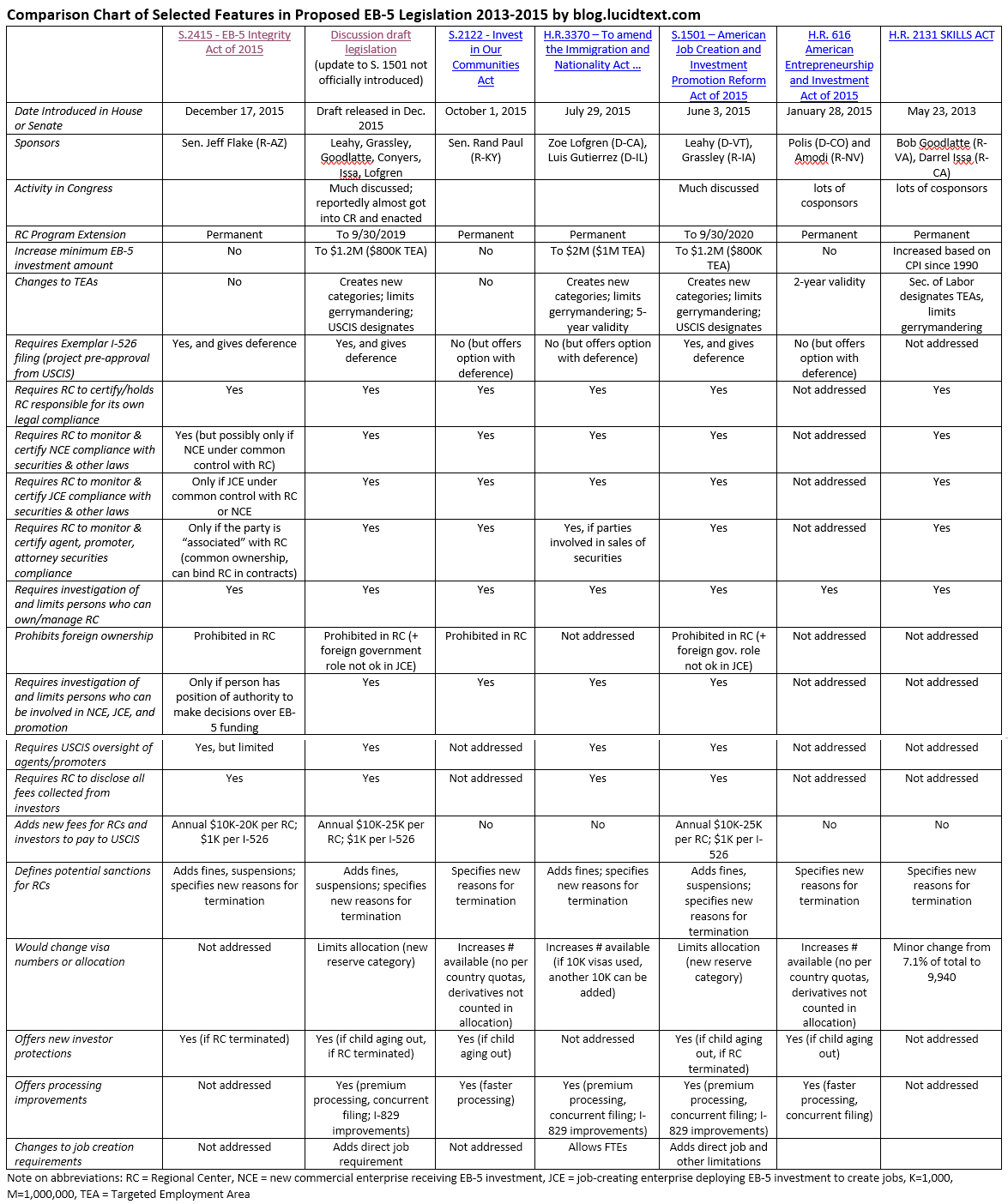
The Regional Center Program has just eight months before it needs another authorization from Congress. Significant EB-5 legislation may be unlikely this election year (I hear people hoping for another short-term extension by 9/30/2016), but we can foresee future directions in the flurry of reform proposals. To help visualize where we are, I’ve made a chart of EB-5 bills that are or were recently on the table. My chart is idiosyncratic (limited to provisions that particularly interest me as a business plan writer) and oversimplified, but it gives a handy overview. I’ve generously uploaded my original to Google docs, in case you’d like to enlarge the font or edit a new version with your own favorite nuances. (NOTE: the Google docs version linked above is now more updated than the chart image below.)
lucidcompchart
The comparison chart highlights areas of consensus and difference, and helps us think about what changes we should prepare to accept (or take action to forestall). Besides the rows dominated by “yes” (likely directions) and the rows full of differences (points of open debate), I’m particularly interested in the left-most columns: S.2415, because it’s the most recent proposal, and the Discussion Draft/S.1501 update, because it came nearest to enactment. These two bills are superficially very similar; S.2415 is a partially defused version of S.1501. S.2415 omits two of the most disruptive changes proposed in S.1501 – changes to TEA definitions and the qualifying EB-5 investment amount – and neatly clips difficult integrity measures by means of three simple terms: “affiliated,” “involved,” and “associated.” The integrity measures in S.1501 (and others) are hard because they would make regional centers responsible for the actions of parties often (in current practice) outside RC control. S.2415 reduces those proposed responsibilities by replacing “job-creating entity” in S.1501’s integrity proposals with the more limited “affiliated job creating entity” (with “affiliated” defined as controlled, managed, or owned by people involved with the regional center or new commercial enterprise) and by adding term definitions that limit who would count as “parties associated” or “persons involved” when it comes to compliance matters involving enterprises, agents, promoters, and attorneys. (To see for yourself, compare the term definitions on p. 29, 37, and 61 of S.2415 with those on p. 30, 37, and 76 of the Discussion Draft, and follow use of those terms.) S.2415 retains the basic shape of S.1501’s regional center integrity measures and program improvements, keeps the reforms that only inconvenience USCIS (additional reports and tasks) or that mainly hurt small regional centers (ie the annual fee), and cuts no corners when it comes to protecting against hypothetical national security threats. I don’t know whether S.2415 retains enough similarity to S.1501 to get any smiles from Senator Grassley (who is on the warpath, judging by quotes yesterday to RadioIowa in advance of his coming hearing on the EB-5 program), or whether it’s modified enough to have EB-5 community support broader than the interests represented by Senator Flake (and Cornyn and Schumer). I wait with impatience to hear legislative updates from people who know what’s happening right now on Capitol Hill. I’m also looking forward to 2/9 in San Francisco, where I’ll be part of a panel that NES Financial has organized to “discuss integrity measures and compliance requirements that have remained consistent through recent drafts of EB-5 legislation, and highlight solutions and strategies that will allow issuers to prepare for these changes.”

SEC Priority Review, RC List Update

SEC Review of EB-5 Offerings in 2016
The Office of Compliance Inspections and Examinations at the Securities and Exchange Commission has named EB-5 in its list of Examination Priorities for 2016. Specifically OCIE promises that “We will review private placements, including offerings involving Regulation D of the Securities Act of 1933 or the Immigrant Investor Program (“EB-5 Program”) to evaluate whether legal requirements are being met in the areas of due diligence, disclosure, and suitability.” To remind yourself of the particular due diligence, disclosure, and suitability requirements that pertain to a private placement, see the article Private Placements Under Regulation D published at investor.gov. This article gives a short and clear summary overview as well as links to government sources with additional information. Be sure you review your offering for compliance before the SEC does. For links to EB-5-specific commentary from consultants, see the Securities Issues & EB-5 section of my Resources page.

USCIS Regional Center List Updates

Changes to the USCIS Regional Center List, 12/22/2015 to 1/14/2016

Newly Designated:

  • American Lending Center New York Regional Center, LLC (New Jersey, New York, Pennsylvania): www.usa-rc.com
  • American Pioneer Regional Center, LLC (Illinois, Indiana, Wisconsin)
  • Americas Green Card Regional Center (Maine, Massachusetts, New Hampshire): www.americasgreencardcenter.com
  • Colorado Headwaters RC, LLC (Colorado)
  • Florida EB-5 Quantum Investments, LLC (Florida)
  • Future American Now Regional Center, LLC (Florida)
  • Savannah World Trade Center for Investment, LLC (Georgia)
  • VR EB-5 Express, LLC (Connecticut, Massachusetts, New Hampshire, Rhode Island)
  • West Virginia EB-5 Regional Center, LLC (West Virginia): eb5affiliatenetwork.com

Renamed:

  • Immigration Funds LLC (former name United States Investors Regional Center) (Maine, Massachusetts, New Hampshire)
  • Mebo Property Development Regional Center, LLC (former name Mebo Property Development LLC ) (California)
  • New England Family Regional Center LLC (former name New England Federal Regional Center) (Connecticut)
  • Golden Gate Global (former name San Francisco Bay Area Regional Center) (California)

Terminated:

  • Chicago Regional Center (Illinois)

EB-5 Timing Issues: Not a Fast Track

October 2017 Update: I now have a new post specific to the process and wait between I-526 and the conditional green card.

May 2017 Update: I’m demoting my original post from January 2016 to an attachment, as people keep consulting the post but all the numbers I used to try calculating timing have changed significantly since then. It’s hard to answer the question “how long will the EB-5 process take.” It depends on where the investor was born, when the investor filed I-526 relative to filing surges, how many petitions and applications get denied or abandoned, how processing times change, how demand changes, and whether Congress agrees to make changes to visa numbers or allocations or the filing process. The bad news, in short, is that the sheer number of people already in line for an EB-5 visa, plus the annual visa quota and per-country limitation, currently means that new China-born investors could be waiting a decade just to get a visa number for conditional permanent residence. Just a few years ago, companies could think in terms of a 5-year exit strategy to comfortably cover EB-5 investors through I-829 approval, but that could look more like 15-year exit strategies in today’s bad-case scenario. But the bad case won’t be reality for everyone — or maybe no one, if legislative proposals are enacted. Or the bad case could get even worse (as it did since I first wrote this post in October 2016, when the visa backlog looked about six years long), if surges in I-526 petition filing continue without other changes. Here is a spreadsheet with my ongoing attempt to calculate the backlog effect. Note that this simplistic approach does not model the influence of filing surges that create different time horizons for investors from different periods. And of course, it doesn’t reflect the fact that new legislation could change the picture entirely. For background on visa timing — the main wild card in the EB-5 process — see Robert Divine’s article The Realities and Implications of Chinese EB-5 Investors’ Wait for Visa Numbers (January 4, 2016).

Stages in the EB-5 Process

STAGE CONSIDERATIONS ESTIMATED DURATION
 (A)  Planning, paperwork, investment Must commit investment and meet other requirements before filing I-526
 (B)   File I-526, receive priority date, and wait for USCIS to process I-526 petition Can’t make material changes to the petition or depart materially from the business plan during this period In 2015-2016, average processing time ranged 13-17 months (USCIS target is < 6 months)
 (C)  Receive I-526 approval, wait for visa interview or I-485 status adjustment (may include waiting for visa number) Can’t make material changes to the petition or depart materially from the business plan during this period From a few months to about 10 years from I-526 filing, if waiting for a visa number (variable depending on whether China-born, where in queue, and whether visa numbers or allocation change). This spreadsheet has the quantitative factors that I know of.
 (D)  Receive green card; begin two-year conditional permanent residence period Investment must be sustained and at risk; job creation must occur; material change may be ok 24 months exactly (file I-829 after Month 21)
 (E)   Wait for USCIS to process I-829 petition For petitions processed in 2015-2016, average ranged 12-29 months
 (F)  Receive I-829 approval and conditional permanent residence No longer subject to EB-5 program requirements

Notes on EB-5 Stages

  • Investment and Escrow: During Stage (A), the EB-5 investor’s full investment must be committed to the enterprise (in the enterprise account, escrowed, or otherwise contractually committed). If escrow is used, investor funds must be released to the enterprise at latest before (D) begins.
  • Sustaining Investment: The investment must be sustained from (B) through (D) and must be actively deployed in job-creating activities at least during (D). USCIS is drafting new policy to address how exactly funds need to be deployed during (D), but has not finalized it yet. (In the meantime, the industry has tried to figure out reasonable redeployment policies.) The EB-5 investor may not recoup or draw down his investment before (E) and may be wisest to wait until (F) to exit.
  • Material Change: The deal needs to be planned and structured carefully during (A), as the petitioner will have limited opportunity to fix any deficiencies after filing I-526. The EB-5-funded enterprise must closely follow the I-526 business plan at least during (B) and (C), when material changes are not permissible.  USCIS allows some flexibility to depart from the business plan during (D). (See also my post on what material change means.) Note that proposed regulations and proposed legislation both offer to relax the material change policy and protect priority dates in light of long waits.
  • Job Creation: The investor can claim job creation that occurs from (B) to (D), and following his investment in (A). Under limited circumstances, he can also claim jobs created before the date of his investment or after the date that he filed I-829. In principle, he should be able to claim jobs that no longer exist when he files I-829 provided that the jobs were created and sustained for more than two years.
  • Planning Horizon: USCIS policy requires the I-526 business plan to show that jobs can be created within 2.5 years of I-526 approval.  However, businesses and investors should keep in mind that investors might not actually be verifying job creation until a decade after I-526 approval, considering the visa backlog and retrogression effect for EB-5 investors, not to mention processing times. EB-5 investment must be sustained throughout the conditional residence period (D), so premature exits must be avoided and exit strategies should consider realistic timing. Five years used to be a standard target for investor exit, but can be dangerously early for the average investor today.

Potential changes that would affect the EB-5 process and wait times

  • Increase the EB-5 visa quota: I list this because it’s the most obvious/simplest solution for the current dire picture, but I’m told that it is a political impossibility. Increasing the EB-5 visa quota would require increasing the total US visas and/or reorganizing how the total visa pie gets divided among different types. That would require comprehensive immigration reform — something that’s not on the table at all now and not expected any time soon.
  • Increase EB-5 visa availability by counting investors only toward the EB-5 quota, not spouses and children. This is a live possibility, included in several versions of EB-5 reform legislation and suggested to DHS for revised regulation (see p. 22-29 of the EB5-IC comment). And indeed, there’s a good argument for this being the original intent of Congressional representatives who designed the EB-5 program. If about 10,000 investors can get visas per year, then about 30,000 people can get cleared from the backlog per year (average 3 visas per investor), and wait times would shorten dramatically. Currently, just over 3,000 investors get visas per year, with family members taking the remainder of EB-5 visas.
  • Increase EB-5 visa availability by allowing EB-5 to recapture unused visas (see p. 22-29 of the EB5-IC comment)
  • Lighten the burden on China-born EB-5 investors by removing the per-country cap for visas. This has been suggested by a couple recent bills. It wouldn’t speed up the visa queue overall, but would mean that China-born investors don’t get held back by retrogression, and other investors don’t get to jump ahead i.e. would share/mitigate the long wait.
  • Use visa set-asides to incentivize Targeted Employment Area investment. This has been proposed in several EB-5 reform bills, and would shorten the visa wait time for new TEA investors while pushing other investors even further back in line. However, it’s likely that most set-aside visas would shortly return to the general pool (since the reform bills make TEA status difficult to achieve and the set-asides temporary) and thus the impact could be limited.
  • Change the filing stages: Several legislative proposals suggest allowing investors to file I-829 after having sustained investment and job creation for at least 24 months, even if they are still waiting for a visa number. In this way, when they finally receive the green card, it can be permanent rather than conditional permanent residence (skipping Step D in the table above). Several EB-5 bills have also proposed to allow concurrent filing of I-526 and I-485.
  • Mitigate the negative impact of long waits by adding more flexibility to the material change policy: Several legislative proposals and revised regulations provide more options and recourse for investors in case of material change, recognizing that such changes are inevitable over the course of years.
  • Mitigate the negative impact of long waits by adding protection for children who would otherwise age out: Several legislative proposals offer to do this.
  • Improve petition processing times: IPO continues to reaffirm its commitment to bring down processing times through staffing and efficiencies. I-829 petition times in particular should see improvement soon, as IPO has launched a new team devoted to I-829 adjudication.

The Basics: Direct and Regional Center EB-5 Comparison

This post doesn’t break any news, but addresses a basic question: what is the difference between direct EB-5 and regional center EB-5?

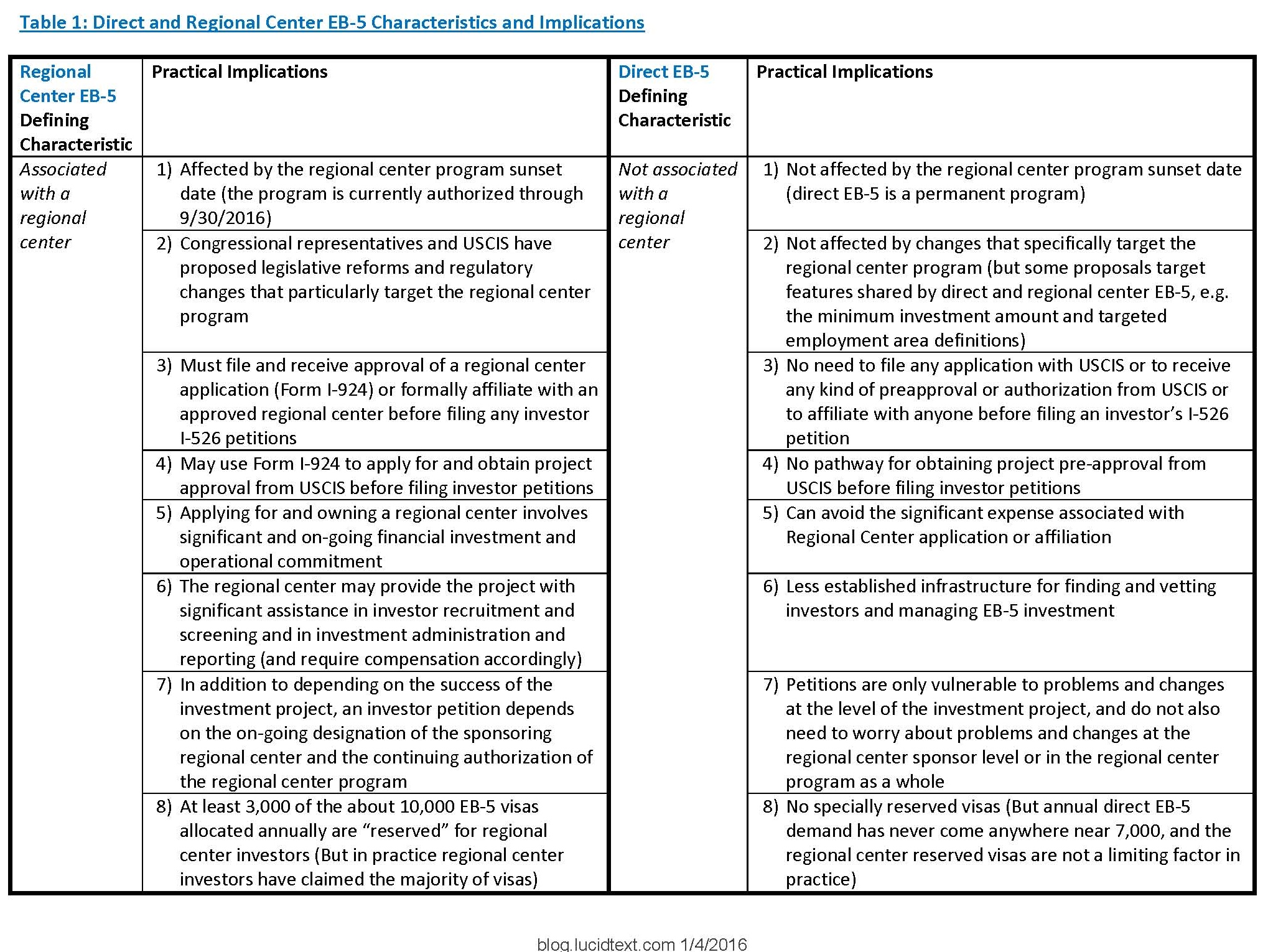
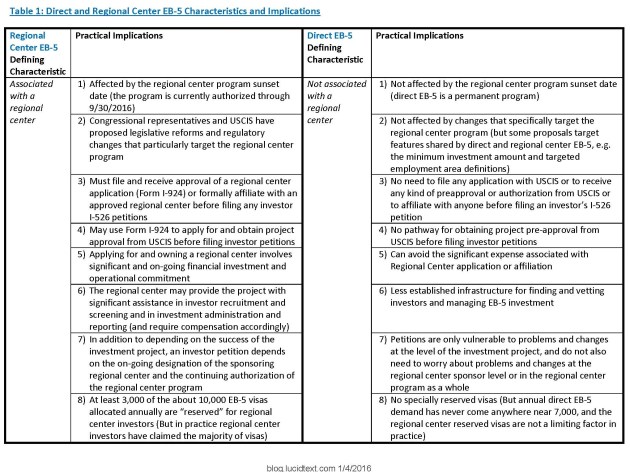
In a nutshell, the answer is that a regional center investment is associated with a designated regional center and therefore may count indirect job creation, while a direct EB-5 investment is not associated with a regional center and may not count indirect jobs.

These two differences – regional center affiliation and indirect job creation – are the only fundamental differences between direct and regional center EB-5. The two tracks share the same basic EB-5 requirements: investment of capital in a new commercial enterprise that creates jobs. Contrary to popular misconception, direct and regional center EB-5 have the same minimum investment amounts, the same targeted employment area incentives, and (USCIS claims) about the same average petition processing times.

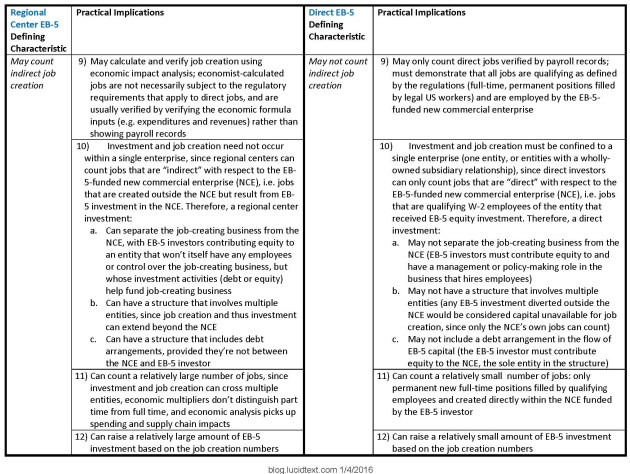
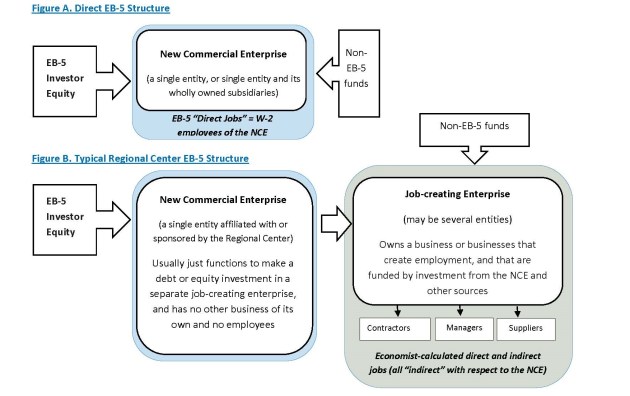
However, the two fundamental differences between direct and regional center EB-5 have implications that make direct and regional center investments quite different in practice. (Click on the images below to see full-size versions of the comparison charts, or click here for a PDF version.)
comparison chart_Page_1
comparison chart_Page_2
comparison chart_Page_3
Examples
Some common scenarios will illustrate the differences, as described above, between direct and regional center investment:

  • Real estate development projects are the most common investment for regional center EB-5 but awkward-to-impossible for direct EB-5. Indirect job creation allows the regional center investor in a landowner to count construction contractor jobs, indirect impacts of supply purchases, and sometimes even jobs created by the tenants of the completed development. A direct investor who invests in the same landowner could only count the permanent W-2 employees of the landowner – but normally the landowner wouldn’t have any employees. Most construction work gets done by employees of a variety of contractors, none of which “indirect” jobs count for direct EB-5, and any direct employee positions lasting only the duration of the construction project may also be disqualified because they are not permanent.
  • Hotels are a common investment for both regional center and direct EB-5, but subject to different considerations. The regional center hotel investment has the luxury of segregating EB-5 investors in an entity that neither owns nor controls the hotel, but simply exists to raise EB-5 capital and make a debt or equity investment in the hotel. This entity can claim credit for hotel jobs, thanks to indirect job creation. Direct investors, on the other hand, can only get credit for direct jobs and so can’t be segregated, but must have equity interest in the hotel owner/employer. (This can bring up liability issues, and may mean that direct EB-5 investors have to be vetted as owners in the franchising and liquor license process.) It’s no problem for regional center EB-5 if one entity owns the hotel and a separate management company hires the hotel employees, since indirect job creation doesn’t take into account which name appears on payroll records. In direct EB-5, this is a problem. Direct EB-5 can’t separate investment from job creation, and therefore the entity that uses EB-5 capital to develop the hotel needs to be the same entity with new hotel employees on its payroll. (If multiple entities are involved in direct EB-5, they must be essentially united by a wholly-owned subsidiary relationship.) Furthermore, a hotel will be able to claim more job creation as a regional center project than as a direct project. A new-build 120-room Homewood Suites might subscribe two direct EB-5 investors based on a business plan anticipating creation of 23 full-time positions, or twelve regional center EB-5 investors based on an economist’s calculation that hotel construction and operation will result in 130 new jobs. Why are the two jobs numbers so different for the same hotel? First, the direct investor can only count hotel employees while the regional center investor can also count construction-associated jobs and economist-defined indirect and induced jobs (associated with supply purchases and employee spending). Second, the direct investor can only count payroll-record-verified full time positions, while an economic model is relatively generous in counting operating jobs. The economist’s multipliers are based on averages, cannot distinguish between full-time and part-time employment, do not consider who holds the jobs, and are not finely tuned to reflect labor variations among hotels of different flags and scales. The economic model calculates average direct employment for an average hotel with a given verified revenue, and this number usually exceeds the number of discrete, verifiable 35+ hour per week positions at an individual hotel. Finally, I-829 paperwork may be easier for the regional center investment than the direct investment. The hotel with direct investors needs to sign up for E-Verify, take special care that its employees are qualifying, maximize full-time employment, and prepare stacks of payroll records to verify job creation. The offering with regional center investors and an economic analysis using expenditure and revenue inputs can (in theory) not worry about individual employees but rather track expenditures and revenue, and prepare financial statements to verify employment by verifying economic model inputs.
  • Small businesses such as restaurants and gas stations are likely to use direct EB-5. Such businesses tend to require only a couple EB-5 investors and will have sufficient direct jobs to justify those investors without needing to rely on indirect job creation. They can generally accommodate EB-5 investors as equity members and don’t require the complex investment structures only possible for regional center EB-5. No regional center affiliation means no regional center fees, no geographic limitation, and no vulnerability to regional center program changes. Regional center investment could work for these projects too and has the attraction of flexibility. But these projects may not be attractive to regional centers, which are often unwilling to sponsor offerings that only need a couple investors, and direct EB-5 provides a viable alternative.
  • Investments involving multiple layers and diversification can work in the regional center context but not for direct EB-5. If a direct EB-5 case has multiple entities in the flow of EB-5 capital or in the staffing plan, then those entities must be united by a wholly-owned subsidiary relationship. If they aren’t so related, then the case will be denied. For example see OCT022015_01B7203 Matter of H-G- (direct investment in a new commercial enterprise that invests in a separate job-creating business), NOV122014_01B7203 and DEC042013_01B7203 (direct investment and job creation divided among several enterprises), JUN182013_01B7203 and JUN042013_01B7203 (job creation in partially-owned subsidiaries).

Regulatory Background
What rules underlie the practical differences between direct and regional center EB-5? To quote the EB-5 Policy Memo: “The EB-5 Program is based on three main elements: (1) the immigrant’s investment of capital, (2) in a new commercial enterprise, (3) that creates jobs.” Direct and regional center EB-5 investors share these elements and the requirement to contribute capital (equity not debt) to a (single) new commercial enterprise and create jobs. The difference comes in term definitions. “Employee” for a direct investor can only mean “an individual who provides services or labor for the new commercial enterprise and who receives wages or other remuneration directly from the new commercial enterprise.” The word has an additional sense for the regional center investor: “an individual who provides services or labor in a job which has been created indirectly through investment in the new commercial enterprise.” The EB-5 regulations at 8 CFR § Sec. 204.6(e) define terms:

  • Commercial enterprise means any for-profit activity formed for the ongoing conduct of lawful business including, but not limited to, a sole proprietorship, partnership (whether limited or general), holding company, joint venture, corporation, business trust, or other entity which may be publicly or privately owned. This definition includes a commercial enterprise consisting of a holding company and its wholly-owned subsidiaries, provided that each such subsidiary is engaged in a for-profit activity formed for the ongoing conduct of a lawful business. This definition shall not include a noncommercial activity such as owning and operating a personal residence.
  • Employee means an individual who provides services or labor for the new commercial enterprise and who receives wages or other remuneration directly from the new commercial enterprise. In the case of the Immigrant Investor Pilot Program, “employee” also means an individual who provides services or labor in a job which has been created indirectly through investment in the new commercial enterprise. This definition shall not include independent contractors.
  • Invest means to contribute capital. A contribution of capital in exchange for a note, bond, convertible debt, obligation, or any other debt arrangement between the alien entrepreneur and the new commercial enterprise does not constitute a contribution of capital for the purposes of this part.

For additional discussion see my Direct EB-5 Page.