IDEA Community Invite

From: U.S. Citizenship and Immigration Services [mailto:uscis@public.govdelivery.com]
Sent: Wednesday, April 27, 2016 3:53 PM
Subject: USCIS Message: Idea Community Feedback on Potential EB-5 Regulatory and Policy Changes

Dear Stakeholder,

As mentioned at the EB-5 listening session on April 25, USCIS is considering potential EB-5 regulatory and policy changes and we want to hear from you, our stakeholders. That’s why we hosted the listening session to begin receiving your individual feedback. We want to continue to hear your thoughts and ideas. Specifically, we would like to hear your individual thoughts on the following four topics:
·        Minimum investment amounts;
·        The TEA designation process;
·        The regional center designation process, including, but not limited to, the exemplar process and the designation of the geographic scope of a regional center; and
·        Indirect job creation methodologies.

As you may know, minimum investment amounts have remained constant since 1991.  We would like your feedback on whether these amounts ($1 million or $500,000) should increase and, if so, the methodology and process by which you believe an increase would be most effective.

We’d also like your thoughts on targeted employment areas (or “TEAs”) and the TEA designation process.  We are specifically seeking your feedback on how the process currently works for you and, if improvements can be made, your input for improving it.

Another topic on which we are seeking feedback is the regional center designation process, including, but not limited to, the exemplar process and the designation of the geographic scope of a regional center.  We are seeking stakeholder feedback on how the process currently works for you and, if improvements can be made, your input for improving it.

Finally, we’d like to hear from you on indirect job creation methodologies.

We are using the USCIS Idea Community, an online crowdsourcing tool, as one method for you to submit your individual feedback and input on these four topics.  Please note that we are only seeking individual input.  We are not seeking group or consensus advice.  Participating in the USCIS Idea Community is easy. All you need is an active email address. You can create a profile and submit ideas.

You can visit the USCIS Idea Community to submit your ideas on the four topics listed above until May 11, 2016.

See you in the USCIS Idea Community!

Please do not reply to this message. Contact us at Public.Engagement@uscis.dhs.gov or USCIS-IGAOutreach@uscis.dhs.gov with any questions.

4/25 meeting notes, RC list changes

4/25/2016 Listening Session
Today’s EB-5 stakeholder meeting with USCIS was indeed a listening session — a venue for stakeholder opinions and not for tips and answers from USCIS. In case you’re a lawmaker or regulator and interested in reviewing insightful comments from the public, here is my recording. For the rest of us, who are mainly just curious about what USCIS has to say, here are a few tidbits that came out in the meeting:

  • USCIS will be initiating an IDEA community campaign to collect additional input on EB-5 regulation/policy changes. When that goes live, I’ll post a notice here.
  • I-829 interviews will begin this year, at first virtually, and interviewees may bring counsel, Regional Center representatives, and Regional Center counsel.
  • An audit program for regional centers is being implemented this year, and site visits are being expanded for direct and regional center projects.
  • IPO is up to 126 staff and on track to have 171 employees by year end.
  • IPO did not give any hints about the anticipated content of or timeline for revised regulations or new policy.
  • IPO will work closely with Congress up to the next deadline for regional center program reauthorization (September 30, 2016), and just in case will prepare “what if” guidance for two sunset scenarios: if the Regional Center program lapses but Congress apparently intends to reauthorize it, or if Congress indicates its desire to end the program.
  • IPO Chief Nicolas Colucci reported some preliminary processing data. Q2 2016 receipts: 849 (I-526), 886 (I-829), 40 (I-924). Completions from October 2015 to March 2016 (Q1-Q2 2016): 4,141 (I-526), 1,255 (I-829), 135 (I-924). The big story in these numbers is I-526 receipts, as illustrated in the following figure.
    Q22016I526

Regional Center List Changes
Additions to the USCIS Regional Center List, 04/19/2016 to 04/25/2016

  • Regional Center of the Pacific (California)

Additions to the USCIS list of terminated regional centers:

  • WRC EB-5 Regional Center, Inc. (Washington) Terminated 4/13/2016

4/25 Meeting Questions, Program Changes, New RCs

Discussing EB-5 Changes with USCIS

Next Monday 4/25 USCIS will hold an EB-5 listening session to give stakeholders a chance “to provide feedback on potential EB-5 regulatory and other policy changes.” This week USCIS emailed “a list of topics that we would like your input on,” as follows: “Minimum investment amounts; The TEA designation process; The regional center designation process, including, but not limited to, the exemplar process and the designation of the geographic scope of a regional center; and Indirect job creation methodologies.” This list gives us an interesting tip of the hand on the areas USCIS plans to address in forthcoming revised regulations and new policy.

So what are the potential changes? I’ve summarized issues and proposals that are on the table in these four categories, with special reference to Secretary Jeh Johnson’s legislative wish list as expressed in his April 2015 letter to Senators Grassley and Leahy, and provisions that have been included in EB-5 reform bills. All these items were put on the table for Congressional action, and I’m not entirely clear about how much USCIS has power to change through regulation and policy, absent legislation. And I don’t hold my breath for USCIS much more than for Congress to get things done. But I hope to hear more on Monday about what USCIS has in the pipeline, and this list may help spur your thinking on feedback you’d like to give during the meeting.

— Minimum investment amounts —
What DHS suggested to Congress:
— Increase both the TEA and base investment amounts, considering that they haven’t been adjusted in 25 years. And link minimum thresholds to inflation indices going forward. (Jeh Johnson letter)
Proposals from EB-5 legislation:
— Leahy & Grassley: base amount $1.2M, $800K in TEA, and CPI adjustments every five years
— Lofgren & Gutierrez: base amount $2M, $1M in TEA
— Flake, Polis, Paul, Schock: no change proposed
Other notes:
— In an IIUSA member poll, 72% thought raising the TEA level to $800K workable for their business; 15% thought the $2M/$1M level workable.
— Judiciary committee hearings have all mentioned the need to raise investment amounts. The Senate TEA hearing discussed Congressional intent for the base amount to be the norm and TEA investment an exception to incentivize a limited number of projects.
— The US investor visa amount is indeed rather low compared with other major investor visa programs. (Migration Policy Institute report.)

— The TEA designation process —
What DHS suggested to Congress:
— Prevent jerrymandering by limiting TEAs to a specified number of contiguous census tracts. Also include closed military bases. (Jeh Johnson letter)
Suggestions from legislative proposals:
— Leahy & Grassley: new set-asides, new NMTC-inspired categories, limit gerrymandering, USCIS designates rather than states, TEA designation valid for 2-year period
— Flake, Polis, Paul, Schock: no change
Other notes:
— In an IIUSA poll, 59% percent thought the 12-census tract California model viable for the industry, 36% thought the NMTC-modeled category could work.
— Judiciary committee hearings have expressed strong and divisive opinions about what types of projects should be incentivized and which type of geographic areas privileged, what types of incentives would be effective, and who should designate TEAs.
— Some interesting analysis has been done on the potential impact of TEA change proposals, including by Friedland & Calderon.

— The regional center designation process, including, but not limited to, the exemplar process and the designation of the geographic scope of a regional center
What DHS suggested to Congress:
— Require RC principals to be US citizens or permanent residents with records free of certain criminal and civil violations. Require exemplar filing (business plan and organizational documents) in advance of individual investor filings. (Jeh Johnson letter)
Suggestions from legislative proposals:
— Most 2015 bills include a provision requiring exemplar I-526 filing for project pre-approval, and include a provision prohibiting foreign RC ownership.
Other notes:
— I haven’t noticed other people talking about regional center geographic scope as a sensitive issue, and interested to see this point raised now. I’ve been remarking since late 2013 on the many multi-state regional centers getting designated, and wondering what IPO thinks “regional center” means. The law establishing the program specifies that “a Regional Center shall have jurisdiction over a limited geographic area, which shall be consistent with the purpose of concentrating pooled investment in defined economic zones” (Section 610(a) of the Departments of Justice and Related Agencies Appropriations Act 1993).

— Indirect job creation methodologies —
What DHS suggested to Congress:
— I can’t recall USCIS proposing changes in indirect job creation methodologies.
Suggestions from legislative proposals:
— The Leahy & Grassley bill proposed adding a requirement that at least 10% of RC project jobs be verifiable direct jobs. (Their original bill would also limit EB-5 investor credit for job creation based on percentage of their investment in the enterprise and says that at least 50% of all indirect jobs in a TEA project must be created within the TEA.)
Other notes:
— In an IIUSA poll, 39 respondents agreed with a 10% direct jobs requirement.
— Speakers at both House and Senate judiciary committee hearings questioned whether it’s fair to let EB-5 investors count all the jobs in a project when they provided only a small portion of funding needed for that project. I don’t resonate with this concern (after all, it’s common for a small piece of the capital stack to be a piece without which that whole project could not proceed), but apparently it’s fixed in the Congressional imagination as a concern. But I don’t know whether it’s in USCIS’s possible policy/regulation reach.
— There have been suggestions in the past about getting other agencies (ie Department of Commerce) involved in vetting and/or setting rules for EB-5 economic analysis, but I haven’t heard this bruited recently. I wonder whether this is the indirect jobs issue currently on USCIS’s radar.

Articles on Proposed Changes
The latest edition of the Regional Center Business Journal has a valuable article by Peter Joseph discussing the schedule between now and September 30, 2016 and what may happen in Congress during that time (page 19), and also a roundtable of EB-5 experts discussing the possibilities for changes through policy and regulation (p 38).

Regional Center List Changes
Additions to the USCIS Regional Center List, 04/13/2016 to 04/19/2016

  • EB5 International III LLC (Oregon, Washington)
  • Global Alliance Carolina Regional Center, LLC (North Carolina)

4/13 Senate Hearing Notes, RC Research, SEC Case (VT), RC List Changes

Senate TEA Hearing
You can now review video of the 4/13 hearing on EB-5 targeted employment areas on the Senate Judiciary Committee website (be patient, the video does start eventually), or download my audio recording. My main take-away from the hearing is that Senate leaders are on a long-term path to EB-5 reform and Regional Center reauthorization. They discussed very substantive potential changes in a very preliminary manner and sounded no-where near ready to sit down and agree on legislation. This is worrisome, considering that only a handful of Congress workdays remain before the 9/30/2016 Regional Center sunset date (what with conventions and vacation and holidays) – hardly enough time to hammer out the issues and questions that this hearing raised as important. The TEA issue is a thorny one because it comes down to a question of what kind of projects Congress wants to see incentivized, and our representatives don’t agree about that, much less on the question of what type and method of incentive would effectively focus on such projects.

EB-5 Project Research
Listening to Gary Friedland testify at the Senate Hearing reminded me that I’ve been remiss in reporting on the latest EB-5 research that Mr. Friedland and Professor Calderon have posted at the NYU Center for Real Estate Finance Research. Their paper EB-5 Mezzanine Financing: A Real World Example (3/23/2016) presents and analyzes an actual term sheet for a large EB-5 regional center deal, and will be very interesting for people seeking examples of EB-5 documents and deal terms. EB-5 Capital Project Database: Revisited and Expanded (3/29/16) follows up on last year’s paper A Roadmap to the Use of EB-5 Capital: An Alternative Financing Tool for Commercial Real Estate Projects (5/24/2015) by adding details of 27 additional EB-5 projects. The number 27 is small – representing a minority of EB-5 projects – and yet these few projects alone involve over $5.6 billion in EB-5 capital, which means over 11,000 EB-5 investors and almost three years of the total EB-5 visas available. I have to hope that Senators and journalists don’t examine the NYU database, because these few projects claiming so many dollars and visas could provide ammunition for criticism that EB-5 TEA investments have become a subsidy for luxury developments in tier one cities, a benefit for mega-developers and Chinese developers, an opportunity to replace existing financing rather than a source of needed capital, and a minor contribution to job creation. As a business plan writer I work with EB-5 projects that could be attractive poster children for the regional center program, but such modest projects usually don’t make the research papers or the news and their fate may depend on how the big players are seen to use EB-5.

New SEC Case (VT)
Also in the category of the last thing we need when facing a fight for Regional Center reauthorization: a venerable figure in the RC program is now subject of fraud charges and an asset freeze. According to today’s press release: SEC Case Freezes Assets of Ski Resort Steeped in Fraudulent EB-5 Offerings. The State of Vermont has filed a concurrent suit. The SEC Complaint does not name Vermont Regional Center, but it does call out Ariel Quiros, William Stenger, and a whole list of Jay Peak companies. I read the SEC complaint ready to make allowances, since I know that in real life it’s extremely difficult to produce documents that are completely free from omissions and misleading statements or that perfectly anticipate what subsequently happens, and I think one should be very hesitant to cry fraud. Sadly the SEC complaint leaves little room for charitable interpretation, and this situation looks like a mess likely to pass beyond Jay Peak and their investors to leaders who have been regional center program champions. Senator Leahy concluded his comments on the enforcement action by saying: “Given the significant problems plaguing this program, I will continue to push for meaningful reform. Without reform, I believe the time has come for the program to end.” Hurry up, reformers!

Additions to the USCIS Regional Center List, 04/05/2016 to 04/13/2016

  • America FX Regional Center, LLC (California)
  • EB5 International II, LLC (California)
  • Hawaiian Ohana Regional Center (Hawaii)
  • Luichi, Inc. (Nevada)
  • Manhattan Metropolitan Regional Center (Connecticut, New Jersey, New York)
  • Watercrest Florida Regional Center, LLC (Florida)

Removed from the list

  • Deictic Investment Group LLC (California)

4/13 Hearing, 2016 AAO Decisions (NCE requirement), RC List Changes

Senate Judiciary Committee Hearing Rescheduled 4/13
The Senate Judiciary Committee’s provocatively titled hearing on The Distortion of EB-5 Targeted Employment Areas: Time to End the Abuse has been rescheduled for Wednesday April 13th.  The hearing will be streamed live at the above link.

AAO Decisions: Regional Center NCE, Jobs Allocation, At Risk Requirement
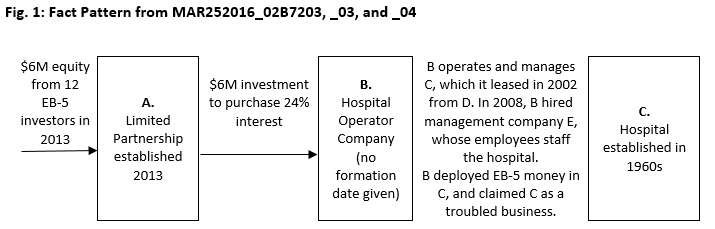
Several 2016 AAO decisions on I-526 cases have been posted on the USCIS website. I’m particularly interested in MAR252016_02B7203 (and the nearly identical _03 and _04), which deal with a regional center investment. Here’s what I’m particularly surprised or intrigued to hear AAO saying in the MAR252015 cases:

  • In the Regional Center context, the job-creating entity’s history and creation date are not relevant to the question of whether EB-5’s “new” commercial enterprise requirement has been met. When the regional center investment involves a new commercial enterprise and a separate job-creating enterprise, only the NCE has to qualify as “new.” In making this point, AAO argues against a position commonly taken by USCIS. In the MAR252016 case, the petitioner invested in a limited partnership formed in 2013 that deployed capital in a hospital established in the 1960s. In its denial, USCIS predictably cited Matter of Soffici and indicated that the NCE requirement wouldn’t be met unless the hospital were restructured or substantially expanded. (Soffici deals with a new enterprise’s purchase of an old hotel and says “It is the job creating business that must be examined in determining whether a new commercial enterprise has been created”.) AAO countered that: “We disagree with the Chief’s analysis. Soffici, unlike this case, did not involve a regional center project.” AAO argues that the relevant precedent is rather Matter of Izummi, which did deal with a regional center case, and “In Izummi, when determining what constituted a ‘new commercial enterprise’, we reviewed the date of creation of the entity in which a petitioner had invested or intended to invest, not the job creating entity where the funds were ultimately to be deployed.”
  • A petitioner can’t get credit for any jobs created by the project if the project didn’t create enough jobs for all EB-5 investors in the project (unless there is an agreement among all investors about how jobs will be allocated). In the MAR252016 case, AAO wouldn’t consider whether any of the 61 new jobs finally claimed could be credited to the petitioner, since there were 11 other EB-5 investors in the project and no job allocation agreement on file. This is not new policy, but an important reminder. Make and file a job allocation agreement, just in case!
  • An EB-5 investment does not meet the “at risk” requirement if the business plan does not “present a comprehensive analysis of the potential net profit available for distribution to each of the limited partners” and therefore fails to “sufficiently establish that there is a reasonable chance for gain, especially in the foreseeable future.” This is not technically a new point (the full “at risk” requirement is “at risk for the purpose of generating a return on the capital placed at risk”), but I haven’t seen AAO/USCIS focus on insufficient profit analysis as a basis for denial.

I’ll let you read the MAR252016 decisions for yourself to get the rest of the story. The case also involves the hot issues of troubled business qualification and the separation of ownership, management, and employment among multiple entities, and AAO doesn’t raise all the questions or reach all the conclusions I would’ve expected. What AAO doesn’t say in this case may be as significant as the points that are made. To assist in following the case, I’ve done my best to illustrate the fact pattern (reading around redactions, so mistakes are possible).
Fig-1UPDATE: You can read more about this case in a civil suit filed by the petitioners. (Update: the petitioners won the suit.)

AAO Decisions: Search Function
The Administrative Appeals Office has launched a search tool for most non-precedent decisions since 2005. Just enter a search term in the box under “AAO Non-Precedent Decision Repository” and poof – links to all AAO decisions where that term is mentioned, with sorting options. I love it. (And now regret that weekend spent downloading EB-5 decisions one by one to make my own searchable master file.)

Regional Center List Changes
Additions to the USCIS Regional Center List, 03/21/2016 to 04/05/2016

Terminations

  • Path America KingCo, LLC (Washington), Terminated 3/23/2016
  • MCIG Regional Center (Florida) Terminated 3/29/2016
  • Velocity Regional Center (California), Terminated 3/24/2016