Final Fee Rule, Processing Updates, RC Withdrawal

Today the Federal Register published U.S. Citizenship and Immigration Services Fee Schedule, a final rule adjusting the fees required for most immigration applications and petitions. USCIS invites stakeholders to participate in a Fee Rule Engagement teleconference on November 2, 2016 from 3:30 to 4:30 PM EST. (To register, click on the USCIS registration page.)

The final rule is similar to the proposed rule that we reviewed this summer, with the addition of DHS response to public comments. Here are the portions of the rule particularly significant to EB-5 (summarized from PDF pages 17-20, 30-31, and 41 of the final rule).

Fee Increases

EB-5 petitions and applications become more expensive to file as of December 23, 2016.
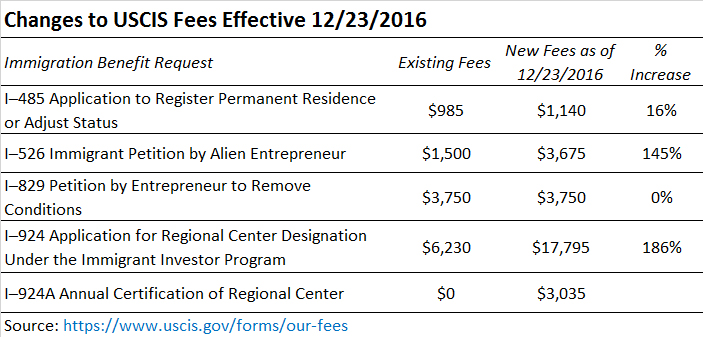
newfees
The fee increase for Form I-924 is especially drastic, and I’m surprised to discover that USCIS apparently did not hear public feedback on its two most obvious problems: that it was assessed based on inaccurate assumptions about regional center revenue, and that it will discourage regional centers from voluntarily using I-924 to file the amendment requests and Exemplar I-526 that USCIS wants to encourage. IIUSA and AILA – did you drop the ball on commenting, or did USCIS just not pay attention? But the rule is final now, so we live with it. And Regional Centers, you might want to hustle to file any exemplars and amendments before December 23.

Processing Issues

  • The rule does not promise that fee increases will bring improved service for EB-5 petitions. The rule states that higher fees will be used to recover costs needed to sustain current operating levels, pay a share of services that DHS provides on a fee-exempt basis to others, bolster IPO’s fraud detection and national security capabilities, and make limited investments in technological improvements to bolster information security. These uses have merit, but none are directly linked to improved EB-5 processing times. But the rule does claim that the new I-924 fee “was, in part, calculated to allow USCIS to hire additional staff to process Forms I–924 and provide better and more thorough service.”
  • The rule includes in passing this interesting tidbit on how IPO currently handles I-829 adjudications:

DHS appreciates the suggestions for improving EB–5 processing times. DHS clarifies that USCIS already has processes in place to streamline adjudication of the business-related portions of multiple Forms I-829 associated with a single, new investment project. Specifically, when USCIS receives a regional center-associated Form I–829 that involves a new commercial enterprise, USCIS reviews the first two petitions associated with that new commercial enterprise to determine if there are specific project-related issues that would apply to all petitioners associated with the new commercial enterprise. After completing that review, USCIS commences adjudication of all Forms I–829 associated with that new commercial enterprise filed within a given period. Similarly, when USCIS receives a regional center-associated Form I–829 that involves a previously reviewed commercial enterprise, USCIS immediately assigns that petition for adjudication. In other words, USCIS currently adjudicates Form I–829 petitions in ‘‘first in, first out’’ order by new commercial enterprises.

  • The rule gives the welcome news that “USCIS is transforming how it calculates and posts processing time information to improve the timeliness of such postings, but more importantly, to achieve greater transparency of USCIS case processing.” To that end, “USCIS is evaluating the feasibility of calculating processing times using data generated directly from case management systems, rather than with self-reported performance data provided by Service Centers and Field Offices” and “USCIS is also considering publishing processing times using a range rather than using one number or date. This approach would show that, for example, half of cases are decided in between X and Y number of months.” (Or, as Sir. Humphrey Appleby might say: of course we understand that you want a usable processing report, and have convened an interdepartmental committee to conduct a feasibility study that will make recommendations at the appropriate juncture, in due course, when the moment is ripe, in the fullness of time. Rome wasn’t built in a day.)
  • The rule says that “USCIS does not have immediate plans to allow electronic filing for EB–5 requests, but appreciates commenters’ desire to avoid voluminous paper filings. USCIS plans to allow electronic filing for EB–5 requests in the future.”

Regional Center Withdrawal Procedure

The rule recognizes the problem that “Currently, there is no procedure for regional centers seeking to withdraw their designation and discontinue their participation in the program,” and offers to provide a withdrawal procedure to “allow a regional center to proactively request withdrawal without the need for the more formal notices sent out by DHS.” To this end, the rule amends the EB-5 regulations, replacing 8 CFR 204.6(m)(6) with the text I quote below. The new language is similar to the previous 8 CFR 204.6(m)(6) except that it adds failure to pay fees as a reason for termination and adds a rather vague paragraph stating that a regional center may notify USCIS by letter or other means if it wishes to withdraw from the program. The paragraph does not clarify what the letter should include, where it should be sent, what kind of decision USCIS has to make about the letter, and to what extent such a regional center will be treated differently from another whose designation is terminated involuntarily.

PART 204—IMMIGRANT PETITIONS
■ 8. Section 204.6 is amended by revising paragraph (m)(6) to read as follows:

  • 204.6 Petitions for employment creation aliens.

* * * * * (m) * * *
(6) Continued participation requirements for regional centers.
 (i) Regional centers approved for participation in the program must:

(A) Continue to meet the requirements of section 610(a) of the Appropriations Act.

(B) Provide USCIS with updated information annually, and/or as otherwise requested by USCIS, to demonstrate that the regional center is continuing to promote economic growth, including increased export sales, improved regional productivity, job creation, and increased domestic capital investment in the approved geographic area, using a form designated for this purpose; and

(C) Pay the fee provided by 8 CFR 103.7(b)(1)(i)(XX).

(ii) USCIS will issue a notice of intent to terminate the designation of a regional center in the program if:

(A) A regional center fails to submit the information required in paragraph (m)(6)(i)(B) of this section, or pay the associated fee; or

(B) USCIS determines that the regional center no longer serves the purpose of promoting economic growth, including increased export sales, improved regional productivity, job creation, and increased domestic capital investment.

(iii) A notice of intent to terminate the designation of a regional center will be sent to the regional center and set forth the reasons for termination.
(iv) The regional center will be provided 30 days from receipt of the notice of intent to terminate to rebut the ground or grounds stated in the notice of intent to terminate.
(v) USCIS will notify the regional center of the final decision. If USCIS determines that the regional center’s participation in the program should be terminated, USCIS will state the reasons for termination. The regional center may appeal the final termination decision in accordance with 8 CFR 103.3.
(vi) A regional center may elect to withdraw from the program and request a termination of the regional center designation. The regional center must notify USCIS of such election in the form of a letter or as otherwise requested by USCIS. USCIS will notify the regional center of its decision regarding the withdrawal request in writing.
Visa Usage, GAO TEA Report, RC List Updates

Visa Usage
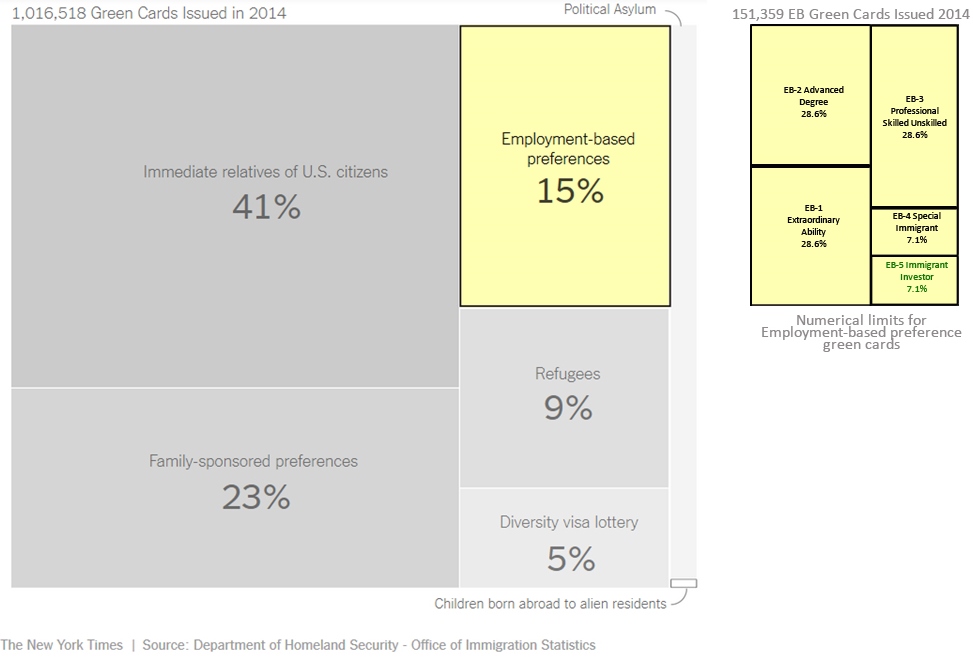
Here is a chart that visualizes how EB-5 fits into the big picture of U.S. immigration. The main chart is lifted from a New York Times article this week that discusses immigration levels. I added the box with detail on numerical limits within EB preference visas.
greencards
It’s worth gazing at this chart and considering how we feel about the allocations. The pie is unlikely to get larger: the message I hear from Washington is that no one has the political will to push for a greater total number of immigrants to the U.S. The pie  could be divided differently, if Mr. Trump or Ms. Clinton gets a chance to make comprehensive immigration reform happen. EB-5 is currently limited to barely 1% of the annual total (7.1% of the EB category), and EB-5 investors get still fewer numbers since they share the allocation with family members. This wasn’t a problem for years when the program didn’t really work, but now is a shame as EB-5 is working overtime and thousands of people eager to invest in US business and bring their resources to the US are stuck in years-long waiting lines. (For sobering figures on wait times, and thoughts about how to alleviate the problem, see the slides from Symposium on EB-5 Visa Usage at the IIUSA EB-5 Industry Forum October 2016.) The employment-based category as a whole is bursting at the seams as it tries to accommodate needs from health care to Silicon Valley with only 15% of total visas, so EB-5 stakeholders aren’t the only ones agitating strongly and loudly for a better piece of the pie. As the New York Times points out, the current legal immigration system prioritizes family reunification over employment-based preferences. Mr. Trump says he wants “to choose immigrants based on merit, skill and proficiency” (so far so good for EB-5, though his idea of reducing total immigration could pull the rug from under EB-5 visa numbers), while Ms. Clinton’s immigration platform keeps the focus on families. One or the other will probably get elected next month, and we’ll wait with bated breath to see what happens next with immigration. Maybe either will solve the problem by reducing the likelihood that a million sensible people a year will even want U.S. immigrant visas. (FYI: my chart and NYT’s chart aren’t exactly in parallel, since theirs shows percentages used in a given year while mine shows numerical limits — percentages that may not match actual usage in 2014.)

GAO Report
The Government Accountability Office has another EB-5 report, this one titled Immigrant Investor Program: Proposed Project Investments in Targeted Employment Areas (September 19, 2016). The report is addressed to Senators Grassley and Leahy and Representatives Goodlatte and Conyers, and responds to their request for information on EB-5 projects in recent I-526 petitions, specifically “(1) proportion of petitioners that did or did not elect to invest in a TEA; (2) proportion of petitioners basing a high unemployment TEA on various types of geographic areas; and (3) EB-5 investment as a proportion of the total investment in petitioners’ TEA projects.” GAO answers these questions with statistics from a random sample of 200 I-526 petitions filed in FY2015 Q4. The report will interesting for people who don’t already know where most EB-5 money goes, in terms of geography and industry, and how EB-5 normally fits into a project’s capital stack. The report is a gift to journalists itching to write a headline with “gerrymandering” in the title (though it also indicates that the majority of combined-census-area TEAs are actually quite small areas, comprising fewer than 11 tracts). I’ve gathered that Grassley et. al.’s ideal EB-5 project is a business with no non-immigrant funding in a thoroughly blighted Midwestern town, and the GAO report reflects the fact that indeed few EB-5 petitioners have chosen such projects. Of course TEA incentives are only one factor in this reality. Market factors also determine the kind of project that entrepreneurs are willing to undertake and investors are willing to fund. But the GAO report will inform the talks on EB-5 legislation that need to resume before December 9.

Regional Center List Updates
Additions to the USCIS Regional Center List, 9/16/2016 to 10/03/2016:

  • Eagle EB-5 Regional Center (California)
  • McCormick Regional Center LLC (Washington)
  • NY Entrepreneurs Fund, LLC (Connecticut, New Jersey, New York)

Restored to list of approved RCs (apparently removed by mistake last week):

  • Benefield California Regional Center, LLC (California)
  • HS Regional Center, LLC (California)
  • SAA Cedisus EB-5 Projects – SW Indiana Regional Center, LLC (Indiana)
  • Western Energy Regional Center (Oklahoma)

Renamed:

  • American Islands Regional Center (former name United States Virgin Islands Regional Center) (U.S. Virgin Islands (USVI))

New Terminations:

  • Northern Illinois Regional Center (Illinois) Terminated 10/16/2016
  • Arizona Alternative Energy Center, LLC (Arizona) Terminated 10/6/2016
  • Detroit Immigrant Investor Regional Center (Michigan) Terminated 9/30/2016
  • Yellowstone Montana Regional Center, LLC (Montana) Terminated 9/28/2016

H.R. 5992 Account Transparency Requirement

The Account Transparency Requirement proposed in Goodlatte and Conyers’ H.R. 5992 American Job Creation and Investment Promotion Reform Act of 2016 (see pages 64-72) is probably the most important new idea in the bill. Commentary on the bill has focused on suggestions that people don’t like (retrogression, set-asides), but we should also be discussing account transparency because it’s genuinely relevant to program integrity. I don’t see national security threats in EB-5, but misappropriation of funds shielded by lack of transparency is a live problem — the major factor in most SEC enforcement actions so far on EB-5 offerings.  H.R. 5992 may not become law, but any EB-5 bill that does get passed will certainly have the words “reform” or “integrity” in the title, and we should be working to refine relevant and effective integrity provisions.  Let’s consider H.R. 5992’s account transparency proposal, the impact it would have if enacted, and how it might be improved.

Summary of the Account Transparency Requirement Proposed by H.R. 5992

  1. A new commercial enterprise (NCE) must place each EB-5 investor’s funds in a “separate account” with the following characteristics:
      • The account contains only pooled investment funds of EB-5 investors for a single project
      • The account is at an insured US financial institution
      • At least one signatory on the account is an independent third party with a position such as a bank officer, broker-dealer, attorney, or CPA

    A job-creating enterprise that’s affiliated with the NCE must likewise hold investor funds in a separate account satisfying the above requirements. The proposal does not place requirements on accounts for an unaffiliated JCE.

  2. Funds may only be transferred out of the NCE account for one of the following purposes:
    • Refund an investor’s investment
    • Transfer to another account that also meets the above qualifications for a separate account
    • Transfer to a job-creating entity
    • Deploy funds in the project for which they were intended
  3. The following oversight and reporting is required:
    • Whenever the NCE accepts investor funds into its account, it must immediately send a notice to the investor, the regional center, and USCIS that contains this account information: contact info for the financial institution, the name of the independent signatory, and access to view the account balance online on an on-going basis.
    • Whenever the NCE transfers funds out of the NCE account, the transfer must have prior written approval from the independent signatory, and the NCE must immediately send a notice to the investor, the regional center, and USCIS that specifies the amount and destination of the transfer.
    • When an affiliated JCE deploys funds into a project, the independent signatory or another attorney, broker-dealer, or CPA has 30 days to “verify that the funds were deployed in the project for which they were intended,” and notify the investor, regional center, and USCIS accordingly.

Analysis and Links

I wrote up some thoughts on the AT proposal, but I’m demoting them to a comment on this post because I’m more interested in what other people think. What’s the perspective from lawyers who specialize in securities law issues? How would H.R. 5992’s Account Transparency Requirement work for large NCEs that already implement fund administration and independent fiduciaries? How would it work for small businesses using EB-5, and direct EB-5 cases? Do investors and their advisors see effective protections in this proposal? What’s the perspective from regulators and receivers working to sort out past misappropriation cases? How could the AT proposal be better directed toward the ultimate account transparency goals of deterrence, detection, and discovery and recovery? What are the best protections we can afford, for investors and for the healthy future of the program?

Articles on H.R. 5992 Account Transparency Requirement

  • Gary Friedland and Jeanne Calderon of NYU have started the conversation with a detailed analysis of the H.R. 5992 Account Transparency Requirement in “EB-5 2.0: Can Account Transparency Save the Program?”  (October 6, 2016 draft). They describe the background that underlies the need for an AT requirement, unpack the H.R. 5992 proposal point by point and discuss its goals and implications, and suggest areas for further discussion and improvement. A few of my takeaways from the article and subsequent emails with Dr. Friedland: For improved effectiveness, the AT proposal might further define the role and duties of the third party signatory and verifier, bolster account transparency by adding account balance reconciliation to the Regional Center’s Form I-924A annual report, consider expanding the scope of reports to be provided to investors in an NCE (e.g. quarterly account statements, notice of transfer of funds from other investors in the NCE, a copy of the Regional Center’s Form I-924A filing), and craft AT requirements for the special cases of small EB-5 projects and direct EB-5.
  • I hope to link to other topical articles here soon.

Other relevant content

  • Assuming that the people drafting the H.R. 5992 Account Transparency Requirement were primarily motivated to avoid another Jay Peak situation, I made a chart (as best I could, based on detail in the legal complaints and news reports) that illustrates how and where exactly money got misappropriated in a Jay Peake project. Here is my simplified chart of where the money went (or see Vermont DFR for the complete, complicated picture). In my chart, related party transactions, single signatories, and multiple layers in the flow of funds stand out as fault lines. The chart also shows why it’s necessary to do more than watch funds safely out the door of the NCE account.
  • Angelo Paparelli’s article All Checks but No Balances — The Systemic Failure to Protect EB-5 Investors (June 24, 2016) diagnoses a lack of meaningful oversight in EB-5 and defines a role for independent fiduciaries representing investors.
  • Ron Klasko’s article Attention Receivers and Litigators: EB-5 Investors Are Not Your Typical Clients (July 11, 2016) addresses the unique position and interests of EB-5 investors when problems arise in an investment project.
  • The EB5 Diligence webinar on Structural Weaknesses in Path America’s Offering (September 12, 2015) considers controls and procedures that might have averted the self-dealing and misappropriation that happened in the Path America case. The discussion is important because it could apply as well to other SEC EB-5 actions, most of which similarly involve related-party scenarios.