FY2016 Q4 EB-5 Petition Statistics, Visa Backlog

I wish I had a merrier Christmas post for EB-5 world, but it’s my duty to report sobering statistics from USCIS for EB-5 petition processing as of Q4 FY2016 (ending September 30) and the National Visa Center for pending visa applications as of November 1, 2016.
NOTES

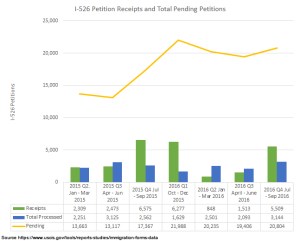
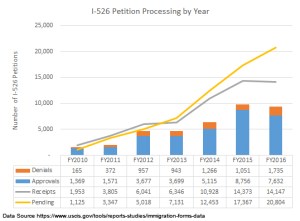
  • I-526 Processing Volume: USCIS sped up considerably in the 4th quarter, processing more I-526 petitions than in prior quarters. 4th quarter decisions were also relatively positive – 91% approvals. However, the 4th quarter was not enough to improve the annual numbers. USCIS still processed fewer and denied more I-526 petitions overall in FY2016 than FY2015.
  • I-526 Receipts and Backlog: The last quarter of 2016 saw another unnatural surge of I-526 filings (thanks for nothing, Congress), further swelling the already huge pool of pending petitions.  If USCIS continues to process about 9,500 I-526s a year (average for 2015/2016), then the 20,805 petitions currently pending will take over two years to process.
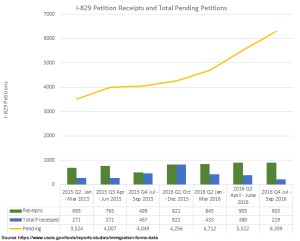
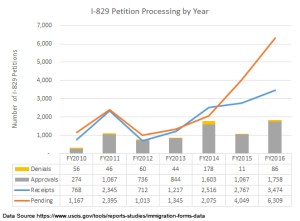
  • I-829 Processing Volume: I-829 processing in FY2016 started well and then fell every quarter, from over 800 petitions processed in the 1st quarter to barely 200 petitions by the 4th quarter. The year was still better than FY2015 overall, with 1.7x more completions. USCIS did not report denying any I-829 petitions in the 4th quarter, and the denial rate for the year is a low 5% (but higher than last year’s 1% overall).
  • I-829 Receipts and Backlog: I-829 receipts grew a few percentage points over the course of the year, even as processing slowed dramatically. USCIS ended the year with 6,309 pending I-829 petitions, which would take three to five years to process at the current rate of adjudication.
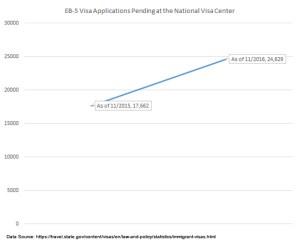
  • Pending EB-5 Petitions and Applications: There are currently about 20,804 I-526 petitions pending at USCIS (each petition representing one investor who may subsequently apply for about three EB-5 visas) plus about 24,629 EB-5 visa applications already pending at the National Visa Center. This means that the queue of current and committed EB-5 visa applicants now is about 75,000 people long and therefore stretches about eight years into the future. (Assuming that DOS can issue only about 10,000 EB-5 visas a year, and that we don’t – though we might — see major changes from investors dropping out or Congress changing its mind about the total numbers or allocation of visas. Here is a link to my spreadsheet with calculations, for anyone who would like to rethink the numbers.) New China-born investors filing today will go to the back of the line of pending petitions and applications, while new applicants from other countries can look forward to skipping ahead of China-born investors once they reach the visa stage. Considering the line, a China-born investor filing I-526 today might receive a green card in 2024 and think about removing conditions and exiting the investment after 2026 (or even later, if future years bring a growing volume of non-China investors), while today’s investor from Brazil may get a green card in 2018 and be ready for exit after 2020. These are unreliable estimates because many possible factors could affect actual timing, but food for thought. I look forward to linking to other commentary and opinions on these numbers.

NOTE: See the comments for additional input and insights


Proposed EB5 investment and TEA changes

The Regional Center program sunset date has been pushed back to April 28, 2017 by Public Law 114-254, but don’t count on the EB-5 status quo remaining unchanged through April. As I reported before, EB-5 filing fees are increasing from next week, there’s a new EB-5 Policy Manual, and Congress and USCIS might be about to unveil major EB-5 rule changes. USCIS signaled intention to post proposed new EB-5 regulations in the coming month, which could (at record speed) mean a final rule as early as March 2017. Congress reportedly came close to finalizing new EB-5 legislation behind the scenes last month and reportedly plans to introduce a new bill shortly. (USCIS has a history of dragging regulation revisions out over months or years or even decades, and Congress has a packed schedule for Trump’s first 100 days without mentioning EB-5. But still, there’s at least a chance of immanent EB-5 action.)

New regulations from USCIS promise to increase the minimum EB-5 investment amount, revise Targeted Employment Area requirements, clarify regional center designation requirements, and consider priority dates. We’ll have to wait for the proposed rule to learn more detail. (UPDATE: here is the detail.) New legislation promises to address those same issues while also adding new rules  for job creation, project pre-approval, investor source of funds, investor vetting and protections, fund administration, and many aspects of regional center operations.  My Bill Comparison Chart summarizes features from various iterations of proposed EB-5 legislation. (2017 UPDATE: I’ve continued to update the bill comparison chart, and also made a comparison of TEA proposals.) This draft is a version of the H.R. 5992 released earlier this summer, with revisions that show the influence of good sense (clearer presentation, no more deadly retroactive effective dates, fewer practically impossible tasks for USCIS and regional centers) as well as good lobbying by large regional centers (lower fees and better incentives for the major players). This staff draft legislation is unofficial (I received the same document separately from three sources, but without much context, and it’s just a redline with many passages marked for further negotiation), but I’m analyzing it because I hear that a bill based on this document may be  introduced early next year.

1/12/2017 UPDATE: DHS has published its proposed changes to investment amounts and TEAs in a Notice of Proposed Rule-making: EB-5 Investor Program Modernization (DHS Docket No. USCIS 2016-0006).

Countdown to reauthorization (CR to 4/28/2017)

The next sunset date for the regional center program is coming up on Friday 12/9, and I’ll update this post with relevant news as I receive it. (See my 9/29/2016 post if you’d like to review the history of RC program authorizations, and my 4/27/2017 post for updates on the more recent reauthorization countdown.)

UPDATES:

  • 12/10/2016: President Obama signed into law H.R. 2028, the “Further and Continuing and Security Assistance Appropriations Act, 2017.” It is now Public Law 114-254. This extends Regional Center program authorization together with government funding and other authorities through April 28, 2017.
  • 12/9/2016: The Senate is up late voting on the CR (HR 2028), and tomorrow should bring the good news of no government shutdown or RC program lapse.
  • 12/8/2016: The Hill reports that the CR passed the House today, and the Senate is expected to vote tomorrow. GOP leaders are confident that it will reach the President by the deadline, though it’s facing some opposition.
  • 12/7/2016: IIUSA has issued an advocacy alert welcoming the CR and the short-term reauthorization of the EB-5 Regional Center Program through April 28. “EB-5 stakeholders and congressional offices have engaged in meaningful discussions all year, particularly over the past few months, to reach consensus and compromise for the healthy future of the Program. With a tight deadline to fund the federal government and address other pressing legislative issues, there was simply not enough time for a reform package to be passed during this Congress. The short-term extension through April 28 will ensure that the industry and legislators will have the opportunity to agree upon a comprehensive reauthorization bill that provides necessary reforms to the Program while allowing the Program to continue to grow, thrive and endure in the long term.”
  • 12/6/2016: Quoted from a House Appropriations Committee Press Release: “House Appropriations Chairman Hal Rogers today introduced a short-term Continuing Resolution (CR) (H.R. 2028) to prevent a government shutdown and continue funding for federal programs and services until April 28, 2017. The legislation also contains funding for emergency disaster relief.  …The CR extends funding for operations for most federal agencies, programs and services until April 28, 2017. It maintains the current budget cap level of $1.07 trillion put into place under the Budget Control Act of 2011. The legislation continues policy and funding provisions included in currently enacted fiscal year 2016 Appropriations legislation. It does not include controversial riders, or major changes in existing federal policy.   ….For the full text of the legislation, please visit: http://docs.house.gov/floor/”  The Appropriations Committee has also posted a nice section-by-section summary.
  • 12/6/2016: Lawmakers haggle over funding bill as shutdown nears, says The Hill
  • 12/5/2016: I hear that Goodlatte and Conyers’ H.R. 5992 EB-5 Reform Act is still under active negotiation behind the scenes. A staff draft of the bill dated 12/2/2016, just forwarded to me by a kind reader, shows significant revisions from the original bill and suggests concessions to industry pressure on TEA definitions, visa set-asides, minimum investment amounts, foreign government involvement, and account transparency requirements. The matter of retroactive effective dates is marked as controversial and “unresolved” in this draft. Provisions on direct jobs, public bonds, and loan restrictions are highlighted as points for discussion. I will be astonished if a substantive EB-5 reform bill gets passed soon, but Congress might exceed expectations. This draft in progress does show a lot of recent work