Washington updates

2/6/2017 UPDATE: The news in this post is now all outdated. Please see my Washington Updates page.
–Original Post–
This week Washington has been busy making good on campaign promises and also throwing babies out with the bathwater. Of most significance for EB-5, the President has frozen federal hiring (halting USCIS plans to deal with petition backlogs and improve processing by bringing on more staff) and created two hurdles for new regulations (a regulatory freeze and a make-one-delete two requirement), deferring hopes and fears for the long-awaited modernization of EB-5 regulations. A horrifying new order suddenly suspends whole countries of people from US visas and even entry based on nationality. Senator Dianne Feinstein decided the time was right put her long-running opposition to EB-5 in the form of a bill (S.232) that proposes eliminating EB-5 entirely, both direct investment and the regional center program. I’ll write more about this bill if anything comes of it, but I expect that that the significant legislation will be a forth-coming update to the Goodlatte EB-5 reform bill (last released 12/2/2016). I am going forward with my work as usual under the assumption that reason will prevail eventually and that immigrant investment and the country generally are not, after all, doomed.  But if anyone would like to offer me a chance to move from the immigration business to the walls-and-bunkers business, I’m listening.

Regulations freeze, SEC action (San Francisco), RC List Changes

Progress of Proposed Regulations
As EB-5 stakeholders process proposed new EB-5 regulations, they are thinking (1) how can I dissuade USCIS from the changes that would be most harmful for me personally; (2) how can I take best advantage of this golden opportunity to explain to USCIS how EB-5 works in the real world; and (3) how early could the proposed regulations become final, effective regulations? We know at least that regulations can’t proceed to the next step until after the public comment period closes on April 11, 2017, and now the new administration has put another hurdle in the road.

President Trump’s first Presidential Memorandum is addressed to the Heads of Executive Departments and Agencies with the subject Regulatory Freeze Pending Review (January 20, 2017). It does not put a moratorium on new federal regulations, but does require that any new or pending regulations be presented for review and approval of a Trump-appointed agency head before proceeding any further. This means that proposed new EB-5 regulations will need to go before General John Kelley, the newly-confirmed Secretary of Homeland Security. Would General Kelley allow new EB-5 regulations to move forward? The tireless Senator Grassley met with General Kelley on January 13, and reported that “In addition, we talked about new proposed regulations published by the Department today that would go a long way to restoring the EB-5 immigrant visa program to the way Congress intended it to be used: to help bring much-needed jobs and capital to rural and economically distressed areas. I [Grassley] expressed my strong desire that these rules be kept in place and allowed to go forward to ensure that this program fulfills its original intent.” I don’t know what input General Kelley may get from other directions, or whether the flood of lobbying dollars out of New York will have an impact. IIUSA indicates that its official comment submission to DHS will seek to demonstrate the negative effects that proposed changes would have on the industry.

New SEC Action
People drafting new EB-5 regulations and legislation are motivated, in part, to implement reforms that can help preempt the kind of situations that end in SEC action. When cases appear, we have a post-mortem opportunity to consider: what went wrong here, and how might problems have been prevented or at least detected earlier? Last week the SEC published a complaint against San Francisco Regional Center, Thomas Henderson, and related parties. This case has the usual allegations (commingling, misuse, and misappropriation of funds), but offers a relatively challenging “what-if” analysis. The regional center’s website and offering documents (as quoted in the suit) appear to make all the right representations about account transparency; it just happens that the RC apparently didn’t follow through on these representations, and a third-party co-owner with apparently every right and motivation to monitor proper use of funds had to resort to a lawsuit to claim his right to oversight and eventually apply the breaks. Retrospective armchair due diligence isn’t as easy for this case as for some others. I wonder – what different policy or different industry practices could have contributed to improved policing in this situation?

Regional Center List Changes
Additions to the USCIS Regional Center List, 11/29/2016 to 12/06/2016.

  • Advantage America Seattle Regional Center (Washington): www.aaeb5.com
  • CP Northern Regional Center (Michigan, Wisconsin)
  • California Agricultural Greenhouse Regional Center, LLC (California)
  • California Bond Finance Regional Center, LLC (California)
  • Greystone EB5 Northeast RC, LLC (Connecticut, Delaware, District of Columbia, Maryland, Massachusetts, New Hampshire, New Jersey, New York, Pennsylvania, Rhode Island, Virginia): www.greystoneeb5.com
  • QueensFort Capital Texas Regional Center, LLC (Texas): queensforteb5.com
  • Texas Crown Regional Center, LLC (Texas)

Renamed:

  • Civitas Pacific Northwest Regional Center, LLC (former name Civitas Northwest Regional Center) (Oregon, Washington)

New terminations:

  • American Development and Investment Regional Center (California) Terminated 1/5/2017
  • Bay Area Regional Center LLC (California) Terminated 12/22/2016
  • Path America Sonoco, LLC (Washington) Terminated 11/23/2016

Recap of Major Winter Developments (policy, regulations, legislation, statistics, fees, Commerce study, new AAO, SEC actions, litigation)

The past few months have been packed with important EB-5 news, and it’s hard to keep up with all that’s happening.  As a reminder, here is a summary list of the major developments to keep in focus. (The first five I’ve discussed in previous posts; the last five I haven’t had time to write about yet.)

  1. New Policy: Effective November 30, 2016, USCIS replaced all existing EB-5 policy with a new Policy Manual: USCIS Policy Manual, 6 USCIS-PM G (November 30, 2016). This major event puts the whole program on a new footing (though 6 USCIS-PM G is essentially similar to the policy it replaced, with a few adjustments, additions, omissions, and clarifications as I started to discuss here).
  2. Proposed New Regulations: As I announced this week, USCIS has published notices of proposed EB-5 rule-making in the Federal Register.  Advance Notice #0008 invites stakeholders to give input on possible changes to regional center designations and terminations and the I-924 and project approval process. Notice #0006 gives proposed new rules covering priority dates, investment amounts, and TEA designation, among other things. If the new rules are finalized as proposed, the EB-5 minimum investment amount will increase to $1.8 million (or $1.35 million within a TEA) as calculated from inflation, fewer projects will qualify for TEA status, investors with approved I-526 will have the option to invest in a different project without losing their original priority date, and regional centers may need to get project approval before offering investments. We can expect action toward finalizing regulations at some point after the public comment period closes on April 11, 2017 – maybe shortly or maybe long after, if the comments inspire redrafting and/or if the new administration chooses not to greenlight the regulations.
  3. Proposed New Legislation: Congress was (reportedly) actively working on EB-5 reform legislation before the continuing resolution that passed on December 10 provided the regional center program with a clean extension through April 28, 2017. We have a staff draft of an EB-5 bill dated December 2, 2016, and understand that staffers and lobbyists are still working with this document behind the scenes. If the staff draft were passed as-is, the EB-5 minimum investment amount would decrease to $700,000 (or $650,000 for a TEA investment), with incremental increases up to $1M/$800K, additional TEA categories and incentives (including rolling visa set-asides) would be introduced, and regional centers would  be given hefty new annual fees ($10,000 or $20,000) and relatively gentle new fund administration and reporting requirements. (My bill comparison chart gives a link to the bill text and summarizes the provisions.) We may see action toward passing reform legislation in the coming months before the next regional center sunset date on April 28 – or may not, with so many other matters demanding attention during Trump’s first 100 days in office, and the anti-change lobby.
  4. New Data and Statistics: We got updated numbers from USCIS and the Department of State on EB-5 petition and visa processing and backlogs as of the end of 2016. The numbers show a queue of current and prospective visa applicants about 75,000 people long, which implies an 8-year visa wait for new China-born investors. And unless USCIS improves processing volumes, it will take 2+ years just to process the currently-pending I-526 petitions and 3+ years to just process the currently-pending I-829 petitions. Proposed EB-5 reform legislation and regulations both plan to improve processing times/volumes, but do not offer to increase available visa numbers.
  5. Fee Increases: EB-5 petitions and applications have higher filing fees since December 23, 2016. The new I-924 fee (dramatically increased to $17,785) is likely to curb the burgeoning number of regional centers (perhaps especially new applications from serial operators, which have accounted for an increasing percentage of new RCs) and discourage voluntary filing of amendments.
  6. Department of Commerce EB-5 Impact Analysis: We finally have the long-promised Department of Commerce study commissioned by USCIS: Estimating the Investment and Job Creation Impact of the EB-5 Program (January 2017). The product is a slender report and based on old data from 2012-2013, so the numerical conclusions are of limited interest at this point, but the analysis is still significant and could have political impact. I can see EB-5-critic Senator Grassley seizing on this report and the barriers to good analysis that the authors describe. EB-5 economists should review the formerly common EIR problems identified on p. 9, and ensure that they’re not still repeating them.
  7. New AAO Decisions: In November and December, USCIS published 27 new decisions on I-526 cases and one new decision on a regional center termination appeal.  The termination decision (NOV022016_01K2610) and 15 nearly-identical I-526 decisions (for example DEC142016_07B7203) are related to Path America KingCo, LLC, which lost designation after an SEC action mainly targeting its principal. The regional center appealed its termination based on pursuing active, viable projects under reputable new management. Investors appealed with the argument that their petition denials were premature, coming while the regional center appeal and the SEC case were still unresolved. AAO found that the investor appeals were hopeless due to the issue of material change, and that the regional center appeal was not sufficiently compelling. (But the RC decision interestingly grants the possibility that mitigating, corrective, and restorative actions could potentially compensate for past problems with the regional center or related entities.) Among decisions not related to Path America, I hope to write more about three decisions with good discussion of material change issues (NOV012016_02B7203, NOV072016_01B7203, NOV292016_02B7203) and two that address the level of business activity necessary before filing I-526 (NOV092016_01B7203, NOV292016_01B7203). I’ll particularly highlight NOV292016_01B7203, which explicitly states what I’ve always said – that an investor must not file a TEA-based I-526 before securing a location for the business.
  8. New SEC Actions: On December 27, 2016, the SEC published a complaint brought against California-based attorney Emilio Francisco and associated companies who are charged with diverting and stealing EB-5 investor funds. On December 28, 2016, the SEC announced settlement on a case against AJN Investments LLC/Jason Adam Ogden, who was charged with diverting EB-5 investor funds and wrongly making midstream business model changes.  I’m interested to note that these SEC complaints do not implicate or even identify the regional centers that sponsored the EB-5 investments involved. The SEC holds the project companies and principals exclusively responsible for problems in the offerings, projects, and use of funds. I wonder whether USCIS will pursue the regional center sponsors, holding them responsible for oversight, or whether it will follow the SEC’s lead in considering the sponsors out of the picture. It appears that the regional centers in these cases did not control any NCE bank accounts and were not involved in offering documents or investor promotion. In other news, the SEC has just settled with Path America (a case that did implicate the regional center).
  9. Other litigation: On November 14, 2016, a long list of EB-5 investor plaintiffs brought a civil suit against a long list of defendants associated with the Palm House Hotel EB-5 project. The suit enumerates the lies that the investors believe they were told, calls out every party and service provider allegedly involved in making false representations, and traces alleged misuse of investor funds. The case appears complicated and ambiguous (not the kind of low-hanging fruit that the SEC seems to favor) but full of drama and makes for gripping reading. Another case that’s older now (filed August 2016), but also a colorful Florida story: USA v. Karamchand Doobay, who was charged with perpetrating fraud through his regional center and projects. I’m sure the investors in these cases would unite in one message for the future: do not neglect due diligence before investing! And the defendants would likely encourage care in partnerships and representations.
  10. Good news: Meanwhile, just to keep  perspective, 99% of the 865 regional centers are apparently doing well and good, or avoiding lawsuits and bad press at any rate. At least $10.4 billion dollars of EB-5 investment entered the U.S. economy in 2016, judging by the number of I-526 petitions filed during the year. I was privileged to write business plans last year for 32 new EB-5 deals that look promising for both local communities and foreign investors, and I continue to be encouraged by what I see on the ground on the bright side of EB-5.

(Also note, adding to the festival of updates and feedback opportunities, an in-person EB-5 stakeholder meeting just announced for March 3 in DC.)

Proposed New EB-5 Regs (priority dates, investment amounts, TEAs)

On January 13, the Federal Register is publishing a Notice of Proposed Rule-making titled EB-5 Investor Program Modernization (DHS Docket No. USCIS 2016-0006). The notice proposes and explains the rationale behind new EB-5 regulations on priority dates, investment amounts, and targeted employment areas, among other changes. The Notice gives a comment period ending on April 11, 2017, and the regulation amendments could go live at any time after that point – though I assume not very soon thereafter, since the notice solicits and will presumably receive extensive public comment.

Summary of Proposed Regulation Amendments in DHS Docket No. USCIS-2016-0006

  1. Priority Dates: Allow an EB-5 petitioner to use the priority date of an approved EB-5 petition for any subsequently-filed petition. (In other words, an investor with an approved I-526 in one project could choose to file a new I-526 in a different project while keeping the original priority date. This would benefit investors whose project or regional center has trouble after petition approval, but before the investor receives a visa number. The regulations do not restrict investor reasons for choosing to file a new petition.)
  2. Investment Amounts: Increase the standard minimum investment amount to account for inflation, reduce the differential between standard and TEA investment amounts, and implement automatic increases every five years based on inflation (rounded to the nearest 100,000).  Based on CPI increases since investment amounts were set in 1990, this means that the standard minimum investment would become $1,800,000 in 2017. The TEA amount, set at 75% of the standard, would be $1,350,000 in 2017. The investor would be required to contribute the minimum investment amount that is designated at the time the petition is filed.
  3. Targeted Employment Areas: Eliminate state designation of TEAs, and have DHS determine TEA qualification by applying its own uniform standards to evidence presented by investors and regional centers. For high-unemployment TEAs, DHS would only designate an MSA, county, city, or project tracts. (A project tract TEA is the census tract where the project is located, or a group comprising any or all census tracts that touch the tract where the project is located — but not a group including any indirectly connected census tracts). The regulations do not specify which unemployment data DHS would use or accept. (This document compares TEA regulations in the proposed regulations to current policy and legislative proposals.)
  4. Other technical changes: define a process by which derivatives may file Form I-829 if not included on the principal’s position; provide greater flexibility in selecting the I-829 interview location; remove the requirement that investors report to a district office in order to receive a permanent resident card; miscellaneous other changes (including clarifying that an investor can be sufficiently engaged in an NCE merely by virtue of being an equity holder, without requiring a management or other active role).

The notice goes into extensive detail about USCIS’s thinking and research behind the proposed changes (which is interesting in itself, even apart from context), and invites stakeholders to respond with equally substantial data and analysis. I look forward to IIUSA or others stepping up to help organize a serious stakeholder response. We need to do better than hundreds of individual stakeholders mailing to basically just say “this would hurt” and “we don’t like change.” (Update: Comments can be reviewed at this link.)

The regulators at USCIS and legislators in Congress share similar goals — to modernize the EB-5 program and change certain aspects of the program in need of reform — but so far the draft legislation and proposed regulations suggest quite different changes. I wonder whether Congressional staffers will be influenced by these Notices of Proposed Rule-Making as they continue to refine legislation. (Update: The House Judiciary Committee held a hearing on March 8 to discuss the proposed regulations.) I note that the draft regulations frequently reference Congressional intent as expressed around 1990, but not current discussions in Congress.

EB-5 Regs (Regional Centers), I-924 Process and 2015 Stats, Processing Times

I-924 Approval Data

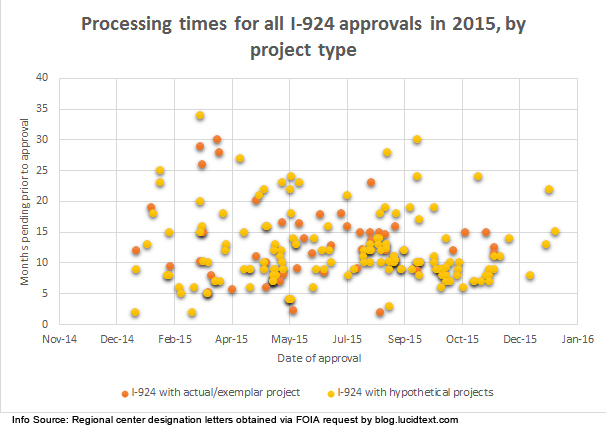
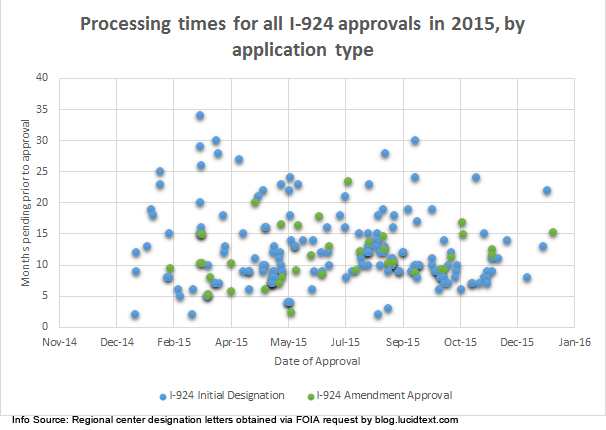
I try to improve the accuracy of my Regional Center List by requesting regional center designation letters from USCIS through the FOIA process. So far I have logged all initial designations and amendments through 2015. I’m sharing summaries of data points gleaned from the most recent letters in my collection (2015 approvals) to help shed light on processing issues.  As we prepare to respond to the ANPRM, let’s think about what’s wrong with the following pictures, and how to improve the situation.

Status of Amended Regulations

USCIS has published an Advance Notice of Proposed Rulemaking (ANPRM) in the Federal Register. This notice “EB-5 Immigrant Investor Regional Center Program” (Docket No. USCIS-2016-0008) does not unveil any revised regulations, but instead generously solicits stakeholder input to help formulate new rules for regional center designation, the exemplar filing process, continued RC participation, and RC termination. (Docket #0008 references a separate notice “EB-5 Immigrant Investor Program Modernization” Docket No. USCIS-2016-0006 that may cover the other EB-5 topics that we expected to see addressed. 1/12 UPDATE: here is Docket No. USCIS-2016-0006, which proposes new regulations for EB-5 investment amount increases, TEA requirements, priority dates, and other EB-5 matters.)

The bad news about notice #0008 is that it suggests USCIS is in a preliminary stage of thinking about new regional center designation rules, hasn’t actually drafted any regulations on this topic, and doesn’t expect to start for at least another 90 days. (Though hustle might be useless anyway, if Trump makes good on his election commitment to issue a temporary moratorium on most new regulations.) The good news is that notice #0008 demonstrates genuine concern to understand and work with regional center reality, presents thoughtful analysis of the issues, and poses excellent questions. Answers prepared for USCIS in response to the ANPRM should be organized and shared with Congressional staffers as well, since draft EB-5 reform legislation covers the same issues that USCIS aims to resolve, and would benefit from the same input.

Processing Times

Speaking of processing times, here is an email that I should have shared last week.

From: U.S. Citizenship and Immigration Services [mailto:uscis@public.govdelivery.com]
Sent: Thursday, January 05, 2017 11:32 AM
Subject: USCIS Now Uses Specific Dates to Show Case Processing Times

Dear Stakeholder,

Starting on Jan. 4, 2017, we will post processing times using a specific date format rather than weeks or months. This is the first step in providing processing times that are timelier and easier to understand.

We post case processing times on our website as a guide for when to inquire (service request) about a pending case. For the last several years, we have posted case processing times using two different formats:

  • For cases that were within our production goals, we listed processing times in weeks or months.
  • For cases that were outside of our production goals, we listed processing times with a specific date.

Always refer to your I-797C, Notice of Action, and look for “receipt date” to determine when we accepted your case. If the receipt date on the USCIS Processing Times web page is after the date we have listed on your notice, you should expect to hear from us within 30 days. If after those 30 days, you have not heard from us, you may make an inquiry on your case.

We recommend using our e-request tool for all case inquiries. In addition, we have many other services and tools at my.uscis.gov

If you move, remember to update your address for each pending case and receipt number at uscis.gov/addresschange.

Kind Regards,
USCIS Public Engagement Division

Note that this change is cosmetic: processing “as of month” and “as of date” are the same information, just in a different form. But the change is helpful to clarify that the report does not give average processing times, but rather a metric for judging when it’s okay to inquire about case status. FYI here is my spreadsheet of historical IPO processing times with columns translating month to date and vice versa. (But whether considering month or date, keep in mind individual deviations as illustrated above in my scatter plot charts of actual I-924 processing in 2015.)