Draft legislation, NYC lawsuit, SEC action, RC decision (Path America), RC list changes

New Policy (comments due)

Recall that Wednesday June 28 is the last day to submit comments responding to USCIS’s new policy language on redeployment I appreciate the AILA Comments on the Policy Manual, which explain where the policy goes wrong in imposing an “at risk” requirement after jobs have been created.

Analysis of Draft Legislation (IIUSA, NYU)

IIUSA issued a legislative update on June 22 that comments on draft bills from Senator Grassley/Leahy and Senator Cornyn. I appreciate IIUSA’s thoughtful analysis, and its difficult position when it comes to commenting on contentious issues. The Cornyn bill would make everyone in EB-5 happy by clarifying that investors only (not investors plus family members) should be counted toward the annual EB-5 visa quota. Its TEA proposals would create winners and confirm losers – the winners being projects in rural areas and on closed military bases (which would be incentivized with new visa set-asides) and the losers being projects in distressed high-unemployment urban areas (which would only get 13.5% discount from the standard investment amount). To be fair, the Cornyn proposal would make projects in distressed high-unemployment TEAs slightly more viable than they are currently, since 13.5% is better than 0% — the effective investment threshold differential if projects not in distressed areas can also get TEA designation. But overall the TEA proposal looks designed to support the status quo, with a large percentage of EB-5 investors going to projects in prosperous urban areas and closed military bases.

NYU Scholar-in-Residence Gary Friedland, Esq. and Professor Jeanne Calderon, Esq. have expanded their analysis of paths to TEA reform and other questions in the paper EB-5 Prescription for Reform: Legislation or Regulation? (Draft 6/19/17). The authors review perceived problems in the structure of TEA incentives, summarize proposed changes, and suggest that USCIS expedite reform by finalizing regulations, which could prompt the industry to unite in supporting comparatively moderate EB-5 legislation. The authors throw down a gauntlet by arguing that allocating 100% of job creation by an EB-5-funded project to EB-5 investors overstates the economic impact of EB-5 capital.  They clarify that they do not challenge USCIS’s job credit methodology, but only question citing USCIS job credit methodology as evidence of EB-5’s economic impact. This is a helpful distinction, but I don’t see reformers in Congress accepting it, or liking the idea that EB-5 investors might get credit in practice for job impacts not supported in theory. The industry needs to take up the gauntlet, and explain (preferably with reference to economic theory, practicality, and other programs that require job creation) why and how EB-5 job counts and allocations make sense.

NYC RC Investor Lawsuit

After receiving many error reports, USCIS pulled down their logs of EB-5 petition approvals and denials by regional center. I hope that the logs will be reposted soon with corrections, and in the meantime we can prepare to interpret the data. A natural conclusion could be: if X Regional Center has had many investor petitions approved, then it must be a reliable regional center with happy investors. Coincidentally, I heard in the same week that New York City Regional Center ranks #1 among regional centers for number of I-829 approvals and #5 for volume of I-526 approvals, and also that it is facing a lawsuit by over a hundred unhappy investors in the Battery Maritime Building project. Chen Dongwu et al. v. New York City Regional Center et al. claims that the investors’ “dream turned into a financial nightmare,” with fraudulent misrepresentations and subsequent coverups and fiduciary failures leading up to investors facing the loss of their entire investment.  Presumably the investors in this suit received I-526 approval, but USCIS adjudication is only part of EB-5 investment success.  I’ll look forward to seeing how New York City Regional Center responds to the allegations, which are a big story since this RC is such a big player in EB-5. At-risk investments inherently risk loss, and some will lose, and loss does not equal fraud. Risk does not equal license to shirk responsibility or deceive investors, however, and the defendants need to explain their side of the story. Future filings for the case can be accessed at the New York State Unified Court System website with Index Number 6520242017.

RC Termination Decision

The AAO decision Matter of P-A-K, LLC JUN092017_01K2610 denies motions to reconsider and reopen filed by Path America KingCo regional center.  This decision reiterates that termination decisions “take into account a variety of factors, both positive and negative, that encompass past, present, and likely future actions.” But having reviewed new evidence of the RC’s on-going projects, AAO apparently concludes — almost in so many words — that SEC action against a former principal for fraud and mismanagement is the kind of negative that cannot be outweighed by any number of positives in terms of current management and project progress and prospects. I trust that USCIS/AAO thinking will be challenged and will develop more nuance over time.

New SEC Action

Securities and Exchange Commission v. Seyed Taher Kameli, et al. is a new civil action involving a regional center. The Complaint filed June 22, 2017 alleges that Seyed Taher Kameli and his companies, Chicagoland Foreign Investment Group, LLC and American Enterprise Pioneers, Inc., falsely claimed to foreign investors that their investments would be used to fund an EB-5 qualifying project, but instead diverted millions of dollars to fund other projects, make unrelated payments, and for personal enrichment. As with other SEC actions on EB-5, conflicts of interest are the dominant red flag. The defendant Mr. Kameli controlled the regional center, investment funds, and job-creating enterprises, and also represented many investors as their immigration attorney. This kind of scenario should not be hard for future investors (or even legislators) to avoid.

RC List Changes

Additions to the USCIS Regional Center List, 6/6/2017 to 6/26/2017

  • Art District Los Angeles Regional Center, LLC (California) Note: This is not a new RC, but recently added back to the approved list after having been briefly listed as a termination

New Terminations

  • JI Northern Nevada Regional Center, LLC (Idaho, Nevada, Utah) Terminated 6/5/2017
  • Dream Harbor Regional Center (Washington) Terminated 6/1/2017
  • ON Regional Center, LLC (California) Terminated 6/16/2017
  • Northeast Monument Regional Center LLC (Massachusetts, New Hampshire, Rhode Island) Terminated 6/20/2017
  • Rock Hill Regional Center LLC (New York) Terminated 6/1/2017
  • Texas Mining & Resource Center, LLC (Texas) Terminated 6/20/2017
  • Adirondack Regional Center of New York, LLC (New York) Terminated 5/24/2017
  • Las Vegas EB-5 Inmigration, LLC (Nevada) Terminated 6/14/2017
  • CIG Regional Center, LLC (California) Terminated 6/5/2017

I continue to update my Terminations Log, though USCIS has not yet posted any new letters for terminations since 2016.
Tally of I-526 and I-829 approvals and denials by regional center (updated)

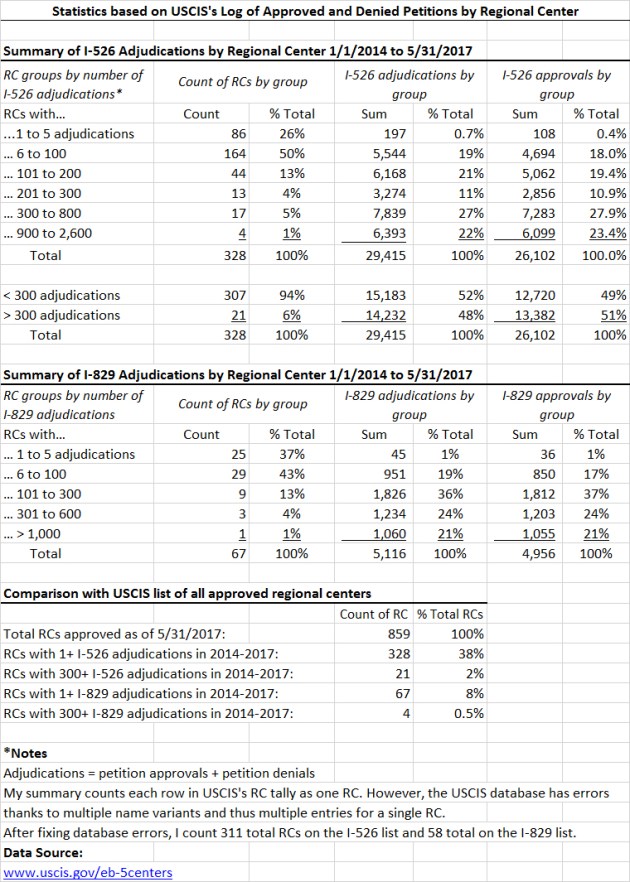
The USCIS Immigrant Investor Regional Centers page at www.uscis.gov/eb-5centers has been updated with links to documents that list regional center names and tally the  I-526 and I-829 approvals for each RC from January 1, 2014 to May 31, 2017.

UPDATE: The logs formerly posted by USCIS have been replaced by a brief message that “USCIS is reviewing inquiries regarding the previously posted Form I-526 and Form I-829 approval and denial statistics by regional center. To provide feedback on that data, please e-mail USCIS.ImmigrantInvestorProgram@uscis.dhs.gov.” Apparently, a lot of regional centers contacted them to complain of errors. IIUSA wrote a formal letter to IPO reporting discrepancies noted by many members.

[ORIGINAL POST]

These documents — if accurate — can be very valuable for potential investors, and for program integrity. Track record of approvals is a material factor in decision-making that, until now, has been unverifiable. Records can offer investors a way to double-check claims about past approvals for a regional center.

Potential investors should interpret the numbers judiciously. As USCIS notes in the documents: “petitions may be denied for various reasons, some of which may be based on investor specific issues and not related to any project issues.” A large number of denials may be related to investor problems or to sudden USCIS policy changes (or to document errors in these posted reports), not to any problems with the regional center. A large number of approvals says something about the size, aggressiveness, and age of a regional center, but does not necessarily promise quality or reliability or anything about the character of future projects or success of future petitions. Also, keep in mind that the numbers are only for petitions adjudicated, not petitions filed. Considering processing times, I-526 adjudications in 2014 to 2017 (the time period reported) largely reflect investments made in 2013 to 2015. Most investments made and petitions filed through RCs since late 2015 would not show up on this log of approvals and denials. And the log does not show any of the EB-5 petition approvals or denials prior to January 1, 2014.

Regional centers should double-check their records in these newly published logs, and follow the instructions in the docs to alert USCIS of errors. Whoever created this database of approvals and denials made a number of entry errors on RC names (resulting in some double or even triple listings from name variants), so the probability of numerical errors is also high. Especially if the published list shows denials that your RC doesn’t in fact have, hasten to report that and request correction!

The petition tally by regional center provides interesting data on regional center activity. We’ve known that a handful of regional centers have dominated the EB-5 field, and now that phenomenon can be quantified. Assuming that the numbers reported by USCIS are reliable, we can draw conclusions about the distribution of investors by regional center.

No wonder the interests of one metro area and a handful of regional center operators dominate EB-5 politics, when those interests claim such a large piece of the EB-5 pie. The USCIS database indicates that three regional center operators (US Immigration Fund, CMB, and Related) account for nearly a quarter of all I-526 petitions approved since 2014. New York City RC alone accounts for a fifth of all I-829 approvals during that time.  Over half of the approved I-526s petitions since 2014 went through just 21 regional centers, while nearly half of investors with I-829 approvals in that time went through just four regional centers. Meanwhile, over half the regional centers currently on the USCIS list of approved RCs did not have any approved investor petitions from 2014 to the present. (Though these RCs haven’t necessarily been inactive. Long processing times mean that approvals and denials through 2017 only reflect petitions filed/investments made through 2014/2015 — or earlier for I-829. An RC that doesn’t appear with many approvals or denials yet may have many petitions currently pending.)

New EB-5 Policy (Sustaining Investment, Redeployment, and Investors in a Terminated RC)–Updated

We’ve been waiting for years for USCIS to clarify its policy on sustaining investment, and when and how EB-5 capital may need to be redeployed if a project winds up before the investor reaches the I-829 stage. Today, we have this notification:

The USCIS Policy Manual has been updated to provide further guidance regarding the job creation and capital at risk requirements for Form I-526, Immigrant Petition by Alien Entrepreneur, and Form I-829, Petition by Entrepreneur to Remove Conditions on Permanent Resident Status. Volume 6 (Immigrants), Part G: Investors is effective on June 14, 2017. The Policy Alert is available here: Volume 6 (Immigrants), Part G: Investors (Final date for comments: June 28, 2017)

The Policy Alert from USCIS does not actually say what changed. I compared the the June 14, 2017 version of the Policy Manual with my hard copy of the previous November 2016 version, and highlighted the changes to the new file in red font. (Here is my folder with dated versions of 6 USCIS-PM G). The June 2017 changes — which are significant and touch on material change and termination issues as well as redeployment — are in Chapter 2(A)2, Chapter 4(C), Chapter 5(A)2, and Chapter 5(C).

UPDATES: I’ve copied the new Policy Manual language on redeployment into a separate document and added my attempt to analyze the language and understand the terms. Here is my work so far.

Here are reactions from others to the new policy:

The new policy is effective as of today, before anyone has had a chance to review or comment on it. Indeed, the policy is essentially retroactive since it defines new requirements for investment agreements that current investors may have signed years ago. But USCIS is offering an opportunity to comment, for what it’s worth at this point.

Please send all comments to publicengagementfeedback@uscis.dhs.gov and be sure to include the following to make your comments clear:

    • State the title of the relevant volume and section in the subject line of your message;
    • Refer to a specific portion of the document;
    • Explain the reason for any recommended change; and
    • Include data, information, or authority that supports the recommendation.

Opening & Closing Dates for Comments: June 14, 2017 – June 28, 2017

As background, here are some reactions to the draft policy memo from August 2015 on sustaining investment, and wish lists of features we wish had been included in the new policy.

Q2 2017 EB-5 Petition Processing Data, Audits, Leahy letter

Q2 2017 EB-5 Petition Processing Data

The USCIS Immigration and Citizenship Data page has been updated with data from FY2017 Q2 (January to March) for petitions including I-526 and I-829.


A few points to note:

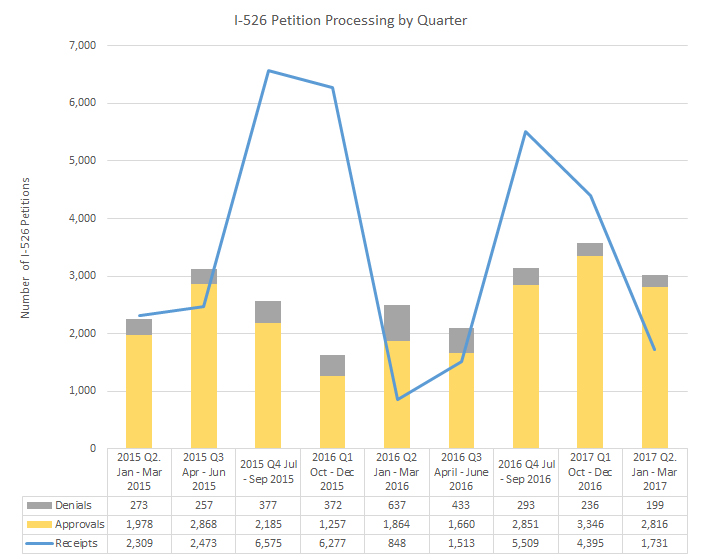
  • The fall in I-526 receipts was to be expected, since the previous quarters represented unnatural filing surges around sunset dates. Even 1,731 receipts in one quarter is not sustainable, however. So long as annual EB-5 visas are limited to about 10,000 for investors plus family members, only about 3,330 investors per year can get visas. The US actually benefited from 13,148 EB-5 investments over the past four quarters – but that’s almost four years of visa numbers for investors plus family.  Such a situation is not sustainable. If Congress wants to welcome more than 3,330 investments per year in the future, it needs to address visa availability.
  • USCIS processed 567 fewer I-526s this quarter than last quarter – not good news.
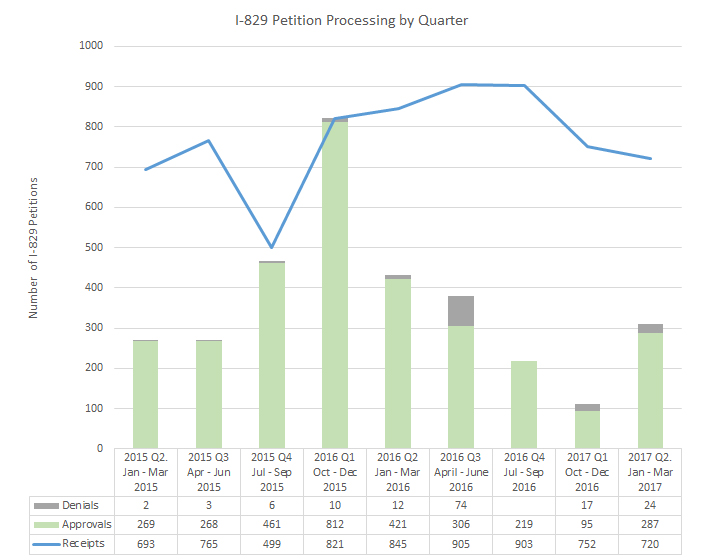
  • USCIS processed about 200 more I-829 petitions this quarter than last quarter – improvement, but not enough. If IPO continues processing about 300 I-829s per quarter, it will take over six years just to work through the existing backlog of I-829s. The California Service Center managed to process over 800 petitions in the final quarter that it handled I-829, and even IPO did better in early 2016 than it’s doing now. IPO announced their new I-829 adjudications unit in early March, so we may have to wait for Q3 stats to see real improvement.
  • The number of I-829 receipts has dropped the last two quarters. I wonder if this reflects petitioners giving up before reaching I-829, or being held up in the waiting line for conditional permanent residence.
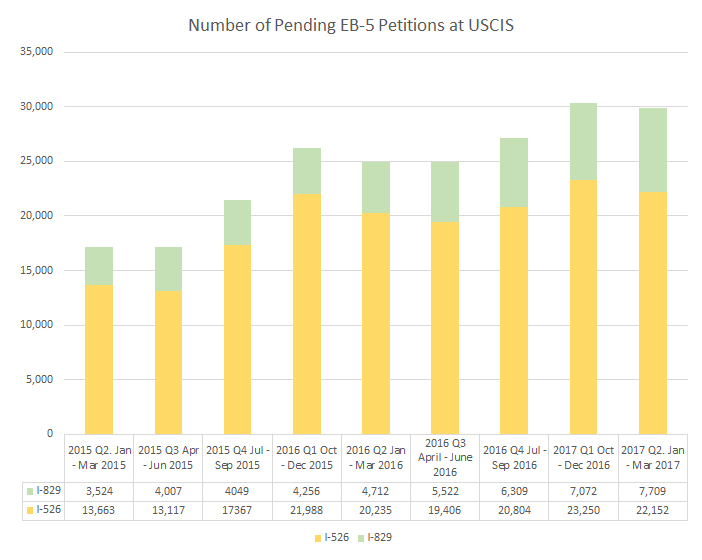
  • The backlog of pending petitions is a tiny bit less dire than last quarter.

While inputting receipt numbers from this processing data report, I thought to try linking them with the dates in the IPO processing time reports. For example, IPO seems to have been working forever on I-526 cases filed in September 2015, and we might explain this this by looking at the surge in I-526 receipts around September 2015. So I added a tab to my processing times log that tries to make the link. My calculations don’t look right, which may be additional evidence that IPO processing time reports do not simply reflect FIFO case processing.

Regional Center Audits

Notes from a May 12, 2017 meeting between AILA and the USCIS Field Operations Directorate has some Q&A on EB-5 questions (page 10-15), including:

  • EB-5 Regional Center Compliance Audit Program: USCIS answered practical questions about the process and content of an audit.
  • Investors in terminated RCs: USCIS said that “Until a regional center that has been issued a Notice of Termination exhausts its administrative remedies before USCIS, the agency will generally delay final adjudication  or revocation of I-526 petitions associated with that regional center if the sole factor determining petitioner eligibility is the termination of the regional center’s designation.” (This is a welcome statement considering past evidence to the contrary.)
  • Regional Center amendments: In another installment of confusing guidance, USCIS indicated that amendments are required for both geographic area expansion and changes to ownership/org structure/administration, but not “required” in the same sense. The geographic area amendment must be “filed and approved” before I-526s are filed, while “Regional center projects are not on hold while the amendment is pending” in the case of an ownership change amendment

Washington Developments

The Kushner Companies EB-5 roadshow in China continues to reverberate, this time in a letter from Senator Leahy, Representative Conyers, and Representative Lofgren on behalf of the Senate and House Judiciary Committees to the Kushner Companies. The letter focuses on potential conflict-of-interest issues, and airs concerns about EB-5 generally. I’m most interested in this letter for the footnotes, and disturbed by the picture it paints of one-sided and minority-focused EB-5 lobbying. This meeting, for example, gives an unfortunate impression.