RC Authorization to 9/30/2018, Processing Times, New RCs

Regional Center Program Authorization
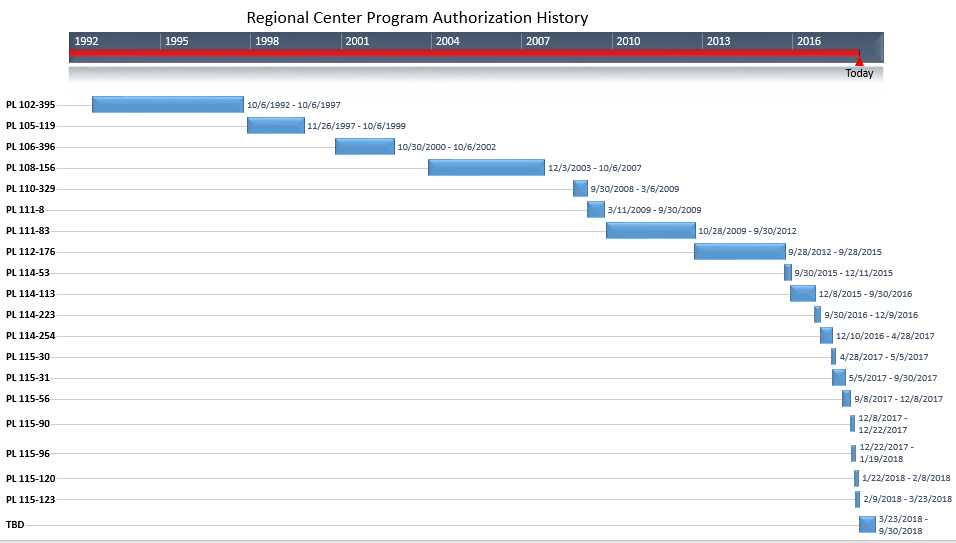
The last time Congress voted a significant regional center program extension was 2012. Since then, the program has been extended a few months at a time, in connection with government funding. This is now happening again with H.R.1625, the vehicle for the Consolidated Appropriations Act 2018, which was signed by the President today.  The text includes regional center program authorization to 9/30/2018 on PDF page 1759, as follows:

SEC. 204. Section 610(b) of the Departments of Commerce, Justice, and State, the Judiciary, and Related Agencies Appropriations Act, 1993 (8 U.S.C. 1153 note) shall be applied by substituting “September 30, 2018” for “September 30, 2015”

This language refers back to Departments of Commerce, Justice, and State, the Judiciary, and Related Agencies Appropriations Act, 1993 (Public Law 102-395) Section 610 (PDF page 47), which established the regional center program. The 2018 Appropriations Act does not include the EB-5 Reform Act, or other EB-5 changes. It just extends the borrowed time until we get a good piece of EB-5 legislation.

Processing Times

USCIS has attempted to clarify reporting for processing times, and succeeded in confusing me, at least, even more than before. Unfortunately I missed a webinar on this topic yesterday because even the emails were confusing, but here’s what I think I understand, having read the new pages at egov.uscis.gov/processing-times/ and egov.uscis.gov/processing-times/more-info, and used my spreadsheet to fiddle with the EB-5 form numbers in comparison with numbers in the old-style report.

USCIS has changed its method for calculating processing times for four forms: N-400, I-90, I-485, and I-751. The underlying method for calculating (and underlying reality behind) times for I-526, I-829, and I-924 has not changed. What’s different for the EB-5 forms is that USCIS now reports three pieces of information: a high and low month in an “estimated time range” and a “case inquiry date.” The low month in the time range corresponds to the date USCIS previously reported for “processing cases as of…” in the old-style report, while the high month multiplies that duration by 1.3, and the case inquiry date more-or-less corresponds to the high month. Apparently IPO doesn’t want people complaining that they’re outside of normal processing times until their cases are taking 130% longer than average. If you took part in the webinar and have additional insights or corrections, please share.

See also the OIG Report: USCIS Has Unclear Website Information and Unrealistic Time Goals for Adjudicating Green Card Applications

Visa Availability

The Visa Bulletin for April 2018 confirms that Vietnam is definitely up next month for a cut-off date based on oversubscription. With visa availability being the major political and practical factor for EB-5 today, I’ll be writing more about this soon.

Regional Center List Updates

Additions to the USCIS Regional Center List, 03/09/2018 to 03/19/2018:

  • 888 American Dream Projects Regional Center (California, Nevada)
  • American National Regional Center d.b.a. EB5 Financial Regional Center (California): www.anrcs.com
  • Dayton Regional Center, LLC (Ohio)
  • Delvelyn Regional Center, LLC (California)
  • Hudson Funds New York Regional Center, LLC (New Jersey, New York, Pennsylvania): hudson-funds.com
  • MGV NYC Regional Center LLC (New Jersey, New York, Pennsylvania)
  • Monterey Massachusetts Regional Center, LLC (Massachusetts)
  • Monterey Northern California Regional Center, LLC (California)
  • Monterey Southern California Regional Center, LLC (California)
  • New York/New Jersey Real Estate and Infrastructure Regional Center LLC (Connecticut, New Jersey, New York)
  • PacNW Regional Center, LLC (Oregon, Washington)
  • Propet American Dream, LLC (Washington): www.propetamericandream.com
  • RSR EB-5 Regional Center, LLC (North Carolina, South Carolina)
  • Smith Mountain Regional Center, LLC (Colorado, Oklahoma, Texas)
  • U.S. Green Capital Regional Center, LLC D/B/A Playa Vista Regional Center (California): pvcapitalmanagement.com
  • Washington American Investments, LLC (District of Columbia, Maryland, Pennsylvania, Virginia)

New Terminations:

  • Chen Roberts Regional Center (Oklahoma)
  • Regency Regional Center LLC (California)

EB-5 Reform: Missed Opportunity

It’s easy to blame big-moneyed New York City real estate interests, as Senator Grassley likes to call them. I had assumed their lobbying was to blame for the draft EB-5 Reform Act, which seemed designed to protect investment in prosperous areas and privilege well-heeled regional centers. But now Senator Grassley blames them for blocking the bill. He says “For the last year, my staff, along with Chairman Goodlatte, Senator Cornyn, and Senator Flake’s teams, has worked around the clock to produce an EB-5 reform package… But, these reforms weren’t acceptable to the big moneyed New York industry stakeholders who currently dominate the program. And because big money interests aren’t happy with these reforms, we’ve been told they won’t become law.” Could this really be what doomed the bill? The EB-5 Reform Act didn’t look like reform to many stakeholders, but apparently Senator Grassley and NYC both believed in its potency, enough to support it and block it respectively. I’ll respond more later to Senator Grassley’s speech, which shows his good faith and fundamental misunderstanding of several aspects of EB-5. Pro tip: don’t have your staffers work around the clock on legislation for a year before calling in organizations like IIUSA to give input and education to help keep the content on track with your laudable objectives. A broad base of people in EB-5 agree with you in wanting legislation that helps support the program’s good purpose with respect to investment in underserved areas and job creation. Include them in the process. (The benefits of such inclusion are already evident in the Revised EB-5 Reform Act of 2018 posted by IIUSA.) As Klasko Law puts it in their client alert: “The EB-5 industry was largely shut out of the process or brought in too late to be able to provide meaningful guidance and input. So it should come as no surprise that the proposed bill died the same way it began: in a secret, back-room agreement without the participation or input of the vast majority of the EB-5 industry.”

Excerpt from the IUSA Statement on Missed Opportunity for Long-Term EB-5 Authorization:

…In early March, IIUSA was pleased to join a group of industry organizations to review and discuss a bicameral compromise draft proposed by Senate and House Judiciary Committee Chairmen and key members of House and Senate leadership. After additional revisions were made to the compromise draft, IIUSA’s Board of Directors voted overwhelmingly to support the bicameral compromise that would have offered a six-year reauthorization and much-needed reforms.

Unfortunately, the compromise reform and reauthorization legislation failed to garner the support of all industry organizations and failed to be included in the omnibus appropriations legislation. We are extremely disappointed in this missed opportunity but are most appreciative of the House and Senate Judiciary Committee leaders and members of Leadership who worked tirelessly to delicately craft the compromise package. The omnibus legislation, however, does include an extension of the current EB5 Regional Center Program through September 30, 2018. We plan to continue to work diligently with Congress and our membership to build on the compromise draft legislation.

Other reactions:

EB-5 Reform Act: the Good

This post summarizes points in favor of the proposed EB-5 Reform Act. Its details and compromises won’t please everyone, as discussed in my previous post, but it is a piece of EB-5 legislation currently without a better alternative.  Here are some reasons for stakeholders be happy if it gets included in the spending bill due by March 23.

  • People who already invested and waiting for a green card: Although they would bear downside of this bill’s most painful compromise – visa set-asides – they will suffer more if the regional center program loses authorization. At least under current policy, the process will simply be over for RC investors awaiting conditional permanent residence if the RC program is deauthorized long-term. The RC program will sunset on March 23 unless something is done, and this EB-5 Reform Act appears to be the only thing that can be done. I’d love to see another short-term extension to give time for Congress to draft more fully-baked and inclusive legislation, but after three years of short-term extensions that’s a lot to hope for. (Update: another short-term extension has now emerged as a possibility.)
  • All EB-5 investors: The bill gives desperately-needed protections and options for investors in case of change with projects and regional centers, and improves and compresses the process for removing conditions.
  • Future investors: The new investment amounts are high, but much lower than they could’ve been, or will be if the regulations are finalized instead. Visa set-asides offer hope (if no more) to potential investors from backlogged countries. Future investors will benefit from new process improvements, investor protections, and integrity measures.
  • Regional Centers: A more difficult and expensive life under the EB-5 Reform Act is better than death from loss of RC program authorization. The five-year program extension will provide much-needed stability. The moratorium and transition period will be rocky at first, but should result in a more-clearly-defined program eventually. The visa set-asides will help with marketing, at least for awhile, and the new incentive categories broaden the kinds of projects that may be viable to market. The new investment amounts are not so high as to kill demand entirely, unlike in the regulations. And the bill opens up a new category of potential demand: investors who already filed with someone else but now want to switch projects and/or regional centers — something not previously allowed.
  • People who want program integrity: This bill proposes integrity measures that mostly appear possible to implement (unlike previous drafts that would have made good-faith compliance near-impossible in practice, and thus not been effective in weeding out bad players either). And it offers funding, personnel, and official authorization for effective compliance initiatives already started by USCIS.
  • People who want to tighten TEA incentives: This bill puts responsibility for incentive-area designation with USCIS, which will be more narrow, rigorous, and consistent than states. It’s naturally difficult to incentivize investment in significantly distressed and remote areas, and such areas would be at least as competitive under the EB-5 Reform Act as they are now.
  • Investor Program Office: Although this bill gives them more work, it also exempts most some of their decisions from judicial review. (I oversimplified — see MF’s comment.)

It’s too late for major changes and amendments if the EB-5 Reform Act is to get into the omnibus at all, but if I could propose one amendment it would be this: a period of at least weeks before the provisions take effect and the filing moratorium begins. Most stakeholders haven’t even seen the bill text yet, and it will be very hard to comply instantly if it goes into effect instantly.

Other commentary on this bill:

EB-5 No-Reform Act, RC List Changes

On Friday, IIUSA reported that “Yesterday IIUSA met with Republican negotiators and received draft legislative text that is being proposed for inclusion on the March 23rd Congressional omnibus package… We expect the House to vote the omnibus out of the chamber as early as March 16, allowing the Senate the entire week of March 19 to pass the measure before government funding expires on Friday, March 23…. the current debate over what policy provisions to include in the FY18 omnibus spending package provides one of the few, if not the only, opportunity to secure a long-term EB-5 reauthorization.”

With three years to work on drafting EB-5 legislation, why did Congressional negotiators keep this most recent EB-5 bill hidden until the very last minute, and provide even IIUSA only a few hours to read it and respond? Possibly because this “Immigrant Investor Visa and Regional Center Program Comprehensive Reform Act” is a tissue of minority hand-outs, declawed reforms, poison pills, and half-baked good ideas. We’re to conclude “This is our last chance to get significant regional center program authorization, and it’s too late to make changes now, so we have to support this, no matter the details.”  I understand, but oh those details. I am ashamed of this bill, and on behalf of the people behind it. How did years of negotiation produce this document? The media, pro-reform lawmakers, and the good proportion of EB-5 stakeholders left out of compromises will not be kind to those who drafted this bill, if it passes as-is.

The EB-5 Reform Act has a few generally-favorable provisions:

  • It would reauthorize the regional center program to 2023
  • It would add some flexibility for material change, and some protection for investors in projects that don’t work out
  • It would make some process improvements

The EB-5 Reform Act is lobbying money well-spent for a few:

    • The TEA reform in this bill is calculated to avoid unduly incentivizing investment in distressed areas. In three years of EB-5 legislative proposals, each version has had a softer TEA proposal than the last. This one reduces the monetary incentive to a hair, compensates with incentives that will either be impotent/unrealizable in practice (visa set-asides, premium processing) or positively counterproductive (lower jobs requirement for needy areas?), broadens the definitions of what qualifies as an urban distressed or rural area (e.g. switching from the NMTC “severe distress” criteria in previous proposals to just the NMTC low-income criteria, and no specified limit on gerrymandering), and adds new incentivized areas for a special few (closed military bases, U.S. territories, infrastructure, franchise investment funds). Congress was originally energized for EB-5 reform because they didn’t like seeing most EB-5 dollars flowing to already well-capitalized projects in already well-capitalized areas. That status quo has little to fear from this legislation. Luxury real estate will keep its top spot if this passes, and we’ll still have Chuck Grassley and the media shaking their fists.
    • The bill offers real estate projects an extra gift for good measure: construction jobs can be aggregated and counted as qualifying direct permanent jobs regardless of duration.
    • The integrity provisions in this bill are calculated to avoid making life difficult. Gone are the suggestions in past bills about involving third parties in oversight or reporting or requiring account transparency or fund administration. Here, integrity measures focus on internal certifications of compliance to the best of the certifier’s knowledge. That’s good for honest players who can do without burdensome and intrusive regulation, but also little limit on bad players happy to self-report compliance. Such teeth as the bill has — site visits, audits, background checks, termination threat — are largely things IPO is doing already, though I’m sure they’d appreciate the official authorization and extra funding. But generally, I’m not sure this bill will satisfy lawmakers who wanted EB-5 reform to combat fraud.
    • The bill retains integrity measures that conveniently double as anti-competitive measures. The bill keeps a previously proposed annual regional center fee – lowering the amount for the largest regional centers and keeping it high for the smallest. It is more severe than previous proposals on involvement by anyone with foreign government connection at any level, even in providing non-EB-5 capital to a job-creating entity.
    • UPDATE: Re-reading more carefully, I see that I’m wrong about this one. The bill says that for four months after enactment, no one can file I-526 except for new investors in in-progress raises with an approved examplar. The bill even attempts to set aside 7,000 visas for these privileged investors, forgetting that the numerical limit for 2018 visas was already exceeded back in 2014.

Here’s who will be most upset, if the EB-5 Reform Act passes:

  • The approximately 92,000 people in line for an EB-5 visa. These people are already in for a long wait with an annual quota of about 10,000 visas, and the EB-5 reform act has set-asides that would reduce generally-available visa numbers to about 6,900 per year. The situation will be especially bad for people from China, Vietnam, and possibly India. Those people already in line didn’t plan to wait 17 years or so for conditional green cards — and neither did the projects accepting their investment. The bill does not include on-purpose retroactivity (it doesn’t make TEA, investment amount, or job creation changes apply to people who already filed I-526), but past investors will be severely affected by the visa set-asides, and potentially by new restrictions that affect regional centers and investment projects.
  • Those hoping to raise EB-5 funds to benefit projects in rural or distressed urban areas. The new incentives are not better designed to benefit them than the current incentive structure. The new regional center fees and requirements are well-designed to put anyone out of business who isn’t raising funds from hundreds of investors for prosperous urban projects.
  • Entrepreneurs planning to file EB-5 petitions in the near future for their own enterprises, and any regional centers planning to raise funds for a project without a pre-approved exemplar. The bill has a 120-day moratorium on filing new I-526 and I-924, followed by a transition period from day 121 to day 365 that limits the petitions that can be processed.
  • The Investor Program Office. This legislation will be tough to interpret and implement. USCIS will have to figure out provisions that the bill hardly explains: the franchise investment fund idea, the provision that I-829 petitions based on investment in unrealized/failed projects are to remain valid, the new amendment and re-petition processes, the provisions that imply retroactive new requirements for past projects, and the effects on direct EB-5. The bill stipulates a 120-day transition period, during which USCIS can come up with new regulations and policy, new forms and supporting processes, a new TEA designation process, and a new premium processing option. Hahahahaha. 120 months would be more plausible, considering past experience.
  • Regional centers with fewer than 20 investors annually. They’ll face a $10,000 annual fee and a list of new compliance certifications that will be hard work if taken seriously.
  • EB-5 projects with any foreign-government-entity-related funds in the capital stack, or personnel at any level.

End of rant. If I wake up tomorrow to find that this has been attached to the House version of the new omnibus spending bill, then I shall transition to learning to live with it. And polish my resume, perhaps.

In the meantime, USCIS approved a bunch of new regional centers. Probably most of these applicants filed I-924 back in 2015, little thinking what they’d be up against today!

Additions to the USCIS Regional Center List, 02/02/2018 to 03/05/2018.

47 regional centers have been added.

  • AHRC GA, LLC (Georgia)
  • All American Investment Holdings, LLC (California)
  • Ameri-Link Northeast Regional Center, LLC (California, New Jersey, New York)
  • American Citizen Regional Center – Southern California LLC (California)
  • American Equity Fund California, LLC (California)
  • American Equity Fund, LLC (Connecticut, New Jersey, New York, Pennsylvania)
  • Avista Regional Center, LLC (Florida, Georgia)
  • BC Southeast Regional Center, LLC (Florida)
  • BC West Coast Regional Center, LLC (California)
  • Bay Area Community Regional Center, LLC (California)
  • CMB Hawaii Regional Center, LLC (Hawaii): www.cmbeb5visa.com
  • Carolina EB-5 Regional Center, LLC (North Carolina)
  • Chicago Golden Pacific, LLC (Illinois): www.usgoldenpacific.com
  • EB-5 Inc Regional Center, LLC (Florida)
  • EB5 Texas Investment Group LLC (Texas)
  • East Coast Prime Regional Center, LLC (Connecticut, New Jersey, New York, Pennsylvania)
  • Education Fund SC Regional Center, LLC (Louisiana, New Mexico, Texas): edufundamerica.com
  • Gateway America Regional Center (New York, Ohio, Pennsylvania)
  • Green Mountains Regional Center, LLC (New Hampshire, Vermont)
  • Happy Family USA Regional Center (California, Nevada): www.hfeb5.net
  • Hawaii Investor Regional Center Corp. (Hawaii)
  • LJHB Perpetual, LLC (District of Columbia, Maryland, Virginia, West Virginia)
  • Landmark Regional Center, LLC (Connecticut, New Jersey, New York)
  • Manhattan CBD Development Regional Center, LLC (New York)
  • Mid-America Renaissance Regional Center, LLC (Kansas, Missouri)
  • NYC Liberty Green Regional Center, LLC (Connecticut, New Jersey, New York, Pennsylvania)
  • New York City EB-5, LLC (New Jersey, New York, Pennsylvania): www.americaneconomicgrowthfund.com/nyceb5
  • New York City Transportation Regional Center LLC (Connecticut, New Jersey, New York)
  • OMS Group, LLC (North Carolina, South Carolina)
  • Omaha Old Market Regional Center LLC (Iowa, Nebraska)
  • Pacific West Economic and Development Center LLLP (California, Nevada)
  • Phoenix & Dragon LLC (Connecticut, Massachusetts, New Hampshire, Rhode Island)
  • Phoenix Pacific LLC (Washington)
  • Prime Capital, LLC (California)
  • RW EB-5 Regional Center, LLC (Nevada)
  • Real Estate Development Center of America LLC (Florida, Georgia, South Carolina, Tennessee): redcoaregionalcenter.com
  • Redwood Regional Center, LLC (Oregon, Washington)
  • Roundhay Partners Regional Center, LLC (California)
  • Serendipity Regional Center, LLC (California)
  • Smith Delta Regional Center, LLC (Alabama, Arkansas, Louisiana, Mississippi, Tennessee)
  • SoCal Global Regional Center, LLC (California)
  • South Florida Real Estate and Infrastructure Regional Center LLC (Florida)
  • SunCapital Texas Regional Center (Texas)
  • The Harbor Bank Community Development Capital RC (District of Columbia, Maryland, Pennsylvania, Virginia, West Virginia)
  • WRCI California Regional Center, Inc. (California, Nevada)
  • Zephyrus Regional Center LLC (Arizona, California, Nevada, Oregon, Washington)

Renamed:

  • EB5 Affiliate Network State of Texas Regional Center, LLC (Texas) into EB5 Affiliate Network States of Texas and Louisiana Regional Center, LLC (Louisiana, Texas

Finally restored to the approved list, after AAO sustained its termination appeal:

  • Path America Sonoco, LLC (Washington)

New Terminations:

  • Omega Puerto Rico Regional Center, LLC (Puerto Rico)
  • Southwest Kansas Regional Center (Kansas)
  • EB5 Memphis Regional Center, LLC (Tennessee)
  • New Orleans’ Mayor’s Office RC (Louisiana)
  • Diversified Global Investment, LLC (Georgia)


No-change February

My Washington Updates page started the month of February full of anticipation.

I thought we’d see final action for EB-5 regulations, because the Fall 2017 Unified Agenda said we would (having advanced the anticipated action date from April to February), Congressmen who might’ve been behind alternative legislative action (Grassley, Goodlatte) instead sent a letter in April 2017 urging DHS to finalize the regulations, USCIS Director Cissna committed in his confirmation hearings in May 2017 to finalize the regulations, and the few White House statements on EB-5 sounded warm to the proposed changes. So I was willing to bet that the February Final Action date would be met. But nothing happened in February, and now I wonder whether we’ll ever see action on these regulations. I’ll keep my eye out for an update in the Spring 2018 Unified Agenda just in case, but now that the initial impetus for action was quelled, I don’t know what’s left to counteract the overwhelming power of administrative inertia. The person responsible for drafting the regulations has left IPO (and Lori Mackenzie’s Policy Chief position was still vacant as of November 2017), the EB-5 industry has many problems with the regs as proposed, DHS would surely prefer to avoid policy-revising headaches associated implementing new regs, Chairmen Grassley and Goodlatte have bigger fish to fry, and who has incentive and energy left to push EB-5 program modernization? The proposed regulations could’ve had a devastating effect on my client base, particularly for direct EB-5, so I’m selfishly glad they weren’t finalized. But the process is still frustrating.

I also started February with hope that Congress might manage immigration legislation, and that EB-5 could benefit from the expressed intent to redistribute some visa numbers in a way that privileges immigration by economically-successful people. But now here we are in March with no immigration legislation and no indication that there will ever be any. The last word I heard is that Congress may handle DACA – the primary impetus for new legislation — with its favorite cop-out: a short term extension attached to the next omnibus funding bill. Negotiations over immigration legislation apparently failed because Democrats really wanted DACA while Republicans didn’t want a border wall or to redefine the nuclear family as much as they wanted Democrats to fail with DACA. Now I see no prospect on the horizon for the two things EB-5 needs from legislation: more visa numbers to relieve the backlog and keep up with on-going demand, and a long-term extension of the regional center program. Would public relations allow Congress to achieve a long-term extension to the little-considered EB-5 regional center program benefiting wealthy foreigners if they simultaneously manage only a short-term extension for the high-profile DACA program benefiting US-raised kids? With DACA and border security having failed to sustain bipartisan immigration negotiations, what remains to bring people back to the table for a successful negotiation involving visa numbers? How likely is it that Grassley & co. will stop demanding genuine TEA reform as a condition for stabilizing the RC program, or that industry lobbyists will suddenly agree to make painful-to-their-backers TEA concessions? Who is there even to seriously advocate for the overall health and long-term stability of the EB-5 program, when most major users just need it a few more months unchanged to finish their own capital raises?

I’m just sitting in my armchair in Utah reading the news, not on the ground in Washington D.C., but at any rate it’s tough to theorize change at this point. Here’s what I currently expect for 2018/2019: several more last-minute months-long content-free extensions to the regional center program, no visa backlog relief, and no change to the EB-5 investment amount or TEA definitions or other targets for EB-5 reform. But I’ll keep updating my Washington Updates page as I hear anything, and maybe I’ll be surprised by action.