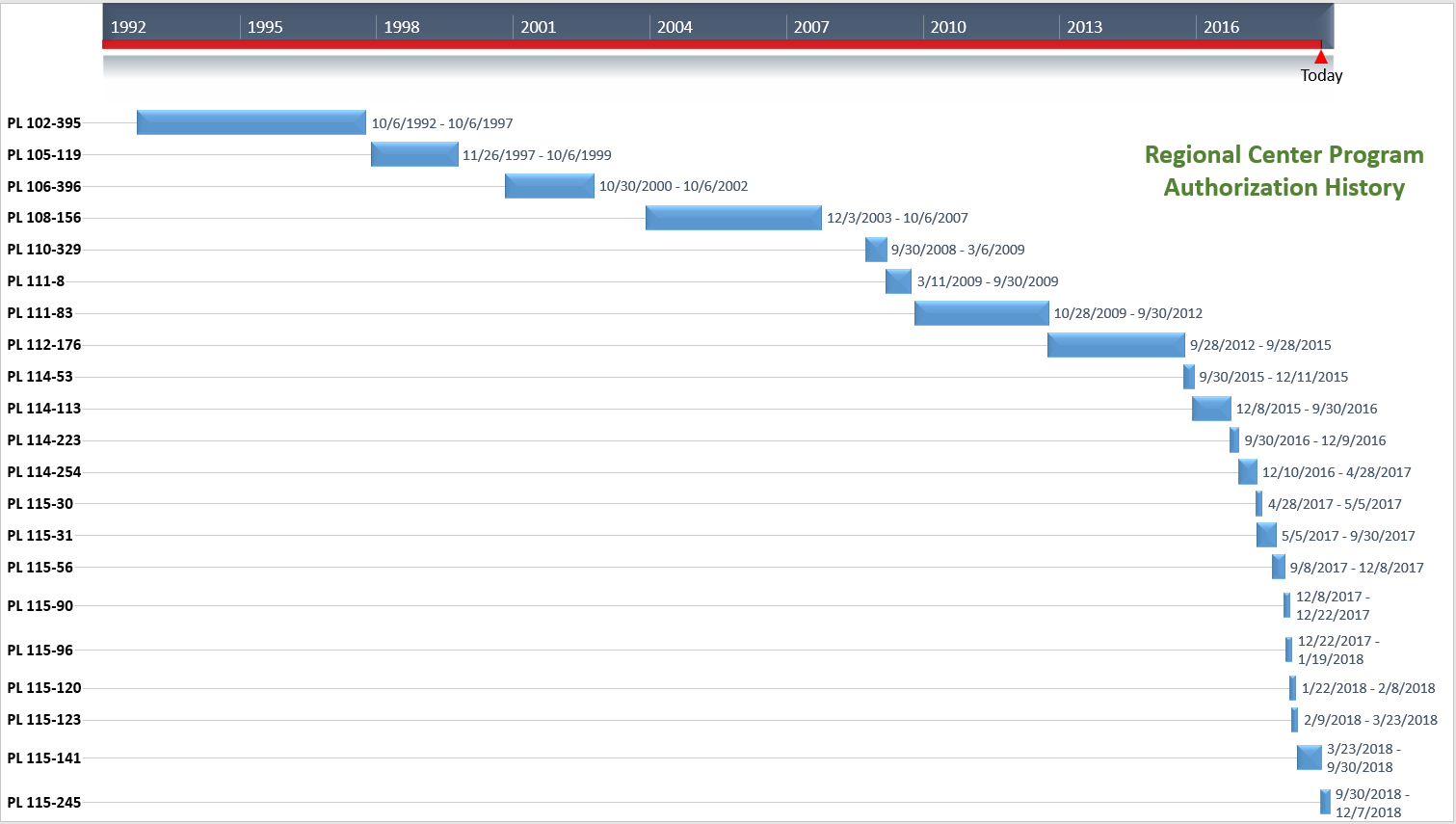
RC program authorization (12/7/2018)

FY2018 is ending with a Continuing Resolution that defers the deadline for unmade decisions about government funding and programs, including the regional center program, to December 7, 2018. (The relevant language from H.R. 6157 is on my Washington Updates page.) The history of regional center program authorization since 1992 now looks like this.

The Continuing Resolution means that the regional center program remains authorized as-is until December 7, 2018, or until the enactment of a new law that reauthorizes or excludes the regional center program going forward. We can’t expect more legislation until mid November at earliest, however, since the House has gone on recess as of September 28 and will not reconvene until November 13.

Meanwhile, EB-5 regulations have still not proceeded to the OMB review stage.

I speculate that Washington will persevere in ignoring and avoiding EB-5 because immigrant investment presents an inconvenient reminder that immigrants can bring a wealth of resources – even hard-to-deny resources such as dollars, economic growth, and job creation. There’s a will to brand immigrants as dangerous takers, and EB-5 investors contradict that image. Unfortunately, the EB-5 program still suffers – ignored by the right, and castigated by the left for being ignored even as new policies particularly harass materially-poor immigrants. Recent op-eds are unfortunately wrong in claiming that the Trump administration has made more EB-5 visas available. (In fact there’s been increased demand but no visa supply increase, resulting in backlogs that make EB-5 a slow track.) It’s hard to imagine any EB-5 relief in current political conditions. Perhaps the strategy pioneered at our southern border can be applied to EB-5, only instead of keeping children while deporting the parents, we keep the billions of dollars in EB-5 investment while fostering indefinite delays to issuing visas to the investors.  Or maybe, we’ll wake up one day and remember who we are and why it’s a good idea to open the door to the many forms of wealth represented by immigrants.  In the meantime, IIUSA at least has not given up and has filed an Amicus Brief in Support of Visa Backlog Litigation.

(For those interested in the new policies related to inadmissibility, see the June 2018 Policy Memo on inadmissible and deportable aliens, an ANPRM on proposed changes to the public charge ground of inadmissibility, and notes from a 9/27 stakeholder meeting on the June policy memo. The EB5 Insights blog discusses implications for EB-5 investors, and Wolfsdorf critiques the policy.)

Preparing to file I-924A Annual Certification

It appears that a Continuing Resolution will extend regional center program authorization at least into December 2018. (I add detail and updates as available to my Washington Updates page.) Assuming business as usual, regional centers should think about preparing to file the Form I-924A annual report. Regional centers use Form I-924A to demonstrate continued eligibility for regional center designation. Regional centers that remain designated for participation in the program as of September 30 of a given year must submit Form I-924A with the required supporting documentation on or before December 29 of that same year.

FILING INSTRUCTIONS

Here are links to official information, instructions, and tips from USCIS:

CHOOSING TO TERMINATE

If a regional center does not file I-924A, or files I-924A that does not demonstrate eligibility for continued designation, then USCIS will respond with a Notice of Intent to Terminate, and eventually terminate the designation. The regulations at 8 CFR 204.6(m)(6)(vi) also offer a relatively tidy alternative for regional centers who do not wish to stay designated: “A regional center may elect to withdraw from the program and request a termination of the regional center designation. The regional center must notify USCIS of such election in the form of a letter or as otherwise requested by USCIS. USCIS will notify the regional center of its decision regarding the withdrawal request in writing.”

The active method (formal withdrawal request) and passive method (just don’t file I-924A) have the same outcome: termination of regional center designation. The active method has the advantage, for what it’s worth, of getting a relatively nice letter back from USCIS. (Representative letters for comparison:  termination based on withdrawal, and termination for failure to file I-924A.)  The word “fail” appears eight times in the no-I-924A termination letter, and not at all in the withdrawal termination letter. Only the withdrawal termination letter template points out that “the withdrawal and termination do not preclude the filing of a new regional center application” and  “the facts and circumstances of the prior designation, withdrawal, and termination may still be considered in the adjudication of future regional center applications.”

PRACTICAL ADVICE

The instructions and tips from USCIS (linked in the first section above) are quite practical and detailed, so do read those carefully. The following section has a few additional lessons derived from my reading of the 207 regional center termination letters posted so far by USCIS. (I also maintain and share an ongoing log of all terminations and associated letters – another bit of generous work for which I am not much thanked.)

Avoidable reasons that regional centers have been terminated despite filing I-924A

  • The I-924A was filed using the wrong edition of the form, to the wrong address, or missing the proper fee
  • The I-924A got lost, and the RC could not show proof of mailing to prove that this loss wasn’t its fault
  • The I-924A was not properly filed until after December 29

I-924A issues for active Regional Centers

  • If the regional center has experienced any changes for which an amendment is required (such as changes in name, ownership, or structure), file the I-924 amendment before filing I-924A.
  • Strive for clear consistency between the info provided in I-924A and the info reflected in the record of past filings, including past I-924A, I-924, and investor petitions. (I’ve seen multiple decisions that indicate that USCIS is cross-referencing I-924A with other filings, suspiciously watchful for any apparent inconsistencies. Of course projects and numbers change over time, but USCIS tends to see changes as aberrations and discrepancies that need explanation.)
  • Double-check that the regional center entity is still active in good standing, and with an active business license. Remind USCIS with which Secretary of State and municipality the regional center is registered, so USCIS doesn’t check in the wrong place.
  • Double-check the Regional Center website for any problematic material (such as images of the USCIS logo, any language that smells like a visa guarantee, or any apparent inconsistencies with the regional center information – e.g. name, ownership, managers – officially reported to USCIS)
  • Google the regional center name and project names, see if any negative media stories appear, and consider preemptively explaining those stories as part of the I-924A

I-924A issues for Regional Centers with no EB-5 investment yet

  • A regional center on its third year since initial designation with no EB-5 investment is in line for termination for failure to promote economic growth, unless it makes a compelling counterargument. (That three-year metric is not published anywhere, but evident in termination letters. USCIS takes 2-3 years just to adjudicate the application for initial designation – enough time in limbo for the RC to lose its originally-contemplated projects and partners – and then gives the RC only 2-3 years to start again from scratch before termination. Quite unreasonable, but the current practice.)
  • A compelling counter-argument requires project evidence. In termination letters, USCIS does not admit to being impressed by evidence of marketing and promotional activities for the regional center, by due diligence on potential projects, or by general industry involvement. USCIS most wants to see evidence of projects imminently likely to use EB-5 investment. They seem to want to see project evidence related to timing (such as registrations, licenses, permits) and evidence related to firm commitment to do the project and include the regional center and EB-5 investment (such as signed term sheets, signed purchase agreements, loan commitments). The goal is to avoid USCIS deciding that “the evidence submitted relate only to potential projects and future aspiration goals” and “thus these projects are not relevant examples of the regional center’s ability to continue to promote economic growth” (to quote language repeated in multiple termination letters).  USCIS seems particularly fixated on the idea of “binding contractual obligation” and to particularly like finalized contracts and signed term sheets as evidence. (Again this advanced-project evidence demand is hardly reasonable – calling for status and commitments not consistent with the fact that USCIS will likely delay projects with years-long I-526 processing times. But the injustice has yet to be recognized.) There’s some evidence that having filed an amendment (especially one with I-526 exemplar request) can help support the activity argument, in lieu of being able to report filed investor petitions.
  • These regional center termination letters discuss specific examples of project evidence provided to USCIS with Form I-924A, and why USCIS did not think the evidence of activity made for a compelling economic growth argument.

FORM I-924A REVISIONS

If you’d like to advise USCIS about how to make the next edition of Form I-924A less faulty, you have until 11/13/2018 to do so through the Federal Register rulemaking comment process.

PLUG

Benefit from this blog? Please consider supporting the considerable effort behind it. Contributions through this PayPal link go to Lucid Professional Writing (a for-profit business), and help support EB-5 research and reporting into the future. Thank you!

I-924 exemplar appeal sustained (reserves, material change)

I read and log all Administrative Appeals Office decisions on EB-5 appeals, in an effort to keep up with EB-5 adjudication trends and be more than just another business plan writer with an English major and MBA. The AAO decisions illuminate and very occasionally question current thinking at USCIS about how to interpret and apply EB-5 requirements in practice.

AUG152018_01K1610 (Matter of A-C-R-C-) is a sustained appeal that challenges USCIS interpretation of the EB-5 at-risk requirement and material change policy. The appeal concerns an I-924 application to request approval of a proposed project as an exemplar.  The applicant filed the I-924 in 2015. When USCIS got around to adjudicating the application two years later, an adjudicator googled local media reports about the project, discovered changes (unsurprisingly) from the original plan, and sent the applicant a Notice of Intent to Deny. The applicant responded to the NOID by explaining the changes and submitting revised and amended documents. USCIS still denied the application for two reasons:

  • changes to the business plan and associated organizational and transactional documents represented impermissible material changes
  • the existence of a working capital reserve and interest reserve in the budget for the job-creating enterprise meant that the full amount of EB-5 investment capital was not available for job creation purposes, and therefore not at risk, and not reasonable as part of inputs to the economic model

AAO found fault with the USCIS analysis.

  • USCIS cited Matter of lzummi ‘s finding that “A petitioner may not make material changes to his petition in an effort to make his deficient petition conform to the Service requirements.” AAO found that Izummi is not apposite because the case in this appeal involved changes made in response to business reality, before USCIS even sent the NOID, and thus obviously not just in attempt to remedy a deficient petition. The changes in this case were significant but not material. (This is good news if it means AAO is tending toward the reasonably limited definition of material change suggested by Ron Klasko: “a change that makes an approvable project un-approvable, or makes an un-approvable project approvable.” This in contrast to the apparent general inclination by USCIS to treat any significant new set of facts as a material change.) At least in this case, AAO agreed with the applicant’s contention that its changes were not material because “while the location, the Borrower, and the JCE differ from the initial filing, these changes are permissible because the ____ hospital project is substantively similar to the management structure, construction and development entities, and economic analysis in the original 2015 business plan’s proposed project in _____,  and moreover, these changes were not an attempt to remedy a deficient petition.” (But this is a non-precedent decision, and thus sets no precedent for how USCIS or AAO will treat other cases.)
  • AAO points out that standards for an I-924 application with exemplar I-526 are not the same as those that apply to an investor I-526 petition. The USCIS Policy Manual, referencing Matter of Katigbak, says that an application cannot be approved with a different set of facts than those presented in the original filing. But this applies to visa petition proceedings, not applications filed by regional centers. The relevant Policy Manual guidance for regional center amendment applications and the Form 1-924 instructions recognize the evolving business realities that are reflected in regional center amendments, and require an amendment submission only for specific, limited changes. Furthermore, the fact that a change could be material for investor petitions already pending for the same project does not have implications for the exemplar I-526. The Form I-924 eligibility requirements are independent of future eligibility determinations for associated investor petitions.
  • USCIS saw a working capital reserve and an interest reserve in the budget for the job-creating enterprise, and determined that the Applicant had not established that the full amount of investor funds would be placed at risk for the purpose of job creation because a portion of the EB-5 capital could be placed in these reserve funds. USCIS cited Matter of lzummi’s findings that “Reserve funds that are not made available for purposes of job creation cannot be considered capital placed at risk for the purpose of generating a return on the capital being placed at risk” and “the full requisite amount of capital must be made available to the business(es) most closely responsible for creating the employment on which the petition is based.” AAO found that USCIS incorrectly interpreted Izummi and misapplied its findings. In Izummi, reserve funds were at the NCE level and created to satisfy the NCE’s potential future obligations and to return a portion of EB-5 capital. In the instant case, the reserve fund was owned by the JCE and for use by the job-creating project, not to facilitate any capital repayment to investors. “The record shows the JCE anticipates using these funds for its operations by the second year, and accordingly, has demonstrated that the full amount of the EB-5 capital would be made available for job creation purposes.” In Izummi, the requirement about capital available for job creation addressed a problem that EB-5 funds were being siphoned off by the NCE and subsidiaries even before reaching the job-creating entity. In the instant case, reserves were at the JCE level, and all EB-5 funds reached the JCE.  Furthermore, Izummi placed no limitations on how the entity most closely responsible for job creation used the funds. USCIS has historically agreed (in an engagement cited by AAO, and also in the Policy Manual 6(G)2(D))) that a JCE can use a portion of EB-5 funds for uses such as land purchase that aren’t in themselves job-creating activities. AAO concluded that “Thus, in the instant case, JCE’s use of EB-5 capital on business activities supported by the credible business plan, even where a portion of those expenditures do not directly result in job creation, does not violate Izummi.”
  • The USCIS denial contended, without explanation, that the record lacks sufficient verifiable details to support the job creation inputs. AAO reviewed the record and found a supporting letter from a major international construction company and a detailed feasibility study. AAO considered this significant documentation supporting the construction costs and operational revenues used as inputs into the RIMS II model. Therefore, “the Applicant has demonstrated that the revised business plan and economic analysis use acceptable inputs to support its job creation estimates.”

Ombudsman on new RFE and NOID policy, visa timing, RC list updates

New RFE and NOID Policy
Today is the effective date for the new USCIS policy memorandum on issuance of RFEs and NOIDs. Basically, the memo expands an adjudicator’s discretion to simply deny a petition, without first issuing an RFE or NOID to ask questions or request additional evidence. The policy since 2013 has been that straight denials were only allowed for statutory denials – i.e. when there was no possibility that the deficiency could be cured by submission of additional evidence. The new policy opens new ground for straight denial based on failure to establish eligibility based on lack of required initial evidence. The memo says that this is designed to “encourage applicants, petitioners, and requestors to be diligent in collecting and submitting required evidence,” and is “not intended to penalize filers for innocent mistakes or misunderstandings of evidentiary requirements.”

I listened into a Ombudsman’s teleconference on September 6, and heard representatives from USCIS answer questions about the memo. (UPDATE: Here are official notes from the engagement.) The answers indicated that the Office of Policy and Strategy, at least, seems fuzzy on what constitutes “required initial evidence” and “innocent mistakes or misunderstandings.” “Pages left on the copier” was the one example given of an innocent mistake. No examples of innocent misunderstandings – though USCIS clarified that having an attorney or not wouldn’t be a factor. In general, “required initial evidence” means evidence as required by statute, the regulations, and form instructions. But what does it mean specifically? Certainly in EB-5, we see a lot of variation among lawyers and adjudicators in their interpretation of the specific documents required in various situations to satisfy forms and regulations. Now adjudicators will be free to indulge their discretion to interpret requirements, with no chance for response before denial. Meanwhile, lawyers will likely start clogging the system with kitchen sink petitions that throw in every possible document and page in case it’s something that someone might want to see.

On the Ombudsman call, USCIS confusingly promised that they would be publishing “optional checklists of required initial evidence”(?) on September 11. If that’s happened for EB-5 yet, I can’t find it. Last year, USCIS published a suggested order of documentation for each EB-5 form, and two distinct sets of filing tips for each form. (These are on a phantom Resources page not linked to menus on the USCIS website.) The specific suggestions are helpful but not applicable to every case, so I hope they won’t end up getting treated as optionalrequired evidence. But who knows what adjudicators make of all this guidance. USCIS told the Ombudsman that adjudicators had received one day of training on the new policy, and may or may not have supervisory review for denials under the new policy. As before, adjudicators are supposed to fully explain the reasons for any denial in the denial notice, and petitioners have the same appeals recourse as before.

Response to Policy Manual Updates
Anyone not pleased about the August 24 Policy Manual update on Regional Center geographic area will appreciate the points made forcefully by AILA in its Comments on USCIS Policy Manual Guidance on the Geographic Area of Regional Centers (September 9, 2018). AILA dissects the policy itself and the suboptimal process behind it.

Gap between I-526 approval and visa allocation
I realize that my series of timing posts is missing an important piece: analysis of the steps and time factors (for countries with no cut-off date yet) between receiving the Form I-797, Approval Notice for the I-526 and claiming an EB-5 visa number. Especially Indians are trying to calculate: if I can count on receiving I-526 adjudication in the next few weeks, can I count on getting allocated a visa number in the advance of the Visa Bulletin giving a cut-off date for India? The point at which the visa number actually gets allocated, and the factors/timing between I-526 approval and that point, vary between I-485 and consular processing, and I don’t understand it all yet. But potential investors should include this in discussions with counsel, because delays can be considerable for consular processing anyway. I’m hearing reports of USCIS taking at least 3+ months and even 8+ months just to forward I-526 approvals to the National Visa Center. Ironically, it seems that the faster USCIS adjudicates I-526, the more it drags its feet on advancing that approval to the next stage. But this is a developing situation, and I have limited examples. Here is my background reading list so far FYI. Please email me any additional helpful articles and current timing information.

SEC Action
In recent years, the SEC has set examples by bringing complaints against people who misappropriated and misused EB-5 investor money. In its latest EB-5 action, the SEC reinforces a message that it’s also wrong to aid and abet fraud by others. SEC Charges Former Raymond James Branch Manager for Facilitating a Massive EB-5 Fraud (September 6, 2018)

Regional Center List Changes
Additions to the USCIS Regional Center List, 08/21/2018 to 09/11/18

  • Regional Center of Washington State, LLC (Washington)

New Terminations

  • Encore Pennsylvania RC, LLC (EPRC) (Pennsylvania) Terminated 8/20/2018
  • Gulf Coast Funds Management, LLC (Mississippi) Terminated 8/30/2018
  • The Mid-American Regional Center, LLC (Indiana) Terminated 8/30/2018
  • Citizens Regional Center of Florida (Florida) Terminated 8/24/2018
  • Central Texas Regional Center (Texas) Terminated 8/21/2018
  • California Global Alliance Regional Center c/o Lewis C. Nelson & Sons, Inc. (California) Terminated 8/31/2018
  • Invest Midwest Regional Center (former name Civitas Indiana Regional Center) (Indiana) Terminated 8/21/2018
  • L Global Regional Center, LLC (California) Terminated 8/20/2018

WA Updates, Visa Numbers, Ombudsman, RC List Updates

Washington Updates

August passed with no final rule for EB-5 regulations. OMB has not even received the regulations for review. USCIS Director Cissna told Congress in June that he thought it would be tough to finalize the regs before Sept 30, 2018, and I don’t expect any action soon.

The Regional Center program is currently authorized through 9/30/2018, pursuant to Consolidated Appropriations Act, 2018, Division M—Extensions, Title II—Immigration Extensions (PDF p. 702). The RC program could be extended beyond 9/30 explicitly (if Congress passes a 2019 appropriations act that mentions RC program authorization) or implicitly (if Congresses passes a Continuing Resolution that would postpone the deadline for 2018 appropriations, including the program authorizations in Division M Title II). 9/13 Update: The House has introduced a Continuing Resolution that would extend a number of 2018 authorities and authorizations, including Division M Title II, to December 7, 2018. I’m adding status updates to my Washington Update page.

The 2019 appropriations could be a vehicle for other immigration changes as part of the Department of Homeland Security Appropriations segment. The version of the DHS Appropriations Act 2019 voted out of committee in the House includes the Yoder amendment, which would eliminate the per-country limit for EB-5 visas. The Senate version of 2019 DHS appropriations includes no such provision. It remains to be seen what final version will be negotiated by the House and Senate.

Here’s my understanding of the current status, based on this article: Congress faces September scramble on spending (September 3, 2018) The Hill.

  • Spending legislation comprises 12 individual appropriations bills for different agencies. In 2018 these were all packaged together in one “omnibus” with miscellaneous other content; this year, lawmakers want to avoid an omnibus, instead sending individual bills to the President.
  • Senators have passed 9 out of the 12 individual appropriations bills for 2019, but the House and Senate have yet to sort out in conference any of the differences in their bills.
  • One of the three appropriations bills that has not passed the Senate, and that lawmakers do not want to touch until after the midterm election, is the Department of Homeland Security Appropriations Act (which concerns border wall funding, among other contentious issues). A Continuing Resolution may be passed as a stopgap to defer votes on 2019 DHS appropriations (and likely at least two other spending bills) until after November. The stopgap is likely to go into December, but leadership hasn’t yet worked out the details of a short-term bill. If a CR is passed for DHS appropriations, what would defer a decision on the per-country cap to December. (A CR for DHS appropriations would not affect regional center authorization, since RC program authorization is not in the 2018 DHS appropriations act, but rather in a different part of the 2018 omnibus.)
  • In 2018 appropriations, regional center program authorization is not attached to any of the 12 individual appropriations bills, but is in a 13th section – Division M – devoted to program extensions/authorization. The Hill reports that “In the Senate, Appropriations Committee Chairman Shelby and Vice-Chair Patrick Leahy agreed to keep authorizing language out of the appropriations process.” I’m not sure what that means exactly. Could Division M be folded into a continuing resolution to December, which would also extend the RC program sunset date to December? I look forward to advocacy alerts from IIUSA.

Visa Numbers

USCIS has responded to the lawsuit by Chinese investors over the issue of family members in the EB-5 visa quota. This article discusses and analyses the USCIS response: The Government’s Poor Defense of Counting Derivatives against Immigration Quotas (August 27, 2018) Cato Institute

Meanwhile, people from India have an on-going challenge to try estimating the visa queue and cut-off date timing by tracking news on EB-5 visa demand among Indians. China models a hard lesson: do not wait to be surprised by the Visa Bulletin! The visa wait time for an Indian investor filing I-526 today does not depend on today’s Visa Bulletin but on future Visa Bulletins, which in turn depend on the number of other Indians currently filing and currently waiting for I-526 processing at USCIS. 700 visas/year * 1 investor petition/about 3 visas = about 233 investors that can be accommodated per year per country considering the 7% per-country limit. Two groups active in India — Can Am and LCR Partners – each report having over 200 Indian investors in 2018, which means about two-years-worth of EB-5 visas available to India claimed just this year through just two firms. Something to watch.  The timing for a Visa Bulletin cut-off date for India depends on USCIS’s speed in adjudicating Indian petitions and advancing them to the visa stage. (My post from June explains the process in more detail.)

New RFE and NOID Policy

I plan to listen in on an Ombudsman Teleconference on USCIS Policy Updates on the Issuance of RFEs and NOIDs  September 6, 2018, from 2:00pm to 3:00pm EDT. The policy updates are not specific to EB-5, but significant for those of us who help prepare I-526 paperwork. As background, see USCIS Issues Two New Policy Memoranda on Notices to Appear and Denials in Lieu of RFEs and NOIDs – What This Means for You (July 16, 2018) GT Alert

Due Diligence

I frequently get emails from investors asking for investment advice, which I can’t give. But I will say that I appreciated the points in this article How Transparent are EB-5 Project Managers (July 11, 2018). If I were a prospective EB-5 investor, account transparency, communication, and independent oversight would be major factors in my investment decision. See also Friedland & Calderon’s article EB-5 2.0: Can Account Transparency Save the Program? (Draft December 6, 2016).

Updates from USCIS

After having hosted EB-5 engagements almost quarterly since 2010, USCIS is now on track to go an entire year with no EB-5 stakeholder meeting. Does this relate to leadership turnover at IPO, I wonder? A wish not to discuss the unfinalized regs, unwritten redeployment policy, and fluctuating processing times? One suspects that no news isn’t good news. Please talk to us, IPO. Maybe we can help.

Regional Center List Changes

Additions to the USCIS Regional Center List, 08/02/2018 to 08/21/2018

  • APRC Mesa Verde, LLC (Colorado)

New Terminations

  • APIC Regional Center, LLC (Oregon) Terminated 8/8/2018
  • Build America Capital Partners Regional Center LLC (California) Terminated 7/31/2018
  • Washington State Regional Center (Washington) Terminated 7/31/2018
  • American Bridge Seattle Regional Center, LLC (Washington) Terminated 8/1/2018
  • Saipan Regional Investment Center, LLC (Commonwealth of Northern Marianas Islands) Terminated 8/8/2018
  • American Altin Regional Center (California) Terminated 8/8/2018
  • Great Ocean Regional Center (Washington) Terminated 7/30/2018
  • Future Resources, Inc. (California) Terminated 8/15/2018
  • North American Regional Center (New Jersey, New York, Pennsylvania) Terminated 8/2/2018
  • Build America Fund 1, LLC (California) Terminated 8/9/2018
  • California International Regional Center LLC (California) Terminated 7/10/2018