Approaching Dec 7->Dec 21

— 12/7 UPDATE –

H.J.Res.143 – Making further continuing appropriations for fiscal year 2019, and for other purposes is a continuing resolution that replaces the previous 12/7 deadline for remaining government funding and authorizations with a new deadline: 12/21. IIUSA continues to press for longer-term regional center program authorization.

— ORIGINAL POST 11/26–

Washington has a deadline of December 7, 2018 to fully fund the government for FY2019, and to reauthorize programs (including the EB-5 regional center program) previously authorized by appropriations acts.

Those of us concerned with EB-5 wait with bated breath for language such as this, which may or may not get into legislation passed in the next few weeks:

  1. Section 610(b) of the Departments of Commerce, Justice, and State, the Judiciary, and Related Agencies Appropriations Act, 1993 (8 U.S.C. 1153 note) shall be applied by substituting ‘[future date]’ for ‘September 30, 2015.’
  2. Such amounts as may be necessary, at a rate for operations as provided in the applicable appropriations Acts for fiscal year 2018 and under the authority and conditions provided for in such Acts, for continuing projects or activities (including the costs of direct loans and loan guarantees) that are not otherwise specifically provided for in this Act, that were conducted in fiscal year 2018, and for which appropriations, funds, or other authority were made available in the following appropriations Acts: … title II of division M of Public Law 115-141
  3. Section 202(a)(2) of the Immigration and Nationality Act (8 U.S.C. 1152(a)(2)) is amended – (1) In the paragraph heading, by striking “AND EMPLOYMENT-BASED”; (2) By striking “(3), (4), and (5),” and inserting “(3) and (4),”’ (3) By striking “subsections (a) and (b) of section 203” and inserting “section 203(a)”;

To translate each statement into common English:

  1. The EB-5 regional center program is reauthorized to a future date past the current sunset date
  2. The FY2018 authorization of the EB-5 regional center program is extended into FY2019
  3. The EB-5 category will no longer have a per-country cap on visas (among other changes)

None of these statements are true yet; they may or may not be in forthcoming legislation. In order to reauthorize the regional center program past its current sunset date of December 7, 2018, either Statement #1 will need to appear in a funding bill for FY2019, or Statement #2 will need to appear in another continuing resolution extending part of FY2018 funding into FY2019.  In order to change the per-country visa cap, Congress would have to agree about Statement #3 (which was in the House version but not the Senate version of FY2019 DHS funding bills voted out of committee in June/July, as discussed here). Congress could potentially attach other EB-5 changes to the FY2019 spending bills, but I’ve heard zero chatter about any substantial EB-5 legislation in progress.

So what will happen? I guess that the next few weeks will be full of wall-funding arguments and shutdown threats, followed by another continuing resolution for DHS funding into January/February 2019, and finally a FY2019 appropriations act that will extend regional center program authorization to September 30, 2019, and will not change visa allocation. I guess this outcome because it’s most consistent with the assumption that Congress has no time right now for EB-5 or EB immigration generally, for good or ill. EB-5 is the least pressing of all immigration issues. I guess that few of our representatives can even parse Statement #1 or Statement #2, much less have motivation to block such statements from being included again, as per long-standing practice, in the next round of funding bills. Apparently, few people can interpret Statement #3 either, since even the House Appropriations Committee has it wrong on its website.  Statement #3 appeared in a controversial early version of the DHS funding bill that’s already in conflict with the Senate and won’t be loved overall by the incoming Democrat-controlled House either. I just can’t imagine partisans charged up to deal with border security and asylum and childhood arrivals having any interest in agreeing now, by the way, on a tweak to EB visa allocations.

I expect to hear no news about EB-5 concerns in connection with spending bills, but will update my Washington Updates page on the off chance of any reports, and when I see legislation. Note that the bottom of my Washington Updates page includes “what if” discussions for several scenarios, including what would happen in case of RC program sunset or government shutdown.

Meanwhile, I regularly check the OMB List of Regulatory Actions Currently Under Review, and have yet to see the EB-5 Modernization Regulation RIN 1615-AC07 progress to the OMB review stage. This makes me doubt the OMB Fall 2018 estimate that we’ll see a Final Rule by 11/00/2018.

11/19 Stakeholder Meeting with USCIS (redemption, redeployment)

Anyone not already depressed and frustrated is welcome to my recording of today’s EB-5 stakeholder teleconference with USCIS.

A commenter asked: can you please clarify what was expected outcome of this teleconference and what did not go well. That’s an excellent question, and makes me admit that the teleconference was no worse than could have been expected. This was the first public engagement with IPO in over a year, and absence makes the heart forget how public engagements work. Public engagements are not the right venue for delivering new policy guidance, so we can’t expect interesting answers to important questions. IPO can’t limit who asks questions, so much time gets wasted in obvious responses to ignorant inquiries. The call did provide some nice program updates and input that didn’t interest me because I’m well-informed and already knew and previously reported on them. But I can’t blame IPO for repeating the information for the general public.

Here’s what I learned:

  • A few pieces of information:
    • “The agency has considered public comments on USCIS’s Immigrant Investor Program Modernization Regulations (NPRM) and is working to finalize this NPRM soon.” (I-829 Division Chief Tisa Weatherall in minute 15) In follow-up questions, IPO declined give any time estimate for EB-5 regulations, or comment on whether they expect the OMB Fall Agenda estimate of 11/00/2018 to be met. The regulations are “moving forward through the formal process.”
    • IPO will put additional resources on I-829 in FY2019
    • “In terms of redemption agreements, we also received questions regarding new language in the recently published Policy Manual, specifically regarding redemption provisions with respect to those I-526 petitions or immigrant visa applications that have been denied. To clarify, agreements allowing redemptions of investors’ equity whose I-526 petitions or immigrant visa applications have been denied are not permissible are not impermissible.” quoting Division Chief Chris Mason at minute 20-22 of the recording. This resolves an ambiguity pointed out by Carolyn Lee in her incisive comments on the New USCIS EB-5 Redemption Policy Update.
    • Division Chief Ricky Murry clarified that the Policy Manual updates on geographic area amendments and regional center boundaries were intended to be separate updates, and were not intended to impose new requirements. IPO thinks that the addition of the word “contiguous” to the geographic area section of the Policy Manual simply harmonizes with the I-924 Form and Instructions, which have used the word “contiguous” since 2010. (at minute 21-22)
    • When a project is completed before the investor achieves conditional permanent residence, the NCE may, can, but above all must redeploy the capital. (at minute 43)
    • IPO has not seen any recent increase in active criminal investigations, and has noted decrease in Requests for Information from law enforcement partners. But it encourages the public to report any known or suspected fraud or abuse. IPO Chief Sarah Kendall pointed out this page on Combating Fraud and Abuse and email address for tips.
    • FYI here are links to other resources mentioned on the call:
  • IPO’s division chiefs sound fresh and sweet, and capable of reading aloud from the policy manual, the USCIS website, and past stakeholder meeting notes. Additional powers were not on display, except from our old friend Jan Lyons who dared at one point to interpret policy in direct answer to a simple question (starting at minute 37), only to have his comments shut down and thoroughly retracted (several times later in the call).
  • These appear to be the available answers to policy questions: (1) let us read to you the current public written guidance, with no comment on what we think it means; (2) the current statutory scheme and regulatory framework limit our ability to address, clarify, or fix this policy, sorry; (3) we make decisions from the gut on a case-by-case basis, and therefore cannot generally state how policy could apply to a fact pattern, sorry; or (4) send an email to the public engagement mailbox and we’ll think about it.
  • IPO has not publicly clarified its policy on further deployment because IPO itself is not sure how to interpret the policy at this time. IPO has not agreed or decided such basics as whether further deployment needs to be in the same geographic area as the original deployment (within the original regional center geographic area or not), whether it needs to be in the same form as the initial deployment (e.g. whether preferred equity must be followed by preferred equity, or could be followed by a loan), whether the redeployment must be in the same type of project (e.g. whether initial deployment in hotel must be followed by another hotel investment), whether the redeployment must be new money in a project or could replace existing financing, what about municipal bonds makes them an option, and when, and how the sustainment rules apply in case of bankruptcy after the job creation requirement was met. IPO at least clarified on this call that these answers do not yet exist – that they’re all points that they still “need to look into,” and about which they have yet to agree internally. Here’s how the call ended at the one hour mark.
    • Public: So can I make one further comment? So a lot of these redeployment deals, they’re going on now, right. So we would like USCIS to apply whatever policy it comes up with prospectively and not retrospectively. Because we’re redeploying now, because we have no choice. We don’t want all of our investors to later get denied because we guessed wrong about what we thought you were ultimately going to come out with. To the extent that we’re redeploying before you come out with a policy, we would greatly appreciate if you don’t, you know, later deny all of our investors for not meeting the policy that hadn’t been promulgated yet.
    • USCIS: So, duly noted. No promises, but duly noted.

Applying data to questions (I-526 timing, visa timing)

This post applies data that’s recently become available to practical questions that EB-5 issuers and past/potential investors keep asking. [FYI: many edits made since first posting.]

Question 1: How long does I-526 take?

This question has a nice answer for new petitioners: much less time than before.

As inventory falls and flow rate increases, processing times fall. People who filed I-526 in 2016/2017 entered at the top of a mountain of pending petitions (as illustrated in Figure 1), and have suffered long processing times as a result. But people who file I-526 now in November 2018 are just standing on a molehill by comparison, plus benefiting from improved completion rates. They can expect their petitions to be processed in less than a year, I estimate. (I estimate processing times based on USCIS data for pending and processed petitions. See my I-526 time spreadsheet.)

As I-526 times improve, the many countries in the world with no visa wait (all but China, Vietnam, and (soon) India) will be able to enjoy EB-5 as a fast track once again. And project companies, investors, and program integrity all benefit from prompt attention by USCIS to investor petitions.

Question 2: If I’m a Vietnam-born person with pending I-526 or pending visa application, how long can I expect to wait for EB-5 visa availability?

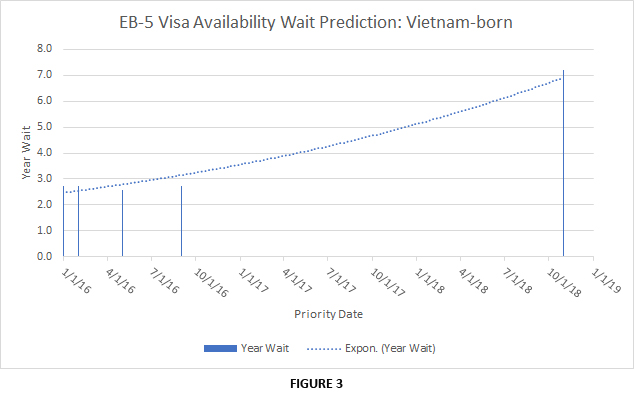
This question has a better answer than many people fear. Last month when Charles Oppenheim of Department of State predicted a 7.2-year wait for Vietnam-born, he was giving a prediction for one point: people filing I-526 on October 30, 2018. If that point-in-time prediction is correct, then the wait time will be less than that for everyone who filed I-526 before October 30, 2018. The blue columns in Figure 3 mark the data points we have: actual wait times for past applicants (calculated by subtracting Final Action Date from Visa Bulletin Date in past Visa Bulletins), and Oppenheim’s future predictions. Fit a trend line through those points, and you can estimate wait times for other priority dates, between the past actual and future predictions. (The trend won’t turn out neatly linear in real life, but I think this is good for a rough estimate. If you want a better trend line, you can factor in quarterly fluctuations in I-526 filing and approvals, and guidelines for allocating visas by quarter. Or you could push for legislative/administrative fixes that would change the picture entirely.) These charts and source data are in the “Vietnam Calc” tab of my Backlog calculation spreadsheet.

[NOTE: When I first put up this post, I included a Figure 2 for China with linear trend through past visa bulletin waits for 2014 priority dates up through Oppenheim’s 14-year prediction for Chinese filing in October 2018. But the more I thought about it, the more I disliked the China chart — because that 14-year estimate for 10/2018 is questionable, and because complicating factors will likely make the China trend look more like the craggy mountain in Figure 1 than a slope. So I edited out Figure 2.]

Question 3: If I’m an India-born person with pending I-526 or pending visa application, can I expect to get a visa number in FY2019, before visas for India get used up for the year (i.e. before Department of State sets a Final Action Date for India)?

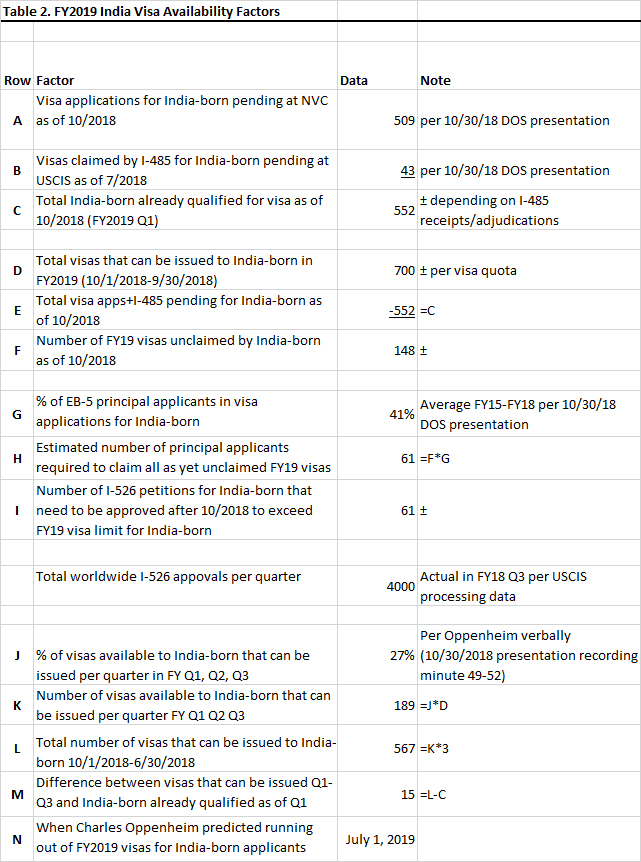
This question is tough, because the answer depends on predicting which petitions get adjudicated in the next few months, and how many. Table 1 and Table 2 below highlight the data points (from among those provided in the 10/30/2018 presentation by Charles Oppenheim) that I consider particularly relevant to the question. (These tables are also in the “India Calc” tab of my Backlog calculation spreadsheet.)

The worst case scenario is that in the next couple quarters, USCIS approves a lot of the I-526 pending for India-born people who filed I-526 in 2013-2017. If that happens (and the newly-approved petitioners quickly become documentarily qualified for a visa), the result could be that no one born in India who filed I-526 more recently will get a visa number in FY2019, no matter how quickly their I-526 was/will be processed or when they filed I-485 or the visa application. This risk exists because visa numbers get issued to qualified applicants in order by priority date, not based on when they filed their visa applications. The risk is accentuated by the fact that Charles Oppenheim at DOS is required by statute to dole out available visas gradually over the course of the fiscal year (no more than about 27% each quarter in the first three quarters), not all at once to as many people as qualify for them. That delay gives time for the pool of documentarily qualified applicants to grow, as USCIS approves more petitions.

The best case scenario is that in the next couple quarters, the pool of India-born people qualified for a visa doesn’t grow much, and additions to the pool mainly consist of people who filed I-526 recently. In that case, everyone already qualified for a visa as of Q1 FY2019 (500+ people) could actually get a visa in FY2019. Plus a few more people (about 60 investors with their families) who will get I-526 approval and become documentarily qualified in FY2019 may also get allocated visas before the approx 700 visas available for FY2019 run out. The best case scenario is possible because expedited projects have been popular with Indians, USCIS can be slow to process older I-526 (and has a lot of older petitions in the backlog from countries besides India), and the process between I-526 approval and becoming documentarily qualified can also be very slow.

The facts in Table 1 and Table 2 suggest to me that an India-born person filing I-526 today is unlikely to get a visa number in FY2019, regardless of how quickly they can get I-526 approval and qualified for a visa. There are just so many older petitions and applications already in the system. I don’t have my life savings and family on the line, however.  If you do have a major life decision depending on EB-5 timing, you should spend more time with the reports and spreadsheets to make your own estimate between the best and worst case possibilities. And talk with the immigration lawyer about limitations and benefits of being at various points in the process (I-526 pending, I-526 approved but not yet documentarily qualified, I-485 pending, documentarily qualified at NVC…) at the time when DOS publishes a Final Action Date for India.

For anyone who doesn’t manage to get a visa number in FY2019, don’t be too discouraged. India will have a trend line, like Vietnam as discussed above. You don’t automatically wait 5.7 years for a visa by virtue of having been born in India. Your wait time will depend on your priority date, with dates before October 2018 promising shorter wait time.

My post EB-5 Visa Waiting Line and Visa Allocation explains in more detail how visa allocation works. FYI, the Telegram group https://t.me/EB5VisaGroup notified me that they assembled their own India prediction spreadsheet. I’m not posting it here because I don’t know how to explain all their calculations and sources, but you can reach out to the group to request their additional analysis.

To the extent that my analysis and reporting benefits your decision-making, please consider my PayPal contribution option (corrected link). My spreadsheets and posts take a lot of time and thought that can only be rewarded if others share their benefit. I hope the work helps my clients who need information, and an industry that needs transparency, but it’s a sacrifice for me personally as a service provider dependent on new EB-5 business.

AILA/IIUSA Forum Updates (Kendall, Oppenheim, visa availability)

Last week I attended the 2018 AILA & IIUSA EB-5 Industry Forum, which featured appearances by new IPO Chief Sarah Kendall and Department of State Visa Control Office Chief Charles Oppenheim.

Ms. Kendall is a career civil servant and spoke accordingly. She gave the impression of being competent, in control, and unlikely to say anything unexpected. I didn’t note anything major in her speech that I hadn’t already heard from the USCIS Policy Manual, OMB Unified Agenda, or previous stakeholder meetings. (UPDATE: Here is a copy of Ms. Kendall’s prepared remarks.) The headlines: no update on regulations beyond what OMB said, and no significant new input on the hot issues of redeployment, bridge financing, material change, or minors as investors. Stakeholder meetings are not the proper venue for policy announcements, so I suppose there’s really not much to do but repeat existing guidance and say “thank you, we’ll consider it,” for everything else. One would expect Ms. Kendall to have a law enforcement orientation, considering her background. And indeed she stated that “focus must be on program integrity,” and listed these objectives for IPO: improve transparency, protect national security, lawful administration of our nation’s laws.  I appreciate that she started with transparency, which is foundational to the other two objectives. And it was gracious of Ms. Kendall (and former Interim Chief Julia Harrison) to attend the AILA/IIUSA event and take time to chat with attendees.

In the past I’ve sometimes felt like a lone crusader with my spreadsheets and numbers reports. I attended the AILA/IIUSA forum in person partly because I suspected that Charles Oppenheim would give information about visa numbers and wait times that my clients need to know, and no one else would process it or publicly report on it. But I was wrong. A wonderful panel on visa numbers not only provided a very extensive data set but analyzed and drew actionable conclusions from it, and then IIUSA made the right choice to promptly publish the full presentation where anyone can access it. And now other people are already reporting on it, without pausing to worry about messaging. Integrity depends on transparency – an important lesson for everyone.

Here is the gold mine: Presentation Materials from Department of State Visa Control Office Chief Charles Oppenheim (UPDTATE: IIUSA has also published commentary on the presentation.)

The slides provide the most comprehensive and current set of visa-availability-related data yet, with helpful interpretation and conclusions. Bottom line: how long should an investor filing I-526 on October 30, 2018 expect to wait for an EB-5 visa number?  Mr. Oppenheim made the following prediction: China, 14 years; Vietnam, 7.2 years; India, 5.7 years; South Korea, 2.2 years; China-Taiwan, 1.7 years; Brazil, 1.5 years. Here’s the famous slide:

These time predictions refer to the time between I-526 filing and visa availability for people filing I-526 on October 30, 2018. People who filed I-526 before October 30, 2018 have fewer people ahead of them in line, and thus can expect correspondingly shorter wait times. People who file later can probably expect longer waits (unless trends or rules change, as they could). The predicted visa wait times for South Korea, Taiwan, and Brazil are now short enough as to be likely imperceptible (i.e. even shorter than I-526 processing time). Mr. Oppenheim foresees that South Korea, Taiwan, and Brazil will remain current (no cut-off date) through 2019 and probably 2020. The predicted wait time for an India-born investor filing today has lengthened since the last prediction from April, but not as much as I’d feared. Mr. Oppenheim now predicts that the Visa Bulletin will have a Final Action Date for India “no later than July 2019.” In other words, the annual EB-5 visa allocation available to India in FY2019 is expected to run out in July. In October 2019, when new FY2020 visas become available, India will have a Final Action Date in 2017, meaning that India-born applicants with priority dates before the 2017 Final Action Date will then be able to apply for visas.  As for China, Mr. Oppenheim predicts that by October 2018, the Final Action Data for China-born applicants will progress to 10/22/2014 (best case) or 10/8/2014 (worst case), and that China will advance (at best) two months in 2019. Mr. Oppenheim expects to be able to move Vietnam’s Final Action Date as far as September 2016 this year, before the FY2019 visas available to Vietnam run out.

For the full background to these predictions, and very helpful commentary on how the visa process and allocation work, potential variability, and what we do and do not know, see the full slide presentation and my voice recording of the panel. (And if you want all the backlog-related data I know, though all you really need is Charlie’s predictions, see my backlog spreadsheet.)

A shout-out to other colleagues reporting on the conference:

Wolfsdorf Rosenthal is holding a free webinar on 11/8 to discuss the DOS data and implications.

See also the conference program/RCBJ Business Journal available online. I particularly recommend these articles:

Regarding legislation and potential developments in Washington, I did not hear anything particularly newsworthy. Industry lobbyists say that they see hope for the future because they are finally united for the first time. This talking point would be more encouraging if we hadn’t heard the same statement last year, before the last attempt at EB-5 legislation that excluded most of the industry until the 11th hour and then met with industry discord. The panel last week did not specify compromises or concessions that have been made since then, and did not reflect specifically on what went wrong. The panel foresaw possibility for renewed legislative efforts in 2019, initiated in the House. EB-5 has best chance of getting attention after border wall funding and DACA are no longer taking all available oxygen, and after more representatives have been educated on EB-5. The panel hinted that we might be looking at more continuing resolutions in December, particularly for DHS funding if Democrats do well in the midterms. The proposal to eliminate per-country caps (in the Yoder amendment to the House version of the DHS funding bill, and H.R.392) got little mention, and no one said they thought it likely to be enacted.