FY2018 Q4 Petition Processing Data

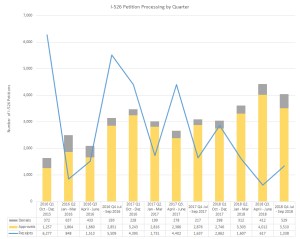
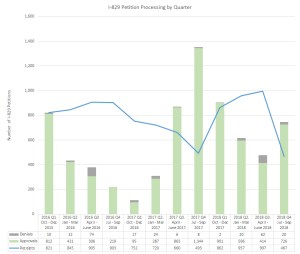
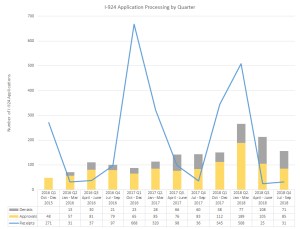
USCIS is finally starting to update its Immigration & Citizenship Data page with data for petitions processed in FY2018 Q4 (July to September 2018). As usual, I’ve made charts to highlight salient features.

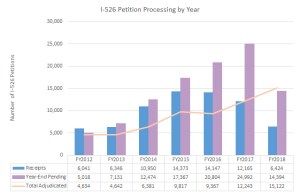
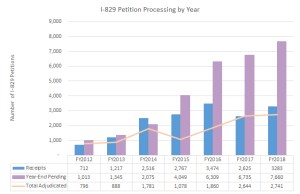
I like to look at annual trends in receipts and adjudications, because this reflects demand and allows understanding and predicting processing times at the Investor Program Office.

The backlog of pending petitions grows and processing times increase when IPO receives more petitions in a year than it can process in a year. That happened for I-526 from 2010 to 2017, when IPO finally started to catch up. In 2018, IPO surged ahead, processing more than twice the number of I-526 received. At this rate, the entire backlog of I-526 pending as of year-end 2018 will be adjudicated in 2019, and new I-526 can expect processing times of less than one year. I-526 processing times were a major factor for people who filed during peak demand in 2015 and 2016, and thus faced years-long processing on average. I-526 processing times will fade as a consideration, as new petitioners can expect months-long waits on average. (My I-526 prediction spreadsheet forecasts future processing times from petition volume.) Meanwhile, I-829 faces continued long processing times because adjudication volume is so small compared to the backlog. So long as IPO can only process less than 3,000 I-829 in one year, it will take 2-3 years just to get through the backlog of 7,660 I-829 pending as of October 2018. But we hope to see I-829 volumes improve considerably in 2019.

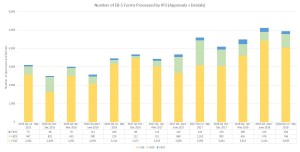
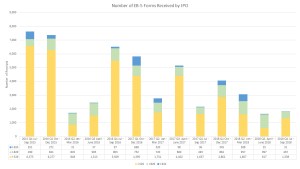
IPO’s total output was about the same in FY2018 Q4 as in Q3, just with a few more I-829 processed at the expense of a few fewer I-526. Meanwhile, the number of forms received by IPO remained relatively low in Q4. There was a small I-526 surge in advance of the September 30, 2018 regional center program sunset date, but nothing like in previous years. There continue to be very few new regional center applications and amendments, and high denial rates for previously-filed I-924.

I’m putting out my PayPal link again, particularly as an appeal to industry colleagues who depend on me to research and report news. How much more work would you have to do, if blog.lucidtext.com weren’t here to watch for and process EB-5 updates? If this blog saves you considerable time and effort, consider helping to make it worthwhile for me. (I am also contemplating advertising options, but have not settled on a strategy for appropriate and effective presentation within the constraints of the blog format.)

EB-5 Modernization Regulation Advances

The Office of Management and Budget List of Regulatory Actions Currently Under Review shows that the EB-5 Modernization Regulation advanced on Friday to the OMB Review stage.

OMB Review is the last step in the rulemaking process before publication of a final rule.

How long does OMB review take? It usually takes many months, as evidenced by other DHS regulations currently listed on the OMB site with receipt dates as early as June 2018, and still with “Pending Review status.” Or it occasionally happens in as little as a month, I’ve noted in my time tracking the OMB site.

After OMB review, the Final Rule will be published in the Federal Register. How long after publication will the final rule become effective? Here’s the answer according to The Federal Register’s Guide to the Rulemaking Process: “When an agency publishes a final rule, generally the rule is effective no less than thirty days after the date of publication in the Federal Register. If the agency wants to make the rule effective sooner, it must cite “good cause” (persuasive reasons) as to why this is in the public interest. Significant rules (defined by Executive Order 12866) and major rules (defined by the Small Business Regulatory Enforcement Fairness Act) are required to have a 60 day delayed effective date.”

And the most burning question of all — what will be in the Final Rule? We know what was in the Notice of Proposed Rulemaking for RIN: 1615-AC07, but that was published in January 2017, and DHS has spent almost two years since making some kind of changes.  It’s unfortunately plausible that DHS just spent two years writing out why they’re not accepting any suggestions in public comments, but I’d like to think that they made some significant adjustments in response to public concerns and insights. I hope to see a different minimum investment amount in the final rule, considering that nearly every single commenter informed DHS that the NPRM proposal would be fatal.  But for what it’s worth, here’s a summary of provisions in the NPRM from 2017:

  • Increase the standard minimum EB-5 investment amount to $1,800,000, or $1,350,000 in a TEA.
  • A TEA is based on high unemployment and incentivized with 25% reduction to the investment amount (not other factors or incentives as proposed by Congress).
  • A TEA can only be designated for a high-unemployment MSA, county, city, single census tract, or limited group of census tracts. DHS, not the states, is responsible for TEA designation.
  • Give priority date protection (an investor with an approved I-526 could choose to file a new I-526 while keeping the original priority date, subject to certain restrictions)
  • Spouse and children may be able to file I-829 even if not included on the principal investor’s petition.
  • Other technical changes.


Retrogression Math

Retrogression — as people imprecisely call the visa wait times resulting from oversubscription — is my least favorite EB-5 topic. The problem threatens my market, and I’d love for it to go away. There are two ways to make the retrogression problem go away: solve it or ignore it. Solving retrogression requires convincing Congress to give EB-5 more visa numbers, or to change allocation. More visas = smaller backlogs = shorter wait times. Different allocation = spreading out the backlog impact = shorter wait times for some.  But solving retrogression is hard because of Congress, so that leaves ignorance. Ignoring retrogression is easiest if one shrouds it in mystery and doubt.  If EB-5 visa availability and wait times seem impossibly complicated and uncertain, then it’s natural to ignore the issue because what else can one do. But that’s not responsible. In fact, retrogression is in the realm of math, not of myth. China is exceptional (the future demand factor introduces need for a crystal ball, and results in variable/unreliable timing forecasts for China), but future EB-5 visa availability and wait times for other countries are calculable. Investors from countries nowhere near demanding 700 EB-5 visas annually need not fear retrogression. For countries that are over (Vietnam) or near (India) the approx. 700 limit, the risk from retrogression can be calculated from the accruing excess over that limit.

For India, we have ballpark figures for number of visas already spoken for as of the end of 2018, and know something of priority dates within this backlog. The fixed number of annual visas available to India simplifies the calculation for wait times implied in past and potential future demand. The math isn’t fun – especially when calculating the wait time for a particular priority date, because of course people at different places in line face different waiting times, and variables vary over time. But still, workable estimates can be made based on available data, with areas of variation and uncertainty accounted for with math plus judgment. “We just can’t know, no one can really predict” gave an alibi for China wait times and backlog buildup, but that excuse is not available for India.  We can’t know exactly but we can generally predict how long someone investing today from India will need to wait for conditional permanent residence. We can predict the result of looking to India for billions of dollars in EB-5 investment, so long as fewer than 700 EB-5 visas are available per year for India.

I collect all relevant data that comes to my attention in my Backlog Calc file, available to anyone undertaking his or her own analysis.  And do undertake your own analysis, because who is motivated and able to do it well for you? (Even some industry veterans have misconceptions.)

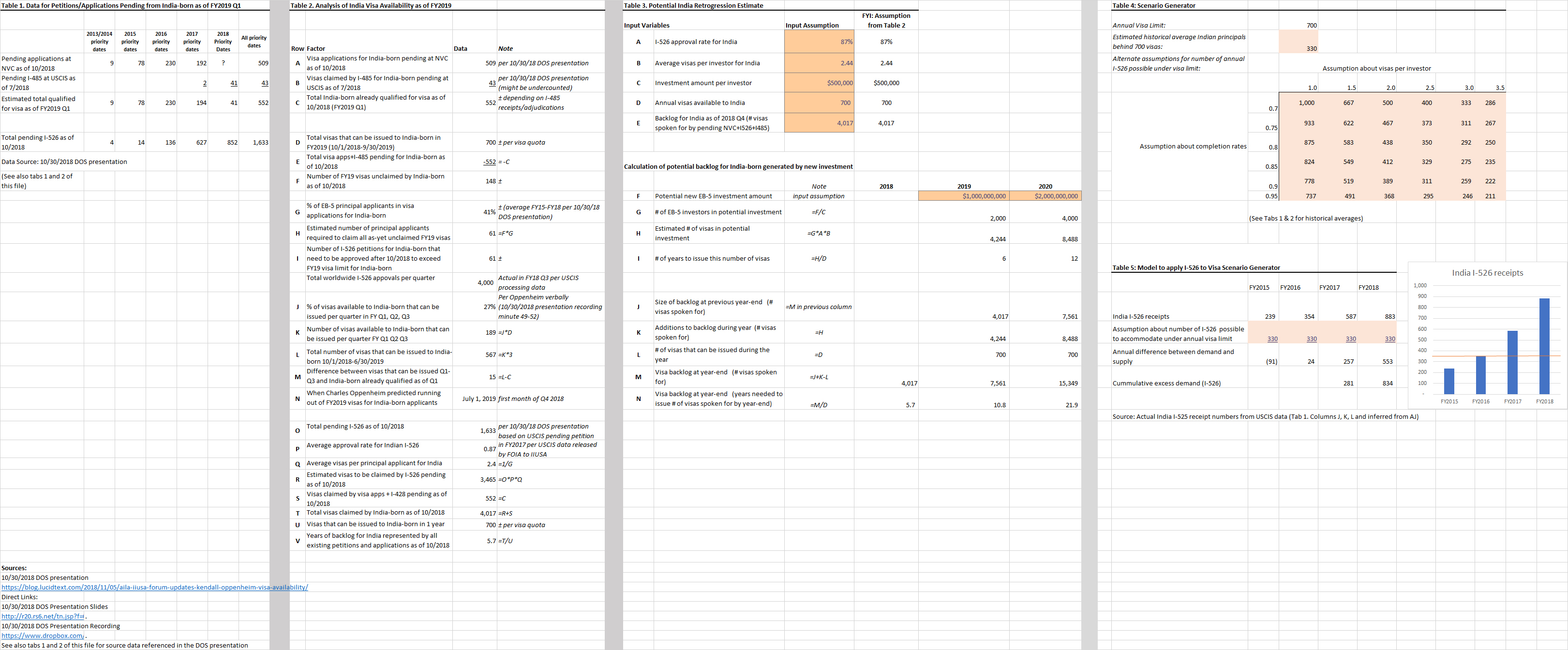
I put several analysis worksheets into my Backlog Calc file as a starting point.  For example, here’s a screenshot of the India Calc tab.

This sheet breaks down the data, assumptions, and equations behind Charles Oppenheim’s estimate for the India backlog and wait time as of Q1 2019, and offers models for calculating scenarios and the impact of future EB-5 capital raises in India. Being in the realm of math, when you doubt a conclusion, you can examine the variables, trace assumptions to underlying data, rethink the equations, and test alternate assumptions. My spreadsheet is your spreadsheet. Download the Excel and play with it on the big screen. Let clients play with it and reach their own conclusions. Just don’t tell prospective EB-5 users “we can’t know, it’s a mystery,” because predictions are possible and necessary.

We must try to be realistic about timing, because EB-5 isn’t only about waiting for a visa. It’s about tying up investor capital, and putting issuers on the line to deploy and redeploy capital for as long as it takes investors to get visas. Projects care whether they have to deal with EB-5 investors for 5 years or 10 or 20. Investors care whether their life savings are deployed at risk with negligible interest for 5 years or 10 or 20.  And lawmakers need to know if our current EB-5 visa limits soil the past, and gut the present and future economic potential of EB-5.

We need “real visa capacity relief,” as IIUSA says in a recent blog post. I’ll be interested to hear more about what specifically IIUSA can and will do toward visa capacity relief, which has historically not been a plank of the advocacy platform. (Not that the industry hasn’t wanted it, but that Congress hasn’t been willing to hear about it.) Certainly, the issue has become central to the long-term health of the EB-5 program.

NOTE: I’ve added a EB-5 Timing page to collect links to data and posts related to EB-5 visa availability, visa allocation, and wait times.

USCIS email: Zhang Class Action

From: U.S. Citizenship and Immigration Services <uscis@public.govdelivery.com>
Sent: February 12, 2019 3:55 PM
Subject: Class Action Member Identification Notice

On Nov. 30, 2018, in Zhang v. USCIS, No. 15-cv-995, the U.S. District Court for the District of Columbia certified a class that includes any individual with a Form I-526, Immigrant Petition by Alien Entrepreneur, that was or will be denied on the sole basis of investing loan proceeds that were not secured by the individual’s own assets. The U.S. District Court for the District of Columbia vacated these denials and ordered USCIS to reconsider the petitions.

If you believe you have received an I-526 denial solely on this ground and would like to identify yourself as a potential class member, please email USCIS.ImmigrantInvestorProgram@uscis.dhs.gov, using the subject line “Zhang Class,” and provide the following:

  1. Name
  2. Alien Number (if any)
  3. Date of birth
  4. I-526 receipt number (if available)
  5. Date of I-526 denial
  6. Copy of I-526 denial (if available)

Note: Identification as a potential class member is subject to USCIS verification and does not grant any immediate rights, as immigrant petitions must meet all eligibility requirements and the court’s decision is presently under consideration for appeal.

USCIS has also posted a notice at https://www.uscis.gov/eb-5

Background:   Zhang et al. v. USCIS et al. addressed whether loan proceeds invested as cash constituted “cash,” as the plaintiffs claimed, or “indebtedness,” as USCIS claimed. The court ruled in favor of the two EB-5 investor plaintiffs, and also agreed to certify a class that comprises all I-526 petitioners who received or will receive I-526 denial solely on the ground that a loan used to obtain invested cash fails the collateralization test created by IPO in a 2015 IPO Remarks announcement. The court vacates USCIS denial of class members’ petitions, and remands the denials to USCIS for reconsideration. For more analysis, see 5 Things to Know About Ira Kurzban’s New “Use of Loan Proceeds for EB-5” Decision by the D.C. District Court (Wolfsdorf, Barnett)

Updates (reauthorization, visa cap, redeployment, AAO decisions)

Reauthorization

There seems to be optimism that Congress and President Trump will agree before February 15 on a deal to fund the government for 2019. I assume and trust that the deal, when unveiled, will include extension of regional center program authorization at least to September 30, 2019. [Update: H.J.Res 31, which became law on 2/15, has regional center program authorization to 9/30/2019 in Division H, Title 1, Sec. 104 (PDF page 463), and no other changes that affect EB-5.]

Luckily for EB-5, the case against it has been taken up by the pariah Rep. Steve King. Last month he introduced H.R.773 – To terminate the EB-5 program, proposing that EB-5 be erased from the INA, and that DHS cease to accept new petitions and dismiss all pending petitions and applications. The bill has gained 0 cosponsors, reflecting what other lawmakers think of this proposal and/or of supporting anything associated with Steve King.

Visa Availability

The per-country cap for EB visas continues to be an issue in the new Congress, with at least two new bills proposing to eliminate it: H.R. 1044 ‘Fairness for High-Skilled Immigrants Act of 2019 and S.386 – A bill to amend the Immigration and Nationality Act. These bills have quite a few cosponsors. This time around, IIUSA has taken a stand on the issue. “While the elimination of per-country caps may make sense for some categories, the elimination of the per-country caps for EB-5 will be to the detriment of the program,” stated IIUSA Executive Director Aaron Grau. [2/18 Update: IIUSA has expanded on its statement. 7/1/2019 Update: See my post on Country Cap discussion.]

EB-5 Activity at USCIS

Here’s what USCIS has done publicly so far for EB-5 in 2019:

  • Not finalized EB-5 regulations (or at least, not yet advanced them to OMB for review)
  • Not approved or terminated any regional centers
  • Not published petition processing data for July-Sept 2018 (I expected this to happen by December 2018)
  • Not held or announced any stakeholder engagements
  • Made a couple tweaks to petition processing time reports, each time adding or subtracting a few days. Currently, petitioners can be considered “outside normal” processing times if they are 796 days from I-526 filing, 1,077 days from I-829 filing, or 715 days from I-924 filing.  Dear me. However, I’m hearing anecdotally of I-526 adjudicated within a year.
  • Published a number of AAO decisions on EB-5 appeals (a few of which I discuss below)

Material Change and Redeployment

I have something to add to the redeployment discussion, as a business plan writer who has spent years grappling with the intersection of EB-5 theory and business practice. But until I have time to actually write the post I have in mind, here FYI are two planks to my thinking on the redeployment issue:

  • Carolyn Lee’s analysis of the EB-5 at-risk requirement and its misapplication in redeployment policy. USCIS, be sure to read this article, which helps explain why applying redeployment policy is so hard for us. When a policy makes sense theoretically, then we don’t have to badger you with questions about how to apply it. Then we can figure it out ourselves with reference to the statue/regs/precedents etc., with the help of our smart lawyers. As it is, we do hassle you with questions because there’s a broken link to the established rules, giving us and you no firm foundation to stand on in applying the policy, and leaving us all vulnerable to capricious case-by-case determinations.
  • A number of redeployment complications and constraints arise from the fact that redeployment policy is a subset of the material change policy. In preparation to discuss that aspect of redeployment, I’ve refreshed my post What is Material Change.  The post discusses the theory and links to most AAO decisions that have addressed material change in specific cases.

USCIS decision-making

AAO decisions on EB-5 appeals shed light on an important question: “If anything goes wrong with an EB-5 investment, is there any way to recover?” What if a principal goes rogue and makes off with some funds, but then there’s new management and funds are recouped and put to work again? What if a regional center was terminated, but currently well-placed to promote economic growth? What if a project did not develop as originally anticipated, but can succeed and create jobs in a new direction? These questions fall in policy grey areas, giving the agency leeway for positive flexibility or reflexive naysaying.  Unfortunately, recent AAO decisions show the later trend, and I hope that there will be pushback.

DEC102018_06B7203 Matter of L-X- is one of two decisions on appeal by investors who put money into an NCE originally managed by Emilio Francisco, who was charged by the SEC in December 2016 with defrauding investors. The NCE and other defendant entities went into receivership, it was determined that a portion of EB-5 investor funds had been diverted, and USCIS denied I-526 petitions for NCE investors. In an attempt to salvage the situation, several EB-5 investors executed an LOI with an institutional investor and amended the NCE’s LP agreement to replace the NCE manager, remove the NCE from receivership, provide necessary funding to the NCE, and complete and operate the project. USCIS/AAO claimed to be “sympathetic to the Petitioner’s situation,” but claimed that the investors still could not satisfy EB-5 requirements. Here’s the USCIS/AAO reasoning:

  • The petitioner could not satisfy the “at-risk” requirement if she replaced diverted capital with additional investment, because that new capital would not be her original capital, and Izummi requires showing that the full amount of “original capital” was made available to the NCE to create jobs. “Petitioner must establish the necessary job creation with capital invested at the time of filing, not based on later infusion of additional funds.” (I don’t quite follow the justification from Izummi, or the “original capital” idea generally. Is the thought that the very dollar bills first passed between the investor and NCE must be the same dollar bills used to pay employee salaries? USCIS sometimes talks about a “path of funds” from investment to job creation – as if cash flowed through a business with each note radio-tagged and leaving a colored path as it goes. In practice, investment goes together into a pool and economic activity and jobs and ROI come out of the pool. A “path of funds” from X original dollar to Y job never exists, and USCIS/AAO should not make demands that presume such a path.)
  • If the investor replaced $182,133.33 of diverted capital with $182,133.33 in additional investment, then the petitioner would be committing impermissible material change because that would effectively increase the minimum investment amount from $500,000 to $682,133.33. (Really, USCIS? How does investing more than the required minimum undermine eligibility?)
  • USCIS couldn’t tell whether the Petitioner had actually invested the additional funds, or only intended to do so. (This is a fair point, but why did USCIS raise this issue if against additional investment in principle?)
  • The Petitioner did not demonstrate that all approvals needed for the proposed NCE restructuring had been obtained, making USCIS doubt whether the restructuring could go forward. (Fair point, if true.)
  • The Petitioner did not file an updated business plan to describe the current status of the project and its current job creation potential. (I wonder if this was fundamentally the most important problem with the Petitioner’s appeal. A business plan is a chance to tell a compelling story about use of investment and job creation, reconcile apparent inconsistencies, argue that changes aren’t material, make an eligibility case, and pre-emptively address questions, doubts, and misconceptions that the reader might have. Don’t miss the prime opportunity to tell your story! As a business plan writer, I’m sensitive to the critical and delicate role of the business plan in presenting changed circumstances to USCIS.)

DEC042018_01K1610 Matter of P-A-K  is AAO’s third decision regarding the designation of  Path America KingCo regional center. This decision was compelled by US District Court, where the regional center filed a complaint after the AAO denied its initial appeal and motions to reopen and reconsider. AAO gives 21 pages this time to reiterate the denial, with arguments that can be summed up in this sentence that the decision quotes from INS v. Abudu: “The INS should have the right to be restrictive.” Path America KingCo presents a compelling case for its current and future potential to promote economic growth, but the AAO finds that this isn’t relevant to its current designation status. AAO rests on this technical claim: that appellate decisions are final, and cannot be reconsidered in light of new evidence, but only reassessed in terms of evidence that existed at the time the decision was made. One might think that Path America KingCo deserves designation if it is continuing to promote economic growth, but AAO says no – the relevant issue is whether it was promoting economic growth at the time it was terminated. A different agency might’ve looked at the fact pattern – a company that has good management (now), good projects, and committed investors dependent on the designation – and found a way to say yes. The so-called “balancing test” discussed in prior terminations claims that “we take into account a variety of factors, both positive and negative, that encompass past, present, and likely future actions.” However, it appears that this test does not apply on appeal, as USCIS does not consider positive present or likely future actions once a termination letter has been issued.

Letter to Senator Collins in the USCIS electronic reading room shows USCIS responding frostily to a plea from Senator Susan Collins regarding a small town in her constituency that planned to use EB-5 investment to rebuild after the catastrophic closing of a paper mill. The scenario sounds like textbook example of what Congress hoped EB-5 could do, but it did not move USCIS, which terminated the regional center purchased for the town before the town had a chance to use it, and just offered Senator Collins the cold comfort of filing an AAO appeal. Is this administering the Immigrant Investor Program in a fair and efficient manner? Fair and efficient, I suppose – the RC was apparently inactive prior to being taken over for Millinocket, Maine. But is the decision in tune with EB-5 program logic and objectives? No.

To be fair, AAO appeals sometimes work. JAN252019_01B7203 is an example of a denial that AAO remanded back to USCIS for more precision in identifying specific problems in credibility and eligibility, and for more rigor in assessing relevant evidence.

And as a reminder that court cases also sometimes work, EB-5 investors have another win on use of loan proceeds for EB-5 investment.