Reauthorization, Country Caps, S.2540, Visa Bulletin
September 30, 2019 26 Comments
Since last writing, Congress gave the regional center program another short authorization, the Fairness for High-skilled Immigrants Act almost passed the Senate, Senators Grassley and Leahy introduced a new piece of EB-5 legislation, and the Visa Bulletin offered a surprise window for Indians and Vietnamese to file I-485 regardless of priority date. I’ve had to hop, trying to keep my Washington Updates page up-to-date.
On Friday President Trump signed H.R. 4378, a continuing resolution that keeps the government funded and the regional center program authorized through 11/21/2019 — or until the next funding bill or (more likely) the next short-term continuing resolution. The history of regional center program authorization now looks like this.
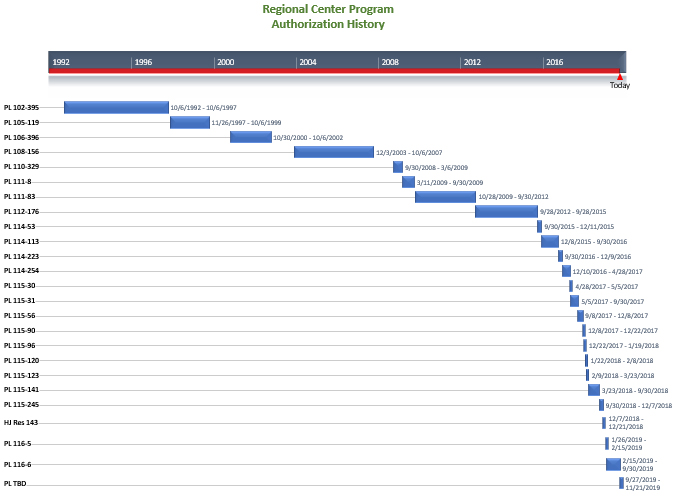
The regional center program needs the stability of a long-term authorization — something it hasn’t gotten since 2012. So far as I know, IIUSA and EB5 Coalition are still marching in lockstep and arm-in-arm over a consensus wish list for legislation that combines long-term authorization with an investment threshold lower than what was set in 1990, a neutered TEA incentive, and a TEA set-aside provision to set aside visas for incoming investors at the inevitable cost of reducing visas available to past investors. Meanwhile, last week Senators Grassley and Leahy announced proposed EB-5 legislation that does not appear to have benefited from any EB-5 industry input. S.2540 – A bill to reauthorize the EB-5 Regional Center Program in order to prevent fraud and promote and reform foreign capital investment and job creation in American communities is an updated version of the EB-5 Reform Acts associated with Senator Grassley’s office since 2015. Unlike previous versions, the new bill does not treat investment amounts or TEA designations. It does attempt to define measures that would improve the integrity and security of the EB-5 program. I admire the intention, but wish that Senator Grassley’s office had consulted with anyone who knows EB-5 in practice. If S.2540 passed, it would sweep almost everyone out of EB-5 except a few big-city regional centers (the only ones who could afford the swathes of new red tape and fees proposed) and direct EB-5 (whose existence the bill apparently forgot). That’s not Senator Grassley’s objective. If I had more time, I would write an analysis for Grassley’s office to explain where and how the S.2540 proposals depart from their intent, and suggest fixes that would better support the laudable accountability and transparency goals. Even better if this task could be done cooperatively by the EB-5 industry. But it seems that industry has decided to put all its marbles in the hope of no-compromise backroom deals.
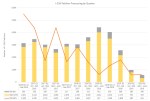
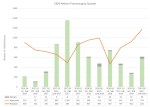
Speaking of a few billionaires trying to cut deals, the Fairness for High-skilled Immigrants Act keeps coming back in the Senate. As of today the bill is blocked by Senator Durban, Senators Grassley, Paul, and Purdue having been talked out of their opposition. The funding bill process offers another possible opportunity to get the legislation passed on the down-low, tucked into a thousand-page omnibus. Unfortunately I can’t find anyone but Breitbart to keep me informed about developments. (I record what I hear of the various versions and actions in this post.) If the Fairness for High-skilled Immigrants Act can pass the Senate and get signed by the President, then there would be no more country cap on EB visas. That means the people already in line for an EB-5 visa – somewhere around 70,000 – would simply receive visas in order by priority date, regardless of nationality. With 10,000 EB-5 visas available per year, that means about 7 years to issue visas to everyone already in line, and 7+ years for any new investors to get a visa. That would be more than fair to the Chinese in line, who invested under a country cap that promised 10+ year visa waits. It would be less than fair to people born elsewhere, who invested under a country cap that promised little to no visa wait. The bill offers to protect people already in the visa queue by saying that no one with an approved immigrant petition shall receive a visa later than that person would otherwise have received a visa under previous rules. However, that doesn’t help EB-5 because most of the non-China backlog is still stuck in slow I-526 processing, and thus does not yet have petition approvals that would protect them. The EB-5 industry has been nearly silent on this legislation, thanks to interests divided between China and the rest of the world. The industry will collapse if the bill passes, with new EB-5 demand quelled by the threat of a worldwide 7+year wait to conditional permanent residence.
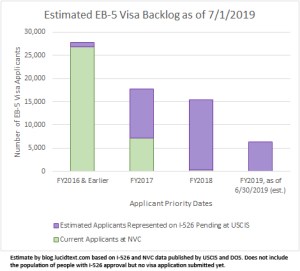
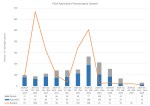
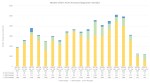
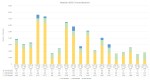
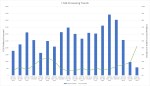
I made a couple charts to assist in visualizing the impact of the Fairness for High-skilled Immigrants Act. To estimate how many years a given priority date would need to wait for a visa under the act, just add up the number of applicants with earlier priority dates, and divide by 10,000. (The latest version of the legislation has no transition period for EB-5.) To estimate how many people would be retroactively affected if the Fairness for High-skilled Immigrants Act becomes law, look at the number of applicants represented on petitions still pending at USCIS. (These charts are rough estimates starting from data by country and priority date published by USCIS and DOS as of October 2018, and that I updated with estimates based on worldwide I-526 and visa data since then. I guess the charts may be undercounting by about 10,000. As a reminder, my EB-5 Timing Page collects all the data to which I have access.)
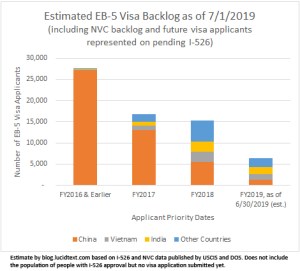
At least there’s one bit of happy news for past investors. USCIS announced that in October 2019, applicants from Vietnam and India who are living in the U.S. and have I-526 approval can file I-485, regardless of priority date. The Visa Bulletin has two charts for EB visas: Chart A Final Action Dates and Chart B Dates for Filing. USCIS has agreed to use the Dates for Filing cart in the October 2019 Visa Bulletin, and all countries except China are Current in that chart. This doesn’t necessarily affect the total time to actually get a visa, but having the I-485 filed brings significant benefits.
The USCIS AOS page explains that it opens Chart B “If USCIS determines there are more immigrant visas available for a fiscal year than there are known applicants for such visas.” The fiscal year starts in October with 700 visas available each to Vietnam and India, and apparently there aren’t yet 700 people ready yet to take those visas. No wonder, when USCIS is only advancing about 200 worldwide I-526 petitions a month. As illustrated in the above chart, much of the effective line for EB-5 visas is still stuck in USCIS processing.
 EB-5 Updates