EB-5 updates and resources under COVID-19

[Update: for newer information, see instead my 5/28 post EB-5 Impact of COVID-19 (processing, eligibility, visa numbers)]

As the war against COVID-19 heats up around the world, EB-5 work continues, but with some changes. A few notes on developments over the past two weeks:

USCIS continues to operate despite COVID-19, with modifications

USCIS offices have been closed to the public since March 18, but USCIS staff are continuing to perform duties that do not involve face-to-face contact with the public. (Except where otherwise noted, the information in this section is from uscis.gov/coronavirus, which gets updated regularly.)

That means IPO (which needless to say lacks public contact) is continuing to adjudicate I-526, I-829, and I-924, and to terminate regional centers. In fact, the latest processing times report (updated March 20) recorded a decrease to I-526 processing times. I’ve heard multiple personal reports of EB-5 decisions received. The USCIS list of regional centers got a significant update this week, recording three new approvals and 24 terminations. Service centers also continue to process I-485 status adjustments.

EB-5 investors at the visa stage will be affected by the fact that all biometrics appointments have been temporarily suspended since March 18 until at least April 7 May 3 June 4, with all appointments to be automatically rescheduled once USCIS again resumes normal operations.

On March 20, USCIS announced flexibility in submitting required signatures. “For forms that require an original “wet” signature, per form instructions, USCIS will accept electronically reproduced original signatures for the duration of the National Emergency.”

On March 27, USCIS announced flexibility for responses to Requests for Evidence and Notices of Intent to Deny. “For applicants and petitioners who  receive an RFE or NOID dated between March 1 and May 1, 2020, any responses submitted within 60 calendar days after the response date set forth in the RFE or NOID will be considered by USCIS before any action is taken.”

On March 30, USCIS expanded this flexibilty: “A response received within 60 calendar days after the response due date set forth in a Request for Evidence, Notice of Intent to Deny, Notice of Intent to Revoke, or Notice of Intent to Terminate will be considered before taking any action if such request or notice is issued and dated by USCIS between March 1 and May 1, 2020, inclusive.”(uscis.gov/coronavirus)

Other IPO Activities

The EB-5 Resources page on the USCIS website was updated on March 23 with Sarah Kendal’s prepared remarks from the 3/13 Public Engagement, as well as with Q&A on the Visa Availability Approach. The Q&A gives a detailed, clear, and helpful overview of the new visa availability approach to I-526 processing that will officially launch next week.

EB-5 visa applications and COVID-19

EB-5 visas are temporarily not being issued through consular processing. On March 20, 2020, DOS announced suspension of routine visa services. “In response to significant worldwide challenges related to the COVID-19 pandemic, the Department of State is temporarily suspending routine visa services at all U.S. Embassies and Consulates. Embassies and consulates will cancel all routine immigrant and nonimmigrant visa appointments as of March 20, 2020. As resources allow, embassies and consulates will continue to provide emergency and mission critical visa services. Our overseas missions will resume routine visa services as soon as possible but are unable to provide a specific date at this time.”

With applicants overseas temporarily unable to claim available visas, this may mean more visas available to applicants in the U.S., since I-485 status adjustments are still being processed (as of now). Depending on how long it takes overseas visa services to get back on track, Department of State faces a challenge to allocate all available visas for the fiscal year.  So long as consulate closures prevent people overseas from claiming visas, that could cause the Visa Bulletin final action dates to advance rapidly to accommodate those few who are placed to receive visas. At the beginning of the year, Department of State had anticipated issuing a total of 11,112 EB-5 visas, including 778 each to Vietnam and India, with an estimated 5,270 leftover for the oldest priority dates (i.e. China).  In the first five months of FY2020 (October to February), consulates had issued 237 EB-5 visas in India, 345 EB-5 visas in Vietnam, and just 1,088 EB-5 visas in China. (Data from adding up monthly tallies of EB-5 visas issued by consulate. Unfortunately USCIS does not publish data on EB-5-related I-485 approved and pending.)

Politico Rumor

Last week someone launched an EB-5 virus – an implausible story that Senator Lindsey Graham was pushing to increase EB-5 visas to 75,000 and decrease the minimum investment amount to $450,000 as part of the emergency stimulus bill. Politico published the story, Senator Graham himself responded publicly that the story was false (listen starting at minute 2:50 in this 3/19 Fox News interview), and yet the story continues to spread and mutate, inspiring a storm of media criticism of the EB-5 program and EB-5 investors. As IIUSA says “Although the EB-5 industry would like to see program reforms, it would never support these extreme and unfounded shifts. It did not do so last week, and it will not do so in the future.” I wonder which interest group planted the rumor, with what intent. Possibly it came from an anti-immigrant faction that’s now chuckling with glee at the backlash? Or a misguided industry insider hoping to stoke the market with false hopes? Certainly, this story has damaged EB-5 just when it’s in a position to be a helpful tool in our current economic state.

EB-5 risks and opportunities under COVID-19 conditions

Martin Lawler’s article COVID-19 Impact on EB-5 Hotel Projects (April 6, 2020) discusses issues related to maintaining EB-5 eligibility in an industry particularly threatened by COVID-19

Green Card by Investment continues to come out with EB-5 Talk podcasts on timely topics, most recently “Restructuring your NCE operating documents for redeployment” with Mark Katzoff (March 23), and “Investor options with troubled projects” with Robert Divine (March 17).

Matthew Galati has a helpful article on Filing I-829s During a Coronavirus Economic Downturn (March 26, 2020)

A reminder of my July 2019 article on Priority date retention and redeployment, which includes a flow chart to clearly illustrate the different project change and redeployment options at various points in the EB-5 process.

IIUSA has started to roll out a new Investor Market Webinar Series.

If no one else does, I will write in April about high-unemployment Targeted Employment Areas, and options for TEA analysis in response to our abruptly increasing unemployment.

EB-5 processing times and visa wait times remain a constantly moving target, but I’m still grappling with the timing estimate problem as well.

Meanwhile, my business plan service remains available to the brave few seeking to launch new ventures, and to the many who may need to describe how updated circumstances still support EB-5 investor eligibility.
Report from 3/13 USCIS Engagement on Visa Availability Approach

The March 13 EB-5 Immigrant Investor Program: Public Engagement provided a few program updates, and discussed the new visa availability approach to I-526 processing. IPO Chief Sarah Kendall mainly spoke, with additional input from DOS Visa Control Office Chief Charles Oppenheim.

As usual I am sharing my recording, so that anyone can review the meeting for themselves. (3/23 Update: Sarah Kendall’s prepared remarks and a Q&A on the Visa Availability Approach have now been posted in the EB-5 Resource Room on the USCIS website.)

Prior the meeting, my many questions boiled down to two: the priority question and the volume question.  How will IPO apply the visa availability approach to decide which I-526 to process when? How many I-526 does IPO have on hand and intend to process, going forward? I was indeed pleasantly surprised by detailed and helpful answers to the priority question. Thank you Sarah Kendall! Particularly, thank you for taking live audience questions, which proved very important. But no thanks for deflecting the volume question.

Key information from the engagement:

What is the visa availability approach? (VAA)

  • Consistent with the initial USCIS announcement, Kendall describes the VAA as an inventory management approach that will prioritize adjudications for I-526 petitions where visas are immediately available or soon to be available.

Who is affected by the visa availability approach?

  • Kendall said that the VAA will apply to all I-526 petitions not assigned as of March 31, 2020, including pending petitions currently in the pipeline, and including petitions to be filed after March 31, 2020. USCIS will continue to work on I-526 assigned for adjudication before March 31.
  • My comment: That is, the VAA will not limit decisions on cases that were already issued a Request for Evidence or Notice of Intent to Deny. The VAA does apply to all unassigned pending I-526, no matter when they were or will be filed.

Who will be held back by the visa availability approach?

  • Kendall said that in deciding which I-526 NOT to assign for adjudication, IPO will consult the monthly Visa Bulletin Chart B Dates for Filing. If a petition’s filing date is not within the dates that can file a visa application or I-485 according to that month’s Visa Bulletin Chart B, then the petition will not be assigned for I-526 adjudication that month.
  • My comments:
    • In practice, this means that for now, only pending I-526 from China will be limited by the VAA. (The April 2020 Visa Bulletin Chart B has a December 15, 2015 cut-off date for China, but current for all other countries.) It’s good news that IPO will at least look at Chart B, not Chart A, to determine visa availability for I-526 purposes.
    • The VAA will create a chicken-and-egg situation between Department of State and USCIS. The visa bulletin moves in response to demand for visas, demand for visas is created by I-526 approvals, and now I-526 adjudications will move in response to the visa bulletin.
    • Vietnam and India will benefit from the VAA in the near term, since they are current in Visa Bulletin Chart B. They will eventually be held back by VAA, since the number of pending I-526 from Vietnam and India exceed the annual visa limit. When they will be affected depends on the rate of I-526 approvals for Vietnam and India. If many Indian and Vietnamese I-526 shortly get assigned for adjudication and soon approved by USCIS, then many visa applications will soon result, creating excess demand that triggers DOS to put cut-off dates in the visa bulletin Chart B, triggering USCIS to stop assigning I-526 for adjudication.  Alternatively, if USCIS continues to approve just a few I-526 for Indians and Vietnamese, then the visa bulletin will stay open due to low visa demand, and the trickle of India and Vietnam I-526 adjudications can continue unchecked by the VAA.  (DOS apparently anticipates the second scenario, according to Oppenheim’s comments on the call.) Either way, whether the flow of I-526 adjudications is limited by the visa bulletin or by IPO’s natural slowness, the VAA would allow USCIS to, in theory, only adjudicate as many I-526 for India and Vietnam per year as needed to produce a years-worth of visa applicants. That would mean about 350 annual I-526 adjudications for India and 250 adjudications for Vietnam (considering Oppenheim’s most recent ratio of pending I-526 to visa applicants). If USCIS used the VAA as an excuse to keep to such minimum volume, within the visa caps, then long I-526 waits for India and Vietnam would result (considering that there were about 2,500 India I-526 pending and 770 Vietnamese I-526 pending as of 10/1/2019).
    • However, Sarah Kendall did not specifically say that I-526 adjudications would be limited to visa availability. The VAA just allows such limitation, as needed to prioritize as many petitions as have a visa available. And this competitive rest-of-the-world demand has historically been low, and likely to remain so considering the EB-5 price increase. China, Vietnam, and India will only have I-526 adjudications limited to visa availability to the extent that IPO can maximize its I-526 capacity with other-country adjudications.
    • The VAA guides which petitions will NOT be assigned for adjudication; it does not promise which petitions WILL be assigned for adjudication. As of 10/1/2019 (most recent available data), there were 7,472 pending I-526 from countries other than China. Those 7,472 petitions won’t all be immediately assigned for adjudication, even though they’re prioritized based on having visas available for them, unless IPO improves its volume from the FY2019 average of 390 I-526  adjudications per month.

Will IPO make any exceptions to the visa availability approach?

  • Kendall stated that:
    • Petitions with approved expedite requests will continue to be promptly assigned for adjudication, regardless of the petitioner’s country of origin.
    • If the Petitioner is from a country that would be held back by the VAA, but could have a visa available due to the spouse’s nationality, then the petitioner should email IPO to explain the situation, and IPO may assign the case based on the spouse’s nationality. Listen starting at minute 25:45 of the recording for detail.
    • Aside from the above two circumstances, IPO does not contemplate offering opportunity for petitioners to opt out, opt in, or request to be treated as an exception to the VAA policy.
    • USCIS currently plans to continue the VAA approach indefinitely.

Will the visa availability approach affect visa distribution, and number of visas available?

  • The VAA does not change the rules for visa availability. The EB-5 quota and per-country cap remain the same. The variable component in visa availability is the number of “leftover” visas available to the oldest priority dates (in the EB-5 case, to Chinese) after demand under the country caps has been satisfied. The VAA is explicitly designed to reduce the number of leftovers (being intended to help rest-of-world applicants to maximize their available visas), but Oppenheim opined that the number of leftover visas would remain unchanged for about the next 12 to 18 months.
  • My comment: When Oppenheim estimates that the number of visas available to any one country will not change for the next 12 to 18 months, he must be assuming that USCIS will not, near-term, approve more rest-of-the-world I-526 than it would have otherwise, without the VAA approach. Visas available to China are a function of rest-of-the-world visa demand, and rest-of-the-world visa demand is a function of number of I-526 approvals. Apparently, Oppenheim expects IPO to actually reduce I-526 completion rates under the VAA (since if completion rates stayed the same, fewer China I-526 completions would be counterbalanced by more rest-of-the-world completions, resulting in fewer visas available to China). I wonder if Oppenheim’s assumption is based on anything Sarah Kendall told him?

Will the visa availability approach improve I-526 completion rates and processing times?

  • Processing times are a function of backlog, processing priority, and processing volume. The VAA changes priority in a way that will benefit petitioners from low volume countries. The size of that benefit depends on what happens concurrently with processing volume (completion rates).
  • Sarah Kendall declined to answer questions about the size of the I-526 backlog, and the number of petitions that could benefit. “As a general matter, we refrain from discussing any kind of numbers with the public outside of our OPQ posting process.”
  • Kendall repeated the same reasons for low I-526 completion rates that she gave in 2019 (recorded in my previous post). Most are related to extreme vetting efforts to seek out signs of fraud and abuse. Kendall stated that “USCIS leadership views these initiatives as absolutely vital to the success of the EB-5 program. We acknowledge that case completion rates have decreased partly because of these activities, and we understand the concerns that raises for our stakeholders. With a lot of the infrastructure development now behind us, IPO is better situated to improve productivity. In fact, preliminary data for February shows a step in the right direction. The USCIS Office of Performance and Quality anticipates publishing new data in the coming month.”
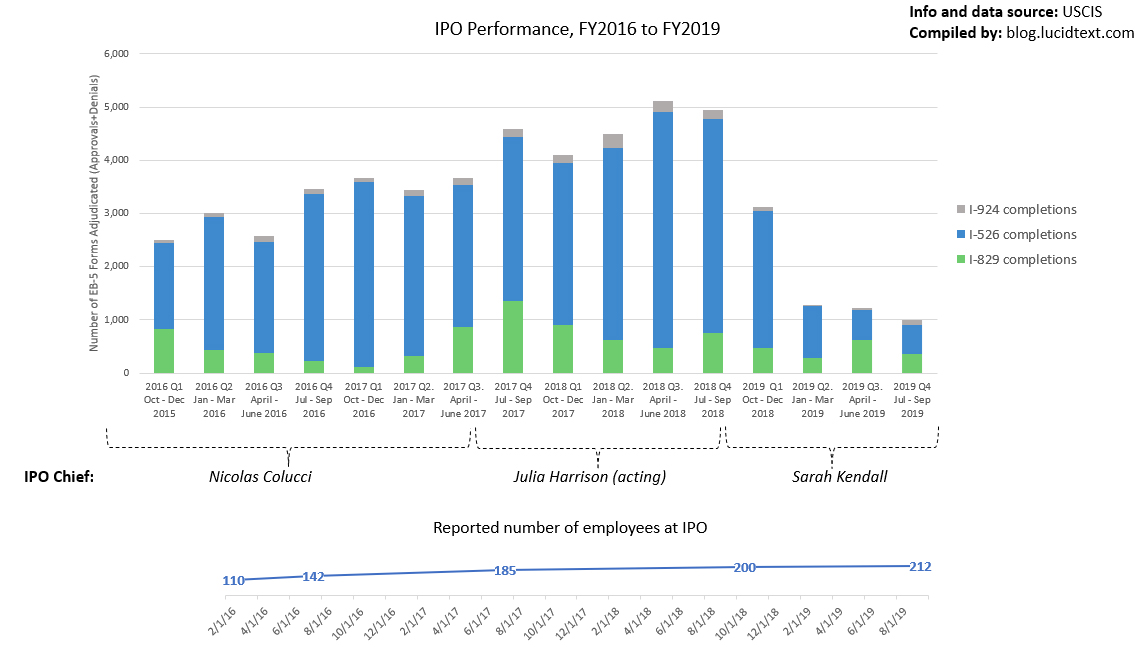
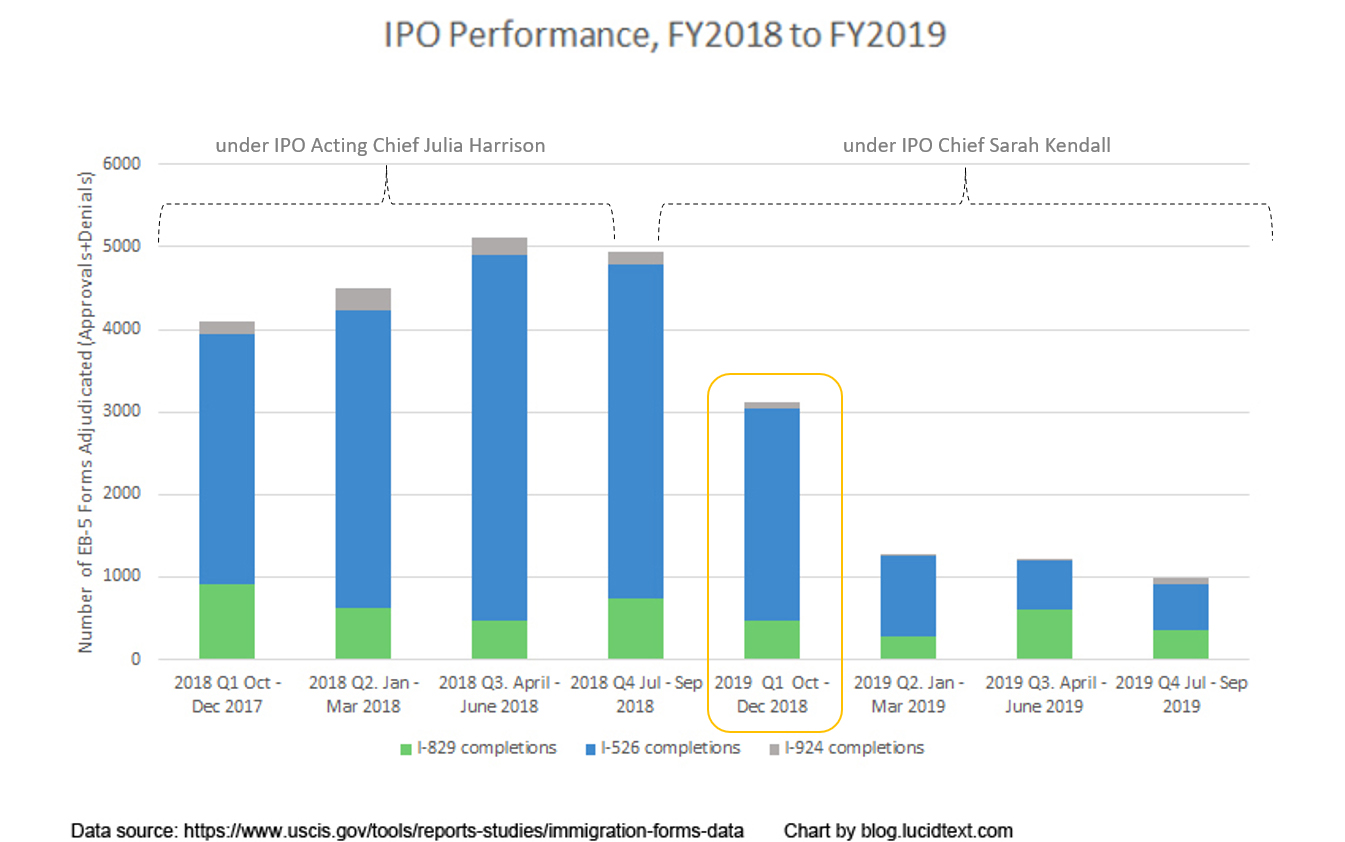
    • I take this to be saying that IPO expects to adjudicate a few more I-526 in 2020 than in 2019, but not many more. IPO’s per-quarter productivity would have to be seven times higher than it was in FY2019 Q4 just to regain 2018 productivity levels. “A step in the right direction” from recent performance is good news, and Kendall mentioned later in the call that she expects such incremental improvement to continue – also good news. But this does not sound like a promise of exponential improvement to counterbalance last year’s exponential productivity loss. Kendall emphasized that the lengthy new review procedures requiring time-consuming multi-agency coordination are “absolutely vital” to program integrity, suggesting that she does not intend to change those factors in long processing times. There will be some improvement this year from the mere fact that the procedures are at least set up, while last year included time lost due to setup/training.
  • In response to my question about number of adjudicators assigned to I-526, Kendall reported that IPO had about 240 dedicated personnel as of the beginning of the fiscal year – a record high number. “This number includes support staff, adjudicators, economists, fraud detection and national security personnel, and other positions vital to the IPO mission. The number of personnel and adjudicators assigned to each EB-5 form type varies according to workload demand and agency priorities.”
    • My comment: I note that Kendall pointedly did not answer the question about I-526 resources. The VAA reduces workload demand for I-526 by reducing the number of petitions that require prompt adjudication, which may be a sign for I-526 resource allocation. I wonder how much of the fees petitioners pay for adjudication actually funds adjudicative staff, and how much goes to staff devoted to seeking fraud.
  • Kendall gave an ambiguous answer to a question about whether or not we can expect to see a reduction in rest-of-the-world I-526 processing times as a result of the VAA. (minute 54 in the recording)

Will IPO provide transparency about its processing under the visa availability approach?

  • Kendall said that the Office of Performance and Quality would revise the I-526 processing times report to reflect the VAA change, but she also said that there’s no plan for the report to show country-specific processing times – the only possible way to reflect the VAA change for EB-5. So it’s hard to visualize how helpful the report could be. As noted above, she also declined to provide any I-526 data (and the IPO Customer Service email continues to refuse or ignore my requests for per-country I-526 data).
  • Note to IPO: you could be commended for a change that moves the EB-5 constraint to the beginning of the process, rather than leaving people to pile-up midway at the visa stage. But only if you are transparent. When you keep I-526 processing a black box, you leave people to file I-526 in ignorance, unable to assess the nature of the backlog, and inventory pileups will still occur. To avoid this, you must give the public timely data about the country composition of the I-526 backlog, and  country-specific information in the processing times report. If you make I-526 processing transparent in this way, you will actually move the constraint to the start of the process, thus improving the whole process. With transparency, demand will self-regulate as people can make informed decisions about filing I-526.  Otherwise, you have made no improvement and the process will remain broken.
  • If petitioners whose cases are not ripe for adjudication under the VAA try to make a case inquiry, they will be sent a stock response that refers them to the visa bulletin.

Other Updates regarding India, China, and regional centers:

  • Regarding the Visa Bulletin Final Action Date for India, Charles Oppenheim said “at this time, I believe that India will become current some time in the summer, and once it becomes current it would stay for the foreseeable future, pending receipt of larger volumes of approved petitions at our National Visa Center.” (Minute 33 and 44 of the recording) (My comment: apparently, Oppenheim expects USCIS to continue low productivity, with the visa bulletin to open for India due to few Indians making it past the I-526 stage and to the visa stage. See my comments above on the connection between I-526 adjudication volume and visa bulletin movement.)
  • A caller asked Charles Oppenheim about the impact of the current shutdown of consular processing in China due to COVID-19, and whether that could result in EB-5 visas that would have been given to China going to Vietnam instead. Oppenheim said: “This is a very unique situation where there is not a lack of applicants which is preventing the numbers from being used, but the situation where at this time the consulate is closed. So this will continue to be monitored throughout the year, and we’ll just have to do the best we can. But again, if it does appear that all the numbers would not be used, then we would go to the next country in line, which would be Vietnam, which is oversubscribed.” (minute 43-44 of the recording) No one asked about other potential visa impacts of COVID-19 (i.e. closures of other consulates besides China, or possible interruptions to service center operations in the U.S.)
  • USCIS has sent out 100 Notices of Intent to Terminate so far in 2020 to regional centers that did not file I-924A in FY2019.
  • Sarah Kendall announced the regulations FAQ that I flagged last week: Questions and Answers: EB-5 Immigrant Investor Program Modernization Rule.

I worked hard on this post, trying to record and explain answers, as available, to many of the questions that I anticipate regarding the visa availability approach. Regarding personalized EB-5 timing estimates, it’s difficult. The timing complications are so many at this point, and limited data makes any estimate time-consuming and not definitive. The best I can offer now, as time permits, is personalized conversations about timing, with some data support. I will soon be announcing a schedule to allow reserving appointments, for those who would like to discuss individually.

And as always, my PayPal link is open. If my work is helpful and time-saving for you, consider making a contribution to support the work. Thank you!

I-526 processing context, 2017-2019

On Friday 3/13, USCIS will hold a meeting (now by teleconference only) that promises to “address program updates, including the agency’s change from a first-in, first-out case-processing approach to a visa availability approach for Form I-526.”

I look forward to being pleasantly astonished when USCIS provides substantive, detailed information at the meeting, and answers questions. (By the way, USCIS recently posted an unannounced new page with Questions and Answers: EB-5 Immigrant Investor Program Modernization Rule. Note that this page includes some guidance not previously provided regarding targeted employment area analysis.)

In the meantime, as we face the visa availability approach to take effect as of April 1, 2020, another post with context for the I-526 processing adjustment.

EB5 Diligence/EB5 Marketplace has posted a helpful podcast: Analysis of Visa Availability Processing and March 13 USCIS Stakeholder Meeting. The discussion features a wide range of industry perspectives on what the visa availability approach means, and its potential benefits and downsides in practice.

As additional background, I’ve created a compendium of things that USCIS has disclosed about EB-5 processing leading up to the change.

First, a picture of the data for EB-5 form processing in recent years.

And a log of recent statements made by USCIS/DHS to explain what’s happened to date with I-526 processing.

  • Factors related to long processing times and low volume of I-526 adjudications in 2019:
    • “Complying with court orders related to the EB-5 program” (5/13/2019, USCIS letter)
    • “Temporary assignment of IPO staff to other agency priorities” (9/9/2019, Kendall)
    • Adjudication time lost due to I-526 training in May 2019 (10/29/2019, Kendall)
    • Disruption to processes due to regional center program sunset (12/22/2018-1/25/2019) (10/29/2019, Kendall)
    • “IPO has made structural changes to ensure continued program integrity” (10/29/2019, Kendall)
    • “More robust quality assurance and control programs” (10/29/2019, Kendall)
    • “A growing number of cases where we have worked with our law enforcement and other partners, including the SEC, related to civil and criminal investigations” (10/29/2019, Kendall)
    • “We also work with USCIS and Department of State officials abroad to perform overseas verification checks on various questions that arise in our petition pool, such as for source of funds and other key elements of the program” (10/29/2019, Kendall)
    • “In the next year [2019] we anticipate putting additional resources to the I-829 so that we can address the needs of the particular line of adjudication.” (10/5/2018, Kendall)
    • The average touch time per I-526 had increased to 8.65 hours by 2019 (+33% since 2016) (2019 fee rule as compared with 2016 fee rule)
  • Factors in the higher volume of adjudications in 2018:
    • At the end of 2017, IPO launched multidisciplinary teams of cross-trained economists and adjudicators to focus on I-526 adjudications (11/7/2017, Harrison)
    • In 2018, IPO focused on standardizing and better managing assignment of EB-5 cases (5/11/2018 USCIS response)
    • “I believe that this [increase in our productivity in 2018] represents that it was a good decision for the leadership here to invest additional resources in the program. We are fully staffed now. And with the normal continuing rotation of having to hire to replace people that are moving on, right? But we are fully staffed and we anticipate that we will continue to be as productive and we’re aiming to be more productive. I say that within the limits of the parameters for integrity that the Director has laid out and that you all have embraced in your discussion with us. So the productivity on the 526s was very good this year. But we’re not sitting on our laurels. We recognize that this is a business community. There are business There are people, the individuals behind every application. And that the credibility of that application’s likelihood of being adjudicated in a timely way is important. So we hear you. And the agency has made long-term investments to make sure that we can reasonably manage the work load that comes in.” (10/5/2018, Kendall)

Other context factors:

  • The IPO staffing level has increased from 110 as of February 2016 to 185 as of July 2017 to 212 as of September 2019.
  • Government Executive reported in February 2020 that “The Trump administration has issued a hiring freeze for non-asylum officers at U.S. Citizenship and Immigration Services.”
  • The latest fee rule, which sets filing fees to fund resources for adjudications, did not propose significant increases to EB-5 form fees. (2019 fee rule)
  • IPO mentioned the idea of a visa availability approach in 2017, and asked for stakeholder input. (11/7/2017, Harrison) The data from Department of State and USCIS does not show that IPO started to implement a visa availability approach before this year, though obviously adjudications have not been simply FIFO.
  • The theory of FIFO processing for immigration forms goes back to the Operations Instructions of legacy-INS at OI 103.2(q), which provided: “(q) Chronological processing of applications and petitions. To deal fairly and equitably with applicants and petitioners, it is Service policy that cases be processed in chronological order by date of receipt.” The Check Case Processing Times page for I-526 still says “We generally process cases in the order we receive them.” And the Adjudicator’s Field Manual instructs careful receipting for petitions because “The receipt date is important to ensure fair, chronological processing.”
  • Since 2015, I have kept a log of public comments by USCIS about I-526 processing factors in this Word file and a log of monthly processing times reports for I-526, I-829, and I-924 in this Excel file.

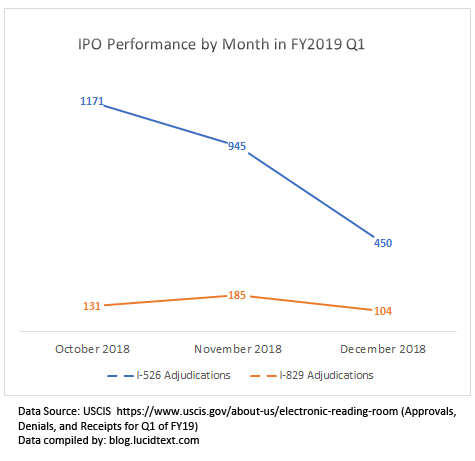
Complete I-526 and I-829 data for FY2019 Q1, by country

Buried deep in the Electronic Reading Room, where USCIS probably hoped no one would ever find them, are two Freedom of Information Act files that individually record every I-526 and I-829 receipt and adjudication from October to December 2018 (FY2019 Q1).

Being diligent, I discovered the files, and immediately converted them to Excel and got to work with pivot tables. This data allows fact-based answers, at least for one quarter, to questions generally subject to rumor and speculation.

  • How do USCIS processing times reports relate to actual processing times?
  • Have petition processing times differed by country?
  • Do approval rates differ by country?
  • From which countries are I-526 receipts coming?

Before considering answers to these questions from FY2019 Q1 data, consider FY2019 Q1 in context.

IPO apparently made dramatic processing changes between 2018 and 2019, and FY2019 Q1 has one foot on either side of that change.  So what happened in FY2019 Q1 isn’t necessarily representative of what came before or after. But for what it’s worth, here’s analysis of exactly what happened in that one quarter.

  • Processing Times Questions
    • Back in December 2018, the USCIS processing times report gave an “Estimated Time Range” of 20.5-26 months for I-526, and 30-39 months for I-829.  USCIS claims that in this range, “The first number is the time it takes to complete 50% of cases (the median). The second number is the time it takes to complete 93% of cases.” Presumably, these percentages get calculated from data for the previous month or two.
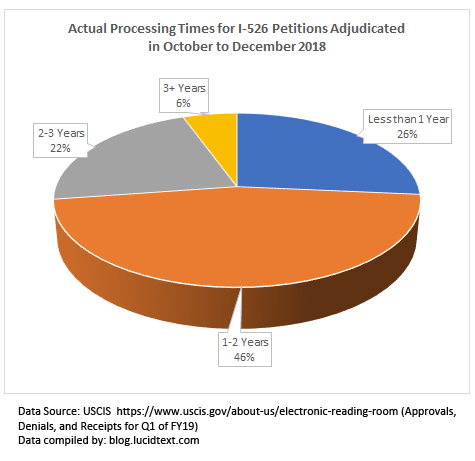
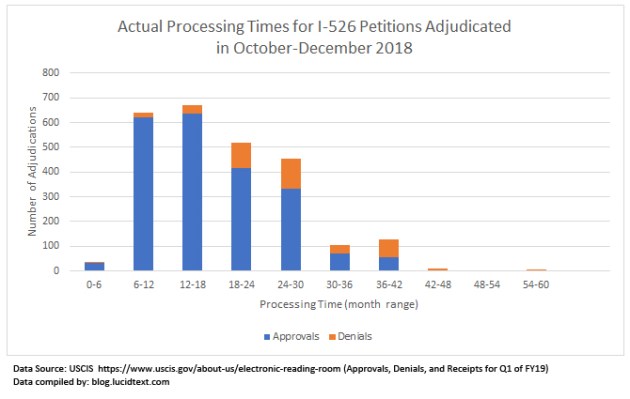
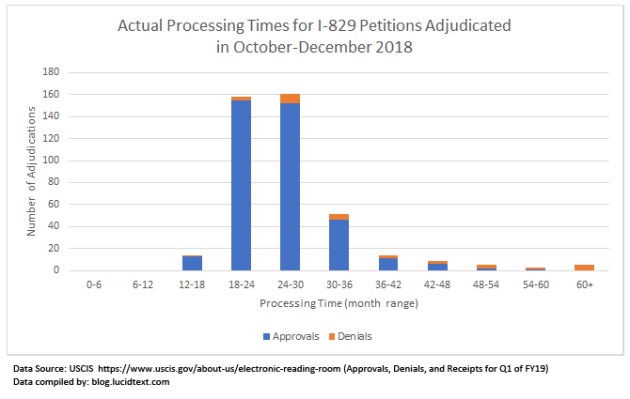
    • In reality, according to FY2019 Q1 data reports, 64% of I-526 adjudicated in October-November 2018 had been pending less than 20.5 months. 79% of I-829 adjudicated in October-November 2018 had been pending less than 27.5 months. Meanwhile, 16% of I-526 and 14% of I-829 adjudicated had been pending longer than the outer limit of the reported estimated time range.
    • In FY2019 Q1, the actual processing times for adjudicated I-526 and I-829 were quite a bit lower on average than the processing times report would suggest, and also had more deviation from average. The link between the contemporary processing times report and actual performance is not clear. Generally, the reality was somewhat better than the report.
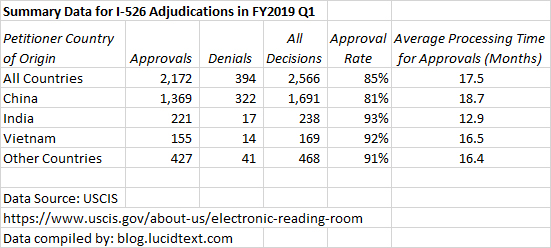
    • The average I-526 approved in FY2019 Q1 had been pending 17.5 months, while the average approved I-829 had been pending 26 months.
  • Country Questions
    • Data on I-526 adjudications for FY2019 Q1 shows differences by country, but not enough to suggest that USCIS was already using a visa availability approach last year.
    • The average processing time for Chinese I-526 approved in FY2019 Q1 was just two months longer than the average for other countries.
    • The average processing time for India I-526 approved in FY2019 Q1 was almost five months shorter than the worldwide average, likely due the influence of expedite requests. Indians accounted for 30 of the 36 I-526 processed in FY2019 Q1 within six months of filing.
    • Indians accounted for a majority (31%) of the I-526 filed in FY2019 Q1, followed by China (15%), Vietnam (11%), and South Korea (6%). Indians filed enough I-526 just in Q1 to use up over a year and half of the EB-5 visa quota for India.
    • Chinese, as might be expected considering past demand trends, accounted for the majority of I-829 filed (81%) and adjudicated (81%) in FY2019 Q1.
    • The I-526 approval rate in FY2019 Q1 was over 90% for most countries, but just 81% for China. I suspect this is due to USCIS’s surreptitious policy change regarding currency swaps, which particularly affects China.
  • Other Notes:
    • The records show that USCIS codes at least two kinds of I-526 denial: Denied Fraud, and Denied Others. In FY2019 Q1, only one petition was denied due to fraud.
    • USCIS may not have its best and brightest on data entry and record-keeping. The “country” column for I-526 receipts, for example, includes 20 petitions coded as coming from Falkland Islands (presumably standing for Great Britain, where DOS categorizes Falkland Islands), 13 from “Unknown,” 8 from USSR, and 1 from United States. Also the totals for the quarter do not exactly match the official report of I-526 and I-829 data for FY2019 Q1.  (For example, 1,808 I-526 receipts in the official quarterly report; 1,743 I-526 receipts recorded in this detailed report.) However, please do not be shy USCIS: publishing slightly inaccurate records is a thousand times better than hiding data, leaving the industry to rumor and speculation.
    • It’s always been clear that EB-5 processing is not simply First-In-First-Out. The USCIS Estimated Time Range for processing would obviously not be so broad under a FIFO system, and the range in actual processing times is even broader. But what explains why some petitions have been processed years earlier or later than others? One factor that’s obvious in the data — denial decisions go “out” much later than approvals.
    • To repeat: petition processing has not been strictly FIFO.  This is clear, looking at the dates of petitions that received decisions in this one quarter. The PDF files linked above record individual decisions. If the FY2019 Q1 record shows that one I-526 with X filing date got approved or denied, does that mean that every I-526 with X filing date has been adjudicated? No.

And now some charts based on the FY2019 Q1 data.

I’m compiling materials for a new data room, and hope to launch a new processing time estimate service later this month following the EB-5 stakeholder meeting with USCIS.

And a few legislative notes. Senator Mike Lee continues to work on the S.386 Fairness for Highskilled Immigrants Act to eliminate country caps and reorganize the order of EB visas. Could the bill that’s been on the table since 2011 actually move in 2020? I doubt, but Lee is pushing hard.  The competitor RELIEF Act has just a few sponsors so far.

Meanwhile, bright-eyed representatives Cardenas (D-CA) and Stivers (R-OH) have introduced H.R. 5971 Case Backlog and Transparency Act of 2020. This bill refers back to P.L. 106-313, which was passed in the year 2000 with this beautiful sentence in section 202: “It is the sense of Congress that the processing of an immigration benefit application should be completed not later than 180 days after the initial filing of the application.” (p. 12) H.R. 5971 proposes to revive that deadline, and require DHS to report in detail on backlog reduction efforts. Lovely! If only the current Congress could agree that immigration benefit applications should be processed efficiently.

And as always, my PayPal link is open. If my work to find and analyze data is helpful and time-saving for you, consider making a contribution to support the work. And thanks to my past contributors!