Why I-526 processing time is relevant

Another response to the announcement “USCIS Adjusts Process for Managing EB-5 Visa Petition Inventory.” Today’s question: Does timely I-526 processing really benefit, or make a difference, to everyone? What about people from countries facing long visa wait times regardless? Does someone from Vietnam care about getting I-526 approval in 2020, if he can’t expect a visa until 2024 anyway? In fact, shouldn’t he rather wait as long as possible for an I-526 decision, since his children are protected from aging out so long as the petition is pending?  Assuming he chose a good project and prepared a solid petition, why care whether the I-526 gets approved early or late?

I argue that processing time is relevant for all petitioners, and that the limited benefit of delay does not outweigh the major drawbacks.

  • Extended child status protection is indeed a benefit of extended I-526 processing time for someone with a long visa wait anyway.
    • If I’m guessing correctly about how USCIS would implement the “visa availability approach,” and near-term processing volume, USCIS may take about a year longer to adjudicate China and Vietnam I-526 than it would’ve taken under the supposed current FIFO approach. If so, that would add one more year to the time that the dependents of Chinese and Vietnamese petitioners can have their ages frozen. (I’m not contemplating the possibility that USCIS might look at Oppenheim’s visa wait time estimates, and plan to just shelve Chinese I-526 for sixteen years, and Vietnamese I-526 for seven years, regardless of rest-of-world demand. Because that would be crazy, from every angle besides helping child status protection.)
    • However, children only benefit if the immigrant petition ultimately succeeds. Delay increases the likelihood that the I-526 may be denied due to circumstances outside the petitioner’s (and often outside the project company’s) control, and the pain of such failure.
  • Adjudication timing can affect the adjudication outcome, even for investors in successful projects.
    • In a fair world, a petition that’s approvable when it’s filed should still be approvable whenever it’s adjudicated, provided that project problems don’t emerge in the meantime. In practice, USCIS sometimes denies originally approvable petitions in projects that succeed. This happens when USCIS policy interpretations shift between the time of filing and the time of adjudication. At the base of this post, I’ve compiled some specific examples of this happening, when USCIS changed thinking over time about investment structures, source of funds, and evidence requirements. (When USCIS admits a policy change, there’s protection from retroactive application, but this protection doesn’t apply when the shift isn’t officially acknowledged as a change.) Long processing times maximize vulnerability to such interpretation shifts. A petition is most likely to be judged by the standards that prevailed when it was filed if it’s adjudicated somewhere near the time it was filed. That’s a major reason to advocate for timely processing for everyone. People won’t file I-526 if they can’t predict the standards that will apply when the I-526 is adjudicated.
  • Timely I-526 adjudication has benefits, even if the visa is not yet available.
    • If the petition will be approved, it’s best to get the approval as soon as possible. I-526 approval establishes a priority date, and the protections that come with having a priority date. (For example, grandfathering under existing rules in case of adverse legislative changes.)
    • If the petition will be denied, it’s best to get the denial as soon as possible. A prompt denial decision reduces uncertainty, increases transparency, helps to catch and stop frauds, and opens the possibility for investor protections and recourse such as denial-triggered exit strategies and approval-contingent escrows.
    • If material changes could happen during the course of the visa wait, it’s best if they happen after I-526 approval. The priority date of the approved I-526 may be retained even if material change necessitates moving investment to a new project, under the priority date retention policy. If the material change happens prior to I-526 approval, there’s no recourse. Also, consular officers are less likely than USCIS to flag changes as material for hypertechnical reasons.
  • I-526 processing times can be relevant to visa wait times. For example:
    • There were enough I-526 filed in FY2012 to use the full annual EB-5 visa quota. But due to I-526 processing delays, Department of State issued less than the full quota of EB-5 visas in FY2013. Visa numbers went to waste in 2013 because USCIS didn’t move people to the visa stage in time. At recent dismal processing volumes, USCIS will have to hustle to advance sufficient India petitions to maximize annual available visas.
    • Charles Oppenheim of Department of State estimated in October 2019 (a) that Indians filing “today” faced a 6.7 year visa wait, and (b) that India could possibly be “current” in the October 2020 visa bulletin. How could (a) and (b) both be true? Answer: if most of the India backlog stays stuck at USCIS, instead of advancing to the visa stage. Currently, I-526 processing is creating the visa bulletin for India, as Department of State moves the Final Action Date depending on how many I-526 approvals for Indians come out of USCIS, and the priority dates on those approvals. The “visa availability approach” concept predicates I-526 processing priority on visa availability. The current India situation shows how visa availability results from I-526 priority. I don’t know whether USCIS has considered how to handle such a Catch 22.

Examples of how I-526 adjudication timing has been relevant even for I-526 with no project problems

Project Documents Examples

  • In 2018, IIUSA wrote a letter to USCIS that discussed problems with long processing times, including changing policy interpretations that occur over the course of the wait time. The letter noted that “IIUSA member Regional Centers report an increase in requests for evidence (RFEs) on pending I-526 petitions, even for projects with I-526 and I-924 petitions already approved.” Some RFEs simply requested updated project information, and would have been unnecessary had the I-526 been adjudicated in a timely manner, when its project documents were still up-to-date. Other RFEs suggested that USCIS was applying new internal policy guidelines. For example, bridge financing arrangements that had previously been approved were being held to unpublished new standards regarding the timing and flow of funds. “The lack of consistent adjudication, and the application of policies developed without public input or visibility, applied retroactively, threatens the viability of the entire EB-5 program: How can projects start and investors invest, based on today’s policies, only to find that the projects and investors are adjudicated based on new policies developed while the petitions wait years for adjudication?”
  • According to the precedent decision Matter of Izummi (1998), EB-5 applicants who are guaranteed repayment of their capital contributions have not made true investments. Historically, USCIS applied Matter of Izummi to prohibit only arrangements which give an EB-5 investor the contractual right to receive back some or all of her capital contribution. However, in recent years USCIS began denying I-526 based on an interpretation that redemption rights given to the new commercial enterprise are also impermissible. [Kurzban & Pratt] The case Chiayu Chang, et. al., v USCIS concerns six investors who made investment and filed I-526 between December 2013 and September 2014. Their Limited Partnership Agreements included a call option of a kind that had been standard in many EB-5 offerings, and previously been approved by USCIS. The investors received RFEs in July and August 2015 that mentioned no problem with the Limited Partnership Agreement. Then in December 2015, the investors received Notices of Intent to Deny based on the call options in their LPA.

Source of Funds Example: Currency Swap

  • Historically, USCIS accepted currency swaps as an acceptable method for transferring funds to the US, and generally did not examine the background of the party providing US dollars in the currency swap. [Hermansky]
  • In 2017, for the first time, USCIS started issuing RFEs to Chinese investors who used third party money exchangers to transfer money to the US. [Klasko] No explicit policy change was ever made, but RFEs starting in 2017 indicated that USCIS was changing its policy interpretation and adjudication practice.
  • JAN142020_02B7203.pdf is an example of a petitioner who made an EB-5 investment in 2016, using the then-accepted currency swap practice to move funds out of China. The petition was not adjudicated until 2018 or 2019, at which point USCIS applied the new policy interpretation regarding currency swaps, and requested source-of-funds documentation for the third party who facilitated the currency swap. No one knew back in 2016 that such documents might be requested, and the petitioner did not have them in hand. The third party, when approached with USCIS’s belated evidence request, “was not willing to provide any financial documentation due to concerns regarding his privacy and security.” USCIS then denied the petition for insufficient source of funds. The petitioner appealed, claiming “it was unreasonable to request [the third party’s] financial documentation because, at the time of I-526 filing, USCIS did not require a third-party exchanger to provide his or her personal banking, business, and financial records, and it was not anticipated by the [Petitioner], his parents, or the [Petitioner’s] attorney, that such a requirement was forthcoming.” AAO did not accept this argument, and dismissed the appeal. The currency swap issue that did not exist at the time of I-526 filing was the sole basis for denial. If the petition had been adjudicated promptly, based on the policy interpretation and adjudication practice that prevailed at the time of filing, it could have been approved because it had all the evidence then required. And this approval, once made, would not have been revisited later despite new policy interpretations, since source of funds are not an issue at the visa application or I-829 stages.

Source of Funds Example: Indebtedness (fact pattern described in Zhang v. USCIS)

  • The EB-5 regulations have long specified that “capital” invested in an enterprise can include indebtedness secured by assets owned by the alien entrepreneur, provided that the investor is personally and primarily liable, and that NCE assets are not used to secure the indebtedness.
  • On December 23, 2013, Mr. Huashan Zhang made a $500,000 cash investment in an EB-5 NCE. He obtained the invested cash via a loan from a company that he owns, secured by his undistributed profits held by the company.
  • In a stakeholder meeting on April 22, 2015, IPO Deputy Chief Julia Harrison expressed an interpretation of the regulations that, for the first time, introduced a “collateralization test” on the value of assets used to secure cash obtained from third party loans.
  • USCIS made a decision on Mr. Zhang’s I-526 on May 28, 2015, and denied the I-526 based on a finding that Mr. Zhang’s loan was not properly secured, as expressed in the collateralization test stated the April 22, 2015 stakeholder meeting.
  • In June 2015, Mr. Zhang and another petitioner filed suit in district court on behalf of themselves and all other investors who had filed I-526 prior to 2015, and subsequently denied based solely on the ground that the loan used to obtain the invested cash fails the collateralization test described in the 2015 IPO remarks. They claimed that the 2015 interpretation was erroneous, put out without proper notice and comment, exceeded authority, and wrongly applied to their I-526 filed before the interpretation. The court agreed with them, resulting in the class action decision Zhang v. USCIS, No. 15-cv-995. This decision was issued on November 30, 2018, and subsequently appealed by USCIS on January 28, 2019.
  • To review, then, the condition of I-526 filed in 2012/2013 if they had one common factor — investments including cash based on indebtedness – but were adjudicated at different times:
    • If the I-526 was adjudicated promptly in 2013/2014, it was probably judged based on policy interpretation at the time of filing. Mr. Zhang’s petition could’ve been approved.
    • If the I-526 was adjudicated 2015 to 2018, it faced the collateralization test first defined in 2015. Mr. Zhang’s 2013 petition was denied in 2015 for a factor not applied to earlier adjudications. (The log of AAO appeals include other examples – for example NOV092016_02B7203, a petitioner who invested and filed I-526 in 2012, and was denied based on the 2015 policy interpretation when her case was finally adjudicated in 2016.)
    • If the I-526 was adjudicated in December 2018, it could be approved with no limitation from the “collateralization test” thanks to the Zhang v. USCIS
    • If the I-526 had still not been adjudicated by January 2019, when USCIS appealed Zhang v. USCIS., it is currently still on hold at USCIS. Whether and when it can eventually be approved or denied depends on the outcome of the appeal.

In summary: timely I-526 processing is important and relevant. Let’s fight for it for everyone!

Other Reactions

Here’s my full agenda for posts in response to the announcement “USCIS Adjusts Process for Managing EB-5 Visa Petition Inventory.”

  1. Argue that when USCIS has proven capacity to give timely processing to all I-526 currently pending, it should not be reducing capacity, necessitating policy to restrict who gets timely processing. [Addressed in last week’s post.]
  2. Discuss how and why I-526 processing time is relevant even for petitioners from high-volume countries who still face a visa wait following I-526 approval. [This post.]
  3. Discuss what a visa availability approach could mean for petitioners from low-volume countries, and calculate the potential processing time impact of the change. [Coming later this week.]
  4. Discuss how and why I-526 processing time makes a practical difference for USCIS, and how delays impact the nature and quality of adjudications. [Coming soon.]
  5. Define questions that I’d like USCIS to answer regarding how it would implement the visa availability approach. [Coming soon.]
  6. Discuss the significance of processing times and processing order for businesses that use EB-5 investment. [Not sure if I’ll have time for this, but someone should write it.]

The topic is important, because the viability and integrity of the EB-5 program depend on fair and efficient processing.

Are these posts helpful? If so, please consider making a contribution to support the work.
I-526 processing times: volume and priority (Comment 1 on the “visa availability approach”)

I’m in my car at the terminal, waiting to board the ferry. There are 15 cars waiting.  The ferry can hold 15 cars. The deck hand comes out and tells the cars to reorganize. “We’re not doing first come first up anymore – today we’re boarding day-trippers first.”  I’m puzzled – why this bother? Why are they troubling to rearrange the cars, when in any case there’s room for everyone to board? Are they fussing about priority because they’re reducing the ferry capacity, and preparing to leave some cars behind?

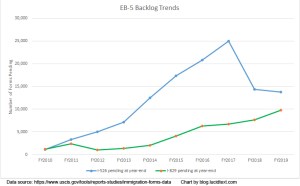
I’m an EB-5 investor today with an I-526 pending. Say there are about 15,000 other I-526 petitions pending now. (There were just 13,763 pending at last report as of 9/30/2019.) We know IPO adjudicated over 15,000 I-526 petitions in FY2018. 15,000/15,000 = 1. Calculating from IPO’s proven capacity for adjudications, all pending I-526 can be processed and to the visa stage in about one year.  Whether the adjudications are in FIFO order, or in order by country, or alphabetical, or totally random, I-526 wait times from today will all be about a year at very most for anyone and everyone in the current backlog (and even shorter for new petitions in an era of low receipts), if IPO does its job and uses its capacity.  In that case, all minority country petitioners will reach the visa stage in time to claim annual visas, regardless of how IPO orders I-526 from China, Vietnam, and India. If IPO has proven capacity to clear the entire current backlog in a year, why does it now announce a new policy for choosing which I-526 get “approved in a more timely fashion to receive consideration for a visa,” going forward? Why not adjudicate everyone in a timely fashion, when that’s a plausible option? Are they fussing about priority because they’ve reduced capacity, and gathering excuses to leave petitions behind?

Today’s press release “USCIS Adjusts Process for Managing EB-5 Visa Petition Inventory” provokes us to focus on the order of I-526 processing, and who should get attention first. But why even accept that discussion before pointing out the more significant factor: volume of processing. Petitioners from traditionally underrepresented countries are not threatened by pending I-526 petitions from China, Vietnam, or India, when there’s room on the I-526 ferry for everyone. The threat is the processing volume trend line. USCIS has not explained how it’s fair to reduce the size of the ferry, and carry fewer and fewer people to the visa stage.

For people from China, Vietnam, and India, a potential perceived benefit from a “visa availability approach” is extended child status protection. (Such a benefit could emerge if USCIS is proposing to not only prioritize not-backlogged countries, but actually to shelve I-526 from backlogged countries until visa availability, be that 1 year or 15 years. regardless of other country demand. The press release isn’t clear on this point.) Some people might welcome an artificial delay for the children. But think about it: how much do frozen children benefit when the petition upon which they depend becomes less and less possible to approve – or indeed, even to adjudicate – as the years pile up? Businesses do not freeze, financial records don’t last forever, USCIS policy continues to evolve, and every year adds to the changes of fact and circumstance that can cause an I-526 to be denied. Such factors may contradict this point: “For many nationals of countries subject to retrogression, the I-526 petition processing time is largely irrelevant unless the primary applicant has a dependent child approaching the age of 21, in which case, this new processing approach can be extremely helpful.” The adjudication time is relevant when it make a significant difference in whether or not the petition will be approved, when it’s finally adjudicated. Not only that, but I-526 approvals bring some protection – they establish priority dates, open the possibility of priority date retention with project change, and offer protection in case of legislative changes. Those benefits are especially important to people facing long visa waits regardless. And furthermore, timely I-526 adjudications judge the petition on its merits at the time of filing, and consistent with its very nature as  preliminary-stage filing. Delayed adjudications effectively create a new stage with new requirements – as we see today from RFEs on delayed petitions that request years of documents not available at the time of filing, and traditionally belonging to the I-829 stage rather than preliminary I-526 stage. Meanwhile, for China, a “visa availability approach” has the further complication that it’s explicitly designed to maximize rest-of-the world demand reaching the visa stage, which directly minimizes visa available to China. And India, with its recent visa bulletin jumps due to “low demand” i.e. few I-526 approvals, exemplifies the complication that delays at USCIS actually skew visa availability.

For pending I-526 petitioners who are not from China, Vietnam and India, let’s consider what would help your processing times. If there are 15,000 pending I-526 now, I estimate there are about 5,000 of you. Consider which adjustment you’d rather have USCIS make:

  1. Address priority: Keep FY19 Q4’s dismal processing volume of 550 adjudications, but prioritize your petitions over the 10,000 from countries that aren’t current. 5,000 minority-country petitions divided by 550 adjudications per quarter equals 9 more quarters to finish processing.
  2. Address volume: No change to priority, but return to FY18 Q4’s processing volume of 4,000 adjudications. 15,000 worldwide petitions divided by 4,000 adjudications per quarter equals less than 4 quarters to finish processing.

The main point of this post: we should be talking about volume, before priority.

And not only that, but what’s this claim about a “visa availability approach” (a term that made its world premier today, according to Google) aligning with “congressional intent” for EB-5 and with “other visa-availability agency adjudications processes.” I’d like chapter and verse on this “Congressional intent” and how the approach has worked out for other Forms pending at USCIS. And additionally…. But even kind bloggers have to sleep sometimes, and keep time for the day job.

For everyone asking me individual timing questions, please be patient. I’ll get a paid service up as soon as I can, to explain as much as I can individually. With both volume and priority up in the air, it’s complicated and time-consuming.

3/13 EB-5 Engagement Invite

From: U.S. Citizenship and Immigration Services <uscis@public.govdelivery.com>
Sent: January 29, 2020 12:21 PM
Subject: EB-5 Immigrant Investor Program: Public Engagement, March 13, 2020

EB-5 Immigrant Investor Program: Public Engagement
Friday, March 13, 2020
11:00 a.m.-12:00 p.m. Eastern

U.S. Citizenship and Immigration Services invites you to participate in a public engagement meeting on Friday, March 13 11:00 a.m.-12:00 p.m. Eastern on the Immigrant Investor Program, also known as the EB-5 program.

This engagement is part of our ongoing efforts to enhance dialogue with the public on the EB-5 program. USCIS will address program updates, including the agency’s change from a first-in, first-out case-processing approach to a visa availability approach for Form I-526, Immigrant Petition by Alien Investor. You will have an opportunity to ask questions during the engagement.

Participation Details:
You may attend this engagement either in person at USCIS, 111 Massachusetts Ave. NW, Washington, D.C., or by teleconference. [UPDATE: now by teleconference only.]

If you wish to attend in person, please email us at public.engagement@uscis.dhs.gov. Seating is limited, so we encourage you to email early to request in person registration. Once we process your registration, you will receive a confirmation email with additional details.

To submit non-case-specific questions as agenda items before the engagement, email us at public.engagement@uscis.dhs.gov by 5 p.m. Eastern on Tuesday, Feb. 11.

To join the event via teleconference:
Call in Toll Free number: (888) 946-7792
Toll number for international callers: (517) 308-9375
Participant Passcode: 3996336

We recommend calling in 10 to 15 minutes before the teleconference begins.

To request a disability accommodation:
Email public.engagement@uscis.dhs.gov, and put “EB-5 Engagement” in the subject line.

Note to media

This engagement is not for press purposes. Please contact the USCIS Press Office at 202-272-1200 for any media inquiries.

We look forward to engaging with you!

USCIS Adjusts Process for Managing EB-5 Visa Petition Inventory

USCIS has officially announced an I-526 priority change I saw coming. People from China, Vietnam, and India with pending I-526: you need to organize to inform IPO how you feel about this. I plan to write about an aspect I doubt IPO recognizes: how USCIS adjudication order can create and skew EB-5 visa availability, with particular reference to the examples of China and India. I also have to go back and revise the new I-526 timing estimate service that I’d been almost ready to post.

From: U.S. Citizenship and Immigration Services <uscis@public.govdelivery.com>
Sent: January 29, 2020 8:33 AM
Subject: USCIS Adjusts Process for Managing EB-5 Visa Petition Inventory

Change Addresses Fairness Issues in Visa Allocation

WASHINGTON— U.S. Citizenship and Immigration Services today announced a process change for Form I-526, Immigrant Petition by Alien Investor, from a first-in, first-out basis to a visa availability approach.

This new operational approach aligns with other visa-availability agency adjudications processes, is more consistent with congressional intent for the EB-5 Immigrant Investor Program, and increases fairness in the administration of the program.

“Changing our approach from a first-in, first-out adjudication process to one that prioritizes petitions connected to individuals from countries where visas are currently available better aligns the EB-5 program with congressional intent and makes it more consistent with other USCIS operations,” said USCIS Deputy Director Mark Koumans. “This new approach increases fairness, allowing qualified EB-5 petitioners from traditionally underrepresented countries to have their petitions approved in a more timely fashion to receive consideration for a visa.”

This operational change is consistent with the agency’s processing of Form I-130, Petition for Alien Relative, in cap-subject categories. The new visa availability approach simply gives priority to petitions where visas are immediately available, or soon available, and will not create legally binding rights or change substantive requirements. Applicants from countries where visas are immediately available will now be better able to use their annual per-country allocation of EB-5 visas. The new visa availability approach will apply to petitions pending as of the effective date of the change. USCIS will implement the visa availability approach on March 31, 2020.

USCIS will hold a public engagement on March 13, 2020, from 11:00 a.m. to noon Eastern, to provide information and answer questions from the public about these operational changes to the management of Form I-526 petition inventory.

2/2020 Visa Bulletin India FAD

The February 2020 Visa Bulletin has a Final Action Date of September 1, 2018 for India.  This represents another dramatic jump (with the January visa bulletin having a May 1, 2018 final action date). I previously wrote about overall EB-5 visa timing in 2020. This post attempts additional clarifications specific to EB-5 petitioners and applicants born in India.

February’s visa bulletin does mean:

  • that visas can be issued in February to qualified Indian applicants with priority dates before 9/1/2018 (Qualified applicants are at the visa stage, having already received I-526 approval)
  • that there are few Indian applicants at the visa stage (A note at the end of the January 2020 visa bulletin explains that the India final action date will proceed rapidly in 2020 so long as demand is low — i.e. so long as few Indians are in a position to apply for a visa)

February’s visa bulletin does not mean:

  • that India demand is low at the I-526 stage
  • that visas are available to people with pre-9/1/2018 priority dates whose I-526 are still pending
  • that USCIS has processed or will soon process most India I-526 with pre-9/1/2018 priority dates
  • that Department of State has already finished issuing visas to all Indians with priority dates before May 1, 2018 (the final action date in January 2020’s visa bulletin)
  • that having reached September 2018, India’s final action date will continue to advance in the future, and will not turn back

In fact, USCIS indicates that it is currently working on I-526 filed 32.5 to 49.5 months ago (i.e. 2015 to 2017 priority dates). I-526 adjudications are not guided by the visa bulletin. Ideally, USCIS would process petitions in the order received, so that people reached the visa stage more or less in order by priority date. But evidently, this is not the case. Some 2018 priority dates are getting visas now even as some earlier priority dates remain at the I-526 stage.

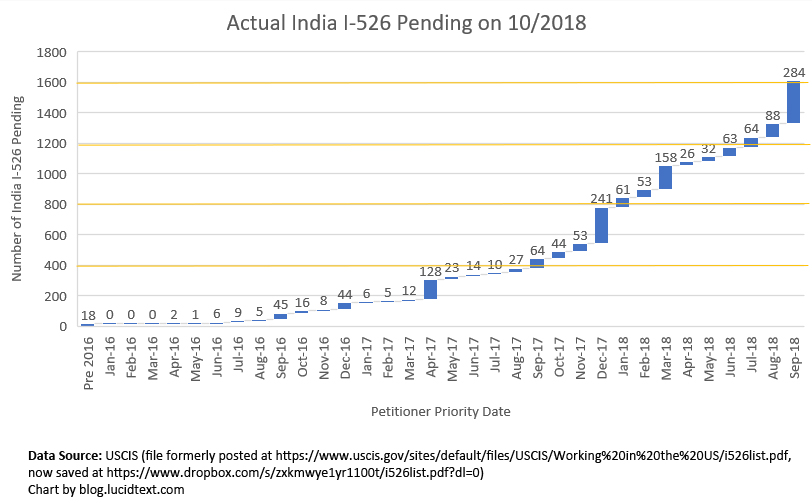
We know that Indians filed at least 525 I-526 petitions from January through August 2018. (That’s how many I-526 were pending from those priority dates as of October 2018, when USCIS published this I526list report.) Over 500 I-526 would conservatively result in over 1,000 visa applications. Over 1,000 visas would take over one year to issue. So when the Visa Bulletin jumps from January to September 2018 in just three months, it’s evident that most people with those priority dates just haven’t even reached the visa stage. If they had, the visa bulletin would slow down to the time needed to issue over 1,000 visas.  And recall the 781 Indian I-526 with pre-2018 priority dates that were still pending at USCIS at the end of 2018 — some of those must still be in the system as well.

For Indians with priority dates before 2019, I suggest gazing at the I526list report from October 2018. Add up the number of pending I-526 with priority dates before yours. Estimate the number of visa applicants associated with those I-526. Subtract the number who could possibly have received visas since then, considering the number of I-526 adjudicated worldwide and number of visas issued to Indians since October 2018. The result estimates the number of people still with priority to get a visa before you do — assuming they can reach the visa stage. That result divided by 700 is your approximate wait time, in a FIFO world. But we’re not in a FIFO world, as the disconnect between USCIS processing time reports and the visa bulletin shows. As things stand, some people from India will get a visa unexpectedly early, and some unfairly late.  The visa bulletin will jump around, depending on who reaches the visa stage when. There’s room for hope, and room for fear — just not much predictability at this stage.


FY2019 Q4 Petition Processing Statistics

USCIS has published processing data on the Immigration & Citizenship Data page for July through September 2019 (FY2019 Q4).

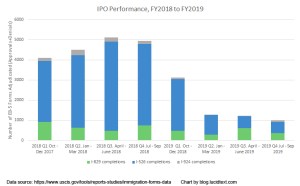
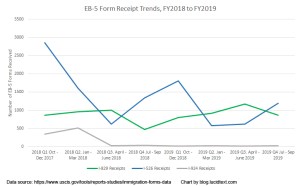
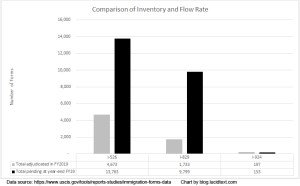
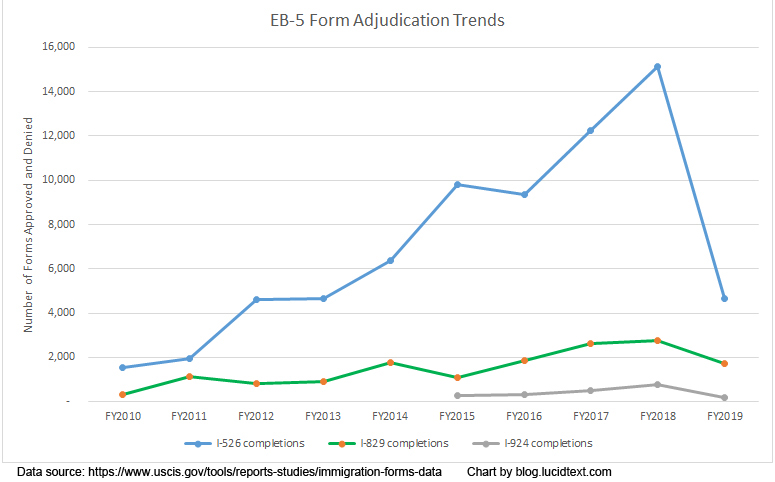
I eagerly awaited this update, with three questions in mind. Would IPO start to recover processing volume in Q4, considering that previous reductions were credited to relatively minor and temporary factors (the RC authorization lapse in Q2 and I-526 training in Q3)? Would denial rates remain high? How large was the I-526 filing surge ahead of the regulations?

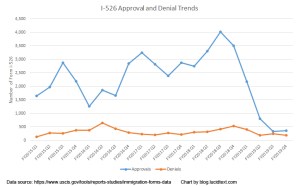
Now we know that IPO performance did not recover — yet —  in Q4. I-526 and I-829 denial numbers have not increased significantly. The I-526 denial percentage rose in Q3 and remained elevated in Q4 because approval numbers were so much lower than before.  People who filed I-526 by the end of September apparently got in before any significant pre-regs I-526 surge.

I-924 was a minor part of IPO’s FY19 workload, with few receipts and few pending forms. Denial numbers are remarkably high, but I suspect that many are actually withdrawals due to delayed processing. I-924 requests for exemplar approval lose value to the applicant if not adjudicated quickly.

I have a few questions for IPO Chief Sarah Kendall.

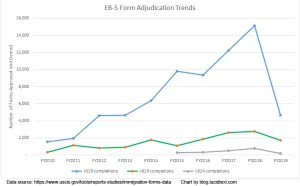
  1. IPO adjudicated 2.8x more forms in FY2018 than FY2019. Please explain.
  2. In one year under your leadership, IPO reversed five years of processing improvements, regressing to 2013 performance levels. Do you consider this reduced processing volume a problem that you plan to fix, or an expected outcome in your overall strategy?
  3. IPO had almost twice as many staff in FY19 as it had in FY15 (214 vs 110), yet adjudicated 41% fewer forms in FY19 than FY15. Productivity per staff member was 69% lower in FY19 than it was in FY15. Do you consider this productivity loss a problem that you plan to fix, or an expected outcome in your overall strategy?
  4. Looking at service-wide processing data between FY18 and FY19, EB-5 forms are the only EB forms that fell behind – other EB forms show increased approval numbers year-on-year. In fact, Form I-526 and I-924 rank #3 and #1 for worst performance in the entire service (with, respectively, 74% and 88% fewer approvals in FY19 and FY18). Only Form I-821 for Temporary Protected Status can compete, with approvals falling by 87%. Should we take a political message from these facts? Or does DHS see a problem and plan improvements in 2020?
  5. Do you recognize the connection between efficiency and integrity? Do you see the problem in denials that come too late to stem bad deals, and approvals that come too late to save good deals? Do you have a plan to strengthen program integrity by improving efficiency?
  6. If IPO continued FY19 processing volume into the future, then the current I-526 backlog would take three years to process, and the current I-829 backlog would take six years to process. How does IPO plan to improve going forward, to avoid such long times becoming the reality?
  7. What is your goal for processing volume in FY2020? How do you plan to reach that goal?

The decade in review

January 2020 marks the 10th anniversary of this blog, and 12 years since I started writing business plans for immigrant investment. I’ve been looking back on years of work and EB-5 reporting, picking out significant milestones on the path that led us to today.

This post is long, because each of the past ten years brought major developments to the EB-5 drama – a drama involving the real-life fate of billions of dollars, thousands of businesses, and tens of thousands of immigrant families.

(Note: I wrote this post without links, but have references for all points. The blog archives are open, named articles can be Googled, and my consulting service is available to people seeking specific detail and evidence related EB-5 developments over the years.)

2010

  • EB-5 was still small, in 2010. The year began with 75 regional centers nationwide, and ended with 104 approved RCs plus about 200 applications pending. The new Form I-924 with filing fee took effect for the first time on November 23, 2010, and the deadline encouraged a surge in regional center proposals.
  • About 2,000 I-526 petitions were filed in FY2010, with the top countries being China (66%), South Korea (8%) and Iran and Taiwan (3% each). Fewer than 2,000 EB-5 visas were issued for FY2010, a fraction of the available quota. 41% went to China.
  • USCIS had an “established processing target” of five months for Form I-526 and Form I-829. The California Service Center stayed within one month of meeting those targets. The magic words “visa fast track” appeared frequently in EB-5 promotions, and held true through about 2013.
  • The regional center program was riding on a three-year authorization through 2012, with proposals to make the program permanent.
  • USCIS began holding quarterly EB-5 stakeholder engagements that provided substantive information and answered questions. (The Meeting Log page off the Resources tab on this blog links to notes from all EB-5 engagements since 2009.)
  • Reuters picked up “Special Report: Overselling the American dream overseas,” an investigative report about the emerging EB-5 market. This report helped to raise awareness about integrity issues, and likely contributed to some subsequent denials and litigation. The term “Wild West” frequently appeared in industry conversations in those days, as we discussed the rapidly-growing and not-yet-quite-civilized EB-5 frontiers.
  • A majority of the EB-5 business plans I wrote were for shopping center developers. Tenant jobs could be counted.

2011

  • USCIS Director Alejandro Mayorkas prioritized the EB-5 program, and pushed for more professional staff, accelerated processing, and better communication between USCIS and stakeholders. In 2011, USCIS began hiring economists, business analysts, and economic development specialists to improve EB-5 adjudications.
  • There were 211 approved regional centers by the end of 2011, and 3,805 I-526 petitions were filed in FY2011 (both about double the previous year). Demand from China increased 130% in one year. A factor in this growing usage was the partial shutdown and then major price increase for Canada’s immigrant investor programs, which had been popular in China. (Previous experience with the Canadian programs contributed to misconceptions in the China market about the level of US government control over EB-5 regional centers and projects.)
  • The House Judiciary Committee held a hearing titled “The Investor Visa Program: Key to Creating American Jobs” in which all speakers praised EB-5. The Senate also held a generally positive hearing on extending the regional center program.
  • Stakeholder meetings and RFEs questioned whether or not a census tract group qualifies as a “geographic area” for TEA designation. RFEs challenged regional center applicants to justify the size of the geographic areas for which they were applying.
  • USCIS released a first draft of the EB-5 Policy Guidance memo that would eventually be finalized two years later. Existing EB-5 policy guidance was sparse.
  • The industry site now called EB5news.com published the article “Huge Chicago EB-5 Multi-Hotel Project Under Scrutiny by Investors.” This scrutiny proved wise, as the Chicago Convention Center project went on to become, in 2013, the target of the first major SEC enforcement action in EB-5.
  • Regional centers filed I-924A Annual Reports for the first time.
  • The regional center directory at uscis.gov was reformatted to remove regional center contact information and business detail, leaving names only. I had to work harder to update the blog RC List page.
  • A majority of the EB-5 business plans I wrote in 2011 were for new regional center applicants, many of them Chinese Americans.

2012

  • Senators Grassley and Leahy co-sponsored a bill to grant permanent authorization to the “successful, job-creating” regional center program. Leahy’s press release proudly noted that EB-5 had “brought economic development and job growth to Vermont since 1997.” President Obama eventually signed S.3245 (sponsored by Senator Leahy), giving the Regional Center program another three-year authorization. This was the last time the regional center program got an authorization that was more than a few months long, and not part of an appropriations bill.
  • USCIS Director Mayorkas announced the creation of a “new dedicated program office” for EB-5 designed to ensure that “this important and complex program is appropriately resourced and managed under a single leadership structure.” Hiring began for the new Immigrant Investor Program Office (IPO) in Washington D.C.
  • The “tenant occupancy” issue emerged. We had heard about petitions and applications “on hold at USCIS headquarters pending resolution of an issue,” and gradually discovered the nature of the issue as RFEs began to question counting jobs associated with tenants in buildings constructed with EB-5 capital. By the end of the year, USCIS released Operational Guidance for Tenant Occupancy that made it effectively impossible to get credit for tenant jobs.
  • I-526 filings jumped to 6,041 in FY2012, with 87% filed by people born in China.
  • The December 2012 Visa Bulletin announced that due to volume of demand, there would likely be a cut-off final action date for China-born EB-5 investors as early as June 2013. The EB5 Insights blog noted that “Ultimately, this could stymie the demand for EB-5 visas by Chinese nationals and have an adverse impact on regional center operators.” This fact was not well-publicized in China, however. EB-5 demand at the visa stage was still well under quota in FY2012, with 6,628 visas issued worldwide.
  • With the tenant occupancy problem discouraging EB-5 investment in retail developments, I found myself writing many business plans for new hotels.

2013

  • By April 2013, the Investor Program Office in Washington DC was open and adjudicating I-924 applications. USCIS Director Mayorkas continued to hold many EB-5 stakeholder meetings and to fight for more resources, professionalism, and transparency for EB-5 adjudications. The political backlash hit when he was nominated as DHS Deputy Secretary, and subject to investigation over his EB-5 efforts.
  • I-526 processing was reported at about one year through 2013, and Director Mayorkas stated a goal to reach 90-120 day processing times for all EB-5 forms. (If we believe current USCIS processing times reports, IPO is still, to this day, processing I-924 filed back in 2013.)
  • President Obama announced immigration objectives that included making the regional center program permanent. EB-5 legislation got a chance as part of S.744, the Border Security, Economic Opportunity, and Immigration Modernization Act that passed the Senate. This comprehensive immigration reform bill would have increased EB-5 visa numbers, among other improvements, but it died in the House.
  • The May 30, 2013 EB-5 Adjudications Policy Memo took effect, providing the first comprehensive collection of EB-5 policy guidance. This memo finally settled the census tract group issue, stating that USCIS should defer to state determinations as to TEA area. In a surprise twist, the memo freed regional centers to sponsor projects outside of pre-approved focus areas. (This freedom was later curbed just as abruptly in 2017 with a stakeholder meeting comment on an I-924 form revision.)
  • The Chicago Convention Center SEC complaint dropped, the first major SEC enforcement action in EB-5. The SEC held a joint stakeholder engagement with USCIS about EB-5 securities issues, and published an investor alert “Investment Scams Exploit Immigrant Investor Program.”
  • The Office of Inspector General conducted an audit which found that “USCIS cannot administer and manage the EB-5 regional center program effectively.” OIG particularly recommended additional authority for regional center termination and more SEC coordination. Prior to this report, there had been five regional center terminations and one EB-5 SEC action.
  • IIUSA first published a list of recommended best practices for regional centers, and industry produced many due diligence articles such as “Protecting the integrity of the EB-5 investment market” (Butler) and “Perspectives on EB-5 Due Diligence” (Klasko).
  • By the end of the year, there were 424 approved regional centers. I-526 filings totaled about the same in 2013 as in 2012, with 83% from China.
  • When visa demand was lower than expected (i.e. the many pending I-526 petitions got approved more slowly than expected), Department of State indicated that China might not, after all, reach the per-country limit in 2013. The EB5 Insights blog reported this in February 2013 with the comment “This means that Chinese EB-5 applicants may continue to file EB-5 petitions without being subjected to a backlog.” (In fact, a couple more months of Chinese I-526 filings avoided backlog. China remained current in the visa bulletin until May 2015. But the first final action date for China, when posted in 2015, went back two years to cut off at May 1, 2013.) Industry articles on the retrogression issue in 2013 include “The myths of retrogression of the visa numbers in the EB-5 program” (Greenberg Traurig) and “The impact of Chinese quota retrogression on EB-5 investors and EB-5 investments” (Klasko).
  • In addition to regional center work, I started writing many business plans for direct EB-5 investment in new franchises. Meanwhile, I was pleased to see investors in my first EB-5 business plans start to receive I-829 approvals in 2013. Once upon a time, the entire EB-5 process could fit within five years.

2014

  • I-526 and I-829 adjudications were gradually transferred from the California Service Center to IPO, which had a staff of 94 by the end of 2014.
  • USCIS began collecting stakeholder input for proposed new EB-5 regulations. This process eventually resulted in a proposed rule in 2017 and a final rule in 2019.
  • USCIS started regional center termination efforts in earnest, issuing over 50 notices of intent to terminate in 2014. These notices began to result in actual terminations in 2015, primarily for inactivity or missing an annual report. Increased SEC activity become evident with five complaints targeting EB-5 projects in 2014/2015. The new IPO office included a 15-member Fraud Detection National Security Team with plans to expand site visits and compliance reviews.
  • Recognizing a growing problem in processing times, I started to record monthly USCIS processing times reports in the Excel log that I continue to update to this day. Through 2014, processing times averaged 13 months for I-526 and 9 months for I-829. We thought that was too long.
  • I-526 filings nearly doubled again, with 10,950 filed by the end of FY14 (88% from China). Meanwhile, growing demand finally reached the visa stage, and EB-5 hit its annual quota for the first time with over 10,000 visas issued in FY2014.
  • The industry continued to discuss the problem of visa availability for China, with articles such as “IIUSA VP Robert C. Divine on Saturday’s Announcement of EB-5 Visa Unavailability for China for Remainder of FY-2014” (IIUSA blog), “FAQs on EB-5 Quota Backlog by H. Ronald Klasko” (IIUSA blog), and “Surviving and Thriving in Times of EB-5 Quota Backlogs” (Klasko). China remained current in the Visa Bulletin, as most future visa applicants were still waiting for I-526 approval.
  • USCIS first promised to work on a guidance memo for retrogression issues. (There was, at that time, no redeployment policy.)
  • Hotels and restaurants continued to provide a significant amount of my EB-5 business plan work, and for the first time I had more ethnic Indian than Chinese clients.

2015

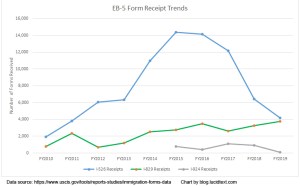
  • The decade’s peak EB-5 demand came in FY2015, with 14,373 I-526 petitions filed, 85% of them from China.
  • The I-526 surge clustered around the sunset of the regional center program authorization that had been in effect since 2012. Over 6,000 I-526 petitions were filed in the quarter leading up to the original sunset date of September 30, 2015, and another 6,000 in the quarter ending in December 2015, when Congress finally granted EB-5 a one-year clean extension instead of enacting proposed changes. This volume has not been equaled since. (And IPO is still, to this day, adjudicating I-526 filed in 2015.)
  • The 2015 regional center program sunset date brought a rush of legislative activity, with five bills proposed that would’ve increased the minimum EB-5 investment amount (with $1.2M or $800K in a TEA being the most common proposal) and tightened TEA rules. Language from Grassley and Leahy’s S.1501 reportedly nearly became law in December 2015. But instead, “the legislation was defeated by a group of lawmakers led by New York Democrat Chuck Schumer, who argued that security improvements were a good idea, but the way the reform was written would unfairly hurt investments in his home state.” This story was to be repeated yearly for the rest of the decade.
  • Friedland & Calderon published “A Roadmap to the Use of EB-5 Capital” that included a Large-scale Projects Database profiling 25 EB-5 projects – of which 19 were in New York, mostly Manhattan. While regional center projects in 2013-2015 had an average 15 EB-5 investors each program-wide, according to DHS data, the top ten projects in Friedland & Calderon’s 2015 database averaged over 600 EB-5 investors each. These large-scale projects helped fuel the surge in I-526 filings in 2014 and 2015. They also fueled political controversy, as billions of EB-5 capital concentrated in a few high-profile urban projects that used the TEA incentive.
  • China began to have a cut-off date in the May 2015 Visa Bulletin, and advanced through most 2013 priority dates by the end of 2015. But the massive filing surge in late 2015 dramatically worsened the China visa backlog problem. Robert Divine’s article “The Realities and Implications of Chinese EB-5 Investors’ Wait for Visa Numbers” (IIUSA blog) noted that Chinese filing I-526 as of the end of 2015 likely faced at least a six-year wait for visa availability.
  • USCIS first raised the redeployment issue in August 2015, releasing a draft memo of “Guidance on the Job Creation Requirement and Sustainment of the Investment for EB-5 Adjudication of Form I-526 and Form I-829.” This memo was never finalized. (Two years later, in June 2017, some redeployment language finally became policy through addition to the EB-5 section of the USCIS Policy Manual.)
  • The Government Accountability Office published “Immigrant Investor Program: Additional Actions Needed to Better Assess Fraud Risks and Report Economic Benefits” and DHS Director Jeh Johnson wrote a letter to Senators Grassley and Leahy that recommended EB-5 changes. These two documents strongly influenced subsequent legislative efforts, particularly by Senator Grassley.
  • My mix of EB-5 business plan work started to include more apartments and assisted living facilities. And I wrote a record number of direct EB-5 plans for franchise businesses.

2016

  • EB-5 demand fell in FY2016 but not by much, thanks to another I-526 filing surge ahead of the September 30, 2016 regional center program sunset date. A total 14,147 I-526 were filed, with somewhat fewer from China (77%) and more from Vietnam and India (3% each). Charles Oppenheim estimated a seven-year wait for new Chinese applicants as of the end of the year.
  • 2016 saw more EB-5 bills introduced and a lot of open discussion in Congress, with two EB-5 hearings in the Senate and one in the House. Unlike the generally positive tone of 2011, the 2016 hearings included some negative voices, and particular concern over perceived abuse of the TEA incentive. However, the new EB-5 bills progressively negotiated down the TEA incentive, and in the end no changes were passed.
  • The SEC filed a complaint in 2016 alleging fraud in EB-5 offerings sponsored by Vermont Regional Center. Vermont Senator Leahy, formerly an EB-5 champion, declared that “Without reform, I believe the time has come for the program to end,” and legislative efforts became more difficult.
  • The OMB and DHS Secretary Jeh Johnson averted us to possible new EB-5 regulations in 2017.
  • USCIS began to deny I-526 petitions based on finding loan proceeds to be nonqualifying capital, call options to be impermissible redemption agreements, and RC sponsor termination to be material change. These findings were not based on stated policy. Lawsuits eventually ensued, with some success so far.
  • The EB-5 chapter of the USCIS Policy Manual was released on November 30, 2016, and became effective the same day. Though nominally a handy compendium of existing policy and guidance documents, in fact the PM also introduced new policy related to material change, regional center applications, regional center amendments, and regional center termination.
  • The trend of sprawling multi-state regional centers began to emerge, as USCIS surrendered the founding logic and very definition of a “regional center” – that it have jurisdiction over a geographic area limited for the purpose of concentrating pooled investment. (By the end of the decade, a five-state “regional center” was unremarkable.)
  • Hotels and restaurants continued to account for a significant number of my EB-5 plans.

2017

  • DHS published a Notice of Proposed Rulemaking for the EB-5 Modernization Regulation in January 2017, with comment period closing in April. The proposed reg introduced a new source of deadlines for potential EB-5 changes. The OMB anticipated Final Action in February 2018. I submitted a comment arguing that the TEA threshold should be reduced from the proposed $1.35M to $900,000.
  • 2017 saw continued struggles with EB-5 legislation, and five regional center program sunset dates followed by short-term authorizations.
  • A New York real estate titan took office as U.S. President, but defied expectations that he would give favorable (or indeed, any) attention to the investment-promoting and job-creating EB-5 program. Other immigration concerns took center stage, and a period of DHS leadership changes and staff attrition ensued.  DHS lost Secretary Jeh Johnson, replaced by soon-to-be-lost John Kelly, replaced to by soon-to-be-lost Kirstjen Nielsen. USCIS got soon-to-be-lost Director Lee Cissna. IPO lost Chief Nicolas Colucci.
  • USCIS finally made an official EB-5 redeployment policy in June 2017. The policy raised questions that have yet to be answered. Meanwhile, revised editions of Form I-526 and Form I-924 introduced new requirements, and I-526 RFEs implied unannounced new policy on currency swaps.
  • The 2017 CIS Ombudsman report noted that the EB-5 visa wait for China had likely reached over ten years. Apparently this report, unlike earlier cautions, did get some publicity in China. New China I-526 filings dropped by 2,000 from the previous year.
  • Overall, I-526 filings dropped 13% in 2017. There were still filing surges ahead of legislative deadlines in April and December, and increased demand from India and Vietnam (with over 500 I-526 filed from each country).
  • IPO improved processing volumes, but reported processing times continued to increase despite the concurrent fall in receipts. USCIS reported average pending time of 19 months for I-526 and 28 months for I-829 in FY2017.
  • In 2017, I wrote an increasing number of EB-5 business plans for projects sponsored by an unaffiliated “rented” regional center.

2018

  • We spent the year thinking that regulations were just about to double or triple the EB-5 investment amount, with successive OMB agendas predicting a Final Rule in February, then April, then August, then November. But nothing happened, yet.
  • The regional center program faced six sunset dates and briefly lapsed twice in 2018. No EB-5 legislation was officially introduced, but negotiations occurred and faltered behind the scenes. Meanwhile, the legislative effort to eliminate the per-country cap on EB visas picked up steam, and remained a factor through 2019.
  • Charles Oppenheim of Department of State continued to make presentations about EB-5 visa availability, and increased the level of detail provided. His 2018 visa wait time estimates looked serious for Vietnam and India as well as China (14-15 years China, 6-7 years Vietnam, 5-6 years India). The Vietnam and India estimates reflected I-526 volume in 2016/2017, while the China estimate reflected increasing rest-of-the-world demand. (These estimates were somewhat downgraded in 2019.)
  • Vietnam got a cut-off date starting from the May 2018 Visa Bulletin. India, whose filing surge occurred slightly later, stayed current until 2019.
  • Overall, EB-5 demand tumbled in 2018, in response to news about visa waits and associated redeployment challenges on top of political uncertainty. I-526 filings in 2018 were 50% fewer than in 2017, and 70% fewer than in 2015. Chinese apparently filed fewer than 1,500 I-526 in 2018 (about the same number as in 2010, in fact), while demand from Indians surged ahead and resulted in over 850 I-526 filings.
  • USCIS made four updates to the USCIS Policy Manual, to modify previous guidance regarding regional center geographic area, tenant occupancy, redemption agreements, and documentation for conditional permanent resident status.
  • Under Acting Chief Julia Harrison, IPO broke the tradition of holding quarterly stakeholder meetings, but processed a record number of EB-5 forms (over 18,000 total forms adjudicated in FY2018). With about 23,000 forms left pending at year-end, the IPO backlog looked possible to clear in just over a year. (If only that processing volume had continued or improved!)
  • Sarah Kendall took over as IPO Chief in June 2018, and held the year’s first stakeholder engagements in October.
  • The IPO customer service mailbox made its best-ever response in October 2018, when it provided a breakdown of I-526 petitions pending by nationality and priority date. This document gave us power, for the first time, to make our own visa timing predictions, and proved extremely valuable for program integrity. (Alas, this transparency has not been repeated since.)
  • My EB-5 business plan clients felt a sense of urgency that this was, truly, the last chance to raise funds under the investment amount and TEA rules set in 1990. I wrote difficult blog posts to report and interpret EB-5 developments, and added a PayPal button to the blog (to which 56 kind readers responded with a contribution).

2019

  • The final rule for the EB-5 Modernization Regulation was published in July 2019, and took effect in November 2019. The promised investment amount increase to $1.8M ($900,00 in a TEA) spurred a flurry of marketing activity and rush to file I-526 ahead of the November deadline.
  • We do not yet know how much of a demand surge occurred in 2019, as USCIS has still only published data through June 2019. What exactly happened with I-526 from July to December will have major implications for the future of EB-5, and for visa wait times.
  • Charles Oppenheim from Department of State provided visa backlog estimates in April and October, with the October estimate being unexpectedly lower than previous estimates. This assumes a combination of changed assumptions about I-526 receipt volume, I-526 denial rates, and family size.
  • India EB-5 visa demand hit the per-country limit for the first time in 2019. But the Visa Bulletin final action date for India progressed more quickly than expected and filing dates became current, due in part to slow I-526 adjudications.
  • IPO experienced some kind of meltdown in 2019, with exponential decreases to processing volume, and major increases to processing times, denial rates, and pages of RFEs issued. Processing times exceeded 2-4 years for each form. This has variously been credited to new training, new guidance, staff reshuffling, staff turnover, and overall political pressure to decimate legal immigration. We clung to the memory of much better performance in 2018, and prayed for a turnaround.
  • Having long hoarded EB-5 data points, I started a timing estimate service to help interpret and apply the data to individual circumstances. The service eventually had to go on hold as USCIS and DOS became more stingy and slow with data updates, disorder increased, and too many variables became unknown.
  • Despite USCIS, EB-5 investors won a number of victories for fair and efficient adjudication thanks to lawyers taking unreasonable denials and unreasonable delays to court, and winning.
  • Regional center terminations exceeded approvals for the first time in 2019. The decade, which began with 75 regional centers, ended with 794 regional centers on the approved list, and 394 on the terminated list.
  • The regional center program faced four sunset dates during the year. December 2019 brought a clean 9-month reauthorization – the longest authorization since December 2015. Two EB-5 bills remain active in the Senate.
  • Expectation that EB-5 regulatory changes might be blocked by litigation or superseded by legislation proved unfounded in 2019. The investment amount increases and TEA changes took effect on schedule. Industry vowed to continue efforts to keep EB-5 viable into the 2020s. Many urgent fronts present themselves, including renewed legislative efforts, more litigation, visa relief, policy clarifications, processing reform, and processing time improvements.
  • I continued to write EB-5 business plans (but fewer than in previous years), assisted with many project updates for I-526 RFEs, and added more E-2 business plan and non-immigration work. I worked hard to track and interpret EB-5 developments for this blog, received support from 47 blog readers, and considered future changes. The blog closed the decade with 127,000 annual visitors and 1,134 followers – a fair share of the total market for tough technical detail about a minor immigration program.

To the readers of this blog, I hope I have been of service through a decade full of challenges and opportunities. And I appreciate your company as we face the future. Stories that started in the 2010s will continue to unfold for years to come.