FY2020 Q4 EB-5 Form Data, Mayorkas Nomination, Backlog for China 2015

FY2020 Q4 EB-5 Form Data

The USCIS Citizenship & Immigration Data page has posted data reports for FY2020 Q4 (July to September 2020).  Data for Forms I-526, I-829, and I-924 can be found in All USCIS Application and Petition Form Types (Fiscal Year 2020, 4th Quarter, Jul. 1-Sep 30, 2020) (PDF, 129.47 KB)

EB-5 Form Data for FY2020 Q4 (July to September 2020)

FormReceivedApprovedDeniedPending
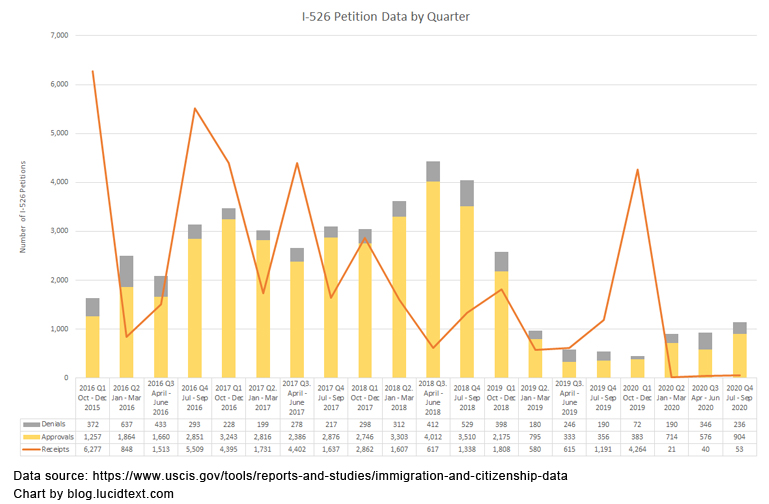
I-5265390423615,063
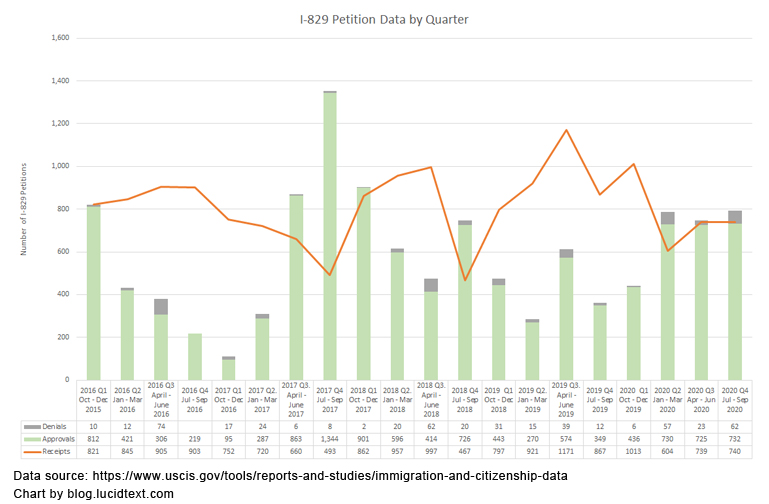
I-8297407326210,304
I-924D*4545163

*Redacted in the report, but must be 129 since there were 124 I-924 pending at the end of Q3

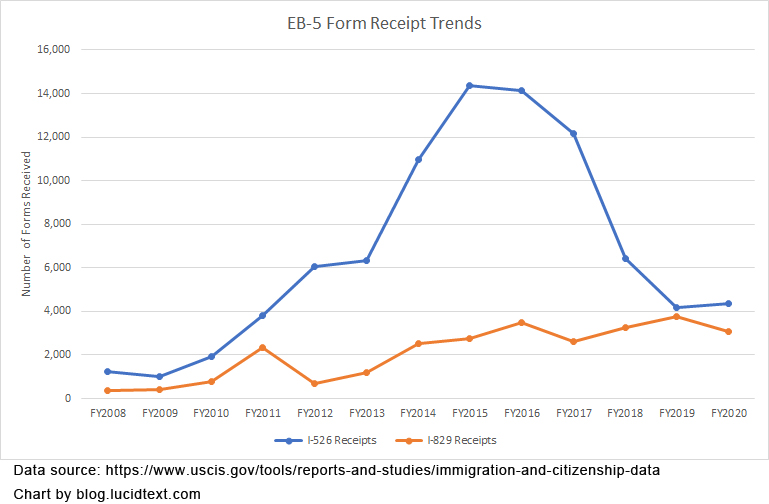
The numbers are basically consistent with the previous quarter’s report, and with my expectations. I-526 and I-829 productivity improved again – by a hair. I-526 receipts remained low, as has been the case since the perfect storm of investment amount increase, lengthy wait times, economic upset, and COVID-19. Denial rates were lower than last quarter, though still higher than average. As usual, I’ve assembled charts below that put the numbers in historical context.
Mayorkas Nomination

The best news for future processing productivity and processing times is that Mr. Alejandro Mayorkas may be about to be approved as Secretary of Homeland Security. His nomination was advanced out of committee yesterday. When Mr. Mayorkas was director at USCIS (2009-2013), one of his goals was to build greater expertise, professionalism, and transparency into administration of the EB-5 program, and he pursued that goal with energy. Faced with problems in adjudication from lack of expertise in business and economics, he arranged for the EB-5 team to hire staff at a higher grade who would bring such expertise. Noting need for more coordination with other government agencies, including SEC and FBI for enforcement, he arranged to relocate the entire EB-5 team from California to Washington DC, creating the Investor Program Office. Noting the problem of undefined and untransparent requirements, he pushed publication of the first major EB-5 Policy Memo in 2013. Learning about the issue of inconsistent adjudications, he created a Discretion Review Board. EB-5 stakeholder engagements were quarterly under his watch, and he frequently participated personally to hear about stakeholder concerns. When members of Congress contacted USCIS about constituent problems with adjudication, Mr. Mayorkas paid attention to the inquiries and frequently got personally involved in addressing the inquiries, overruling and chiding adjudicators if necessary. All this wonderful and officious activity earned Mr. Mayorkas a large target on his back, and the Inspector General eventually wrote a report about three of the hundreds of cases in which he interfered – a report that we’ll never hear the end of, and which concluded that he was guilty of creating an appearance of favoritism. (I wrote about this in 2015.)  But for those of us who want the EB-5 program to be administered with expertise, professionalism, and transparency, having Mr. Mayorkas at the top at DHS is great news. Just listen to these beautiful words from his nomination hearing on January 19, when he was explaining his approach to leadership at USCIS: “USCIS is an agency that adjudicates cases. That’s what it does. When I had authority and responsibility to fix problems, I fixed problems in the cases the agency handled. It is my job to become involved, to learn the problems that an agency confronts, to become involved in those problems, and to fix them, and that’s what I did.”

Not that Mr. Mayorkas will have much time for EB-5 specifically (indeed, EB-5 administration slipped somewhat back when he moved on from USCIS to become deputy DHS secretary). But at least he should set a positive tone from the top. Those plummeting downward lines that we see in the EB-5 adjudications chart above will eventually trend sharply upward again, I hope. I almost wish that Sarah Kendall were still in charge at IPO, so that in fairness she could have a chance to perform under leadership that instructed her to value efficiency, transparency, and order. I heavily criticized her tenure for decimating productivity at IPO and destroying stakeholder trust, but I believe that she may have been simply and competently pursuing the objectives she was instructed to accomplish.

(As a side note, thank you to everyone who contributed to my Ombudsman survey form! I summarized and submitted your input to IIUSA to bring to the attention of the CIS Ombudsman. I hope that these concerns will make it to an open ear in USCIS leadership.)

China 2015 Backlog and Visa Bulletin Movement

And finally, a note for Chinese EB-5 investors who filed I-526 in 2015 and still waiting for visas. I have a lengthy post or article coming for you eventually, but keep modifying my analysis because it’s all so complicated! But note that this new report which has some significant information for you:  Form I-140, I-360, I-526 Approved EB Petitions Awaiting Visa Final Priority Dates (Fiscal Year 2020, Quarters 3 and 4) (PDF, 108.43 KB)

The report format is tough to interpret (I previously tried to explain it with pictures here.) In short, the report gives (A) a number of Chinese applicants who have approved I-526 but CANNOT move forward to final action based on the Visa Bulletin. That is not very helpful, because what we really want to know is (B) how many Chinese have approved I-526 plus CAN move forward to final action based on the Visa Bulletin.

I want to know (B), because that is a clue about when the visa bulletin will move again. If (B) is a small number, then the visa bulletin will need to move again soon to allow more people to join the group at the finish line, ready for final action. If (B) is a large number, greater than the number of visas available in the near-term, then final-stage applicants already exceed supply and the visa bulletin will not need to move again for awhile.

It occurred to me that the USCIS report is indirectly helpful, because (in the special case of China in 2020) we can infer (B) from the change over time in (A). Specifically, by the difference in numbers reported in the April 2020 and November 2020 reports.

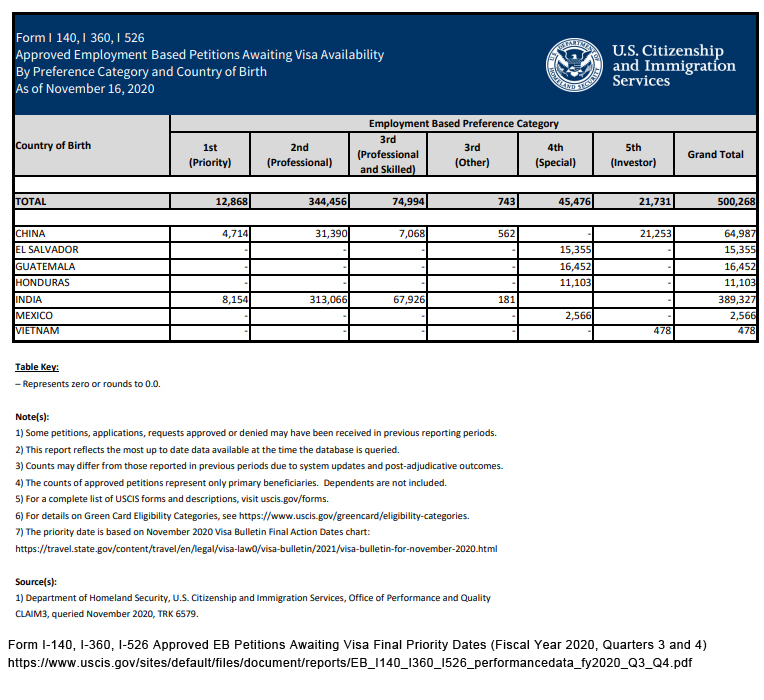
The number of Chinese applicants who have approved I-526 but CANNOT move forward to final action (A) is increased over time by number of I-526 approvals, and decreased the number who CAN move to final action thanks to visa bulletin movement.  The number of Chinese who have approved I-526 plus CAN move forward to final action based on the Visa Bulletin (B) is increased over time by applicants released by the visa bulletin, and decreased over time by applicants receiving visas. However, for China, half of those variables are near zero. There should be few-to-no incoming I-526 approvals since April 2020, because the I-526 visa availability approach that took effect in April 2020 limits adjudication of I-526 without visas available. Thus I think we can discount additions to (A) for China in 2020, and only look at subtractions. The consulate in Guangzhou has issued 0 EB-5 visas since March 2020, so I think we can almost discount subtractions from (B) and mainly look at additions. (The only Chinese visa completions since March 2020 have been from adjustment of status, and that number is low. Chinese apparently received only 489 visas through AOS in FY2020.)

Therefore, I conclude that the difference between the reported numbers of approved I-526 awaiting visa availability in April 2020 and in November 2020 about equals the number of principal applicants who were released to the visa stage by Visa Bulletin movement since April 2020, and still waiting there, with their families, for visas. Referring to the above tables: 23,511-21,253=2,258 approved I-526 (i.e. principal visa applicants). 2,258 principal applicants means about 6,136 total visa applicants. (Considering that for Chinese visas issued in FY2018, principals accounted for 36.8% of total applicants.) So I think we can conclude that there are at least over 6,000 Chinese applicants queued up for final action based on the current Visa Bulletin Final Action Date of August 15, 2015. As of November 2020, Charles Oppenheim was estimating that it might be practically possible to issue about 3,000 visas to China in FY2021. I’m guessing that picture isn’t any better today considering that the consulate in China still has no timeline for resuming EB-5 visa interviews, and USCIS remains slow. If there are already 6,000+ people queued up for only around 3,000 spaces, then that’s already a big crowd at the visa final action stage. The visa bulletin won’t need to move any time soon to increase the size of that crowd. Thus I doubt the Visa Bulletin Chart A date will move for China in FY2021 at all, unless a miracle makes the consulates/USCIS able to work double time and actually issue the over 10,000 visas theoretically available to China this year under the unusually high FY2021 EB-5 visa quota. As I said, though, this is all very complicated. I may well revise or refine this analysis in the future as I receive more information or corrections. And please share your insights!

(Note that I don’t attempt to interpret the Vietnam EB-5 numbers on this report, because there’s no way to guess how the Vietnam number was affected by incoming I-526 approvals vs. exits to the visa final action stage.)

Ombudsman Meeting Input

2/2 Ombudsman Meeting

IIUSA has announced that its staff have been invited to a virtual meeting on February 2 with representatives from the Office of the Citizenship & Immigration Services (CIS) Ombudsman.

Ombudsman’s Office meets with stakeholder communities to hear about their concerns and identify issues with USCIS programs and processing. The Ombudsman then uses this input to make recommendations to USCIS to fix systemic problems and improve the quality of their services.

In preparation for this meeting, IIUSA is collecting comments and feedback on areas of concern that industry would like to be addressed at the upcoming meeting. You can send your comments to info@iiusa.org no later than Wednesday, January 20.  (Note that the CIS Ombudsman deals with USCIS specifically, not with consulates/Department of State and not with legislation.)

I am still thinking about my comments and questions, and invite you to help me. The CIS Ombudsman is most likely to note and act on problems that are systemic and widespread. So the strongest comments will be able to reference the specific experience of multiple witness. I made a Google Form designed to collect such experience, and I invite you to fill out the form with your input on processing issues encountered for I-526, I-485, I-829, etc.. This will save me the time of sorting through old blog comments to collect details from reader experience, and will help to shape and inform my thinking. (And of course, you can respond directly to IIUSA as well.) [Note: the form is now closed. Thank you to the 40 readers who submitted input. I summarized and used detail from your comments to craft the suggested questions I sent to IIUSA.]

Other Updates

Recent announcements on the USCIS News page may be relevant for some readers:

USCIS to Replace Sticker That Extends Validity of Green Cards (January 12, 2021)

USCIS Lockbox Updates (January 08, 2021) regarding delays in issuing receipt notices

USCIS Extends Flexibility for Responding to Agency Requests (December 18, 2020)

New EB-5 Q&A from USCIS

In my post Report on Nov 2020 IPO Non-Engagement, I pointed out that the November 11 EB-5 engagement presentation avoided addressing industry questions. I now see that on December 16, USCIS took a step to compensate by publishing EB-5 General Questions and Answers (updated Dec. 2020) on the EB-5 Resources page. This 7-page PDF selects a portion of questions asked (e.g. from IIUSA’s list), doesn’t necessarily answer them, and was published with no announcement in a place where even I took a month to notice it. But nevertheless, it’s seven pages of something like communication with the industry, and we rarely get even that much, so thank you USCIS. I appreciate this step!

Visit the USCIS website to review the full Q&A, which is indeed worth reading. The following is my biased summary of the Q&A content.

I-526

1. An I-526 expedite approval merely expedites assignment of the I-526, not adjudication time. USCIS cannot provide specific processing times for adjudication of an “expedited” I-526.

2. The Q&A tries to justify the practice of requesting I-829 evidence in the context of I-526 adjudication.

3. IPO assesses visa availability monthly.

4. I-526 workflows are adjusted monthly based on visa availability.

5. USCIS does not have or plan to develop technology that would allow I-526 petitioners to incorporate project-related documents submitted with a pending or approved I-924 (I-526 exemplar) rather than submit duplicative documents with each I-526. USCIS is “open to exploring ways to achieve efficiencies within our existing systems” but lacks budget to improve the systems. [Who did not use the fee rule process to request needed budget, I wonder.]

I-829

6. Read the Q&A for a detailed answer to this question: “What steps should a petitioner take to add an eligible derivative to a Form I-829?”

7. After denying an I-829 petition, USCIS will generally wait until after the initial motion period to issue a NTA with immigration court, but reserves the option to refer cases to ICE earlier.

8. Fraudulent activity in a project has a bearing on I-829 adjudication if it prevents satisfying all investment, sustainment, and job creation requirements for removing conditions.

9. I-829 receipt notices issued in July 2020 were not intended to extend CPR status, just to replace possibly missing notices.

Regional Centers

10. There is no timeframe for posting regional center termination letters since 2018, which are still “in the queue to be reviewed by USCIS FOIA specialists.” [So much for transparency. The entire unredacted immigration record for Kamala Harris’ mother was posted by FOIA within a month of Harris’ nomination, but it takes two years and counting to review regional center termination letters—a type of record previously cleared for routine release, and obviously serving an integrity purpose.]

11. “We will consider your request, but USCIS does not currently have plans to proactively publish regional center designation letters.”

12. USCIS imposes a duty for RCs to monitor and oversee investment activities, but declines to specify what this duty entails because “it is not possible to do a one-size-fits-all checklist.” [But such checklists must exist behind the scenes, unless USCIS is simply arbitrary and capricious in regional center terminations. Assuming that there’s some method and consistency to USCIS oversight, then USCIS must have some specific and defined criteria for what Regional Center monitoring, oversight, and activity look like in practice. And given that, why not come out and tell Regional Centers the criteria by which they will be judged?]

13. The Q&A takes the industry question “When will anxious stakeholders learn more about the results of the submitted comments on the policy manual update on redeployment?” and answers that there’s no timeline to advance the universally ignored Advance Notice of Proposed Rulemaking from 2017 on the regional center designation process. We see you dodging the question, USCIS.

14. Since January 5, 2021, the newest Form I-924A version (dated 11/21/2019) must be used.

15. The Q&A states that in fact “there is no requirement that an approved regional center must have affiliated I-526s filed within a three-year period or lose designation.” [This contradicts the evidence of regional center termination letters that such a metric was applied in practice at least through 2018. But good to hear this statement, since the 3-year metric was particularly unfair and harmful for regional centers in distressed and rural areas.] The Q&A also clarifies that I-924 regional center processing times are not actually 5-8 years, though the USCIS Processing Times Page reported them as such until recently due to what’s now acknowledged as a reporting error.

16. Regarding interfiling of project status updates, the Q&A gives this helpful information: “Updates and other correspondence are received in our mail room. We keep the envelope or shipping label, we stamp the date we received the correspondence, and we insert the documents into their corresponding file(s). We randomly sample the work to ensure the documents were properly interfiled.”

2/3 Government Affairs Webinar Invitation

IIUSA invites the public to join a free Government Affairs and Association Update on February 3, 2021. Promised topics include legislative updates, Grassley/Leahy integrity reform discussion, IIUSA USCIS Ombudsman Meeting recap, ongoing FOIA litigation, and how you can be an advocate. You can register here, and are invited to email questions in advance to info@iiusa.org. Thank you IIUSA! Take advantage of this opportunity, and convey your questions. My sacrifice before the camera this week was not in vain, I like to think, if it helped encourage this very welcome engagement. Those wondering about potential post-election changes may also appreciate Episode 18 of the KlaskoLaw podcast “2020 Post-Election Immigration Breakdown.”

As a reminder of where we’ve been, here’s the most recent update to my history of regional center program authorizations. The regional center program was established in 1992 and typically extended for several years at a time, until 2015. Since then, it’s been a bumpy ride thanks to the chaotic appropriations process, with funding bills and continuing resolutions extending government funding (and incidentally, associated immigration program authorizations) for a few months at a time. Now a new regional center program sunset date of June 30, 2021 separates the regional center program from the appropriations drama, and creates the challenge and opportunity of dealing individually with EB-5.

What would happen if Congress did not reauthorize the regional center program in time? The last time we seriously asked this question was back in 2012, when we were coming off a three-year authorization and depending on Congress for another long-term reauthorization. At a January 2012 stakeholder meeting, I noted this exchange: “A stakeholder asked what procedures might be employed in the event that Congress does not extend the EB-5 Regional Center program past its current sunset date of 09/30/2012. Rachel Ellis responded that this as a question that will just have to be addressed when and if it occurs, and that the Service does not have a response at this time.” After the May 1, 2012 stakeholder engagement, USCIS published a Q&A with a similarly vague answer to a question about how a regional center sunset might affect current and future applications and projects. “If Congress does not reauthorize the Immigrant Investor Pilot Program, all existing regional center designations will expire automatically. Following the sunset of the Immigrant Investor Pilot Program, USCIS will no longer possess authority to approve a regional center designation. USCIS will continue to monitor Congressional actions pertaining to the EB-5 Immigrant Investor program, and will keep stakeholders informed as new information becomes available.” I think the bottom line is that there’s no developed policy for a sunset because it’s just not possible to contemplate that a multi-billion dollar program would get abruptly terminated mid-stride with those billions of dollars and over 80,000 pre-CPR investors in the balance. Certainly regional centers and their lobbyists are motivated to do what it takes to avoid that eventuality, and politicians who like jobs and investment should be too. I could imagine a temporary lapse in authorization thanks to Congressional inefficiency, which would presumably play out like the temporary authorization lapses we’ve seen in connection with government shutdowns. Scroll to the bottom of my Washington Updates page to see further discussion. The regional center program strongly needs the stability of long-term if not permanent authorization, and has proven its value for economic development and job creation. I look forward to seeing long-term authorization accomplished this year.

I’m reminded of this EB-5 Legislation? post I wrote just over a year ago, reviewing what happened with EB-5 legislation between 2015 and 2019. The dynamics described in that post are still presumably at play as we look at a renewed legislative effort in 2021. But now a near-term deadline gives extra pressure and encouragement to actually cross the finish line.


EB-5 Outlook 2021: questions about legislation and reauthorization

2/17/2021 Update: Please visit my new Reauthorization Page, which collects resources that answer many of my questions below.

— Original Post —

On Wednesday January 6 at 2 pm EST, Carolyn Lee is hosting an EB-5 Outlook 2021 Webinar (register here) with guests Bill Gresser, Adam Greene, and me. Carolyn is Legislative Counsel to IIUSA, a 4-term Chair of the American Immigration Lawyers national EB-5 Committee, and industry godmother. Bill is Vice-Chair of IIUSA’s Board of Directors, and both Bill and Adam are former chairs of IIUSA’s Public Policy Committee and industry leaders. [1/5 update: Bill Gresser and Adam Greene no longer plan to join the webinar.] I am famous for asking questions.

This webinar aims to start 2021 right, with dialogue. I look forward to hearing perspectives, and to raising questions. So far I’ve prepared a list of questions regarding prospects for EB-5 legislation and regional center program authorization before the new sunset date of June 30, 2021. Of course a small panel speaking informally can’t possibly answer all these big questions, but any discussion is a good start. I hope that the discussion will grow, and that IIUSA/the industry will eventually speak to questions like these. (I may also volunteer my labor to ask questions on a larger scale — currently contemplating a conducting a survey to assess the range of regional center interests and concerns with respect to legislation and specific Grassley/Leahy proposals. Regional centers, contact me if you’d like to see this and have suggestions.) Meanwhile, feel free to add your questions re 2021 outlook to the comments on this post.

Suzanne’s questions regarding 2021 outlook for EB-5 legislation and regional center program authorization

  1. Legislative activity coming soon…
    • Is there any chance of a “clean” regional center program extension beyond June 30, 2021, or will regional center program reauthorization certainly come with significant program changes?
    • Do you expect to see Grassley and Leahy reintroduce their EB-5 Reform and Integrity Act promptly in 2021?
    • Is it possible/probable that anyone else in the House or Senate might introduce EB-5 legislation shortly? If so, would such alternative legislation have a chance to proceed?
    • How much attention is EB-5 likely to get between now and June? Do you expect things like committee hearings and significant discussion around stand-alone EB-5 legislation, or is it more likely that RC program authorization would get tacked on to some other more important legislation? (And if so, what might that be?)
  2. Regarding the Grassley/Leahy EB-5 Reform and Integrity Act…
    • What are the major concerns/barriers in Congress for the Grassley/Leahy bill?
    • What are the major questions/concerns in the industry for the Grassley/Leahy bill?
    • What has been done/will be done to identify and address those questions, concerns, and barriers?
    • To what extent is the Grassley/Leahy bill still open to negotiation?
    • If you think the Grassley/Leahy bill as-is represents the best possible option for regional center program authorization, what’s the reason for thinking that?
  3. Interests and goals…
    • What are Grassley/Leahy trying to accomplish with the bill? Whom are they trying to benefit?
    • What have industry negotiators been trying to accomplish with legislation? For what priorities have they been advocating?
    • Is there any hope/plan/timeline to realize these items not in the Grassley/Leahy bill: More visas for EB-5; More marketable EB-5 investment amount/TEA definition
  4. Options for participation, collaboration, and engagement…
    • How can a concerned regional center get a hearing for their input to EB-5 legislation?
    • Any options for concerned investors to assist or influence the process?
    • What can IIUSA do to identify and address concerns, and broaden involvement in and support for EB-5 legislation?
    • What needs to happen in the next few months to ensure that the regional center program gets extended?
  5. Outlook for reauthorization…
    • Do you see any chance of the regional center program being allowed to sunset? If that happened, what would be the likely reason?
    • Do you see any chance of regional center program authorization being allowed to lapse for a time? If that happened, what would be the likely reason?
    • EB-5 legislation has been actively discussed since 2015, but not passed. What reason is there to hope for a result in the next six months?
    • As people involved in the process, what lessons have you learned from past legislative efforts that you intend to apply going forward?