FY2021 Q1 EB-5 Performance Data

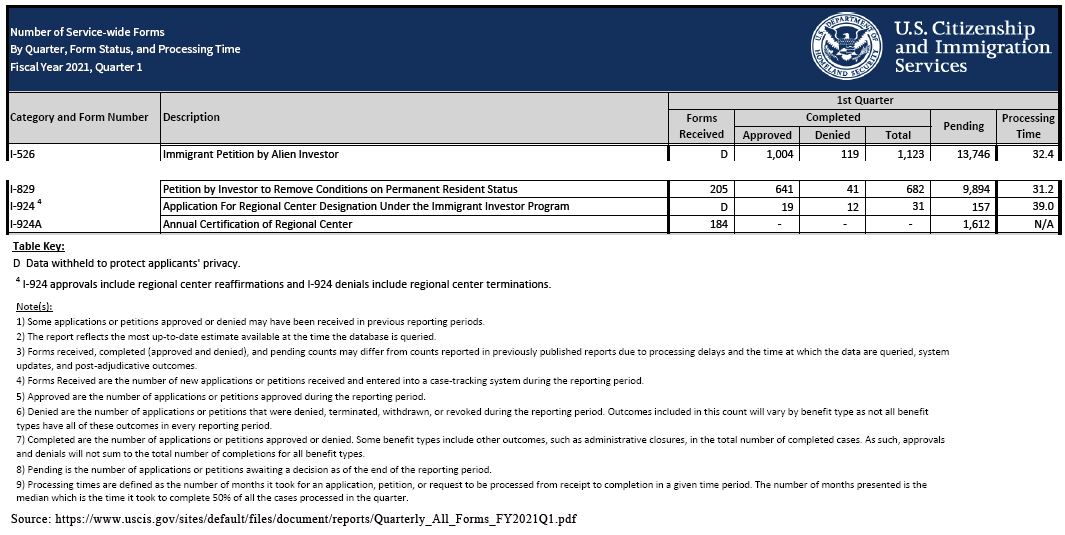
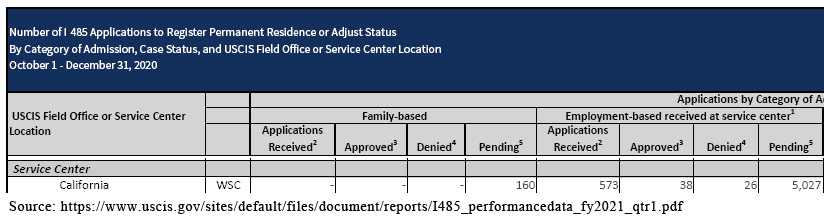
The USCIS Citizenship & Immigration Data page has published performance reports for FY2021 Q1 (October to December 2020), with data for EB-5 form receipts and adjudications. Since the full reports are formatted to be almost unreadable, I clipped out content most significant to EB-5 from the All Forms report and I-485 report. These summaries are followed by notes and charts that put the FY2021 data in context of previous reports.
General Comment

Overall, the numbers for October 2020 to December 2020 show low receipts, low productivity, and a faulty record-keeping system. But this time period represented dark pandemic days, and lingering Trump administration leadership on immigration. So I do not consider the period characteristic, or necessarily indicative for future performance. I am not ready to predict the current/future trends until I hear from new USCIS leadership, and start to see performance data for this year.

Report Format

For the first time, the All Forms performance report adds columns for total processed petitions, and processing times. That’s nice.

As with the annual report, the quarterly-report processing times are significantly lower than the median times reported day-by day for the same period. (For example the USCIS Processing Times Page reported median times for I-829 of 35 months in October, 36.5 months in November, and and 33 months in December, per my log of contemporary reports. And now this quarterly report states that 50% of I-829 processed October to December 2020 took less than 31.5 months to process.)

I-526 Performance Data Notes

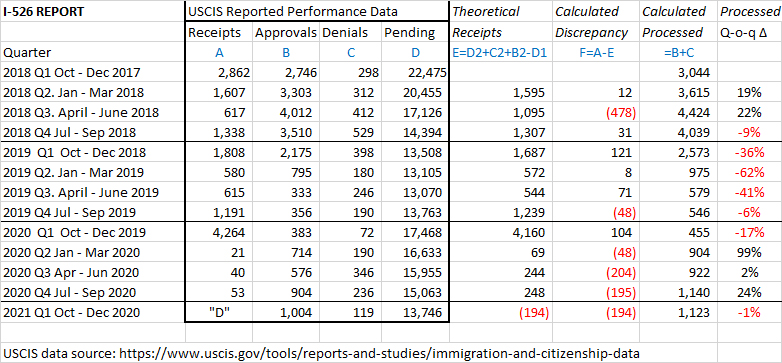
The I-526 data reported for FY2021 Q1 shows that USCIS struggles to count inventory, even after taking over three months to generate the report.

We don’t know how many I-526 were filed in Q1, because the report gives a letter “D” in place of I-526 receipts. The report code explains that “D” means “Data withheld to protect applicant’s privacy.” Another definition could be “Data withheld to disguise our counting errors.” In theory, last quarter’s period-end pending petitions plus this quarter’s receipts minus this quarter’s approvals and denials (which also includes withdrawals) should equal this quarter’s period-end pending petitions. If that equation gives a false result, then something’s wrong with USCIS data reporting. Doing this equation quarter by quarter (as I do in a table below), shows discrepancies every quarter. Using the equation to solve for receipts in FY2021, I see that “D” masks a negative number: -194 to be exact. EB-5 demand would plausibly have been low October to December, but can’t have been actually negative! So USCIS must have miscounted approvals/denials or pending in Q1, or possibly compensating for errors in previous quarters. This quarter’s I-526 report is not very helpful, except as additional ammunition for Mandamus lawyers demonstrating to judges that USCIS self-reporting is confusing at best and unreliable at worst.
I-829 Note

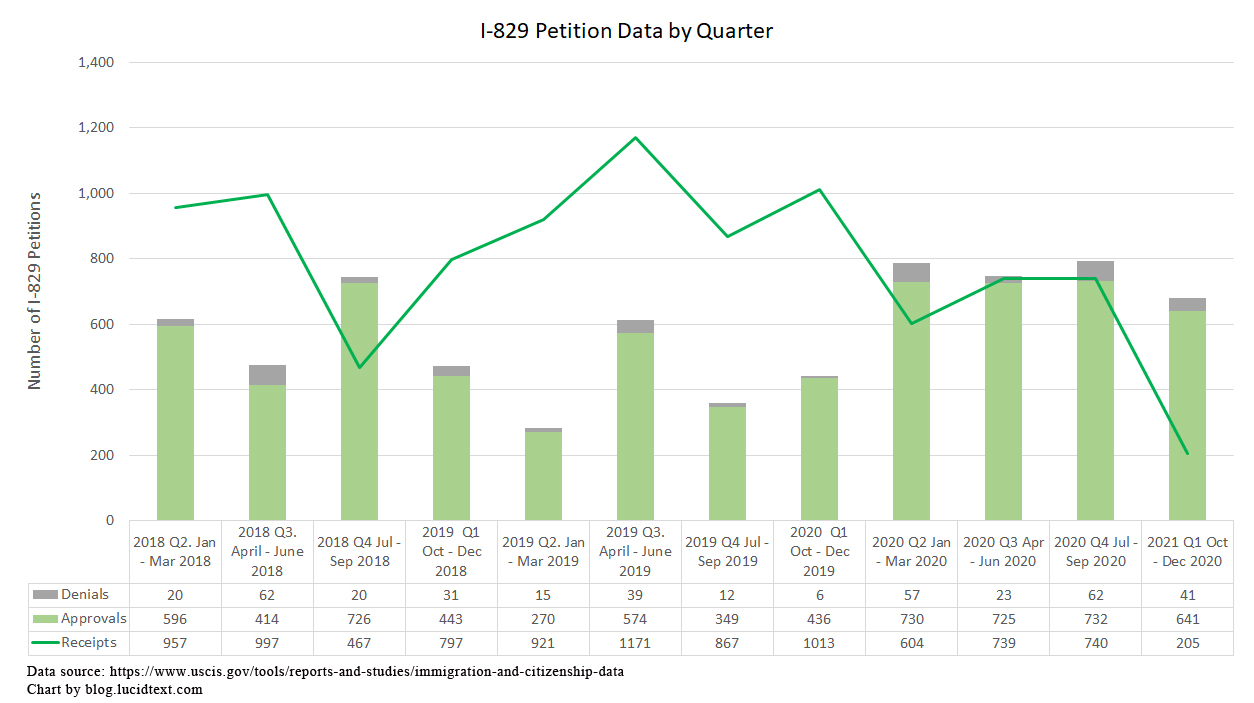
I-829 receipts were down significantly in FY2021 Q1, and calendar year 2020 overall. In theory, I-829 filings to remove conditions should be fairly steady, reflecting the steady pace of EB-5 visa issuance two years previously. When I-829 receipts fall, I worry that some disaster befell the cohort of EB-5 investors who entered the U.S. 21 months earlier. I want I-829 numbers to show success through to the EB-5 finish line. (Update: BOS InvestorVoice makes a good point in the comments: USCIS struggled in 2020 to issue I-829 receipt notices, with mutliple I-829 applicants reporting severe delays just to get the notice. That could explain low recorded receipt numbers even if I-829 submissions were in fact as high as ever.)

On the bright side, I-829 processing productivity only fell a little in Q1, and the approval rate remained high (94%).
Investor Program Office Productivity

Between Q3 and Q4 2020, IPO had exhibited an encouraging 16% increase in number of forms processed (I-526 plus I-829).  Q1 FY2021 regressed again, with 7% fewer forms processed than the previous quarter. Sarah Kendall left IPO after November 2020 according to her LinkedIn page, so FY2021 Q1 represents the end of her direct influence. I warmly hope that future FY2021 reports will show the positive effect of new leadership at IPO (though Kendall still looms as USCIS Regional Director). IPO has so much room for productivity improvement, considering that they used to regularly process three times more forms with fewer staff than they have today.

I-485 Note

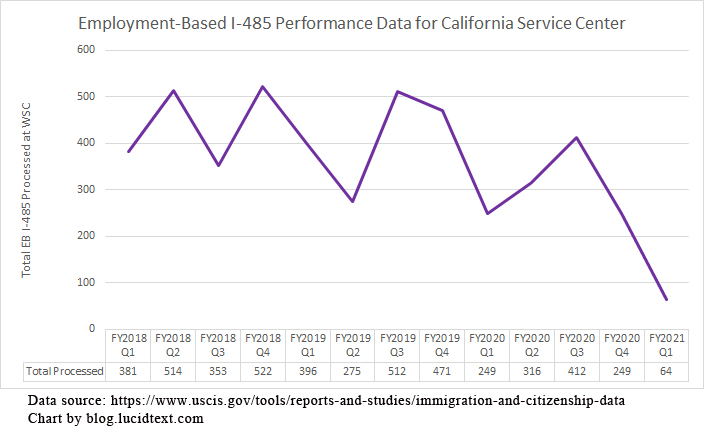
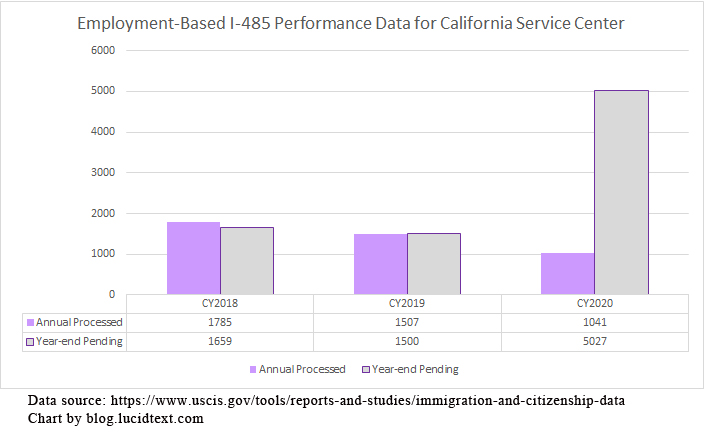
I do not usually report I-485 data because USCIS does not itemize EB-5-based I-485. The report just gives aggregate numbers for all EB category visas. However, this post highlights employment-based I-485 performance data specifically for the California Service Center, which I understand is responsible for most (all?) EB-5 I-485 decisions, and which is apparently having a meltdown. In FY2021 Q1, the California Service Center approved a record-low only 38 Employment-Based I-485 per the report (having previously averaged 300-400 EB approvals per quarter), and ended with a record-high backlog of 5,027 Employment-Based I-485 pending. Ms. Mendoza Jaddou, please hurry up and get confirmed as USCIS Director, and then find out what’s going on at the California Service Center. No one wants to see the processing times that will result if 5,000+ Employment-based I-485 continue to get processed at a rate of fewer than 100 forms per quarter. If indeed EB-5 I-485 are all ultimately forwarded to the California Service Center for adjudication, how about reconsidering that decision in light of recent performance? Too many EB-5 visas have been lost already.
Plug

Collecting and processing EB-5 data has become increasingly difficult and time-consuming. If my analysis helps you, please consider a PayPal contribution to support my work. Thank you!

I am not currently promoting my I-526 timing estimate service, due to limited recent information. After I see 2021 data and hear from new leadership at IPO, I will be better able to judge the current trend and make educated estimates about the future.
EB-5 news (USCIS public input request, reauthorization, RFE response and litigation, NVC update, PT report update)

Request for Public Input

Today DHS published Request for Public Input: Identifying Barriers Across USCIS Benefits and Services. This request aims “to better understand and identify administrative barriers and burdens (including paperwork requirements, waiting time, and other obstacles) that impair the functions of the USCIS process and unnecessarily impede access to USCIS immigration benefits.” Thank you Secretary Mayorkas! Yes, we have input for you.  

Click on the above link for instructions for how to submit effective comments. Note that the comment due date – originally written in error as today – has been updated to May 19, 2021. If anyone would like to hire me for EB-5-specific comment writing service, I am available and bring a successful track record. The Final Rules on the EB-5 Modernization Regulation and the 2019 USCIS Fee Rule both quote extensively from comments that I submitted on the proposed rules. My strategy is to be rigorous and draw on my massive repository of data and citations.

Reauthorization

The best news I have on the push for regional center program authorization is that EB-5 giant Robert Divine has published an article in EB5 Investors Magazine: “The problem with EB-5’s reliance on temporary legislation.”  In just 600 unminced words, Mr. Divine explains the reauthorization situation and what’s at stake for investors, industry, and the country. If I were writing to my representative to press for reauthorization, I would attach Mr. Divine’s article as clear, honest, and authoritative background reference. If I shared anything on social media, I’d share this article as a call to action. And I’d like to give a standing ovation to this conclusion from the article:

Congress should at least provide that the regional center legislation in effect at the time an investor files Form I-526 will remain in place throughout those waits until the investor can remove conditions on permanent residence through adjudication of Form I-829. The United States is a country of laws designed to protect reasonable expectations. This nation should not be encouraging people to invest to create jobs for us without protecting the reasonable expectations of investors who take the risk of such investment.

I continue to update my Reauthorization page as I hear of news and resources. Most recently, I noted that the text of S.831 has finally been published at Congress.gov.

RFEs and Litigation

The April 2021 edition of EB5 Investors Magazine is generally rich in helpful articles. I particularly note my article, and multiple articles on recent trends in EB-5 litigation.

Consular Processing and Visa Updates

The Visa News page on the Department of State website includes several significant updates.

  • Apr 6, 2021 Visa Services Operating Status Update This post confirms that as of April 2021, EB-5 is still not a priority for interview scheduling. “Posts that process immigrant visa applications are prioritizing Immediate Relative family members of U.S. citizens, including intercountry adoptions, fiancé(e)s of U.S. citizens, and certain Special Immigrant Visa applications.”
  • Apr 9, 2021 National Visa Center Meeting with AILA on February 17,2021 This meeting transcript from February is full of interesting information. Including:
    • “During CY 2020, the median time for an approved I-526 petition to reach NVC from USCIS was 126 days…. NVC does not have a way to proactively search USCIS systems for approved I-526 petitions that have not been electronically transferred to NVC.” (DOS here quantifies the problem of delays by USCIS in forwarding I-526 approvals to NVC, and suggests there’s not much DOS can do about the problem.)
    • “As of January 25, 2021, NVC’s queue of documentarily complete employment-based or family-sponsored cases (including family preference and immediate relative cases), with a visa number available, waiting for an immigrant visa interview is: Family-Sponsored: 312,782 cases; Employment: 11,504 cases; EB-5: 3,930 cases.” (That huge family-based number is alarming, because family cases are getting priority over employment cases as noted above. The EB-5 number is interesting, because it tells us how many consular cases are ready to go based on how far the visa bulletin has already moved. The total number of EB-5 cases registered on the immigrant waiting list at NVC, which includes those without visas available yet per the visa bulletin, is much higher of course.)

See also “Briefing with Consular Affairs Acting Deputy Assistant Secretary for Visa Services Julie M. Stufft on the Current Status of Immigrant Visa Processing at Embassies and Consulates” from March 1, 2021

The May 2021 visa bulletin has announced another “Chats with Charlie” to take place on April 22, 2021 at 1:00 p.m. EST at https://www.youtube.com/user/TravelGov Questions can be emailed to VisaBulletin@state.gov ahead of the event with “Chat with Charlie Question” in the subject line. The previous visa bulletin live chat from March 17 was incredibly helpful and informative, and I’m looking forward to the April iteration.

Processing Time Report Update

The USCIS website has long had a page titled “Historical Average Processing Times” that I used to ignore because it reported a meaningless and misleading data point. Instead of reporting processing times, this “processing times” page used to report “average age of all petitions currently pending.” Average inventory age combines processed and unprocessed petitions, naturally falls with an influx of new receipts, and does not directly reflect on processing times. This misleading page was probably heavily referenced by people filing Mandamus complaints, because average inventory age is often less than processing times. And now, USCIS has finally gotten around to fixing the page. 

Since March 31, 2021, the Historical Average page is now titled “Historical National Median Processing Time (in Months) for All USCIS Offices for Select Forms By Fiscal Year,” and uses a revised method. Instead of reporting average inventory age, the page now reports median age specifically of processed forms, consistent with the method used for the Case Processing Times page.  “Processing times are defined as the number of months it took for an application, petition, or request to be processed from receipt to completion in a given time period. …The number of months presented is the median. It represents the time it took to complete 50% of the cases in a given time period.” This page provides median times across a full year, which are interesting when compared with median times reported monthly for those same years (as recorded in my on-going log). For example, the Historical Average page now reports a median I-526 processing time of 19 months across FY2019 adjudications, while monthly I-526 processing time reports from October 2018 to September 2019 indicated median times ranging from 20 to 27.5 months – never as low as 19 months. Hmmmmm….. After all, the revised Historical Average page continues to provide ammunition for Mandamus lawyers seeking to show that the monthly USCIS processing times reports are misleading. The annual averages also starkly illustrate that the I-526 visa availability approach, instituted in 2020, did not bring down the average age of adjudicated cases as intended by USCIS.

Historical National Median Processing Time (in Months) for All USCIS Offices for Select Forms By Fiscal Year: Fiscal Year 2017 to 2021 (up to March 31, 2021)

FormFY 2017FY 2018FY 2019FY 2020FY2021 to March 31
I-52616.617.91931.231.2
I-82918.221.825.924.833.7
I-92419.51918.819.134.8
I-485 (all employment-based)710.6108.811.5
summarized from https://egov.uscis.gov/processing-times/historic-pt as of April 19, 2021

Sharing I-526 Experience

The most compelling processing time evidence comes from individual experience. I appreciate EB-5 investors who share their experience and case status analysis in blog post comments. And I appreciate the suggestion for a single static place to collect these reports for common reference. I’ve made failed attempts at this in the past (including starting a forum that I didn’t have time to moderate, and setting up a Google form whose link no one can ever find). But I will continue to think how I can best facilitate info sharing. FYI, from my various information sources, November 2018 continues to be the filing date I most commonly see on I-526 decisions.

Perspective on reauthorization and S.831

This week IIUSA held a Leaders Advocacy Summit to help explain and build support for efforts to reauthorize the regional center program in advance of its June 30, 2021 sunset date. Particularly, the summit focused on the only active reauthorization legislation to date: Senator Grassley and Senator Leahy’s S.831 – A bill to reauthorize the EB-5 Regional Center Program in order to prevent fraud and to promote and reform foreign capital investment and job creation in American communities.

The IIUSA Leaders Advocacy Summit recordings are available for free. I recommend them for extensive primary-source information about what’s happening now with EB-5 legislation, and what we can do.

  • The panel “Capitol Hill Update and IIUSA Advocacy Strategy” features commentary from IIUSA’s lobbyists. They discuss the process that resulted in the currently-proposed Grassley/Leahy bill, potential hurdles, milestone goals for the coming weeks, and influencing key decision-makers in Congress. The lobbyists acknowledged that EB-5 legislation is unlikely to get floor time as a stand-alone bill, but will depend on getting sufficient endorsements, co-sponsors, and attention that key decision-makers can recognize its importance and popularity and agree to attach the EB-5 bill to other legislation.
  • The panel “Congressional Staff Roundtable” allows us to hear directly from the staff at Senator Grassley and Senator Leahy’s offices responsible for the proposed EB-5 legislation. They give interesting insights into their senator’s priorities and hopes for the bill, and practical considerations as the bill moves forward in the legislative process.
  • The panel “EB-5 Legislation Review” gives an expert-guided tour of the text of S.831. I was interested to hear the panelists’ insight on what is and isn’t an actual change from current practice/existing law, and what resulted from IIUSA negotiation or remains in place despite negotiation. At least, S.831 is an improvement on previous iterations of Grassley/Leahy EB-5 legislation. For people struggling for reasons to support S.831 for what it contains, not just what it represents, this panel’s in-depth analysis offers some help.
  • Other panels discuss media strategies and regional center reactions to the bill.

Hearing the IIUSA speakers struggle to present S.831 as a good bill reminds me of us last year trying to feel good about our presidential votes. S.831 is the Joe Biden and Donald Trump of legislation. Whatever happened that the choice came down to this? How many of us voted in last year’s election with a bitter taste, not for our candidate so much as from a calculation of alternatives? And that’s where I am with S.831. The bill is not well designed to accomplish its objective “to prevent fraud and to promote and reform foreign capital investment and job creation in American communities.” It does not address the factors that have depressed investment and stymied job creation. Its impractical reforms would help deter good use of the program (by making it exclusive to the few who can afford all the fees and red tape) and undermine USCIS accountability (by deferring judicial review) as much as deter fraud. S.831 will not make the regional center program work as intended — the truly needed changes will have to come in another bill after S.831 addresses the immediate reauthorization crisis. S.831 is only a stopgap, since a mere five-year authorization will not even cover the existing regional center backlog through the visa stage, much less provide needed stability for new investment in an environment of multi-year processing and visa waits. But I support S.831 because I must have some vote against the alternative, which is to allow the regional center program to lose authorization after June 2021. Supporting S.831 appears to be my only chance to vote against betraying the in-process EB-5 investor applicants who depend on on-going regional center program authorization to get visas, and to avoid undermining the projects deploying their billions in investment. And the negative way Grassley and Leahy frame S.831 – as a bill to solve problems and reduce risks, not as a bill to support immigrant investment – is plausibly the best way to make it uncontroversial in Congress and get reform+reauthorization a chance at passage.

Last Fall, I spent a moment with pen hovering over my presidential ballot, wondering if I could make myself feel better by writing in Joe Neguse. But I admitted that would be false comfort. And now too in the EB-5 legislation context, supporting a positive but nonviable option could be counterproductive. Consider the low probability of a significantly renegotiated S.831 (what we’ve got is already the fruit of six years of industry negotiation with Senators Grassley and Leahy), a bill that gives visa relief (who thinks that Schumer and Pelosi would dare be seen to help immigrant investors right now, while kids at the border, DACA, etc. remain unresolved?), a bill with investment amount/TEA changes (such a bill doesn’t exist yet, and would be a long shot if it did since the Biden Administration just ratified the regulations, and reducing the TEA incentive would look controversial to Congress), or another indefinite series of short-term extensions (an option that was already tenuous over the past six years, and which Congress apparently intentionally took off the table when it gave the RC program a new mid-year sunset date). I would love for someone to give me reason to hope for and way to support one of these alternatives. From my armchair, I do not see the realistic path around S.831 to get to reauthorization. But IIUSA, at least, sees alternatives in the path after S.831.

If my future business would be dead without RC program authorization, but equally dead if S.831 passes, why not gamble on holding out for a third alternative, however improbable? But gamblers must remember that someone else does have something to lose: tens of thousands of EB-5 investor families whose future immigration hopes depend on on-going regional center program authorization. S.831 is a bird in the hand that could protect them in the near-term, at least (and protect the projects that don’t want to be abruptly besieged now by tens of thousands of anxious/disappointed investors). We have a responsibility to these constituents — and should recognize that their public future success or failure affects our interest as well. Therefore, I have added my name to  https://www.saveandcreatejobs.org/members, where it can be used by lobbyists to help create the impression of support and enthusiasm that the Grassley/Leahy reauthorization bill will need to pass. And I encourage other industry stakeholders to do the same. Ah, democracy.

Note that I continue to update my Reauthorization page and Washington Updates page on an on-going basis, to avoid cluttering the blog feed.

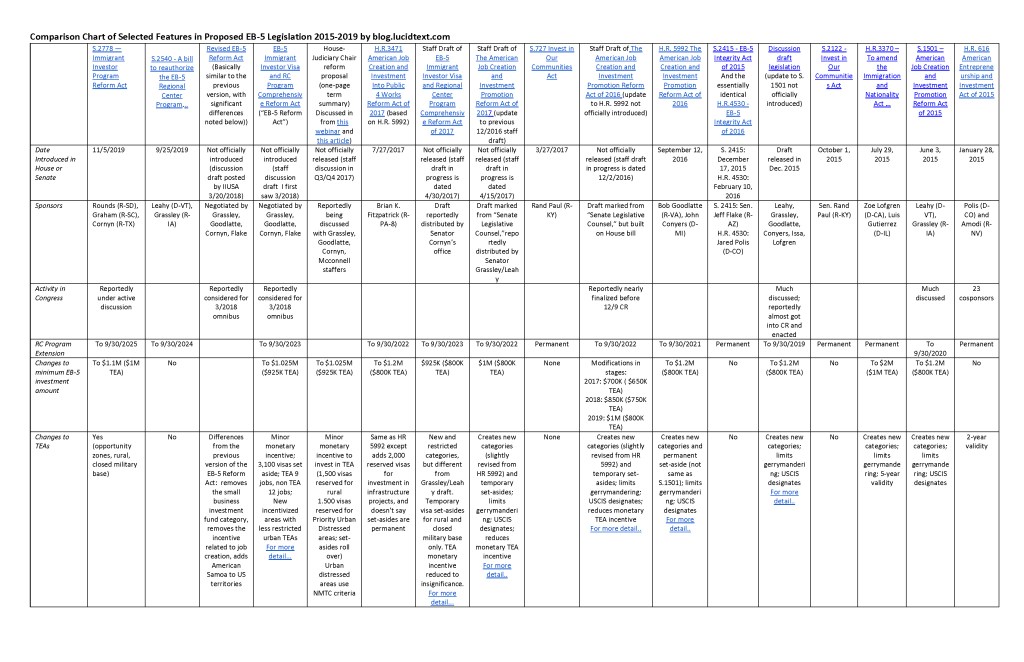
I shall end this post with a bit of history, as context for how we got where we are today: My log of EB-5 legislative proposals 2015 to 2019, and my chart of regional center program authorization history.

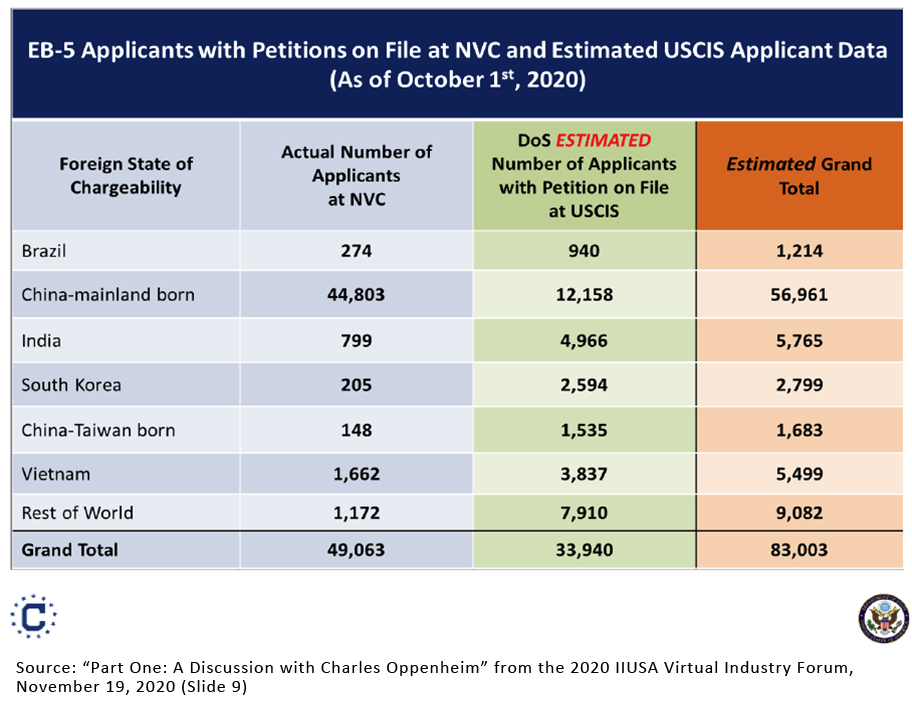
And finally, because this reminder can’t come too often, the last count (from Charles Oppenheim in November 2020) of EB-5 investors and family still at NVC or USCIS without visas yet. The tens of thousands of regional center investors in this count will not be a happy constituency if the regional center category becomes “unavailable” in the Visa Bulletin — which will happen automatically starting July 1, 2021 unless and until the regional center program is reauthorized.