EB-5 legislation and the question of options (Grassley’s S.831 vs. the “holistic” S.2778)

The EB-5 Regional Center Program sunsets on June 30, 2021, unless Congress passes legislation to extend it. (I’ve been updating my Reauthorization Page with resources and suggested action items for this effort.) But still, even many people who want reauthorization hesitate to strongly support the legislative option on the table: Senator Grassley and Leahy’s S.831, and its House companion bill H.R.2901, sponsored by Rep. Stanton and with 13 co-sponsors so far. Why the hesitation?

There’s hesitation based on hope for X: X meaning an alternative to S.831/HR.2901. If you are a regional center, investor, or Congressperson who understands the economic, public policy, and personal stakes and wants the regional center program reauthorized, what’s in your best interest: (a) go all in to push now for S.831/HR.2901 (as IIUSA suggests), or (b) wait for X (as EB5IC suggests)?

Besides the risk of holding out for an alternative not yet available, let’s consider an important question: What is X? If there will be a future alternative to the Grassley bill, provided I wait long enough, what will it be, exactly? Whose interests will it represent? Will it avoid my problems with the Grassley bill, not create worse problems for me or my clients, have better politics to pass, and reward me for holding out for it?

Those wondering about options can and should pursue these questions. Although Alternative X is not on the table at the moment, it has existed and can be scrutinized. The great Grassley vs. Not-Grassley EB-5 debate has been actively on-going since before 2015, leaving an extensive paper trail at Congress.gov. We have the “good government” faction and the “holistic” faction. Both sides call what they want “reform,” but mean different things by that word. To Grassley, “reform” means regulating and directing EB-5. To the other side, “reform” means making EB-5 more accessible and usable. IIUSA currently supports the Grassley “good government” effort as the best and likely only path to long-term regional center program authorization. The “holistic” side has been associated with EB-5 Investment Coalition, Greenberg Traurig, U.S. Chamber of Commerce, and Senators such as Schumer and Cornyn whose constituents include the kind of big-city developers whose prolific EB-5 usage looks like abuse to Senator Grassley.

In 2019/2020, we had a Grassley/Leahy “good government” bill (S.2540), and also an alternative “holistic” bill (S.2778, introduced by Senator Rounds, co-sponsored by Senators Graham, Cornyn, and Schumer).  For those holding out hope for a future alternative to Grassley, and looking for Schumer’s support, let’s scrutinize what the Holistic Faction previously negotiated in S.2778.  You can pull up the text of S.2778 and S.831 at Congress.gov, and do a side-by-side comparison. (Keeping in mind that S.831 is current this Congress, and S.2778 is a bill from last Congress that might or might not be eventually updated and brought forward again.) A bill-to-bill comparison helps to look beyond the rhetoric, and think specifically about what has been offered by each side in the EB-5 debate. I highlight below a few key issues.

Comparison of the 2021 Grassley-backed legislation (S.831/HR.2901) with the most recent alternative legislation (the Schumer-backed S.2778 from 2019) across key areas

Limits on Judicial Review

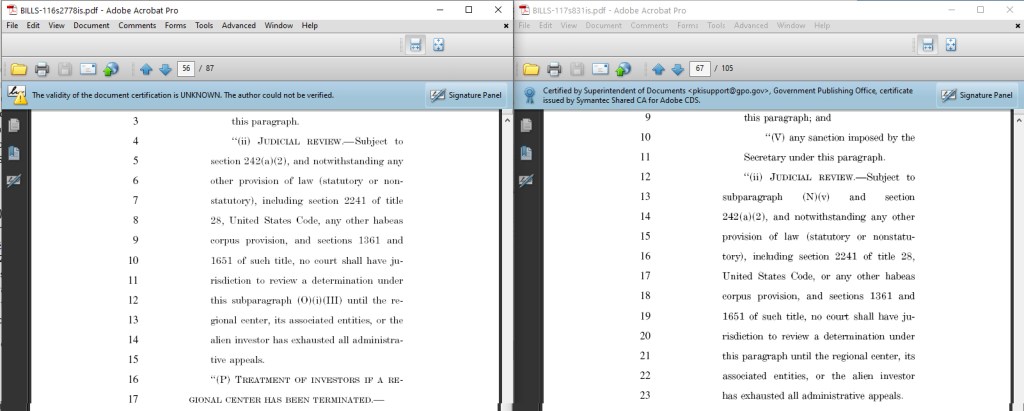
The most broadly unpopular provisions in Grassley’s current S.831 are the limits on judicial review, and the requirement that petitioners exhaust administrative remedies (i.e. spend forever in the internal appeals process that almost always sides with USCIS) before suing USCIS over a denial or termination. EB-5 investors and service providers join in disliking these provisions. However, note that S.2778 included identical language on judicial review.I suppose that the judicial review limit has come from both sides because it’s probably the number one demand from USCIS to Congress. (USCIS has spent a lot of money recently being found wrong in court on EB-5 issues.).
Additional Fees

Another unpopular aspect of Grassley’s S.831:  new fees that would further depress the market and particularly burden small regional centers. However, S.2778 proposed the same fees for regional centers and heavier fees for investors.

Fees in both S.2778 and S.831

  • Regional centers pay an annual fee of $20,000 (or $10,000 if the RC is non-profit or had under 21 investors)
  • Investors pay a $1,000 fee with each I-526 (called a Petition Fee or Integrity Fund Fee)
  • Monetary sanctions/fines up to 10% of total investor capital are authorized for non-compliant regional centers

Fees in S.2778 only

  • Investors pay a required $50,000 Program Improvement Fee with each I-526
  • I-924 applicants have the option to pay an additional $50,000 for premium processing (I-526 petitions with TEA investment are offered premium processing without fee)

I suppose that fees appear on all sides because fees are probably near the top of cash-strapped USCIS’s EB-5 legislation demand list for Congress. Also, the proposed regional center fees are not really a burden for any RCs prosperous enough to be lobbying, and could help eliminate their competitors.  There’s no clear hope for an alternative when it comes to fees historically backed by all sides.

Reauthorization

Like S.831, S.2778 offered a 5-year extension to the Regional Center program. 5 years means people will need to stay at the negotiating table, because 5 years is not long enough to create program stability. Current EB-5 investor distress has informed the market that EB-5 immigration depends on regional center program authorization continuing on to the visa stage. New investors will hesitate to start a program that is at risk of expiring before it can deliver the promised return. If legislation says “Visas made available under subparagraph (A) shall be made available through September 30, 2025,” then the legislation will stay potent only so long as new regional center investors can expect to get visas before 9/30/2025 — i.e. not long, considering processing times. The market will soon be demanding a longer-term authorization.

Investment Amounts and TEAs

 S.831 is silent on investment amounts and TEAs. The Holistic Faction is holding out for change in this area.

Senators Grassley and Leahy want to incentivize investment in rural and distressed areas, and they think that the November 2019 EB-5 Modernization Regulation already accomplishes this, with its $900,000 difference between TEA and non-TEA investment and TEA definitions. Therefore, they did not propose any investment amount or TEA changes in S.831.  (They do not like the idea of EB-5 as a program for the very wealthy, but haven’t realized that it was not so, until the Regulation forced it to be so by doubling the EB-5 investment amount.)

The Holistic Faction wants to make EB-5 accessible, and seeks to vacate or legislate a replacement to the EB-5 Modernization Regulation. S.2778 proposed to reduce the TEA incentive to only $100,000 ($1.0M TEA; $1.1M non-TEA), and to redefine what can qualify as a TEA – including by incentivizing Opportunity Zone investments instead of high unemployment area investments. In 2019, Senator Schumer supported this proposal, which would have been good for New York. However, it happens that the S.2778 proposal would be bad for Schumer’s constituents in 2021, because COVID-battered New York City actually has significantly more high-unemployment area than Opportunity Zone area, and benefits under the existing TEA rules. IIUSA encourages New York constituents to point this out to their representatives. So I’m not sure what would be in the Holistic Faction’s future legislation with respect to investments/TEAs, if they introduced something. (Presumably they are not sure yet either, pending the outcome of regulations litigation.) But in any case, the investment amount and TEA incentives are moot if the regional center program lacks authorization to carry RC investors to the visa stage. From an investor perspective, $500,000 is just as much too high as $1.1 or $1.8 million, if for a low-interest equity investment with no reliable path to a visa. So Holistic Reform must prioritize long-term regional center authorization via legislation, before TEA or investment amount changes from any source or side can do regional centers any good.)

A spokesman for Senator Schumer told ABC in 2015, when the legislative battle we see today was already well underway: “Sen. Schumer supports reforms that will bring transparency and accountability to the EB-5 program, but strongly believes that the EB-5 program should continue to act as a catalyst for thousands upon thousands of jobs throughout New York.” A Schumer spokesman explained to the Wall Street Journal in 2017 that Schumer believes good projects in EB-5 “should rise to the top based on how many jobs they’ll create,” and that the government should not be trying to direct development to specific areas. What do you think? What will Congress and the Administration think, when it comes to having to pass bills? What message will Schumer want to send in 2021 about EB-5 reform, considering his donors and his image? Can we and he afford the optics of holding out for legislation that reduces TEA incentives very dramatically?

On the Grassley side, although S.831 does not change incentives to invest in certain areas, it does try to constrain the types of projects and investments that can use EB-5. Specifically, by restricting EB-5 investment in publicly-available bonds, and by requiring projects to have at least some economically-direct job creation impacts. Consider the rationale and impact of those restrictions, and the optics of resisting them.

Visa Backlog Provisions

High on the industry wish list for EB-5 legislation: visa relief. To regain viability and make additional economic contributions, EB-5 must have more visas. Today, over 80,000 people are already in line for EB-5 visas that can only be issued at a rate of about 10,000 a year. Country caps concentrate that backlog burden on the few countries that would normally drive EB-5 demand. That’s clearly a damper on program potential.

Grassley does not claim to offer visa relief. The Holistic Faction does hold out for visa relief. At least, that’s the rhetoric. The details are more ambiguous, if we look at what’s specifically in S.831 and S.2778.

  • Neither S.831 nor S.2778 offers additional visas to EB-5. (Additional visas seem to be a political impossibility, despite the need and potential reward. Even Biden’s generous U.S. Citizenship Act proposal was not generous to EB-5, proposing to reduce the EB-5 percent quota so that EB-5 would not benefit from a proposed increase to total EB visas.)
  • Both S.831 and S.2778 offer some provisions that would ease the visa backlog pain. Both offer “concurrent filing” of I-526 and I-485. S.831 offers most flexibility for petitioners to change course in the event of project and RC changes or problems that occur over the course of long wait times. S.2778 offered the best child status protection, providing that a child at the time of I-526 filing shall continue to be considered a child until removal of conditions.
  • Only S.2778 offered visa set-asides and a parole option. This is what the Holistic Faction calls visa relief. The offer also risks being called bait-and-switch.

The set-aside proposal is clever, if it’s effective. Let’s say I’m a regional center deploying EB-5 investment, and hoping to stay active in economic development. The longer my past investors wait for visas, the longer I can and must deploy their funds. In that sense limited visas benefit my efforts, since they create visa wait times that expand my time to use the EB-5 investment. However, limited visas are a problem for raising new capital, because I have nothing but wait times to offer my best prospects from high-demand countries. What I need is ideally to free up some visas to incentivize new EB-5 investment, while at the same time not reducing time under management for my existing EB-5 investment. Plus avoid the problem that politics do not allow adding additional visas for EB-5.

So what can be done? Why not go for the classic “rob Peter to pay Paul” strategy, removing visas from the pool available to past investors to offer them to new investors.  This becomes possible with legislation for “set-asides,” proposing to take 30% of visas from the EB-5 quota, and reserve them for applicants making investments in newly-defined TEA areas. This could create a fast track around the backlog for new investors and incentivizes new EB-5 usage, with the profitable (for some) tradeoff of increasing time under management for redeployment funds, since past investors would progress more slowly with fewer annual visas available to the backlog. (Set-asides would primarily hurt the China backlog, which would see the “leftover visas” available to the oldest Chinese applicants (just over 4,000 in recent years, thanks to relatively low ROW demand) reduced by 3,000 annually.)

Before past investors cry about their deferred immigrant visa dreams, they can be comforted with the offer of a temporary, case-by-case non-immigrant option during their newly-extended wait: parole. “Parole” is a provision that can allow certain noncitizens to enter or remain in the U.S. for specific reasons, while not yet formally “admitted” to the U.S. (This CRS report goes into detail of what parole involves, why it’s been controversial, and how existing parole programs for special populations have worked.)  Why should investors care about the receding EB-5 visa opportunity, if parole may allow them to still enter and stay temporarily in the U.S. without EB-5 visas, and possibly get work authorization? True, parole is temporary by definition — typically one year, with special parole programs offering two years (Haitian and Cuban programs) or at maximum five years (International Entrepreneur Program). True, parole means an option given to DHS, not a right necessarily granted to noncitizens, even when they qualify as part of a special population. (S.2778: DHS “may temporarily parole, in its discretion, under such conditions as the secretary may prescribe, on a case-by-case basis” and “may authorize” parolees to engage in employment, with “may” being the operative word. For reference, the CRS report linked above gives parole approval/denial statistics and DHS’s track record in actually implementing parole programs approved by Congress.) True, parole is ungenerous to spouses and children (in the IEP program, the spouse can only enter with the entrepreneur if he or she can independently argue significant public benefit.) But even a possible option for some EB-5 investors to enter the U.S. through parole for a short time is better than the status quo, which has no EB-5 parole option for anyone to ease wait times. Assuming that Congress could be convinced to give parole to EB-5 (it’s controversial even for Dreamers) and DHS agreed to grant it to many investors, why would the investors care about set-asides creating a longer wait for green cards and more distant EB-5 investment exit? They’re living in the U.S., at least for a couple years maybe, and maybe with their spouse — what more did they want? Maybe I can look my past investors in the eye and say “I support set-asides with parole; this is visa relief” and maybe the investors will look back and agree “Yes, that’s how it looks to us too. Thank you for being a good fiduciary. Supporting visa set-asides makes you and the industry look great. We’ll tell our friends and media how happy we are with the EB-5 deal.”

Speaking as Suzanne and not a hypothetical regional center, I see the visa set-aside proposal as the single greatest fault in Holistic Faction advocacy. I believe the best of people, and keep expecting advocates to say “Oh, I didn’t realize how bad this proposal is and looks in light of impact on backlogged applicants, but now I see and will not pursue set-asides anymore.” But that has not happened. I still hear set-asides mentioned by smart people as a top priority for holistic reform, and a prime reason to hold out for potential future legislation that includes set-asides. (Aside: it’s possible that set-aside language would actually neither hurt nor help anyone, if it were interpreted to not apply to new TEA investment but to simply duplicate the TEA set-aside that already exists in statute. The existing TEA set-aside makes no difference because it’s available to the backlog dominated by old TEA investment. If a mere duplication, then the Holistic Reform visa set-aside suggestion is not problematic, except as a meaningless red herring with no effect for or against visa relief or TEA incentive. But if it’s effective for new investment, then it’s paid for by backlog harm. If it offers a fast track to new investors, that means line-cutting around existing investors.)

Integrity Measures

Both the Grassley side and the Holistic Faction support integrity measures. S.831 and S.2778 differ in what they specifically offer, considering that Grassley prioritizes security and the Holistic Faction prioritizes usability. I’m not going to line everything up in this already overlong post, but you can make the comparison yourself. If there’s a restriction or requirement that you don’t like in S.831, check whether that language was also in S.2778. If you do like a protection offered in S.831, see whether S.2778 also offered that protection. [Update: I subsequently did this comparison myself; this Word doc has my notes FYI. Comparison shows that the two bills are actually very close when it comes to integrity measures, with S.831 having, if anything more limited language than S.2778 when it comes to most oversight requirements. The exception is that S.2778 excludes three integrity measures that are in S.831: making annual statements available to investors, fund administration, and regional center audits.]

For example, Aaron Grau of IIUSA mentions that S.831 opposition is coming in part from interests who do not like required disclosure of broker fees and conflicts of interest, and who do not want the S.831 prohibition on foreign government participation. However, note that S.2778 had similar language restricting involvement in EB-5 by foreign individuals and governments.

One significant difference is the account transparency/fund administration provision, which S.831 has and S.2778 did not. Fund administration and account transparency are powerful integrity measures from an investor and public policy perspective (directly addressing a common denominator in past problem deals), and also a significant hassle and expense for regional centers. Would an alternative bill with no fund admin/account transparency requirement be better, more likely to gain support, and worth holding out for? What about the requirement for regional center to make annual statements filed with USCIS also available to investors (a provision in S.831 and not S.2778)? That makes sense, right? How serious would integrity measures look, if they only involve making records available to opaque and sluggish USCIS?

Investor Benefits

Both the Grassley side and the Holistic Faction are primarily concerned with regional centers, and not necessarily going out of their way for immigrants. But each side has negotiated a few benefits. Both offer processing time improvements (S.831 by asking USCIS to adjust fees for efficient processing generally; S.2778 by asking for a premium processing option available for a fee and to TEA investments.) The best investor benefit in S.831 involves “treatment of good faith investors following program non-compliance” (with new flexibility to affiliate with different regional centers and NCEs if things go wrong, and not only in case of RC termination, as in S.2778). The best investor benefits exclusive to S.2778 were protection for children against age-out, and the possibility of parole. At the end of the day, no investor benefit is more important than regional center authorization, which determines whether or not regional center investors will be able to qualify for visas at all.

Conclusion

I aim to help with information, but cannot do much more than that. As one side or another suggests advocacy actions and opportunities, I include them on my Reauthorization Page. You can visit that page for ideas. If you know of relevant resources not mentioned on that page, please email me links and I will update. I want to be fair to all sides. The bottom line that must unite all efforts to some extent: no one benefits if we wake up on July 1, 2021 with a lapsed program, and uncertainty hanging over billions of dollars in deployed EB-5 investment. I believe that all sides are working to avoid that outcome. I hope that these efforts can be as thoughtful and informed as possible.
Public input to USCIS

I’m sharing below a copy of my comment to USCIS, submitted yesterday in response to “Identifying Barriers Across U.S. Citizenship and Immigration Services (USCIS) Benefits and Services; Request for Public Input.” USCIS asked the public to suggest ways that USCIS “can reduce administrative and other barriers and burdens within its regulations and policies, including those that prevent foreign citizens from easily obtaining access to immigration services and benefits.” Where does one even start? In my comment, I tried to highlight EB-5 problems in context of specific USCIS questions and concerns, while suggesting achievable actions that I judge would help get at the root of those problems. (And I have a long list of other items to discuss shortly in forthcoming articles, as I get time free from business plan work to post more on this blog.)

TO:                         Tracy Renaud

FROM:                   Suzanne Lazicki, Lucid Professional Writing

SUBJECT:                DHS Docket No. USCIS-2021-0004

DATE:                      May 19, 2021

1           Assessing Burdens

(2) Are there any USCIS regulations or processes that are not tailored to impose the least burden on society, consistent with achieving the regulatory objectives?

Problem: Are there any USCIS regulations or process from recent years that were tailored to impose the least burden on society? In her July 2019 Statement for the House Judiciary Committee, Sharvani Dalal-Dheini described her experience at USCIS.

Throughout most of my career at USCIS, any time new policies and procedures were being discussed, there was an informal, but almost automatic reflex to sincerely consider the operational impact it would have on adjudications and the overall effect it would have on the budget. … Things changed in 2017 when a new group of political leadership took the reins and were eager to get out new policies at any cost. As new policy measures were being discussed, we were told that “operational concerns don’t matter.” It became clear that operational, legal, and financial concerns were no longer co-equal voices at the table, but rather policy goals and vetting took the favored child status. [1]

Ms. Dalal-Dheini’s testimony gives many specific examples of burdensome policies and procedures initiated under the leadership attitude that “we are not a benefit agency, we are a vetting agency”[2] and “operational concerns don’t matter.” So long as leadership declines to count costs and considers barriers as a value, then burdens and barriers will proliferate.

Solution: Today, I suggest that the single most important change that new USCIS leadership can make is to say at every table: “we administer benefits” and “operational concerns do matter.” When leadership places a priority on efficiency as well as integrity, then specific efficiencies will naturally result. When leadership cares to count operational and financial burdens, then specific burdens will naturally tend to be noticed and reduced where appropriate.

Example with Data: As an example, consider the performance of the USCIS Investor Program Office (IPO), and how productivity rose and fell as a function of leadership priorities.

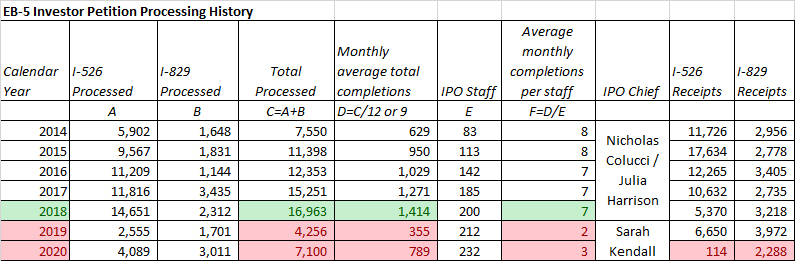
Table 1. Performance History for EB-5 Forms (I-526 and I-829) at the Investor Program Office[3]

In her first year as IPO Chief, Sarah Kendall succeeded in making the Investor Program Office four times less productive than it had been previously, and processing times ballooned. In her second year, new EB-5 form filings fell to historic lows.  Plummeting receipt and adjudication numbers reflect a variety of specific barriers and burdens implemented under her leadership, but fundamentally follow from the basic attitude discussed above — “we are a vetting agency” and “operational concerns don’t matter.” Sarah Kendall repeatedly emphasized during her tenure that “Program integrity is at the forefront of everything we do. IPO is continually fielding questions from Congress and others on performance in this area.”[4] She did not place a value on efficiency, and performance data shows the result. Today, the single best way to reduce barriers and burdens in EB-5 would be to put new leadership in place who will say “Integrity and efficiency are at the forefront of everything we do, and we are continually fielding questions about our operational effectiveness.”

2           Promoting Equity

(3) Are there USCIS regulations or processes that disproportionally burden disadvantaged, vulnerable, or marginalized communities?

Problem: Long USCIS processing times disproportionally harm the most vulnerable. This is obvious in theory: who suffers most from a long wait for a benefit? The one who most needs the benefit. It is also evident in practice.

Take the example of EB-5, where the processing time for I-924 Application for Regional Center has been posted at three to five years. Which kind of project can best afford to wait three years for USCIS review: the wealthy urban project that can proceed with or without EB-5 immigrant investors, or the project in a distressed area that depends on EB-5 to proceed? With unpredictable multi-year processing times for I-924 and I-526, EB-5 can hardly do what Congress intended: promote investment in vulnerable areas, in projects where economic impact and job creation are contingent on EB-5 investment, and thus on EB-5 processing. Instead, long processing times privilege the strongest projects best able to proceed without EB-5 and create jobs regardless of EB-5 delays.

Data Example: To confirm and quantify the disproportionate negative impact of long USCIS processing times in EB-5, USCIS could request the following data from the Investor Program Office: (1) trend in number of direct EB-5 vs. regional center I-526 filings (with direct EB-5 generally involving small business and individual entrepreneurs for whom long processing times present a particular barrier); (2) trend in the number of projects in first tier cities vs. small cities and rural areas (with small areas most dependent on the EB-5 investment and thus the timely processing); and (3) trend in the amount of EB-5 investment used to replace existing financing, rather than directly fund project costs.  Anecdotally, I see ballooning EB-5 processing times correlate with a trend toward EB-5 investment seeking the large and fully-funded urban projects best able to weather USCIS processing delays. This pushes EB-5 from a job-creating to a mere capital-cost-reducing program, contradicting Congressional intent for EB-5.

Solution: USCIS should place a value on efficiency and well as integrity, realizing that long processing times are not equitable.

3           Data Sources

(6) Are there existing sources of data that USCIS can use to evaluate the post-promulgation effects of regulations and administrative burdens over time?

a. USCIS should analyze and learn from its own data as reported on the Immigration and Citizenship Data page.[5]

  • Receipt data: USCIS should regularly analyze trends in receipts for each Form type. Falling receipts means depressed demand, which likely reflects a barrier or burden. For example, data shows that I-526 receipts fell 98% following implementation of the EB-5 Modernization Regulation in November 2019 (comparing I-526 receipts in the three quarters before and after the regulation took effect). That Form receipt data point is obviously relevant to understanding the impact of the regulation on potential immigrants.

USCIS’s own receipt data is also critical when budgeting for Fee Rules. According to OMB Circular A-25, fees should be set “based upon the best available records of the agency.”  But the 2019 Fee Rule relied on estimated “projected workload receipts” dramatically at odds with actual workload receipts as published on the USCIS Citizenship & Immigration Data page. For example, the 2019 Fee Rule had a “projected workload” of 14,000 I-526 receipts for FY2019/2020 even as USCIS had reported barely 5,000 I-526 receipts for FY2018/2019. This resulted in the 2019 Fee Rule massively overestimating future Form I-526 revenue, not to mention failing to account for funds needed to cover the burden of processing the large backlog of pending I-526 from previous years. Such oversights could have been rectified, had USCIS consulted its own data for form receipts and inventory.

  • Approval and denial data: USCIS should regularly analyze trends in adjudications (approvals plus denials) for each Form type. Falling adjudication volume reflects falling productivity at USCIS, which flags a barrier. For example, data shows that Investor Program Office productivity was 77% lower in FY2020 than in FY2018 despite staffing increases (comparing the number of approvals and denials of Form I-526, I-829, and I-924 between those fiscal years). That productivity data point flags management problems at IPO, and raises questions about new EB-5 policies and procedures that resulted in making adjudications three to four times more time-consuming than previously.
  • RFE data: USCIS should regularly analyze RFE trends for each form type. When an increasing percentage of cases are receiving an RFE, this flags a burden that can then be scrutinized. Educated by data, management can ask: why are more RFEs being issued? Have standards changed, and if so, how? Are the changes reasonable and operationally justifiable? Were the changes announced? Could the situation be improved by clarifying Form instructions or other guidance, so that petitioners know to provide correct and complete information upfront to avoid RFE?
  • Cost data: USCIS should examine trends in the amount of money it has spent defending against litigation. When constituents resort to suing USCIS, this signals frustration levels with barriers and burdens that need to be addressed. It also invites management reflection about how funds might be better used to address problems before they become lawsuits. For example, USCIS could reduce Mandamus litigation significantly by the simple expedient of improving the USCIS Processing Times Report. A confusing and misleading methodology and obviously unreasonable “case inquiry date” on the Processing Times Report create needless frustration and attracts lawsuits.
  • Data reporting: To the end of making its own data useful for management, USCIS should improve its data collection and reporting. The “All Forms Report” on the USCIS Immigration and Citizenship Data page may take the prize for Worst Data Presentation of All Time. The report makes every data point impossible to read without a magnifying glass, omits historical data needed to identify trends, and stymies Form-specific analysis. And yet this report is the only data source for many USCIS forms. Even Excel could take minutes to generate individual reports of USCIS form data, if USCIS valued data transparency and data-based oversight enough to generate readable and actionable reports.

b. USCIS should attend to existing public feedback about USCIS operations.

  • I recommend USCIS to review testimony presented at the House Judiciary Committee Hearing on “Policy Changes and Processing Delays at U.S. Citizenship and Immigration Services” held on July 16, 2019.[6] This hearing gathered detailed feedback from a wide array of constituencies on specific barriers and inefficiencies at USCIS, specific costs associated with those barriers, and suggested solutions. It is not clear that USCIS noted or responded to any of the excellent input offered at this hearing.
  • I recommend USCIS to review public comments made in response to USCIS Policy Manual updates.[7] We the public put great effort into providing detailed feedback on the practical impacts of policy changes, and no one even reads the Policy Manual feedback so far as we can tell.[8]
  • I recommend USCIS to review input provided to the CIS Ombudsman. The Ombudsman and the public expend considerable effort to identify and diagnose performance problems, and then USCIS does not respond.[9]

4           Form I-526 Inconsistency

Problem: The evidence requested in the Form I-526 and Form I-526 Instructions does not align with evidence checklists provided to adjudicators who review Form I-526. This inconsistency is evident to the public from (1) Requests for Evidence, which routinely quote standardized evidence lists not included in the Form I-526 or I-526 Instructions, and (2) materials from “Immigrant Investor Program Office Training May 8, 2019” (obtained via FOIA request) which instruct adjudicators to request evidence that the Form I-526 and Instructions do not request.

For example: no public-facing guidance requests I-526 petitioners to prepare source of funds documentation for non-EB-5 investors in the New Commercial Enterprise. This category of evidence is not mentioned in the Form I-526 Instructions, not in the Form I-526 Filing Tips or Suggested Order of Documentation for I-526 published on the USCIS website. The EB-5 regulations could justify requesting this category of evidence, but in practice USCIS evidence collection documents and guidance do not request it. (Possibly, because it’s obviously unreasonable to ask a petitioner to prove the source of funds for unrelated third parties who happen to have invested in the same project, and are not seeking immigration benefits.) But if an unreasonable information request exists, it should at least be published. No one benefits from lack of transparency upfront about required evidence. Petitioners cannot know to prepare evidence that USCIS does not request.

Solution: The May 2019 IPO Training discloses the existence of the following three internal “adjudication worksheets,” each of which is accompanied by an “instructional guide”: Form I-526 Worksheet; EB-5 Project Review Worksheet; Form I-526 Deference Worksheet. USCIS should review the content of those adjudicator worksheets and instructional guides, and identify discrepancies with the public I-526 Instructions, Filing Tips, and Suggested Order of Documentation. Then revise the internal and/or the public guidance and instructions as needed so that everyone is on the same page about what is required for I-526 adjudication.

5           Form I-924 Inefficiency

Problem: Form I-924 is problematic because it uses a single form, single fee, and single processing workflow for a variety of applications that are entirely different in their workload and processing needs: initial application regional center application; request for project review; required regional center amendment; optional regional center amendment. Regional centers are discouraged from sending optional updates to USCIS (e.g. new contact information) because such updates use the same form and thus involve the same $17,795 fee as a labor-intensive new application.  Regional centers are discouraged from getting optional project review from USCIS – a step that’s extremely valuable for program integrity – because that project approval uses the same form and thus promises the same deadly 3-5-year processing time as an initial application.

Solution: Create separate forms, fees, and processing workflows for the separate processes currently combined in Form I-924.

6           Data Reporting: Country-Specific Demand Data

Problem: USCIS does not report country-specific demand data for numerically limited categories (i.e. receipt data for petitions in categories with limited visa availability).

Specific example of why this is a problem: EB-5 is a numerically limited category subject to country caps, with future backlogs and visa waits created by the number of people by country who start the process by filing Form I-526. Thus, preparing for backlogs and wait times requires data for the number of I-526 receipts by country.  USCIS regularly collects and reports this data to Department of State for planning purposes, but has persistently not only neglected to but positively refused to share such data with the public. I-526 receipt data by country is not published on the USCIS Immigration and Citizenship Date Page.  Furthermore, the Investor Program Office Customer Service has repeatedly declined to respond to public inquiries requesting this information[10], Freedom of Information Act Request soliciting this information have gone unanswered[11], and the one country-specific I-526 inventory report briefly provided by USCIS was subsequently deleted from the website[12]

Lacking visibility into I-526 receipt numbers by country, businesses and prospective EB-5 immigrants cannot predict or plan to avoid future backlogs and excessive visa wait times. The public is left with no visa backlog signal except the visa bulletin (which reports on past visa wait times rather than signaling future wait times), and periodic non-public industry event presentations from Department of State.

Lack of country-specific I-526 data reporting led to the quiet buildup of a decade-long EB-5 visa backlog before China-born prospective immigrants became aware of the problem, and were empowered to choose to avoid it. [13] This unfortunate history promises to repeat today for India, whose EB-5 backlog situation may be severe but is not yet publicized. U.S. businesses today are still recruiting EB-5 investor applicants from India and making business plans assuming a five-year investment horizon, looking at the Current visa bulletin. They are unable to account for the number of India I-526 filed with and pending at USCIS, because USCIS refuses to publish this information. This lack of transparency from USCIS is a major integrity problem and needless process barrier.

Solution (EB-5 example): Start publishing these two data reports regularly on the USCIS Immigration and Citizenship Data Page:

  1. Essential: quarterly I-526 receipts country (top 8 countries + rest of world)
  2. Ideally also: I-526 pending inventory itemized by country (top 8 countries + rest of world) and by month or quarter of filing date

Alternatively or additionally, publish the I-526 data report that the USCIS Investor Program Office already generates monthly and provides privately to Charles Oppenheim of Department of State for visa bulletin reference.

Publishing demand information will help to prevent pileup of expensive and painful backlogs by educating the public and facilitating self-regulation. Publishing visa demand data would conform to the project management best practice to “elevate the constraint” with respect to the visa limits that constrain immigration processes.

7           Data Reporting: USCIS Processing Times Report

Problem: The USCIS Processing Time Report[14] is confusing and creates costly frustration. It reports an “estimated time range” for each form, where the first month represents the median age of recently-adjudicated cases, and the second month represents the age of extreme outliers in recent adjudications (the 7% oldest cases)[15]. The second number – the age of extreme outliers – is then used to calculate a “case inquiry date” which limits who can use normal channels to inquire about case status. According to the stated method, only the low month in the “estimated time range” represents something like normal processing – i.e. the median age of recent adjudications. And yet, the report stipulates a case has to be older than 93% of cases recently adjudicated before the petitioner can even make a case inquiry.

Example of why this is a problem: According to the current USCIS Processing Times Report, the median processing time for recent non-China I-526 adjudications is less than 31 months, and yet a given petition cannot be considered “delayed” or make an inquiry unless it has waited over 49.5 months for adjudication. In April 2021, I-829 had a “case inquiry date” in the year 2000, meaning that no I-829 petitioner could even inquire about status unless he or she had already been waiting over 20 years for I-829 adjudication.  These metrics are too-obviously unreasonable, create frustration, and lead petitioners who have above-average wait times yet barred from ordinary inquiries to jump to costly litigation. In EB-5, Mandamus litigation has become “the new normal”[16], creating needless expense for immigrants and USCIS.

Solution: Revise the USCIS Processing Times Report to calculate the “Case Inquiry Date” from the low end (median) rather than the high end (extreme outliers) of the “Estimated Time Range.” This will allow for reasonable inquiries, short of litigation.

To make the USCIS Processing Time Report less misleading, report an average as well as a median processing time.


[1] Statement of Sharvani Dalal-Dheini Director, Government Relations for the American Immigration Lawyers Association Submitted to the House Judiciary Committee’s Subcommittee on Immigration and Citizenship “Oversight of U.S. Citizenship and Immigration Services” July 29, 2020, available at https://docs.house.gov/meetings/JU/JU01/20190716/109787/HHRG-116-JU01-Wstate-LindtM-20190716.pdf

[2] Louise Radnofsky, Ken Cuccinelli Takes Reins of Immigration Agency With Focus on Migrant Vetting, THE WALL STREET JOURNAL, July 6, 2019, available athttps://www.wsj.com/articles/ken-cuccinelli-takes-reins-of-immigration-agency-with-focus-on-migrant-vetting-11562410802

[3] Data for I-526 and I-829 receipts and processed (approvals plus denials) from the USCIS Immigration and Citizenship Data page. Reported numbers of IPO staff from EB-5 stakeholder meetings and Congressional testimony.

[4] https://www.uscis.gov/sites/default/files/document/outreach-engagements/IIUSA_2020_Virtual_EB-5_Industry_Forum-IPO_Chief_Sarah_Kendalls_remarks.pdf

[5] https://www.uscis.gov/tools/reports-and-studies/immigration-and-citizenship-data

[6] https://judiciary.house.gov/calendar/eventsingle.aspx?EventID=2273

[7] https://www.uscis.gov/outreach/feedback-opportunities/policy-manual-for-comment

[8] For example, see IIUSA’s “Comments on USCIS Policy Manual, Vol. 6, Part G, Chapters 2 and 4,” submitted through the USCIS Policy Manual Feedback process and also available at https://iiusa.org/wp-content/uploads/2020/08/IIUSA-AILA-Comments-on-Deployment-of-Funds-to-USCIS_8.23.2020.pdf 

[9] For example, consider IIUSA’s “EB-5 Industry Comments, Questions, and Concerns for IIUSA Meeting with CIS Ombudsman Office on Tuesday, February 2, 2021” submitted to the CIS Ombudsman, and also available at https://iiusa.org/wp-content/uploads/2021/02/IIUSA-Comments-for-CIS-Meeting_2.2.21.pdf

[10] For example, this document copies my email correspondence with IPO customer service (uscis.immigrantinvestorprogram@uscis.dhs.gov) on this topic from January 2020 to March 2020 https://www.dropbox.com/s/jrvykh6l8grdgqo/IPOemail.docx?dl=0

[11] For example, I have been waiting for over a year so far for response to my FOIA request COW2020000203 submitted in March 2020 for country-specific I-526 data. EB-5 industry trade association IIUSA has made many FOIA requests for country-specific I-526 data that are still pending – for over three years, in some cases. https://iiusa.org/blog/iiusa-foia-information-court/

[12] One extremely helpful data report posted on 10/24/2018 at https://www.uscis.gov/sites/default/files/USCIS/Working%20in%20the%20US/i526list.pdf was deleted by USCIS, and now only saved in my folder https://www.dropbox.com/s/zxkmwye1yr1100t/i526list.pdf?dl=0

[13] Excess volume of I-526 filings from China apparently began in 2013, but not well-known until 2017 with the publication of the CIS Ombudsman Annual Report 2017, which reported that Chinese nationals “will likely wait 10 years or longer for their EB-5 immigrant visas due to oversubscription.” The China EB-5 market then regulated itself after 2017, thanks to this education, but too late for thousands of U.S. businesses and investors who had already made investment decisions in ignorance of decade-long wait times resulted from un-reported country-specific usage.

[14] https://egov.uscis.gov/processing-times/

[15] https://egov.uscis.gov/processing-times/more-info

[16] “EB-5 litigation: The new norm for EB-5 investors” By Bernard Wolfsdorf in EB5 Investors Magazine (April 1, 2021) https://www.eb5investors.com/magazine/article/eb5-investor-litigation