USCIS Guidance for RC Lapse (updated)

10/4/2021 UPDATE: USCIS published revised guidance on October 4, 2021.

7/1 UPDATE: USCIS just replaced its guidance on the USCIS website page for Approved EB-5 Immigrant Investor Regional Centers with a new message that now says regional center Form I-485 and I-765 filings will not be accepted during the lapse. (The message is now also repeated on the main EB-5 page, the Form I-924 page, and the Form I-526 page.) The I-485 change is odd, since Department of State is accepting regional center visa applications, per the July 2021 Visa Bulletin. I’m copying below the guidance on 7/1, while keeping my original 6/30 post that records what USCIS said yesterday. Who knows how often I’ll need to update this post going forward, as USCIS changes its mind.

Statutory authorization related to the EB-5 Immigrant Investor Regional Center Program expired at midnight on June 30, 2021. This lapse in authorization does not affect EB-5 petitions filed by investors who are not seeking a visa under the Regional Center Program. Due to the lapse in authorization related to the Regional Center Program, USCIS will reject the following forms received on or after July 1, 2021:

Form I-924, Application for Regional Center Designation Under the Immigrant Investor Program, except when the application type indicates that it is an amendment to the regional center’s name, organizational structure, ownership, or administration; and

Form I-526, Immigrant Petition by Alien Investor, when it indicates that the petitioner’s investment is associated with an approved regional center.

In general, we will not act on any pending petition or application of these form types that is dependent on the lapsed statutory authority until further notice. If you were issued written correspondence regarding your petition or application on or before June 30, 2021, you should review the written correspondence and respond by the due date (as applicable). Although USCIS is unable to review your response at this time, we will receive and maintain the response for review if circumstances change.

We will continue to accept and review Form I-829, Petition by Entrepreneur to Remove Conditions on Permanent Resident Status, in the normal course, including those filed on or after July 1, 2021.

We will begin rejecting all Forms I-485, Application to Register Permanent Residence or Adjust Status, and any associated Forms I-765, Application for Employment Authorization, and Forms I-131, Application for Travel Document, based on an approved Regional Center Form I-526.

We will provide further guidance to the public if circumstances change or further guidance becomes necessary.

https://www.uscis.gov/working-in-the-united-states/permanent-workers/employment-based-immigration-fifth-preference-eb-5/eb-5-immigrant-investor-regional-centers/approved-eb-5-immigrant-investor-regional-centers

Original 6/30 post:

The USCIS website page for Approved EB-5 Immigrant Investor Regional Centers was just updated with this statement:

Alert: Statutory authorization related to the EB-5 Immigrant Investor Regional Center Program will expire at midnight on June 30, 2021, unless Congress reauthorizes it. A lapse in authorization does not affect EB-5 petitions filed by investors who are not seeking a visa under the Regional Center Program.

In the event of a lapse in authorization related to the Regional Center Program, we will reject the following forms received on or after July 1, 2021:

–Form I-924, Application for Regional Center Designation Under the Immigrant Investor Program, except when the application type indicates that it is an amendment to the regional center’s name, organizational structure, ownership, or administration; and

–Form I-526, Immigrant Petition by Alien Investor, when it indicates that the petitioner’s investment is associated with an approved regional center.

In general, we will not act on any pending petition or application of these form types that is dependent on a lapsed statutory authority until further notice. If you were issued written correspondence regarding your petition or application on or before June 30, 2021, you should review the written correspondence and respond by the due date (as applicable). Although we cannot review your response at this time, we will receive and maintain the response for review if circumstances change.

We will continue to accept and review Form I-829, Petition by Entrepreneur to Remove Conditions on Permanent Resident Status, in the normal course, including those filed on or after July 1, 2021.

We will continue to accept Form I-485, Application to Register Permanent Residence or Adjust Status, based on an approved Form I-526. However, in the event of a lapse in authorization, we will be unable to act on any Form I-485 based on an approved Form I-526 associated with an approved regional center unless a visa through the Regional Center Program is reauthorized.

We will provide further guidance to the public if circumstances change or further guidance becomes necessary.

https://www.uscis.gov/working-in-the-united-states/permanent-workers/employment-based-immigration-fifth-preference-eb-5/eb-5-immigrant-investor-regional-centers/approved-eb-5-immigrant-investor-regional-centers

Authorization (webinars updated), Regulations (articles), FY2021 Q2 Processing Data

With a record level of uncertainty in EB-5, it’s hard to know what to say. But I shall provide resources and processing updates, at least.

Regional Center Program Authorization Legislation Updates

  • USCIS has not yet published guidance for the now-inevitable regional center program expiration/lapse as of July 1. 6/30 UPDATE: Now USCIS has published an alert on the website page for Approved EB-5 Immigrant Investor Regional Centers.
  • Attorney Carolyn Lee hosted an EB-5 Program Sunset Pop-Up Event, on 6/30 at 2:00 PM ET. I will link to a recording here when available
  • AIIA is hosting a Town Hall on July 1 at 6 pm ET to provide EB-5-investor-focused updates on what’s happening and solicit investor input for EB-5 reform negotiations. UPDATE: Recording available on YouTube.
  • IIUSA is hosting a webinar on June 7 at 12 pm ET to discuss reauthorization efforts and the IIUSA advocacy plan. UPDATE: Recording available on YouTube.
  • EB5IC and the China-focused EB-5 investor advocacy organizations are not offering any public engagement so far as I know, but I’ll update this list if I hear anything new. (UPDATE: EB5IC is doing some Sarah-Kendall-style public engagement, and emailed video on July 1.)

Regulations Update

The government has not yet reacted publicly (that I can find) to the court decision on June 22 vacating the EB-5 Modernization Regulation. The Code of Federal Regulations 8 CFR 204.6 at ecfr.gov (updated as of June 25), the USCIS Policy Manual Vol. 6 Part G, and the EB-5 page at USCIS.gov still say that the minimum EB-5 investment amount is $1.8 million, or $900,000 in a TEA designed by USCIS. EB-5 lawyers agree that the June 22 court win did indeed return the EB-5 investment amounts to $500,000 or $1 million in a State-designated TEA, and that I-526 can be filed at this level so long as the June 22 change still applies. The expert lawyers do not agree on the probability that USCIS will go on to approve I-526 filed at the lower investment level, or how and how soon and for whom the rules may change back again. I’ve started a table lining up the variety of opinions I’m seeing/hearing on regulations-related questions, and may publish it later once I have more feedback. A few expert reference articles available so far:

EB-5 Form Processing Update and FY2021 Q2 Processing Data

On the positive side, USCIS says they welcome the extensive public feedback on “Identifying Barriers Across USCIS Benefits and Services.” A USCIS Public Engagement email last week said that: “We greatly appreciate all the feedback submitted and are actively reviewing the comments we received. We will use this feedback to inform future policy changes and operational improvements. We remain dedicated to providing all stakeholders with opportunities to share meaningful feedback and to engage with the agency.”

A second piece of good news:   On June 24, the Senate Judiciary Committee advanced Ms. Ur Jaddou’s nomination for USCIS director, bringing her bringing the nomination closer to a full Senate vote.

And now for the rest of the news. The Investor Program Office and EB-5 processing have not shown improvements yet. Last week, the USCIS Citizenship & Immigration Data page was updated with data reports for FY2021 Q2 (January to March 2021). Processing volume in this quarter remained low – even worse than in the last quarter under the Trump administration. This is not the trend I wanted to see. I-526 receipts also remained low, though a bit higher than we had thought: total 189 for October 2020 to March 2021. I was glad to see that I-829 receipts caught up in January to March, compensating for an artificially low previous quarter.

I-526ReceiptsApprovalsDenialsTotal ProcessedPending
Jan 2021 to Mar 20219875213088213,044
Fiscal Year to Date1891,7562492,005
I-829
Jan 2021 to Mar 20211,0535663760310,356
Fiscal Year to Date1,2581,207781,235
EB-5 Form Processing Data from https://www.uscis.gov/sites/default/files/document/reports/Quarterly_All_Forms_FY2021Q2.pdf

USCIS reported 13,044 pending I-526 as of March 31, 2021. Considering historical trends, we can assume that over 90% of those are regional center I-526 that cannot be processed once the regional center program lapses starting on July 1.  A Bloomberg Law article from June 25 “Backlog of Investor Visa Applications in Limbo as Program Dies” included this quote: “The Homeland Security Department subagency can’t yet say what the fate of those EB-5 applications are, USCIS spokesman Joe Sowers said Friday.” That’s over 10,000 regional center investors and their families and over 5 billion dollars in limbo associated with pending I-526 alone, not to mention over 70,000 regional center applicants at the visa stage. As industry negotiators keep up their “my way or nothing” positions, they must think about the implications associated with that amount of money in the economy, if not that number of tender individual human beings dependent on regional center program authorization.

Mandamus litigation has offered hope to combat the EB-5 processing slowdown since 2018. But the hope is limited. The above-linked Bloomberg Law article reports (though without citing sources) a high rate of denial and dismissal for mandamus lawsuits. The article indicates that federal courts threw out two of four EB-5 mandamus actions in 2020 and two out of three suits in January and February. One suit in May had a partial victory for the plaintiffs, while three were denied in June. “In many of these cases, judges cite a set of factors in a 1984 case—Telecommunications Research and Action Center v. FCC—that set standards for when courts ought to compel agencies to take action in the event of an unreasonable delay. The opinions often cited the concern that siding with the plaintiffs would send a signal that litigious applicants for the program can jump to the front of the line.” Ideally someone will soon address the across-the-board slowdowns and productivity loss at the Investor Program Office, as illustrated in the above charts, so that individual petitioners do not have to fight individually for treatment that everyone deserves.

What will happen to EB-5 processing during the regional center program expiration/lapse? If we assume that about 1,300 pending I-526 are direct petitions, that IPO continues processing I-526 at a rate of 900 petitions per quarter, and that the RC program stays expired for months to come, then the direct I-526 inventory could all be adjudicated this year. Or maybe IPO will eventually respond to changes by moving staff over to I-829 adjudications, in which case I-829 rather than direct EB-5 may benefit from the RC program lapse/expiration. With so many moving parts, prediction is difficult.

Senate setback for RC program authorization

What happened?

Today June 24, the Senate’s last working day before the regional center program sunset on June 30, Senators Grassley, Leahy, and Cornyn stood together on the Senate floor to request unanimous consent to pass S.831 to reauthorize the regional center program. (The EB-5 portion of the Senate floor proceedings on 6/24 can be reviewed here starting at time 2:54:52.) All three Senators spoke warmly about the regional center program and their efforts to reform and preserve it. Senator Cornyn’s decision to join Grassley and Leahy was significant, since he had been associated with the “holistic” faction alternative to Grassley’s reform efforts, and was an original co-sponsor of the S.2778 bill that the opposition hopes to revive. I was happy to see at least this level of compromise and unity in the cause of reauthorization. However, South Carolina Senator Lindsey Graham, another Senator in the “holistic reform” corner, registered an objection to the unanimous consent. And so S.831 did not pass the Senate today. A short-term extension was not brought forward by Senator Schumer or his proxy, as some had hoped. The Senate is now on recess until after July 4, so the window for legislation in advance of June 30 has closed. (The House version of the Grassley bill has been making progress, with 23 cosponsors so far, but the House can’t pass laws by itself.) The regional center program will sunset starting July 1, 2021. The battle for reauthorization legislation will continue once Congress gets back to work after July 4. The timeline and outlook for final resolution remains unknown.

What does it mean?

Regional center program lapse/expiration does not directly affect direct EB-5, or regional center investors who have already been admitted for conditional permanent residence. The lapse will put a freeze on pre-green card regional center petitioners and applicants, until the RC program is reauthorized.

USCIS has yet to publish guidance for how exactly they will handle regional center petitions during this program lapse/expiration. There’s informed speculation that the policy will initially be similar to what was published in December 2018 during the last lapse. I will report when the USCIS website gets updated. (In the meantime, attorney Robert Divine has a helpful article on practical implications of a lapse.)

The July 2021 visa bulletin gives the Department of State policy on visa issuance during the lapse/expiration for regional center (i.e. I5 and R5) visas. “The I5 and R5 visas may be issued until close of business on June 30, 2021 and may be issued for the full validity period. No I5 or R5 visas may be issued overseas, or final action taken on adjustment of status cases, after June 30, 2021. Since there has been no legislative action at this time, the final action dates for the I5 and R5 categories have been listed as “Unavailable” for July. If there is legislative action extending this category for July, the final action dates would immediately become “Current” for July for all countries except China-mainland born I5 and R5, which would be subject to a November 8, 2015 final action date and Vietnam I5 and R5, which would be subject to an April 1, 2020 final action date.” Any questions regarding what’s in the visa bulletin can be directed to the blessed Charles Oppenheim, who will be hosting another “Chat with Charlie” live on Youtube on Monday, June 28, 2021 at 1:00 PM Eastern Time. (Per the visa bulletin, one can email questions to VisaBulletin@state.gov ahead of the event with “Chat with Charlie Question” in the email subject line.)

Why did it happen?

Maybe there was practically no chance to get RC reauthorization passed before the tight June 30 deadline regardless, given the lack of legislative vehicles to which it could have been attached. Maybe compromise could and should have advanced legislation, if only negotiators had been more flexible.

Instead of speculating about causes and blame, I will start by simply repeating what key players in the reauthorization drama have to say for themselves. As background, key industry players have been IIUSA and its allies, who have chosen to support the current Grassley bill as the best/only way to avoid RC program death; and EB5 Investment Coalition (EB5IC), which considers that the Grassley bill is death and should be opposed to make an eventual path to something better. IIUSA has associated with Senators Grassley and Leahy, while EB5IC has implied association with Senator Schumer, and also Rounds, Graham, and (previously) Cornyn. Grassley v. Schumer represents a long-standing division around EB-5 legislation that has been in place since the last multi-year RC program extension ended in 2015 – a division roughly caricatured as Middle America vs. the Big City.  Schumer, Rounds, and Graham did not make any EB-5 statements today that I can find (beyond Graham’s one-word objection on the Senate floor). I’m copying below statements made today by Grassley, Leahy, and Cornyn, and excerpts from the most recent statements from IIUSA and EB5IC. I’ll let you think about where grains of salt need to be applied, where the rights and wrongs lie, and where the path forward could be. (One question I keep thinking about: what does each of these players think the BATNA is? Could compromise be encouraged by pointing out issues with some of those envisioned BATNA?)

IIUSA’s perspective was recently represented in an article by IIUSA Executive Director Aaron Grau published on June 21 in the Times Union. I copy excerpts here:

Recently, Senators Chuck Grassley, R-Iowa, and Patrick Leahy, D-Vt., introduced S.831, the EB-5 Reform and Integrity Act of 2021, a bipartisan bill that protects investors, assures the program’s integrity and secures its longevity. Shortly after, Rep. Greg Stanton, D-Ariz., and Rep. Brian Fitzpatrick, R-Penn., introduced an identical companion bill in the House of Representatives, HR 2901. The House bill has 20 cosponsors and counting, Republicans and Democrats.

However, opposition continues to mysteriously fester, unfairly keeping key policy makers, like Senate Majority Leader Charles Schumer and House Judiciary Committee Chairman Jerry Nadler, away from embracing the bipartisan, bicameral solution at hand.

The EB-5 Regional Program needs change, including increased integrity measures to help protect against the fraud and abuse brought on by one too many bad apples. It needs provisions to protect good-faith investors who, through no fault of their own, may find themselves in a terminated project. And the program needs stability — the kind of stability that only comes from a long-term, five-year reauthorization.

With just days until the program expires, time is of the essence and, without Schumer’s support, this powerful development tool goes away and future EB-5 investments and vital jobs for New Yorkers will be eliminated.

[Update: See also IIUSA’s 6/25 Advocacy Alert on program sunset. I also recommend the 6/23 Investment Migration Report webinar with Aaron Grau, an extremely substantive 1.5-hour discussion that addresses most questions about the legislative process, and also touches on the Behring litigation on regulations.]

EB5 Investment Coalition does not typically make statements, but kindly held a webinar for the public at 9 am EST on June 24, ahead of activity in the Senate. Below, I transcribed an excerpt of legislation-related remarks from that webinar, quoting EB5IC co-founders Laura Foote Reiff of Greenberg Traurig and Jeff Campion, CEO of Pathways EB-5.

Jeff Campion: So I know that we’re working on extension. Obviously you said it expires June 30, we all know that. So let’s talk about where the extension is. Grassley and Leahy, they’ve hot-lined the bill. It’s on UC I guess today. What does that all mean? I know that we’re trying to get the program extended for a period of time. But what’s the lay of the land from your side?

Laura Foote Reiff: So we’ve always had for the last six-plus years some key players who have been interested in the program. We saw last Congress Senators Cornyn, Rounds, Schumer, and Graham introduce a more holistic bill, S.2778. It was a bill that would change the programmatic rules and deal with integrity measures. Senators Leahy and Grassley have introduced an integrity-measure only bill. They reintroduced that bill this Congress. And we’ve been trying to talk to them about adding in some programmatic measures to deal with backlog issues and investment levels and the TEA definitions, to no avail. There were some serious conversations for the last couple weeks with, I think, Senator Schumer’s office. We’re trying to work with them on some edits that would be acceptable. Senators Grassley and Leahy have now done what they called “run a hotline” on the legislation, and I understand they’re going to take the bill to floor of the Senate for unanimous consent without any edits except for the fact that instead of the five-year extension, they’ve amended it to a two and a half year extension of integrity measures only. So it’s unfortunate.

Jeff Campion: So there’s a few options here, right? I guess one option is they make it where its not 27 months, it’s 15 months or 3 months, or someone puts a hold on it and it doesn’t go through. I mean those are kind of the different options, right?

Laura Foote Reiff: Yeah, I mean, it’s unfortunate in Congress these days that you can’t go through regular order to get legislation through. We’ve been trying to get more comprehensive legislation on EB-5 through for many years. So this is one tool that Senators will use, the unanimous consent effort. If there is any objection to the unanimous consent motion, then the thing fails. And we think that there are enough holds on it that it probably won’t pass. But there’s going to be some negotiation. We’re hoping in the end they come up with something, some kind of compromise so that there’s a shorter-term extension of the regional center program with an opportunity to negotiate out that more holistic reform to deal with some of the programmatic issues that exist.

…What could happen with the reauthorization, when Congress comes back from their recess, they could take this up at any time. They could have unanimous consent in July, they could have unanimous consent on something, whether it’s a short-term extension, whether it’s integrity measures, whether it’s a holistic thing. They could also work together, like Senators Cornyn, Graham, Schumer and Rounds did, on a more holistic bill, and have that attached to another vehicle. As we just said at the beginning of this program, it’s very difficult to pass a stand-alone piece of legislation. So the vehicle could be an infrastructure bill, it could be some other immigration bill going through. And/or we could see ourselves being reattached, maybe recoupled back in September. Nothing is guaranteed. It’s all kind of making sausage up on the Hill. I know a lot of people are afraid about the program expiring. It’s never fun to have a program expire, but it happens.  I know, as you said Jeff, there’s going to be a lot of pressure to do something to try to resuscitate the program between now and September 30.

(As background on what’s involved in a more holistic bill, see my post EB-5 legislation and the question of options. See also IIUSA’s article on why the industry trade association did not to demand programmatic fixes as a condition of passing integrity reforms. As background for what Senator Grassley thinks about short-term extensions coupled with appropriations bills, see his posts from 2015 and from 2018.)

Senator Grassley published an article on his website today with a typically pugnacious comment about what happened. To quote some excerpts:

Sen. Chuck Grassley, Ranking Member of the Senate Judiciary Committee, and Sen. Patrick Leahy, Chairman of the Senate Appropriations Committee, today condemned a blockade of their bipartisan bill to reform and extend the EB-5 investor visa program, which expires on June 30. The blockade was led by a small group of wealthy and unscrupulous real estate developers who blindly oppose any efforts to improve accountability and transparency in the EB-5 visa program.

“A narrow subset of big moneyed and corrupt interests has now shown that they would rather kill the program altogether than have to accept integrity reforms designed to clamp down on their bad behavior,” Grassley said on the Senate floor.

“It’s really unfortunate that a bipartisan bill supported by the overwhelming majority of EB-5 stakeholders was blocked at the behest of a small minority that blindly opposes much-needed accountability and transparency in the program.  Senator Grassley and I have worked together for years to develop a thoughtful, careful compromise that would both keep the program alive and curtail the worst abuses of it.  Now that our bill has been blocked, the EB-5 visa program is unfortunately going to lapse in the days ahead and have untold economic consequences throughout the communities that rely on the program for development projects.  I remain committed to reforming the EB-5 program should there be another opportunity to do so,” Leahy said.  

Senator Cornyn’s website published this message.

Today on the floor, U.S. Senator John Cornyn (R-TX) discussed the importance of the EB-5 Immigrant Investor Program and his legislation that would make commonsense reforms, which was blocked from passage this afternoon. The current authorization runs out on June 30th. Excerpts of Sen. Cornyn’s remarks are below, and video can be found here.
EB-5 investments are a major economic driver in Texas. EB-5 projects use merit-based immigration to create thousands of American jobs and bring billions of dollars in investment to major urban areas like Dallas and Houston, as well as our rural communities across the state. These projects include investments in infrastructure for a wide variety of sectors, including energy, hospitality, residential and commercial.”

“I’m a supporter of the EB-5 program and its resources it delivers to the community, but there is no question, as Senator Grassley has said, that it could stand some reforms.”

“I’m glad to join Senator Grassley today in offering this legislation to improve the integrity and security of the EB-5 program while ensuring law-abiding Texas job creators aren’t negatively impacted. This bill would have reauthorized the EB-5 program until 2023 with significant oversight and integrity measures.”

Senator Cornyn went on to say (quoting from the end of his statement on the Senate floor starting at time 2:57:11):

This happens to be very similar to legislation that I introduced in 2015 with Senator Schumer and Senator Flake, which included recommendations from both the Department of Homeland Security and the Government Accountability Office. I appreciate Chairman Grassley’s leadership on this legislation, and I hope at some point we can reauthorize the EB-5 program and safeguard critical investments in communities across the country.

Senator Leahy of Vermont had this to say (starting at time 2:59:26 in the recording of Senate floor proceedings for June 24):

I was happy to join both Senators Grassley and Cornyn on the EB-5 reform bill. Senator Cornyn has worked very hard on this, Senator Grassley has, and I have. And it was a truly bipartisan bill that has widespread support among EB-5 stakeholders – those who responsibly welcome changes in the program that would improve oversight and accountability.

Senator Grassley and I have been working for years to reform the EB-5 visa program. We want to reduce the fraud that’s current in several EB-5 projects, including one that occurred in my own state of Vermont. And this legislation – again, bringing Republicans and Democrats across the political spectrum together – reflects a careful, thoughtful compromise that will keep the EB-5 program alive and curtail the worst abuses.  

There’s actually only a small minority that wants to keep the program operating without these improved these standards and oversight, and I wish they would be willing to bring it out, vote it up or down. Be on the record, saying how they’re going to vote. Because opposing our effort on this is a vote that allows the EB-5 program to lapse. That’s going to have untold economic consequences throughout the communities that rely on the program for development projects, like those that the Senator from Texas just mentioned.

I wish that the senators supported Senator Grassley’s consent request, but I will take a moment to thank Senator Grassley for working with me over the years to find a bipartisan compromise reform list. Hours have gone into that. He and Senator Cornyn and I and others have worked hard to have a compromise. I’m sorry that the unanimous consent was objected to, especially since it means this will expire, and we won’t have votes on improvements that could take part. I think it’s a wasted opportunity.

And finally, a note for people inspired to share their touching personal-impact stories in response to this post. Advocacy organizations might love to hear your experience, so they can bring it forward in conversations with members of Congress and the media to directly influence legislative outcomes. Consider contacting an advocacy organization to tell your story. AIIA has a form up to collect contact info for a database of EB-5 investors willing to speak with or be quoted to Congresspeople in various constituencies, and journalists. And IIUSA says “Share your EB-5 success stories with us via e-mail so we can share them with members of Congress.”

What the RC program deadline means

This blog is not the place for hot takes, so I will wait to report in detail on regional center authorization status and implications going forward. But I’m getting showered in marketing emails that imply that filing a regional center I-526 before June 30 will allow investors to beat the regional center program deadline and its consequences. For the sake of program integrity, I would like to repeat a paragraph from preeminent EB-5 authority Robert Divine in the article “The problem with EB-5’s reliance on temporary legislation.”

WHAT HAPPENS IF THE EB-5 PROGRAM DOESN’T GET REAUTHORIZED?

The shocking reality is that expiration of the program without renewal would invalidate the immigration processing of every regional center investor who has not already been admitted to the U.S. as a conditional permanent resident, even if they already have filed their I-526 or have an approved I-526 and is waiting for a visa number or processing.  That would affect as many as 100,000 investors who have already placed their capital in a project and who might remain stuck in the investment while losing all immigration benefits.  The investors would not be able to “change gears” to try to count only the direct operational jobs of the project (if there would be any) if they invested through an NCE separate from a JCE (extremely typical). 

USCIS probably would hold I-526 petitions in abeyance for several months waiting for a retroactive legislative solution, but eventually if that solution did not come, USCIS would deny all pending I-526 petitions and revoke all I-526 approvals for all investors who had not already been admitted to conditional permanent residence.  Affected investors might bring lawsuits against USCIS arguing that the expiration of legislation should only be prospective, but that would be an uphill battle. Investors who already were admitted as conditional residents would not be affected and would be able to file I-829 petitions to remove conditions.

[Update: see also Mr. Divine’s follow-up article “A swirl of EB-5 Developments”]

This tough reality needs to be disclosed and accounted for in today’s decisions, and motivate how hard we work to get authorizing legislation as soon as possible. I 100% agree with Mr. Divine that “Congress should at least provide that the regional center legislation in effect at the time an investor files Form I-526 will remain in place throughout those waits until the investor can remove conditions on permanent residence through adjudication of Form I-829.” It’s a pity that such a provision does not exist yet, and a shame when promoters pretend that it does. As Mr. Divine notes in his article “Given how much the EB-5 investments have benefitted regional economies all over the U.S., it seems unlikely that Congress will let the regional center program expire, but in the next renewal Congress should eliminate the nagging worry that investors must face when considering whether to invest in the program.”

The drama continues (reauthorization, regulations)

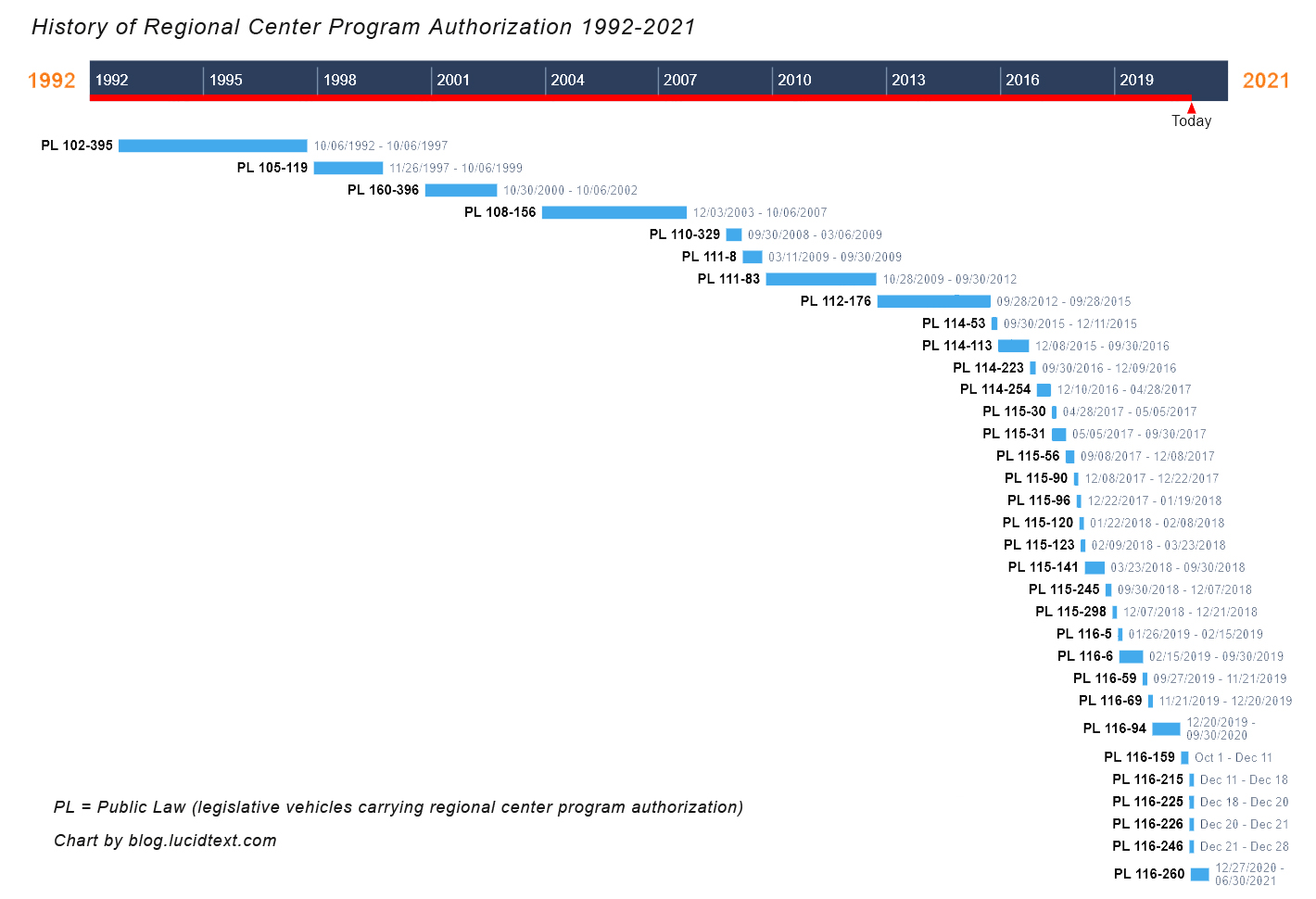
For a recent update on what’s happening with EB-5 legislation see “EB-5 Regional Center Program reauthorization: Will it happen this week?” (June 22, 2021) in Homeland Preparedness News. Senator Grassley has been still pushing to get a reauthorization bill to the finish line. People opposed to the Grassley bill would like to see that bill fail and a short-term extension – or least hope of a future short-term extension – instead. However, Senator Grassley says that he would rather see the program die than allow for such a short-term extension. The HPN article quotes Grassley staffer Taylor Foy: “Extending the program without the reforms ‘would be legislative malpractice,’ said Foy. ‘If they are not enacted by the end of the month, the program will die.’” Strong words, with little understanding or sympathy for the economic not to mention personal stakes involved. But disturbing, and I understand the frustration. The industry said “a short-term extension to give more time for legislation” in 2015, and again in 2016, and again in 2017, and again in 2018, and again in 2019, until 2020 when the removal of the regional center program from the appropriations process that had facilitated short-term extensions. The pattern of extensions since 2015 is clearly not sustainable. We are past time for stabilizing legislation.

The investor advocacy organization AIIA has published open letters to Senators Schumer, Grassley, and Leahy, calling on them to keep faith with past regional center program users. “With the reauthorization deadline looming and no sign of resolution of gridlock on this issue, AIIA would like to remind Congress about the importance of upholding the contract with existing immigrant investors.” 

Meanwhile, the 2019 regulations that increased the EB-5 investment amount and changed TEA definitions have been vacated in court. This sends the matter back to current DHS leadership, which may choose to reinstate the regulation with the $900,000/$1.8M investment amount (and likely will, since Director Mayorkas already confirmed that he supports the 2019 regulation) and/or to Congress to include investment amounts and TEAs in future legislation (thus making the legislative battle even more wide-ranging and contentious than it is already). I’m watching the USCIS website for an announcement. While waiting for these things to happen, there maybe a limited window to make a $500,000 investment – in the case of the regional centers, an investment in reliance on an immigrant investor program that may offer no chance to immigrate. Not the easiest marketing pitch. But if the court win on regulations does prove effective for marketing, that will be great for U.S. businesses that desperately need funding, especially where offering documents allow businesses to keep and use the money regardless of whether or not the investors are practically able to pursue the immigration process. (Regional centers may consider using escrow to help share the risk.) Making an investment/filing I-526 locks funds into a private business, but those actions do not lock in a chance to get a visa from the government based on that investment. (I have a post coming soon on what does get “locked in” at various stages in the EB-5 process.) So it’s complicated, and the need for authorizing legislation continues.

To quote Behring Companies, which brought the suit:

Today, the US District Court for the Northern District of California ruled in favor of Behring Regional Center, vacating the 2019 EB-5 Modernization Rule. The court agreed that DHS had no authority to implement the 2019 Rule due to the unlawful appointments of the Acting DHS Secretary and Acting USCIS Director who were appointed during the Trump administration without confirmation by the Senate. The Court vacated the Rule and remanded the matter to DHS and it may take steps to reinstate the Final EB-5 Rule pursuant to Administrative Procedure Act’s rule-making process. DHS may also file an appeal and seek to stay the order while the appeal is pending. The current sunset date for the EB-5 Regional Center Program is June 30, 2021. Congress is already discussing various legislative proposals for EB-5 reform. With Behring’s legal victory, we fully anticipate final bills will increase the required investment amount. Our efforts are focused on achieving a long-term extension and meaningful EB-5 reform for a better and more sustainable EB-5 Program.

UPDATE: I will copy relevant articles here as they are posted.

EB5 Investment Coalition has decided to speak with the public, and holding a webinar on June 24 at 9 am EST. This is a chance to hear from the faction opposed to Senator Grassley’s legislation to reauthorize the regional center program, and how they see their efforts creating hope rather than spelling disaster for the future.

Policy Updates, Webinars

USCIS Updates Policies to Improve Immigration Services

Today USCIS announced policy updates “to clarify the criteria and circumstances for expedited processing; improve request for evidence (RFE) and notice of intent to deny (NOID) guidance; and increase the validity period for initial and renewal employment authorization documents (EADs) for certain noncitizens with pending adjustment of status applications.”

These actions are part of a series of planned improvements designed to modernize USCIS and “to eliminate policies that fail to promote access to the legal immigration system.” The USCIS press release quotes Acting USCIS Director Tracy Renaud: “USCIS is committed to promoting policies and procedures that ensure we operate in a fair, efficient, and humane manner that reflects America’s heritage as a land of opportunity for those who seek it.”

Yay! Looking forward to several more years of improvements like this!

AIIA Webinar Invitation

In debates over regional center program reauthorization, EB-5 legislation, and USCIS processing, EB-5 investors have had little voice and influence. A few investors are trying to change that, and have formed American Immigrant Investor Alliance, a non-profit organization with plans for investor-focused advocacy and community development activities. “AIIA hopes to provide investors a seat at the table with respect to the decisions that directly affect them. As investors, we believe our stories and our investments are the best representatives of the good that the EB-5 program brings to the United States.” Interested in this effort? The organizers are hosting an introductory webinar on Saturday, June 12 at 8 am PDT/11 am EDT to discuss goals and plans and invite participation. UPDATE: A recording of this excellent webinar is now available on YouTube.

Behring Companies Webinar Recording

On June 7, Behring Companies hosted a webinar covering topics including the Behring V Wolf et. al. lawsuit on the EB-5 regulations (including goals, arguments, and potential outcomes), EB-5 program reauthorization efforts, and reform priorities from a holistic perspective. Register to view the recording.

Know of other EB-5 advocacy events and activities that should be mentioned? Email me at suzanne@lucidtext.com

Updates (USCIS director, visa bulletin, visa numbers, regs litigation, country caps)

Another post with bits and pieces of news you should know in EB-5.

USCIS Leadership and Processing Improvements

Ur Mendoza Jaddou, the nominee for USCIS Director, made this statement to the Senate Judiciary Committee at her nomination hearing on May 19:

At the heart of a functioning immigration system is an agency that effectively processes immigration and naturalization applications under the law, like those of my family and so many others. This means that USCIS must process applications fairly, efficiently, and in a humane manner; be accessible, transparent, and accountable; and safeguard the integrity of the system; and ensure the security of the nation.

My most immediate responsibilities if confirmed will be to return the agency to firm solvency, resolve dramatically increasing processing times and backlogs, and utilize 21st century tools. I’ll work to ensure that USCIS retains the confidence of the American public as an agency able to fulfill its mission. In addition, I’ll work to ensure that the hardworking and dedicated men and women, my former colleagues at USCIS, have the resources, leadership, and support they need to carry out their roles without undue difficulty.

[Transcribed from Ms. Jaddou’s opening statement 1 hour and 23 minutes into the hearing video.]

These are precisely the words I wanted to hear. I also appreciated this testimonial from the U.S. Chamber of Commerce:

Ms. Jaddou has significant experience working on immigration policy and she is very familiar with the operations of USCIS. Ms. Jaddou’s knowledge and experience would be indispensable in providing the critical leadership needed to stabilize the agency’s financial challenges, reduce its significant processing backlogs, and provide stakeholders with more consistency throughout the various adjudications processes it conducts every day. Throughout Ms. Jaddou’s public service, she has shown a keen understanding of how USCIS operations affect businesses across various industries. The Chamber is confident that she would continue to consider the views of the American business community on the issues that are critically important to the ability of many companies to meet their current and future workforce needs.

Ms. Jaddou presented herself well at the hearing, and did not get many questions. A couple Senators grilled her on the controversial issue of parole, and one asked about tackling petition backlogs. Regarding backlogs, she noted that she has a running start thanks to understanding all the small steps that go into creating processing times. I hope that she is confirmed soon! The Biden Administration has nice-sounding goals for restoring integrity to USCIS operations, and I’d love to see a few of them realized.   

Visa Processing and Availability (Vietnam, China, FY2022 numbers)

Department of State Press Office has been doing a wonderful job with the YouTube live chats at https://www.youtube.com/user/TravelGov/videos In just a few minutes a month, Department of State reminds us that they have skilled, caring human beings ready to take and respond to public questions. Watch and learn, USCIS.

At the end of the June 2021 Visa Bulletin “Chat with Charlie” (minute 33) Charles Oppenheim mentioned “an excellent chance” that the Vietnam EB-5 Final Action Date will be “current” by September 2021. Current means that any Vietnamese who’s ready at the visa stage could proceed to final action then, regardless of filing date. Mr. Oppenheim did not give any background to this prediction, but we can identify two reasons:  (1) slow I-526 processing limiting the number of Vietnamese who reach the visa stage, and (2) Vietnam’s excellent work in controlling COVID-19 and getting consular processing back on track. Judging by visa issuance so far, Vietnam may be the one country that may actually approach the 1,302 EB-5 visas technically available to each country in FY2021. According to statistics on monthly visa issuance, Vietnamese had received 541 EB-5 visas through consular processing as of April 2021. Ho Chi Minh City issued a heroic 320 EB-5 visas in March alone. If that kind of performance continues into next year, the estimated visa wait time for incoming Vietnam EB-5 applicants could be reduced from the expected 7-8 years to more like 5-6 years.

Guangzhou and Mumbai are still not doing well with EB-5. I count only 29 EB-5 visas issued to Indians and only 14 to Chinese through consular processing so far this year (October 2020 to April 2021). The consulates in China and India are issuing a small number of visas in all categories, and EB-5 sadly belongs to the “Tier 4” lowest level in Department of State’s priority list. The best hope for Chinese and Indian EB-5 applicants may be to catch up next year, when EB-5 will once again have additional visas available.

EB-5 visa availability in FY2022 will be increased by a share of the unused family-based visas that spill over from FY2021. In the “Chat with Charlie” video linked above, Mr. Oppenheim stated that he expected the FY2022 Employment-Based visa limit to be at least 290,000. That would mean EB-5 would get over 20,590 visas (7.1% of the EB total) and each country would get over 1,441 visas (7% of the EB-5 total). If consular processing is back to normal by then, and those extra visas could be issued, then India and China could at least counterbalance the losses in FY2021.

The June 2021 Visa Bulletin finally moved the China EB-5 Final Action Date from August 15, 2015 (where it’s been since last August) to September 15, 2015. In the “Chat with Charlie” linked above, Charles Oppenheim indicated that he expects to continue to move all EB dates aggressively, but mentioned China EB-5 as a specific exception to that rule.  (For other EB categories, he predicted that the the “dates for filing” in the June 2021 visa bulletin will likely be the “final action dates” in the September 2021 visa bulletin). Department of State elaborated further in an AILA Liaison Committee Meeting on May 27, 2021. AILA had asked “2. Given that Guangzhou resumed IV processing on April 9th, how far does DOS expect the EB-5 final action dates to advance by the end of this fiscal year?” DOS responded: “The China EB-5 Final Action Date will be advanced based on estimates of visa availability under the FY 2021 EB-5 annual limit. Movement of the date is likely to be limited based on the large number of filings received during September 2015.”

EB-5 Regulations Litigation

I’ve avoided commenting on the litigation to invalidate the EB-5 Modernization Regulation – an effort that’s justified and that also risks derailing regional center program reauthorization efforts and being misrepresented to prospective investors. What makes an immigrant investor program attractive? One important factor: price. A more important factor: whether the program even offers a path to immigrate. That second factor is in question now, and must be resolved before the regulations can make a difference.

For expert analysis of what the litigation involves and could imply, see these articles:

Court may invalidate 2019 EB-5 Regulations while regional center legislative expiration looms” (May 14, 2021) by Robert Divine

“Behring Regional Center v. Department of Homeland Security and The Case for Common Sense” by Aaron Grau, May 2021 Regional Center Business Journal (page 37)

Update: Behring Companies hosted a helpful webinar on June 7 to explain their goals and vision for the litigation, and expected outcomes. Recording available here.

Country Caps Legislation (EAGLE Act)

The country caps debate is now officially back on the table, as Rep. Zoe Lofgren has reintroduced the Fairness for Highskilled Immigrants Act, now called the EAGLE Act. The bill text reflects H.R.1044 from last Congress, and once again offers no transition period to protect in-process EB-5 investors, should the bill become law. (The proposed transition period and special provisions apply to EB-2 and EB-3 only, suggesting who’s paying for lobbying.) Country caps are what prevent high-demand countries from claiming all available visas in EB categories. If the EAGLE Act passed, then the EB-5 visa wait line would become simply first-come-first-served order, benefiting the tens of thousands of Chinese who have been waiting longest, and creating unexpected multi-wait times for applicants from most other countries. With over 80,000 people in the EB-5 wait line, a new investor from any country could expect to wait over 8 years for a visa. (I discussed the implications in this post.) Country caps legislation has been around for many years without getting passed. It managed to pass both House and Senate in last Congress, but didn’t end up on the President’s desk. We’ll see what happens this time around. Kamala Harris had co-sponsored the Fairness Act when she was a Senator.

Other Articles of Note

“The Corporate Rights of EB-5 Investors: How to Navigate the Legal Maze of Redeployment and Liquidation Once the EB-5 Investment is Repaid” by Vivian Zhu and Rogelio Carrasquillo May 2021 Regional Center Business Journal (p. 10)

“What The Latest Unemployment Data Tells Us About The Trends and Distribution Of EB-5 TEAs” by Lee Li May 2021 Regional Center Business Journal (p. 40)

I am once again a “Top 5 Business Plan Writer” in the EB5 Investors Magazine poll. A big thank you to my industry colleagues who have voted for me every year since 2016, and to clients who trust me with their business plans. I continue to enjoy the challenge of figuring out how to make EB-5 work for business.