Responding to Direct EB-5 RFEs

In August 2021, the USCIS Investor Program Office approved only 16 I-526 petitions, but sent out 87 Requests for Evidence (RFE) on I-526. RFE response presents a strategic challenge and opportunity for petitioners: another chance to strengthen the basis for approval and to avoid adding basis for denial.

Most direct EB-5 RFEs ask about the business plan. By the time USCIS reviews I-526 years after filing, every I-526 business plan is deficient at least in the sense of being outdated. The adjudicator reviewing the I-526 does not only want to know what the plan used to be, but how the plan has turned out. A business plan may also be deficient in the sense of being incomplete – lacking validation, or lacking relevant detail about use of investment and job creation. In the worst case, a carelessly-prepared business plan may positively demonstrate that the EB-5 investment does not meet EB-5 requirements.  So what can be done, when USCIS sends an RFE that identifies “deficiencies,” states that “Petitioner has not established eligibility for the benefit sought” and warns “a petitioner may not make material changes to a petition that has already been filed in an effort to make an apparently deficient petition conform to [USCIS] requirements.” How can one correct deficiencies, and also not make material changes? It takes experience, care, and strategy.

Having helped with many RFE responses as a business plan writer, I see three strategic steps:

  1. Identify the USCIS adjudicator’s specific concerns. It helps to be familiar with RFE template language, so that you can distinguish case-specific questions from the boilerplate content.
  2. Regardless of the specific RFE questions, identify what the adjudicator needs to know about the enterprise, investment, and job creation order to approve the I-526.
  3. Prepare an RFE response that addresses specific concerns, provides clarification and evidence to further support compliance with EB-5 requirements, and emphasizes the non-materiality of any changes from the information and evidence previously filed with Form I-526.

Step 1: Identify Explicit Adjudicator Concerns

I start by looking at the RFE and asking myself: “What does the adjudicator think is deficient about this I-526 petition?” Note that business plan-related questions that the adjudicator wrote for the RFE are normally located between these two template sentences: “Upon reviewing the business plan, USCIS finds that the evidence in the record does not establish that the business plan is Matter of Ho compliant” and “For the reasons identified above, the business plan is not credible.” Everything before that first and after that second sentence in the job creation/business plan section is normally template content: generic language that’s simply cut and pasted verbatim into every RFE job creation section. The template content is there for reference, and not necessarily a question or concern. Petitioners tend to be particularly spooked by a 2-3-page list of bullet points for business plan content, with item requests in categories from “Market Analysis” down to “Projections.” That list is in the RFE because it’s part of the RFE template (and I’ve seen versions of it since at least 2012). That list may or may not be in your RFE because the adjudicator read your business plan and found it to be deficient on any of those bullet points.

Step 2: Identify Underlying Eligibility Issues

Strategy does not stop with identifying specific questions in the RFE.  Lazy adjudicators are known to send RFEs with no case-specific questions at all – just an uncustomized RFE template. I’ve seen two such RFEs in the last month – a hint that the adjudicator didn’t even really look at the I-526 record yet, but just sent a generic RFE to get the ball out of the court for awhile. Or, sometimes RFEs specifically request evidence that does not exist for the particular business. Or the petitioner may know of clarifications that need to be added to the I-526 record, although the RFE didn’t request them. So it’s wise to not only react to specific RFE requests, but to stand back and think about the basic eligibility issues, and what can best be added to the I-526 record to support eligibility for I-526 approval and the road ahead.

For example, when an RFE asks for an improved business plan, the eligibility issue is job creation. An improved plan may not be necessary if it’s now possible to replace business plan predictions with the even more compelling job creation evidence of payroll records for employees already hired. When an RFE asks for supply contracts, the eligibility issue is whether the business is viable and active, to be able to create and sustain jobs. So if the business does not have supply contracts, the petitioner can think of other evidence to address the underlying concerns about business activity and feasibility. When the adjudicator was too lazy to look at the I-526 record and ask specific questions, the petitioner can still grasp the RFE opportunity to preemptively provide relevant answers.

For a recent RFE response, I worked with the client to prepare a business plan addendum designed to clarify ambiguities in the I-526 record and to explain COVID-19-related business plan adjustments in context of on-going eligibility. The client had received a generic RFE, with no specific questions about I-526 inconsistencies or subsequent developments. We responded by giving the adjudicator the correct and up-to-date information that we knew he’d need to understand and approve the petition, hopefully preempting confusion and challenge.  

EB-5 eligibility on the project side comes down to three things: (1) investment (2) in a new commercial enterprise (3) that creates jobs. Regardless of what specific items an RFE may request, the I-526 should be approved if the record manages to provide clarity and a preponderance of evidence for eligibility on those three basic points.

Step 3: Avoid Material Change Challenges

Many RFEs include this language in the “Conclusion” section, to remind petitioners of the peril in submitting new information.

If Petitioner submits updated or revised documents, please note that “[a] petitioner must establish eligibility at the time of filing; a petition cannot be approved at a future date after the petitioner becomes eligible under a new set of facts. See Matter of Katigbak, 14 I&N Dec. 45, 49 (Comm. 1971). Therefore, a petitioner may not make material changes to a petition that has already been filed in an effort to make an apparently deficient petition conform to [USCIS] requirements.” Matter of Izummi, 22 I&N Dec. 169, 175 (Assoc. Comm’r 1998); see also 8 C.F.R 103.2(b)(1).

To navigate this Catch-22 for RFE business plan updates, the business plan writer should (1) know what was in the filed I-526, (2) take care to present new facts in context of continuity with the original I-526 filing, and (3) be able to support the basic message that the investment was eligible at the time of filing and remains eligible to this day, even through business developments and document updates. A good RFE business plan update takes care and labor, because it looks backward as well as forward. I start by reading the thousands of pages originally filed with I-526, so that I know where consistency can be highlighted and where new information needs explanation.  I do not only read the original business plan, because when USCIS says “business plan” they really mean “business plan plus supporting evidence,” and business plan updates involve supporting evidence as much as the document that says “business plan” on the cover.  

In the excitement of filing I-526, many people think about documents as mere formalities that exist to check boxes. I-526 can get filed with a document that says “business plan” on the cover, but that does not clarify and validate the specific business and how it meets EB-5 requirements. Unfortunately, some EB-5 business plan writers just specialize in business plan-like formatting, while others follow a snow job strategy of making the plan so confusing and long that the adjudicator will probably just approve it to avoid the work of wading through it.  But when an RFE comes, things get real. The I-526 RFE basically says “your business plan did not just check a box and I do actually want to understand it, and to be convinced that your specific investment qualified and still qualifies for EB-5.” At that point, it’s time to value a business plan with genuine business plan content and shaped by EB-5 expertise. And it’s time to look past the RFE questions and challenges to think through what specifically USCIS needs to know for the petition to succeed.

For more information, see my EB5 Investors Magazine article on Strategies for I-526 RFE business plan updates, and my RFE service page.
In-process EB-5 applicants and legislative stakes

For whose sake should Congress act on EB-5 legislation? The discussion tends to focus on the future of the regional center program, and the question of potential and protections for future EB-5 investment. However, past EB-5 investment must also weigh on the discussion. Regardless of its future, EB-5 certainly has a past: tens of thousands of foreign nationals who heeded the EB-5 incentive created by Congress to invest in job-creating U.S. business through the regional center program, but who do not yet have the offered incentive. Tens of thousands of past regional center EB-5 applicants do not yet have visas. Their on-going process depends on legislation to reauthorize the regional center program, or at least to offer existing investor protections in case of expiration.

Why are people whose EB-5 investment was made and spent many years ago still a factor in today’s immigration policy discussion?  Because: they haven’t immigrated. Contrary to popular belief, EB-5 investment does not purchase a green card. EB-5 only allows foreigners to potentially qualify for green cards in the future based on job creation resulting from qualifying investment.[i] The “EB” in EB-5 stands for “employment-based” not “investment-based.” The ultimate condition for immigration success is not satisfied at the beginning of the process, with the initial investment, but at the end of the process, with proven job creation. This process takes at least five and up to over 20 years. Meanwhile, in-process regional center investors who do not yet have visas represent at least $23 billion dollars currently at work in the U.S. economy.[ii] Table 1 quantifies the population of regional center EB-5 investors and applicants who are currently already in the EB-5 immigration process.

Table 1. EB-5 Process Timing and Population as of 2020

EB-5 Process StageEB-5 investor received a visa yet at this stage?EB-5 investment must be deployed at this stage?Estimated Timing as of 2020Estimated number of regional center investors at this stage as of 2020Estimated number of regional center applicants (investors + family) at this stage as of 2020
Start: make investment and initiate the immigration process     
Qualify for conditional permanent residence (I-526 + visa application)NOYES2-17+ years[iii]Over 40,000[iv]Over 80,000 [v]  
Conditional permanent residence stageYES (conditional)YES2 years[vi]About 6,000[vii]About 18,000[viii]
Remove conditions on permanent residence (I-829)YES (conditional)Not required for immigration1-5 years[ix]Over 9,000[x]About 21,000[xi]
Finish: Proven job creation and  permanent residencyYES  Not required for immigration   
Total  5-20+ yearsOver 55,000About 119,000

When the regional center program expires, then the 80,000+ regional center investors and applicants who do not yet have conditional permanent residence status lose eligibility for an EB-5 green card. This hard fact under current law is evident today, as USCIS is not accepting or acting on Form I-526 or I-485 from regional center investors, and Department of State is not issuing visas to regional center investors. (People who have conditional permanent residence status still have opportunity to complete the immigration process and remove conditions. USCIS continues to accept and adjudicate regional center I-829.) Since June 30, 2021, the immigration process for regional center EB-5 investors has just been frozen, waiting for Congress to act. If Congress does not act, the process will eventually unfreeze, and petitions and applications will be denied. This ends the EB-5 immigration hope but not the investment, which is still held by private parties who can hardly be ordered to suddenly undeploy and return the funds. If the chance for visas is lost, that’s a multi-billion dollar disaster waiting to happen for deployed investment. Switching midstream from regional center to direct investor status is unfortunately impossible due to indirect job creation and material change. Legislation is the only path forward to protect the program as a whole, or at least its past investors.

The moral of the story: (1) industry advocates, remember the size of the constituency that depends on your fiduciary duty, as you gamble for RC program authorization, and (2) investor advocates, push for legal changes that would at least protect in-process investors from mid-stream RC program changes. AIIA has been working for a Foreign Investor Fairness Protection Act (FIFPA) that would provide such protection, and is currently raising funds for a lobbying effort to push the bill.  


[i] USCIS Policy Manual, Volume 6 Part G Chapter 1(A): “The Immigration and Nationality Act (INA) makes visas available to qualified immigrant investors who will contribute to the economic growth of the United States by investing in U.S. businesses and creating jobs for U.S. workers. Congress created this employment-based fifth preference immigrant visa category (EB-5) to benefit the U.S. economy by providing an incentive for foreign capital investment that creates or preserves U.S. jobs.” In contradistinction to some “golden visa” programs around the world, the U.S. EB-5 program is not a “cash for passports” arrangement. For more background see “The Changing Landscape of Immigrant Investment Programs” (October 25, 2019) by Congressional Research Service. https://crsreports.congress.gov/product/pdf/IF/IF11344

[ii] EB-5 investment must remain sustained in the U.S. enterprise and deployed (“at risk”) at least through the end of the investor’s conditional permanent residence period. USCIS Policy Manual Vol. 6 Part G Chapter 5(A)2. Approximately 46,000 regional center investors have not yet reached the end of the conditional permanent residence period, as calculated in Table. 1. Each of these investors must have invested a minimum of $500,000.  46,000x$500,000=$23 billion

[iii] The process to qualify for conditional permanent residence starts with I-526 petition processing, and ends with a visa application and wait for visa availability. I-526 processing has taken 1-5 years, according to processing time reports from USCIS. https://www.dropbox.com/s/dfa4ifgop1vhm63/IPO%20Times%20Dates.xlsx?dl=0 For countries with no visa wait, the visa application normally takes six months or more. Countries with historically high EB-5 demand face a long wait for visa availability at this stage. As of October 2020, Charles Oppenheim, Chief of the Visa Control & Reporting Division at the U.S. Department of State, estimated wait times for EB-5 visa availability for investors filing I-526 “today.” The longest wait time, for China-born investors, was estimated at 17.2 years. The wait times for Vietnam and India were estimated at 7-8 years. See slide 10 of “Part 1: A discussion with Charles Oppenheim” (November 19, 2020) 2020 IIUSA Virtual Forum https://iiusa.org/wp-content/uploads/2020/11/Virutal-Industry-Forum-Visa-Update.pdf

[iv] As of April 2020, USCIS reported 16,633 pending I-526 petitions for EB-5 investors, and 24,005 approved I-526 petitions for EB-5 investors who did not have visa availability yet according to the visa bulletin. A third category is unreported, but likely in the thousands: approved I-526 with visas available but not yet issued. Over 95% of these pending and approved I-526 are likely for regional center investors, judging by past experience. (The regional center category accounted for 95% of EB-5 visas issued from 2012 to 2019.) References: “I-526 Performance Data FY2020 Q1” https://www.uscis.gov/sites/default/files/document/data/I526_performancedata_fy2020_qtr1.pdf “Count of Approved I-140, I-360 and I-526 Petitions as of April 20, 2018 with a Priority Date On or After May 2018” https://www.uscis.gov/sites/default/files/document/data/EB_I140_I360_I526_performancedata_fy2020_Q1_Q2.pdf and “Annual Report of the Visa Office” https://travel.state.gov/content/travel/en/legal/visa-law0/visa-statistics/annual-reports.html

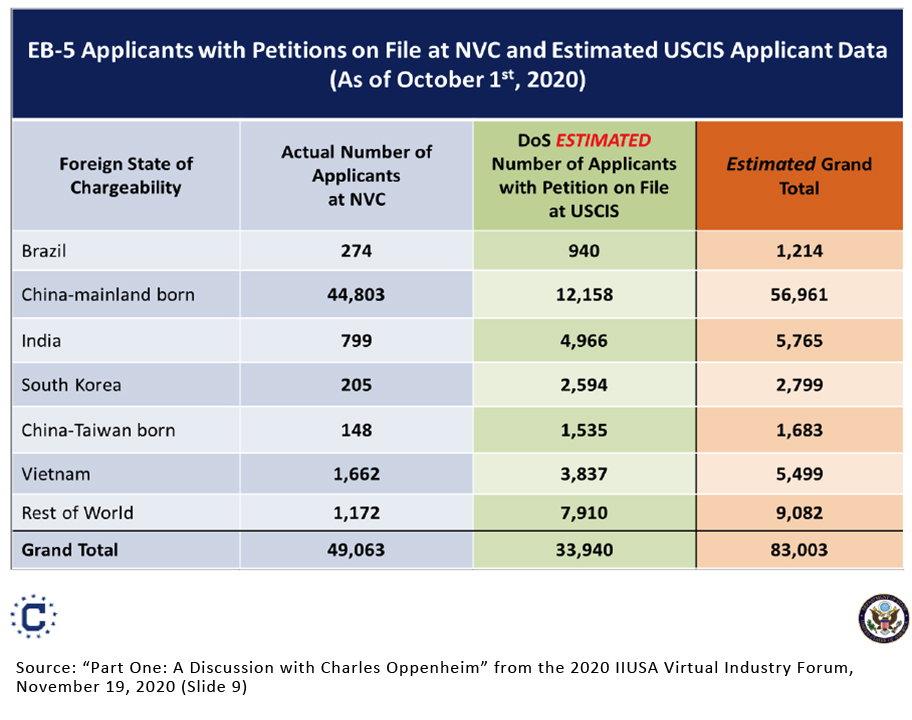
[v] Charles Oppenheim, Chief of the Visa Control & Reporting Division at the U.S. Department of State, estimated a grand total of 83,003 prospective EB-5 visa applicants in process as of October 2020. This estimate includes applications on file at the National Visa Center and estimated applicants associated with I-526 petitions pending at USCIS. It does not include EB-5 applicants with pending I-485 status adjustment petitions: a population in the thousands. Over 95% of the estimated total EB-5 applicants are likely associated with regional centers, judging by past experience. (The regional center category accounted for 95% of EB-5 visas issued from 2012 to 2019.) See slide 9 of “Part 1: A discussion with Charles Oppenheim” (November 19, 2020) 2020 IIUSA Virtual Forum https://iiusa.org/wp-content/uploads/2020/11/Virutal-Industry-Forum-Visa-Update.pdf

[vi] The Conditional Permanent Residence Stage is defined as two years from the date that the green card was granted. USCIS Policy Manual Vol 6. Part G Chapter 5

[vii] People in the CPR stage in 2020 received green cards in 2018-2019. In 2018, 3,160 visas were issued to principal applicants through the regional center program. In 2019, 3,135 visas were issued to principal applicants through the regional center program. See Table 7 of the DHS Yearbook of Immigration Statistics for 2018 https://www.dhs.gov/immigration-statistics/yearbook/2018/table7 and 2019 https://www.dhs.gov/immigration-statistics/yearbook/2019/table7.

[viii] People in the CPR stage in 2020 received green cards in 2018-2019. The Department of State reports issuing 8,995 regional center EB-5 visas in 2018, and 9,064 EB-5 visas to regional center investors in 2019. These figures include investors (principal applicants) and family members. See “Immigrant Visas Issued and Adjustments of Status Subject to Numerical Limitations (by Foreign State of Chargeability): Fiscal Year 2019” https://travel.state.gov/content/travel/en/legal/visa-law0/visa-statistics/annual-reports/report-of-the-visa-office-2019.html and “Immigrant Visas Issued and Adjustments of Status Subject to Numerical Limitations (by Foreign State of Chargeability): Fiscal Year 2018” https://travel.state.gov/content/travel/en/legal/visa-law0/visa-statistics/annual-reports/report-of-the-visa-office-2018.html

[ix] I-829 processing has taken 1-5 years, according to processing time reports from USCIS. https://www.dropbox.com/s/dfa4ifgop1vhm63/IPO%20Times%20Dates.xlsx?dl=0

[x] As of March 30, 2021, USCIS reported 10,309 I-829 petitions pending, of which over 90% were likely filed by regional center investors. (91% of EB-5 visas issued 2010 to 2017 were issued to EB-5 investors.)

[xi] Assumes that the ratio of total visas to investor visas is about the same at Stage 3 as Stage 2.

Visa Processing and I-829 investigation

Visas cannot be issued to regional center applicants while the regional center program is expired, but processing steps short of visa issuance can theoretically be taken, if USCIS and Department of State are willing. USCIS appears to be doing nothing with pending regional center I-485, but Department of State confirms that it is still working on regional center visa application documents — at least for now. The following Q&A is transcribed from minute 17:30 of the Youtube Chat With Charlie for the September 2021 Visa Bulletin.

Q: Is NVC still processing the documents that are being submitted by R5 and I5 applicants who were previously contacted despite those preferences having expired as of June 30?

A: The answer is yes, at this time the National Visa Center has not implemented any type of changes and continues to be processing the cases submitted by R5 and I5 applicants who were previously contacted. These procedures remain under constant review and they may need to be changed if Congress does not authorize an extension of the I5 and R5 categories in the future.

[September 7, 2021 Update: I’m told that NVC has started sending emails with this content, contradicting what Oppenheim said in the chat.

“The EB-5 category pilot program has expired as of June 30, 2021, for applicants seeking a visa under the Regional Center Program.
This includes the following visa categories:

  • I5, for an investor Pilot Program in a targeted area
  • R5, for an investor Pilot Program not in a targeted area

The National Visa Center (NVC) will not act on any new or pending EB-5 visa petitions as described above until further notice. Please do not submit any additional fees or forms to NVC.

If this visa program is extended by Congress, new notification letters will be sent to all case parties. Unfortunately, we cannot predict when a decision will be made. All previously submitted fee payments will remain valid if this program is extended in the future.”]

Other insights from the September and August Chats with Charlie: USCIS is expected to use the Dates for Filing chart for all EB categories in October 2021, no EB categories that aren’t already current are expected to become current in FY2022, Vietnam EB-5 is expected to remain Current throughout FY2022, and only China is expected to have a Final Action Date for EB-5 in FY2022. Mr. Oppenheim stated that he is moving dates based on the numbers theoretically available, despite the pandemic restricting visa issuance in practice. He noted the large EB visa limit for FY2022 (262,288, which would mean a record 18,622 visas theoretically available to EB-5), and also: more numbers available doesn’t necessarily mean more visas can be processed, considering staffing constraints and on-going COVID-19 restrictions.

With the USCIS Investor Program Office currently having little to do but work on Form I-829, I’m trying to find out whether they are, indeed, working on I-829, and more about the I-829 inventory. If you have a Form I-829 pending, or recently approved or denied, could you share a couple details about your case status and experience? I have set up a quick Google Form. (Or if you’d like to share info outside the form, just email me at suzanne@lucidtext.com, or Telegram to 626.660.4030.) Thanks!

Updates (reauthorization, regulations litigation, FY2021 Q3 processing data)

Reauthorization Update: On Wednesday 8/25 at 12PM EDT, the EB-5 investor organization AIIA will hold a webinar to update stakeholders on efforts for legislation to reauthorize the regional center program and protect investor interests. Register here to participate live in the AIIA webinar (or check the Youtube channel later for a recording). See also the most recent AIIA newsletter. AIIA has been unusually open about sharing whatever information they can gather from Congressional staffers and industry contacts about EB-5 legislation, and I recommend the resource. I am not a primary source for advocacy info or opportunities.

Regulations Update: USCIS has indicated that it will appeal the Behring Regional Center decision, which restored the old $500,000 investment amount and TEA rules. For more background, see this EB5 Investors Magazine article and this article by Behring Regional Center. It seems clear that the EB-5 investment amount will not change by regulation any time soon, since court cases take time. USCIS will likely continue to accept I-526 based on $500,000 for some time. However, will USCIS go on to approve I-526 filed today at the $500,000 level? Discuss with your lawyer what will happen to eligibility for pending I-526 if USCIS wins the appeal, and the new regulation thus not vacated after all.

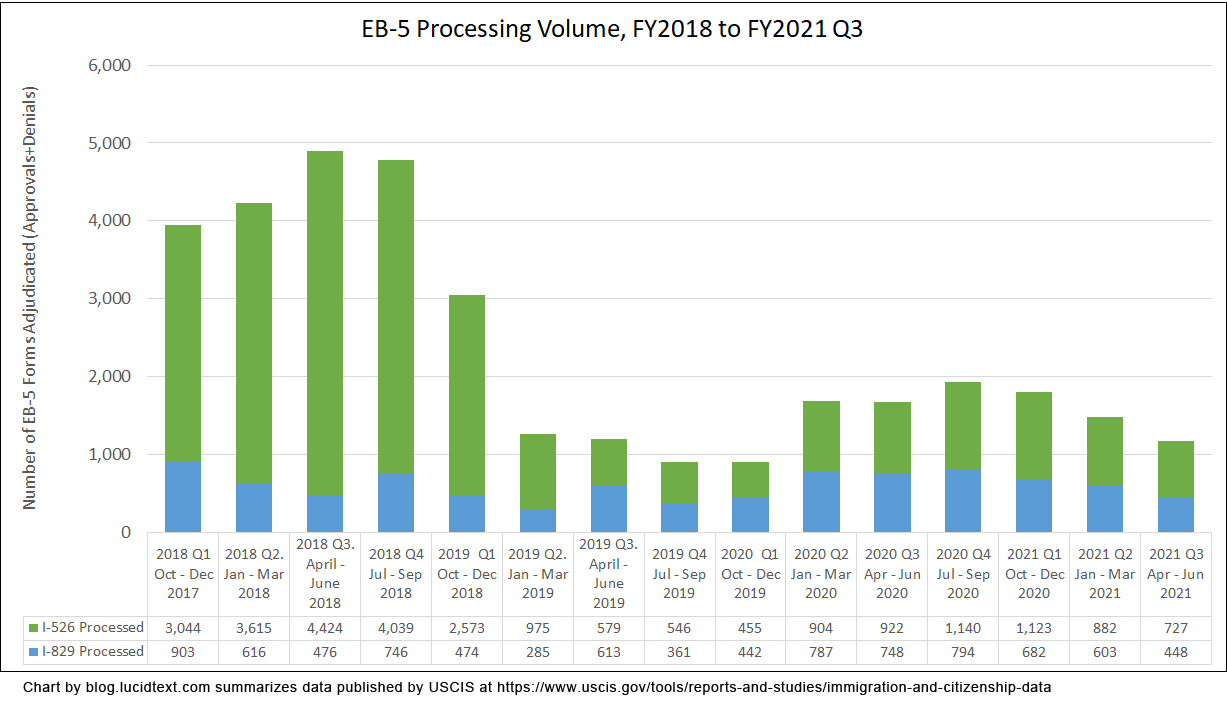
Processing Update: Meanwhile, I continue to get real-time updates that IPO has been handling only a handful of I-526 petitions per day. But thanks to the lack of FIFO discipline, IPO is assigning new as well as old cases, and a number of I-526 filed in late 2019 are already getting reviewed. So some direct EB-5 petitioners will enjoy relatively short I-526 processing times – a welcome development so far as it goes. EB-5 integrity would get such a boost if we could expect that every I-526 would get USCIS attention in months, not years!  So far, the official USCIS Immigration and Citizenship Data page reinforces what my leak says: that productivity at the Investor Program office has still not improved under the Biden administration, and in fact has gotten worse for I-829 as well as I-526 through June 2021 — according to the FY2021 Q3 update. I continue to wait for new leadership at IPO to address this trend. (I am not reporting on receipts in the FY2021 Q3 USCIS report, because I note an error. The report is missing hundreds of I-526 receipts that were received during the reporting period on June 29 and 30, but apparently physically entered into the case tracking system in the first days of July, outside the reporting period.)

I-526 Status Report: July 2021

At last report (in November 2020, the last time IPO deigned to have a stakeholder engagement of any kind), the Investor Program Office at USCIS had a staff of 232 people. What are these people doing, especially now during the regional center program lapse when USCIS decided that “we will not act on any pending petition or application of these form types that is dependent on the lapsed statutory authority.” Are IPO staff busy making progress with the direct EB-5 inventory and I-829, or are they doing something else in or out of the office?

Before I share some inside information on this question, consider the workload facing IPO’s staff of 232 people. Current IPO management is unknown (former Chief Sarah Kendall having left back in November, and a replacement not yet announced), but if you were management, how would you allocate IPO’s staffing and fee revenue resources? What level of processing productivity would you expect?

FormPending Inventory as of 3/31/2021Completion Rate (Average Touch Time per Form)Status during regional center program expiration
I-52613,044 (direct I-526 likely <10% of total)8.65 hoursOnly direct EB-5 I-526 are being processed
I-82910,3658.15 hoursAny forms can be processed
I-92415234.95 hoursNo forms can be processed
SourceQuarterly reportProposed Fee RuleWebsite Alert
Investor Program Office Workload as of 2021

The only official window into IPO productivity comes from quarterly reports with limited data published after months of delay on the USCIS Citizenship & Immigration data page. I chart these data reports to track trends in IPO resource allocation and productivity.

In my frustration at USCIS’s limited and delayed data reporting, I also welcome leakers:  confidential sources within USCIS who can share information that the public should know. I will now share some recent I-526 information from a source that I cannot name but believe to be solid.

I-526 Data Leak: July 2021

  • In the last week of June 2021, between the Behring lawsuit decision (June 22) and the regional center program expiration (June 30), USCIS received 405 I-526 filings.
  • From the 4th of July holiday until the end of July (July 6-30), IPO issued 16 I-526 approvals and 32 denials. At the same time, IPO issued 77 RFE and NOID on I-526 cases. The following is the priority date distribution (calendar year) of these actions: 2015 2%, 2016: 13%, 2017: 16%, 2018: 38%, 2019: 31%.  The priority date range was from September 2014 at oldest to July 2019 at youngest.
  • In July 2021, 16 people withdrew their I-526 petitions.

As I look at these numbers, here’s what strikes me as significant.

More I-526 were filed in the last week in June 2021 than in the entire previous year and half. That shows strong demand for EB-5 at the $500,000 minimum investment, a high level of industry preparation for the Behring court win, and optimism about regional center program prospects.

I-526 adjudication volume was extremely low after 4th of July: only 48 decisions and 77 notices in 21 working days – in other words, fewer than 6 total actions per day on average, and just over 2 decisions per day on average. We’d feared that one consequence of regional center program lapse on June 30 could be IPO decision to move resources away from I-526 adjudication, and that appears to be happening, at least so far. In January to March 2021 IPO adjudicated 882 I-526, and I thought that was extremely low. But that was an average 14 decisions per working day, in addition to RFEs. And now they’re down to barely over 2?

USCIS reported in the 2019 Fee Rule that adjudicative “touch time” for I-526 is less than 9 hours per form on average. If that report is accurate, how few people must have been assigned to I-526 in July 2021, to result in an average of only 2 decisions and 6 total actions per working day? Can it be that with 232 people on staff, funded at least half by I-526 fees, that IPO had fewer than 10 people assigned to I-526 cases in the month of July? I have not been informed about IPO staffing allocation decisions, but feel that the public has a right to know whether a fee-funded agency is using fees to provide the paid-for service.

I have not been told yet how the I-526 inventory divides between direct and regional center cases, but by historical averages it’s possible that only about 1,000 direct I-526 remain to be adjudicated. IPO adjudicated that many cases per month in 2016-2018, and at least adjudicated that many per quarter until recently. But if July 2021’s productivity were the new normal, with only about 2-3 decisions per working day, then even 1,000 I-526 would take forever to process. I have not yet been given I-829 data or staffing data, so I can’t tell whether the I-526 loss is temporary, and whether it is balanced by gains for I-829. If 232 IPO staff are mostly not processing I-526, and not processing I-924, they must be doing something EB-5-related, I hope? (Sarah Kendall attributed part of the huge IPO productivity drop in 2019 to “temporary assignment of IPO staff to other agency priorities” — i.e. staff sent outside to work on non-EB-5 cases. That was an inexcusable use of EB-5 fee-funded resources, and I hope that’s not happening again now.)

I note that 2/3 of IPO’s actions in July 2021 were sending RFEs and NOIDs, supporting my anecdotal observation that IPO rarely decides a direct EB-5 I-526 these days without sending an RFE first – often, an RFE that basically requests I-829 evidence. This practice naturally slows the process and reduces volume of completions.

If, as USCIS claims, “We generally process cases in the order we receive them,” then we’d see a fairly tight date distribution in I-526 actions. The July 2021 data, with actions distributed over I-526 from 2015 to 2019, reinforces what we can also see in the USCIS Processing Times Report “Estimated Time Range”: that I-526 processing is hardly FIFO in practice.

I was not told whether IPO is still using the visa availability approach for I-526, even now with the RC program expiration already drastically reducing the active I-526 inventory. It would be interesting to know whether any/many of the older I-526 actions in July 2021 were on Chinese cases. I do note that most denials in July were on the oldest cases, reinforcing the intuitive sense that delayed adjudication means higher adjudication risk.

USCIS does not normally report withdrawals, but for public policy reasons we need to know how many people are choosing to exit the program, even after having made investments. I will continue to track this number with interest and concern.

The details reported in this post are a fraction of what we’d like and need to know about what’s going on behind the scenes at IPO. I am thankful for whatever I can get, and will continue to make periodic (probably, monthly) reports so long as I can keep my sources. I hope that public exposure can help to encourage accountability and performance at IPO.  Going forward, IPO civil servants, please act like you are being observed and might be accountable to the public.

And for anyone at USCIS/IPO who sees this post, I welcome you to join my public-spirited leaker community. Reach out to me by phone or on Telegram at (626) 660-4030, and let’s chat. The list of areas where USCIS should but doesn’t have public transparency include IPO leadership, I-829 performance, IPO staffing allocation, IPO training, the country composition of the I-526 inventory, the distribution of I-526 receipts by regional center, reasons for increasing denial rates, and I-485 processing for EB-5 cases, to name a few priorities. I would love to hear and share confidentially whatever you can tell me in these areas, for the good of program integrity. And ideally: encourage leadership to start holding public EB-5 stakeholder meetings again, publish timely data for everyone on the USCIS website, and perform in a way that does not justify reproach and desperate measures to get basic information.

I am happy to see that leadership change is starting at the top anyway, with Ms. Ur. M. Jaddou now confirmed as USCIS Director. Her first statement this week sounds great: “As USCIS director, I will work each and every day to ensure our nation’s legal immigration system is managed in a way that honors our heritage as a nation of welcome and as a beacon of hope to the world; reducing unnecessary barriers and supporting our agency’s modernization.”

Sizing the reauthorization hurdle

I’ve been overwhelmed with everything that could be written, in this period of unparalleled transition, opportunity, and existential crisis for the EB-5 industry and investors. I’ll start by getting out a few words on the elephant of regional center program reauthorization, so that I can move on to many updates about USCIS processing, policy revisions, visa numbers and timing, and direct EB-5. And my business plan writing day job, also.

Before I begin my editorial about reauthorization, note that I’m summarizing and commenting from a distance on what I’ve read and heard. You can get more information and direct involvement by joining an advocacy group. Regional Centers and service providers can join IIUSA and/or EB5IC to get educated and influence legislative efforts. For EB-5 investors, I recommend joining AIIA. This organization is off to an impressive start in getting meetings with Congressional staff and industry decision-makers, and holds regular video call updates to involve and inform even small donors. For Chinese investors specifically, I see that AAED has recently been the largest spender on EB-5 lobbying.

And now, my perspective on the outlook for regional center program authorization.

Question: When will the regional center program be reauthorized? Answer: after Congress agrees to the industry’s reauthorization wish list, or the industry backs down and accepts sub-optimal reauthorization legislation. Practically, September 2021 now appears to be about the earliest that reauthorization could happen, and the latest it should happen.

Everyone seems to agree that regional center program authorization can’t get passed as a stand-alone bill, but must get loaded onto one of the big legislative trains going through Congress. That could mean the infrastructure bill being finalized right now, or the budget reconciliation and appropriations bills that will come up in September. The disagreement comes with the question: how big a reauthorization bundle can and should we try to load onto a legislative train?  How small a bundle can the industry agree to present, and how large a bundle will Congress be willing to take onboard?

With S.831/ H.R.2901, Senator Grassley made a relatively small bundle: just reauthorization with integrity measures. Integrity measures are not fun for the industry, but they are politically uncontroversial. No Congressperson is going to get slammed in the media or face an election challenge for having voted for integrity measures. EB-5 industry groups dislike some details, but they unite in saying that they support integrity measures. The industry association IIUSA supports S.831 because it’s a small bundle, and thus relatively easy to fit on a legislative train. The industry association EB5IC opposes S.831 because it’s a small bundle, and thus leaves some important industry priorities behind on the platform. EB5IC accepts reauthorization and integrity measures, but wants that to be bundled together with programmatic changes to reopen new investment: TEA/investment amount changes and visa set-asides. AAED, the group lobbying particularly for Chinese investors stuck in a terrible backlog, wants reauthorization to be bundled with visa relief.

Both EB5IC and AAED see reauthorization as the prime and only near-term chance to get what they need on a legislative train, and thus they balk at allowing a smaller reauthorization bundle to proceed instead. But the things that EB5IC and AAED want to add to reauthorization are politically controversial, thus increasing the risk that legislative trains will pass by without accepting such large bundles.  A Congressman can get slammed in the media and his next primary for having been seen to support TEA changes that obviously benefit prosperous urban developers. If he supports additional visas or new admissions for EB-5, he’ll incite everyone who’s against immigration, and also spark opposition from everyone who’s in favor of immigration but wants the same benefits for different categories. The politically-costly legislative bundles contemplated by EB5IC and AAED would have some great benefits for the EB-5 industry, if only they could be passed, but they create a high political hurdle for reauthorization. The industry has previously agreed that that TEA and visa relief asks are desirable, but now disagrees as to whether they’re at all achievable.  

And thus the reauthorization fight so far has happened on the loading dock, with disagreements about what to try to get on a train together with reauthorization. When Senator Grassley, with IIUSA’s support, brought S.831 up for Unanimous Consent on June 24, Senator Graham, pushed by competing industry factions, blocked S.831 from passing the Senate. In their webinar on June 24 prior to the Unanimous Consent effort, EB5IC explained the reasoning behind this block: they said that they do support integrity measures, but do not want a long-term reauthorization that omits and thus defers their other priorities of TEA/investment amount changes and visa set-asides.  (Senator Grassley attempted to compromise by offering the industry a shorter-term reauthorization – 2.5 years instead of 5 years – but this was not accepted.)  EB5IC went on to reference their negotiations behind the scenes for alternative legislation, and foresaw the infrastructure bill as a possible vehicle, with Senator Schumer as a possible champion willing and able to heft a larger and more valuable reauthorization bundle onto that vehicle.

We spent the month of July waiting, wondering if the industry factions with the will and power to temporarily block the advance of the low-risk low-reward Grassley reauthorization bill would also have the will and the power to advance a more ambitious alternative path to reauthorization. Senator Schumer and his group finalized the text of the infrastructure bill yesterday. The text as of August 1 spans over 2,000 pages and covers a number of economic development programs. It does not include the regional center program. I’m sad but not surprised. With all the effort to rid the infrastructure bill of controversial elements, could Senator Schumer possibly have agreed to pick up a heavy reauthorization bundle weighted with controversial elements, as had been hoped? And yet would industry groups have allowed him to pick up less, considering their objectives for reauthorization?

If the infrastructure bill proves to be a missed opportunity, then industry groups should re-assess how much they can expect and afford to demand in the next reauthorization attempt.  If Congressional negotiators wouldn’t touch TEA changes and EB-5 visa relief in the infrastructure bill, would these asks have a chance to board the next legislative train? Senator Grassley’s S.831/H.R.2901 remains an option, if the industry can accept a medium-term reauthorization with integrity measures, and without other programmatic changes in the medium term. The option of a “clean” no-change short-term reauthorization with the September funding bill is impossible, if Senator Grassley has power to make good on his strongly-worded promise to block such a move. A clean long-term reauthorization is even less an option, since no one but IIUSA would support it. Senator Grassley would oppose it as long-term deferral of his priority integrity measures, while industry groups would oppose it as long-term deferral of their priority programmatic changes. So long as we get long-term reauthorization at all, it’s going to be a bundle of some kind – a bundle that’s a compromise between what the interested parties want and what the interested parties are willing to give. (I don’t bother to account for the majority of Congress and the public who hardly realize or care that EB-5 even exists, and who lack the interest or the power to affect RC program authorization.)

We cannot afford to miss the next opportunity for legislative vehicle. Senator Grassley has little reason to shed tears if the regional center program stays expired due to dissatisfaction with his bill, which he is supporting for his own reasons and not on behalf of constituents. Industry groups do have reason to seriously consider compromise on their priorities, if necessary to get authorization, and the Senators only involved as a favor to constituents have reason to listen to them. AAED’s investor constituents have already suffered greatly from RC program expiration, with long-awaited consular interviews in Guangzhou scheduled and then abruptly cancelled, U.S. jobs lost, and thousands of visas going to waste. Chinese investors have much to lose if reauthorization happens without visa relief, but likely even more to lose from forcing reauthorization to wait for the blue moon of achievable visa relief. Some regional centers are hardened by belief that the EB-5 program is dead with or without reauthorization, unless Congress adds programmatic fixes. But regional center constituents will suffer too if the program stays expired long enough to result in mass I-526 denials, investors fighting for exits for their capital, and wide reputational damage. Regional center EB-5 petitions and applications are being held in abeyance for now, not denied, but USCIS and Department of State may reassess that policy if the fiscal year ends on September 30 with no progress yet toward RC program authorization. That’s a lot of pressure on industry to get reauthorization legislation attached to one of the legislative vehicles available by September 2021, one way or another. Let’s be serious about making reauthorization as probable as possible within that informal deadline. Reauthorization runs genuine risk of continuing to miss the train indefinitely, unless we are realistic.

This is my understanding, based on what I’ve read and heard. You’re welcome to post dissenting views in the comments. But even better, take action that makes a difference. Get involved in advocacy, get the interested factions to hear your voice, and let good results prove you right.

And finally, because I’m a business plan writer and prefer tables to paragraphs, here’s an attempt to summarize the various interests and priorities in table form.

 Priorities for EB-5 Legislation, as of June 2021
Interested FactionRegional center program authorizationIntegrity measuresTEA/investment amount flexibilityVisa set-asidesVisa backlog reduction
Senator Grassley & Senator LeahyPriority (but only if combined with integrity measures)Top PriorityOppose changes to minimize distressed and rural incentivesWere willing to consider this in the pastGrassley opposes increasing immigration
IIUSATop PriorityWilling to supportWas willing to consider this in the pastWas willing to consider this in the pastSupports in theory but believes to be politically impossible now
“Holistic faction” (e.g. EB-5IC)Top Priority (but only if combined with programmatic fixes such as TEA and set-asides to make EB-5 more usable)Generally supportive; a few quibblesTop Priority (goal to make a wide range of projects viable for EB-5 by minimizing high-unemployment and rural incentives)Top Priority (set-asides could mitigate the RC’s backlog problem by offering new investors a shortcut around the backlog)Speaks supportively but tentatively (“hope” “maybe”). Set-asides would only have an effect if the backlog continues to exist.
Chinese EB-5 investors specifically (e.g. AAED)Priority (but only if combined with visa backlog relief)Probably mostly supportiveNot a major concernAppear willing to consider, assuming concurrent backlog reliefTop Priority (more EB-5 numbers, changes to priority, or at least advance parole)
EB-5 investors generally (e.g. AIIA)Priority (but Top Priority is rather protection for past investors, even if without reauthorization)Generally supportive; a few quibblesNot a major concernStrongly opposed, considering negative impact on backlogged investors Would make backlog reduction a top priority if possible (but opposes backlog reshuffle)
The public, the media, and Congress in generalNot a high priority but also not terribly controversial; relatively small and little-known program using <1% of visas; some negative perceptions about program integrityNot controversial; everyone likes integrity; program is perceived to need reformSomewhat controversial, if too-obviously designed to minimize distressed and rural incentivesNot very controversial: “TEA set-aside” sounds good, and those who object to a fast-track to new Chinese investment do not realize that such is the desired effectVery controversial, because triggers those who oppose immigration and those who support immigration but want benefits for other visa categories
*Note that Senator Grassley and Leahy are the only Congressional representatives I’ve listed as an “interested faction,” because it appears that they are the only representatives who are interested for themselves, based on personal motivation. This is compared with other Senators and representatives such as Schumer and Cornyn who are interested and involved in EB-5 only on behalf of constituents, based on what the constituents want, but would not act on EB-5 out of any personal interest.

USCIS Policy Manual EB-5 Updates (regulations, reauthorization, indebtedness, CSPA)

The USCIS Policy Manual is a fluid online document that gets edited periodically, with and without notice, which is exciting and disconcerting. Being someone who likes to know the rules, I save copies of the PM at different dates, and redline changes. In July 2021, USCIS made several PM updates that affect EB-5. However, redline shows that the updates are minor, and reflect policy that’s been in place for awhile already. Here’s my document highlighting specific EB-5 content added to the PM in July 2021.

  1. Regulations update. I’d wondered when USCIS would acknowledge the Behring lawsuit win by revising policy language about EB-5 investment amounts and TEAs. On July 15, 2021, USCIS made a minimal Policy Manual revision: simply copying and pasting the same “Alert” about the Behring lawsuit that’s on the USCIS website EB-5 homepage into the beginning of Policy Manual Volume 6 Part G, Chapters 1, 2, 3, 4, and 5. USCIS did not revise the body of the PM.  So if you go to Chapter 2 today, the body of the chapter still says that the EB-5 investment amount since November 21, 2019 is $1.8 million, or $900,000 in a USCIS-designated TEA, but the header alert clarifies that the required EB-5 investment amount is $1.0 million, or $500,00 in a state-designated TEA and “In other words, we are applying the regulations in effect before Nov. 21, 2019 in this chapter.”  With this update, USCIS takes another important step to officially acknowledge the Behring lawsuit outcome. At the same time, the minimal note implies that someone does not expect the outcome to last long enough to justify actually revising rather than merely footnoting the old policy language.
  2. Regional Center lapse update. Also on July 15, USCIS acknowledged the regional center program expiration by adding an “Alert” to the beginning of Policy Manual Volume 6 Part G, Chapters 1, 2, 3, and 4 (but not Chapter 5 on removal of conditions). Again, the body of the PM was not revised, presumably reflecting hope that the RC program expiration also will not last long. The “Alert” added to the PM is identical to the first half of the “Alert” put on the USCIS website regional center page. The PM alert does not include the language about RFE response, I-829, or I-485.
  3. CSPA: On July 26, USCIS announced a Technical Update – Adding References to the EB-5 Visa Program in Child Status Protection Act Guidance. It appears that the single change was to add the words “Immigrant Petition by Alien Investor (Form I-526)” to the list of applicable underlying forms for status adjustment.
  4. Indebtedness: On July 22, USCIS announced a POLICY ALERT – Immigrant Investors and Investment of Loan Proceeds. Redline shows that this update did no more than to replace a couple words in the Policy Manual with the word “indebtedness,” and to add a footnote that “USCIS no longer follows its interpretation of indebtedness as including the investment of loan proceeds as of November 30, 2018, the date of the district court decision Zhang v. USCIS, 978 F.3d 1314 (D.C. Cir. 2020).” Since USCIS lost the Zhang court case in November 2018 and lost its final appeal of that decision back in January 2019, USCIS should have been “no longer following its interpretation” for over two years now already. The new Policy Manual footnote is merely a belated acknowledgement of that fact. See also the “Class Action Member Identification Notice” that’s been on the USCIS website EB-5 homepage for a couple years now. And more to the point, see Administrative Appeals Office decisions that sustain appeals of I-526 denials over loan proceeds. For example: JUN162021_01B7203 and MAR242021_01B7203. If you are a member of the class whose I-526 was “denied on the sole basis of investing loan proceeds that were not secured by their own assets,” you have had and still have the right to get that denial vacated and reconsidered.