Factors and Trends Underlying I-526 Processing Times
August 25, 2022 21 Comments
While everyone buzzes about when I-526E can be filed with USCIS (a key point in the proposed Settlement Agreement for the Behring litigation), I consider another critical issue: when I-526/I-526E can be reviewed and approved by USCIS. The processing time topic should concern everyone who wants immigrant investment to possibly result in immigration.
I’ve noted that “about two years” has long been a favorite guess to answer the question “How long does I-526 take?” Actual estimates are tough, and the two-year guess looks relatively tolerable (still longer than I-526 should take, but about the outside limit of how long most EB-5 project developers and investors can imagine waiting in limbo). The guess was also justifiable as an estimate through about 2018, but now quite unmoored from observable processing factors.
Processing times naturally result from the size of the I-526 inventory, the quantity and productivity of resources assigned to I-526 adjudication, and the order of I-526 adjudication. I’ve carefully assembled below a table highlighting data to help ground thinking about these factors.
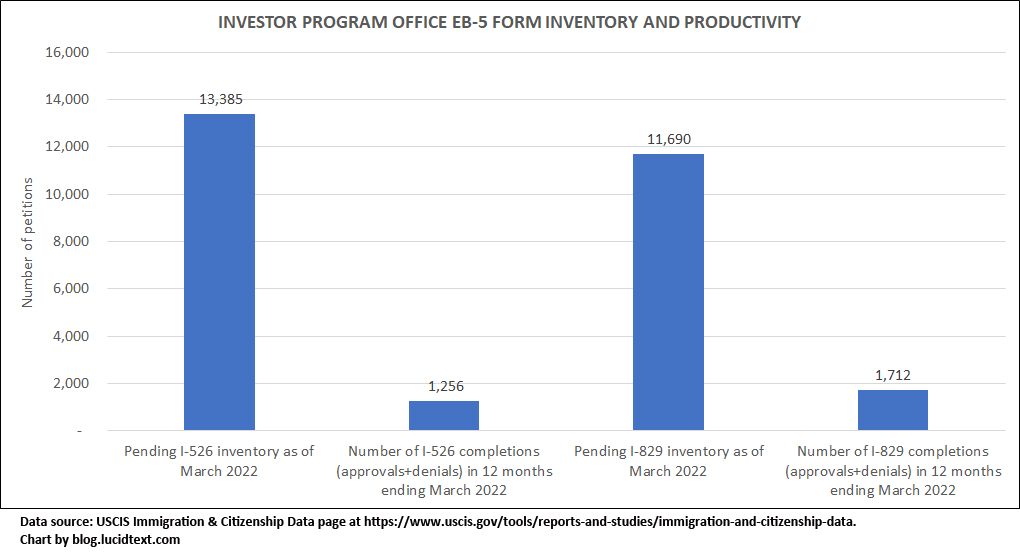
Consider: back in 2018, the median age of completed I-526 was 18 months. From 2018 to Summer 2022, the number of adjudicators assigned to I-526 fell by 61%. In the most recent officially-reported quarter (January to March 2022), IPO completed 24x fewer I-526 than in the same period in 2018. IPO has over 13,000 I-526 pending today, and has not processed more than 400 I-526 a month since 2018, and not more than 200 I-526 per month since July 2021. How far does that put us from expecting two-year I-526 processing times?
When one collects fees for a service, spends the fees, and then does not deliver the service or even allocate resources to provide the service, that’s generally called fraud. Today, $49 million of spilt I-526 filing fees call from the ground, asking why the United States government has assigned only 26 I-526 adjudicators to handle an inventory of over 13,000 pending investor petitions, offers excuses rather than improvement plans for falling IPO adjudicator productivity, and manages I-526 inventory by defining a large percentage of the inventory as ineligible for processing (via the “visa availability approach”).
People in government and industry who want to pave the way for future EB-5 investment and more I-526 (I-526E) filings must look at processing factors as of today. Witness how conditions have deteriorated since 2018, back when we thought two-year I-526 processing times were long. Consider how much needs to change going forward to allow for the “timely processing” of under a year that Congress wants to see for EB-5 forms according to the EB-5 Reform and Integrity Act of 2022. (Tables can look boring, but persevere. This table highlights significant detail worth thinking about. I have also created a new Processing Data page to house trend charts.)
| 2018 | 2020 | 2022 | Source | |
| Number of I-526 pending as of March 31 | 20,455 | 16,633 | 13,385 | A. USCIS Immigration & Citizenship Data page reports |
| Number of I-526 completed in the quarter ended March 31 | 3,615 | 904 | 152 | B. USCIS Immigration & Citizenship Data page reports |
| Average I-526 completions per working day in the quarter ended March 31 | 59 | 15 | 2 | C=B/61 |
| Approximate number of IPO employees as of March | 200 | 245 | 177 | D. USCIS reports in stakeholder meeting notes, Congressional testimony, and/or litigation declarations |
| Number of employees gained or lost by IPO during the previous 2-year period | 45 | (68) | E is calculated from D | |
| Number of IPO employees assigned to I-526 | 67 | 56 | 26 | F. USCIS reports in stakeholder meeting notes, Congressional testimony, and/or litigation declarations |
| Percent of IPO employees assigned to I-526 adjudication | 34% | 23% | 15% | G=D/F |
| Percent change to IPO’s number of adjudicators assigned to I-526 2018-2022 | -61% | H is calculated from F | ||
| Average I-526 completions per I-526 adjudicator in the quarter ended March 31 | 54 | 6 | I=B/F | |
| Percent change to IPO’s productivity per I-526 adjudicator 2018-2022 | -89% | J is calculated from I | ||
| Estimated time (months) to process all I-526 pending as of March 31, assuming that the rate of completion from the most recent quarter continues going forward | 17 | 55 | 264 | K=A/B*3 |
| Median processing time (months) of I-526 completions in this fiscal year | 18 | 31 | 44 | L. USCIS “Historical Average Processing Time Report“ |
| Approximate number of I-526 pending as of March from China-born petitioners | 8,600 | 4,900 | M. Estimated from USCIS report for 10/2018; DOS report for 11/2021 | |
| Approximate number of pending I-526 with visas available | 8,485 | N=A-M | ||
| Number of I-526 expedite requests granted by USCIS | 93 | 67 (to date) | O. USCIS report in declaration for litigation | |
| Theoretical hours of “Touch time” per I-526 reported by USCIS and used by DHS as a basis to budget for needed I-526 fee revenue | 8.65 | P. 2019 DHS Fee Rule | ||
| Actual “touch time” hours per I-526 adjudication calculated from completions per I-526 adjudicator in the quarter ended March 31 | 9.0 | 83.5 | Q=(61 days*8 hours day)/Row I | |
| I-526 filing fees associated with pending I-526 ($ millions) | $75 | $61 | $49 | R=A*$3,675 |
| Percent of I-526 decisions in the quarter ended March 31 that were denials or withdrawals (not approvals) | 9% | 21% | 67% | S. USCIS Immigration & Citizenship Data page reports |
Considering the factors summarized above, an individual I-526 or I-526E filed today may avoid an unthinkably long processing time if (1) IPO dramatically increases the amount and productivity of I-526 adjudication resources and/or (2) IPO implements exceptions to the nominally First-Come-First-Served order that benefit that particular I-526, or (3) that particular I-526 or a massive number of other petitioners give up and drop out of the process. Addressing adjudication resources is the best and toughest solution. I have noted no IPO adjudicator job announcements yet this year at USAjobs.gov (only five openings for management staff) — UPDATE: but a reader informs me that there was an IPO adjudicator job announcement that closed recently. If and when USCIS hires more staff for EB-5, it takes an average 241 days to move a new USCIS adjudicator from hiring decision to completion of basic training, according to the CIS Ombudsman. IPO has not explained why it has assigned only 15% of its employees to adjudicate the Form that accounts for more than 50% of its fee-paid workload, or whether that allocation decision is open to change. To compensate for resource problems, IPO has fiddled with processing order, implementing multiple queues and a visa availability approach that effectively excludes thousands of I-526 from the processing workload. Petitioners have fought to become exceptions to the dreadful processing average by means of expedite requests and Mandamus litigation. And the new EB-5 law encourages special priority for new I-526 associated with rural projects.
The longer I-526 resource problems remain unresolved, the more IPO will face political and industry pressure to adjust processing order, pushing some subset of pending I-526 forward by pushing the other subset of pending I-526 backward. If the entire system cannot be improved with sufficient resources to provide reasonable processing for everyone, then pressure will build to improve processing times inequitably for at least a few constituents. I do not want to see I-526 processing replicating the cynical tragedy already in place at the visa stage, where “reserved visas” offer to fast-track new applicants by excluding and displacing backlogged applicants. USCIS must address I-526 resources to avoid resorting to processing inequalities and broad-based damage.
I particularly highlight I-526 processing and backlog issues, because I-526 processing is the engine for the entire EB-5 immigration process. But I-526 problems are not unique. USCIS as a whole is laboring under resource and backlog challenges. Current DHS and USCIS leadership recognize and deplore the agency-wide problems, which is encouraging. Their sympathetic attention illuminates the magnitude and the systemic nature of problems, which is useful but less encouraging. In recent statements, webinars, and reports on processing conditions across USCIS, I hear principled commitment to improve more than practical hope for broad-based change any time soon. This shapes my expectations for improvement EB-5 processing – a small part of the total immigration system.
My expectations for processing improvements must also consider mixed incentives even among EB-5 stakeholders. Who is willing to take the first step toward affecting change — identifying and discussing EB-5 processing problems — when the problems look discouraging? Who needs to care if a protracted EB-5 process increases the time to hold EB-5 funds under management and defers government oversight? Who needs to think about what happens after investors file I-526 or I-526E, when most incentives for service providers, projects, and regional centers come before petition filing? Among those motivated to care about immigration outcomes, how many will slog through articles like this instead of clinging to hopeful guesses? Here’s a gauntlet. Let’s see our industry warriors, fresh from successful I-956 battles, take up the fight to salvage processing conditions for investor petitions.
For further insight into the context of EB-5 processing, I recommend the CIS Ombudsman 2022 Annual Report to Congress. “This year’s Report examines the ‘snowball effects’ and pain points associated with backlogs and recommends actions USCIS can take to address not only the human consequences suffered by applicants, families, and employers but also the detrimental impacts on the agency … This article examines how the agency arrived at the crisis of backlogs which is now threatening to overwhelm it and highlights some of the steps it is taking to overcome this challenge.” A really excellent report: thoughtful, substantial, and sympathetic. EB-5 stakeholders should note the insightful analysis of resource constraints (not EB-5-specific, but applicable), and the detailed discussion of the EAD and Advance Parole processes and the expedite process. Regarding parallel issues with Department of State and consular processing, see the study Mounting Backlogs Undermine U.S. Immigration System and Impede Biden Policy Changes (February 23, 2022) by the Migration Policy Institute. See also U.S. Citizenship and Immigration Services: Actions Needed to Address Pending Caseload by the Government Accountability Office (August 18, 2021).