RIA Implementation Status, one year later

On March 15, 2022, the EB-5 Reform and Integrity Act of 2022 (RIA) became law as part of the Consolidated Appropriations Act, 2022 (Public Law No: 117-103).  One year later, how far have we come? How much of the law has been implemented?

The following bullet points give status as of March 31, 2023 for steps that need to be taken to implement RIA.

Updating policy, forms and guidance based on the new law

  • USCIS Policy Manual: Incomplete. On October 7, 2022, USCIS updated only the introductory Chapters 1-2 of the Policy Manual EB-5 section 6G, while EB-5 Chapters 3-6 remain untouched. The chapters still still not updated with RIA-compliant policy cover I-526 adjudication, I-829 adjudication, and regional center designation and reporting requirements.
  • USCIS website: Incomplete.  Some new EB-5 content has been added to the USCIS website over the course of the year, and some outdated content remains in the mix. It’s still impossible to go to the USCIS website to find out which regional centers are approved or active under the new law.
  • EB-5 forms: In Process. All EB-5 forms required by the new law have been published or revised but remain subject to change. (Indeed, new versions of all I-526 and I-956 were just published today.) USCIS has yet to respond to (and for I-956, even to post) the second round of public comments to the Federal Register on I-526E and I-956.

Prescribing regulations required by the new law

  • Regulation for parameters on capital redeployment: Not done. (RIA does not state a deadline for this regulation.)
  • Regulations prohibiting foreign involvement in a regional center: Not done. (The RIA deadline, 270 days after the date of enactment, has passed.)
  • Regulation to ensure that EB-5 capital is not used on publicly available bonds: Not done. (RIA does not state a deadline.)

Monitoring and enforcing regional center compliance with new requirements

  • Clarify how RIA requirements apply to previously-approved RCs not active under RIA: Not done.  The EB-5 stakeholder meeting previously scheduled for March 20, then delayed to April 25 is slated to address this question. (UPDATE: The April 25 meeting did not after all address expectations for regional centers with pre-RIA but not post-RIA investors.)
  • Review and approve regional center compliance procedures: Status Unknown. USCIS has not reported any decisions on I-956 Regional Center Applications. (We hear anecdotally about approvals received, but USCIS does not report I-956 approvals or denials on the USCIS Regional Center page or the USCIS Immigration and Citizenship data page.)
  • Vetting and background checks of persons involved with regional centers: Status Unknown. USCIS has not reported any decisions on I-956H forms.
  • Review Regional Center Annual Statements and Certifications: Not done.  Form I-956G were not filed for 2022 because “USCIS is extending this deadline until we publish guidance that clarifies the requirements of these forms.”  Such guidance has yet to be published.
  • Review regional center projects: Status Unknown. USCIS has not reported any decisions on I-956F Applications for NCE approval.
  • Review registrations by direct and third party promoters: Status Unknown. USCIS has not reported any decisions on I-956K registrations, and has not made any lists publicly available.

Implementing visa availability changes

  • Reshuffle visa availability to reserve visas for new TEA investment: In process. The Visa Bulletin and Annual Report of the Visa Office show new visa categories as required by RIA. Zero reserved visas were issued in FY2022, due to slow USCIS processing.
  • Carryover of unused reserved visas: In process. The FY2023 Annual Limit report says cryptically “The employment chart (above) does not include numbers carried over from the previous fiscal year in the EB-5 category.” (UPDATE: the April 26, 2023 DOS/AILA Liaison meeting (question 22) confirms intent to carry over visas.)

Other requirements

  • Timely Processing Fee Study: Not done. (RIA gave a deadline of 1 year from the date of enactment to complete a study of fees levels required to achieve timely processing goals, and this study has yet to be published. The USCIS Fee Study does not address timely processing for EB-5.)
  • Announce appropriate channels of communication: Done.  The bottom of the EB-5 Support page has been updated with Channels of Communication.
  • Publish Log of communications: Not done. The FOIA page for USCIS does not show a log of communications with Congress regarding EB-5.
  • Transparency regarding Publication of Information: Mixed. (For example, we know that USCIS is having court-ordered quarterly meetings with litigation plaintiffs. So far one set of meeting minutes has been published, and publication happened more than 30 days after the meeting.)

Other questions

  • Other Rule-Making: Not done. In response to I-956 comments in the Federal Register, USCIS indicated in December 2022 that it could not yet answer questions about but “may consider rule-making to address” each of the following issues:
    • Evidence to establish regional center geography;
    • Whether regional center policies and procedures need to be provided or only described;
    • What circumstances require an I-956F amendment;
    • Whether stand-alone investors need to use fund administration;
    • The definition of an infrastructure project;
    • Whether regional center annual reports need to cover funds raised prior to RIA.
  • Implementing the RIA change to the sustainment requirement and investment period: Not done, but the USCIS April 25 stakeholder meeting is slated to discuss the topic. (UPDATE: USCIS stated at the 4/25 meeting that they were after all “unable to discuss” the topic yet, while “USCIS is engaged in ongoing efforts at the immigrant investor program office and across the agency to ensure that when we do have updates, we’re equipped to provide the EB-5 stakeholder community with clear guidance.”)

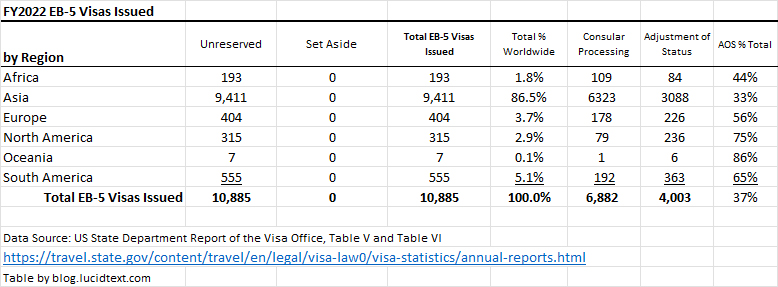
FY2022 Annual Report of the Visa Office for EB-5 visas issued by country

The Department of State has finished publishing its Report of the Visa Office 2022. The report covers EB-5 visas issued from October 2021 to September 2022, with breakdown by country of origin, path (consular processing or status adjustment), and category (direct, regional center, TEA, reserved, unreserved). I’ve been waiting anxiously for the report, wondering about visa wastage, Integrity Act implementation, and impacts on the visa backlog and EB-5 visa wait times for China, India, and Vietnam.

This post comments on highlights, followed by data tables summarized from the reports.

FY2022 EB-5 Visa Issuance and Wastage

USCIS actually issued 10,885 of the unusually-high 19,987 EB-5 visas available in 2022.   Of the 9,102 EB-5 visas that didn’t get issued in FY2022, 6,396 couldn’t have been issued because segregated in newly-created set-aside categories. (The unused set-asides should carry over in future years, though the FY23 visa limits report doesn’t show the carryover.) The remaining 2,706 unused EB-5 visas in FY2022 were permanently lost to EB-5. (FY2022 is still much better than FY2021, when EB-5 lost 15,673 total visas, and FY2020, when EB-5 lost 7,498 visas.)

Visa wastage particularly affected countries with mostly regional center applicants using consular processing. For example, South Koreans got 695 EB-5 visas in 2019 (the most recent “normal” year) but only 396  visas in 2022 (86% by consular processing), despite the fact that 909 South Korean EB-5 applicants were ready and registered at the National Visa Center at the start of 2022. Hong Kong likewise suffered, with only 142 EB-5 visas issued in FY2022 despite 866 Hong Kong applicants ready at NVC at the start of the year. Meanwhile Indians, many adjusting status in the U.S., managed to get a record 1,381 visas in 2022 – even more than technically available to them under the year’s unreserved visa limit.

Reasons for FY2022 EB-5 Visa Wastage

EB-5 visa issuance in FY2022 was as low as it was largely due to the unfortunately protracted regional center program expiration, and the policy that prevented visas from being issued to regional center applicants from October 2021 to May 2022. (I wish that policy could be litigated on behalf of the over 18,000 EB-5 visas lost during the expiration.) Monthly visas statistics show that all regional center visas issued in FY2022 were packed into just four months: June to September 2022.  

The government had the entire year to issue direct EB-5 visas, but only issued 621, likely constrained by low demand (i.e. few direct I-526 filed and even fewer making it through I-526 processing to the visa stage). By comparison, 414 direct EB-5 visas were issued in the last normal year of FY2019.

Consular processing numbers were also depressed overall compared with FY2019, reflecting on-going struggles with post-COVID backlogs. For color on why the steps in consular processing remain so slow and problematic, see questions and answers in the Department of State/AILA Liaison Committee Meeting February 9, 2023, the NVC Immigrant Visa Backlog report (look at trends in the number of interview appointments, and compare appointment volume with backlog size), and the October 2022 Update on Worldwide Visa Operations. Those in or approaching consular processing should be aware of the NVC Timeframes page, with information on process status and times. The bright side is that consular problems affect not only EB-5 but also family-based visa issuance, and EB-5 benefits in 2023 from a share in FB visas that went un-issued in 2022 (as reflected in 2023’s unusually high EB visa limit).

High Volume of EB-5 Status Adjustments in FY2022

EB-5 visa issuance in FY2022 was as high as it was thanks to an unprecedented high number of status adjustments (37% of the total, as compared with 17% in 2019). For example comparing 2022 with 2019 visa issuance, China got fewer visas last year through consular processing but five times as many visas through status adjustment. 

The unusually high AOS numbers reflect the fact that USCIS got political pressure and made herculean efforts at the end of FY2022 to step up work on employment-based status adjustments, even as consular processing continued to struggle post-COVID.  

Direct EB-5 (and the visa bulletin even briefly becoming Current for China direct EB-5) did not contribute much boost. China ended the year with only 199 direct EB-5 visas issued – not much higher than usual, and not explaining the unexpected thousands of Chinese who adjusted status in 2022.

RIA Implementation, Reserved Visas, and Country Caps

Report of the Visa Office 2022 does segregate EB-5 visas into “5th Unreserved” and “5th Set-Aside” categories, reflecting changes to visa availability made by the EB-5 Reform and Integrity Act enacted March 15, 2022. Of course, no visas were issued in 2022 in the “5th Set-Aside” categories, since no applicants who filed I-526 after March 15, 2022 could have reached the visa stage in time. And according to Department of State interpretation, all EB-5 applicants with pre-March 2022 priority dates can only now qualify for a visa in the new 68% unreserved category, regardless of whether they invested in a TEA that matches new definitions. (I think this interpretation can and ought to be challenged, at at least one lawsuit by DRVC is challenging it, but it’s the fact for now.)

In theory, country caps further restrict availability within each category. Thus pending applicants from any one country can only expect up to 7% of the 68% unreserved EB-5 visas (with “otherwise unused” unreserved numbers going to the oldest priority dates i.e. Chinese).

In 2022, this theory held true for Vietnam but not for India. While both countries have excess demand for unreserved visas, and large NVC backlogs, the government in fact issued 815 EB-5 visas to Vietnam (about 7% of unreserved EB-5 visas) and 1,381 EB-5 visas to India (about 7% of total EB-5 visas). Hmmm…

Was this different treatment of Indians and Vietnamese an oversight, with the government remembering the unreserved limit in the new law for Vietnam while forgetting it for India? 2022 was naturally confusing for the Visa Office, which had to deal with a mid-year law change and leadership change. Or did many Indians get lucky just because they happened to be in the US, unlike most Chinese and Vietnamese EB-5 applicants with earlier priority dates? I wonder if maybe Indians got assigned “otherwise unused” numbers at the end of the year that should’ve gone by right to earlier Chinese priority dates, but practically couldn’t because the consulate in China lacked capacity to hold more interviews in time while the California Service Center had capacity to complete more I-485 and help avoid wastage. (I also wonder if a difference between consular and USCIS capacity to issue visas at the end of the year could explain the unusually high number of Chinese regional center applicants who were able to adjust status in FY2022 — more applicants than one would expect from priority date order.)

Country Diversity

FY2022 was similar to previous years in terms of countries claiming the most EB-5 visas. As in 2019, the top users in 2022 were (in descending order): China, India, Vietnam, South Korea, Brazil, and Taiwan. Meanwhile, Mexico, Canada, Russia, and Iran moved a few notches up the list in 2022, while Venezuela, South Africa, Great Britain, and Japan moved a few notches down. I was surprised mainly by the number of Canadians on this year’s list (why, Canada?) and Iranians (considering the often arduous source of funds path).

Visa Demand Context

For a reminder of the size of the visa queue before FY2022 visa issuance,  see the presentation by Charles Oppenheim for IIUSA in November 2021. At that time, Oppenheim estimated the EB-5 backlog (including applicants already registered at NVC and potential future applicants associated with I-526 pending at USCIS) at 57,253 visa applicants for China, 7,418 for India, 3,954 for Vietnam, and 18,054 for other countries  (see Slide 10).

Visas issued in 2022 reduced those queues by 6,125 visas to China, 1,381 visas to India, and 815 visas to Vietnam. (I assume that I-526 filings in 2022 didn’t grow the queues very much, unless it turns out that most of the 829 receipts last year came from Indians).  

The future wait times associated with that scary queue depend on (1) how many petitioners/applicants in the queue will ultimately give up/lose eligibility before they can clam a visa (likely a large number given the untenable wait times looming for Chinese and Indians near the end of the queue), and (2) how many EB-5 visas will be issued per year from now on, with the base case being 9,940 EB-5 visas * 68% unreserved * 7% country cap = up to 473 to applicants of each country. The actual number of visas available per-country in a given year can be significantly higher than the 473 base case based on carryover of family-based visas (as happened in FY2022 and happening again in FY2023 due to COVID-19), carryover of reserved visas (as should happen in 2024 and 2025 assuming law compliance and continued slow I-526 processing), and unreserved visas leftover after country caps (which should increasingly benefit China in coming years).  But even with the most optimistic assumptions on future visa availability, Chinese who filed I-526 from October 2016-March 2022 and Indians who filed I-526 from November 2019-March 2022 could face five or more years of waiting just for conditional permanent residence. Or would face that wait, except that it exceeds what many applicants (not to mention their RCs, projects, and investments) can practically bear, predictably leading to many queue-shortening drop-outs/failures. Meanwhile, new investors in reserved categories have to sweat over limited availability (with just 20%, 10% or 2% of visas available in each new lane, further restricted under the 7% country cap) and guessing the time for I-526 filings to invisibly build and max out that limited availability. I’ll write more about unreserved and reserved visa availability and wait time issues in separate articles.

The bottom line is that EB-5 suffers from a supply problem. EB-5 needs more visa numbers in order to accomplish what regional centers, investors, and public policy all require: a stable and predictable immigration opportunity that can accommodate new investors plus prevent a despairing rush for the exits for past investors/investment.

Tables based on the Annual Report of the Visa Office

EB-5 Integrity Fund FAQ, with notes on regional center status and investment period

Today, USCIS sent out an email alert with the title USCIS to Start Collecting Fee for EB-5 Integrity Fund, published a new EB-5 Integrity Fund page on the USCIS website, posted a Federal Register notice with information about the Integrity Fund, and created a new page for EB5 – Annual Fee for Regional Center at Pay.gov.  

We’ve known that annual regional center fees were coming, since Section 103(b)(J) of the EB-5 Reform and Integrity Act (RIA) created this new requirement. But we’ve been waiting for USCIS to clarify questions around the fee, including how and when to pay it, who qualifies as the “each regional center designated under subparagraph (E)” who needs to pay the fee, and who counts as “investors in the preceding fiscal year in its new commercial enterprises” for the purposes of calculating how much to pay.

Here are answers gathered from the documents published today by USCIS.

Who needs to pay the new EB-5 Integrity Fund fee, and when?

USCIS interprets RIA to mean that every regional center, regardless of when designated and regardless of when or if it sponsored investors, needs to make its annual Integrity Fund payment of $10,000 or $20,000 to USCIS between tomorrow and March 31, 2023. The fee due this month will apply to FY2023. (The next annual fee, for FY2024, will then come due in October 2023.) The Federal Register notice indicates that USCIS expects that all 630 previously designated regional centers will pay the fee, including those with no investors at all. The announcements give no indication that USCIS considered exceptions for regional centers that were not designated under the new law and do not have investors under the new law.  

What does the USCIS fee policy imply about USCIS treatment of previously-approved regional centers?

The fee policy apparently takes for granted that when RIA created a fee requirement applicable to “each regional center designated under subparagraph (E),” RIA did not actually specifically mean RIA subparagraph (E), but also the 1993 law Section 610.  

USCIS has yet to designate any regional centers under subparagraph (E) by approving I-956 applications. An unknown number of previously-approved regional centers have filed I-956 and chosen to solicit investors under RIA. This creates a grey area for the many regional centers that were only approved and only raised investment under the old law.  USCIS admitted as recently as October 2022, in meeting with the litigation plaintiffs, that “USCIS has not determined what will happen to regional centers that choose not to file Form I-956” and “whether any of the RIA requirements apply to them.”

But whoever drafted today’s USCIS fee policy did not recognize a grey area. The policy simply assumes, without argument or explanation, that new requirements applicable to regional centers designated under RIA also apply to regional centers previously designated under Section 610 of the Departments of Commerce, Justice, and State, the Judiciary, and Related Agencies Appropriations Act, 1993. The drafters of the fee policy apparently did not consider the arguments in my Comment on the RIA impact on pre-RIA Regional Centers and investors.

What will happen to any regional center that does not pay the EB-5 Integrity Fund fee by March 31, 2023?

On May 31, 2023, USCIS will start to send out Notices of Intent to Terminate to every regional center whose fee was not received on-time. (For some RCs, the NOIT may be the first they hear about the fee requirement. USCIS explained that today’s publications will be the only notice, and that USCIS will not individually notify or send invoices to regional centers.) A regional center’s designation will be terminated following the NOIT, unless the regional center can document that it did indeed submit the full required fee amount by the deadline of March 31, 2023.

The termination threat is a concern primarily because the new law defines devastating investor consequences from regional center sponsor termination (as further discussed in my previous post). INA 203(b)(5)(M) stipulates that I-526 petitions will be denied and even conditional permanent residence status terminated upon regional center termination. And the escape route offered in (M) is only theoretical, since USCIS permission is no guarantee that a good faith investor or NCE can – in fact – have a viable option to associate with another regional center. The termination consequence places great weight on today’s fee announcement.

What is the required amount of the EB-5 Integrity fee? What does the fee policy imply about who’s an investor, and what’s the investment period?

RIA states that the required fee for a regional center depends on the regional center’s number of investors in the previous year  – with the $20,000 annual fee reduced to $10K for “each such regional center with 20 or fewer total investors in the preceding fiscal year in its new commercial enterprises.”

But who counts as “investors in the preceding fiscal year” for the purpose of fee calculation? The statutory language could justify a reading as limited as “people who invested and filed I-526/I-526E in the previous fiscal year under RC sponsorship” to as broad as “people at any immigration stage whose investment was still in some sense under RC custody in the previous fiscal year.” The USCIS fee policy published today in the Federal Register presents this reasoning:

  • A possible interpretation of “investor” is “someone still in the investment period”
  • “Investment period” means the period from I-526 filing through the point of I-829 filing, on the authority of a 2021 blog post by Canadian financial professional Rupy Cheema of EB5 Diligence. (I don’t know whether to laugh or cry at this evidence that the USCIS Office of Policy and Strategy was apparently not sweating over statute, regulations, or precedent decisions or its own Policy Manual but just casting about the Internet to find a policy for the EB-5 investment period, but props to EB5 Diligence for catching OPS’s eye and earning the footnote citation in the Federal Register notice!)
  • Since Rupy said in 2021 that the investment period goes approximately from I-526 filing to I-829 filing, and since USCIS has ready data for number of I-526 and I-829 filings while other calculations would be hard, therefore USCIS intends to estimate “total investors in the preceding fiscal year in its new commercial enterprises” as equal to the total number of pending and approved I-526 at year-end less the total number of I-829 filed at any time by principals. With the qualification that “USCIS adjudicators retain discretion to evaluate the Integrity Fund fee due and the number of investors on a case-by-case basis, accounting for any other facts or evidence in the record in the totality of the circumstances, including any evidence provided by a regional center that believes it has greater or fewer total investors.”

This is a sober recital of the content of the Federal Register notice.  What can we expect next from the Office of Policy and Strategy?

Everyone involved in the huge fight over defining the “investment period” (on the regional center side and investor side) will be interested in this paragraph from the Federal Register analysis:

“USCIS considered generally counting only the Forms I-526 that were filed within two years of the applicable period used for determining the EB-5 Integrity Fund fee given the expected two-year minimum timeframe for the investment, or sustainment period, under the 2022 Act. INA section 203(b)(5)(A)(i); 8 U.S.C. 1153(b)(5)(A)(i). However, that would likely be underinclusive given that many investors are actively in the process of investing (i.e. not yet fully invested) when they file their Form I-526 petition as permitted under applicable requirements and, additionally, would not align with the sustainment period for those who filed prior to the 2022 Act, which runs approximately to the point of the Form I-829 filing, regardless of when they filed their Form I-526 or made their investment.”

Do we have a chance to provide feedback on the fee policy?

The Federal Register notice states that “USCIS is imposing this fee without soliciting public comment prior because this is a general statement of policy and an interpretive rule exempt from notice and comment procedures.” The notice claims that “The statutory provision that requires the $20,000 and $10,000 fees contains little ambiguity for USCIS to resolve or explain.” (And this, after the notice grappled with ambiguities around the investor count and overlooked the major ambiguity of regional center applicability.)  I will update this post if I learn of a chance to respond with questions and concerns.