EB-5 processing volumes fall in USCIS FY2025 Q1 data report

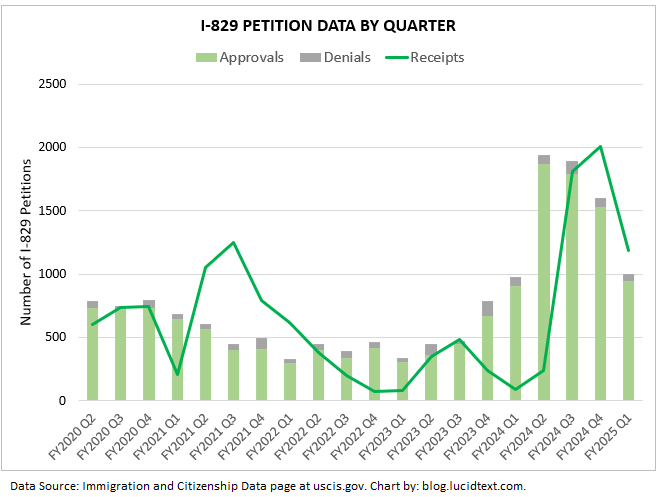
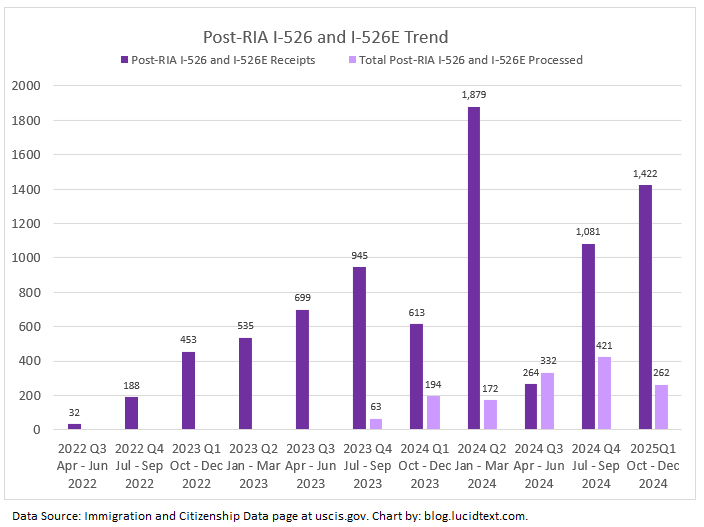
And now, the USCIS Immigration and Citizenship Data page has finally published performance data for the first quarter of FY2025 (October to December 2024). The data shows a strong start to implementing the new administration’s immigration agenda. Last time around, it took two years for USCIS staffing and policy changes to translate into sluggish EB-5 form processing. This time, IPO preemptively cut its processing productivity in half even before the inauguration. Maybe October to December was an aberration, with no political connection and no trend to worry about. But at least for the one quarter, every EB-5 form suffered. I had expected USCIS to start shifting more resources to I-526E, given the visa urgency and dwindling I-526 workload, but this did not happen through the end of last year. Meanwhile, as previewed in AIIA’s data by country and TEA category, I-526E filings continued to shoot up through the end of 2024.
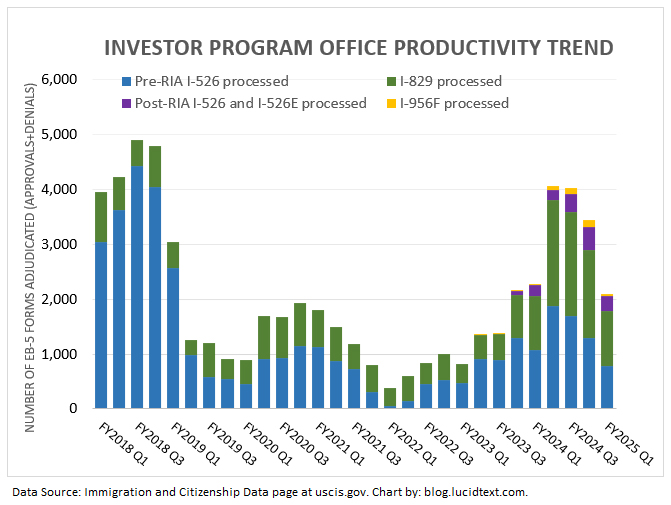
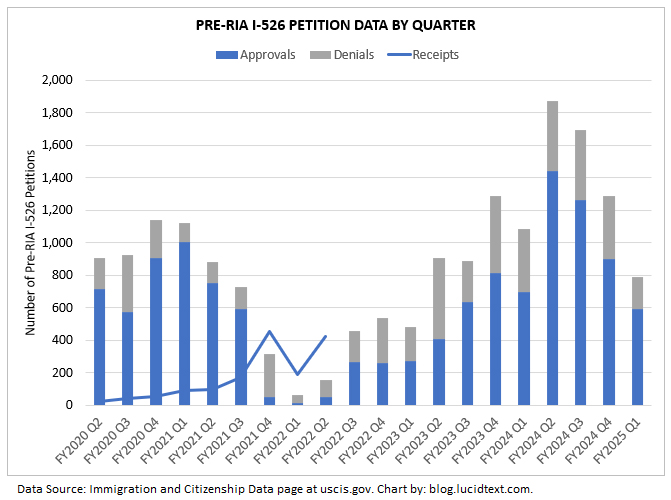
The FY2025 Q1 report is notable for including, for the first time, median processing times for post-RIA I-526 and I-526E.
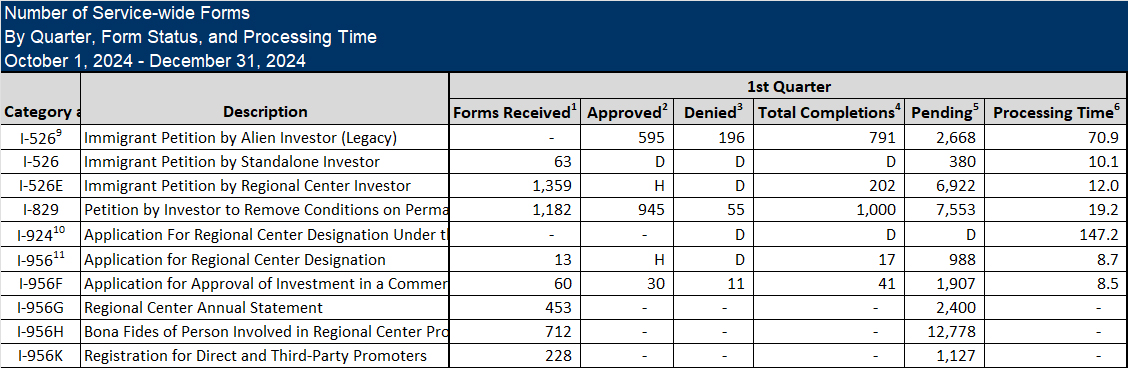
Be cautious in interpreting the Processing Time number, which is not necessarily predictive! Footnote 6 to the Processing Times column explains: “Processing times are defined as the number of months it took for an application, petition, or request to be processed from receipt to completion in a given time period. The number of months presented is the median which is the time it took to complete 50% of all the cases processed in the quarter.” I’m very happy for the 50% of recently-completed I-526E that experienced a processing time of less than 12 months. However, 50% of the 202 completions in FY25 Q1 is just 101 forms — barely 1% of the inventory. How long will it take to process the 6,922 I-526E that remained pending at the end of last quarter? If USCIS kept going at the FY25 Q1 processing pace, then it would take 6,922/202=34 quarters=8.6 years. In order to get through the pre-2025 I-526E inventory in 12 months from now, USCIS would have to increase quarterly I-526E processing volume to 6,922/4=1,730 completions. On the other hand, the reported median processing time of 19.2 months for I-829 may be reasonably predictive, so long as USCIS can keep processing the I-829 inventory (7,553 at last count) at a rate of at least 1,000 completions per quarter.
New I-526E Data to January 2025

And now, we finally know what’s been happening with EB-5 demand and I-526/I-526E adjudications since mid 2024. See AIIA FOIA Series: Updated I-526E Inventory Statistics for January 2025. Thank you to AIIA, Galati Law, and the Freedom of Information Act! USCIS has not published any EB-5 data since September 2024, so we welcome this trove of new information about I-526 and I-526E receipts, approvals, and denials by country and TEA category through January 2025.

I will shortly revise my backlog analysis to incorporate this new information. My previous analysis made optimistic wait time estimates based on optimistic assumptions: that future EB-5 demand would remain at the level documented as of mid 2024, and that USCIS and Department of State processing would allow issuing available visas. My revised analysis must now downgrade these estimates. We now know that in fact, EB-5 demand shot up through the beginning of 2025, while processing volumes remained quite low.

The AIIA FOIA showed that “only 351 HUA and 1,126 rural petitions have been approved as of January 2025.” That’s likely too low for a year with 2,200 HUA and 4,400 rural visas available, and considering that visa interviews take months to schedule. If there aren’t enough applicants to claim available FY2025 set-aside visas, that means that the visa bulletin gets to stay “current” for a longer time (good news for concurrent filing), but some set-aside numbers will be permanently lost, Rest of World applicants will get more time to accumulate and crowd out China/India applicants, and expected visa wait times will lengthen.

Meanwhile, the AIIA FOIA showed the count of filed investor petitions reaching 5,191 High Unemployment and 4,329 Rural by the end of January 2025. That’s conservatively 10-11x annual HU visa availability and 4-5x annual Rural visa availability (considering that these investors may get I-526E approval and be joined by spouses and/or children to claim visas). Those are fearsome queues to enter the back of, for a new investor today. If a 2025 High Unemployment investor gets a visa in less than 10 years or a Rural investor gets a visa in less than 5 years, it will be thanks to country caps (allowing minority country investors to move ahead of earlier priority dates from China and India) and the possibility of category-switching (with Unreserved being an alternate lane as congestion builds in the TEA lanes.) I’m now anxious to get updated information on the pre-RIA backlog for Unreserved visas, to better assess Unreserved visas as a potential fallback for new HU and Rural investors.

Regional Centers will want to grapple with the fact that the coming 10+ years of HU visas and 4+ years of Rural visas have already been sold, even as a significant Unreserved backlog remains. Unless and until visa relief is possible, what’s left to offer is a chance for Rest-of-World EB-5 investors to cut the queue in front of earlier but cap-limited China-born and India-born investors. Keeping the “immigrant” in “immigrant investment” will require hard work for visa relief.

EB-5 visa issuance in February 2025

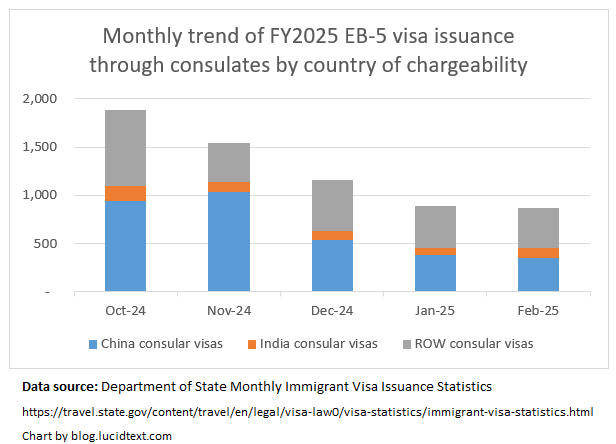
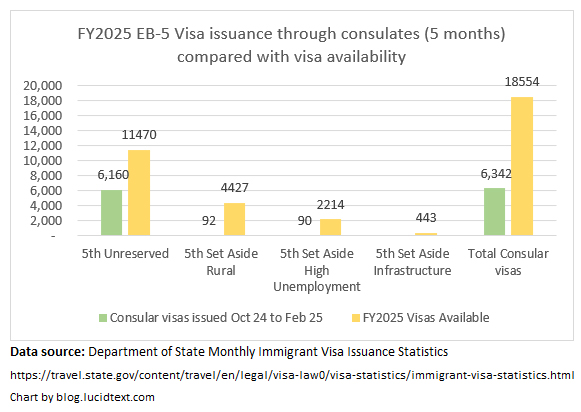
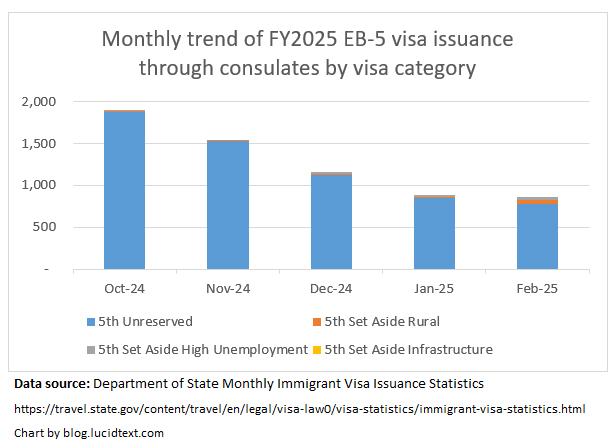
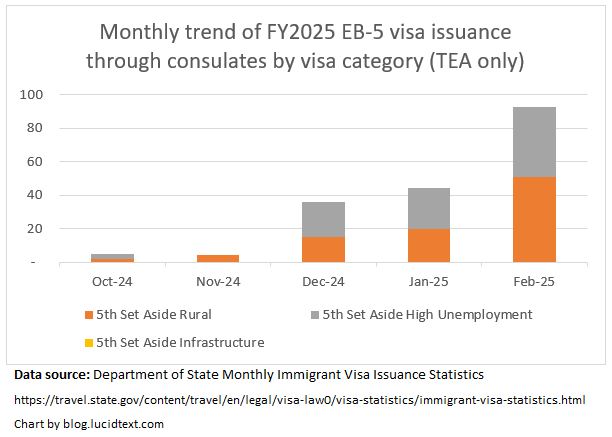
Finally a bit of data to report: Department of State has added Monthly Immigrant Visa Issuance statistics for consular processing in February 2025. I made a few charts to highlight EB-5 numbers.

February data shows set-aside visa issuance continuing to pick up steam but very gradually, with visa issuance still extremely low in context of set-aside visas available this year. If this trend continues, then I guess that Rural and High Unemployment visa supply may not be maximized this fiscal year, and thus Rural and High Unemployment may not get visa bulletin dates this year. I may revise this guess if and when USCIS ever starts reporting data again for I-526E approvals (indicating how many people are potentially qualified for visas) and I-485 approvals (indicating the number of visas being allocated through status adjustment). USCIS 2025 data reports are now very delayed, but I keep checking — hoping that the USCIS Office of Performance and Quality still exists! Also waiting on the delayed 2024 NVC waitlist report. If set-aside visa issuance remains low throughout FY2025, that would be good news for the concurrent filing window, and bad news for the pipeline backlog — especially for applicants from China and India who depend on getting through the visa gate as soon as possible before more rest of world applicants have a chance to get I-526E approvals. Actual visa wait times could be worse than calculated in my EB5 Backlog Analysis model in case of low set-aside visa issuance. (I’ll revise the entire model when the next USCIS and NVC reports finally come out.)

Looking at Unreserved visa issuance through consulates, I note that Department of State remains on track to issue all Unreserved visas available for the fiscal year. Good! But the rate of Unreserved visa issuance to rest-of-world countries did not increase in February — as I think it should have, given that ROW applicants are so numerous that DOS might even have to impose a ROW Unreserved a cutoff date this year (according to the April 2025 visa bulletin note). A number of consulates seem to be having problems with scheduling EB-5 interviews — for example in Nigeria, which has many EB-5 applicants but no EB-5 interviews at all this year. Can consulates be given a push to act on EB-5 cases? On the bright side, low EB-5 visa issuance to ROW meant that China-born applicants were able to continue to pick up “otherwise unused” Unreserved visas in February.

In other news, IIUSA has posted a letter from their lobbyist on advocacy efforts.