Good news (CIS Ombudsman, Sustainment litigation, good faith investor litigation, FOIA on Security Checks)

CIS Ombudsman Restored

I had mourned in March when the Administration shut down the CIS Ombudsman, which exists to help resolve problems with USCIS and improve USCIS processes. The Ombudsman committed considerable effort in 2024 to researching and communicating with USCIS about EB-5 issues, and we couldn’t afford to lose them. I rejoiced when a reader brought to my attention that the office has been restored as of May. The Ombudsman website was updated on May 23, 2025 with the note: “The Office of the Citizenship and Immigration Services Ombudsman continues to exist and will perform its statutorily required functions.” I don’t know how many former Ombudsman staff can have returned from administrative leave, but at least the Request Case Assistance function is live again.

Sustainment Litigation

The litigation around the EB-5 sustainment period has reached a good milestone. Yesterday Judge Ana Reyes issued an Order in IUSA vs. DHS et al. that does not revert to the legacy sustainment requirement linked to Conditional Permanent Residence.

In the previous round of filings, Defendant DHS had asked the judge to hold the lawsuit in abeyance pending rulemaking, while Plaintiff IIUSA had asked the judge to vacate USCIS’s 2-year sustainment interpretation pending rulemaking. We waited with bated breath, wondering whether the judge was about to doom the industry to pre-RIA sustainment rules and/or confusion for as long as it takes to complete notice-and-comment rulemaking on RIA.

Thankfully, Judge Reyes did as DHS requested. She notes in the July 29 Order that the law did edit the sustainment requirement (“With the RIA, now immigrant investors’ investment ‘is expected to remain invested for not less than 2 years.'”), that the USCIS guidance on this change is “not (yet) final agency action,” and that a formal rule-making process is forthcoming with a Notice of Proposed Rulemaking slated to be published in November 2025. The NPRM will be followed by a notice-and-comment period, which will eventually be followed by a Final Rule. And after that, if the Final Rule does not address the Plaintiff’s concerns, then “the parties and Court can take up the final rule as necessary.”

I’m particularly happy to see the IIUSA press release celebrating this ruling as a win for IIUSA, which it is. Pushing USCIS to formal rulemaking is the one laudable goal of the IIUSA litigation, and IIUSA is so right to shift its weight to that solid point. The benefits extend beyond the sustainment issue, as we’re overdue for rulemaking to clarify and implement many aspects of RIA. I’m thankful that we finally get a deadline for this proper formal process to start. Some individual regional centers may want to continue to pursue other litigation arguments. But if any want to press the toxic contention that RIA intended to codify the pre-RIA sustainment requirement, let them come out and do so under their own names. With another Regional Center sunset looming, IIUSA needs high ground and a unifying role.

The rulemaking process may be lengthy. The last EB-5 regulation started with an NPRM and notice and comment in 2017, and resulted in a Final Rule in 2019 that was promptly challenged and ultimately vacated by litigation in 2021. I won’t be surprised if we get a new EB-5 law in 2027 before we get a chance to see any final result from the rulemaking process set to start with an NPRM in November 2025. I don’t know what sustainment period nuances will ultimately be defined by a final rule or rewritten in new law.  But in the interim, I’m glad that the status quo is the USCIS website guidance on RIA’s 2-year minimum sustainment period, not a complete lack of guidance or the horrors of CPR sustainment.

Good Faith Investor Protections

Subsection (M) “Treatment of Good Faith Investors Following Program Noncompliance” is another positive part of the EB-5 Reform and Integrity Act that needs implementing. Subsection (M) offers some opportunity for blameless investors in troubled regional centers and projects to salvage their immigration process by changing affiliation or moving investment. I wrote about this last year in the article What happens to investors after regional center termination. But the Subsection (M) provisions are confusing and investors have faced difficulty in claiming protections – partly due to USCIS delay in terminating non-compliant regional centers. Now litigation is getting involved, with Galati Law leading the way. See the articles EB-5 Investors Sue USCIS Chief for Failing to Protect their Good Faith Investments as Required by Law and The Fight to Protect Good Faith EB-5 Investors.

FOIA on National Security Checks

I should also note tireless efforts by John Pratt and Ed Ramos to litigate for EB-5 integrity. They recently assisted AIIA to obtain a trove of FOIA documents from USCIS on how the Investor Program Office screens EB-5 petitioners for national security risks, including extreme vetting of Chinese nationals. For a summary of insights from the FOIA response see the article AIIA FOIA Series: Hidden USCIS Adjudication Standards – National Security Checks.   

Extra FY2025 visas for China and India (August 2025 visa bulletin)

The August 2025 Visa Bulletin has been published with a nice surprise: advanced final action dates for China Unreserved and India Unreserved. These countries had retrogressed back in April 2025, effectively shutting down the flow of Unreserved EB-5 visas for the year to China and India. Now the Visa Bulletin is moving dates forward to allow more visa issuance to these countries in August and September — the last months of this fiscal year. Chart A moved to December 8, 2015 for China and to November 15, 2019 for India.

I’m quoting below the notes at the base of the Visa Bulletin that explain the changes. Basically, when one country/category gets more visas, it means that another is having problems. China EB-5 will get more 2025 visas after all because Department of State has not managed to allocate visas to Rest of World EB-5 applicants. (The Visa Bulletin delicately says: “[rest of world] EB-5 number use has not materialized to the degree that was expected.” This might mean that the thousands of ROW EB-5 applicants registered at NVC have disappeared. But I’m readier to blame consulates for failing to schedule interviews and request numbers for ROW applicants who are ready to go.) Meanwhile, DOS credits low family-based visa issuance for extra visas now being made available at year-end to India EB-5.

The following chart shows how monthly EB-5 visa issuance to China and India dropped after April retrogression, but without any increase to ROW visa issuance. Now we can expect China and India numbers to spike up again for August and September 2025, while Rest of World applicants can look forward to their backlog being punted to 2026. (My previous post discussed how the ROW waitlist as of 2023 mostly did not get 2024 visas but instead pushed into 2025.)

Quoting from the August 2025 Visa Bulletin:

F.  VISA AVAILABILITY IN THE EMPLOYMENT-BASED FIFTH PREFERENCE (EB-5) UNRESERVED CATEGORY FOR CHINA

In the April 2025 Visa Bulletin, the EB-5 Unreserved final action date for China was retrogressed due to high Rest of World demand.  In the months that followed, EB-5 number use has not materialized to the degree that was expected.  Consequently, and in accordance with INA 202(a)(5), the EB-5 Unreserved final action dates for China has advanced to allow continued EB-5 Unreserved number use.  Note that if at any time the EB-5 Unreserved annual limit were reached, it would be necessary to immediately make the preference category “unavailable”, and no further requests for numbers would be honored. 

G.  VISA AVAILABILITY IN THE EMPLOYMENT-BASED FIFTH PREFERENCE (EB-5) UNRESERVED CATEGORY FOR INDIA

In the April 2025 Visa Bulletin, the EB-5 Unreserved final action date for India was retrogressed due to high demand.  It is expected that India will have unused family sponsored preference numbers that, under INA 202(a)(2), can fall down for use in the employment-based categories, including EB-5 Unreserved.  As a result, the final action date for EB-5 Unreserved has been advanced to use these available numbers.  Note that if at any time the EB-5 Unreserved annual limit were reached, it would be necessary to immediately make the preference category “unavailable”, and no further requests for numbers would be honored. 

I look forward to hearing what Joey Barnett and Charlie Oppenheim have to say about the August Visa Bulletin in the next episode of WR Immigration’s Chatting with Charlie.

Major Data Update (FY2024 Visa Report, FY2025 Q2 data, FY2025 I-485 and visa progress, visa interview timing)

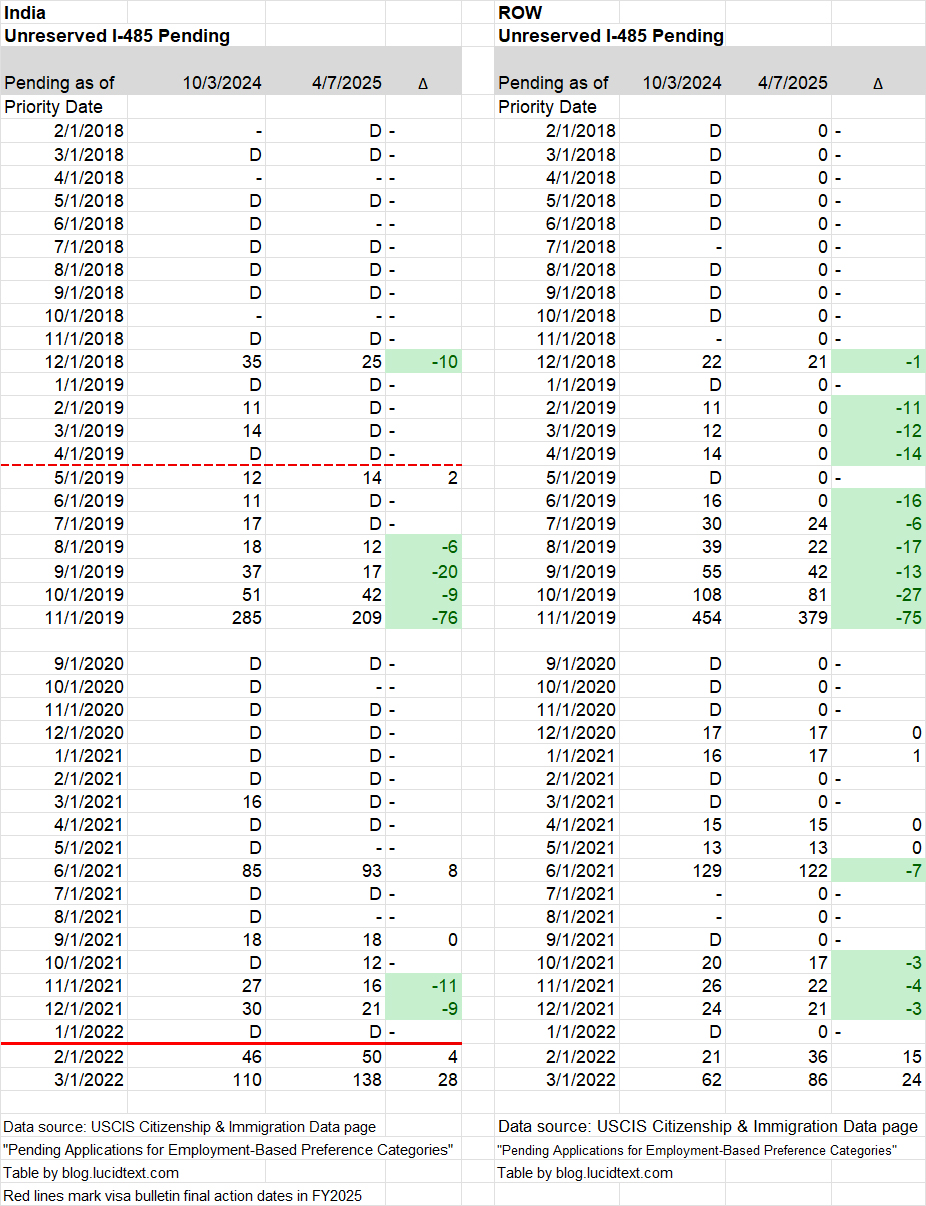
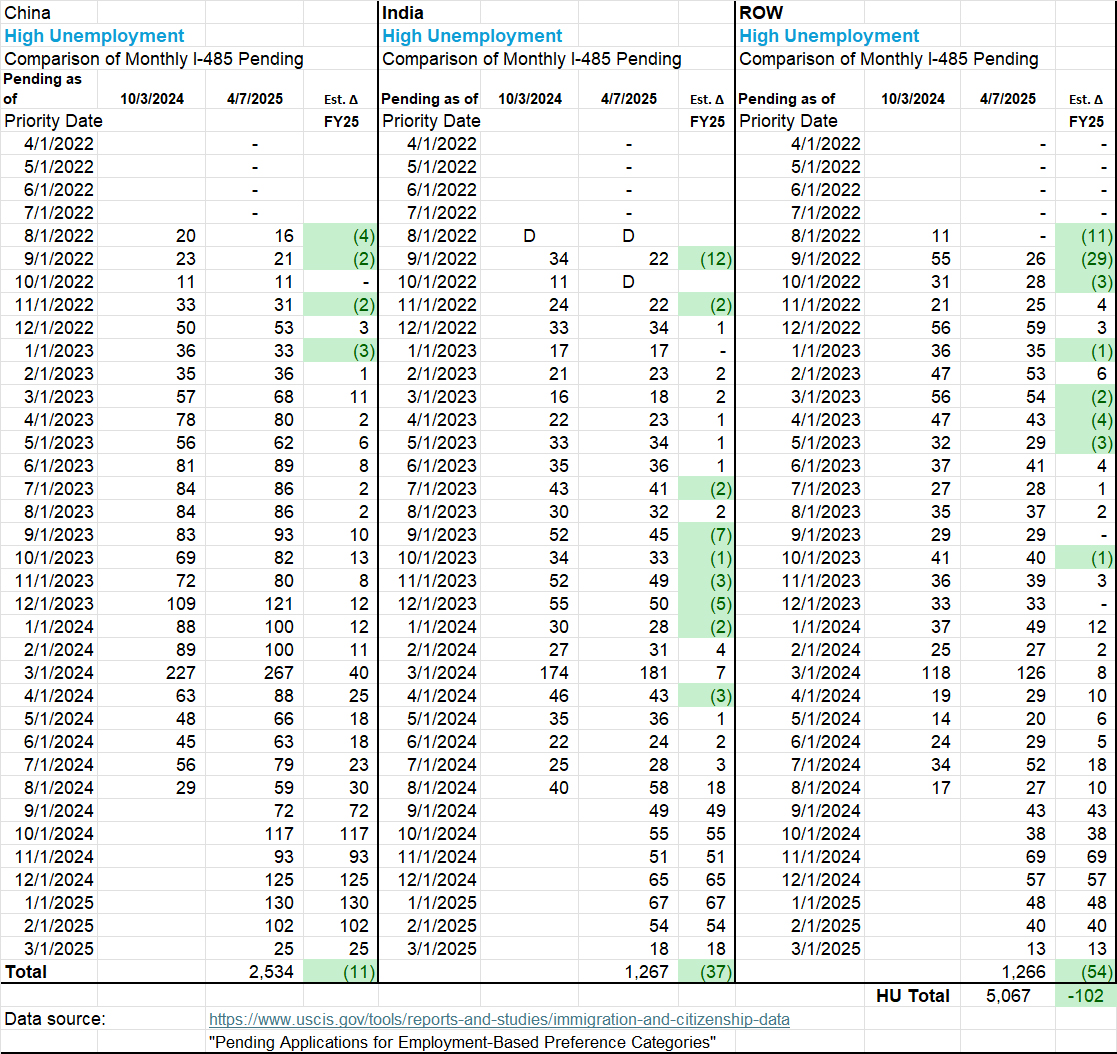
It’s time to feast after a famine of EB-5 data. We finally have the Report of the Visa Office 2024 (though not the NVC Waiting list yet), monthly immigrant visa issuance numbers through May 2025, the monthly pending I-485 report to April 2025, and EB-5 form receipt and processing data through FY2025 Q2 (January to March 2025). Before copying summary charts, I’ll start with lessons I take from the data updates for pre-RIA investors, post-RIA investors, and regional centers.

Data Insights for Pre-RIA EB-5 Investors

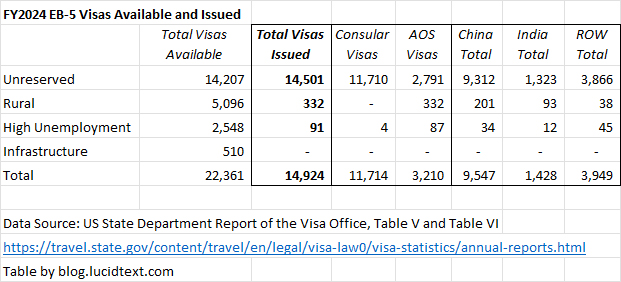
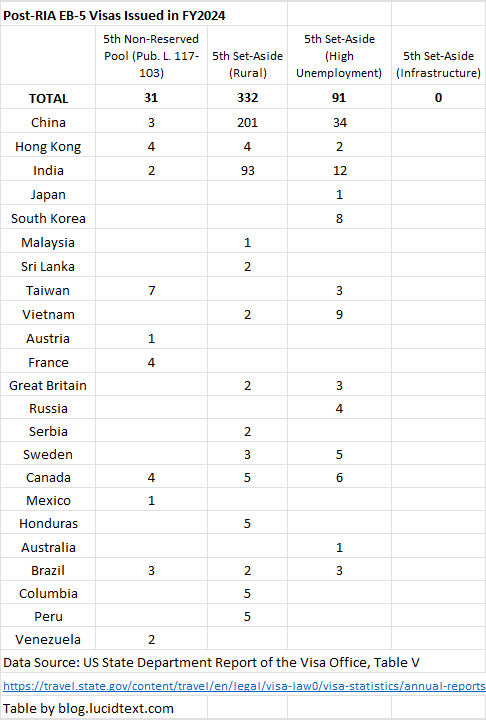
Department of State issued a record 14,501 Unreserved EB-5 visas in FY2024 — even more than technically available under the quota. China, India, and Vietnam did especially well. Vietnam cleared its legacy NVC waitlist with 1,522 Unreserved visas issued, India got 1,323 Unreserved visas (within 7% of the total EB-5 visas theoretically available to India, considering set-asides, but 9% of Unreserved), and China cleaned up with 9,312 Unreserved visas — 64% of visas issued in FY2024. (A few Unreserved visas even got allocated to post-RIA Chinese and Indian applicants — can anyone explain?) Other countries fell behind. Of “other” country EB-5 applicants who were registered at the National Visa Center in November 2023, only 38% got visas in FY2024. The other 62% were not constrained by any cap or quota limit, but by DOS capacity to schedule interviews and USCIS ability to complete I-485.

The answer to the question “who gets a visa” doesn’t only depend on priority date and country limits, but also depends on country-specific processing capacity. I’d like to highlight a helpful new page on the DOS website: IV Scheduling Status Tool. The page explains the visa interview process and factors, and gives timing by post. Post-specific timing differences for immigrant visas generally help explain the differences we see in EB-5 visa issuance. For example, the tool shows that NVC is currently scheduling documentarily complete IV cases with visas available from February 2025 in Ho Chi Minh City, but from March 2023 in Lagos. The page itemizes factors that can affect visa interview times by post, including interview capacity of the embassy or consulate, local conditions that affect operations, staffing levels, volume of cases, and vetting timelines.

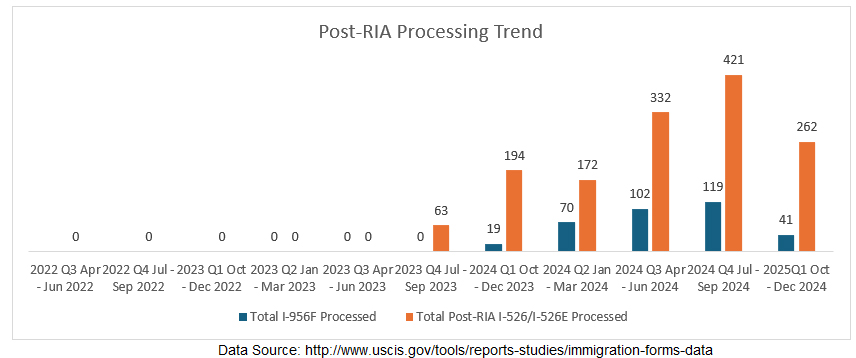
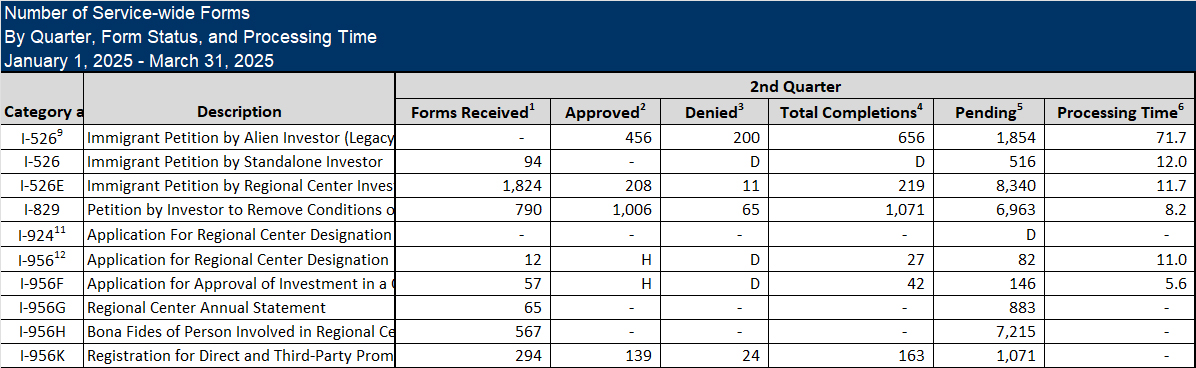
Meanwhile at USCIS, the legacy I-526 backlog continues to shrink — but slowly. Fewer than 2,000 I-526 remain pending (and only 300 unassigned), but processing volume dropped from nearly 2,000 in Q2 2024 to only 656 in Q2 2025. Denial rates for old I-526 remain relatively high – 30% in Q2.

I-829 processing volumes in FY2025 Q2 were half what they were this time last year, and not FIFO. The FY2025 Q2 report shows about 1,000 I-829 processed, nearly 7,000 left pending, and a median processing time for completed I-829 of only 8.2 months. This tells me that Mandamus actions are having an impact, causing USCIS to pick out and adjudicate many recently-filed I-829 even as many older cases remain pending.

FY2025 remains on track to issue all available Unreserved visas. ROW should have a good chance at more visas since the Visa Bulletin retrogressed for China in April and India in May. (However, as of May 2025 the effect was to lower visa issuance for China and India without increasing ROW visa issuance.)

Data Insights for Post-RIA EB-5 Investors

The data is not good news from a post-RIA investor perspective. Already-too-large backlogs are getting larger, and an already-too-slow process has been slowing down. Set-aside visa issuance proved low in FY2024 (just 332 Rural and 91 High Unemployment visas issued), and has stalled since March 2025. I-526/I-526E adjudication volume was already low in 2024 and has fallen since then (with just 219 processed in FY2025 Q2). Meanwhile, FY2025 Q2 yielded another bumper crop of new investors with 1,918 I-526/I-526E filings, bringing the post-RIA total to over 10,000 investors. As those 10K investors become 20-30K visa applicants, they’ll overwhelm the 3K annual limit for set-aside visas. Approval rates remain high, which is good for individuals but bad for the backlog. The Visa Bulletin remains current, which is good for people filing I-485 but bad for the backlog. The median processing time for completed I-526E is low (just 11.7 months in Q2) — which is nice for the 3% of I-526E completed in Q2, but no indicator for the 97% of cases not completed. I am interested to note the 31 post-RIA Unreserved visas issued in FY2024 — contradictions/exceptions to what I’d assumed to be the rule: that Unreserved visas get issued in priority date order with the pre-RIA backlog going first.

Data Insights for Regional Centers

Regional centers have facilitated an influx of over 10,000*$800,000=$8 billion dollars from EB-5 investment since 2022. This is great for the U.S. economy and job creation — and also 8x more investment than underwritten by the visa incentive (considering about 3,000 annual set-aside visas able to accommodate about 1,200 annual investors, or about $960M investment).

Slow processing times and low visa issuance are a win for capital raises, because they delay the day of public reckoning with backlogs. The Visa Bulletin can continue to show its encouraging “C” for Rural, High, Unemployment and Infrastructure so long as only a trickle of investors are getting I-526E approvals and becoming visa applicants, while the majority of the backlog stays hidden in I-526E processing. (If I-526E filed through 2024 had all been approved by now, and if DOS were issuing visas, then today’s Visa Bulletin would have final action dates for every country in High Unemployment, and for China and India in Rural.)

Who has to care about the hidden backlog? Or about continuing to accept in three months more investors than could possibly get visas in a year (as happened in FY2025 Q2)? Is it right to offer “immigrant investment” while saying “I honestly have no idea when you’ll be able to immigrate based on this investment”? And even for people who care, what can be done? Could any data milestone make the market/industry collectively decide “this is has gone too far, let’s choose to pause?” Some of us have made this call individually, but there’s no mechanism for the market to regulate itself.

If only EB-5 could get more visas! The program has an outsize economic impact, contributing $184 billion to U.S. GDP from investment in 2016-2019 alone, according to the recent Fourth Economy Economic Impact Analysis. Fourth Economy calculated that EB-5 created an average of 45 American jobs from each EB-5 investor, and has potential to generate 3.1 million American jobs annually if only supported by sufficient visas.

FY2024 Annual Report Summary

FY2025 Q2 Processing Data

FY2025 I-485 Trend

FY2025 Consular Processing Trend