Gold Card Executive Order

“For He said and it came about; He commanded and it endured.” This verse is quoted from the Psalms, not from the U.S. Constitution. The “he” in this verse refers to God, not the U.S. President. “By the word of the Lord the heavens were made” — but it happens that by the word of the President is not how U.S. immigration law gets made.

I don’t know how much more than that to say about the executive orders that were dropped on Friday regarding H-1B fees and Gold Card.  The release made for effective theater with dramatic audience response, but new immigration requirements and legal options do not instantly come about and endure by word of the President.  The reality is more complicated.

The legal immigration system, which does after all exist and control borders, is now trying to sort the confusion around H-1B. (USCIS FAQ here.) The courts will soon be hearing about conflicts between the executive order and established processes and authority for setting immigrant fees. And then there’s the Gold Card. I’m bemused by everyone solemnly reporting on this meme as a live immigration option. The President spoke, and it was so? The President speaking starts a process, and where could the process end up, realistically? How can people be opening https://trumpcard.gov/ and reading it straight, not bursting into a hearty collective guffaw and giving Trump credit for a brilliantly funny troll of immigration?

Can the executive branch executively redefine who qualifies for U.S. visas defined in the law? If the answer is “no,” then the Gold Card executive order has the weight of the paper it’s written on. If the answer is “yes,” then the order can be effective on the President’s word until the next president comes along with his or her different word. If the 47th president can stipulate that giving a money gift qualifies as an extraordinary ability and thus a path to an EB-1 visa, then the 48th president has as much basis to decide, for example, that being a still-living Haitian today clearly reflects extraordinary ability and thus qualifies for an EB-1 visa.

Could President Trump possibly be serious about making the Gold Card a reality, enough to get Congress involved? On the off chance that he truly wants to back up the pitch to “receive U.S. residency in record time with the Trump Gold Card,” then he’ll have to push Congress for more visa numbers. (Otherwise as a practical matter, EB categories are already oversubscribed nearly across the board, with long visa number wait times to offer to incoming new priority dates for EB-1/EB-2 visas, even if new ways to qualify could be created and even if the pre-visa processing steps can be expedited.)  What a funny and welcome plot twist if current leadership become the ones who finally raise the employment-based visa limit and increase the overall level of legal immigration, for the sake of making the Gold Card project work. And then future leadership might redefine more dignified bases than unrestricted cash gifts to qualify for the expanded visa limit. For example, what about supporting job creation? So I can sympathize with the lobbying flutter around the proposal. But … it all seems so improbable. But if anyone feels inclined to make an unrestricted cash gift in exchange for a Trump-branded immigration promise, what can I say? Department of Commerce could use the money.

For more discussion of the Gold Card idea, I refer for once to Center for Immigration Studies, and to Carolyn Lee and Joey Barnett. (I also note that immigration lawyers, who would know, are more optimistic than I am that Trump’s word on the Gold Card is effective.)
Unreserved EB-5 Visa Limit Reached

Today, Department of State announced Annual Limit Reached in the EB-5 Unreserved Category. This is good news overall — meaning that all Unreserved EB-5 visas available for FY2025 (at least 11,229 visas by my count) have been issued and won’t be lost to EB-5. The announcement clarifies that DOS did remember to include carryover of unused FY2023 Reserved visa numbers in FY2025’s Unreserved limit. I’ll be interested to see which countries ultimately benefited from the last-minute flurry of Unreserved visa issuance.

Consular interviews interview scheduling and I-485 adjustments Visa issuance for Unreserved EB-5 will now stop until FY2026 visas become available in October. (“Since all available EB-5 unreserved visas for FY 2025 have been used, embassies and consulates may not issue visas in these categories for the remainder of the fiscal year.”)

Apparently, FY2025 annual limits have sadly not been reached for EB-5 reserved categories, which means harm to the Rural and High Unemployment backlogs but future benefit to Unreserved from unused visas and carryover. For background, see my previous post on the October 2025 Visa Bulletin.

EB-5 in the October 2025 Visa Bulletin

The October 2025 visa bulletin has been published, giving the first indicator for EB-5 visa issuance in FY2026. Spoiler: the October 2025 visa bulletin imposes no filing or final action dates for EB-5 set-aside visa categories, and it has no note warning when such dates may appear in coming months. The bulletin gives Unreserved dates for China and India that are optimistic according to my backlog calculations, but less optimistic than the dates in the October 2024 visa bulletin. This post looks behind the surface of visa bulletin silence on EB-5 set-aside visas, and the retrogression for EB-5 Unreserved.

Rural and High Unemployment Visa Bulletin Silence

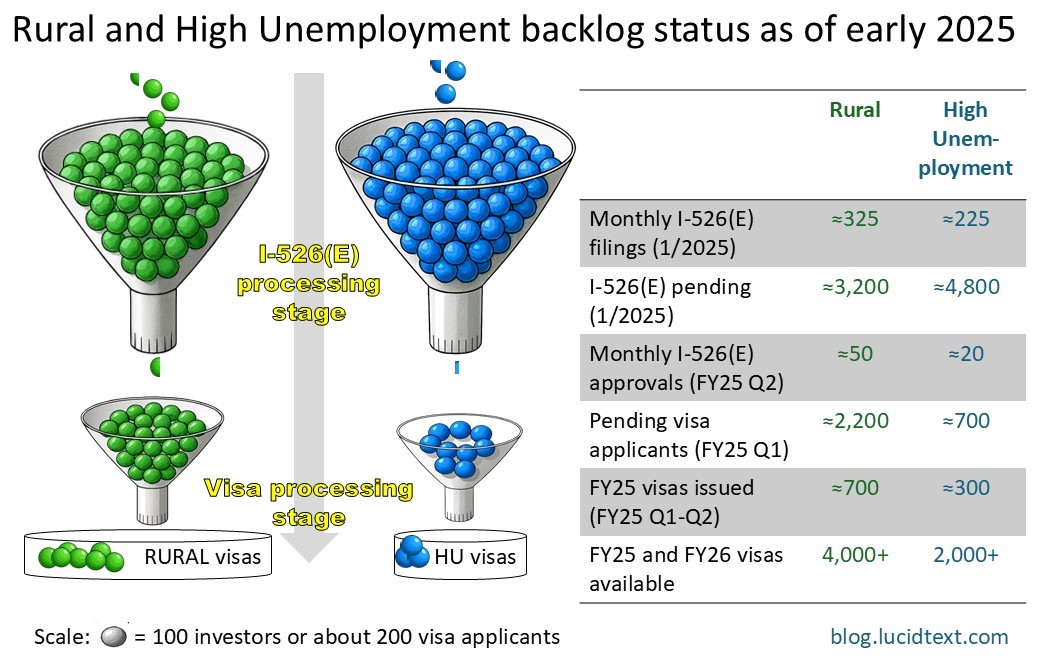
Why does the October 2025 visa bulletin still show “C” for all EB-5 set-aside categories? Why isn’t there any note at the base of the visa bulletin warning about cut-off dates coming soon? Because, the visa bulletin only imposes dates when there’s near-term risk of issuing more than the number of visas available in a category. That risk has not yet been triggered for Rural and High Unemployment due to (1) relatively few visa applicants and (2) even fewer visa interviews and adjustments. Reserved visa activity is apparently still low, despite thousands upon thousands of Rural and High Unemployment investors, because USCIS is not creating enough visa applicants by approving enough I-526(E) petitions, and Department of State is not issuing enough visas even to the qualified applicants it does have waiting.

Here’s an attempt to tell the story with a picture. The image shows the EB-5 process – I-526(E) processing followed by visa processing – and the issue: lots of pending and incoming I-526(E) (which aren’t considered in the visa bulletin) but relatively few petition approvals, few qualified visa applicants, and few visas issued (factors that do affect the visa bulletin). The image is more-or-less to scale, with each little ball intended to represent 100 investors, or about 200 current/future visa applicants. (Though it turns out, AI can’t really count.)

The data cited in the image is old now, since USCIS hasn’t published a data report since March 2025 and DOS hasn’t published a report since May 2025. But unless processing volumes magically improved in the unreported last six months, we may still be stuck with little set-aside visa issuance activity — and thus no visa bulletin activity yet — despite the high number of Rural and High Unemployment investors. (By the way, you can find my data collection saved together with source links on the EB5 Timing Page.) 

If you’re only wondering when the visa bulletin will announce set-aside retrogression, then you can just look at the base of the image and be comforted by relative lack of activity at the visa processing stage. If you’re wondering how long the green card process will take for a new investor, then you need to consider the entire image. A new EB-5 investor can’t skip straight to visa processing, but first waits in the I-526(E) processing funnel – which, as illustrated in the image, is already very crowded plus continually growing at a high rate and emptying at a low rate. That picture is not good for overall set-aside visa wait times.

Unreserved EB-5 Retrogression

The following chart compares Unreserved EB-5 dates in the October 2025 visa bulletin with the October 2024 visa bulletin.

October 2024 Visa BulletinOctober 2025 Visa BulletinMovement (months)
China Unreserved Chart A7/15/201612/8/2015-7.2
China Unreserved Chart B10/1/20167/1/2016-3.0
India Unreserved Chart A1/1/20222/1/2021-11.0
India Unreserved Chart B4/1/20224/1/20220.0

The comparison helps flag one wrong way to read the visa bulletin. Don’t look at the dates in one visa bulletin and assume “everyone within these dates is going to get visas soon, and many/most people up to these dates already have visas.”

Any Chinese and Indian EB-5 applicants who got excited back in October 2024 about 2016 and 2022 dates now realize – with Department of State – that those dates were aggressive and needed to be walked back. I am not surprised by the October 2025 visa bulletin dates, because I look at the number of people reportedly queued up within those dates as compared with visas issued and available.  As I discussed last year, FY2025 did not have enough visas available to satisfy all pending Chinese EB-5 applicants with pre-2016 dates, or all Indian EB-5 applicants with pre-2022 dates. No wonder that those dates from the October 2024 visa bulletin retrogressed, even after unexpectedly-high Unreserved visa issuance to China and India in FY2025.

I guess that the China Unreserved final action date could advance again to July 2016 shortly, but will not pass September 2016 for another few years — considering that 5,334 Chinese filed I-526 in July to September 2016, and may still be waiting to claim visas with spouses and children. I expect that the India Unreserved final action date will return shortly to November 15, 2019 and stay there, considering that the November 2019 filing surge could take years to work through the system – if most of the 745 Indians who filed I-526 in November 2019 ultimately claim visas with their spouses and children.  (For the detail and data behind this analysis, see the Pre-RIA China and Pre-RIA India tabs in the EB5 Backlog Analysis Excel file linked to my EB5 Timing page. I had previously hidden those Pre-RIA tabs because they use old National Visa Center waitlist data – as of May 2024 – and I kept expecting the NVC waitlist numbers to be updated and maybe significantly reduced. I hear that Department of State has been actively culling the NVC waitlist, booting out applicants who registered but then didn’t pursue a visa within a year. If this process eliminates many potential applicants from the backlog reported as of 2024, then my model can be recalculated and wait time estimates will fall accordingly. But, for now I’m working with the data that has been published.)

A benefit (for some) of aggressive visa bulletin dates is opportunity for out-of-order visa issuance. If an Indian EB-5 applicant with a January 2021 priority date had to wait for every Indian with an earlier EB-5 priority date to get visas before his turn came, then he could expect to wait years for a visa. But when the visa bulletin makes final action technically available already to January 2021, maybe that recent investor can skip over the remaining crowd of November 2019 India priority dates and snag a lucky non-FIFO visa shortly. With the disorder in USCIS and consular processing, there’s opportunity to benefit or suffer from queue-jumping. And meanwhile, the visa bulletin is generously letting all Indians benefit from an April 2022 Date for Filing, even though the India EB-5 backlog through April 2022 doesn’t appear on track to clear for several more years.

And finally, here’s an attempt at illustrating the Unreserved EB-5 visa backlog situation in a picture. By contrast with Reserved EB-5, Unreserved has a small and shrinking backlog awaiting I-526 processing but a large crowd of qualified applicants at the visa stage, where they trigger visa bulletin traffic control.