Proposed new fee rule (lower EB-5 fees, Form I-527 for subsection M, integrity fees and RC compliance status, I-829 technical amendment)

Department of Homeland Security has published a proposed rule for Employment-Based Immigrant Visa, Fifth Preference (EB-5) Fee Rule.

Summary

The 2025 EB-5 fee rule proposes to LOWER EB-5 form filing fees, primarily based on allowing IPO to keep EB-5 fee revenue instead of also helping to fund other USCIS functions.  DHS foresees increased resources and continuing efficiency improvements at IPO, considering RIA goals, but offers no timely processing guarantees. (See below for more detailed discussion.)

The rule proposes a new Form I-527. “An investor may file this form if they filed a Form I-526 before March 15, 2022, and are seeking to retain eligibility under section 203(b)(5)(M) of the INA because their regional center has been terminated or their NCE or JCE has been debarred and they do not otherwise continue to be eligible notwithstanding such termination or debarment.”

The promised “technical amendment” turns out to be about I-829, and “specifies that where the dependent family members cannot be included in the Form I-829 petition filed by the principal investor because that principal is deceased, all dependents (spouse and children) of the deceased investor may be included on a single Form I-829 petition.”

I expect that the liveliest public comments may be on the section of the rule discussing integrity fees, and the fundamental question of whether there’s any compliance distinction between a “previously-approved regional center” and a “regional center designated under (E).” No, suggests the rule. “DHS reiterates that the statutory language is clear in that these new provisions of the INA added by the EB-5 Reform Act, including the required fees and penalties, also apply to previously designated regional centers as of the date of enactment.” The rule also offers detailed discussion (which I couldn’t quite follow) of how to define “investors” for the purpose of calculating integrity fee payments. The rule proposes a minimal inflation-based increase to the integrity fee amount.

The rule is open for public comments until December 22, 2025. And then “After considering comments on this rule, DHS will complete and publish a final fee study that will take effect 60 days after publication.” So we are still months away from new fees, but the proposed rule publication is an important milestone.

Fee Change Discussion

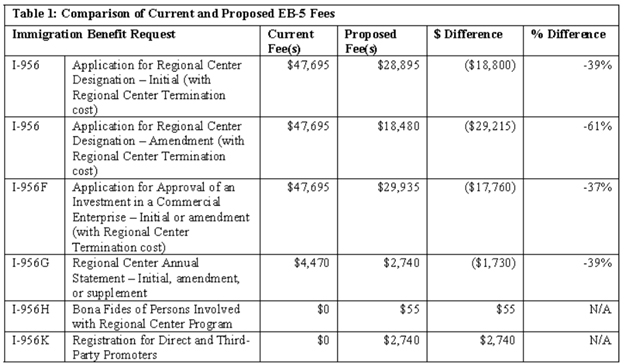
DHS proposes to lower filing fees for most EB-5 forms.

The single major factor in this recalculation is a decision to NOT use EB-5 filing fees to cover non-EB-5 costs. As I pointed out in my analysis of the 2022/2023 fee rule, DHS previously set EB-5 fees to allow collecting over $20 million that would be reallocated to USCIS budget needs outside EB-5, to help cover the cost of no-fee/low-fee benefit processing. The 2025 EB-5 Fee Rule explains “the proposed fees are lower than the current fees because the proposed fees do not include any additional costs for processing benefit requests with no fee or a reduced fee, thus reducing the fees overall.” DHS made this decision because doing cost reallocation outside EB-5 again “would likely result in litigation,” and because the reallocation from EB-5 is a drop in the total USCIS budget that might also be covered by USCIS balances and reserves and new appropriations in the “One Big Beautiful Bill.”

Another factor in the 2025 fee recalculation is that DHS is projecting slightly higher EB-5 receipt numbers than assumed in the 2022/2023 fee review (including remembering to account for all the various I-956 forms) and slightly lower average hours per adjudication than assumed in the previous fee study. If one assumes more form fees and lower time commitment per case, one can afford to consider lower fees.
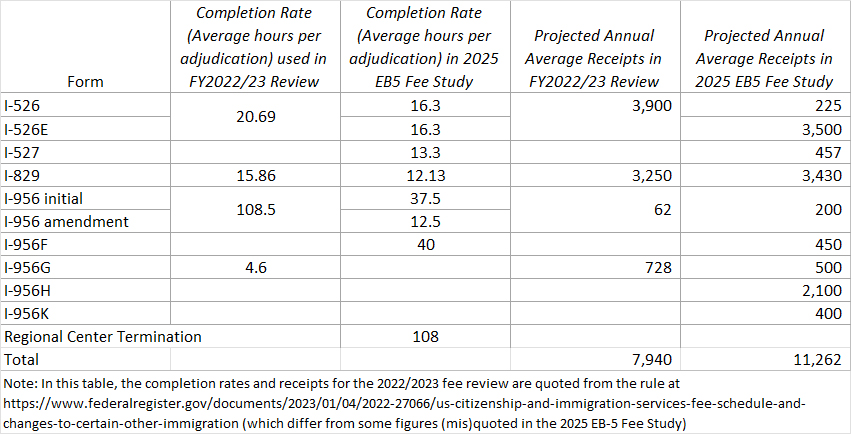
Basically, the methodology and goal behind the 2025 EB-5 fee study is the same as the general DHS fee-setting methodology, with a focus on cost recovery rather than performance. The goal is “to assess whether the current EB-5 fees meet full operating-cost recovery consistent with the EB-5 Reform Act requirements.” The 2025 fee study does reference RIA timely processing targets, but points out that “Completion Goals Are Not Requirements.” The rule explains that “consistent with the statute, DHS is not proposing to codify any processing deadlines, or any consequences for missing those processing time goals. USCIS will strive to process EB-5 requests as quickly and efficiently as possible to meet the time goals referenced in the EB-5 Reform Act and on which the fees in this rule are based, while keeping the integrity of the program utmost in mind.”

The 2025 Fee Study makes welcome comments about USCIS efficiency improvements, and plans to invest in more staff at IPO. The rule specifies a goal to reach “a total of approximately 334 employees (FTEs) across multiple USCIS offices (237 FTEs in IPO, nine (9) FTEs in Administrative Appeals Office, two (2) FTEs in Office of the Chief Counsel, 86 FTEs in Fraud Detection and National Security Directorate).”  For reference, IPO Chief Emmel previously reported that “All told, we have around 180 IPO staff and 36 IPO Fraud Detection and National Security staff for a total of 216 employees on-board as of October 1, 2022.”

Is it possible that DHS will not only lower EB-5 filing fees but also increase IPO resources to the point that we see processing improvements? The fee rule is ambiguous on this point. The rule disclaims responsibility to meet RIA timely processing time goals, and doesn’t formulate a specific plan to meet the goals. But processing should improve in fact, if the IPO budget and personnel are indeed increased as contemplated in the rule. All the better if this can be accomplished simply by letting IPO keep all EB-5 fee revenue, with no increase to EB-5 filing fees.

Is this analysis helpful to you? Consider supporting my work on the blog with a contribution through PayPal or Stripe (Link or credit card).

Interpreting the report of I-526 Approved Petitions Awaiting Visa Final Priority Dates

Quarterly reports at the USCIS Citizenship and Immigration Data page include a confusing report titled “Form I-140, I-360, I-526 Approved EB Petitions Awaiting Visa Final Priority Dates.” I’ll explain how I interpret this report.

I added yellow underlining to the screenshot to highlight key interpretive clues. The data refers to “approved” I-526/E petitions only (not to all filed or pending petitions). It does not cover all approved petitions, but only the subset of approved petitions that are defined as “awaiting visa availability.” And “awaiting visa availability” is defined with reference to a given monthly visa bulletin Final Action Dates chart.

Therefore, to interpret the USCIS report, I turn first to the referenced Visa Bulletin (June 2025, according to Note 6 in the report) and I check the EB-5 Unreserved Chart A dates that month: January 22, 2014 for China, and May 1, 2019 for India. I then interpret the USCIS report to say: “We have approved 30,313 I-526 for 5th Unreserved China investors who have priority dates later than January 22, 2014. We have approved 755 I-526 for 5th Unreserved India investors who have priority dates later than May 1, 2019. Since these priority dates are later than the final action date in the visa bulletin, the cut-off for visa availability, the assumption is that these approved investors don’t have LPR status yet and are still awaiting visa availability. (We’re overlooking the complication that the June 2025 Visa Bulletin retrogressed, so it happens that some approved investors with these priority dates used to be current and thus could’ve already received visas. We are also, by definition, not counting investors who are waiting for visas but whose I-526 we have not approved yet.)”

Compare to the March 2025 USCIS report, which referenced the March 2025 Visa Bulletin to define the cutoff for visa availability.

EB-5 Unreserved Chart A dates in the March 2025 Visa Bulletin were July 15, 2016 for China, and January 1, 2022 for India. I then interpret the March 2025 USCIS report to say: “We have approved 12,117 I-526 for 5th Unreserved China-born investors who have priority dates later than July 15, 2016. We have approved 116 I-526 for 5th Unreserved India investors who have priority dates later than January 1, 2022. We’re not the agency that issues visas but we’re offering the data that we do have – for I-526 approvals — as a hint at the number of petitioners who may still be awaiting visa availability. We are overlooking the complication that in practice approved investors with priority dates BEFORE the visa bulletin final action date may also not have visas yet for for one reason or another. And by definition we’re not counting still-pending I-526, and not counting spouses or children.”

USCIS report numbers between March 2025 and June 2025 are so very different primarily because the two reports are counting a different subset of petition approvals, as defined by different visa bulletin dates. “I-526 approvals for priority dates since June 2016” is a smaller segment than “I-526 approvals for priority dates since January 2014.” A bit of adjudication activity between measurements adds to the difference, but basically the two reports are measuring different things. It’s not that the China backlog abruptly increased in three months from 12,117 to 30,313. The USCIS report numbers are not referring to a total backlog at all, but very specifically to different date-defined segments of approved I-526.

The USCIS report is confusing partly due to the disconnect with what the public wants. The public wants to know how many EB-5 applicants are still waiting for visas. It’s impossible to derive that information from this USCIS report, despite its enticing title. The report simply gives limited information for a segment of the backlog – principals not dependents, approved petitions not pending petitions, and only those approved petitions after a specified Visa Bulletin cut-off date. Furthermore, I judge it impossible that this report actually excludes petitions on behalf of individuals that have obtained LPR status, as Note 8 claims. USCIS isn’t the visa-issuing agency, and how would USCIS know who all of their approved I-526 petitioners went on to LPR? I guess that USCIS has no ready way to judge who exactly is “awaiting visa availability,” except to simply look at a current visa bulletin and take that as a definition of which priority dates might not have visas yet. Finally, the USCIS report numbers make sense when interpreted as a number of I-526 approvals within certain dates (compared against other data for I-526 filings for the same dates and approval volumes), and don’t match up if one expects them to represent still-pending applicants (compared against data for actual pending visa applicants and visa issuance).  30,000 is a plausible number for total I-526 approvals for China Unreserved with priority dates after January 2014, considering about 43,000 China I-526 filed from January 2014 to March 2022. It is not plausible as a number of China-born principal Unreserved applicants still waiting for visas as of 2025, considering that Chinese investors with PD later than January 2014 have in fact been getting visas since 2016, per previous visa bulletins, and data reports showed just over 33,000 total Chinese applicants (principals plus spouses and children) registered at NVC and on pending I-485 as of mid 2024.

Is this analysis helpful? Consider supporting the hard work and keeping it public by making a contribution to the blog.

I-485 processing to September 2025

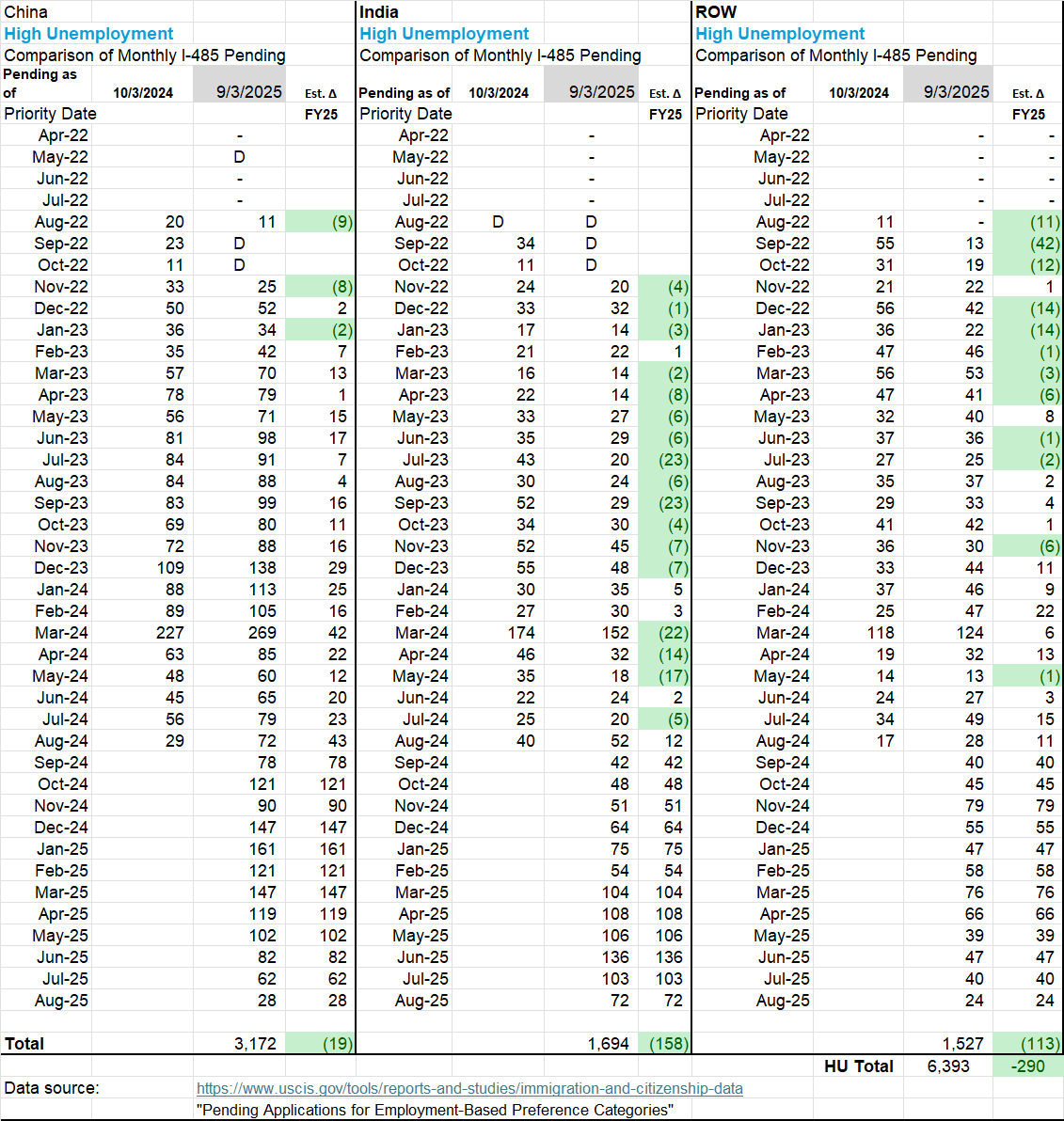
The November 2025 visa bulletin is out, with no changes to EB-5 dates and no warnings about future retrogression. We don’t know yet what’s happening with consular processing, since monthly visa issuance reports still haven’t been updated since May, but USCIS just published a report of I-485 pending as of September 2025.

Comparing the I-485 pending inventory as of September 2025 with the inventory as of October 2024 gives a hint at the volume and distribution of status adjustment visas issued in FY2025. Only a rough hint, since new receipts and denials also contribute to inventory change, the comparison misses change in intermediate months, and numbers <11 are redacted. But inventory report comparisons at least give some window into visa processing.

Looking at the I-485 inventory report comparisons for High Unemployment and Rural, I’m struck by the low volumes overall, exceptions to FIFO order, and timing differences by country. A wide range of priority date months show a handful of applicants disappear while dozens of others with the same PD remain pending. The lack of visa FIFO presumably originates in non-FIFO I-526/I-526E processing, since I-485 can’t be decided until the I-526/I-526E is approved or denied. I see that India-born applicants have lead the way both in terms of volume and dates for I-485 inventory changes. I assume this is because Indians have been most aggressive with I-526 mandamus actions. But volumes have been so low overall. I assume that the distribution of I-485 decisions will tighten as I-526/I-526E adjudication volumes increase.

For Unreserved, I’m particularly interested to notice a significant number of post-RIA Unreserved applicants. I doubt that many people have invested at the $1.05 million level, so assume that many/most of these post-2022 Unreserved applicants represent Rural or High Unemployment investors who chose to request Unreserved visas. I also note the number of India Unreserved I-485 pending as of September 2025. One would think, looking at the Visa Bulletin alone, that the India Unreserved backlog is on track to clear out this year. That seems less likely when one considers over 600 India Unreserved I-485 still pending as of September 2025, not to mention however many India-born applicants are still registered with NVC for consular processing.

Do you benefit from this analysis? Consider supporting all the work it requires by making a contribution to the blog.

FY2025 Q3 processing data analysis

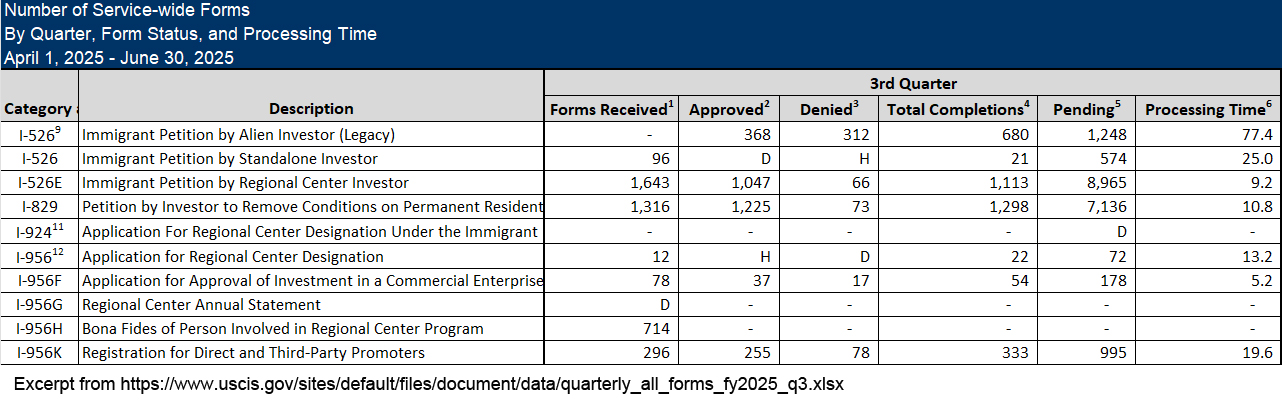
This is the first of a series of posts about USCIS receipt and processing data for FY2025 Q3 (April to June 2025), now published on the Immigration and Citizenship Data page. I’ll start with charts highlighting significant points from the All Forms report.

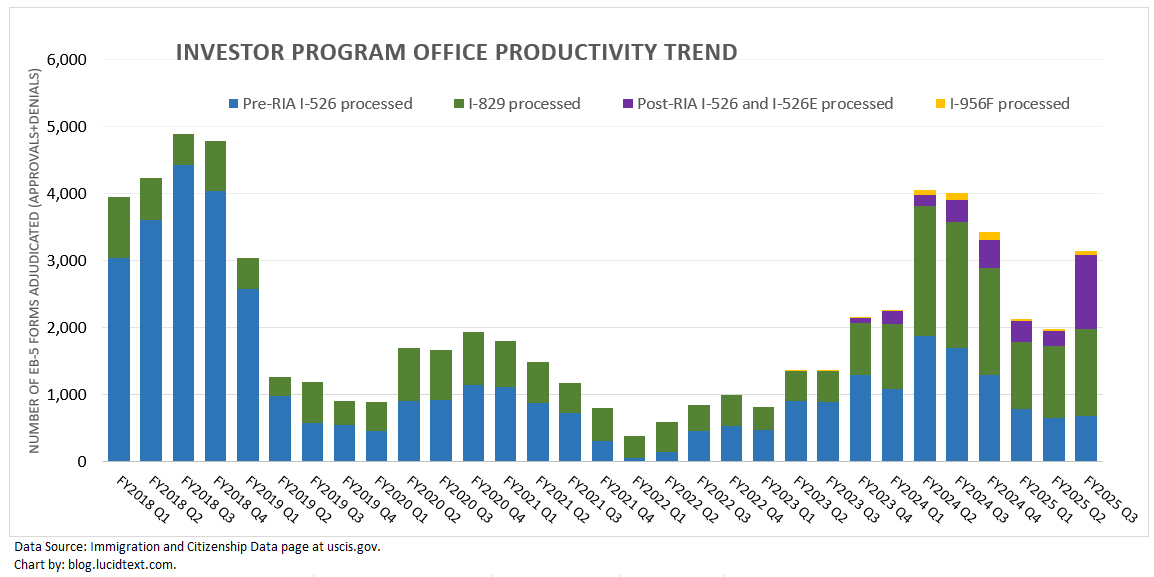
Overall Processing Productivity

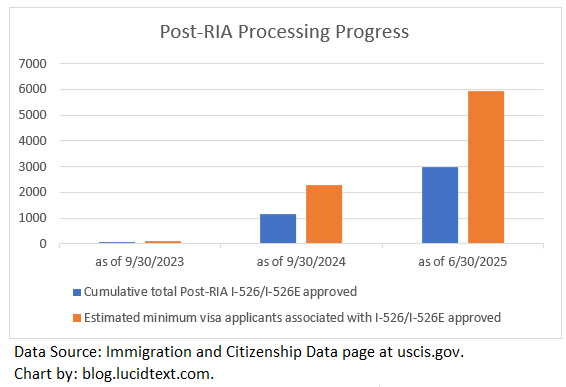
I had been alarmed by the downward trend in EB-5 processing volumes, and happy to see a significant upswing in Q3 — primarily driven by increase to the number of post-RIA I-526 and I-526E processed. It’s good to see the Investor Program Office using the processing resources it evidently has, considering past volumes.

Post-RIA Processing Volume Trend (I-526 and I-526E)

The spike in post-RIA I-526/I-526E processing could well have generated more than enough qualified applicants by now for all 4,000 Rural and 2,000 High Unemployment visas available in FY2026. This is particularly true if high adjudication volume continued into Q4 — and I expect it did, considering that the “net backlog” report indicates over 3,000 I-526E actively in process of adjudication as of Q3. But I’m not certain, because the breakdown of approvals by TEA category is unreported. And we don’t have data yet for the other factor needed to predict retrogression: Has Department of State also increased its processing volume, thus allowing qualified applicants to get matched with visas? So there is not currently a data-based answer to the question of when the Visa Bulletin will have cut-off dates for Rural and High Unemployment.

Post-RIA denial trend

The FY2025 year-to-date section of the USCIS report shows 114 I-526E denials (just 6% of total processed) and 35 post-RIA direct I-526 denials (75% of total processed). Apparently, USCIS is currently mostly processing regional center cases they can approve and direct cases they can deny. Direct EB-5 has always required very careful preparation, and I’m happy to report that two of my business plan clients were among the handful of direct I-526 that got approved in 2025. Regional center adjudications are now divided into two forms, with projects first assessed in I-956F and then investors in I-526E. When projects get denied, I-526E denials will follow for investors in those projects. USCIS reported denying 50 I-956F in FY2024, and 45 I-956F in FY2025 YTD (20% of total projects adjudicated in 24/25). Maybe USCIS is waiting for project denial appeals before pulling and denying the I-526E for investors in those 95 projects.

Post-RIA Processing Trend (I-956 and I-956F)

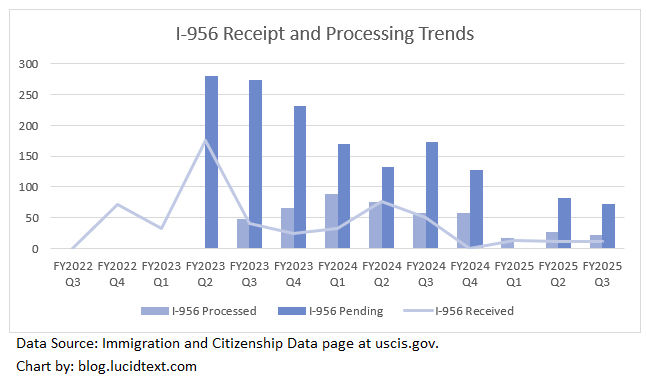
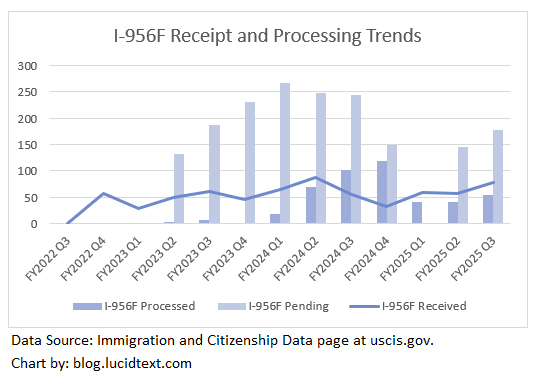
I-956 regional center application volumes remain low. I-956F project application processing has dipped below receipt numbers as of 2025, causing the backlog to inch up again.

Pre-RIA Processing Trend (Legacy I-526 and I-829) and Processing Times

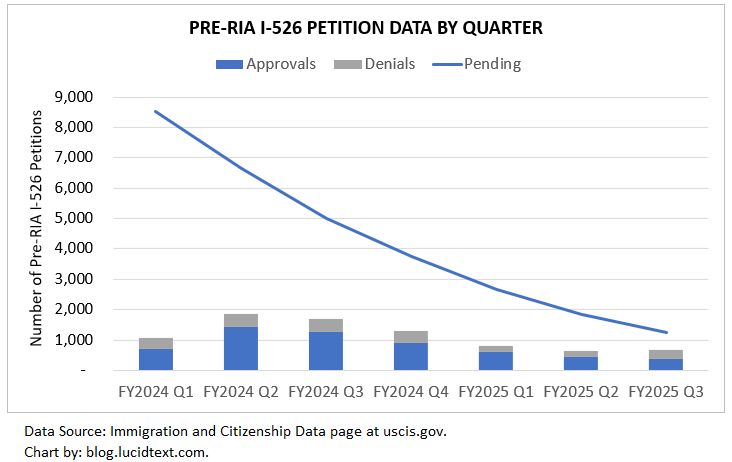
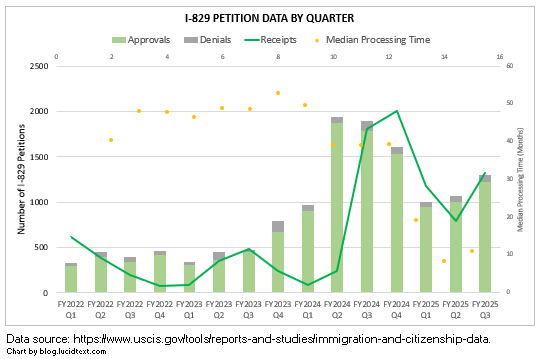
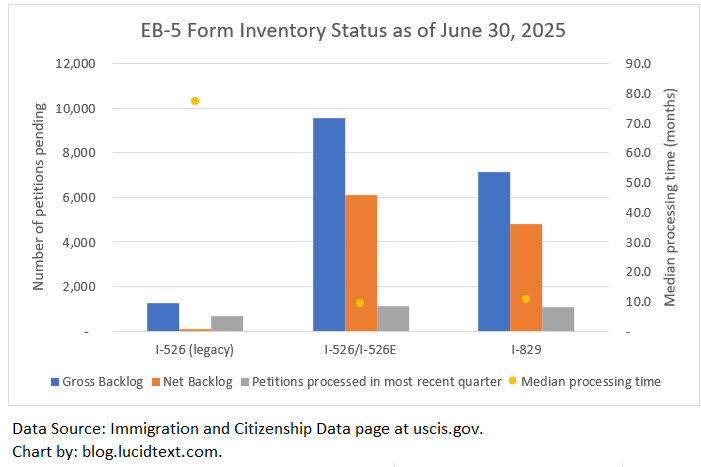
USCIS has nearly finished clearing the legacy I-526 inventory (with the “net backlog” now down to just 100 forms). The reported legacy I-526 processing time is extremely high only because recent decisions have been on old China I-526 held back by visa availability. For I-829, quarterly processing volumes continue to nearly keep pace with receipts. So the I-829 backlog has been holding steady, neither growing nor shrinking overall. With 7,000+ I-829 pending, how can the median I-829 processing time be only 10.8 months, as reported? Evidently, USCIS has not been processing I-829 in FIFO order. I assume this reflects the impact of Mandamus actions. Reported processing times (which reflect timing for the subset of cases that DID get happen to get adjudicated during the period) should always be looked at in context of the volume and age of pending petitions not getting adjudicated.

Post-RIA Demand Trend

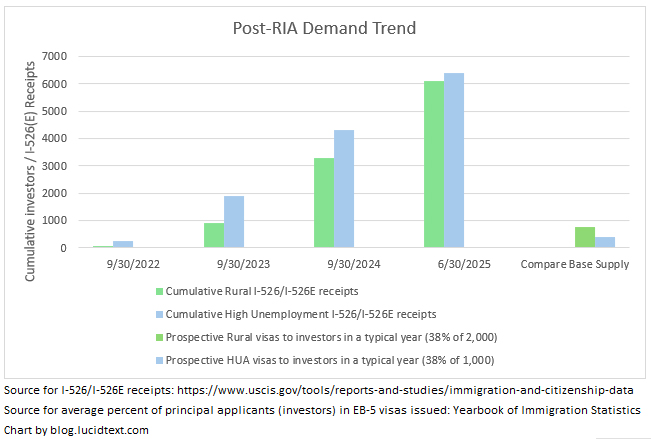
I’ll write a separate post on the TEA-specific new Q3 data and backlog analysis, but I will start with a couple charts to contemplate. Demand from Rural and High Unemployment investors has grown extremely far above the level possible support with timely visas (with 2025 levels proving even higher than 2024). Especially considering that only 38% of EB-5 visas have historically gone to investors, on average, while the remaining get absorbed by spouses and children. Country caps, Unreserved visas, and non-FIFO processing give space for complicated mixing and matching such that some investors won’t have to wait as long as others for visas. But the overall picture shows EB-5 demand so high by June 2025 that visa wait times would exist even if post-RIA investors had access to the full 10,000 or so annual EB-5 visas, not to mention competing for the 32% of visas set-aside. 2026/2027 will have to see either visa relief or a demand crash.

Do you benefit from this analysis? Consider supporting all the work it requires by making a contribution to the blog.

Data victory! (FY2025 Q3 with I-526E detail)

Wonderful news to report: USCIS finally published more quarterly data (for April to June 2025) and preemptively included two new reports with I-526/I-526E receipt detail by country and TEA category! Maybe someone at USCIS wisely thought: we don’t want to see Galati Law’s name one more time — let’s just give the people what they want instead of getting sued. Thanks to AIIA and IIUSA for all the hard work on FOIA requests that helped push this good result of improved data transparency, and to USCIS for listening. You can visit the USCIS Immigration and Citizenship Data page to access the new reports (and appreciate how much work goes into processing the raw data into the kind of analysis you find here). I’m in process of updating my spreadsheets. I will note a couple headlines: over 1,000 I-526E were approved in Q3 (4x more than the previous quarter), meaning that the pool of qualified Rural and High Unemployment visa applicants is very likely large enough by now to trigger Visa Bulletin cut-off dates, if only Department of State can catch up with interview scheduling and visa issuance. And Q3 had another bumper crop of I-526/I-526E receipts, with over 1,700 more investors added to EB-5’s economic benefit and ballooning backlogs. Important knowledge to have!

Looking to FY2026 (fees, regs, data, notices, deadlines)

Fiscal year 2026 begins today, with a promise of new fees, new regulations, denial and termination notice drama, Gold Card drama, data drama, and the deadline for grandfathering under current regional center program authorization. A few notes on developments that I expect in the coming months.

EB-5 filing fee changes

EB-5 filing fees are set to increase. We don’t know yet when or by how much, but we do know that U.S. Citizenship and Immigration Services Employment-Based Immigrant Visa, Fifth Preference (EB-5) Fee Rule (RIN: 1615-AC93) concluded regulatory review on September 25, 2025. This means that DHS could publish a Notice of Proposed Rule-making in the Federal Register any time. After the proposed rule is published, there should be a couple months (at least) before a Final Rule is published and the new fees take effect. The public may get a chance to comment. The proposed fee rule responds to the EB-5 Reform and Integrity Act requirement that USCIS set fees at a level to allow “timely processing” for EB-5 forms. At last report (March 2025), USCIS was processing approximately 10 times fewer forms than they would need to process to achieve the goal of <1 year processing times for everyone (despite already-high form fees, and despite having previously achieved much higher volumes with existing resources). Being in such a hole currently, how much might USCIS say they need to raise fees, to realize timely-processing targets? I also wonder what’s behind this sentence in the rule teaser: “This rule also proposes to codify in regulation certain elements of the EB-5 Reform and Integrity Act of 2022 and make one technical amendment.” We should find out soon. Certainly, timely processing can’t come too soon.

RIA regulations

Major EB-5 policy changes/clarifications are set to emerge when DHS proposes regulations to fully implement the EB-5 Reform and Integrity Act. In sustainment litigation, DHS promised a November 2025 deadline to publish a proposed rule for EB-5 Reform and Integrity Act of 2022; Ensuring the Integrity of the EB-5 Program (RIN: 1615-AC94). Publication of this proposed rule (NPRM) will certainly be followed by a public comment period (as promised in litigation), and then DHS has to review and respond to public comments. So we might still be a year or more away from a final rule. But November will at least bring insight into what DHS is thinking about hot button issues from sustainment to regional center compliance to investor protections, and will give the public a chance to weigh in.

Denial drama

With the low volume of I-956F and I-526E adjudications in 2022-2025, denial rates were also very low. As processing volumes increase and USCIS finds its stride with RIA compliance, the industry will grapple with more denials and terminations. I hear that USCIS finally, last week, started sending out notification letters to investors affected by regional center terminations, thus providing opportunity for investors to test Subsection M good faith investor protections. (Carolyn Lee has written about the notices and will hold a webinar next week.) If only USCIS would start publishing AAO appeal decisions again, to give a window into denial reasoning. (Publication of AAO decisions stopped abruptly in March 2025, and has yet to resume.)

Gold card drama

A Gold Card program will be implemented on December 18, 2025, IF agencies fulfill the Executive Order directive: “The Secretary of Commerce, the Secretary of State, and the Secretary of Homeland Security shall, within 90 days of the date of this order, take all necessary and appropriate steps to implement the Gold Card program.” I personally cannot imagine this actually happening — but even the pending prospect is a hassle for EB-5. What a shame that a 30-year-old program to get a visa for job creation, underwritten by the law, has to watch its back for a proposal to finagle a visa for nothing but some money, underwritten by nothing but a president’s gold-stamped face and an executive order.

Data drama

Backlogs and visa timing are the single most important topic in EB-5 today, as they define the window to keep raising EB-5 funds. I believe that explosive data developments exist to be reported, and I keep hitting “refresh” on government pages to find out.  Unfortunately DOS hasn’t updated the “monthly” visa report since May 2025 or the “annual” NVC waitlist since November 2023, and USCIS hasn’t updated its “quarterly” data report since March 2025. So pernicious. IIUSA and AIIA continue to pursue data reports via Freedom of Information Act and litigation, and I look forward to being able to report sooner rather than later on what’s happened to EB-5 waiting lines since early 2025.

Visa bulletin retrogression

In 2026, the conditions for Visa Bulletin retrogression could exist for Rural and High Unemployment. The EB-5 set-aside categories did not have cut-off dates in 2022 to 2025 despite a high volume of Rural and HUA investment, because low-volume I-526E and visa processing held back investors from becoming qualified visa applicants. But the inevitable retrogression announcement gets closer by the day, as I-526E approvals continue daily to add to the pool of qualified visa applicants. For example, USCIS had approved 1,126 Rural I-526(E) by January 2025, and was approving new petitions at an average rate of about 100 per month in the last three reported quarters (with 74% of approvals being for Rural cases). Even if USCIS never improved on that atypically low volume, it is sufficient to have generated over 2,000 Rural I-526(E) approvals by January 2026. And 2,000 approved investors, when joined by spouses and children, could be over 4,000 visa applicants able to maximize the FY2026 quota of about 4,100 Rural visas. When qualified visa applicants exceed available visa supply, then the Visa Bulletin reacts. The actual month of Visa Bulletin movement remains unknown, as it depends on processing productivity and how many visas were ultimately issued at the end of 2025.

Grandfathering deadline

In reauthorizing the regional center program, the EB-5 Reform and Integrity Act stated in Section (E)(e) that “Visas under this subparagraph shall be made available through September 30, 2027.” However, Section (S)(i) “protection from expired legislation” applies to petitions “based on an investment in a new commercial enterprise associated with a regional center that were filed on or before September 30, 2026.” This distinction doesn’t matter provided that the regional center program gets reauthorized once again. (Assuming that program authorization is extended by September 2027, then visa issuance proceeds seamlessly for all priority dates and no one needs protection from expired legislation.) But in case the regional center program does not get another authorization, then the grandfathering deadline of September 30, 2026 becomes significant. In that case, only petitions filed up through this year will still be technically eligible to move forward under the grandfathering protection despite program expiration.  Will this fact prompt a surge of EB-5 demand in 2026? Think about it. If you believe that the regional center program will sunset in 2027, then you might question the viability of a regional center investment today — even with the government offering some grandfathering protection on the immigration side. If you’re confident that the regional center program will gain timely reauthorization in 2027, then the grandfathering deadline is not a concern. And regardless of push from authorization deadlines, there remains the concern of visa availability amidst backlogs. Opportunity to beat a deadline is only compelling if opportunity to get a visa also exists. Ideally, the primary effect of the 2026 grandfathering deadline is to supercharge legislative advocacy efforts this year, including for visa relief. IIUSA and AIIA are starting to push the discussion.

Blog future

I continue to contemplate changes in 2026 for my E-2, L-1A, and direct EB-5 business plan service and for my EB-5 reporting service. At minimum, I resolve to switch out this blog’s outdated wordpress theme. If you are familiar with wordpress.com themes and can suggest one that would work for this content, please email suzanne@lucidtext.com.