New inventory management announcement for Form I-526/I-526E (visa usage approach)
February 26, 2026 3 Comments
USCIS updated the EB-5 Questions and Answers page on February 25, 2026 with one new Q&A: a question about “Inventory Management.” Specifically, how has RIA impacted IPO’s case management approach for I-526 and I-526E? I’ll quote a paragraph from the answer provided:
…Effective March 30, 2026, we will generally assign Form I-526 and Form I-526E under a first in, first out (FIFO) approach that seeks to balance these considerations by:
- Assigning Form I-526E petitions for review after we make official decisions on the associated Form I-956F;
- Assigning Form I-526E rural petitions by a FIFO approach as priority for anticipated fiscal year rural visa usage; and
- Assigning other Form I-526E and post-RIA Form I-526 petitions by a FIFO approach after the Form I-526E rural queue is empty or when we determine we have made decisions on enough petitions from that queue.
Considering resource and visa availability, IPO may also group the petitions in the non-rural Form I-526E and post-RIA Form I-526 petition queue by visa subcategory (rural post-RIA Form I-526 petitions, high unemployment area, infrastructure, and unreserved) and assign petitions by sub-queue in FIFO order to facilitate usage of reserved visas in line with congressional intent.
[end quote]
I will guess that the subtext for this Q&A is Mandamus actions accusing IPO of having no rule of reason for I-526/I-526E processing. That allegation looked plausible, particularly since FOIA data showing a chaotic-looking processing pattern for I-526/I-526E (see my summary table of AIIA data copied again below). The data can make it appear that IPO has been capriciously picking out Rural cases here and there, non-FIFO over a wide range of dates, plus negligently abandoning High Unemployment processing.
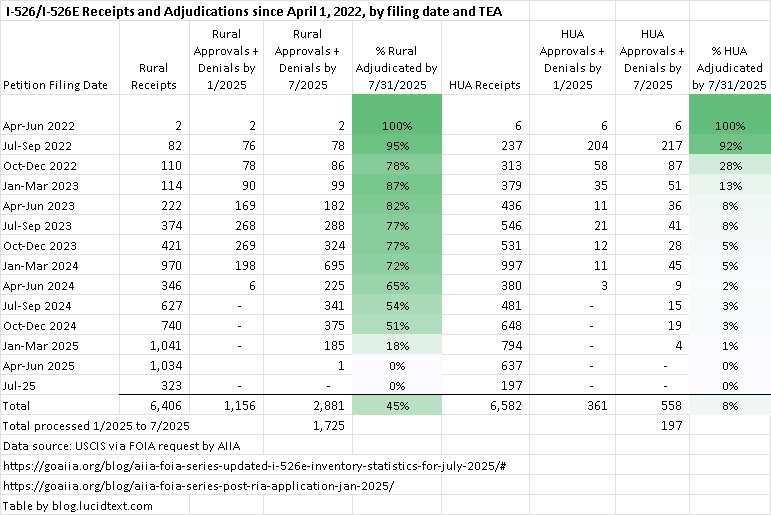
But now, USCIS can point to the new Q&A while saying “see, we do have a rationale for choices about which I-526/I-526E get processed, and when.” The rationale is: (1) it’s not quite FIFO because naturally I-956F have to be decided before I-526E can be decided, and (2) it’s not FIFO between categories because Rural petitions have priority per RIA, and (3) processing volume is related to visa usage.
The first two points are obvious from RIA and no surprise. The third point is intriguing and a bit ambiguous. The Q&A identifies a guiding principle for I-526E processing: “to facilitate usage of reserved visas.” How will this principle be wielded in practice? How, if at all, does it differ from the “visa availability approach” that preceded this Q&A?
Will the visa usage principle now cover USCIS to reallocate resources to adjudicate more High Unemployment and Infrastructure I-526E after March 30? Given that previous approval volumes (<600 HUA processed 2022-2025 Q3!) weren’t even high enough to generate enough applicants for annual High Unemployment and Infrastructure visas? Might Infrastructure particularly benefit near-term, as the category with visas most likely to be wasted unless USCIS swiftly approves very-recently-filed I-526E?
And/or will the visa usage principle give USCIS an excuse to increasingly cut I-526E processing volume, initially for Rural and eventually for everyone, with the reasoning that there’s no point in approving petitions for more people than can get visas shortly? Is USCIS setting itself up for an argument that regardless of how many petitions it has pending, and how many staff it has sitting around, it only has to produce about 1,000 Rural, 500 HUA, and 100 Infra approvals per year — in line with approximate annual visa numbers for investors?
Is this new Q&A answer a good sign for Rural and bad sign for everyone else, or vice versa, or mixed? The Q&A says that non-Rural I-526/I-526E will only be assigned “after the Form I-526E rural queue is empty or when we determine we have made decisions on enough petitions from that queue.” What a significant “or”! If most HUA and Infrastructure I-526E may sit untouched until the Rural queue is empty, then HUA and Infra I-526E processing times could become indefinite (or at least very long, considering the 4,000+ Rural I-526E pending and new receipts incoming daily). On the other hand, if “enough petitions” means “enough petitions to apply for one year’s supply of Rural visas,” then the trigger to stop Rural processing has likely already be met for FY2026, and HUA and Infra processing volumes may be about jump ahead. (If the trend in approval vs visa issuance volume from early 2025 continued, then there would currently be well over 4,000 qualified — i.e. I-526E-approved — Rural applicants ready for visas, while there may be almost no qualified HUA or Infra applicants today after years of low/no I-526E processing.)
I worry about how well USCIS can estimate what’s “enough” processing to facilitate visa usage. Is USCIS remembering about carryover visas above the usual limit? Is USCIS remembering that Rural, HUA, and Infrastructure investors also qualify for Unreserved visas? Because if not, USCIS could be mentally giving themselves 7 years to process currently-pending Rural I-526E and 14 years to process currently pending HUA I-526E — considering that demand in the Rural and HUA pipelines exceeds the next 7-14 years of Rural and HUA visas. I hope it won’t, but the principle could also allow USCIS to limit processing according to country caps – pre-emptively holding back investors from China and India. Those investors might have a better competitive chance against Rest of the World if USCIS would only send them on with a timely FIFO I-526E approval, and leave DOS to deploy country limits only at the visa stage.
I note that the new answer in the USCIS Q&A does not mention the words “visa availability approach” – the term used for the previous inventory management process (as introduced in 2020, and updated in 2023). Under the VAA: “rather than taking a first-in, first-out approach for adjudications of pending I-526 petitions, USCIS will now first process petitions for investors for whom a visa is either now or will soon be available.” The VAA had an exclusive function – USCIS stopped processing I-526 for China-born investors until Chart B moved past the investor’s filing date. The VAA directly reacted to the Visa Bulletin. It also allowed USCIS to help create the Visa Bulletin by controlling through I-526 processing choices who got to become qualified visa applicants.
Is the new Visa Usage Approach different from the previous Visa Availability Approach? If the same as VAA, then China-born and India-born investors behind backlogs face — like pre-RIA China-born investors — the upside of long I-526E processing times adding to child age-out protection, and the downside that denial rates increase with delays. But I’m guessing that USCIS has a difference in mind, since they chose not to just repeat the old VAR language in this new Q&A. Dare I hope that the VUA is less limiting? I disliked the old VAA because it functioned to excuse reducing I-526 processing volumes overall, and to China in particular. The result was more denials and fewer visas to China than might otherwise have been the case. I hope that the new approach will function as a reason to boost HUA and Infrastructure I-526E processing to sustainable levels in the near term, but without cutting processing in the long-term, or artificially limiting who can become qualified visa applicants.
Discover more from EB-5 Updates
Subscribe to get the latest posts sent to your email.
 EB-5 Updates
Hi thanks for all your work. I was wondering if you had any updates on i829 processing. It seems that uscis stopped publishing the all forms data so no way to exactly track how many are being processed and are pending.
I also lament the stop/delay to USCIS data reporting, and don’t have any I-829 updates to share. Listening the lawyers complain, I get the impression that review has been intensive and often nasty recently. So there may be a silver lining to having I-829 sitting safe in the warehouse. But if a decision sooner rather than later is desired, I hear that Mandamus actions can be effective.
Pingback: Thông báo mới về quản lý kho hồ sơ cho Mẫu đơn I-526/I-526E (phương pháp sử dụng visa) – EB5 Vietnam Info & Case Studies