EB-5 Set-Aside Visa Backlog and Outlook Update as of March 2026 (set-aside backlog size, Unreserved visa availability, Infrastructure, Visa Bulletin outlook)
March 5, 2026 1 Comment
[3/6 UPDATE: I have updated the tables and Infrastructure discussion in this post after Department of State published some additional visa issuance data, and I became aware of two additional Infrastructure projects.]
Where are we with EB-5 visa backlogs and wait times as of early 2026?
I have been holding off on this article, thinking that USCIS and/or Department of State would publish more data any day. But the government has maintained its silence since May 2025 as to visa issuance, and silence since June 2025 about the progress of petition receipts and adjudications. But still, we can’t afford to just keep looking at old numbers and thinking as if it were still 2025. The ground has shifted.
This article reviews developments that appear particularly significant to me:
- Set-aside backlog growth since last I-526E report
- Significance of Unreserved visa availability and access
- Infrastructure category activity and outlook
- Processing sequence factors and changes
- Visa bulletin outlook compared to backlog outlook
Set-Aside Backlog Growth
EB-5 backlog numbers, whatever they may be exactly, are certainly not the same as they were as of mid 2025. Industry chatter suggests undiminished incoming set-aside investor demand, even as the silent Visa Bulletin suggests on-going low set-aside visa issuance.
For a tangible reference in absence of recent EB-5 data, I made a napkin calculation. I took the FOIA numbers we have for I-526/I-526E receipts and approvals through July 2025, and advanced them to the present day with a simple assumption: what if the past seven unreported months mirrored the previous seven reported months. (This calculation is spelled out in the “Summary2” tab now added to my EB5 Backlog Analysis file linked on the EB5 Timing page, and also represented in image thumbnails below. With thanks again to AIIA and Alexandra George of Galati Law for getting data through FOIA as of January 2025 and July 2025, to Google and industry colleagues for Infrastructure intel, and to the government for publishing at least some data in 2025.)
The take-away: if the EB-5 train kept going at its previous reported rate, then by now over 30,000 people are in process heading toward set-aside visas, including over 15,000 each in Rural and High Unemployment, and potentially around 1,000 in Infrastructure. (I call these people “pipeline applicants,” meaning I-526/I-526E filed and investors plus family in the pipeline to claim visas eventually — though most don’t qualify for a visa yet since they are still waiting for the investor petition approval. For the sake of estimate, I make my typical assumption of average two future visa applicants per I-526/I-526E filed, after denials and with family, though the reality could turn out higher or lower than that.) Think about the wait times, if 30,000+ people are in queues headed for windows with just over 3,000 visas to give in a typical year.
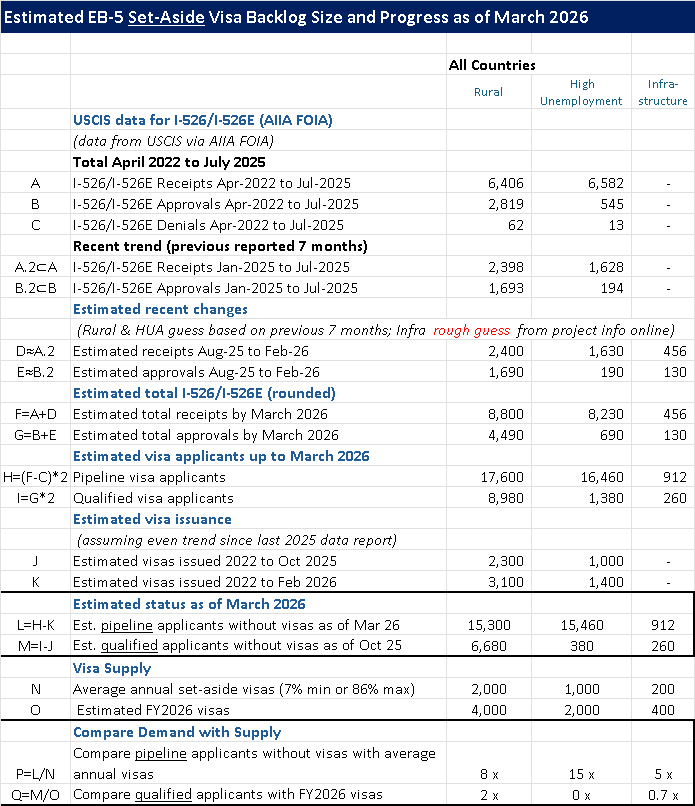
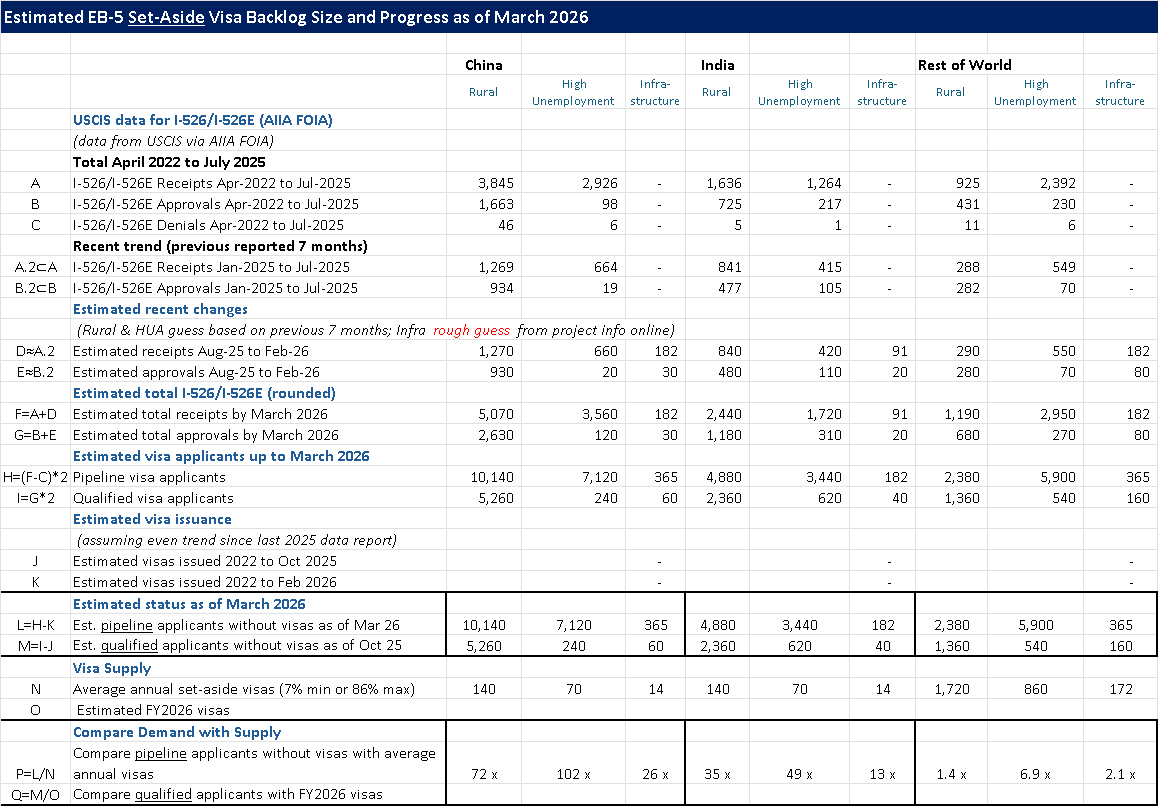
Drilling down by country emphasizes set-aside retrogression risk for new investors as of March 2026. If every applicant in the high unemployment area pipeline had to take a high unemployment area visa, then even the new “rest of world” investor (not from China or India) would face a 6+ year HUA visa wait time and Visa Bulletin retrogression, while China-born and India-born investors would theoretically face multi-decade HUA visa wait times. That’s based on looking at the bottom line of the backlog table above — at the difference between pipeline applicants as compared with annual category visas: 6.9x excess for “rest of the world” in high unemployment (even if ROW gets all HUA visas above country caps) and a shocking 49x excess for India and 102x for China. Those massive HUA pileup estimates reflect what would happen if every high unemployment investor and family had to take a high unemployment visa, and if Rest of World demand continued as it has been. The calculation within Rural is less dire than for HUA, considering the double set-aside portion plus less excess demand from Rest of World. But the Rural inventory numbers are still high enough (and the supply numbers low enough) to add up to multi-decade wait times for China and India — if every Rural investor has to take a Rural visa. (But that shouldn’t be so, as further discussed below…)
Meanwhile, the Unreserved backlog has been shrinking. Pre-2022 investors from China and India have apparently been getting a good volume of visas, the Visa Bulletin is advancing dates, and few new investors are heading exclusively for Unreserved by making $1.05M investments.
The upshot: the backlog picture has flipped. When RIA passed in 2022, Chinese and Indian investors faced prohibitive legacy backlogs in Unreserved but clear lanes ahead toward Rural, High Unemployment and Infrastructure visas. For new investors in 2026, the greatest imbalance appears to be on the set-aside side.
Unreserved Visa Availability and Outlook
Once set-aside lanes are unquestionably overcrowded, the hope for a visa number has to depend on Unreserved visas being also on the table for today’s set-aside investors. We are to the point where, effectively, many new set-aside investors are not investing for set-aside visas. Incoming investors from China and India, in particular, are not counting on multi-decade waits for the corresponding set-aside visa. They are relying on the chance to also access Unreserved visas in priority date order, regardless of which type of investment they choose.
Concluding that today’s EB-5 visa wait times depend so heavily Unreserved visas, I have been sweating over the question of Unreserved visa access for set-aside investors.
On the positive side, the theory looks solid. I-526E approval notices for set-aside investors continue to list “Unreserved” as well as “Reserved” as “approved visa classifications.” Department of State published a process for consular applicants to request a visa category from among the options on the approval notice. Immigration lawyers mostly seem optimistic. (For example, listen to 11:30-22:11 in this February 2026 webinar for Carolyn Lee’s thoughtful response to my grilling on Unreserved visa access.)
On the positive side, the Unreserved category made a huge leap forward for India in the January 2026 Visa Bulletin, and may be about to advance quickly for China as well. (The March 2026 Visa Bulletin notes a windfall of extra visas headed for the countries not blocked by President Trump’s various visa orders). Until recently, I had been looking at 2024 data and typical allocations, and thinking that the pre-2022 Unreserved backlogs wouldn’t be out of the way until 2030 for India and the mid/late 2030s for China. Now it looks as if pre-2022 EB-5 priority dates might all be cleared from waiting lines by 2027 for India, and maybe even before 2030 for China. And then there would be opportunity for backlogged post-RIA set-aside investors from China and India to overflow into the larger Unreserved pool.
On the worrisome side, there isn’t friction-free access to Unreserved visas for set-aside investors. USCIS has not yet followed Department of State in establishing a process whereby an I-485 applicant can pro-actively request an Unreserved visa. It naturally hasn’t been a priority for USCIS in this period when set-aside visa supply has gone under-used anyway, but I’ll feel better when I see a process. I also worry about whether the new I-526E inventory management approach just announced by USCIS could limit I-526E adjudication according to set-aside visa availability, erecting another speedbump to Unreserved visa usage.
On the worrisome side, I watched and raged at what happened leading up to 2022, when a new law took 3,200 previously unreserved EB-5 visas and set them aside in new categories untouchable by the legacy backlogged applicants who had been counting on access to those numbers. (Reminded now of what I got right and wrong in old posts on this.) As TEA backlogs have now grown anew, could lobbyists today be dreaming of another carve-out to circumvent backlogs and reduce future unreserved visa availability to today’s investors? They had better not be, but I wish I knew for sure that this couldn’t happen. Prospective investors today must be able to rely on priority date/country-specific access to the full pool of Unreserved visas, or else they will stop considering Rural, High Unemployment, or Infrastructure investments in light of backlogs.
Potential Unreserved Visa Impact
What’s the best possible outcome, assuming no limits or friction to future Unreserved visa access for today’s set-aside investors? How good can visa wait times look, if we can assume that everyone already in process gets efficiently matched with the first qualifying category visa available, including Unreserved, according to priority date and country-specific priority?
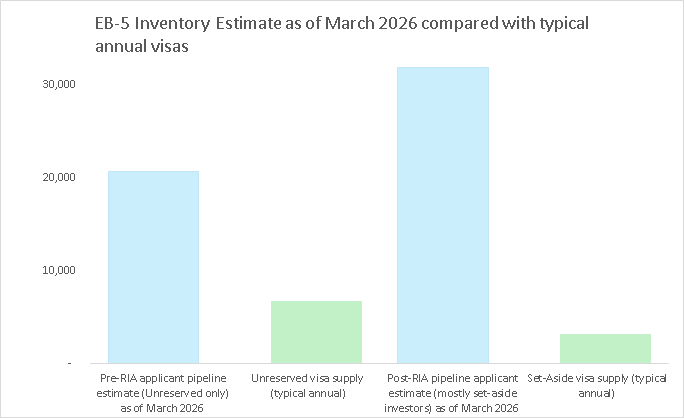
As discussed above, the existing EB-5 pipeline to be accommodated by now appears to include about 20,000 old applicants who can only take Unreserved visas, plus 30,000+ applicants with more recent priority dates who could take their set-aside or an Unreserved visa. (The tables above show the numbers by country, and my linked spreadsheet shows the data, assumptions, and calculations behind the rough estimate.)
It would take five full normal EB-5 visa years to issue visas to 50,000 pipeline applicants if country and category limits didn’t apply, or if incoming EB-5 demand shortly stopped for good. When one tries grappling with country-specific and category-specific factors, and assuming on-going demand from Rest of World countries, the calculation can only get worse than the baseline for China and India, while looking better for Rest of World.
I made myself some big spreadsheets to work with the sorting question, experimenting with how the pipelines of Pre-RIA, Rural, High Unemployment and Infrastructure investors from China, India, and Rest of World might get optimally matched into available EB-5 visa pools (and react to a variety of scenarios on factors like family sizes and denial rates and ongoing demand). I can make my spreadsheet conclude that Chinese and Indian investors with priority dates through 2026 could all have been matched with visas by 2033 or so, regardless of the TEA category in which they invested. I’m not putting the spreadsheet on the Internet because it’s a low-confidence conclusion, with many assumptions and elaborate setup that take a lot of explanation and qualification. The reality could be shorter or much longer, particularly for individual cases.
Working with the models did impress a few overall conclusions on me. One: the estimated visa wait time differential between Rural and High Unemployment for India and China increasingly flattens as backlogs increasing depend on accessing Unreserved visas. Two: The market-favored “3-5 year” EB-5 visa wait time estimate looks vanishingly probable, at least in Rural and High Unemployment for China and India, even assuming optimized access to Unreserved visas. Given the sheer number of people who appear to be currently in process, not to mention ongoing demand, I can’t get my calculators to conclude moderate wait times for China and India in HUA or Rural — unless I start entering (what I consider) quite extraordinary assumptions about extra visa supply and/or applicant attrition. (Though not to say that the extraordinary is impossible, in these strange days.) The balance of probability looks to be on the side of greater-than-five-year visa wait times.
Infrastructure Outlook
[3/6 UPDATE: Thank you to the reader who emailed to notify me of two large Infrastructure projects not on my list. It now appears that over 400 Infrastructure investors may have been recruited by the end of 2025, meaning a multi-year backlog already in place in the Infrastructure category. See the Infra tab in my EB5 Backlog Analysis file for such detail as I’ve been able to find on infra projects, and email me if you can contribute any corrections or additional detail.]
What about the infrastructure category? In the last data release through July 2025, USCIS reported zero Infrastructure I-526E filed ever, not to mention zero petition approvals or denials. That must be a database glitch, as I’ve since confirmed reports of a few infrastructure I-526E filed before July 2025. But still, anecdotal evidence suggests that Infrastructure activity is recent and low-volume to date.
Based on the infrastructure project information that I can find from the Internet and by talking to people, I gather that 100 to 200 infrastructure investors may have been recruited by the end of 2025, and that over 1,000 infrastructure project slots are contemplated by the end of 2026. (See the Infra tab in my EB5 Backlog Analysis file for such detail as I’ve been able to find on infra projects, and email me if you can contribute any corrections or additional detail.)
For the investor from China or India, the recent activity means a tantalizing chance to be among the first <400 infrastructure visa applicants (in which case, clear path to a green card before the initial Infrastructure visa limit is reached and triggers the Visa Bulletin). On the other hand, the investor with an early 2026 priority date has no guarantee of ending up among the first wave of visa applicants. Even the earliest investors have no guarantee of snagging the first visas because I-526E processing and visa processing are not quite FIFO. And once Infrastructure demand collects and advances sufficiently to trigger country caps, Infrastructure supply suddenly becomes potentially tiny to China and India.
With supply so small – about 400 visas in the first year and 200 visas in subsequent years – the demand/supply imbalance can potentially go from 0x to 10+x very quickly. If every Infrastructure investor has to take an Infrastructure visa, then the China-born or India-born investor in 2026 faces a realistic chance of anywhere from zero visa wait time to a multi-decade wait time, depending on where he or she happens to sort out in the flurry of petitions coming in around the same time, and ongoing demand from Rest of World investors. On the other hand, assuming access to Unreserved visas, I assume that Infrastructure investors today are — at worst — no worse off than Rural and High Unemployment investors with the same priority date. Since country and priority date theoretically determine access an Unreserved visa, no matter if the investment was in a Rural, HUA, or Infrastructure project. Also, many Infrastructure projects also qualify in High Unemployment or Rural, further diversifying visa options.
Process Factors
My big picture analysis looks at applicants in the aggregate, assuming that groups proceed in order according to the distinguishing features of priority date, TEA category, and country of origin. The reality is not so tidy, and individual experience can vary widely.
Looking around in 2026, I note developments related to the confusing issue of who gets advanced when and why in the EB-5 process.
As of today, there appear to be more processing barriers in consular processing than status adjustment. There appears to be better opportunity for litigation to affect timing in the U.S. Applicants who happen to be currently based in the U.S. may, at least for awhile, enjoy a timing advantage over fellow-countrymen abroad with the same priority date.
The new I-526E inventory management approach now explicitly considers set-aside visa usage, which can result in changes going forward to processing order. I-526E processing in 2024/2025 varied over a wide range of dates, with a few people getting very quick processing times (and thus early chance at a visa) while others waited. I guess that those variations may be about to decrease.
I’ll guess that Mandamus actions, which may explain a lot of individual processing time difference in 2024/2025, have decreasing opportunity/effectiveness going forward for I-526E and visa issuance. Considering the new inventory management guidance, the sheer numbers now awaiting I-526E processing and visa issuance, and impending Visa Bulletin dates. I-956F timing should also have a decreasing effect on investor petition timing, as a greater proportion of the I-956F inventory has now been processed. But I-526E processing order, for good or ill, retains potential to help determine who gets a visa and and when independent of the priority factors that are supposed to control visa allocation.
Visa Bulletin Outlook vs Backlog Outlook
The long-term risk of visa wait times and retrogression follows the difference between total applicants in the pipeline as compared with visa availability in coming years. (When I say “pipeline visa applicants,” I mean everyone who’s started the process by filing I-526/I-526E and who doesn’t have a green card yet, regardless of where they are in processing.)
By contrast, the near-term risk of Visa Bulletin cut-off dates follows from the difference between currently-qualified visa applicants and visa availability/usage this year. (When I say “qualified visa applicants,” I refer to the subset of the pipeline who currently have I-526/I-526E approval and visa applications complete, ready and waiting for the visa interview/adjustment and visa number assignment.)
As of early 2026, we appear to remain in the situation where set-aside categories have many pipeline applicants but few qualified applicants. (Refer again to the tables copied above for detailed estimates from approval data vs receipt data.)
If trends as of early 2025 continued, then there just haven’t been enough I-526E approvals in HUA or Infrastructure yet to create sufficient applicants yet for FY2026 visas. (This may be about to change, as the I-526 inventory management change may spur more HUA and Infra processing.) If lacking qualified applicants for available visas, no wonder the Visa Bulletin keeps showing “current.” This is a total guess on my part (in absence of any 2026 data yet), but (betting on government dysfunction) I would be surprised if High Unemployment gets Visa Bulletin dates this year, and (considering recent demand) astonished if Infrastructure gets Visa Bulletin movement this year. [3/6 UPDATE: I have now been notified of a flurry of Infrastructure approvals in recent months, making Visa Bulletin movement for Infrastructure at least not impossible this year.]
Rural is more dicey for the Visa Bulletin, because a continuation of 2025 USCIS processing trends would’ve resulted in more than enough Rural approvals and qualified visa applicants by now to use FY2026 visas. No dates or warnings yet in the Visa Bulletin for Rural makes me infer that despite having applicants ready and waiting, Department of State is not yet on track – for its own processing reasons — to issue all the 4,000+ Rural visas available in FY2026. If consulates are continuing to move as slowly as last year on set-aside applicants, then there’s no need for the Visa Bulletin to step in and control visas that aren’t being issued anyway. I hope – for the sake of wait times long term – that visa issuance volumes will increase enough to justify Visa Bulletin dates for Rural shortly. But I won’t be very surprised if that doesn’t happen.
If FY2026 ultimately passes without any Visa Bulletin cut-off dates in EB-5 set-aside categories, that’s good for the concurrent filing window, good for anyone who wants to lie that backlogs don’t exist until announced in the Visa Bulletin, and bad for wait times in the long term because it reflects deferred backlog advancement and lost visas.
More Information
If you’d like to discuss specific visa and timing questions one-to-one, my paid timing consultation service remains available. You can book a Zoom meeting through my scheduler. (And if the payment or time zone options don’t work for you, email suzanne@lucidtext.com and I can set you up with an alternative.)
If you benefit from everything I share with the writing and spreadsheets, please consider making a contribution to support the research, thinking, and time behind them. I have Paypal and Stripe links available. This is really a lot of work, on the side of my regular business plan writing service, and the blog is uncompensated except when a few readers step in with support. I appreciate it!
Discover more from EB-5 Updates
Subscribe to get the latest posts sent to your email.
 EB-5 Updates
Very insightful and clear! Thank you for doing this