EB-5 processing volumes fall in USCIS FY2025 Q1 data report

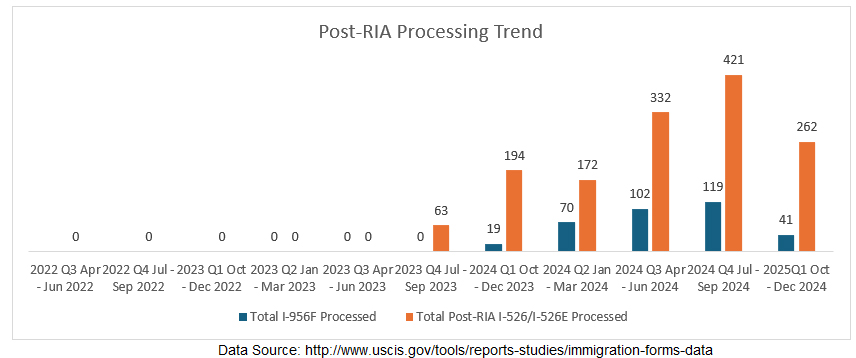
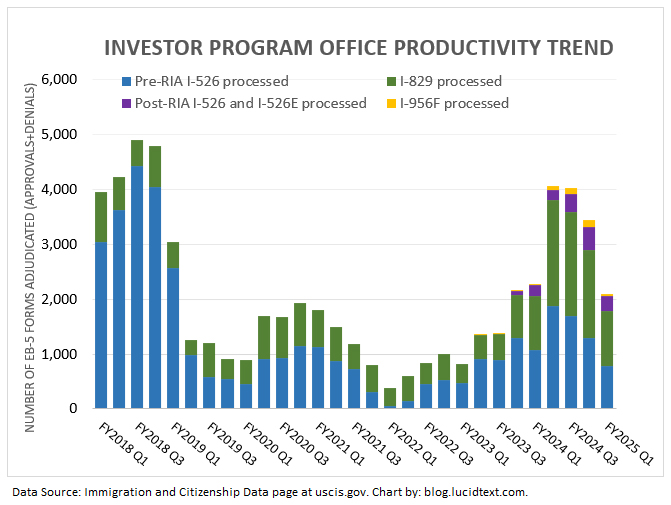
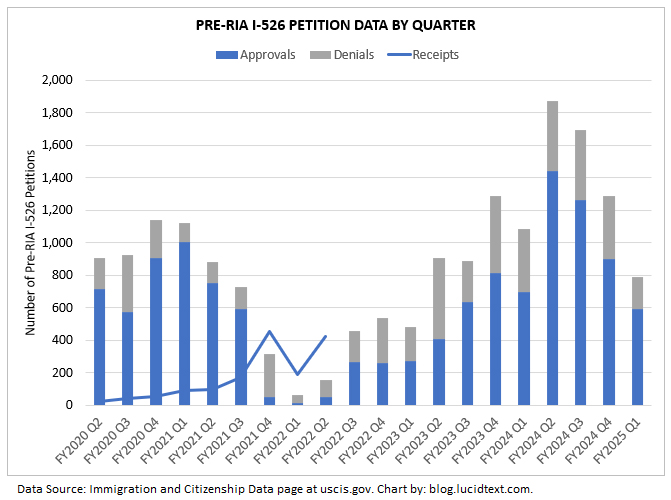
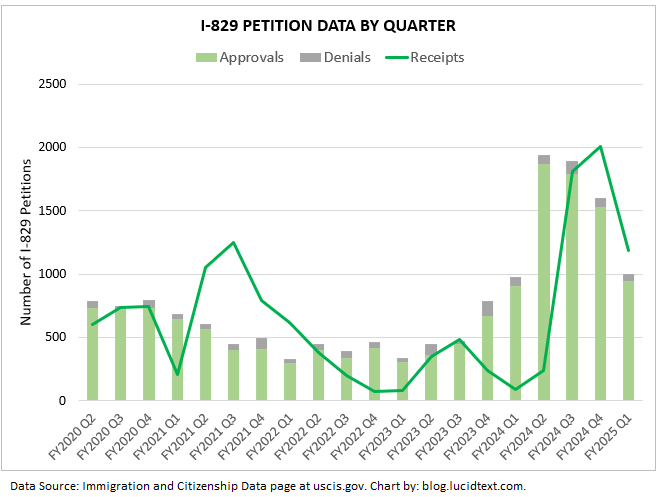
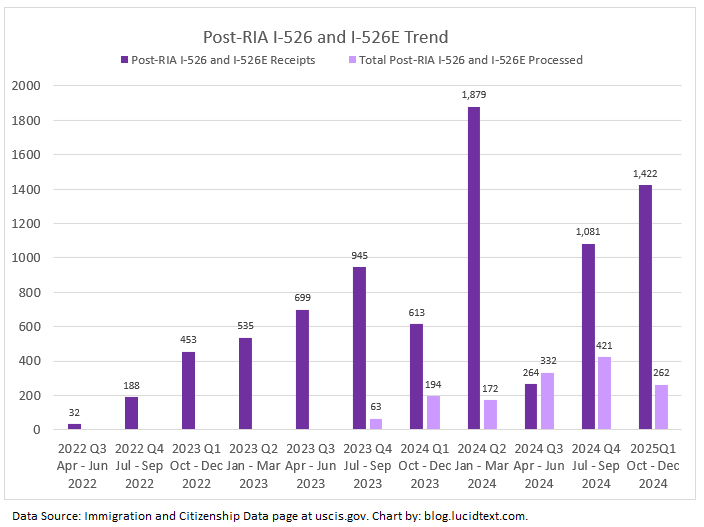
And now, the USCIS Immigration and Citizenship Data page has finally published performance data for the first quarter of FY2025 (October to December 2024). The data shows a strong start to implementing the new administration’s immigration agenda. Last time around, it took two years for USCIS staffing and policy changes to translate into sluggish EB-5 form processing. This time, IPO preemptively cut its processing productivity in half even before the inauguration. Maybe October to December was an aberration, with no political connection and no trend to worry about. But at least for the one quarter, every EB-5 form suffered. I had expected USCIS to start shifting more resources to I-526E, given the visa urgency and dwindling I-526 workload, but this did not happen through the end of last year. Meanwhile, as previewed in AIIA’s data by country and TEA category, I-526E filings continued to shoot up through the end of 2024.

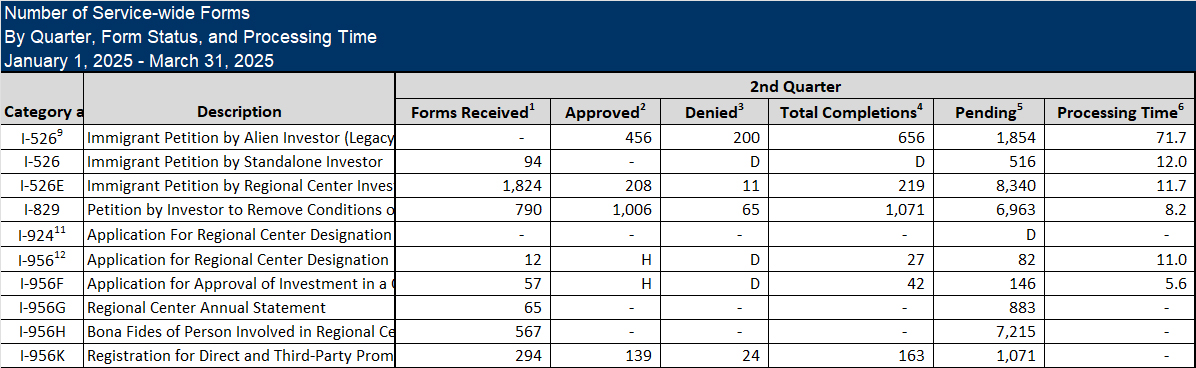
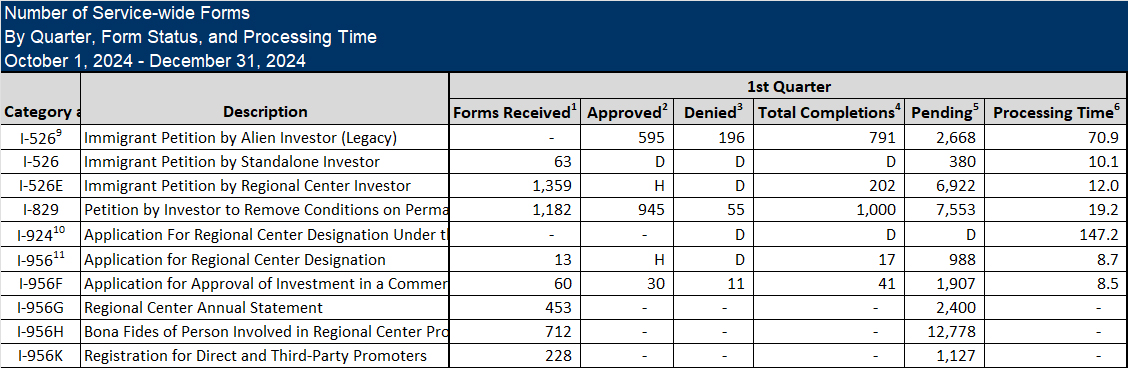
The FY2025 Q1 report is notable for including, for the first time, median processing times for post-RIA I-526 and I-526E.

Be cautious in interpreting the Processing Time number, which is not necessarily predictive! Footnote 6 to the Processing Times column explains: “Processing times are defined as the number of months it took for an application, petition, or request to be processed from receipt to completion in a given time period. The number of months presented is the median which is the time it took to complete 50% of all the cases processed in the quarter.” I’m very happy for the 50% of recently-completed I-526E that experienced a processing time of less than 12 months. However, 50% of the 202 completions in FY25 Q1 is just 101 forms — barely 1% of the inventory. How long will it take to process the 6,922 I-526E that remained pending at the end of last quarter? If USCIS kept going at the FY25 Q1 processing pace, then it would take 6,922/202=34 quarters=8.6 years. In order to get through the pre-2025 I-526E inventory in 12 months from now, USCIS would have to increase quarterly I-526E processing volume to 6,922/4=1,730 completions. On the other hand, the reported median processing time of 19.2 months for I-829 may be reasonably predictive, so long as USCIS can keep processing the I-829 inventory (7,553 at last count) at a rate of at least 1,000 completions per quarter.

New I-526E Data to January 2025

And now, we finally know what’s been happening with EB-5 demand and I-526/I-526E adjudications since mid 2024. See AIIA FOIA Series: Updated I-526E Inventory Statistics for January 2025. Thank you to AIIA, Galati Law, and the Freedom of Information Act! USCIS has not published any EB-5 data since September 2024, so we welcome this trove of new information about I-526 and I-526E receipts, approvals, and denials by country and TEA category through January 2025.

I will shortly revise my backlog analysis to incorporate this new information. My previous analysis made optimistic wait time estimates based on optimistic assumptions: that future EB-5 demand would remain at the level documented as of mid 2024, and that USCIS and Department of State processing would allow issuing available visas. My revised analysis must now downgrade these estimates. We now know that in fact, EB-5 demand shot up through the beginning of 2025, while processing volumes remained quite low.

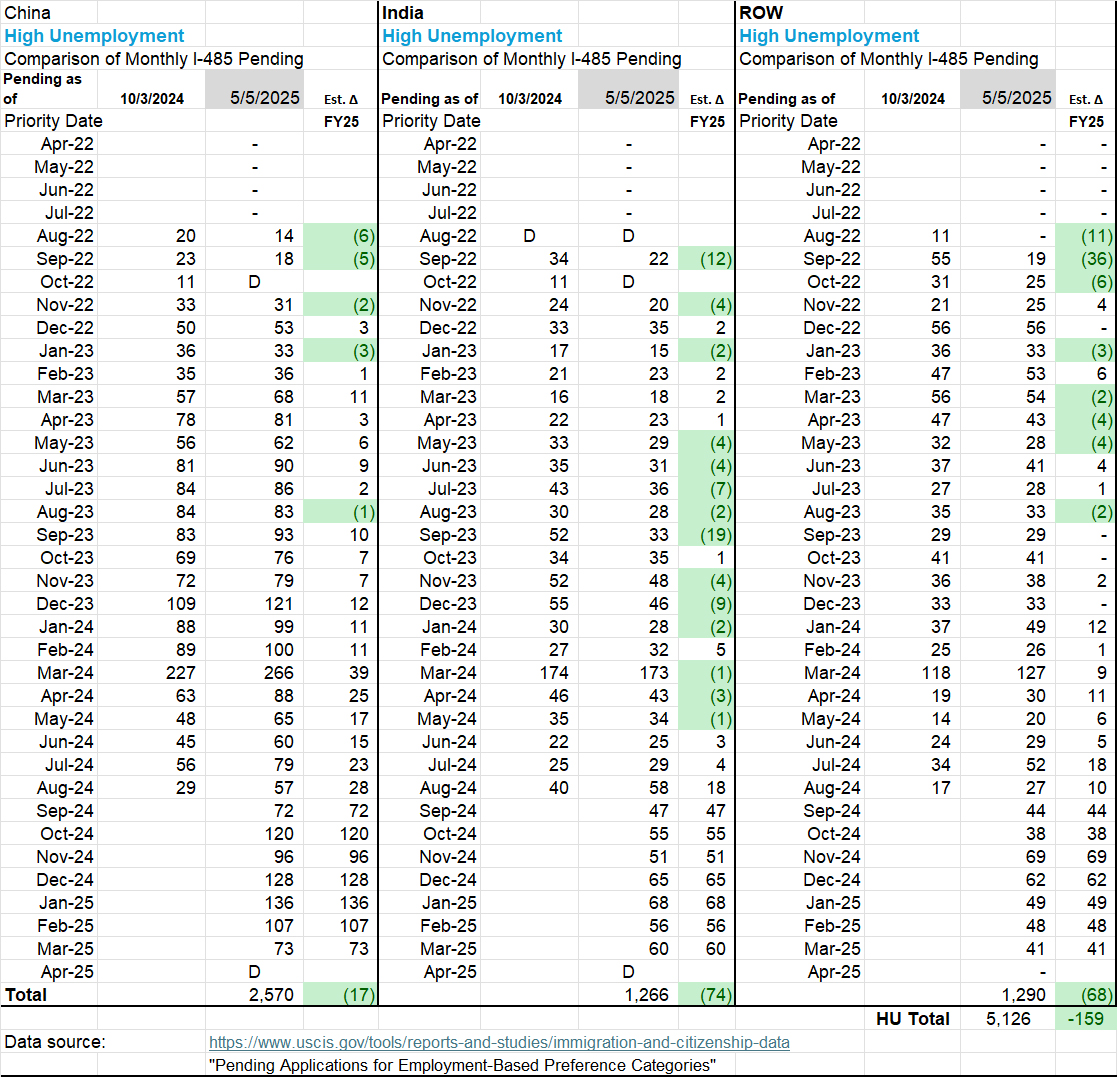
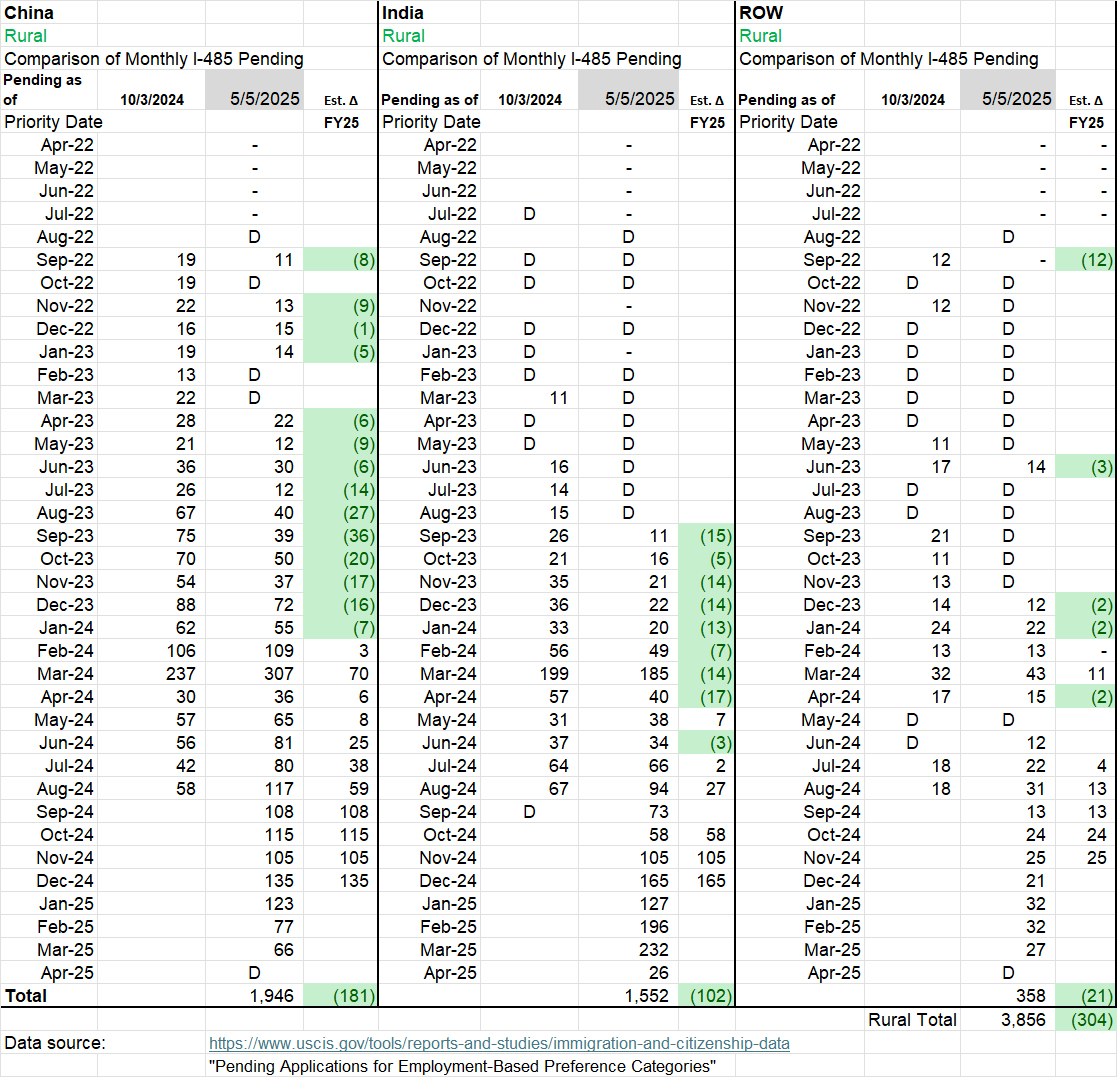
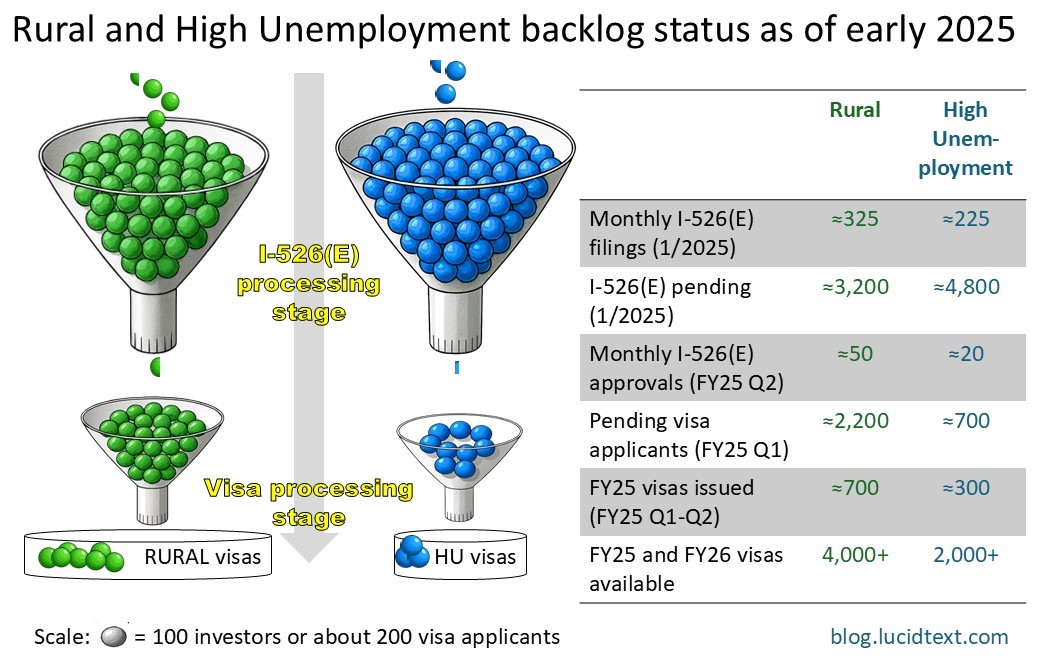
The AIIA FOIA showed that “only 351 HUA and 1,126 rural petitions have been approved as of January 2025.” That’s likely too low for a year with 2,200 HUA and 4,400 rural visas available, and considering that visa interviews take months to schedule. If there aren’t enough applicants to claim available FY2025 set-aside visas, that means that the visa bulletin gets to stay “current” for a longer time (good news for concurrent filing), but some set-aside numbers will be permanently lost, Rest of World applicants will get more time to accumulate and crowd out China/India applicants, and expected visa wait times will lengthen.

Meanwhile, the AIIA FOIA showed the count of filed investor petitions reaching 5,191 High Unemployment and 4,329 Rural by the end of January 2025. That’s conservatively 10-11x annual HU visa availability and 4-5x annual Rural visa availability (considering that these investors may get I-526E approval and be joined by spouses and/or children to claim visas). Those are fearsome queues to enter the back of, for a new investor today. If a 2025 High Unemployment investor gets a visa in less than 10 years or a Rural investor gets a visa in less than 5 years, it will be thanks to country caps (allowing minority country investors to move ahead of earlier priority dates from China and India) and the possibility of category-switching (with Unreserved being an alternate lane as congestion builds in the TEA lanes.) I’m now anxious to get updated information on the pre-RIA backlog for Unreserved visas, to better assess Unreserved visas as a potential fallback for new HU and Rural investors.

Regional Centers will want to grapple with the fact that the coming 10+ years of HU visas and 4+ years of Rural visas have already been sold, even as a significant Unreserved backlog remains. Unless and until visa relief is possible, what’s left to offer is a chance for Rest-of-World EB-5 investors to cut the queue in front of earlier but cap-limited China-born and India-born investors. Keeping the “immigrant” in “immigrant investment” will require hard work for visa relief.

EB-5 visa issuance in February 2025

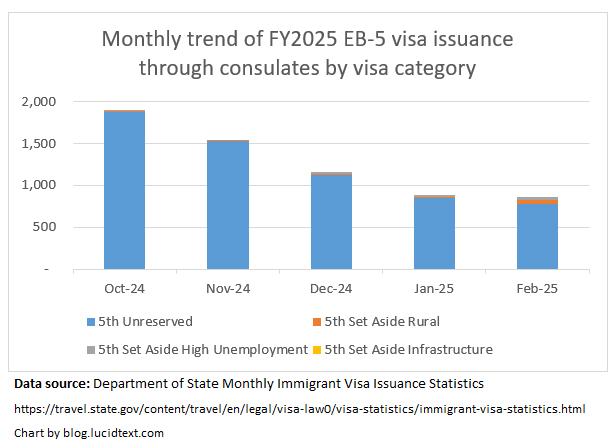
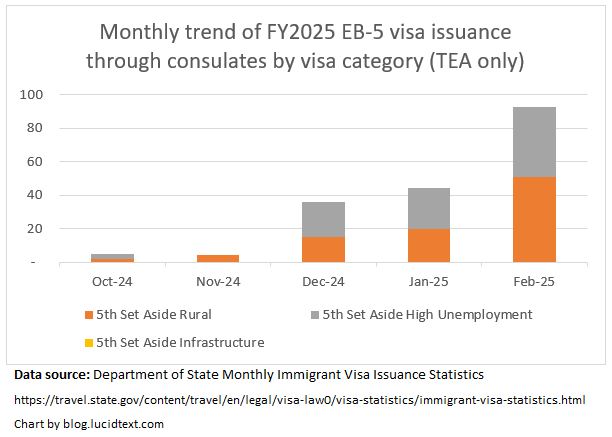
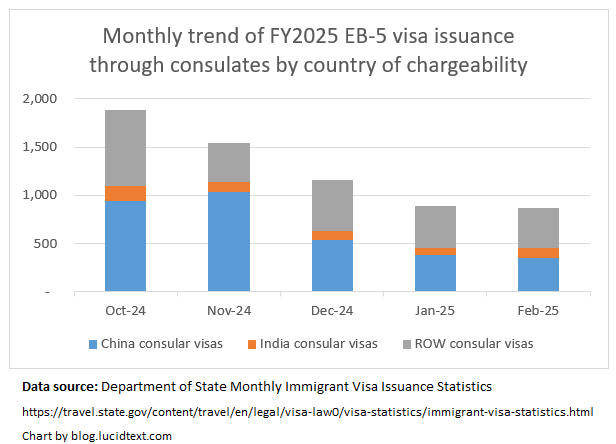
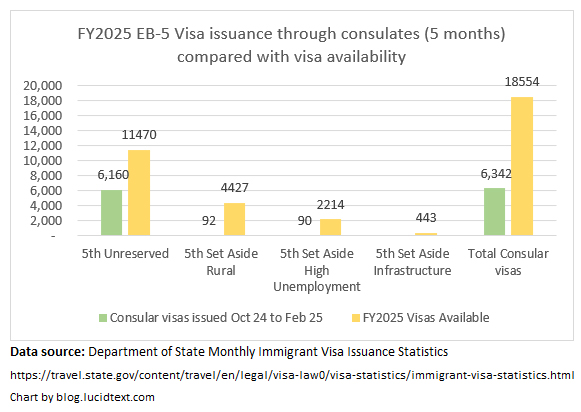
Finally a bit of data to report: Department of State has added Monthly Immigrant Visa Issuance statistics for consular processing in February 2025. I made a few charts to highlight EB-5 numbers.

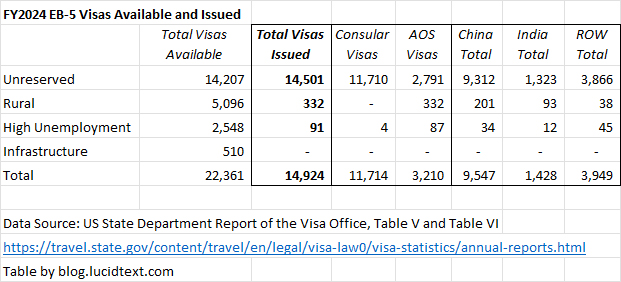
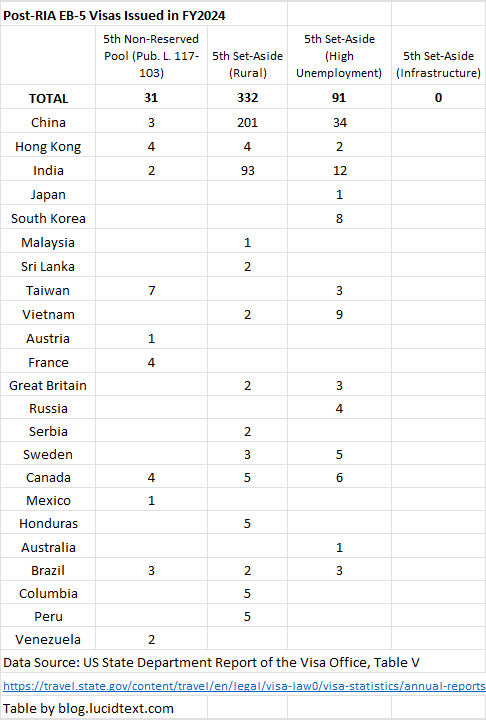
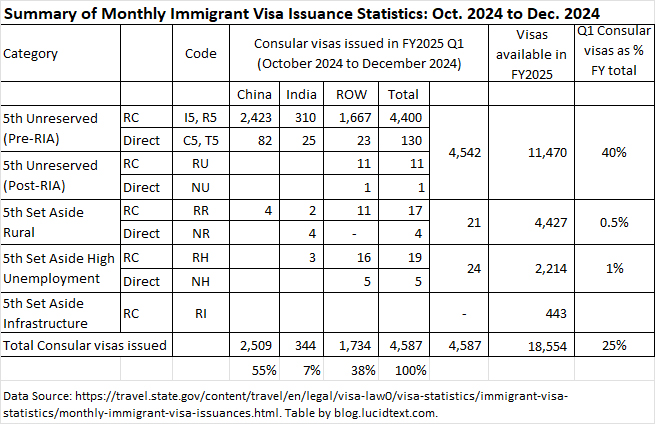
February data shows set-aside visa issuance continuing to pick up steam but very gradually, with visa issuance still extremely low in context of set-aside visas available this year. If this trend continues, then I guess that Rural and High Unemployment visa supply may not be maximized this fiscal year, and thus Rural and High Unemployment may not get visa bulletin dates this year. I may revise this guess if and when USCIS ever starts reporting data again for I-526E approvals (indicating how many people are potentially qualified for visas) and I-485 approvals (indicating the number of visas being allocated through status adjustment). USCIS 2025 data reports are now very delayed, but I keep checking — hoping that the USCIS Office of Performance and Quality still exists! Also waiting on the delayed 2024 NVC waitlist report. If set-aside visa issuance remains low throughout FY2025, that would be good news for the concurrent filing window, and bad news for the pipeline backlog — especially for applicants from China and India who depend on getting through the visa gate as soon as possible before more rest of world applicants have a chance to get I-526E approvals. Actual visa wait times could be worse than calculated in my EB5 Backlog Analysis model in case of low set-aside visa issuance. (I’ll revise the entire model when the next USCIS and NVC reports finally come out.)

Looking at Unreserved visa issuance through consulates, I note that Department of State remains on track to issue all Unreserved visas available for the fiscal year. Good! But the rate of Unreserved visa issuance to rest-of-world countries did not increase in February — as I think it should have, given that ROW applicants are so numerous that DOS might even have to impose a ROW Unreserved a cutoff date this year (according to the April 2025 visa bulletin note). A number of consulates seem to be having problems with scheduling EB-5 interviews — for example in Nigeria, which has many EB-5 applicants but no EB-5 interviews at all this year. Can consulates be given a push to act on EB-5 cases? On the bright side, low EB-5 visa issuance to ROW meant that China-born applicants were able to continue to pick up “otherwise unused” Unreserved visas in February.

In other news, IIUSA has posted a letter from their lobbyist on advocacy efforts.

Second Joint Status Report in Sustainment Litigation

George Orwell defined an important political skill called doublethink: “To know and not to know, to be conscious of complete truthfulness while telling carefully constructed lies, to hold simultaneously two opinions which cancelled out, knowing them to be contradictory and believing in both of them…” This skill is adaptive in many situations these days, including for the EB-5 sustainment litigation IIUSA vs. DHS et al. (previously discussed here).

The second Joint Status Report in the sustainment litigation has now been released. In JSR2, IIUSA asks the Court for a ruling that would apparently revert to the legacy sustainment period tied to an investor’s conditional residency. IIUSA has shared JSR2 in a blog post that states: “Once again, IIUSA reaffirmed that we do not support reverting to a sustainment period tied to an investor’s conditional residency.”

Let’s take a look at JSR2, starting with the first paragraph:

The parties continued to discuss a potential resolution of this matter but have been unable to reach agreement. Plaintiff respectfully requests that the Court resolve the pending motions before it; Defendants respectfully request that the Court hold the case in abeyance while Defendants engage in rulemaking that will resolve this litigation within the estimated timeframe as described below.

Here USCIS (Defendant) is requesting what IIUSA (Plaintiff) had offered in the first JSR – to hold the lawsuit in abeyance pending rulemaking. Abeyance could be an effective strategy to avoid falling back on legacy CPR sustainment period, because abeyance would close the gap between ruling (which could simply void the post-RIA change, if the Court rules as IIUSA had suggested) and rulemaking (which could define a modified new sustainment rule). When IIUSA first offered abeyance in JSR1, I had thought that that IIUSA truly wanted to avoid near-term reversion to the legacy sustainment policy.

But in JSR2, IIUSA declines to accept litigation abeyance because rulemaking can take a long time. USCIS was able to offer a start date for the rulemaking process (November 2025), but not a completion date. IIUSA explains that they do not want the lawsuit to be held in abeyance until rulemaking because that would mean “no change in the status quo between now and then” and thus “no relief in connection with bringing this lawsuit.” Apparently, Plaintiff is primarily fighting for a profitable change to the status quo EB-5 sustainment requirement. Plaintiff does not want to have to wait for a change for as long as it could take to make via the proper notice-and-comment rulemaking process that it had claimed to be fighting for.

IIUSA rests its case by asking the Court to “resolve the pending motions before it.” I assume that means asking the Court to sign off on IIUSA’s [Proposed] Order on Summary Judgment, whose content is simply to order “that USCIS’s action changing the investment sustainment period for EB-5 immigrant investors is vacated, held unlawful, and set aside.” I further reason that the single action of vacating a change puts us back to the sustainment period that existed before the change.

On the other hand, the USCIS side of JSR2 does argue against reverting to legacy sustainment period. First, because stakeholders would predictably react to the unfairness. As USCIS contends:

Applying regulatory requirements based on the pre-amendment version of the INA to investors who filed petitions for classification after the enactment of RIA and amendment of the INA would result in such investors also having investment sustainment periods with unknown future end dates based on uncontrollable variability in visa availability despite the plain language of the post-amendment version of the INA, and would expose Defendants to significant risk of litigation from such investors with potentially contrary judicial rulings.

Secondly, there is some “fact of the matter” here. RIA did make statutory changes, however one interprets the language. The USCIS portion of the JSR concludes:

4. In the event the Court does not hold this case in abeyance, Defendants are amenable to revising the existing website guidance to restate the statutory changes and amendments to the INA made by the RIA. This would also resolve Plaintiff’s claims to the extent that anything in the existing guidance goes beyond a mere restatement of applicable statutory provisions.

How can regional centers and investors deal with the uncertainty created by litigation challenges to USCIS guidance? I wish I knew. It’s so material for deal-planning, structuring, marketing, management, and investing to have a ballpark idea of how long EB-5 funds need to stay invested. I don’t know when and how this open question will be resolved. I sincerely regret the reputational damage that this lawsuit has caused for IIUSA, which occupies such an important place in the industry and needs a strong, respected, and unifying voice. And I’m ashamed of the regional centers who chose not to sue in their own names or own their support for this shameful and compromising if very profitable effort, but using IIUSA as a mask to push it forward.

Set-aside visa issuance and demand

As someone alarmed by the EB-5 set-aside visa pipeline backlogs already accumulated as of 2024, I have had two hopes for 2025: high set-aside visa issuance and reasonably low new I-526E filings. I want to see as many as possible rural and high unemployment visas issued this year, taking a maximum bite from the backlogs, and I don’t want to see the timing outlook worsen considerably. But the reality seems to be otherwise. It appears that the Trump administration’s threats to EB-5 have not dampened but are actually spurring new EB-5 demand — contradicting my guesses from a couple weeks ago. And the latest published monthly visa issuance data (as of January 2025) shows set-aside visa issuance remaining extremely low, at least through consulates. The following chart illustrates the numbers informing my current impression that new EB-5 set-aside investors in coming months can likely still expect a “current” visa bulletin (due to distance between FY2025 visa availability and visa issuance so far) but may also face a dire wait for a visa number (due to distance between pipeline applicants and forthcoming visa availability overall). It’s so tough to make educated decisions when the visa situation is so dynamic, and lacking real-time data, but I keep trying to keep a sense of the big picture in view.

EB-5 Retrogression in April 2025 Visa Bulletin

The April 2025 Visa Bulletin has retrogressed the EB5 Unreserved Final Action Dates for China and India, and concludes with a note indicating that Rest of the World Unreserved may also get a final action date this year.

E.  RETROGRESSION OF EMPLOYMENT-BASED FIFTH PREFERENCE (EB-5) UNRESERVED FINAL ACTION DATES FOR CHINA AND INDIA 

Increased demand and number use by China and India in the EB-5 unreserved visa categories, combined with increased Rest of World demand and number use, made it necessary to retrogress the final action dates to hold number use within the maximum allowed under the FY-2025 annual limits.  Please note that it may also become necessary to establish a final action date for Rest of World countries if demand and number use continues to increase. This situation will be continually monitored, and any necessary adjustments will be made accordingly.

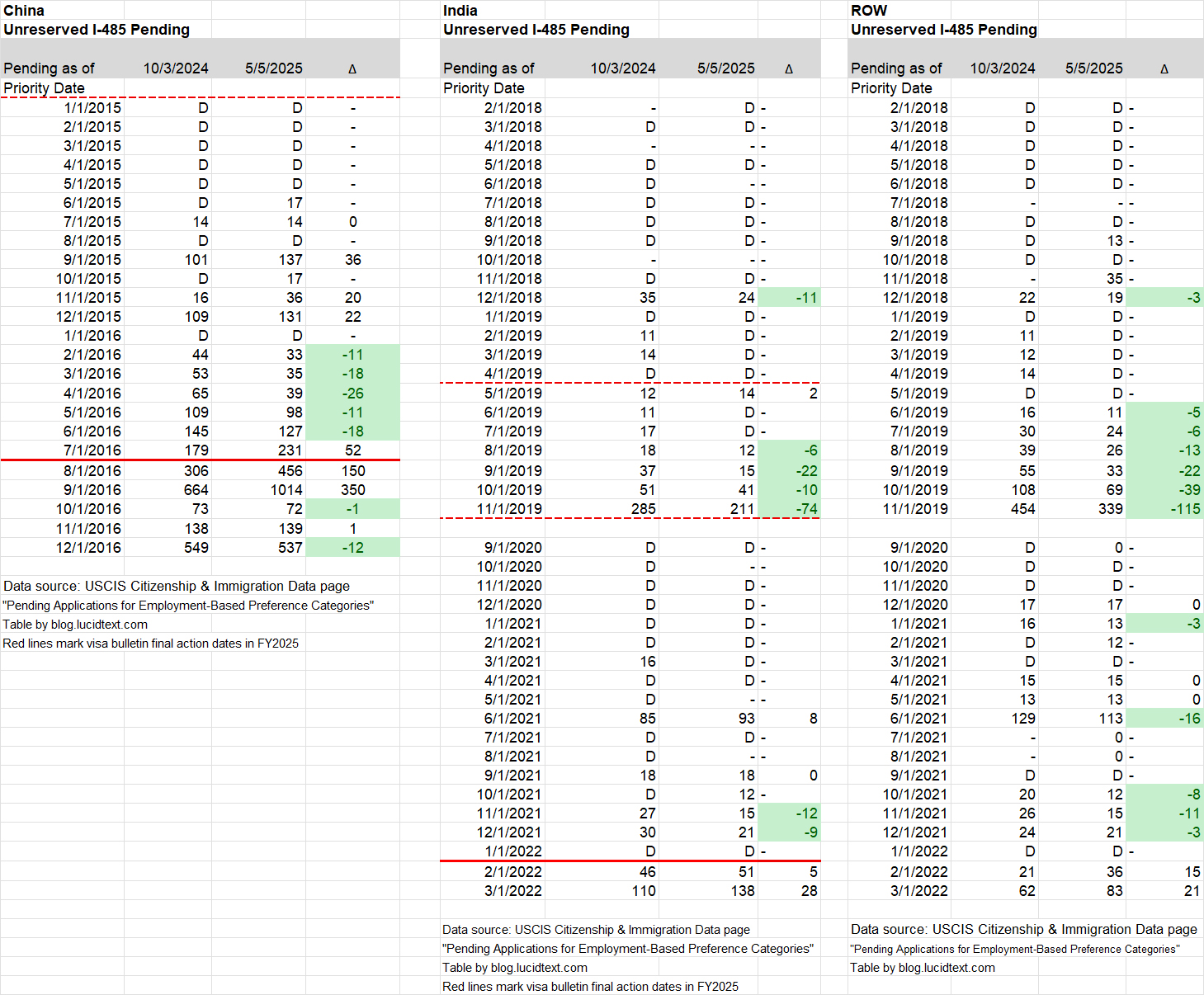
I read this announcement as good news for Unreserved visa wait times overall, since it means that the process is working efficiently. When I expected the process to work inefficiently, I thought that USCIS would slow-walk rest-of-world petition processing and consulates would slow-walk visa issuance, with the result that the visa bulletin would not need to move to add an extra constraint. Now I see that the visa bulletin is having to jump for Unreserved, which tells me that DOS has apparently already efficiently issued most EB-5 Unreserved visas available this year to China and India, while USCIS and NVC are maximizing the number of Rest of World applicants able to claim visas. ROW could only reach a limit this year if DOS manages to issue more ROW EB-5 visas this year than it ever has in the past. The more ROW visas issued this year, the fewer ROW applicants left for next year, so maxing out ROW visas this year would be good for ROW. However, high ROW visa demand directly corresponds to limits on China, so Chinese EB-5 applicants may receive thousands fewer visas this year than I had hoped.

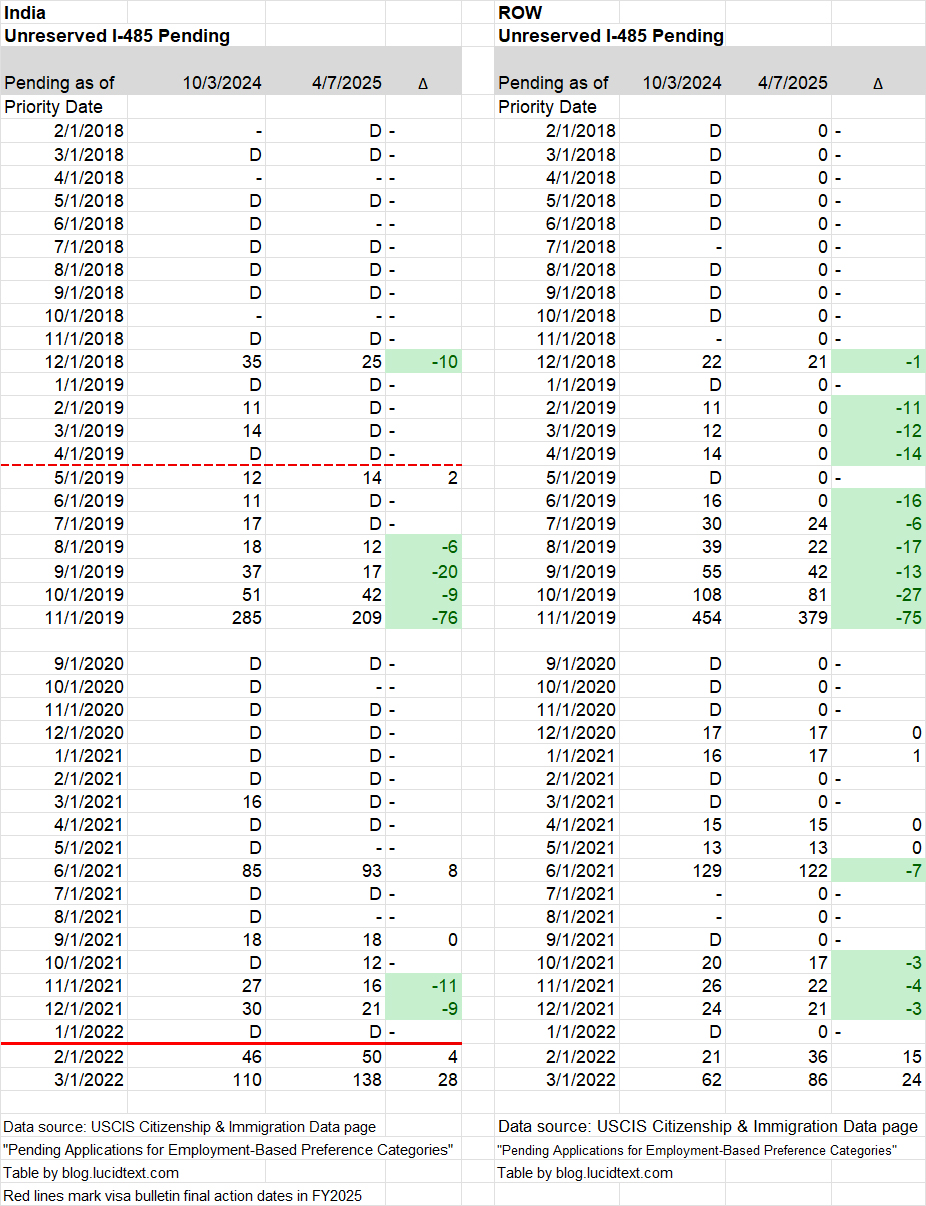
As a reminder, I have estimated at least 8,100 pre-RIA ROW applicants in the pipeline for EB-5 Unreserved visas. This is greater than the number of visas remaining to ROW in FY2025 (given the 11,470 Unreserved visas available in FY2025, of which China has already absorbed over 2,500 and India can claim 803 under country caps). The ROW queue for Unreserved visas may also be expanded by post-RIA ROW investors fleeing from High Unemployment and Rural backlogs. Though this flight may be reversed, if and when ROW Unreserved gets a final action date while set-aside categories remain “Current.” (For earlier predictions of future visa bulletin movement for China and India, calculated as a function of demand/supply balance, see the “Pre-RIA China” and “Pre-RIA India” tabs in the EB-5 Visa Supply and Demand Analysis workbook linked to the EB-5 Timing page. I may now need to revise the Pre-RIA China tab with a more pessimistic estimate based on assuming more ROW visas/fewer China visas in FY2025.)

The April 2025 Visa Bulletin does not include a corresponding note for the EB-5 Set Aside categories, which suggests that USCIS and DOS are not working as efficiently to advance and issue visas to the High Unemployment and Rural backlogs.

I look forward to what the next Chatting with Charlie webinar has to say about the April Visa Bulletin.

(In other news, the spending bill to fund the government past March 15 appears to be not, after all, a potential vehicle for a new “Gold Card” or EB-5 changes. The House Appropriations Committee released a draft of the The Full-Year Continuing Appropriations and Extensions Act, 2025 on Friday, emphasizing that it contains “no poison pills or unrelated riders – the bill is simple: extend funding and certainty for the nation.”)

Joint Status Report in sustainment lawsuit

7/30 UPDATE: See Good news (CIS Ombudsman, Sustainment litigation, good faith investor litigation, FOIA on Security Checks)

— ORIGINAL POST —

I am happy to see that the February 27 Joint Status Report in the IIUSA sustainment lawsuit addresses the issues that I raised last month. The JSR did not conclude with agreement — IIUSA and USCIS now have a March 21 deadline to try again. But IIUSA took care in its side of the February 27 JSR to speak to industry concerns.

To address concerns about rulemaking delay and negative effects on the market, IIUSA proposes holding the sustainment lawsuit in abeyance pending USCIS rulemaking. If it were practically possible, this could allow jumping straight from the current USCIS interpretation to a new sustainment rule – leaving no gap to be stuck with the legacy sustainment regulation. IIUSA suggests that post-RIA investors prior to the settlement could “receive the benefit” of USCIS policy at the time, while investors after the settlement would be subject to the concurrently-finalized new regulation. “While IIUSA does not believe that this [the current USCIS] policy is lawful because of the way in which it was adopted, IIUSA has no interest in disrupting the interests of investors who relied in good faith on the USCIS policy.”

In its side of the JSR, USCIS did not comment on its ability to give investors benefit from pre-existing policy if the court ultimately chooses, as IIUSA had requested, to vacate and hold that policy unlawful. USCIS did respond to concerns about rulemaking timing, stating that “USCIS considers this matter to be a regulatory priority at this time and does not anticipate rule promulgation to take several years.” New regulations to fully implement RIA are in progress, but USCIS was unable to promise IIUSA a specific “limited timeframe” for completion. “In light of the recent change in administration, USCIS requires additional time for its new leadership to review the proposed regulations, familiarize themselves with this litigation, and assess the appropriate next steps for the regulatory process.” To put it mildly.

What are we trying to accomplish? IIUSA states in the JSR that “IIUSA ultimately wishes for a sustainment rule that would mirror the intent of Congress, as clearly articulated expressed by the co-sponsors of the RIA in their letter to USCIS Chief Emmel dated February 2, 2024.” The IIUSA statement refers to a letter by Representatives Greg Stanton and Brian Fitzpatrick – who claim in their letter to be “lead authors” of RIA. As it happened, Senators Grassley and Leahy were RIA’s lead authors while Stanton and Fitzpatrick co-sponsored a companion bill mirroring the Grassley/Leahy bill in the House. But in any case, IIUSA filed the 2024 Stanton/Fitzpatrick letter with the Court, and this letter calls for “a fair and reasonable investment holding period, a minimum of at least five years, for all EB-5 investments made at any time after March 15, 2022, when RIA became law.”

How likely is new USCIS rulemaking to land on the five-year minimum sustainment rule that is IIUSA’s “ultimate wish”? Such a rule could be nice for good projects, but could USCIS make it? How could USCIS require a fixed minimum investment period greater than USCIS’s minimum period of oversight over the EB-5 process? As designed by Congress, the minimum EB-5 process is less than three years from inception to filing of the last petition. RIA defined processing time goals of less than a year for I-526E, I-526E approval is followed by a visa with two-year conditions, and I-829 is filed in the final three months of conditional residence. How could USCIS require or enforce five-year minimum holding periods if USCIS may get its last review of an EB-5 case in as little as three years from the time of investment? As EB-5 users, we have to count on the realistic likelihood of processing delay and visa delay extending the immigration process far beyond that base three years for many investors. But how could USCIS formulate a policy predicated on the assumption that USCIS will never reach processing time goals, and that Department of State will not have or be able to issue timely visas.

The goal of sustainment litigation is worth rethinking. I concluded my last post on the lawsuit by fearing that the only possible win could be for anyone “looking forward to cashing in on visa backlogs and slow USCIS rulemaking to help keep that money beyond expected timelines.” But IIUSA protests in the February 27 JSR that it seeks no such win. In case of slow USCIS rulemaking: “IIUSA would receive no relief—nothing at all—in connection with bringing this lawsuit.” On that basis, if USCIS proves unable to offer a limited rulemaking timeline, then IIUSA should naturally want drop the lawsuit. IIUSA could still celebrate a win in having brought USCIS to public commitment in the February 27 JSR to — at least — prioritize new EB-5 regulations, subject to administration approval.

Trump Gold Card transcripts

The Trump administration has put immigrant investment in the spotlight and crosshairs, with discussions in the Oval Office yesterday and at a cabinet meeting today that talked up a potential new “Gold Card” immigration path, and mentioned EB-5. You can go to social media and your favorite advisors to get “what does this mean for EB-5 investors” analysis and reassurance, and all the alarming new developments. (A few good articles so far: “Will the Gold Card be a Wrecking Ball for the EB-5 Industry” (March 2, 2025) by Matthew Galati and Halston Chavez in IMI Daily, and “Trump’s Gold Card Plan Has Benefits But Legal and Practical Obstacles” (February 26, 2025) by David Bier for Cato Institute.)

What I have done is to transcribe exactly what President Trump and Commerce Secretary Howard Lutnick have said in two events so far, for everyone’s reference. [With on-going updates as the topic continues to be discussed.]  

In the worst case that Congress believes in “Gold Cards” as a spending offset tool and hastily makes them law (reportedly possible as part of the budget reconciliation process) [UPDATE: but not in the draft released on March 8], then at least we’ll have a record of what was said, to hold our representatives to account. And in the best case that the preliminary ideas just introduced get more time to bake, the transcript sets an agenda of misconceptions to address, facts to correct, and objectives to support. The President’s remarks highlight immigration goals that are great points of departure for explaining what’s good about existing EB visa categories.

Reading the transcript, I note that the President and Secretary Lutnick are currently expressing different visions for immigrant investment. The President is focused on a Gold Card “green card for sale” idea, with a range of objectives from deficit reduction to helping companies employ talented young graduates. The President did not name or allude to EB-5 (at least in the meetings I transcribed so far). In fact the President spoke warmly about advantageous types of immigration that could be supported by his Gold Card, without seeming to realize that such good immigration is already happening under EB-1, EB-2, EB-3, and EB-5, only constrained by not enough visas to support it. Meanwhile the Commerce Secretary was negatively focused on EB-5, suggesting yesterday that EB-5 would be eliminated and replaced by the Gold Card, and today suggesting that EB-5 would be moved to his department, with contradictory statements on whether it would then be a project investment or a buy-a-green-card program. It wasn’t clear from either that the Gold Card and EB-5 are necessarily interrelated or mutually exclusive.

I could spend infinite time fact checking the following transcript – pointing out actual worldwide wealth and migration data, the Law of Demand, what’s in current immigration law, what EB-5 does and how tightly it’s regulated, the political and economic differences between EB-5 investment and buying a green card, the negative impact of other high-ticket gold card programs… But would it matter? Does the President need to put forward a Gold Card possibility and repeatedly say that there could be 1 to 10 million wealthy people eager to buy it, thus raising at least $5 trillion for the government, because his tax priorities are estimated to reduce revenue by at least $5 trillion? Does it matter that realizing the deficit elimination objective would require the participation of real aliens, since our planet only has about 600,000 ultra high net worth individuals ($30M+ net worth) and about 2.3 million people with $5M+ net worth, of whom over a third are already in the US? Perhaps the President has the number $5 million in mind because it’s reportedly what people are eager to pay for access to eat dinner with him. I note that top global migration expert Christian Nesheim is optimistic that a $5M Gold Card to the U.S. might get 100+ takers a year if accompanied by quick processing times — which would be $500 million in revenue as compared with the $3.9 billion in revenue generated by EB-5 last year by 4,848 investments at $800,000 each. (Also noting by the way that the real-life EB-5 wait line has five times fewer visa applicants — i.e. 10+ times fewer investors — than the 250,000 number that Secretary Lutnick made up on the fly.)

Before moving on to the transcript, I’d like to remind everyone of my PayPal link. If you benefit from articles like this and would like me to keep reporting and keep the work public, please consider a voluntary donation to support the blog.

Quoted from February 25, 2025 President Trump signs executive orders in the Oval Office

[Minute 24:38-30]

Media: Mr. President, there are approximately 2 million federal employees right now. At the end of your term, what do you expect that number to be? What would you like that number to be?

President Trump: It will be lower, but I can’t tell you. Everybody knows that I ran on downsizing government, but making government better. I ran on tariffs and making our country rich, and that’s what I’m going to do.

We’re going to be doing something else that’s going to be very very good. We’re going to be selling a gold card. If you have a green card, this is a gold card. We’re going to be putting a price on that card of about $5 million dollars, and that’s going to give you green card privileges plus it’s going to be route to citizenship. And wealthy people will be coming into our country by buying this card. They’ll be wealthy. And they’ll be successful. And they’ll be spending a lot of money and paying a lot of taxes and employing a lot of people.  We think it’s going to be extremely successful. Never been done before anything like this. But it’s something that we’re going to be putting out over the next, would you say, two weeks, Howard? Would you like to say something about it?

Media: Do you have to invest a certain amount of money in the country in order to qualify for that gold card?

President Trump: Yes, exactly.

Commerce Secretary Howard Lutnick: So the EB-5 program, was really, you lend some money, but it was all, it was full of nonsense, make believe, and fraud. And it was a way to get a green card that was low priced. So the President said rather than having this sort of ridiculous EB-5 program we’re going to end the EB-5 program. We’re going to replace it with the Trump Gold Card which is really a Green Card Gold so they’ll be able to pay $5 million dollars to the U.S. government. They’ll have to go through vetting of course, we’re going to make sure they’re wonderful world class global citizens. They can come to America. The President can give them a green card. And they can invest in America. And we can use that money to reduce our deficit. Why do we give out lotteries of green cards. Why do we give out EB-5 for green cards. The President of the United States understands that the right answer is “why don’t we eliminate the deficit of the United States of America instead.”

President Trump: The Gold Card will bring in with it people that create jobs, very high level people. I think companies will pay to get people in. Since you today graduate from the Wharton School of Finance or Harvard or Stanford or any college and nobody knows if you can even go to work for a company. So Apple and all these companies that want to get people to be working for them will be able to buy a card. And for the people that are number one in their class at top schools, I see that as one of things.

But generally speaking it will be people with money and people that create jobs. And they won’t have to pay any tax on income outside of the United States. Which they’re not paying right now, they’re not citizens. But they’ll have to pay if they create jobs in the United States – they’ll pay full taxes like everybody else. So you’re getting big taxpayers, big job producers. And we’ll be able to sell maybe a million of these cards, maybe more than that. And if you add up the numbers, they’re pretty good. As an example, a million cards would be worth $5 trillion dollars. $5 trillion.

Secretary Lutnick: Wow!!

President Trump: And if you sell 10 million of the cards, that’s a total of $50 trillion dollars. Well we have $35 trillion in debt – that would be nice. So we’ll see. But it could be great. Maybe it will be fantastic. We have it all worked out from the legal standpoint. It’s totally legal to do. It hasn’t been done before. It’s been done in many different forms. We give them away. Why should we give them away. We shouldn’t give them away. And I think it’s something very exciting. I think it’s potentially something that we’re all very excited about.

So it is a gold card. It is somewhat like a green card but a higher level of sophistication. It’s a road to citizenship for people, and essentially people of wealth or people of great talent, people of wealth pay for people of talent to get in. Meaning companies will pay for people to get in and to have long-term status in the country. I think that is something we are very, very happy about. You have anything to say about that?

Secretary Lutnick: Many other countries do this, by the way, including, of course your 51st state does that.

Media: The money is earmarked for deficit reduction?

President Trump: It may be earmarked for deficit but it actually could be more money than that. I mean if you did $10 million, you’d have $15 trillion left over. But generally it’s going to be paid down debt, yes.

Media: Do you need Congress for this?

President Trump: No, we don’t need Congress. Because we’re not doing citizenship, we’re doing the card. It’s a path to citizenship, a very strong path to citizenship. But we’re not doing citizenship – for that I would have to get Congress.

Media: And would all countries be eligible for this gold card?

President Trump: It depends. Countries largely. The people will be vetted very carefully.

… [Minute 34:17 – 36]

Media: Have you lifted any sanctions on Russia?

President Trump: No, we haven’t lifted any sanctions on anyone.

Media: Is that part of the negotiations?

President Trump: I guess it will be at some point, but right now we haven’t agreed to lift sanctions on anybody.

Media: That gold card, getting back to that. I’m fascinated by that.

President Trump: You should be fascinated. Your taxes will go down to nothing.

Media: Would a Russian oligarch be eligible for a gold card?

President Trump: Yeah, possibly! Hey, I know some Russian oligarchs that are very nice people. It’s possible.

Secretary Lutnick: Heh heh heh.

President Trump: They’re not quite as wealthy as they used to be.

Secretary Lutnick: Heh heh heh heh heh.

President Trump: I think they can afford 5 million dollars. A lot of people are going to want to be in this country. And they’ll be able to work and provide jobs and build companies and pay taxes. All of those things. It’s an incredible thing. This is the group who is the first to hear it. Nobody’s heard about it. Nobody’s ever thought about it. But we’ve been thinking about it very strongly over the last week. And I was going to announce it sometime next week, and I figured why not, we have a lot of cameras blazing right now, might as well do it now. We’ll have Caroline announce it the next time. No, it’s a great thing, the gold card. Remember the words, the gold card. Somebody said, can we call it the “Trump Gold Card”? I said “If it helps, use the name Trump, I’ll give it to you for free.”

Media: You probably just launched 10,000 stories. Do you want to elaborate a little more on what Russian oligarchs you know?

President Trump: I know. Isn’t it interesting how many stories we do tell? And they all turn out to be true.

Secretary Lutnick: Heh heh heh heh

President Trump: And they all turn out to be ultimately correct. Trump was right about everything. Do you have one of the “Trump was right about everything” hats? I’m going to give it to this gentleman. Get me one of those.

Secretary Lutnick: But they’re all going to be vetted. Everybody who comes in gets vetted, ok, they get vetted. So you gotta, you know…

Media: When does this begin?

Secretary Lutnick: We’re going to begin in two weeks.

President Trump: About two weeks. The sale will start in about two weeks.

Secretary Lutnick: Heh heh heh heh

Quoted from President Trump Holds First Cabinet Meeting of Second Administration (February 26, 2025)

[starting at about minute 20] [2/27 UPDATE: text now replaced from the transcript published by the White House in Remarks by President Trump before Cabinet Meeting]

Q    Mr. President.

Q    About the — the Trump gold card idea —

     THE PRESIDENT:  Yeah.

     Q    — that you unveiled yesterday.

     THE PRESIDENT:  I hope you liked it.  (Laughter.)

     Q    I await more information.  But the question is: Does this reflect a view, on your part, that the American immigration system has never been properly monetized as you feel it should be?
    

     THE PRESIDENT:  Well, not so much monetized.  It hasn’t been properly run.  I get calls from, as an example, companies where they want to hire the number one student at a school.  A person comes from India, China, Japan, lots of different places, and they go to Harvard, the Wharton School of Finance.  They go to Yale.  They go to all great schools.  And they graduate number one in their class, and they are made job offers, but the offer is immediately rescinded because you have no idea whether or not that person can stay in the country.  I want to be able to have that person stay in the country. 

     These companies can go and buy a gold card, and they can use it as a matter of recruitment. 

     At the same time, the company is using that money to pay down debt.  We’re going to — we’re going to pay down a lot of debt with that.

     Q    Are they going to have to —

     THE PRESIDENT:  And I think the gold card is going to be used by — not only for that.  I mean, they’ll be used by companies.  I mean, I could see Apple — I’ve spoken with Tim Cook — and, by the way, he’s going to make a $500 billion investment in the country only because of the results of the election and, I think, because of tariffs.  He’s going to want to be in the country because of tariffs.  Because if you’re in the country, there is no tariff.  If you’re out of the country, you got to pay tariffs.  And that’s going to be a great investment, I think, that he’s making.  I know it’s going to be a great investment. 

     But we have to be able to get people in the country, and we want people that are productive people.  And I will tell you, the people that can pay $5 million, they’re going to create jobs.  They’re going to spend a lot of money on jobs.  They’re going to have to pay taxes on that too.  So, they’re going to be hiring people, they’re going to be bringing people in and companies in.  And, I don’t know, maybe it will sell like crazy.  I happen to think it’s going to sell like crazy.  It’s a bargain.

     But we’ll —

     Q    Will they have to commit to a certain number?

     THE PRESIDENT:  — know fairly soon.  I think Howard and — and Scott — a few of you, really, are responsible for it.  But, Howard, if you want to discuss that for a couple of minutes, I think I’d like to have you.  I think it’s going to be a very successful program.

     SECRETARY LUTNICK:  Sure.

     THE PRESIDENT:  This is Commerce.

     SECRETARY LUTNICK:  So, the EB-5 program, which has been around for many years, had investment of a million dollars into projects in America.  And those projects were often suspect, they didn’t really work out, there wasn’t any oversight of it.  And so, for a million-dollar investment, you got a visa, and then you came into the country and ended up with a green card. 

     So, it was poorly overseen, poorly executed.  Then you had our border open, where millions of people came through. 

     So, the idea is we will have a proper business.  We will modify the EB-5 agreement.  Kristi and I are working on it together.  For $5 million, they’ll get a license from the Department of Commerce.  Then they’ll make a proper investment on the EB-5, right?  And we think Scott and I will design the EB-5 investment model, because Scott and I are the best people together to do that.  So, this is joint. 

     This is exactly the Trump administration.  We all work together.  We work it out to be the best.  And if we sell — just remember — 200,000 — there’s a line for EB-5 of 250,000 right now — 200,000 of these gold green cards is $1 trillion

to pay down our debt, and that’s why the president is doing it, because we are going to balance this budget, and we are going to pay off the debt under President Trump. 

     Q    Mr. —

Q    And to qualify, do you have to promise and make commitments to create a certain number of jobs here in the U.S.?

     THE PRESIDENT:  No.  No.  Because not all these people are going to be job builders.  They’ll be successful people, or they’ll be people that were hired from colleges, like — sort of like paying an athlete a bonus.  I mean, Apple or one of the companies will go out and they’ll spend five mil- — they’ll buy five of them, and they’re going to get five people. 

     Look, I’ve had the complaint where — I’ve had the complaint from a lot of companies where they go out to hire people, and they can’t hire them b- — out of colleges.  And you know what they do?  They go back to India, or they go back to the country where they came, and they open up a company, and they become billionaires.  They become — and they’re employing thousands and there are a lot of examples. 

There are some really big examples where they were forced out of the country.  They graduated top in their class at a great school, and they weren’t able to stay.  This is all the time you hear it. 

And the biggest complaint I get from companies, other than overregulation, which we took care of, but we’re going to have to take care of it here, because a lot of that was put back on by Biden.  But the biggest complaint is the fact that they can’t have any longevity with people.  This way, they have pretty much unlimited longevity. 

Also, with the $5 million, you know, that’s a path to citizenship.  So, that’s going to be — it’s sort of a green card-plus, and it’s a path to citizenship.  We’re going to call it the gold card.  And I think it’s going to be very treasured.  I think it’s going to do very well.  And we’re going to start selling, hopefully, in about two weeks.

Now, just so you understand, if we sell a million — right? — a million, that’s $5 trillion.  Five trillion.  Howard was using a different number, but that’s $5 trillion.  If we sell 10 million, which is possible — 10 million highly productive people coming in or people that we’re going to make productive — they’ll be young, but they’re talented, like a talented athlete — that’s $50 trillion. 

That means our debt is totally paid off, and we have $15 trillion above that.  And — now, I don’t know that we’re going to sell that many.  Maybe we won’t so many at all.  But I think we’re going to sell a lot, because I think there’s — there really is a thirst. 

No other country can do this, because people don’t want to go to other countries.  They want to come here.  Everybody wants to come here, especially since November 5th.  (Laughter.)

(Cross-talk.)

SECRETARY LUTNICK:  They’ll all be vetted, by the way.  All these people will be vetted. 

Q    How?

SECRETARY LUTNICK:  Okay?  They’ll be vetted.

Q    On the gold cards, sir.  Can you talk a little bit more about the vetting process, you know —

THE PRESIDENT:  They’ll go through a process.  The process is being worked out right now, and we’re going to be — we’re going to be very careful. 

Q    And will there be restrictions on, for instance, can Chinese nationals get one? 

THE PRESIDENT:  No, we’re not going to restrict. 

Q    Can Iranian nationals get —

THE PRESIDENT:  We’re probably not going to be restricting too much in — in terms of countries, but maybe in terms of individuals.  We want to make sure we have people that love our country and are capable of loving the country.

Q    Is there a process, sir —

Q    Mr. President, there is a measles outbreak in Texas at the moment in which a child is reported to have died.  Do you have concerns about that?  And have you asked Secretary Kennedy to look into that outbreak? 

THE PRESIDENT:  Well, why don’t we — Bobby, do you want to speak on that, please?

Interview of Commerce Secretary, Howard Lutnick by Fox News chief political anchor Bret Baier on February 26, 2025

Baier: Commerce Secretary, Howard Lutnick, thanks for having us here at the Commerce Department.

Lutnick: Great to be with you.

Baier: How’d that cabinet meeting go today? First one!

Lutnick: It was so fun. We have such a great cabinet. There’s great camaraderie. The feeling is just fire. And this administration is winning. Every day it’s winning.

Baier: Let me talk about what you were talking about there the EB-5 program, which is gold, green cards, $5 million that essentially gets you a pathway to citizenship. Explain, first of all, how that came to be.

Lutnick: So there’s an EB-5 program that always had, if you invest in real estate or make a loan in America, you get a path to citizenship with a green card. And so the President had conversations over the weekend with his friend John Paulson, who came up and said, “Hey, why aren’t we doing better with that?” He called me. We talked about it, and I did work over the weekend, on Monday and on Tuesday, at a press conference, the President comes out and gives the path, which says, imagine if we sell a million of them, that’s $5 trillion and that pays off our debt, drives down interest rates and makes America amazing.

Baier: So the coverage of it, you know, Trump gold card to offer rich foreigners route to US citizenship for 5 million; Trump says us can pay off $36 trillion debt by selling wealthy immigrants $5 million gold card visas. And then Politico took another take: “Trump: I know some Russian oligarchs that are very nice people.” What do you say to people who say…

Lutnick: Come on….

Baier: Yeah, no, not about that. Are they going to be vetted?

Lutnick: First of all, of course, deeply vetted. And we said that from the first minute go. These are vetted people. These are going to be great global citizens who are going to bring entrepreneurial spirit, capacity and growth to America. If one of them comes in, think of the jobs they’re going to bring with them, the businesses they’re going to bring with them, and they’re going to pay American taxes as well. So this is huge money for America.

Baier: And how many people are waiting in this line currently?

Lutnick: So there are 250,000 people waiting in line. Now, if they’re willing to pay the 5 million, that’s over a trillion dollars. That comes directly to $1,250,000,000,000 just for that line. And I think these people are going to come enormous ways, because they know they can come into America, and they can be in the greatest country on Earth.

Baier: You’re kind of bullish when you talk about paying down the debt, and you said it again today in the Cabinet meeting, you truly believe that with this program, with DOGE, you can make this money all materialize and counteract a really skyrocketing deficit.

Lutnick: So if you go back to my Twitter feed, which I’m sure no one does, but October 14, when I recruited Elon and came up with the name DOGE, October 14, we agreed to balance the budget that he would take a trillion of expense out. Remember, we have just under $4 trillion of entitlements, but no one’s ever gone through it. No one’s ever looked at it. If I told you, no one’s ever, ever, ever, ever looked at it, you’ve got to assume 20, 25% is just mistakes, errors, and it’s wrong. That’s a trillion dollars a year. We do tariffs, we do the gold card, we drill, baby drill, and we get rid of these tax scams that are all over the United States of America, and that will produce a trillion in revenue, trillion in cuts, and a trillion in revenue and it balances this budget, and we’re going to do it.

From February 28, 2025 interview of President Trump by Ben Domenich of The Spectator

BD: Was it more important for you to use that to balance the budget than to do other things?

DJT: Well. I think a big sleeper is going to be this gold card. It’s an idea I had. I think this could be a very big bridge. If you sell, let’s say, a million at 5 million, that’s $5 trillion. The budget’s almost going to be balanced. It’s not going to be that far short. It’s going to make $5 trillion. That’s part of you know, that’s part of the—

BD: How do you ensure that that’s something that doesn’t get exploited by the wrong people?

DJT: It’s so simple. You know, the other stuff, the different programs you put money in and you can build a building and you get a mortgage, and this and that. Oh, yeah-yeah. You can imagine what’s going on. “I think we’re going to terminate the program,” they say, “it’s just so terrible.” This is very simple. Five million and you have a path to citizenship. You essentially get a green card plus. It’s a green card plus. It’s a gold card. And you have a plan. If we did a million, it’s a lot. Now, if we did 10 million, that’s $50 trillion. Ten million. You know, if that thing exploded, you had people that would pay that. Yeah, I have people all the time begging me to help them get into the country. Some of them are very wealthy people. They’d pay that in two minutes.

Transcribed from President Trump Addresses Joint Session of Congress (March 5, 2025)

Starting at about 1:10:00

THE PRESIDENT: More than 100 years older than our country. 

But we’re going to find out where that money is going, and it’s not going to be pretty. 

By slashing all of the fraud, waste, and theft we can find, we will defeat inflation, bring down mortgage rates, lower car payments and grocery prices, protect our seniors, and put more money in the pockets of American families.  (Applause.) 

And today, interest rates took a beautiful drop — big, beautiful drop.  It’s about time.

And in the near future, I want to do what has not been done in 24 years: balance the federal budget.  We’re going to balance it.  (Applause.) 

With that goal in mind, we have developed in great detail what we are calling the gold card, which goes on sale very, very soon.  

     For $5 million, we will allow the most successful, job-creating people from all over the world to buy a path to U.S. citizenship.  It’s like the green card but better and more sophisticated.  (Laughter.)  And these people will have to pay tax in our country.  They won’t have to pay tax from where they came.  The money that they’ve made, you wouldn’t want to do that, but they have to pay tax, create jobs.

They’ll also be taking people out of colleges and paying for them so that we can keep them in our country, instead of having them being forced out.  Number one at the top school, as an example, being forced out and not being allowed to stay and create tremendous numbers of jobs and great success for a company out there.

So, while we take out the criminals, killers, traffickers, and child predators who were allowed to enter our country under the open border policy of these people — the Democrats, the Biden administration — the open border, insane policies that you’ve allowed to destroy our country — we will now bring in brilliant, hardworking, job-creating people.  They’re going to pay a lot of money, and we’re going to reduce our debt with that money.  (Applause.)

Quoted from President Trump interview with Maria Bartiromo on Fox Sunday Morning Futures on March 9, 2025 (starting at about Minute 2:12)

Bartiromo: So we’re coming up — Congress is doing this reconciliation package. When you look at where the spending is, 76% of the spending is going to the mandatory programs. Don’t you have to really cut into those mandatory programs in order to really make a dent? You say you’re going to balance the budget. You can’t balance the budget just by DOGE cuts, right?

Trump: We’re going to have growth like you’ve never seen before.

Bartiromo: That’s true, you said that.

Trump: We’re going to have growth. I’m not going to touch Social Security, Medicare, Medicaid. Now we’re going to get fraud out of there. … And I’m doing something else that I think is very exciting. Maybe I’m wrong. A Gold Card. For $5 million you buy a path to citizenship in this country. We’ll see. I believe that Apple and all these companies that can’t get people to come out of college and come cause they get thrown out – think of it, you graduate number one at the Wharton School of Finance or Harvard or Stanford and you get thrown out of the country, you can’t stay more than one day. And they want to hire these people, but they can’t. They’ve complained to me about it. Now they can buy a Gold Card. And they can take that Gold Card and make it a part of their deal to get these top students. No different than an athlete. It’s like a bonus, a signing bonus. And you’re going to have a lot of people buy that. You’re going to have a lot of companies buying Gold Cards. So for $5 million – now, it’s a lot of money if you add it up, if you sell a lot of them. If we don’t, it’s nothing ventured nothing lost. But I think it’s very successful. You can’t get a green card. This would be a green card on steroids. This would be much better than a green card.

Bartiromo: How do you know the Chinese are not going to take advantage of it and exploit it? They do that with student visas.

Trump: They may. They may. But they don’t have to do that. They can do it in other ways.

Bartiromo: Look, the Democrats say that Elon Musk and DOGE are overstepping their bounds. …

Transcript from a portion of an interview by Laura Ingraham of President Trump on The Ingraham Angle March 19, 2025

Trump: Now they’ve got a new one. We’re going to back murderers, killers and people that hate our country. We’re going to back people that hate Israel. Want to destroy it, people that are murderers, people that are horrible. We’re going to back them. I think that might be a 100% issue for us. They don’t ever find an issue that’s like a politically, very politically– I mean, backing Khalil is not a great issue, but backing Khalil is better than backing these other you know, hundreds of people that are really serious criminals. It’s probably a step better than that.  

Ingraham: The EB-5 visas, you’ve spoken about them and the fraud and abuse of that process over years. They’re basically immigrant investment visas. $800,000 you can get a fast track to a green card. You don’t have to speak English, you don’t have to have a special skill. But it’s very popular. It’s a big, long line of people waiting to get these.

Trump: We’re going to have one that’s much more popular.

Ingraham: But the golden visa, which you also you’re obviously backing, probably is going to have to go through Congress. We’ll see if they actually do that. But $5 million investment from a foreigner coming into the United States. Why should our citizenship be purchased for any amount of money, especially given the fact that you’re America First, given the types of people who have $5 million to throw down for a visa or for a permanent residency?

Trump: That’s why, because I’m America First, because at $5 million you’re getting a lot of things, but you’re getting $5 million. Let’s say we sell a million of them. That’s $5 trillion. We are now an unbelievably successful country paying down tremendous amounts of debt. It’s all going to pay down debt. We’re going to have very little debt. But if you did think of it, if you did $5 million– Now, generally, people that can pay $5 million are going to be job producers. Okay, they’re going to be successful. They’re going to produce jobs. But here’s another thing, Apple comes to me. A lot of companies come to me, they say, Sir, we just made a deal to hire the number one student at the Wharton School of Finance or at Harvard Business School, or anything else, or MIT, or Stanford, or any– But they’re going to throw them out of the country the day after graduation. They’ll buy these.

Ingraham: Why should any American–?

Trump: By the way, they’re going to call it either the gold card– The problem is, there are many gold cards. I will tell you what my people want to call it. It’ll drive you crazy. It’ll drive the Left crazy. They want to call it the Trump Card, because the Trump Card sells much better than the gold card. Everybody has–

Ingraham: You’re not worried about any unsavory people coming in and taking–

Trump: Yeah, I’m worried about unsavory. In which case we’re going to–

Ingraham: They’re going to be vetted.

Trump: Give them the money back, and they get out.

Ingraham: They’ll be properly vetted.

Trump: They’re going to be properly vetted. But, you know, here we are talking about a lot of people. I think it’s going to be very successful. If somebody’s wrong, we get– we are actually very, very nice, because it makes it a lot easier legally. We give them that money back and we send them out.

Quoted from All-In In DC! Podcast interview with Howard Lutnick on March 20, 2025 (starting at 1:10:37)

Q: Speaking of potentially great ideas, can you tell us about the Trump card.

Lutnick: Sure

Q: So whose idea was that? And how did that come about?

Lutnick: John Paulson had a call with Donald Trump and was talking to Donald Trump and was kicking around the idea of — we should sell. Right. Why do we give away visas? We should sell them. And they’re talking about it. And Donald Trump calls me, gets me on the phone. Right? We all talk about it. Right? And then we go from there. And then my job is to figure out, like I always figure out, how to do it. What’s the path? Let’s go figure it out. Of course, about two weeks from today it goes out. Okay Elon’s building me the software right now. Right. And then out it goes. And by the way, uh, yesterday I sold a thousand.

Q: Oh you did? I got a poly market I created on how many are you guys going to sell this year, So yeah Curious to see how many.

Q: Cool. That’s fantastic. Do you want to tell people just the rough terms?

Lutnick: Okay. So if you’re a US citizen you pay global tax. So you’re not going to bring in outsiders, going to come in to pay global tax. So if you have a green card — which used to be a green card now gold card — you’re a permanent resident of America. You can be a citizen but you don’t have to be. And none of them are going to choose to be. What they’re going to do is they’re going to have the right to be in America. They’d be $5 million and they have the right to be an American. They have the right to be an American as long as they’re good. As long as they’re good people

Q: And they’re vetted

Lutnick: And they’re vetted. And they can’t break the law. We could always take it away if they’re like evil or mean or bad or something. Not mean. But you know if they do something horrible, you could take it away, right? But the idea is if I was not American and I lived in any other country, I would buy six. One for me one for my wife and my four kids because God forbid something happens, I want to be able to go to America and I want to have the right to go to the airport to go to America and them to say “hello Mr Lutnik, Hello Mr Lutlnick and the Lutnick family, Welcome home.” Right? That’s what I want to hear. I don’t want to hear I can’t come here when there’s a you know a a horrible war a horrible whatever? I want to be able to go home, right. And once I’m home – ehhhh, I might as well build a business. So you have the most productive people in the world going to start spending time here. They’re going to have a family office. They’re going to hire some people.

Q: And you’re not going to tax their external worldwide income.

Lutnick: I only tax the money they make in America. Which is what we do now. But their global income stays out.

Q. And they pay 5 million.

Q: And how many people do you think there are that could qualify in the world? How many—

Lutnick: There are 37 million people in the world who are capable of buying the card. In case you were wondering.

Q: 37 million. That’s a lot more than Chat GPT told me.

Lutnick: Who are capable of buying.

Q: Who are capable of buying it.

Lutnick: Now I’m not saying they will but they’re capable of buying.

Q: How many do you think he’ll sell?

Lutnick: Uh the president thinks we can sell a million So five trillion dollars.

Q: I think a million is reasonable.

Q: I mean look as an outsider who came in and got his green card and then got his citizenship and now pays global tax every which way known to man. If this were available 15 years ago after the Facebook IPO that’s what I would have done. It would have been much better for me theoretically. Now I’m happy I’m happy to pay the tax.

Lutnick: So the idea, So the idea is um– and it’s going to go fast. Meaning you apply, right? We take your money. And you know the way computers work now. They have these cool things, like these computer things. They’re amazing. You like you know you put stuff in and they actually check everything. It’s– It’s fantastic. I don’t–You don’t even have to plug them in anymore. It’s amazing. Like they get them– they get the information through the air. I mean you could do a better vet than anybody in government has ever done it before in one second, right? Better than they’ve ever done it before.

Quoted from April 3, 2025 remarks by President Trump aboard Air Force One

President Trump: Five million. For five million dollars this could be yours. Notice the person on the card. You know what that card is? It’s the Gold Card. The Trump Card Gold Card.

Media: Who’s the first buyer?

President Trump: Me. I’m the first.

Media: Who’s the second?

President Trump: I don’t know. But I’m the first buyer. It’ll be out in about– less than two weeks. Pretty exciting, right?

Quoted from Cabinet Meeting at The White House – April 10, 2025

00:06:12-00:06:17 (6 sec)

Howard Lutnick

We’re getting the respect we deserve now and I think you’re going to see historic deals one after the other.

And then I’m very excited that with a week and a half we’re going to start with the Gold Card and the Trump Card. It’s coming out. And we’re very excited about that, and that’s coming soon. So very excited.

Donald Trump

Thank you very much. Good job. Linda?

00:32:16-00:32:34 (18 sec)

Elon Musk

So um, so I think we’re doing a lot of good uh, an excellent collaboration with cabinet to achieve these savings. And it will actually result in better services for the American people. Um, and that we’re going to be spending their tax dollars in a way that is sensible and fair and good.

Donald Trump

And your people are fantastic. In fact, hopefully they’ll stay around for the long haul. We’d like to keep as many as we can. They’re great. Smart, sharp, right?

Unidentified

Yes.

Donald Trump

Finding things that nobody would have thought of. Very computer savvy.

Unidentified

Yes. 100 percent.

Elon Musk

And we’re working hard to get that the Trump gold card operational hopefully in the next week or so.

Donald Trump

That’ll be good.

Unidentified

Incredible.

Donald Trump

That’ll be very exciting.

Unidentified

It’s really exciting.

Donald Trump

That’s a pathway to citizenship into the United States. It’s —

Unidentified

Yeah.

Elon Musk

It’s a big deal.

Donald Trump

Yeah, it’s a big deal. Thank you very much. Great job you’re doing.

From a conversation between Mike Allen and Secretary Howard Lutnick at Axios’ streamed event, Building the Future on May 21, 2025

Mike Allen: Secretary, you promoted the Trump Gold Card, which makes it possible for you to get a visa for $5 million. I think you said, when you’re out to dinner, someone asked you for 10, keep the change. When is this Trump Gold Card coming?

Howard Lutnick: So they’ll I expect there’ll be a website up called trumpcard.gov in about a week.

Allen: So this is news.

Lutnick: Oh yeah. And then, and then the details of that will come soon after. But people can start to register. And all that will come over a matter of the next weeks — not months, weeks.

Allen: How many have you informally sold or pre cleared, or however you think–

Lutnick: So I’m in the Middle East. I’m at one of these giant dinners. There’s 400 people at this giant dinner, and everyone’s really respectful. And I have my phone out, you know? And so someone says, so one of the senior leaders walks by, and they go why do you have your phone out? I go, I’m selling cards. So Okay, so basically, everyone I meet who’s not an American is going to want to buy the card if they have the fiscal capacity. Because why wouldn’t you want to be able if something bad happens?

Allen: Haha.

Lutnick: Well, I’m not saying – Right, for those who can afford to help America pay off its debt, right? This is for people who can help America pay off its debt. Why wouldn’t you want a Plan B that says, God forbid something bad happens, you come to the airport in America and the person in immigration says, Welcome home, right? As opposed to, where the heck am I going? Something bad’s happening in my country– So we’re going to vet everybody. Everybody’s going to be vetted, right? But these are going to be great people who are going to come and bring businesses and opportunity to America, and they’re gonna pay $5 million. So 200,000 people — remember, we give 280,000 visas a year now for free, not counting the 20 million people who broke into this country for nothing under Biden. But 200,000 people who pay. That’s a trillion dollars that pays for everything, everything. And so I want you to think about that. We give it away for free, and said Donald Trump’s gonna bring in a trillion dollars. For what purpose? To make America better. And it makes perfect sense to me. Thank you.

June 11, 2025 announcement by President Trump on Truth Social

THE UNITED STATES OF AMERICA

FOR FIVE MILLION $DOLLARS, THE TRUMP CARD IS COMING! Thousands have been calling and asking how they can sign up to ride a beautiful road in gaining access to the Greatest Country and Market anywhere in the World. It’s called THE UNITED STATES OF AMERICA! THE WAITING LIST IS NOW OPEN. To sign up, go to — TRUMPCARD.GOV.
IPO employee terminations, and why people are important

[3/4 UPDATE: I am happy to see the report that OPM walks back memo on firing probationary employees, leaving decision to agencies. 3/17 UPDATE: USCIS announced Probationary Reinstatements. I’m thankful that IPO can keep as many as possible of its valuable employees.]

Last week the media reported mass firings at DHS, and I can confirm that the USCIS Investor Program Office is affected. Since 2022 IPO has been striving to get staffed up again, hiring for 60 vacancies to reach its previously-authorized level of 237 staff, plus additional positions to support new workloads created as a result of the EB-5 Reform and Integrity Act. The hiring surge I reported in 2023 was ultimately successful. But the recent staff up unfortunately means that a number of IPO employees are newly hired, thus still in probationary periods, thus now on the chopping block. I can’t report total termination numbers yet for IPO, just going from anecdotal evidence, but I see that OPM directs agencies to fire government workers still on probation.

Terminating staff at the USCIS Investor Program Office is wrong as a budgetary measure, wrong for enforcement, and wrong for the economy.

USCIS employee payroll is not funded by taxpayers/the government but by filing fees collected from immigrants, so firing USCIS employees has no impact on the federal budget and saves taxpayers no money. (Indeed terminating IPO employees specifically could have a negative budgetary effect, because EB-5 filing fees are set intentionally very high to not only fully cover EB-5 adjudication costs but also help support non-fee-funded agency costs. Creating EB-5 processing problems could discourage those high-fee forms — not to mention the job-creating investments that occasion such forms to be filed.)

IPO employees represent “The Wall” between EB-5 investors and a chance to immigrate, and are also responsible for realizing nearly every integrity provision in the EB-5 Reform and Integrity Act of 2022. Without IPO employees there are no EB-5 audits, no security checks, no review of disclosures, no review of registrations, no review of job creation claims, no sanctions, and fraud gets to hide indefinitely in dark warehouses for lack of staff to pull out and review files. It’s not as if the EB-5 train can be stopped by terminating USCIS employees: regional centers are still free to raise money and EB-5 investors can still get work authorization and parole just based on filing petitions, even if no one at IPO reviews and approves or denies the EB-5 petitions. What’s reduced, by terminating employees, is oversight for immigrant investment.

IPO employees help make the difference between function and dysfunction for EB-5 as a job-creating investment program. When Alissa Emmel held her first stakeholder meeting as IPO Chief in April 2022, IPO was at rock bottom with 177 employees who had adjudicated fewer than 600 forms in the most recent quarter (and received barely over 800 forms). After two years under Ms. Emmel’s leadership, and since hiring scores of employees, IPO has been completing nearly 4,000 forms per quarter (and receiving over 2,000 forms). Immense improvement, thanks to new people! I apologize for doubting you at the time, Chief Emmel. You accomplished what you promised, though even more work is needed to maximize EB-5 program potential. Who wins, if progress to date is lost by terminating the people who created it? As Chief Emmel explained in October 2022, “Combined with filling vacant positions, proper staffing will allow us to decrease the backlog of pending EB-5 petitions, work toward meeting new statutory processing time goals and implement other provisions under the new EB-5 law, and perform other necessary administrative functions such as data entry for new applications and petitions.” And new hires at IPO represent a major investment of resources – according to the CIS Ombudsman, it takes an average 241 days to move a new USCIS adjudicator from hiring decision to completion of basic training. What a waste, to lose that investment.

I have encouraged terminated IPO employees to contact IIUSA with their stories. Just in case advocacy can help to stem the termination tide, and prevent the Administration from unintentionally reducing oversight and enforcement for immigration and from gutting a job-creating investment program.

EB-5 Visa Backlog and Outlook as of 2025

5/21/2025 UPDATE: Please see the new version of this post based on more recent data: EB-5 Visa Backlog and Outlook as of 2025 — UPDATED

–ORIGINAL POST–

The EB-5 “investor visa” program obviously depends on visas. It’s tough to get a handle on the EB-5 visa outlook, considering spotty data, moving parts, and disincentives to recognize a threat. I keep working on analysis, because it’s so practically important for EB-5 issuers and investors to assess the visa incentive. I keep hesitating to publish, because conclusions are controversial and tough to fully qualify. But EB-5 is in a visa crisis that keeps getting more severe, and too dangerous not to address as best we can.

I’ve now updated the EB-5 Timing Page by publishing the current fruit of my on-going labor – a detailed Excel model that carefully patches together available facts, adds assumptions step by step, and builds a responsive model for assessing current backlogs and visa wait times. This article gives the tip of the analysis iceberg. For full detail you can download the EB-5 Visa Supply and Demand Analysis Excel model and make your way through it, following the sources and formulas and adjusting assumptions as needed to reach your own conclusions.  As time permits, I may put up additional articles to discuss portions of the analysis in detail. And my paid timing consultations are now available again for those who’d like to discuss one-on-one.

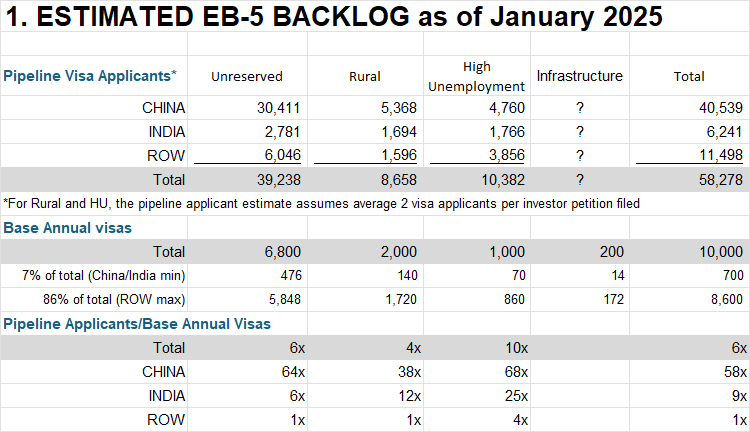
EB-5 already has more pipeline visa applicants than annual visas in the Unreserved, High Unemployment, and Rural categories. This means retrogression coming in each category. I dare say that every analysis of available data leads to that general conclusion. The debatable question is who will be affected, when, and to what extent.

Table 1 gives an estimate of the total pipeline backlog going into 2025, while Table 2 gives the timing predictions that result from one detailed comparison of the existing backlog with forthcoming visa supply. As a base case, I populated the model with assumptions that I consider conservative, and erring on the side of optimism regarding processing speed and retention rates.

TABLE 1: Estimated EB-5 backlog size compared with supply as of FY25China visa applicants (qualified or in the pipeline as of 10/2024)India Rest of WorldEstimated total qualified plus pipeline visa applicants as of 10/2024Compare visas available in FY2025Compare annual visas available in FY2026 and beyond
Unreserved33,3003,2008,10044,60011,4706,800
Rural3,9001,0501,275  6,2254,4272,000
High Unemployment3,9701,4903,160  8,6202,2141,000
Infrastructure????443200
Total41,1705,74012,53559,44518,55410,000

Key assumptions behind Table 1 estimates: an average 2-to-1 ratio of visas to I-526/I-526E filings for post-RIA investors (assuming average 2.5 family size and 80% approval rate), accurate NVC records for pre-RIA investors, and minimal visa-stage attrition. “Pipeline backlog” means qualified visa-stage applicants plus future visa applicants coming up from I-526/I-526E processing. Key data behind Table 1 estimate: NVC wait list as of May 2024, pending I-485 as of October 2024, pre-RIA I-526 pending as of July 2024, recent I-526 denial rates and family sizes, post-RIA I-526 and I-526E filed through September 2024, post-RIA filings by country and category through July 2024.

TABLE 2: EB-5 timing estimatesWho may get a visa in FY2025? (optimistic best-case scenario for China and India)Estimate for when an investor with a 2025 priority date might expect a visa number in this category
Unreserved ChinaPriority dates up to September 2016 (best case for China assuming ROW visas are limited by processing constraints)After 2033 (considering the existing pre-RIA backlog and assuming that ROW demand continues neither much higher nor much lower than in 2024)
Unreserved IndiaPriority dates up to July 2019 (assuming FIFO order)After 2030 (considering existing pre-RIA backlog)
Unreserved ROWUp to 9,800 applicants in theory, but likely about 4,000 due to processing constraintsAfter 2026 (considering existing pre-RIA backlog)
Rural ChinaPriority dates up to March 2024 (best case if maximum FY25 visas issued, and no visa bulletin limit until year-end)2032 (assuming maximum FY25 visas issued, and that ROW demand continues as in 2024)
Rural IndiaPriority dates up to March 2024 (best case if maximum FY25 visas issued, and no visa bulletin limit until year-end)2029 (assuming maximum FY25 visas issued, and that ROW demand continues as in 2024)
Rural ROWWhichever priority dates can get processed in time to claim a FY25 visaAs soon as processing times permit
High Unemployment ChinaPriority dates up to April 2023 (Best case if maximum FY25 visas issued, and no visa bulletin limit until year-end. November 2022 would be worse case if ROW visas can be maximized.)After 2033, when pre-RIA Unreserved backlog clears making Unreserved visas also available to post-RIA applicants (theoretical worst-case if HU investors limited to HU visas: 2102)
High Unemployment IndiaPriority dates up to April 2023 (Best case if maximum FY25 visas issued, and no visa bulletin limit until year-end. November 2022 would be worse case if ROW visas can be maximized.)After 2030, when pre-RIA Unreserved backlog clears making Unreserved visas also available to post-RIA applicants (theoretical worst-case if HU investors limited to HU visas: 2053)
High Unemployment ROWPriority dates up to May 2023 (Scenario if F25 visas are FIFO with no visa bulletin limit on China/India. January 2024 would be best case for ROW if swift processing allows maximizing ROW visas in FY25)After 2026, when pre-RIA Unreserved backlog clears making Unreserved visas also available to post-RIA applicants (worst-case if limited to HU visas is 2030)
Infrastructure Unknown Unknown

Key assumptions behind Table 2 base estimates: That all available FY2025 visas will be issued, with no limits imposed yet on China or India Rural or High Unemployment in FY2025. (In the likely event that this optimistic assumption is not realized, worse visa wait times would result for China and India.) That the backlog entering FY2025 is as described in Table 1 (and as detailed by priority date in the supporting Excel). That new EB-5 demand in 2025 and future years will mirror the volume and TEA/category distribution of EB-5 demand in FY2024. (To the extent that this proves not true, actual wait times for China Unreserved, China Rural, and India Rural could be less than estimated in Table 2.) That qualified Rest-of-World High Unemployment and Rural applicants are likely to take High Unemployment and Rural visas at least in 2025 (considering that they are first-in-line for Rural and HU visas while thousands of earlier pre-RIA ROW applicants still stand in the way of access to an Unreserved visa), but that Rural and High Unemployment investors from all countries are likely to request/be assigned Unreserved visas as soon as the pre-RIA Unreserved visa backlog clears for their country. That visas are generally assigned in priority date order. (As discussed in the previous post, exceptions to this general rule mean that individual experience can turn out to be faster or more delayed than the average, even assuming that the times in Table 2 are on-target as averages.)

Table 3. Potential annual additions to the EB-5 pipeline backlog (if current/future years mirror the number of I-526/I-526E filings in FY2024)ChinaIndiaROWTotal estimated new pipeline visa applicants resulting from one year of investments (FY2024)Compare annual visas available in FY2026 and beyond
Unreserved/Other100 501503006,800
Rural 2,6007001,0004,3002,000
High Unemployment 2,2008001,8004,8001,000
Infrastructure??? ?200
Total4,9001,5502,9509,40010,000

Tables 1 and 3 highlight the basic EB-5 visa predicament: that we’re in a deep and rapidly deepening visa hole. EB-5 entered 2025 with about five times more pipeline visa applicants than base annual visas. 2024 alone brought in 2.3x as many Rural investors and nearly 5x as many High Unemployment investors as can reasonably get visas in a year with their families in a normal year under category limits.

Table 2 summarizes attempts to quantify when investors could dig out of that hole and secure visas. (See individual tabs in the Excel model for sources and derivations for the estimates in this table. And you can use the worksheets to try the effect of different assumptions.) 

Table 2 is a reminder that if something doesn’t give, the only new EB-5 investors in 2025 who can expect to get a green card this decade may be Unreserved and Rural investors from “Rest of World” countries, and possibly Rural investors from India. The supply/demand imbalance in High Unemployment is already large enough to create retrogression for applicants from every country in 2026 (or earlier if USCIS increases processing volume), and to measure theoretical wait times for China and India in lifetimes (though less in practice assuming Unreserved visas can be allocated to post-RIA investors as soon as the pre-RIA Unreserved backlog clears).

Could actual wait times be even worse than the Table 2 estimate? Theoretically yes, if low-volume I-526/I-526E processing continues to hinder visa issuance, if on-going Rest-of-World visa demand increased from 2024 levels, and if family sizes and/or approval rates beat historical averages.

Actual visa wait times could also turn out less than estimated in Table 2, so long as visa demand proves less or supply proves greater than modeled in the Excel workbook. Maybe thousands of the pre-RIA China and India applicants registered at the National Visa Center have withdrawn or will give up or get denied, thus hastening the day when post-RIA applicants can start to access Unreserved as well as set-aside visas. (Visa Bulletin dates may signal this possibility for India – I’ll be interested to see the forthcoming updated NVC waitlist.) Maybe recent applicants will prove to have a high rate of project and/or evolutionary failure, resulting in a visas-to-I-526E ratio of much less than 2.0 for Rural and High Unemployment. Maybe the EB-5 market will shortly collapse over uncertainty around visas, sustainment, and reauthorization, thus stemming the incoming tide of Rest-of-World demand that would otherwise limit future visa supply to China and India. Or maybe politicians will realize that they love the visa category that has given the U.S. innumerable jobs, measurable economic growth, and immigrants such as Elon Musk, and decide to allocate more visa numbers to EB-5.

As illustrated in Tables 1 and 3, stabilizing the EB-5 visa situation could require a one-time infusion of around 40,000 visas to clear the existing backlog, or alternatively about 2.3x more rural visas and 4.9x more high unemployment visas on an annual basis to support ongoing demand potential. There were just under 5,000 EB-5 investments made in 2024, which could be nearly sustainable for a program with 10,000 annual visas — if not for the EB-5 backlog blocking paths for new investors and blocking access to 68% of those visas.  Alternatively, wait times could stabilize at a tolerable level (for those few who can persist) if the EB-5 market contracts by at least half, and/or about half of past Unreserved and High Unemployment investors give up.

Something is certain to give, when theoretical wait times become intolerably long. Consider this exercise: “100 people arrive for breakfast at a restaurant that can serve 20 customers per hour. How long will customer #101 wait for breakfast?” The real-life answer is not “100/20=5 hours” but rather “however long she/others are willing to wait for breakfast before giving up and going to eat somewhere else.” Ideally the restaurant owner is smart enough to rustle up more staff and tables in time to accommodate the profitable crowd, and to avoid discouraging new customers.

In cell D42 of the HU tab of the model, you’ll find a formula 5,252/70=75. The China high unemployment pipeline backlog is on track to be 75x greater this year than annual HU visa supply under country caps. But of course, no Chinese HU investor will wait anywhere near 75 years for a visa. The gap between demand and supply will inevitably close somehow, to reduce wait times to tolerable levels. I sincerely hope that supply-side relief is what ultimately closes the gap, making many more visas available across categories such that HU investors from all countries can get timely access to a HU or Unreserved visa. But for now, please “mind the gap” or risk unexpected failure.

As time permits, I may write additional posts to discuss the methods and thinking baked into the Excel model behind this post, and to walk through using and modifying the model. As time permits, I may redo the model when Department of State publishes the November 2024 NVC Waitlist and the 2024 Report of the Visa Office, and as new processing reports from USCIS and DOS help clarify possible visa issuance this year. If you benefit from the considerable effort that I’ve put into this otherwise thankless analysis, please consider making a contribution to support the work. If you’d like to pay for a consultation to discuss the model and your EB-5/timing questions individually, please book a meeting here.

I would like to thank Lee Li of IIUSA, Connor Chen of EB5 Sir, and Joey Barnett and Charlie Oppenheim of WR Immigration for responding to my requests for advance review of this analysis. And I welcome any additional corrections and feedback to the EB-5 Visa Supply and Demand Analysis model. You can email me at suzanne@lucidtext.com.

Insights from consular visas issued in FY2025 Q1

Department of State has also been updating its data, with monthly immigrant visa issuance reports now published for the first quarter of FY2025 (October, November, and December 2024). While my previous post focused on adjustment of status visas so far this year, the DOS numbers show what’s been happening with consular processing. As illustrated in the summary table below, DOS did great work with Unreserved visa issuance in the first quarter, managing to issue 40% of Unreserved visas available for the year. Chinese applicants particularly benefited from this efficiency. I’m also delighted to announce, for the first time, visas issued in almost every new post-RIA category (only missing infrastructure). However, the set-aside numbers are low. Rural and high unemployment visa issuance at consulates in the first quarter barely reached 1% of visas available this year. With AOS numbers apparently low so far as well, this makes me question whether/when FY2025 limits in those categories could possibly be reached. If this low volume continued, it would mean deferring set-aside retrogression in the visa bulletin (giving more “C” months for filing AOS), wasting some FY2025 set-aside visas, and pushing more of the existing backlog into future years. I trust that we’ll see much higher issuance numbers in coming monthly reports, to get as many set-aside applicants as possible into FY25’s unusually high visa limits.

Insights from pending EB-5 I-485 reports in FY2025 Q1

Last year, USCIS started publishing a valuable monthly report titled “Pending Applications for Employment-Based Preference Categories.” As explained on the AOS FAQ page, “The report provides our estimate of how many Forms I-485 we have in our inventory for each employment-based preference category, by selected country of chargeability, and by the month and year of the estimated priority date.”

I look to the pending I-485 reports for detail on the EB-5 inventory by TEA category, and for evidence of EB-5 processing movement. This post compares the EB-5 I-485 inventory report as of October 3, 2024 (the start of FY2025) with December 3, 2024 (the most recent report). I’m struck by the large number of applicants for reserved visas, by hints of I-526E processing progress by priority date, and by evidence that adjustment of status visas are not necessarily being issued in order by priority date.

Table 1 summarizes the USCIS report of EB-5 I-485 pending as of December 3, 2024. Note that the numbers represent every EB-5 applicant with a pending I-485, including applicants who can’t claim visas yet because the underlying I-526/I-526E has not yet been approved. The USCIS report has “D” in some cells to represent a redacted number less than 11; the figures in Table 1 assume that D=5 on average.

Table 1. EB-5 I-485 Pending as of December 3, 2024 (assumes “D”=5 on average)

CategoryChinaIndiaRest of WorldTotal
High Unemployment1,8071,0341,0753,916
Rural1,3969073502,653
Infrastructure15154070
Post-RIA Unreserved–  15179194
Pre-RIA Unreserved2,9768821,3625,220
Total6,1942,8533,00612,053

In Table 1, I note that Infrastructure investors exist (despite not being recorded on FOIA reports of I-526E filings), and the numbers of high unemployment and rural applicants. If the pending high unemployment I-485 applicants could all get I-526E approval and qualify for visas this year (with 2,200 HU visas available), then we’d have high unemployment retrogression in the visa bulletin for all countries, including Rest of World countries – and that’s not even counting all the HU applicants coming up separately through consular processing.

The USCIS pending I-485 report uses one label for all Unreserved EB-5, but in Table 1 I divided the Unreserved applicants based on priority date into pre-RIA (through March 2022) and post-RIA (after March 2022). This highlights the fact that — so far — not many post-RIA applicants are requesting Unreserved visas.  This may change when ROW applicants who qualify for High Unemployment visas find themselves retrogressed in the crowded HU queue for only 10% of EB-5 visas, and opt to queue up instead behind the pre-RIA Unreserved ROW applicants going for 68% of EB-5 visas.

And now, on to more detailed tables that compare the December 3, 2024 report with the October 3, 2024 report. Looking at inventory changes, I can make some inferences about what happened with EB-5 processing in the first two months of FY2025.

Looking at changes to the Rural I-485 inventory between October and December, I can tell that USCIS has at least been adjudicating Rural I-526E with priority dates up to December 2023. (I-526E approval precedes I-485 approval.) I also note that the inventory isn’t being cleared FIFO in priority date order. Over a wide span of priority date months, we see a few I-485 being cleared while others in the same month get left untouched.  I will guess that this lack of FIFO discipline originates with I-526E processing, where order depends on I-956F timing and not just filing date. Mandamus actions may also play a role. I recently heard reports from investors with November 2023 and March 2024 priority dates who got I-485 approval in January 2025 – six months after I-526E approval, and two months after having Mandamus actions filed for their I-485.

Looking at changes to the High Unemployment I-485 inventory between October and December, I can’t tell that USCIS has moved much beyond 2022 priority dates with I-526E processing. Most HU I-485 visas issued so far this fiscal year were to 2022 PD, with just a handful 2023 and later PD getting visas so far. The delta column in each table doesn’t capture all processing activity, since it’s just the difference between additions and subtractions to the inventory by priority date month. But overall, I get the impression that I-485 approval numbers have been quite low so far this year for high unemployment, and not FIFO.

Changes to the Unreserved I-485 pending inventory likewise do not suggest a FIFO situation. What made those 15 Chinese I-485 applicants with April 2016 priority dates so lucky to be cleared, even as 50 others with priority dates in the same month and at least 337 other Chinese from previous months were left untouched? It’s possible that the change reflects withdrawal rather than approval, but still I wonder.

The pattern illustrates why we need to qualify EB-5 timing prediction for individual cases. A model can estimate how long it will take to issue visas to everyone with April 2016 priority dates, as a function of visas available and the total number of people waiting up to that date. But the model doesn’t know if Investor X will have the luck to be picked out earlier than others, or somehow left behind. At the same time, the pattern shows why we can’t conclude that backlogs have been cleared just because some recent priority dates are getting visas. Apparently two Indian applicants with December 2021 priority dates left the I-485 inventory recently – but that doesn’t erase over 500 Indian applicants with earlier priority dates whose I-485 are still pending.

I’m about to publish my best effort at a comprehensive analysis of the current EB-5 backlog and timing outlook, but wanted to first publish this article to highlight the key issue of order in visa processing.

IIUSA sustainment lawsuit and EB-5 integrity

7/30 UPDATE: See Good news (CIS Ombudsman, Sustainment litigation, good faith investor litigation, FOIA on Security Checks)

— ORIGINAL POST —

I had hoped to be spared writing more about the IIUSA sustainment lawsuit, IIUSA vs. DHS et al.  I protested when it came out last year, but expected it to die a natural death once a judge had a look at the arguments. Or ideally even earlier, when IIUSA would wisely decide to retract the effort before it brought any more harm to EB-5 program integrity and future viability.

But the litigation has rolled on, and we learned this week that the DC District Court is probably not going to save us from ourselves. Judge Ana Reyes heard oral arguments in the case on Tuesday, and indicated after listening to an ill-prepared DOJ attorney that she did “not understand” the government’s case and was inclined to rule in favor of IIUSA. The judge ordered the parties to discuss and submit a Joint Status Report by February 27. I take time to write now, just in case anything can be done in 30 days, before the litigation comes to a decision that would be disastrous for the industry as well as investors.

To briefly review the issues and history… the IIUSA sustainment lawsuit questions the required period to sustain an EB-5 investment. Does EB-5 require investment to remain deployed at risk throughout the investor’s two-year conditional permanent residency period (CPR), or is the minimum two years from the time of investment and until jobs are created? CPR-linked sustainment was the rule prior to the EB-5 Reform and Integrity Act of 2022 (RIA), and IIUSA disputes that RIA changed the rule. When RIA came out in 2022, industry read the law and noticed that RIA edited the sustainment requirement. USCIS responded to the apparent RIA change in 2023 when it posted a website Q&A to explain how USCIS would apply the RIA-revised rule that the minimum investment period starts from the time of investment. The market was excited about the RIA change and USCIS interpretation, which promised to protect investors from investment periods that can become unpredictably long when linked to immigration milestones. Over $6.1 billion in EB-5 investment was raised from 2022 to 2024 (judging by data showing 6,160 post-RIA I-526 and I-526E filed) from investors relying on the RIA change. But IIUSA sued in 2024, arguing that the RIA never changed the sustainment period, that CPR-linked sustainment has always been and remains the controlling regulation until properly modified, and USCIS can’t just make new rules on its website but needs to do notice-and-comment rulemaking if we’re going to get a different sustainment rule.

IIUSA’s statements explain why IIUSA filed the sustainment lawsuit. The goal is to get a new rule from USCIS through proper procedure – a good new sustainment rule that will be fair to everyone, and more manageable than the two-year minimum apparently defined by RIA. The IIUSA plaintiffs most definitely aren’t suing for the sake of keeping the already-pocketed $6.1+ billion for years longer than anticipated.

AIIA’s statements explain why investors are so outraged at the sustainment lawsuit. If the lawsuit succeeds in overturning the USCIS interpretation of the RIA change, the immediate result could be to restore the bad old days of having to stay invested throughout conditional permanent residence, however long CPR may be delayed by slow processing and visa backlogs. IIUSA’s stated goal to eventually arrive at a new and better sustainment policy via notice-and-comment rulemaking is not soothing for investors, considering that the USCIS rulemaking process historically takes years, with neither timing nor outcome being predictable.

As an IIUSA member, I’d like to point out that “IIUSA lawsuit” means “a lawsuit promoted by some members under IIUSA’s name, and opposed by some other members.” I also understand that some members have been carried along by the expressed good goals of the litigation, not realizing the practical circumstances that undermine those goals. In case it’s not too late to change a few key minds, let’s remind ourselves of those circumstances.  

  • The apparent Day 1 result of IIUSA litigation success is not a new and fair sustainment rule, but a chance for rulemaking. In other words, the Day 1 result is falling back on the pre-existing sustainment regulation unless and until USCIS promulgates a new sustainment rule.
  • USCIS rulemaking can be expected to take many years, and even then does not reliably produce results that benefit the industry or investors. The most recent EB-5 regulation (EB-5 Modernization) was first promised by USCIS in 2014, published for notice and comment in 2017, finalized in 2019, and vacated in 2021 following industry litigation. As of January 2025, three years after RIA, USCIS has not even proposed any of the three EB-5 regulations that RIA required DHS to prescribe – not even the one for which RIA stipulated a 270-day deadline. If USCIS can’t even make a timely EB-5 regulation when so ordered by Congress, what can we expect now from rulemaking on sustainment? Is the market likely believe in a good new rule coming soon?
  • Backlogs and visa wait times are already a threat to post-RIA investors, and promise immigration wait times far longer, for many new investors, than the sustainment periods IIUSA considers fair. For example, 3,995 high unemployment investors (i.e. about 8,000+ future visa applicants) were already in process as of July 2024, while high unemployment visa supply is only 2,200 visas this year and 1,000 in future years. Until now, we’ve been able to reassure prospective investors that at least visa delay is just visa delay, but not impacting the investment timeline. The sustainment lawsuit could cancel that anodyne, and double the pain of looming visa waits by linking repayment waits.
  • Over $6.1 billion was invested from 2022 to 2024, under the now-challenged USCIS sustainment policy.

Who wants to try to recruit or advise prospective EB-5 investors with this unattractive message: “Sorry but we can’t tell when you may be able to get your money back – it doesn’t depend on when your project creates jobs or repays the issuer. The required sustainment period as of today depends on your immigration process timing. If you fear that your visa could be delayed seven years, that means also having to fear repayment in a minimum of nine years, because existing rules require sustainment through conditional residence. Your funds may need to be redeployed in future projects that you don’t choose. We’re trying to advocate for a reasonable minimum five-year sustainment period insulated from immigration delay, but that’s a goal and not the existing rule that applies now.”

And who wants to manage revolt among existing post-RIA investors who perceive their exit strategies sued out from under them by IIUSA? Who wants to have to explain: sorry, I know you agreed to invest in a four-year project, but I’ll have to hold your money for longer than that if your immigration process takes longer. Who wants IIUSA’s reputation to drip with the appearance of having facilitated a bait-and-switch implicating $6.1+ billion dollars already raised since RIA?

For everyone who wants to avoid such disastrous outcomes, is there any way to influence the Joint Status Report due by February 27? The goal: don’t let the litigation outcome be to apply the legacy conditional-permanent residence sustainment rule to all post-RIA investors pending new rulemaking. Because otherwise, IIUSA and investors will find themselves in the same kind of disaster: having to wait for what they want (a livable new regulation, or chance for investment exit) for as long as it can take for the government to act (whether on new sustainment rulemaking, or to get and allocate enough visas). Otherwise, no one will win except for those few who don’t care about EB-5 program integrity or future, but just laughing all the way to the bank over extending control over billions of banked post-RIA funds, looking forward to cashing in on visa backlogs and slow USCIS rulemaking to help keep that money beyond expected timelines.

FY2025 Visa Limit Announced

Department of State has just updated the Immigrant Visa Statistics page with Annual Numerical Limits for Fiscal Year 2025. As expected, there are an estimated 150,000 total EB visas available for FY2025 (only slightly above the 140,000 baseline, as consular operations have mostly recovered from the Pandemic). EB-5 gets 7.1% of new EB visas, or about 10,650 in FY2025, plus carryover visas.

According to EB-5 carryover rules, the FY2025 Reserved limit will be increased by Reserved visas that were newly-issued but not used in FY2024, while the Unreserved limit will be increased by Reserved visas that were newly-issued in FY2023 and then not used in 2023 or 2024. Here’s how I calculate the FY2025 total including carryovers.

We’ll have our eyes particularly on the approximately 4,400 Rural Visas and approximately 2,200 High Unemployment visas available this year. The race is on for USCIS to approve enough of the 3,000+ pending Rural I-526E and 4,000+ pending High Unemployment I-526E to generate applicants for this year’s visas. See also my post on the latest Q4 adjudication numbers and receipt data and my analysis of family sizes in EB-5. (These important new articles were inadvertently not emailed out upon publication).

EB-5 family size trends

In the spirit of the holidays, I’m sharing a few data-rich charts on the topic of EB-5 family sizes. How many EB-5 investors even have families, on average? It’s a critical and controversial topic, because EB-5 visa availability depends on how many visas go to spouses and children. The estimated market size for EB-5 investment can vary by a factor of three, depending on whether each EB-5 investment absorbs closer to one visa or three visas. The EB-5 backlog is either catastrophic or not-too-bad, depending on the multiplier used to convert I-526E receipt numbers to an estimated number of family vises.

It’s dangerous to generalize from limited samples and personal experience, because EB-5 investor family size numbers have varied by country, by immigration path, and over time. Government data is available from two sources. The annual Yearbook of Immigration Statistics counts the EB-5 visas issued to principals, spouses, and children through status adjustment and to new arrivals. The Department of State periodically provides tables showing the percent of principals (investors) among EB-5 applicants registered at the National Visa Center.  I made charts showing the past seven years of EB-5 data from the Yearbook of Immigration Statistics, and illustrating the most recent report from Department of State for all applicants in the NVC inventory (from Slide 6 of the May 2024 DOS IIUSA conference presentation).

The charts illustrate trends and variation, and set some guardrails. You can examine them for yourself, and draw your own conclusions. Looking at the charts, I’d say it’s clear that 1.5 is too low and 3 is too high to use as the number for average EB-5 family sizes. From 2017 to 2023, 2.6 was the average total EB-5 visas per investor visa. The seven-year average was higher for EB-5 investors abroad (2.9) than for U.S.-based investors (2.2), but the gap narrowed during the period. Maybe consular visas have steadily fallen over time due to children aging out, while adjustment visas show an upward trend as young investors start to build families.  I don’t know the story behind the Pandemic-adjacent dip in people immigrating together with spouses.  Looking at the country-specific differences in NVC data, we can guess about the impact of shifting the EB-5 market from one place to another.

The NVC data has the limitation of covering consular processing only, but the strength of covering the current population of applicants for future visas (including set-aside applicants with priority dates through 2024). The Yearbook data covers historical visa issuance only, but it reports on status adjustment as well as new arrivals from consular processing.

For my post-RIA EB-5 backlog estimates, I have been using 2.0 as the minimum multiplier to convert I-526 filings to estimated EB-5 visa demand. I don’t feel justified going any lower than that given the data on family sizes in the current EB-5 inventory and historical visa issuance, as detailed in the charts below. Estimated failure rates are another factor in the multiplier, but we should hesitate to count on high failure rates for Pre-RIA investors. “Don’t worry about the backlog because most of them will probably fail” is not a good sales pitch.

We should keep reminding Congress that the economic impact of EB-5 could be so much bigger, if family members didn’t get counted against the EB-5 visa limit. Does Congress realize that under current rules, fewer than 4 out of 10 of the visas designated to incentivize investment can actually go to investors?

FY2024 Q4 EB-5 Form Data

USCIS has finally updated the Citizenship and Immigration Data page with form receipt and adjudication numbers through September 2024, the end of the fiscal year. The numbers continue to show encouraging EB-5 processing improvements and robust but sadly unsustainable EB-5 demand.

I put the FY2024 data in context of the fifteen years since I launched my business plan writing service and started blogging about EB-5.

The chart shows that USCIS just had its best EB-5 processing year since 2018. EB-5 form completions more than doubled from the previous year, and reduced the I-526 and I-829 backlog to the lowest level since before 2015. USCIS also managed to process 1,119 post-RIA I-526 and I-526E, thus generating a significant number of applicants for set-aside visas in 2025. If the processing capacity applied to pre-RIA I-526 in 2024 is moved to I-526E in 2025 (as it might be, considering that the net backlog for I-526 is only 300 forms), then nearly all currently-pending I-526E could be processed in 2025. This is the good news.

Meanwhile, I-526E receipts in FY2024 reflect EB-5 demand at its highest level since before 2019, and once again shooting above the level possible to accommodate under the EB-5 numerical limit (i.e. about 10,000 visas annually, of which historically an average 38% go to investors while the rest to go spouses and children). Incoming EB-5 demand is largely aimed at the fraction of visas in set-aside categories, and lacks an escape route since Department of State is still working through the legacy Unreserved visa backlog generated by excess EB-5 demand from 2012 to 2019, as illustrated in the above chart. When the Unreserved backlog disappears (which I calculate could happen by 2030), thus clearing the way for post-RIA applicants to access Unreserved as well as Set-Aside visas, the 10,000 annual visa limit would still not be sufficient to accommodate new investors coming in at a rate of nearly 5,000 per year, as happened in FY2024.

The above chart illustrates that EB-5 needs, overall, about 30% more annual visas than it has, in order to close the gap between actual/potential and sustainable demand. (If we drilled down to historical imbalances by country and TEA category, the gap would be greater than 30% in some cases and less in others.) If the visa demand gap isn’t closed by increased visa supply, it will be closed by plummeting EB-5 usage when prospective investors see the gap producing backlog delays.

I am committed to doing whatever I can to support relief from the current unsustainable situation in EB-5, whether that be any possible EB-5 visa relief, or measures to make visa wait times more tolerable. I have been in advocacy conversations about legislative options, and have tried to support data and education to make visa wait times at least more understandable and predictable. I oppose measures such as the IIUSA sustainment lawsuit that would make visa wait times more painful and unattractive by linking repayment timing to visa timing for post-RIA investors. I also made the tough decision this year to stop writing regional center EB-5 business plans, given my backlog analysis, though that work had been my bread and butter for over a decade. Not that my small professional sacrifice will make a difference, but it reflects how seriously I take the current EB-5 backlog problem.  I don’t want to help dig the hole deeper, and I hope for the day when EB-5 can become sustainable — which it may, if many people take the current problem seriously. Immigration opportunity in exchange for economic development and job creation is a beautiful thing, when it’s real. EB-5 investment has supported so many good projects and business ideas, and it needs to be able to realize its immigration promise to investors, including investors from China and India.

And now for a full set of charts for the FY2024 Q4 data. I notice that I-956 and I-956F receipts have been falling while adjudication volumes continue to grow – an interesting industry phenomenon and a good sign for processing times. I-829 receipts reached an unprecedented high this year. Are people increasingly removing conditions individually rather than as families with the principal applicant? Denial rates remain very low for post-RIA forms and I-829, and elevated for legacy I-526. I included a summary table for the pending I-485 inventory as of November 2, 2024, showing over 12,000 EB-5 adjustment forms pending.  And I note that Department of State has also published the first month visa issuance report for FY2025. Only 6 post-RIA visas were issued through consular processing in October 2024 (3 high unemployment, 2 rural, and 1 unreserved), but the Visa Bulletin suggests that Department of State expects this pace to increase shortly. I’ve also updated my Processing Data page with the Q4 data.

EB-5 Set-Aside Visa Retrogression in 2025?

We’ve known that EB-5 set-aside visa retrogression is coming, but not when. Excess demand has been evident in data for I-526 and I-526E receipts for High Unemployment and (soon) Rural categories. (AIIA just published a FOIA response based on a September 2024 query, and before that we had the IIUSA FOIA data queried in July 2024, the WR Immigration FOIA data queried April 2024, and AIIA’s FOIA of 2023 data.) But when will high unemployment and rural investors reach the visa stage with their families in sufficient numbers to max out available visas? I had predicted that sluggish USCIS processing might slow-walk the backlog and keep the Visa Bulletin “current” through 2025 for EB-5 set asides. However, USCIS has apparently accelerated the volume of petition processing since last report in June 2024. The January 2025 Visa Bulletin includes a note with this warning signal for potential retrogression this year.

E.  VISA AVAILABILIY IN THE EMPLOYMENT FIFTH PREFERENCE (EB-5) SET ASIDE CATEGORIES

The Department of State and USCIS note increased I-526E petition approvals, and both agencies see increasing numbers of individuals processing their applications to completion in the EB-5 set aside categories.  It may become necessary to establish Dates for Filing and Final Action Dates during the fiscal year to ensure that issuances in these categories do not exceed annual limits.  This situation will be continually monitored, and any necessary adjustments will be made accordingly.

Is this announcement significant? What changes, when the Visa Bulletin changes and imposes cut-off dates?

Let’s start with what doesn’t change: visa bulletin retrogression does not make expected visa wait times longer than they were already. A high unemployment investor with an August 1, 2024 priority date has a wait time that’s a function of the 3,995 other high unemployment investors who have earlier priority dates, and who will be joining their spouses and children to compete for available HU visas (2,200 or so visas this year, and 1,000 annually thereafter). A rural investor with an August 1, 2024 priority date has a wait time that’s a function of the 2,809 other rural investors who have earlier priority dates, and who will be joining their spouses and children to compete for available HU visas (4,400 or so visas this year, and 2,000 annually thereafter). The picture is a bit complicated by the fact that expected wait times for Chinese and Indians can be increased over time by subsequent Rest of the World investors, while ROW investors benefit when the Visa Bulletin limits China and India. But basically, an investor’s visa wait time originates in the demand/supply balance on the day he joined the back of the visa queue by filing I-526E. The wait time is not created or changed on the day that the front of the visa queue exceeds annual limits and triggers a cut-off date in the visa bulletin. The Visa Bulletin reflects a backlog situation; it does not create that situation. If anything, an early Visa Bulletin cut-off date would be good news for visa timing overall, because it would mean that USCIS petition processing is proceeding more quickly than expected, and that 2025 set-aside visas may be maximized instead of lost.

Visa Bulletin retrogression will change the EB-5 market, because many people don’t believe in backlogs until reflected in the visa bulletin. I sadly keep getting marketing emails and seeing published articles with variations on this false/misinformed statement: “There is no significant retrogression concern for the time being for post- RIA investors who invest in rural and high unemployment projects (all of which remain current as of the latest State Department Visa Bulletin).” When the Visa Bulletin is silent, people don’t do the math with I-526/I-526 receipt numbers, and don’t calculate for themselves that all rural visas this year and all high unemployment visas this decade could be absorbed by the investors+family already in line as of mid-2024. When the Visa Bulletin speaks, then industry and prospective investors don’t need math or FOIA data to see oversubscription. For the sake of EB-5 program integrity, I’m glad that the Visa Bulletin is starting to give warning of a backlog situation that should already be informing industry and investor decisions. It’s highly material for issuers and investors to know whether the incentive supporting the investment exists or not.

Does it matter that the warning in the January 2025 Visa Bulletin might not be fulfilled, and that set-aside cut-off dates may not actually appear in 2025? For historical reference, the December 2012 Visa Bulletin first warned that “It appears likely that a cut-off date will need to be established for the China Employment Fifth preference category at some point during second half of fiscal year 2013.” But as it happened, China EB-5 did not get its first cut-off date until the May 2015 Visa Bulletin — thanks again to slow/low-volume I-526 and consular processing. Did past Chinese EB-5 investors with priority dates between 2013 and 2015 benefit from the delay in imposing cut-off dates? Not really, because excess demand was a fact regardless of when reflected in the visa bulletin. A delay in processing the China EB-5 crowd just resulted in lost EB-5 visas in 2013 and 2014. Subsequent visa bulletins show that China-born EB-5 applicants with April 2015 priority dates did not start getting visas until 2017 or finish getting visas until 2022, no matter the word “Current” in the April 2015 Visa Bulletin. On the other hand, a delay in imposing cut-off dates was great for the EB-5 market, which stayed hot under the attractively “current” visa bulletin and was able to raise over $14.3 billion dollars from China-born investors from FY2013 to FY2015. The harvest would likely have been much smaller, had Chinese investors realized at the time that everyone with priority dates from May 2013 would end up experiencing retrogression delay.

As discussed above, a Final Action Date in the Visa Bulletin does not suddenly make wait times longer than they were already. So it’s not quite honest to say “hurry to secure your place in line by filing I-526E before the Visa Bulletin imposes Final Action Dates.” Two Indian high unemployment investors, one with April 31, 2025 priority date and one with a May 1, 2025 priority date, would have nearly the same place in line and thus nearly the same visa wait time outlook regardless of whether May 2025 happened to be the month when the Visa Bulletin showed retrogression. No matter the visa bulletin status on the date of filing, these two investors will wait for as long as it takes to grant green cards to other Indian HU applicants with earlier priority dates, and to rest-of-world HU applicants with earlier and later priority dates.

However, there is some sense in a message “hurry to file I-526E before the Visa Bulletin imposes a Date for Filing for your country/category” — at least for investors based in the United States. While Chart B Date for Filing does not change the time to get a visa, it does change the opportunity for concurrent filing. A Date for Filing stops new investors from filing I-485 with I-526E, meaning they can’t immediately file for employment and travel benefits.  And these interim benefits are valuable. I’ve had direct EB-5 clients who made recent EB-5 investments for the sake of EAD and advance parole, even understanding the likelihood of severe green card delay. Our hypothetical friends with the April 31 and May 1 priority dates may have the same green card waits but very different experience during the wait, if hypothetical Visa Bulletin retrogression in May 2025 meant that one could get I-485 on file and thus able to apply for and enjoy interim employment and travel benefits, while the other couldn’t.

For additional analysis, see Lee Li’s new article for IIUSA January 2025 Visa Bulletin: EB-5 Dates Remain Unchanged, Noting Possibility of Cut-Off Dates for Reserved Categories. and IIUSA’s newly-refreshed EB-5 Visa Data Dashboard. I have been working on detailed analysis that I haven’t yet published, but note that I continue to make timely updates to my Key EB5 Backlog Data file (always linked to the top of the EB5 Timing and Processing Data pages so the public can access as much data input as I have at any given time). Recently I am particularly benefiting from AIIA’s FOIA requests for Pre-RIA I-526 inventory data and Post-RIA I-526 and I-526E receipt data, because these datasets provide a breakdown by month that can be used in forecasting visa bulletin cut-off dates. Combining the recent wealth of FOIA data with newly-available granular NVC and I-485 numbers, I’m considering reopening my customized EB-5 timing service in the new year.  

Updates (source of funds litigation, options after I-829 denial, election impacts)

Path of Funds Litigation

Path of funds has been a major factor in I-526 denials, especially since 2019, and behind many appeals to the AAO. Is USCIS right to demand the tracing of every penny so many steps beyond the EB-5 investor? The AAO generally upholds USCIS decisions, but now a federal judge has weighed in with more nuance, and nice ammunition for future appeals. To quote Battineni v. Mayorkas:  “In sum, the Court concludes that while the regulations require a petitioner to ‘show’ that their funds were obtained from a lawful source, they do not require the petitioner to ‘trace every penny’ beyond their initial acquisition.” For more, see: Alert: Another Victory for the Klasko Immigration Litigation Team.

Other Resources (I-829 denial options, RC audits, RC sanctions, I-526E data analysis)

The latest IIUSA Regional Center Business Journal features many good articles. I’d particularly like to highlight “Review of USCIS I-829 Denials in Removal Proceedings” (John P. Pratt, Edward Ramos, Elizabeth Montano, and Daniel B Lundy) which gives valuable information about the process and investor options following I-829 denial. Regional center operators will want to read Laura Kelly’s article “What Happens During a USCIS Regional Center Audit? Now We Know,” and Robert Divine’s article “EB-5 Sanctions: Real Danger with Possible Relief.” Note also that Li Lee’s full I-526/I-526E analysis, previously available just as an excerpt, is published in full here as “Latest Data on I-526E and I-526 Filings, Adjudications, and Withdrawals: Country-Specific Trends in EB-5 Demand, Investment Preferences, Case Processing, and Reserved Visa Waitlists.”

Election Impacts

What will happen to EB-5 under the new presidency and Congress? If you’d like some comfort, I recommend Carolyn Lee’s discussion with Christine Chen in this webinar: “Navigating EB-5 Amid Political Change: How Recent Elections Could Shape the Future of Investment Immigration.” They sympathetically review many of the questions and concerns that EB-5 immigrants may have today, bringing perspective as people who have faced the challenges of EB-5 through multiple administrations. To quote Carolyn: “It’s going to be as difficult as it ever was, and perhaps not more so.” I’m also looking forward to the analysis in IIUSA’s upcoming webinar “Post-Election Outlook & EB-5 Advocacy,” coming up on Wednesday, December 11 at 12 PM ET. In the article “Recapping the 2024 Elections and the EB-5 State of Play” (November 11), IIUSA discusses the Congress-level changes that may be even more consequential to EB-5 than the presidency.

Last time around, in 2016, we were excited/anxious that a President Trump might pay attention to EB-5, being a real estate developer with EB-5 projects in the family. But I couldn’t tell that he ever did. EB-5 was tangentially affected during his previous presidency has part of a general turn toward “extreme vetting” of immigrant petitions and reallocation of USCIS resources toward “other priorities.” But it took a couple years for those trends to translate into reduced processing volumes and increased processing times for EB-5. The really devastating impact to processing and visa issuance in that period did not come from administrative choices, but from COVID-19. Former President Trump reauthorized the regional center program five times, though likely unknowingly as it was just a sentence buried in 1000-page spending bills for his signature. Painful new EB-5 regulations were finalized under his administration, but drafted before he arrived.

As resident EB-5 chart-maker, I made a few pictures of what happened with EB-5 and immigration generally under the previous Trump administration.  The information on IPO staffing comes from stakeholder meetings and litigation, petition processing numbers are from the USCIS data page, and visa issuance numbers from the DOS statistics page. I’ll let you look at the numbers and guess whether correlation means causation. The year 2019 interests me particularly, being the year when policies had had a chance to take effect but the Pandemic hadn’t skewed things yet. If past performance predicts future results, I would expect EB-5 processing to slow within a couple years as fewer staff have to perform more steps, and legal immigration numbers to fall only fractionally (barring the excuse of another pandemic, or unless Steven Miller is able to realize all his evil plans).

October 2024 wrap-up (Integrity Fee due, EB-5 diligence resources, retrogression update)

Integrity Fees

A reminder to all regional centers that the Integrity Fund payment for the coming year is due THIS WEEK by October 30, 2024 (i.e. 30 days from Oct 1). See https://www.uscis.gov/IntegrityFund, and discuss with your attorney to make sure of getting all the fiddly details right with the payment process. Any regional centers who miss this week’s deadline may have a chance to pay with a late fee penalty until December 30. Regional centers who do not pay in full by December 30, 2024 face termination.  Many people were understandably confused by the process last year, and recently USCIS agreed (following litigation and advocacy) to offer a make-up opportunity for RCs that received termination notices over FY23 or FY24 fees. USCIS added a note to the EB-5 What’s New page this month that “For regional centers that failed to pay fees for FY 2023 and/or FY 2024, we are also accepting delinquent payments for FY 2023 and FY 2024 from Oct. 1, 2024, through Dec. 30, 2024.” However, the page warns that “We will reject any EB-5 Integrity Fund fee payments for FY 2023, FY 2024, and FY 2025 we receive after Dec. 30, 2024” and “we will take steps to terminate any regional center that, on or before Dec. 30, 2024, has not paid the required EB-5 Integrity Fund fees for each of FY 2023, FY 2024, and FY 2025.” If you’d like additional explanation, Carolyn Lee has recorded a webinar on Regional Centers: USCIS Integrity Fee Update – Compliance, Litigation, and I-956G Filing.

Resources

I’m happy to report that The Essential EB-5 Investor’s Guide is now published and available for purchase on Amazon. Many people know author Dilip Parameswaran from Telegram, where he has engaged with the EB-5 community and shared his experience as an EB-5 investor and professional financial analyst. I had opportunity to review and contribute to the book, and I salute Dilip for achieving a tough goal: lucidity. The book is introductory, addressing basic questions simply and concisely. At the same time it’s remarkably comprehensive, providing sophisticated treatment of both the investment and immigration sides of EB-5. Dilip has turned his own hard-won EB-5 education into an efficient, systematic, and unbiased curriculum to help others. The book is by and for EB-5 investors, but I would recommend it to new EB-5 issuers and project companies. Blogs like mine can become a confusing blizzard of shifting detail. This book lays out a solid basic framework for thinking about how EB-5 works.

I also contributed recently to a short, free guide prepared from an industry perspective and published by JTC: EB-5 Investor Due Diligence: Finding the Right Project for Immigration Success. This whitepaper addresses project structures and timelines, and suggests practical considerations and questions for vetting EB-5 offerings.

Meanwhile, I continue my day job of writing business plans for immigration purposes. Thank you to everyone who voted for me as a business plan writer in the EB5 Investors Magazine Top 25 poll — this year and since 2016.

EB-5 Retrogression Update

As I wrote in August for the EB-5 visa availability FAQ, retrogression happens IF a large crowd of potential applicants forms, with enough people to exceed annual visa availability, and WHEN that large crowd reaches the stage of becoming qualified visa applicants. October has provided new info on both the “if” and “when” questions.

“If”: I-526E filing numbers continue to show that retrogression is a foregone conclusion in the High Unemployment category, at least for China and India, and closing in on a possibility for the Rural category. IIUSA shares its most recent FOIA data in Post-RIA EB-5 I-526E Data Trends: Insights and Implications for Investors and Stakeholders (October 21, 2024) and Potential Retrogression and Visa Waitlist in the EB-5 Program (October 28, 2024). IIUSA analyzes pipeline demand for EB-5 reserved visas, and points to potential advocacy remedies for demand/supply imbalance. I salute IIUSA for taking the key first step toward recovery – acknowledging that we have a problem – and for starting to foresee advocacy steps toward EB-5 visa relief. AIIA is also vigilant on this issue, and I look forward to their FOIA results coming soon. I’ve been writing up a detailed analysis that puts post-RIA petition filing numbers and other recent data in a wider context of overall EB-5 visa availability in the coming five years, considers scope for matching visas to applicants across per-country and TEA-category limits, and notes variable assumptions about visa demand per investment. My analysis takes ten tough pages to reach the same basic conclusion as other analysis: EB-5 needs more visa numbers to remain viable.

“When”: Even as I-526 and I-526E numbers show a growing pipeline backlog, data from Department of State continues to moderate our expectations for how quickly that backlog could reach the point of claiming all available annual visas and thus triggering Visa Bulletin retrogression. In May 2024 DOS had reported nearly 1,000 post-RIA applicants already registered at the National Visa Center, but also noted that EB-5 applicants were taking 4-9 months from NVC notification to interview scheduling. As it turned out, Department of State did not manage to schedule any interviews for reserved visas until August 2024 – and then only four High Unemployment visas (“RH”) were issued in Vietnam. (See Monthly IV Issuances and p. 14 of minutes from the October 2024 AILA DOS Liaison Committee Meeting. On the status adjustment side, DOS reported that only 17 reserved visas had been issued through AOS by May 2024.)

The timing of Visa Bulletin retrogression has been pushed back by visa-stage delays on top of a sluggish process at USCIS. IIUSA’s FOIA request indicated that as of early July 2024, only 478 Rural I-526E and 240 High Unemployment I-526E had been approved – not near the number needed to generate qualified applicants for all the 4,200+ rural visas and 2,100+ high unemployment visas available in FY2025. I expect I-526E approval volumes to increase dramatically going forward, as USCIS likely moves adjudication capacity from the disappearing pre-RIA backlog onto the thousands of pending post-RIA I-526E. But I-526E processing speed now may come too late to maximize FY2025 reserved visas, considering the slow process remaining following I-526E approval. I currently do not expect the Visa Bulletin to move for EB-5 set-aside categories in FY2025. This could be good and bad for EB-5.

Slow-walking the EB-5 set-aside backlog creates a mix of opportunity and confusion. So long as the Visa Bulletin does not announce cut-off dates for EB-5 set-aside categories, new EB-5 investors in the U.S. can continue to enjoy the window to concurrently file I-485 with I-526E, regardless of where they were born, and thus secure valuable travel and employment benefits that will remain potent even through any future EB-5 retrogression. However, people may be confused into thinking that they’re not entering a serious backlog situation with respect to green cards, just because not yet flagged yet in the visa bulletin.

Meanwhile, October brought good news for the over 30,000 retrogressed applicants in the EB-5 Unreserved category. FY2025 will likely have over 11,000 Unreserved visas available to distribute, thanks to including unused reserved visas carried over from FY2023.  While Department of State has not yet announced the annual limits for FY2025, USCIS recently updated the AOS FAQ page to say: “The employment-based (EB) annual limit for fiscal year (FY) 2025 will be higher than was typical before the pandemic, though lower than in FY 2021-2024. We are dedicated to using as many available employment-based visas as possible in FY 2025, which ends on Sept. 30, 2025.”

Webinar on new I-526E filing and adjudication intel

Just a reminder to sign up for this week’s IIUSA webinar New EB-5 Data and Emerging Trends on I-526/E Filings, Adjudications, and Processing Times on Wednesday October 2 at 12 ET. We’ll discuss findings from the project undertaken by Li Lee with leadership from Christine Chen and eleven regional center operators to collect and analyze data on actual I-526E and I-956F processing times (report now available here). We’ll also present critical new TEA backlog information that IIUSA just received in response to a FOIA request spearheaded by Brandon Meyer (report now available here). How full are the queues for EB-5 visas? At what rates are the queues advancing, and in what order? The new data provides essential intel for regional centers and project companies considering their future offerings and markets, and for prospective and current investors concerned about timing.