New EB-5 Program Office

USCIS has just emailed a Message from Director Mayorkas on staffing and organizational changes for the USCIS EB-5 program team. These changes show how much USCIS is willing to invest in the quality and also the survival of the EB-5 program.

Dear Stakeholder,

I am pleased to announce that U.S. Citizenship and Immigration Services (USCIS) will be creating a new office to oversee our administration of the EB-5 Immigrant Investor program.

The EB-5 program has spurred the creation of tens of thousands of new jobs and the injection of billions of dollars into the U.S. economy since Congress created the program in 1990. Interest in the EB-5 program has grown exponentially in recent years, both from domestic project developers seeking capital and foreign investors who have the capital that can fuel economic growth. USCIS has met this unprecedented growth and interest with a corresponding dedication of resources. USCIS has approved more than 3,100 Form I-526 petitions in Fiscal Year 2012 to date, more than triple the number approved in all of Fiscal Year 2009. Since 2009, we have quadrupled the size of the EB-5 adjudications team and brought on board eight expert economists dedicated to the EB-5 program to ensure that EB-5 cases are handled expeditiously and with appropriate expertise. In the next month, two full-time attorneys with substantial transactional experience will enter on duty as new additions to the USCIS EB-5 program team. And by the end of July, a special Review Board consisting of two Supervisory Immigration Services Officers and one economist will review every pending application for regional center designation for which a denial has been recommended, with applicants receiving the opportunity to discuss their cases in-person before any final adverse decision is rendered.

By now creating a dedicated program office, we will build on these steps toward ensuring that this important and complex program is appropriately resourced and managed under a single leadership structure.

I am also excited to announce that the new office will be led by a new Chief of Immigrant Investor Programs, and that an advertisement for this new leadership position will be posting today. Our new program chief will have significant experience in the business world and will assume responsibility for ensuring that the program is administered efficiently, with integrity, with predictability, and with an understanding of today’s business realities.

We understand that more work needs to be done to further improve our administration of the EB-5 program. We are committed to this work. USCIS welcomes and appreciates your input as we stand up our new EB-5 Program Office.

Thank you.

Alejandro N. Mayorkas
Director
U.S. Citizenship and Immigration Services

5/1 Engagement Mega Executive Summary! (Tenant Occupancy! TEAs! Bridge Financing! RC Sunset! More!)

Many people left the California Service Center disappointed after the Quarterly EB-5 Stakeholder Engagement on 5/1/2012, but now USCIS has made up for telling us little in person by publishing an amazing 17-page Executive Summary that covers what they didn’t say at the meeting. I’ll probably be commenting on this summary for weeks. Particularly note the Q&A on tenant occupancy, which is less ambiguous and more restrictive than the guidance from Chief Economist John Rodgers. I’m copying a few of the hottest new releases below, and I encourage you to download and review the full document.

Selected Q&A from USCIS’s Executive Summary of the 5/1/2012 EB-5 Quarterly Stakeholder Engagement

NAICS Codes
Q: In a regional center application, kindly confirm that two digits of North American Industry Classification System (NAICS) codes are considered sufficient with the industry cluster specified and economic report elaborating the same. The rationale behind this is because in a retail and office setting, three digit code tenants are not ascertained at the time of filing the I-924.
A: This is not acceptable. Even within clusters and projects that incur similarities, USCIS requires four digit NAICS codes at a minimum.

Permissible Expenditures
Contingencies
Q: Any reasonable budget will include line items for “contingencies” and “operating capital” which are required in order to sustain a business successfully during the development process. Some business plans have been approved with such lines (as they should be) while others have been rejected specifically citing these budget lines as “not being job creating activities”. Please confirm that such expenditures are permissible – no business plan is believable without such budget lines.
A: Whether a particular line item in a budget presented in support of an EB-5 petition is appropriate cannot be confirmed in general, but must be analyzed in the context of the instant case. However, USCIS does agree that a credible business plan should contain a reasonable budget that outlines the prospective expenses of the business.

Real Estate Acquisition
Q: One of the most effective ways to attract investors is for the business into which they are going to invest to buy and own the real estate in which they will operate the business, rather than merely lease it. This makes the investor feel that the business is more likely to succeed, or, if it fails, the real estate could perhaps be used to establish a second business. Therefore, where part of the investment expenditure is spent on real estate in which the business is to be operated, is it correct that such expenditure is a job creating expenditure for which appropriate job creation credits can be obtained. For example, if an investor invests $1million to acquire a building for $500,000 and then spend another $500,000 to renovate and equip as well as fund operating capital for a restaurant, would the entire $1million be considered an appropriate EB5 investment, assuming it otherwise qualifies.
A: This is a simple transfer of real estate with renovations occurring subsequent to the purchase. The renovation and outfitting of the facility will create temporary jobs, and it is possible that a trivial number of jobs could be created by the fees charged for the real estate transfer. Summarily, yes—the $1 million could be considered an appropriate EB-5 investment—assuming that the other requirements of the EB-5 regulations are satisfied.

Bridge Financing
Q: Under what circumstances will USCIS approve bridge financing? Will the memo address this? This does not appear to be covered with adequate specificity in the last iteration of the policy memo. Stakeholders are not aware of any written guidance on bridge financing other than am AAO decision on the Victorville case, and this is an extreme example with specific facts. Of the two memos in 2009 (June and December) on construction, the December 2009 memo superseded the June memo, but stakeholders continue to receive RFEs referencing the June memo.
A: Pursuant to 8 C.F.R § 204.6(j)(4)(i), the new commercial enterprise, not the EB-5 investors, must create the requisite employment. As such, it is acceptable for the developer or the principal of the new commercial enterprise, either directly or through a separate job-creating entity, to utilize interim, temporary or bridge financing – in the form of either debt or equity – prior to receipt of EB-5 capital. If the project commences based on the bridge financing prior to the receipt of the EB-5 capital and subsequently replaces it with EB-5 capital, the new commercial enterprise still gets credit for the job creation under the regulations.
This policy will be issued in the forthcoming EB-5 policy memo in Section C, the Creation of Jobs section:
“It is important to recognize that while the immigrant’s investment must result in the creation of jobs for qualifying employees, it is the new commercial enterprise that creates the jobs. This distinction is best illustrated by an example:
Ten immigrant investors seek to establish a hotel as their new commercial enterprise. The establishment of the new hotel requires capital to pay financing costs, purchasing the land, developing the plans, obtaining the licenses, building the structure, taking care of the grounds, staffing the hotel, and the many other types of expenses involved in the development and operation of a new hotel. The immigrant’s investments can go to pay part or all of any of these expenses.”

Verifying RC Job Creation
Q: Can expenditure models based on RIMs II Final Demand Multipliers, if they project adequate number of jobs to satisfy the 10 full time job requirement per investor, satisfy the job creation requirement and proof of such expenditure submitted with the I-829 in accordance with the business plan submitted with the I-526?
A: This is an acceptable methodology if the structure of the business entities precludes the acquisition of tax documents or other evidence of employment for the components projected to be involved in direct job creation. USCIS would require a detailed explanation as to why the use of a model projection as opposed to evidentiary proof is necessary.

TENANT OCCUPANCY!
Q: In a case where the EB-5 business is a real estate development, which leases space to tenant businesses who then hire employees, do the following factors increase the likelihood that those tenant’s jobs can count toward satisfying the job requirements of the development’s EB-5 investors:
a. The tenant business is a new business which did not merely move from another location
b. The tenant business received cash from the development for tenant improvements
c. The tenant business received a loan from the development
d. The tenant received free rent or rent reductions
e. The tenant received an equity investment from the development
A:
a. The tenant business is a new business which did not merely move from another location
This is not acceptable. None of the EB5 capital would be flowing to the jobs created by the tenant.
b. The tenant business received cash from the development for tenant improvements
This is not acceptable. The tenants would still be responsible for creating the jobs. The EB-5 capital would simply be improving/outfitting/customizing the structure already owned by EB-5 capital.
c. The tenant business received a loan from the development
This is acceptable with caveats. This effectively represents the co-mingling of capital. Similar to the quid pro quo expenditure agreement referenced above, however, this will render the agency vulnerable to fraud because the tenants could form an agreement beyond the adjudicative scope of USCIS to funnel the funds back to the developer. In addition, USCIS would need to define the constraints of the loan amounts and duration. Otherwise, the developer could loan $0.01 to a tenant to take credit for any jobs created. Finally, the tenant business must verify that the jobs are new jobs not transferred from elsewhere.
d. The tenant received free rent or rent reductions
This is acceptable with caveats. Similar to (b) above, this effectively represents the co-mingling of capital as the free rent/rent reductions acts as a loan. The same caveats apply here as in (b) above. In addition, this will cause a significant decrease in rental income for the EB-5 NCE, which should be an investment at-risk, not at-loss. USCIS would still need to define the constraints of the rental discount required, which effectively serves as a loan. It is highly unlikely, however, that the free rent or rent reduction over a 2.5-year period would sum to a total amount that could be considered a substantial investment in the tenant business.
e. The tenant received an equity investment from the development
This is acceptable with caveats. Again, this effectively represents the co-mingling of capital as in (b) above. The same caveats apply here.

TEA Designations and Census Tracts
Q: Will a single or multiple contiguous census tracts be considered as a geographic subarea?
A: USCIS encourages that standard Bureau of Labor Statistics (BLS) estimation methodology be used. In the event that subareas for which Local Area Unemployment Statistic estimates are not regularly produced, such as census tracts, the TEA applicant should be aware of the following: (1) the census-share technique be used ONLY where inputs for the preferred BLS methodology are not available and (2) only household-only inputs be used, in order to eliminate the impact of the Census 2000 Group Quarters processing error. More information regarding this answer can be found at the Bureau of Labor Statistics webpage at: http://www.bls.gov/bls/empsitquickguide.htm

Q: Can a qualifying census tract with unemployment 150% of the national rate be certified as a TEA?
A: Yes, but designation will depend on the quality and timeliness of the data used to support the 150% of the national average rate of unemployment claim. Acceptable data sources for purposes of calculating unemployment include Local Area Unemployment Statistics produced by a government agency, U.S. Census Bureau data, and data from the American Community Survey.

Q: Has there been any progress on further defining an acceptable vs. gerrymandered TEA? Will USCIS be providing additional guidance?
A: This issue is being examined in the context of the draft memorandum, which will be posted for comment in the near future.

Profit Requirements
Q: At the end of the two year period, to remove the restriction, does the business created have to make profits? Or can the business lose money as long as the ten job creation requirement is satisfied?
A: There is no “profit” requirement in the statue or regulations. As long as the investment has been made and is at risk of loss and the required jobs have been created there is no additional profitability requirement.

USCIS Staffing
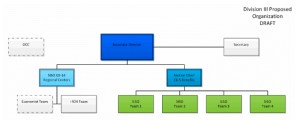
Q: What will the USCIS EB5 unit organizational chart look like once hiring is complete?
A: We can only provide a generalized org chart, without specific staffing numbers.
Non-Profit Organizations
Q: How can non-profits benefit from this program? Can they receive a direct investment from an EB-5 investor or do they need to work through a regional center?
A: An EB-5 investment must be in a for-profit entity, so a direct investment in a non-profit probably does not meet program requirements. EB-5 promoters may be able to advise on structuring specific investment opportunities, but the premise of the EB-5 program is investment in for profit activities. Job creation is the same, but premise of program is for for-profit commercial entities.

EB-5 Sunset
Q: What is the status of the EB-5 “sunset” scheduled for September 30, 2012, and how might this affect current and future applications and projects?
A:
The EB-5 Immigrant Investor Pilot Program is scheduled to end or “sunset” at the end of the current fiscal year, on September 30, 2012.
Without Congressional reauthorization, the Immigrant Investor Pilot Program will end on September 30, 2012. Congress may choose to end or extend the program.
If Congress does not reauthorize the Immigrant Investor Pilot Program, all existing regional center designations will expire automatically.
Following the sunset of the Immigrant Investor Pilot Program, USCIS will no longer possess authority to approve a regional center designation.
USCIS will continue to monitor Congressional actions pertaining to the EB-5 Immigrant Investor program, and will keep stakeholders informed as new information becomes available.

Q&A from USCIS on Economic Methodologies

Well, well. We ask and USCIS answers! I regret not emailing my questions to the USCIS public engagement mailbox, as it appears that public.engagement@uscis.gov is not a black hole after all. USCIS has already responded to two stakeholder questions arising from the conversation with USCIS Economist John Rodgers on June 22. Thank you to Stephen Yale-Loehr for pointing this out to me.

From the USCIS website:
Questions and Answers: EB-5 Economic Methodologies
On June 22, 2012, USCIS hosted a public engagement featuring two economists who work on the EB-5 Immigrant Investor program.  Following that engagement, some stakeholders sought clarification as to certain points raised by the economists.  USCIS is now pleased to provide clarification as to two of the primary questions raised.

EB-5 Projects Involving Hotel or Resort Development

Q:  When an EB-5 project involves the development of a hotel or resort, when is it economically reasonable to input projected funds spent by visitors into economic models to project indirect and induced job creation resulting from the spending of these potential hotel occupants (e.g. on rental cars, dining, etc.)?

A:  In general, job credit based on “visitor spending” is appropriate only where the applicant or petitioner can show by a preponderance of the evidence that the development of the EB-5 project or resort will result in an increase in visitor arrivals or spending in the area.  Applicants or petitioners should provide reasonable estimates of how new visitor spending and tourism demand is driven by the specific project that is the subject of the application or petition.  If the applicant or petitioner presents a reasonable case that the visitor spending and demand for tourism generated by a project is new then it may be reasonable to conclude that the specific project has generated an increase in demand, and thus, has generated increased employment in the region resulting from the projected increase in visitor spending.  If the applicant or petitioner meets this burden and the application or petition can otherwise be considered reasonable, new visitor spending revenue can be considered an eligible input to an appropriate regional input-output model.

Regardless of whether visitor spending is shown to be attributable to a particular project, jobs created from construction (lasting over two years), management, and operation of the hotel or resort, including hotel revenues, can be considered eligible inputs to an appropriate regional input-output model assuming that the application or petition can otherwise be considered reasonable.

Acquiring Real Estate

Q:  May a regional center use funds from EB-5 investors to acquire real estate?

A:  In general, yes, subject to the requirement of Matter of Izummi, 22 I & N Dec. 169 (Comm’r 1998), that the “full amount of money must be made available to the business(es) most closely responsible for creating the employment upon which the petition is based.”  For example, a job-creating enterprise may propose to allocate some EB-5 funds to purchasing land and allocate other EB-5 funds to developing and operating a business on the purchased land, and the jobs created by the enterprise can be apportioned among all the EB-5 investors.  It is important to note, however, that real estate acquisition is not generally recognized as a job-creating activity in and of itself.  Thus, it is not generally reasonable to treat funds spent on real estate acquisition as inputs to an employment impact model.  Where some EB-5 funds will be used for real estate acquisition, such apportionment should be detailed in the business plan.

USCIS does recognize that certain soft costs directly related to real estate transactions may reasonably be counted as valid job-creating expenditures and inputs to regional input-output models.  In addition, soft costs related to the development and construction of EB-5-supported projects on designated land parcels may be considered on a case-by-case basis.  If the input-output model utilized in the economic impact analysis provides specific categories for the soft costs, the multiplier categories specific to these costs should be used instead of bundling such costs under general construction expenditures.

I-924 Processing Times and RFE Template

The USCIS EB-5 Regional Center page has been updated as of 06/25/2012 with yet longer actual case processing times for the I-924. With so many points having to be judged “on a case-by-case basis” and in consultation with the experts, application review will naturally be time-consuming.

Processing Time
Summary
 Target Case
Processing Time
 Actual Case
Processing Time
 I-924 Initial Application  4 months   9 months
 I-924 Amendment Application  4 months   10 months

Also, Joseph Whalen has kindly posted an EB-5 plan assessment template showing language and format typical of I-924 Requests for Evidence and Notices of Intent to Deny. Thinking about the potential RFE before you file your application may help you avoid common problems and possibly reduce those processing times.

Processing times for the I-526 and I-829 are regularly updated at the USCIS Processing Time Information page (search by California Service Center Processing Dates).  Processing times  as of 4/30/2012 are 8 months for I-526 and 6 months for I-829.

Call with USCIS Economists: Transcript and Thoughts

I am officially an EB-5 hero, having spent my Saturday transcribing much of the June 22 Engagement with Director Mayorkas and USCIS Economists regarding  EB-5 investment in real estate-related projects. (Here is my recording of the call.)

After many hours listening to the voice of John Rodgers, new Chief Economist at USCIS, and typing his sentences, I am feeling sympathetic. Tone and syntax suggest that he approached this engagement as a real, unscripted discussion and was very nervous about it. Being on the spot is hard, and John Rodgers got himself lost at points. When making an uncontroversial point about land acquisition costs as an inappropriate input to an IO model, he surely did not mean to make a judgment about budget items to which EB-5 capital may be applied – a separate issue that he admitted to be outside his purview. To his credit, John Rodgers struggled partly because he didn’t come armored with polished talking points and did try to answer questions. I typed out most of the meeting so that you can review exactly what was said and consider the implications, but remember to keep this information in context. The transcript is not a guidance memo but simply the record of a discussion with plenty of mistakes and points that will be clarified or modified later. I wouldn’t have recorded this except that I suspect USCIS will not quickly deliver the promised written guidance, and we are desperate for whatever information we can get.

Here are a few of my personal conclusions from the June 22 engagement with the economists:

  • USCIS still thinks that real estate developers may claim job creation associated with their tenants. The conditions are that the owner/developer must demonstrate: 1) that the tenant jobs/impacts will be new and not shifted from anywhere else in the US, and 2) that the owner/developer will have a substantial business relationship with the tenant. USCIS is not currently defining exactly what may constitute an acceptably substantial relationship, and is open to arguments from applicants. Possibilities mentioned included equity stakes, joint ventures, partnerships, rental rebates, and revenue-sharing. John Rogers resolutely declined to set in stone any particular metrics or guidelines, disavowing even those in the tenant occupancy RFE.  This gives us freedom to experiment, but no guarantees of success. If adjudicators are as unclear about the standards as we are, it’s going to be a confusing few months going forward, with many RFEs and long processing times. I haven’t decided if I should stop writing real estate-related EB-5 business plans, admitting that even I don’t know the current rules of the game, or if I should start charging an arm and a leg for plans because, lacking set metrics, success will be all about clever rhetoric and impressive presentation. I’m also not sure that developers will want to try EB-5 under the current conditions. Everyone who can show in advance that all your future tenants will house all new jobs in your building plus agree to a significant financial relationship with you, please stand up!
  • The USCIS economists consider their mandate to include judging the validity of economic reports and also the viability of business plans. They want to ensure that the job creation formulas are correct and also that the inputs are reliable. The economic impact report filed with the I-924 application postulates “under X conditions, Y job creation would occur.” USCIS wants the application to convince them that X conditions will in fact occur. If your economist says that a hotel at 80% occupancy will generate a certain number of jobs, USCIS will check the economist’s math and formula and then ask you to demonstrate that your hotel is very likely to actually reach 80% occupancy in time. That explains why John Rogers spent more time talking about market analysis than about economic methodologies, and why the current review standards are not as cut-and-dry and quantitative as we might like. (USCIS may also be putting such a spotlight on demand analysis because it can be a theoretical approach to the issue of the “newness” of tenants and their job creation. Is that the case?)
  • USCIS has been traumatized by poor applications to the point that it will assume your data and assertions are baseless and unrealistic unless you demonstrate otherwise. If you are going to file an application now, be prepared to go all out to source and validate every claim that you make about project costs and timing and market conditions and prospects.
  • The economics team at USCIS is new, and its thinking is open to change. Director Mayorkas invited people to email thoughts to USCIS at the public engagement mailbox (public.engagement@uscis.gov), being sure that any comment clearly identifies the EB-5-related issue and suggests an approach to the issue. He also promised additional engagements with the economist. Listening to John Rogers discuss hotel job creation, I could tell that he had reviewed and been influenced by recent feedback from the EB-5 community. (Specifically, his statement about the acceptability of hotel jobs controlled by a management company modifies the stance in recently-issued RFEs from USCIS, which have been questioning such jobs.)

Enough of my thoughts. If you are concerned about options for EB-5 investment in real estate development, I encourage you to listen to the call or read my partial transcript for yourself.

June 22, 2012. Unofficial transcript of portions of the Engagement with Director Mayorkas and USCIS Economists. The primary speakers include USCIS Director Alejandro Mayorkas, Chief USCIS Economist John Rodgers, and Will Cooper, a contract economist from ICF International. Click here for Suzanne’s unofficial recording of the call. Note that I have added list numbers below for ease of reference; these numbers don’t refer to anything in the call.

  1. John Rodgers: The economists at the California Service Center that are under the EB-5 team are very very much aware of the importance of all of your applications with respect to employment, immigration, and economic growth. We take that role very seriously. When we receive an application, every single data point is looked at, every source is looked at, every single word is looked at, nothing is left unturned. And I think that when we come out at the end today what I hope to be able to have us all take away is that we see the going forward of this program as valuable in getting your inputs as well, for you to help us in understanding what constitutes reasonable methodologies. As you are all aware, job creation is a science, but it is not a perfect science, and it is also an evolutionary science that encumbers [sic] new research methods, business and economic fundamentals, and other dynamics.
  2. That being said, in keeping spirit with what Ali mentioned, the first substantive topic is going to be tenant occupancy. I’m going to tackle it in two specific ways after getting to some of the key points, and that is the overall issues that we see with respect to tenant occupancy and also the RFE that many of you have submitted questions pertaining to.
  3. About 70% of all applications that we see from Regional Centers involve some form of tenant occupancy. Not all the forms are the same, so it is a very significant part of the program. We understand that it’s very important. What we specifically focus on is first the question: is data, methodology being presented to us in the business plan that allows us to believe reasonably that in the future, tenant jobs that move into a commercial or retail space will be new, they will not be transferred or shifted from elsewhere? The new commercial enterprise, whether it be the EB-5 directly-funded enterprise such as Limited Partnership or the tenants themselves, the job creation needs to be new and not shifted from elsewhere.
  4. What we specifically look for in business plans is a linkage between the EB-5 capital and the actual new commercial enterprise that pays the wages of tenant workers for example. What we especially look favorably on are financial arrangements such as equity stakes and joint ventures between the EB-5- funded partnership or company and the tenants. As most of you are aware, we also accept as reasonable, direct job inputs into benchmark models, employees funded by management, operational support, maintenance, and things like that that go into the space, or the building if you will. In circumstances in which there is not a direct link or connection between the EB-5 capital and the tenant businesses, under some circumstances we will grant economic benefits in the form of direct employment inputs into whatever relevant model you have presented, if we can reasonably see a long-term, sustained business relationship between the facility owner and the tenant business. I’ll let you absorb that for a sec and switch to the next topic. I want to rephrase, that that is one part of the tenant occupancy core substantive aspect of EB-5, and that is ensuring that the economic benefits – and I mean direct inputs into benchmark accepted regional input-output models, are attributed to EB-5 capital. Under circumstances in which that link is not direct, we will still consider reasonable methodologies, and we look forward to having you help us out in presenting those to us.
  5. The second issue has to do with the RFE. … We are very pleased actually with some of the responses that we have gotten recently. … We have been quite pleased with some of the responses that have attempted to present reasonable metrics and indicators based on that RFE. Based on questions and submissions that we have received from other forums, we also understand and believe that this is a good opportunity to help clarify some of those, again based on your questions. I think the most important thing that I want to convey to you is that the language in that RFE was not meant to create litmus tests or benchmarks that if you could not present them, we would look unfavorably at the application. They are meant to be part of a comprehensive business plan in which data is available, and we realize that sometimes it’s not, that that data relevant to local occupancy rates and the overall interplay of supply and demand for specific types of commercial tenants is available. The economists, the team that we have in place, has a very good idea of what data is available. And again, we know sometimes it’s not. Sometimes it could be under proprietary controls, and we understand that. However, we do encourage you to attempt to present to us data that focuses on the interplay of supply and demand with respect to specific types of commercial, office, retail space, and potentially important aspects of that industry like the absorption capacity of the local area. To really get to the economic science for a minute, I know that there were a few questions concerning the vacancy-unemployment ratio, and that is specifically not related to the Beveridge curve, which is a very formal mathematical model for modeling transitional probabilities in labor markets. That was not the intent of that RFE, even though the language is similar to some of the economics literature in that regard. Again, I’m not going to go into specific types of metrics right now. We could potentially follow up based on the Director’s intentions. But I just want all of you to know that not providing one or two or potentially some of those metrics, not being able to do so is not something that’s going to render your application unfavorable. Again, it should be part of the overall comprehensive business plan, which again I’m going to talk extensively about.
  6. … The next topic, which again is significant in the sense that it encumbered [sic] perhaps a quarter of the questions submitted for this forum, involved the construction and development of hotels and resort-like projects. Approximately a quarter of all of the applications that we see for Regional Centers involve these types of projects, and it’s growing. We’ve seen a significant increase in the time trend over even the past several months. What I want to say first is the main shortcoming that we see with respect to this type of project is the lack of data and the lack of data sourcing. The way we see the ultimate requirement for this program being met in terms of job creation with respect to this type of endeavor, is a chain of causation that starts with local market conditions, very localized market conditions, based on occupancy rates, local occupancy rates. It is in those two categories where we feel the need for data sourcing, data robustness, and timeliness is very important. As we move along the causation chain, we get to the local concept of absorption. And I want to spend a few minutes talking about what I mean in that sense. When we look at occupancy rates, and an applicant presents data that says the occupancy rate for this area is approximately x percent, we do not look favorably upon simple extrapolation of how that percentage would fall into the new supply. In some cases it may, in some cases we may not. What we would like to see is more of a comprehensive plan for the absorption rate of the new supply of hotels, of the new supply of hotel rooms per se. And that’s where I think the modeling and methodology comes in. The sourcing is first, the methodology is second, and it really comes into play when we’re talking about how the local supply, the new supply of hotel rooms will be absorbed in the local market. So essentially what we’re talking about here is the need to match supply and demand. I realize that sometimes this is difficult to do. There are a lot of business studies on this, but not a lot of formal economic established methodologies, so we really look forward to you helping us out in presenting some of those. The single biggest metric or indicator that we look at is what’s known as REVPAR, revenue per available room, that’s we consider the industry benchmark. And it is through absorption and revenue per room that we see the method by which the job creation requirements will be met. When I talk about the matching of supply and demand, what also needs to be taken into consideration is a reasonable plan that details, justifies, or outlines, why visitors would not have visited that specific area were it not for that hotel to be built. So once again, what we would like to see is a business plan that details and frames the art of the possible for how and why these specific construction of a specific hotel relates to increased visitor spending in that area.
  7. Moving on to the second component of the hotel projects. The economics team has come to recognize that there is a specific type of model the hotel and resort industry operates under with respect to development, ownership, management, and operation. If capital from the developer, partly or wholly financed by EB-5 capital, directly contributes to the equity and finance of the development and operations, then all of the operational jobs derived from that connection can be counted as direct employment inputs into the regional model. This type of arrangement is favorable. However, given the specificity and the nature of this industry, USCIS, the economics team specifically, will grant economic benefits to management functions that are hired by the developer and/or owner even if they are not directly funded by EB-5 capital. However, I want to be clear in saying that that does not include all of the employees of the management company or the people who work in various support functions. It needs to specifically involve only those that are necessary for this project and this hotel. This is very important ladies and gentlemen, so let me just rephrase it if I might. The type of financing arrangement that we consider favorable is that in which EB-5 capital directly funds the maintenance, operation, the overall functionality of the hotel, the operations. Due to the specific nature of this industry, however, we will grant economic benefits in the form of direct inputs into the – which means that they get the full multiplier effects, indirect, induced – on the grounds that in this specific type of setting one could look at potentially at those jobs and those functions as part of a supply chain for the overall ability of the hotel to operate. I imagine that there’s going to be some questions on that, so I’ll just stop there and end this section with the issue of the tenants, the non-affiliated tenants of a hotel. In this situation, too, we will grant economic benefits, and again, by that — and I’m going to say this several times because I think it’s very important – economic benefits in terms of direct employment effects into a standard-practice input-output model – if a significant, substantive, long-term business relationship is established with the tenant. Long-term, sustained, clear, and transparent business connection. And I’m going to attempt to provide specifics on what those might be, but again I look forward to your input on that.
  8. … The economics team essentially approaches all of your applications as a twofold process. One is a detailed analysis, an assiduous [sic] study of the business plan. We look at the business plan, again, as framing “the art of the possible.” Is it possible, given what’s presented to us, that the job creation requirements set forth in the regulations of the EB-5 program, will in fact be met. The second part of the at is the economic impact analysis which is derived from the three of four major – with some incarnations of the standard practice – regional input-output models that are known in the academic and business literature and practical fields, as well. The way we look at the second part, the economic impact analysis, is: does that analysis give us a reasonable belief that there is decent probability that the job-creation requirements will actually be met. So the business plan is the art of the possible; the economic impact analysis tells us whether we think the projects will actually get to the requirements. So they are both very very very important, very important, and they are taken very seriously.
  9. If I were to convey four – and I realize these are very broad themes, but in consulting with the team there are four general terms that I would like to convey to you as important: 1) We want them to be concise, which means only talking about the projects that are encumbered in the plan, and specifically related to the projects in the plan with respect to the data sources that are necessary to support that plan. If the data sources are not relevant, not necessary for that plan, you can certainly include it, but we don’t necessarily need to see that. 2) Robust is the next one, and that means models and methods that are as current as possible and that are standard practice in the sense that they are accepted by the supporting literature or business community. 3) Appropriate data sourcing. In this, one of the key take-aways is the timeliness. Again, we have a very good idea of what data is out there and what data is missing and what the timelines are. We like to see the most up-to-date data. 4) And then transparency, and that is to provide mainly the relevant information on the specific key components of the plan. Those are four very broad buckets.
  10. Now I want to turn to more specificity with respect to the questions you’ve submitted as to what should be in those business plans and what we consider favorable. Foremost: real estate transactions, reserve funds, and contingency funds cannot be used for EB-5 job creation purposes because they are not place in at-risk, job-creating investment position. If you feel you need to include that data in your business plan to give us better situational awareness of the overall project, that’s fine and we welcome that, but funds that are not place in an at-risk position in productive service of capital cannot be used for EB-5 job creation purposes.
  11. Secondly, the applicants do have the option of providing expenditures or projected revenues as the inputs into the model. We accept both, and we defer to you as to which you think is most appropriate at the time of application.
  12. A third topic is the construction timelines. One of the key aspects of business plans that we would like to see improved a bit is construction timelines that reflect industry standards. Those are available, those are widely available, in business correspondence, and we would like to see how the applicant projects correspond to those industry generally-accepted standard practices. If there are situations in which construction timelines do for some exogenous [sic] reason exceed what we would consider industry standards — and our general approach is that most construction projects should not last more than two years – in the event that they could, we would ask for specific reasons, specific constraints on materials, supply, transportation mechanisms, whatever, that would give rise to that need. We would evaluate that on a case by case basis.
  13. Okay, soft construction costs. There are soft costs that can be included in the input-output models for purposes of EB-5 job creation. I’m not going to go through the whole laundry list. But for instance, things like architectural and engineering fees could potentially be used. Land acquisition costs cannot be used. There are a number of others that we would consider, but again those are just some potentials that we would consider. Again land acquisition expenditures should not be considered part of EB-5 capital.
  • [Selected portions of the Q&A period. Note that I abbreviated a number of the questions and did not type out all exchanges. No offense intended to any of your good comments and questions; I just got weary of transcribing. You are welcome to listen to the recording, type out sections that I missed, and email them to me for inclusion here.]
    1. Q: You said on the tenant occupancy that you were concerned that the jobs will be new and not transferred from elsewhere. Where is “elsewhere”? How would you define the market area within which you don’t want those jobs being transferred?
    2. Will Cooper: The region is the US. If it’s a new US job, it’s a new US job. If you move a job from Palm Beach to Nevada it’s not a new US job; it’s simply being transferred from one location to another.

* * *

    1. Q: My name is David Shiver, Bay Area Economics, and I wanted to address the tenant occupancy. I’m maybe a little unusual. I’m new to the EB-5 but I’m a real estate economist, worked a lot with federal agencies and developers on the projects. What’s funny about this process as I got introduced to it is the tenant occupancy issue. If you’re looking at new jobs or job shifting, it seems to me that that’s solved by the real estate feasibility studies that simply show that there’s demand for the product or business activity being proposed in the market area which the analyst would define in an appropriate manner. So I wanted to point out that using some of the real estate industry standards for preparing your look at demand for the real estate-oriented Regional Centers is really the simple way to go. There are methodologies out there, there are plenty of different ways that you can document demand. When you look at when you grant economic benefits, I think you can get into a slippery slope with respect to defining and monitoring the relationship between the property owner or developer and all of the tenants. What is long term? What is equity stake? Would tenant improvements count as an equity stake? If it’s part of the property, or do you have to transfer improvements to the tenant to have it count? There are a lot of issues that you’re raising with these standards. And I think the simplest way to go is to look at it as any bank or developer themselves would look at it, which is: does this project make sense in the marketplace? Thank you.
    2. John Rogers: You raised a good point with respect to the tenant occupancy issue, and I want to be clear. You said that you’re new to this. What you’re specifically referring to as far as the real estate component reflects the construction side of the project. If you look at the overall tenant occupancy issue, we don’t see it as completely separable but there are two phases if you will of projects that involve this, and that is the construction/refurbishment/renovation of a space and then the employment effects. So when we look at the construction phase, we do look at the local real estate conditions. Again, we have a good idea of what data is available. And that is the key component of our understanding what the art of the possible with respect to demand is. We do address that specifically in the way we look at the construction phase of the project. The tenant component of it is related, but it engenders an additional component of the business plan. And I’m going to leave it at that, but I just wanted to respond. Thank you for your question sir.

* * *

    1. Q: I hire a management company to manage my hotel but the employees are mine. There is a third party management company but I am the one paying the salaries of the employees – a typical hotel model. For what I understand, that would allow us to receive credit for those direct jobs in the operational phase of the hotel. Can you please confirm that?
    2. John Rodgers: You know that is a very good question but it is a very specific one. Again, I’m going to repeat what I said before, and that is that we realize the unique structure and operational system of the hotel. If in the business plan a reasonable and comprehensive plan can be proposed that shows that the functionality of the hotel depends on a specific company that was hired via operational or management employees, we would grant economic benefits in terms of job creation.

* * *

    1. Q: I wanted to ask a question based on the vacancy-unemployment ratio which was mentioned in that RFE. You said that that was not related to the Beveridge curve, and I was hoping that you shed some light on what exactly that was related to and what kind of information you are looking for. You are aware that some of this data doesn’t exist on a local level, so if the economists could shed some light on what kind of data would be sufficient and what kind of relationship do they want applicants to demonstrate.
    2. John Rodgers: What we’re looking for is data that provides a reasonable picture that demand for specific types of space is sufficient to generate future occupancy that will meet the job creation benefits of the program. I’m not going to get into the specific types of data, but what I would say in terms of that general metric is that a relationship between supply of specific types of space, demand based on local market conditions, and the interplay of that supply and demand with the respect to the ability of the market to absorb the increased capacity such that new jobs will be created.

* * *

    1. Q: You mentioned that there needed to be a “significant relationship” with the tenant and the EB-5 capital. Does that significant relationship specifically mean “lease”? When you say “long term,” do you mean five years, ten years? Is there a certain period of time? And secondly, but part of that, when you talk about the supply-demand dynamic, by way of illustrating an exception, many of our build-to-suit transactions may be in an area where there is significant vacancy for office space, yet our lessor wants specific space built for them and would not take that space.
    2. John Rodgers: Let me speak more generally and then hone it more toward your specific question. When we talk about “financial relationship” there is obviously a very wide umbrella of what that could potentially be. In the event of joint ventures, in the event of a partnership … there are many many options available that you could present to us. In circumstances, for example with [intel?], where there may be a time or situations where normal businesses process by which those are not practical – well I don’t want to get into specifics we are seeing, but I will say that things like rental rebates, revenue sharing with the tenant would be things that we would potentially look favorably on. And I invite you to provide some thoughts to us, given your expertise in this area, what types of arrangements you think would be in tune with that type of industry that would present a link to the EB-5 capital germane to the developer. …
    3. More important than “long term,” I would say, is a substantive business relationship that is presented to us with the [right?] documentation and the [right?] evidence. I don’t want to try to answer what specific time length we’d be looking at. But the second part of the question, I think is very important too, because it goes back to my statement that the metrics that were conveyed in the Request for Evidence were meant to be part of a comprehensive business plan, not specific litmus tests by which we would look at an application unfavorably in their absence. What you’re bringing up is a situation in which there may be overall high vacancy rates, we may be talking about an underserved area, a blighted area – in those situations when you are referring to a specific type of business that needs a specific type of space, all we would request is that you submit whatever evidence you can provide in the business plan. And we would not consider it unfavorable even if it is a high vacancy area. It all depends on the type of business and the type of space. If you can make that case to us, we would be happy to take a look.

* * *

    1. Q: You said you’d like to see construction timelines. So if we had the construction company provide a timeline that says we break ground here and receive a Certificate of Occupancy here, is that sufficiently credible to show a timeline longer than two years?
    2. John Rodgers: On the timeline, we in the research and the consultation that we have access to, many of the industry standards that we see do in fact conform to the two year window. However, absolutely we agree that there are certain local conditions, certain types of projects that may require expansive timelines. We are absolutely amenable to looking at that on a case by case basis and the evidence presented to us. As far as providing certification from the construction company, we would rather have certification ensconced in your business plan not from a third party. You can present the evidence, the sourcing, but we don’t necessarily ask for third party correspondence.
    3. Will Cooper: I think that if you submitted the construction timeline from the construction company, we would look at that very favorably. What we have been seeing are a lot of unsupported and unjustified construction timelines that simply say “it’s going to last this long.” They don’t tell us what activities are happening, they don’t tell us what these individual activities will cost, and there is in general a lack of detail that we would like to see. In response to your first question, I think we would look at that very favorably. Our agency also understands that sometimes these data are propriety, and in those cases our agency would like to see validating data that shows that this construction timeline is in a reasonable range when compared to industry standards. In terms of the second question with respect to direct, indirect and induced jobs, I think in general if you provide the agency with a detailed construction timeline that is either well validated or from a construction company – if we consider it reasonable and other circumstances – then direct, indirect, and induced jobs in those cases would be attributable to the EB-5 capital.
    4. John Rodgers: Added to what Will said, and something that’s extremely important is, in the overall construction segments of the business plan, we really want to see as precise as possible itemization of the hard costs as well as projected milestones and timelines. We understand flexibility, changing fundamentals and changing dynamics, but the more you can provide specific data, the more you can tailor the plan industry standards, and the more you can provide reasonable justification to fall outside of those normal intervals, so to speak, the better it is in terms of our ability to analyze the business plan.

* * *

    1. Q: Ron Klasko, Philadelphia. I am merely a lawyer, trying to understand what you’re saying. I do represent many developers, involved with very large projects, maybe hundreds of millions of dollars at stake. And what I see as a lawyer trying to advise developers is a big difference between what you’re saying and what I was dealing with and advising-on say six months ago. Six months ago, it seemed to be a more quantifiable process. I could, as a non-economist, review the economic report; look at the inputs, look at the multipliers; and make a determination to be able to advise a developer, who may not move forward with this multi-million, multi-hundred million dollar project, unless he’s pretty sure he can get EB-5. Previously, when it was more quantifiable, I could give advice on that. From a macro sense, what I’m hearing from you is “This is really not very quantifiable.” There was almost nothing in what I heard you say that is quantifiable. If that’s where we’re going, and if there isn’t a way to quantify this, where we can’t say how long a lease has to be for a long-term sustainable relationship; if that’s the case, it seems critical to have some procedure to vet a project in advance, whether you call it an advisory process, or whatever, rather than saying “Well, we don’t have a quantifiable standard, but you have to create a shovel-ready project, you have to spend hundreds of thousands or millions of dollars to get to that point, and the we will let ya’ know what we think based on fairly subjective factors. I would appreciate your comment on that. And then I would have one other question (though I may have just misunderstood). The question specifically is: did you say that for the purposes of hotels and guests, did you say we have to show that guests would not visit that city were it not for building the hotel? For example, do I have show, if I’m building a hotel in New York, that these folks would not visit New York if I don’t build this hotel?
    2. John Rodgers: I’m going to tackle the first part of your question and then let Will take up the second. […] The first, with all due respect, I don’t believe that I said that things are not “quantifiable.” They are quantifiable. What I said is that very specific industry conditions differ, and that what we would like to see is you present the case to us as to what the reasonable time lines and reasonable length of contracts […] etc should be. So it’s not that they’re not quantifiable. It’s just that we don’t impose benchmarks and litmus tests which we […] could convey to the officers if something’s unfavorable. Thank you. […]
    3. Will Cooper: In general, the agency just wants to see justification and some supporting data that the demand will be new demand as opposed to demand that’s not simply transferred from elsewhere.
    4. Q: So, again, there would be no quantifiable vacancy rates we can look to? So, say, if there’s 90 percent occupancy in a city, does that get me anywhere?
    5. Will Cooper: We would consider that in combination with a bunch of other things. It really would, again, be a case by case basis. I can’t really say anything too specific.

* * *

    1. Q: My question is a question of clarification. In the past EB-5 money has been spent to acquire land in the course of building something. One of you made a comment that the cost of the land would not be included in the calculation of the job creation. Are you now also saying that EB-5 funds cannot be used for the acquisition of the land as well, or just that the project has to have excess job creation such that the job creation from the other spending in the project must cover the funds used for the land?
    2. John Rodgers: We do not consider real estate transactions to be part of the EB-5 job-creating input into an IO model. We realize that it’s very important, and if you feel that for purposes of our awareness that you include that in the business plan then we welcome it, but we do not include real estate transactions in job-creating methodology.
    3. Q: So if I have a $100 million project, and $90 million of it is EB-5 funds, and my land costs $20 million: I’m clearly using some of the funds from EB-5 to purchase the land, but I have excess job creation, which if the project only costs $70 million I have enough jobs for my $90 million of expenditure. Where am I?
    4. John Rodgers: I think that’s a question that we would take up with Counsel and Policy.

* * *

    1. Q: My specific question has to do with the market studies which seem to be requested in the RFEs. Could you provide some guidance as to what type of area that market studies should cover? Should it be the entire region of the Regional Center? Should it be the town? Should it be the business district? This is something that’s very unclear.
    2. Director Mayorkas: The issue of the geographic area is actually something that we are looking at internally, so we’re going to take at that internally and engage on that separately or include it in our forthcoming policy memo.

* * *

    1. Q: How long are the RFEs going to be pending? Are you going to work on RFE responses not related to the tenant occupancy issue, or are you waiting to process all RFE responses together?
    2. John Rogers: That’s an adjudicative question.

* * *

    1. Q: I have the data related to vacancy rates, rental rates, absorption rates, and they’re all over the board, from vacancy rates funder 5% to over 25%. Each one of these clients is thinking they qualify for excess demand, and I’m trying to weigh, where is that cut-off point? Is it quantitative, is there a metric, or is more qualitative, comparable to other places in the area? I just need some direction.
    2. John Rodgers: In the recent RFEs that have come to us, we have seen attempts to provide good data in a comprehensive way that can potentially overcome some of the tenant occupancy concerns that we have. In other cases we have seen business plans retooled and recalibrated as necessary. I don’t want to give the impression that we encourage or discourage either of those, but what I would say is: I understand that those numbers are all over the place, they can vary significantly even within cities. What I would ask is that you present the most comprehensive and relevant data to us with respect to the most localized area you can, and not go into it a priori thinking that a certain vacancy rate is a cut-off for what we think is unfavorable. I wouldn’t want to convey that at all. What I would say is: present a plan as accurately and comprehensively and accurately sourced as you can, and we will take it into consideration on a case by case basis.

* * *

  1. Q: You indicated that the portion of the budget related to land acquisition is not a job-creating expenditure. However, is it still the case that the purchase of a vacant building in which a business will be operated and funded with EB-5 money is in fact a job-creating expenditure?
  2. Will Cooper: I believe that under the facts of that case we would consider the acquisition of real estate as analogously a non-job-creating activity.
  3. Q: Even if it’s improved real estate? I’m referring to buying a vacant building and putting a business in it, like buying a vacant restaurant building and putting a restaurant in it and funding and operating the restaurant. Would that acquisition be considered EB-5 job-creating expenditure?
  4. Will Cooper: I think we would need to see some more detail of the actual acquisition and how the money was spent.

* * *

USCIS Chief Economist Speaks

I will calm down, arrange my thoughts, listen to the call five or six more times, and then attempt to say something useful about today’s Engagement with Director Mayorkas and USCIS Economists. I may even be kind enough to transcribe portions of the meeting. In the meantime, you may click here to download my recording of the call. Topics include counting jobs in real estate development projects, hotel-related job creation, and what USCIS currently does and does not want to see in business plans and economic analyses for EB-5 investment projects.

Engagement with USCIS Economists

This just in from the USCIS Office of Public Engagement:

Dear Stakeholder,

U.S. Citizenship and Immigration Services (USCIS) Director Alejandro Mayorkas invites any interested individuals to participate in a stakeholder engagement with USCIS economists on Friday, June 22, 2012 from 3:00 pm to 4:30 pm (Eastern). During the session, USCIS economists will address the agency’s review of economic methodologies used in EB-5 Immigrant Investor cases. This discussion will complement the next regularly scheduled quarterly EB-5 engagement, which will take place on July 26, 2012, by focusing on a discrete topic of inquiry.

To Submit Agenda Items
If you would like to submit agenda items and questions you must RSVP via email and attach a Word document with suggested items. All submissions should be received by the Public Engagement Division by COB Monday, June 11, 2012.

To Participate in the Session
You may attend this engagement either in person** or by teleconference. To RSVP, please email the Public Engagement Division no later than Wednesday, June 20 at Public.Engagement@uscis.dhs.gov.

If you plan to attend in person, please reference “Economist – In Person”

If you plan to attend by phone, please reference “Economist – Phone”

Following registration, we will confirm via email your in-person attendance or provide the call in details. If you are attending in person, please be sure to bring photo identification and arrive at least 15 minutes early to allow extra time to complete the security process.

**Please note that, due to seating capacity, we must limit in-person participation to the first 75 individuals who respond. Please see the attached invitation for more information.

Kind Regards,

Public Engagement Division
U.S. Citizenship and Immigration Services
http://www.uscis.gov

May News and Information

Now to tear myself away from the exciting work of writing business plans and assisting with RFEs, and comment on what’s new in EB-5.

“Operational Guidance” for the Tenant Occupancy Issue

The USCIS Office of Public Engagement just released a brief letter of “Operational Guidance” with the promising subject line: “Guidance on EB-5 Adjudications Involving the Tenant-Occupancy Methodology.” The letter treats the issue of deference to prior adjudications, and echoes the statement that Director Mayorkas made at the April 27th engagement.

5/1 Stakeholder Non-Engagement

Here’s what came out of today’s hotly-anticipated in-person EB-5 stakeholder meeting at the California Service Center:

  • USCIS did not allow questions about and did not comment on the “tenant occupancy” issues.
  • USCIS did not provide a PowerPoint presentation, and did not address the stakeholder questions solicited and provided in advance of the meeting. (This may have been an error of organization, as it was announced at the beginning of the call that the panelists had prepared to answer the questions submitted in advance.)
  • Although quite a few senior staff were present at the meeting, they said little. Sasha Haskell of Service Center Operations did nearly all the talking.
  • USCIS acknowledged comments on but expressed no specific plan or goals to improve processing times.
  • USCIS acknowledged comments on but expressed no specific plan or goals to improve communication through the public engagement mailbox or through the I-924 applicant email lines.
  • USCIS acknowledged comments on but expressed no specific plan or goals to communicate expectations and standards in a more open manner.
  • USCIS provided the usual EB-5 statistics, and promised that stats will be published consistently in the future.
  • USCIS suggested that a new draft of the EB-5 policy memo will be emerging “in a few weeks,” and that the service is not currently deferring to the draft memo or implementing the “material change” guidance included.
  • USCIS confirmed that, as indicated in yesterday’s general email from the Office of Public Engagement, applicants who were issued a “tenant occupancy” RFE will be contacted with a notice that their deadline for response will be extended. However, there were no promises of forthcoming guidance related to the RFE.

I have uploaded my recording of the call, but I don’t recommend it, except for the eloquent appeals expressed by members of the EB-5 community. I approached this meeting full of sympathy for the USCIS panelists and their difficult task of engaging upset stakeholders on the complex and valid concerns that have recently arisen. But  as it turned out, I had no occasion for sympathy. Engagement hardly occurred.   After the moderator had ended the meeting, the mic caught a private comment that I interpret to be Sasha Haskell saying aside: “I think we’re doing fine, I don’t care what they say.” I’m almost certainly mishearing, but if Ms. Haskell did say that, it is consistent with the dense, unaccommodating attitude that was apparent throughout the meeting, and that bodes ill for future improvement.

I am sad. The EB-5 Regional Center program has so much promise, and yet this meeting highlighted management problems and points of confusion while giving no indication that they are being seriously addressed or will go away any time soon.  I spent the weekend at the IIUSA conference talking to people with proposals for  projects involving real job creation and significant economic development, and today’s “engagement” doesn’t leave us any closer to knowing whether it’s safe for business people to use EB-5 to support those plans.

7/03/2012 Update: USCIS has published a very informative Executive Summary covering questions not addressed at the meeting.

Mayorkas Statement on Tenant Occupancy

Today’s “Conversation With The Director – Tenant-Occupancy Economic Model” proceeded much as I expected, with participants airing concerns and confusion and Director Mayorkas maintaining that issues in the “tenant occupancy RFE” reflect fact-specific questions, not new policy. The Director made a useful opening statement, which I have transcribed below.  Pay attention to his comments on the specific types of previous approvals that may be given deference. Director Mayorkas promised that a follow-up engagement involving the USCIS-contracted economists will be arranged ASAP, with a tip sheet of econ analysis guidance to follow. He also agreed to inquire into the possibility of getting the RFE deadline extended to allow more time for those who want more guidance before responding.

Transcription of the opening statement by Director Mayorkas 
We are focused this morning on the tenant occupancy economic methodology. We appreciate the fact that there is a lack of certainty in the community with respect to how our agency is addressing EB-5 applications and petitions that are predicated on that methodology to prove the required job creation. We thought we should have this engagement to address the uncertainty.
Our intention this morning is to clarify for you what we have done and are doing with respect to cases that are predicated on the tenant occupancy methodology. It is not, I should say at the outset, it is not my intention to discuss the intricacies of the economic methodology itself, though we will certainly listen to your concerns and address them as and when appropriate.
First, if I can provide you with some assurances. We well understand the law, that there is no requirement to present a particular methodology in support of a petition. Rather, the law requires a “reasonable” methodology. Whether or not the tenant occupancy methodology is reasonable in proving job creation in a particular case is a fact-specific and fact-dependent inquiry. We have not changed any policy with respect to the tenant occupancy methodology, nor have we changed the applicable criteria.
This is, instead, what we have done. In response to the request of adjudicators and your — stakeholders’ – request – and a very appropriate request — we have hired full time economists and business analysts to improve the analysis of EB-5 petitions and the quality of our work. I should note also that we have announced or are about to announce other positions as well such as a hiring of corporate attorneys to interpret the many legal documents that petitions often include. Our new experts have reviewed cases, not previously adjudicated, that are predicated on the tenant occupancy methodology, and based on the specific facts of those cases have raised questions as to whether the evidence presented proves the required job creation, or instead merely establishes job relocation, for example. We have issued Requests for Evidence to obtain additional evidence that our experts will review and analyze.
A decision, as I mentioned, on the economic methodology presented in the EB-5 case, including the tenant occupancy methodology, is very fact specific. Consistent with our deference policy, we are communicating to our adjudicators that they are to accord deference to prior adjudications. Our adjudicators should rely on a previous determination that the economic methodology is reasonable when the economic methodology is presented to us in later a proceeding based on materially similar facts.
For example, if we approved a Form I-924 Regional Center Application based on a specifically-identified project, including the specific locations and industries involved, we will not revisit the determination that the economic model and underlying business plan were reasonable when adjudicating related Form I-526 petitions, Form I-485 applications, or Form I-829 petitions. If we approved an I-526 petition for an immigrant investor based on a specifically-identified project, not associated with a Regional Center, we will not revisit the determination that the business plan was reasonable when adjudicating the investor’s related I-485 or I-829 petition. If, however, the facts underlying the application of the economic methodology have materially changed, then we will conduct a fresh review of the new facts to determine whether the petitioner or applicant has complied with the requirements of the EB-5 program, including the job creation requirement.

That is, in summary, what we have done, and what we have not done.

I have uploaded my recording of the meeting to Dropbox, for the convenience of those who would like to re-listen for insights or actionable points that I missed.

RC Application Materials Posted!

I have sighed through the part of  EB-5 stakeholder meetings when a newbie calls in to ask  about the availability of example actual Regional Center applications, and receives the usual and obvious answer that such documents are full of proprietary business detail that USCIS has no right to share with the public. But I sighed too soon. Joseph Whalen just alerted me to the fact that USCIS has released application materials for several Regional Centers in connection with FOIA (the Freedom of Information and Privacy Act). The file for each RC runs to many hundreds of pages — many of the pages blank (redacted) but also many pages offering bits of actual business plans, offering documents, Requests for Evidence, and responses to RFEs. The EB-5 Related Documents posted by USCIS are as follows:

A note of caution. These materials will be of interest to voyeurs and historians, but not so useful to those who mainly want an example to copy. Most of the materials are at least three years old, and applications filed in 2012 are subject to different expectations. Also, the heavy redacting means that it’s hard to put these materials in context. For example there’s no way to tell whether the segment of business plan copied on page 652, with many blank pages on either side, represents part of the initial application or an amendment, whether USCIS accepted or challenged that segment, and whether or not the RC actually implemented that aspect of the plan. So I wouldn’t suggest relying on these documents for any guidance, though they are a trove for the curious.

Tenant-Occupancy Request for Evidence

6/23 Update: Note that I have set up a page collecting information on this issue, including details on the conference call with USCIS economists.
3/23 Update: Note that the comments to this post offer interesting discussion and useful insights.
3/1 Update: Peter Joseph of IIUSA, who has been collecting redacted RFEs, confirms that this is indeed the common language, and that applications using a variety of methodologies (including IMPLAN, RIMS II, and REMY) have been affected.

In the past week I have seen three new RFEs on initial Regional Center applications. Each application involved a different economist and attorney and different types of real estate development projects, but each RFE includes identical language related to the “tenant-occupancy” issue.  Since this language was applied to three such different cases, it’s evidently not case-specific and USCIS should have released it to the community at large. The fact that they didn’t, but instead released an evasive Public Engagement email while hiding the specifics in individual RFEs, suggests that they are uncertain and open to change based on feedback. And they will get feedback. Let’s not panic, but instead hunker down to create a solid response that addresses the root concerns and clarifies the misconceptions reflected in the following request, and prevents it from being repeated in future RFEs or official guidance.

Upon further review, it appears that __RC is using EB-5 capital to construct commercial buildings. The job creation estimates employed in this application are based, at least in part, on the assumptions that direct employees of the future tenants of the buildings can be utilized as inputs into the applicable input-output model. However, USCIS has concerns that the attribution of these direct jobs to the EB-5 investment may not be based on reasonable economic methodologies, and therefore do not demonstrate in “verifiable detail” that the requisite jobs will be created. Rather, contemporary economic methodologies appear to indicate that such jobs would be more appropriately be attributed to the tenants themselves and not to __RC because the demand for labor precedes the decision about where to house that labor as a general economic principle. For example, if a federal agency determined that additional federal employees needed to be hired to fulfill the agency’s mission at a particular location, the federal agency would see to hire the requisite number of employees and as part of that process, would also take steps to lease the appropriate physical premises to provide sufficient workspace for the new hires. In this instance, it is the federal agency that is creating the jobs through its decision to hire more employees, not the landlord who will ultimately lease the workspace to the federal agency.

USCIS observes that the tenant-occupancy methodology (that the direct jobs created by future tenants are intended to be attributable to the EB-5 investments) is not economically reasonable on the facts as presented. To allow for the existing methodology would require USCIS to credit the prospective EB-5 investors in the new commercial enterprise with the employment impacts created by the unrelated business ventures of future tenants (even though such tenants might engage in business activities within the requested industry categories and NAICS codes). After reviewing the tenant-occupancy methodology presented thus far, USCIS observes that the nexus between the investment and the job creation is either too attenuated or too incomplete to constitute a reasonable economic methodology. Consequently, the existing record presents USCIS with a justification to recognize only those employment impacts that could be attributed to __RC, such as those resulting indirectly from the construction activity and, if applicable, the ongoing building management activities that will be required to maintain the building.

However, USCIS does not foreclose the possibility that __RC might present additional evidence to demonstrate an economically acceptable nexus between the EB-5 investment and responsibility for the job creation asserted in the application. Accordingly, __RC may present additional evidence to demonstrate that the proposed methodology is economically reasonable.

To help illustrate the factors that USCIS finds central to adjudicating the fundamental reasonableness of this particular economic methodology, USCIS requests that any response address the following points:

    1. Evidence that there is excess demand for the specific types of tenants (various tenants as indicated in the business plan and economic analysis) to your construction project and business plan. Please provide a data-based assessment, and the source of data utilized by the assessment. To show such excess demand, the assessment should:
    a. Analyze: whether prospective tenants which would locate in the commercial space that will be constructed and/or renovated under the proposed project are currently suffering from a lack of a unique or specialized business space, that, in economic terms, such prospective tenants are “constrained” from commencing or expanding their businesses by a lack of unique or specialized business space.
    b. Provide a data-based analysis, including the source of data, which establishes whether there is “pent-up” demand for the specific professional and business services relevant to your project. Such data-based analysis should include:
    i.      Evidence of congestion externalities as demonstrated by a low vacancy-unemployment ratio pursuant to specific space and businesses seeking to expand, respectively; and
    ii.      Evidence of upward wage and rental pressures in specific regional sectors that are likely to be attracted to the proposed project space.
  1. The jobs that become located within the tenant space of the project should be shown to be a result of an expansion in specific services driven by your project as opposed to tenant shifting and/or relocation of already-existing jobs. Please explain how it will be verified that the jobs that will become located within the tenant space of the project can be considered “new” jobs.

Alternatively __RC is afforded the opportunity to provide business plans and an economic impact analysis for any industry categories and NAICS codes to demonstrate employment creation which is not based on tenant occupancy.

I-924 Processing Times Published

The EB-5 Regional Center page on the USCIS website now includes a table reporting I-924 Regional Center application processing times. Here is the current report:

Data as of March 31, 2012
Processing Time
Summary
 Target Case
Processing Time
 Actual Case
Processing Time
 I-924 Initial Application  4 months   6  months
 I-924 Amendment Application  4 months   8  months

Processing for the I-526 and I-829 petitions are still reported at 8 months and 6 months respectively (as of the 12/31/2011 California Service Center processing times report).

Economic analysis problem revealed!

2/27 Update: see my post including generic text seen in several recent RFEs.

The USCIS Office of Public Engagement has just sent the following email:

Dear Stakeholder,

In our last stakeholder call regarding the EB-5 immigrant investor program, a number of stakeholders raised questions with respect to our adjudication of petitions that for purposes of the job creation requirement have utilized what has been commonly termed a “tenant-occupancy” methodology. In light of the number of questions we received on this subject, we thought that providing clarification of our approach was warranted.

The “tenant-occupancy” methodology seeks credit for job creation by independent tenant businesses that lease space in buildings developed with EB-5 funding. USCIS continues to recognize that whether it is economically reasonable to attribute such “tenant-occupancy” jobs to the underlying EB-5 commercial real estate project is a fact-specific question. Each case filed will depend on the specific facts presented and the accompanying economic analysis.

USCIS is now moving forward with the adjudication of certain pending I-924 Applications For Regional Centers Under the Immigrant Investor Pilot Program that are supported by the “tenant-occupancy” economic methodology. Our newly-hired economists and business analysts will be bringing expertise to these new adjudications, and requests for evidence will be issued to certain applicants and petitioners to address any questions or issues we have about the economic methodologies employed in their specific cases. Our adjudications will continue to be made on a case-by-case basis and we do not intend to revisit factual findings. I-526 Immigrant Petitions by Alien Entrepreneurs and I-829 Petitions by Entrepreneurs to Remove Conditions will have predictability in connection with early regional center adjudications.

Our retention of experts with economic and business analysis expertise is part of our ongoing efforts to improve our administration of the EB-5 program. We are taking other steps to both improve the efficiency of the program as well as to ensure its integrity. We look forward to keeping you informed of these improvements.

Kind Regards,

Office of Public Engagement
U.S. Citizenship and Immigration Services
http://www.uscis.gov

The caginess of this phrasing is nice in that it avoids undercutting previous approvals, but gives no guidance for how we should deal with “tenant-occupancy” jobs going forward and what will and won’t be acceptable. This is huge. I hope that Requests for Evidence issued will provide further hints.

Info from 1/23 Stakeholder Engagement

The presentation from the 1/23 Stakeholder Engagement did not, this time, contain the written Q&A, so I’ve written up my notes on note-worthy points that emerged at this meeting. In case you’d like to review the entire conversation, you can download my recording of the call.

TEA Issues

  • Kevin of the Office of Policy and Strategy announced that, as indicated in the draft EB-5 guidance memo, “we are going to defer to the state agencies in regards to the geographic area of TEA designation.” However, USCIS is not yet saying whether it will allow a single census tract to qualify as a geographic area. Kevin specifically declined to state a position, saying that it “is a question that we’ll cover in the written questions/issues.”
  • Sasha Haskell said that they have consulted with the Bureau of Labor Statistics and determined that yes, it is appropriate to use newly-available five-year American Community Survey data from the U.S. Census Bureau as a base for estimates for TEA designation. (As an alternative to Census 2010 data.)
  • Question: When determining 150% of the national average for unemployment rate, which national unemployment rate should we use? Just the most current one? Sasha Haskell: In general the recommendations that we have received from the Bureau of Labor Statistics involve the analysis of 12-month or an annualized set of data. So I think in general that’s what we are looking for.

“Hold at headquarters” Issue for I-924 Regional Center applications

  • Sasha Haskell: “If I understood the question correctly, there is a concern raised about an issue that’s being examined across a number of applications and the question focuses on when there will be resolution, is that correct?… Okay, well, actually this is an issue that we’re dealing with regarding the economic analysis. We’ve had our contract economists online with us for several months now and we’ll be talking more about that in the staffing section of these presentation. They’ve been invaluable in terms of presenting their expertise in approaching these cases. This is all a growing period for us, incorporating their expertise into our adjudications. We want to make sure that we proceed very carefully. This is being discussed at the highest level in the agency. We expect to have some better clarity within the next couple of weeks on this issue. We appreciate all the patience that the applicants have displayed on this issue, but we’re really trying to proceed carefully.”
  • The leadership reiterated the hope (but not certainty) that a resolution on questions regarding the econ analysis would be reached in the next couple weeks, and that applicants would have the opportunity to provide supplemental information if needed.

Issues with I-924 applications generally

  • Common reasons for denial will be discussed at the next stakeholder meeting
  • A new I-924 Form is currently being prepared that will describe more fully what USCIS is looking for at the Regional Center application stage, and will that lay out standards for “shovel ready projects.” According to Sasha Haskell, generally “what we have found is the greater the specificity the better prepared the package is.”

Customer Service Issues

  • Email Communication: Sasha Haskell conceded that USCIS has had some growing pains with its EB-5 email-box, but assured stakeholders that the EB-5 mailbox is now administered full time by an EB-5 administrator and has a goal to respond to inquiries within 2-3 days.
  • CSC Staffing: It was reported that the CSC now has four teams of adjudicators working on EB-5 cases (versus one team in Summer 2010) and that the most recent training was conducted 12/2011.  The agency is working to incorporate economists into the review process. Each team has a supervisor and there is one supervisor in charge of work flow issues. They are trying to bundle filings for single Regional Centers for the sake of consistency while still adhering to the “first in first out” principle.
  • Processing Times: The leadership was not able to provide any current estimate on I-924 processing times, but said that time estimates will be available soon on the EB-5 page of the USCIS website.

Regional Center program sunset question

  • A stakeholder asked what procedures might be employed in the event that Congress does not extend the EB-5 Regional Center program past its current sunset date of 09/30/2012. Rachel Ellis quickly responded that this as a question that will just have to be addressed when and if it occurs, and that the Service does not have a response at this time.

Questions regarding amendments

  • Sasha Haskell and Kevin discussed at length the requirements for various types of Regional Center amendments (e.g. to industry code, geographic area, or economic impact modeling). To summarize, the applicant needs to follow I-924 relevant instructions and submit evidence that the change is warranted and appropriate, which usually involves submission of a business plan and economic analysis. Concurrent filing of an amendment and I-526 petitions dependent on approval of the amendment is not okay.

Questions regarding investment in real estate

Insights from Conversation with Director Mayorkas

And now a guest post from Joseph McCarthy, an immigration attorney and EB-5 expert who was one of the select few in-person participants at both “Conversations with the Director” in Washington DC on 1/12/2012 and 9/14/2011. I’m one of the hundreds who struggled to follow by phone what exactly was going on in the lively discussion with USCIS Director Alejandro Mayorkas, so I prevailed on Mr. McCarthy to share his first-hand experience and highlight key topics and notifications from the session. I don’t know how he found time to write this, but thank you Joe for this generous and useful report from the front. We look forward to hearing more from you.

For the second time in sixth months, USCIS Director Ali Mayorkas offered a small-audience EB-5 “conversation” as part of his ongoing outreach efforts to EB-5 stakeholders.  Much like the first event last fall, the meeting took place in an intimate conference room located within USCIS headquarters in Washington DC.  This time, however, the audience was noticeably smaller and primarily composed of veteran immigration attorneys and senior USCIS staff (accompanied by 350 passive participants who listened-in via teleconference).  The events also differed in tone and format.  The first event introduced the beginning of a new EB-5 policy memo, but the meeting as a whole might fairly be characterized as a “listening session” in which Director Mayorkas invited audience topics and concerns.  This most recent event largely focused on the content of the revised memo wherein USCIS more vocally espoused positions on policy topics.

While one could devote many pages to analyzing the new memo, perhaps the biggest conceptual change added to the most recent draft is related to what many EB-5 practitioners refer to as the “venture capital model.”  USCIS inserted several paragraphs discussing how an immigrant investor may diversify their total EB-5 investment across a portfolio of wholly-owned businesses, so long as the minimum required investment and number of jobs occur within a new commercial enterprise.  The language chosen by USCIS clearly contemplates a traditional, or non-Regional Center, investment, which quickly led to a discussion as to how the model might apply to Regional Center projects, how job creation could be verified (the ongoing debate between tracing an individual’s investment to job creation versus the creation of jobs by the commercial enterprise (8 CFR §204.6(j))), and the effect of multiple projects with varying TEA status.  While discussion was provocative, as one might anticipate, no resolution resulted.  Nonetheless, Director Mayorkas acknowledged that USCIS would further drill down into the topic and the Agency on the whole appeared receptive.

In subsequent topics, there appeared to be less agreement between the Agency and stakeholders.  In truth, not all debate may have been over closely held policy positions, but rather informed discussion of how certain hypothetical fact patterns play out given proposed ideas.  The topics varied and reached beyond the content of the memo, including:

  • Timing of job creation with respect to the two-year provisional residency period:  What is considered to be a “reasonable” period of time following the two year timeframe if the full number of jobs hasn’t been created?  USCIS appeared committed to the idea that idea of a reasonable timeframe only contemplated a “short tail” following the initial two years.
  • The extent to which USCIS should scrutinize the legitimacy of petitioner’s funds:  Again, USCIS appeared unapologetic about hyper-technical examination of source of funds, perhaps even addressing compliance with foreign laws.
  • The source and necessity of the delay in adjudications pending the resolution of unknown policy issues at USCIS headquarters:  Frustratingly, USCIS appeared unwilling to identify either the source of the delay, or the expected timeline when adjudications would renew.

At times the debate appeared to get fairly contentious; the Agency seemed highly resistant to particular stakeholder positions or interpretations of law, at times even conveying their own frustrations.  Yet overall, Director Mayorkas maintained a professional meeting posture in the spirit of fostering dialogue.  An amateur poll of attendees indicated that most participants felt encouraged and appreciative of the increased dialogue with the Agency, but reserved their final impressions until after the January 23rd quarterly stakeholder call.

Two small, yet highly important notifications were made at the meeting.  Director Mayorkas stated that three contract economists and/or business analysts (the distinction was blurred, so it was unclear) have already been hired by USCIS, and the Agency is interviewing for three more contract positions and one full time federal economist.  The Director implied that the Agency may be vetting for a corporate or securities attorney, which seemed curious, given that this is within the purview and available expertise of other federal agencies.  And certainly the question that is on every client’s mind: there currently is no available timeline for the advent of premium processing, but Director Mayorkas renewed his commitment to the idea.  Many EB-5 practitioners continue to wonder if premium processing will manifest as originally proposed – strictly for the I-924 Regional Center petitions – or if some other alternative can be explored that will result in getting money to projects faster.  My guess is that will be the topic of conversations with Mayorkas to come…

New RCs in 2011

As we reach the end of 2011, a few comments on Regional Center approvals this year:

  • USCIS approved 74 new regional centers across 27 states in 2011. As of 12/31/2011, there were 211 entries on the USCIS list of approved Regional Centers (including duplicate listings for centers spanning more than one state).
  • The greatest number of new centers was in California (28, or 38% of the total). Texas came in second with 9 new centers approved in 2011, followed by Washington (5 new centers), New York (4 new centers), Illinois (3 new centers) and Florida (3 new centers).
  • A number of states added two new centers each, including Georgia, Hawaii, Michigan, Missouri, Nevada, New Jersey, Pennsylvania, Oregon, and Utah.
  • States with one new center each include Alabama, Arizona, Connecticut, Indiana, Kansas, Maine, Maryland, Minnesota, Montana, New Hampshire, North Dakota, and Ohio.
  • An average of six new centers were announced per month, distributed throughout the year as follows:

Month (2011)

# of Centers Approved

January

2

February

0

March

7

April

5

May

7

June

7

July

5

August

11

September

13

October

6

November

4

December

7

  • USCIS reports 176 initial RC proposal filings from 10/2010 to 09/2011, and 83 applications pending as of 06/2011. We’re still seeing applications from the 11/2010 rush making their way through the system, but I’ve also seen  faster approvals (for example applications approved in 09/2011 included one filed in 03/2011 and another filed in 05/2011).

New I-924a Guidance

USCIS has just published a list of Questions and Answers regarding the I-924a (annual reporting requirement for approved Regional Centers). The guidance in this Q&A is more specific and more demanding than the I-924a Form and Instructions, stating for example that: “If a regional center chooses to adopt a job creation reporting methodology using economic impact modeling for the job-creating business activities that occurred within its capital investment projects during the fiscal year, then a detailed narrative and analysis should be provided with the Form I-924A that identifies the jobs that were created during the fiscal year and the methodology used to estimate the job creation.” All Regional Centers should be sure to review this Q&A before filling out the I-924a form.

List of Regional Centers

Since www.uscis.gov/eb-5centers now lists Regional Center names only and no longer functions as a directory, I have added a page to my website  (RC List) with more helpful information including the web address and approved geographic area/industries for each center.