This blog is not the place for hot takes, so I will wait to report in detail on regional center authorization status and implications going forward. But I’m getting showered in marketing emails that imply that filing a regional center I-526 before June 30 will allow investors to beat the regional center program deadline and its consequences. For the sake of program integrity, I would like to repeat a paragraph from preeminent EB-5 authority Robert Divine in the article “The problem with EB-5’s reliance on temporary legislation.”
WHAT HAPPENS IF THE EB-5 PROGRAM DOESN’T GET REAUTHORIZED?
The shocking reality is that expiration of the program without renewal would invalidate the immigration processing of every regional center investor who has not already been admitted to the U.S. as a conditional permanent resident, even if they already have filed their I-526 or have an approved I-526 and is waiting for a visa number or processing. That would affect as many as 100,000 investors who have already placed their capital in a project and who might remain stuck in the investment while losing all immigration benefits. The investors would not be able to “change gears” to try to count only the direct operational jobs of the project (if there would be any) if they invested through an NCE separate from a JCE (extremely typical).
USCIS probably would hold I-526 petitions in abeyance for several months waiting for a retroactive legislative solution, but eventually if that solution did not come, USCIS would deny all pending I-526 petitions and revoke all I-526 approvals for all investors who had not already been admitted to conditional permanent residence. Affected investors might bring lawsuits against USCIS arguing that the expiration of legislation should only be prospective, but that would be an uphill battle. Investors who already were admitted as conditional residents would not be affected and would be able to file I-829 petitions to remove conditions.
This tough reality needs to be disclosed and accounted for in today’s decisions, and motivate how hard we work to get authorizing legislation as soon as possible. I 100% agree with Mr. Divine that “Congress should at least provide that the regional center legislation in effect at the time an investor files Form I-526 will remain in place throughout those waits until the investor can remove conditions on permanent residence through adjudication of Form I-829.” It’s a pity that such a provision does not exist yet, and a shame when promoters pretend that it does. As Mr. Divine notes in his article “Given how much the EB-5 investments have benefitted regional economies all over the U.S., it seems unlikely that Congress will let the regional center program expire, but in the next renewal Congress should eliminate the nagging worry that investors must face when considering whether to invest in the program.”
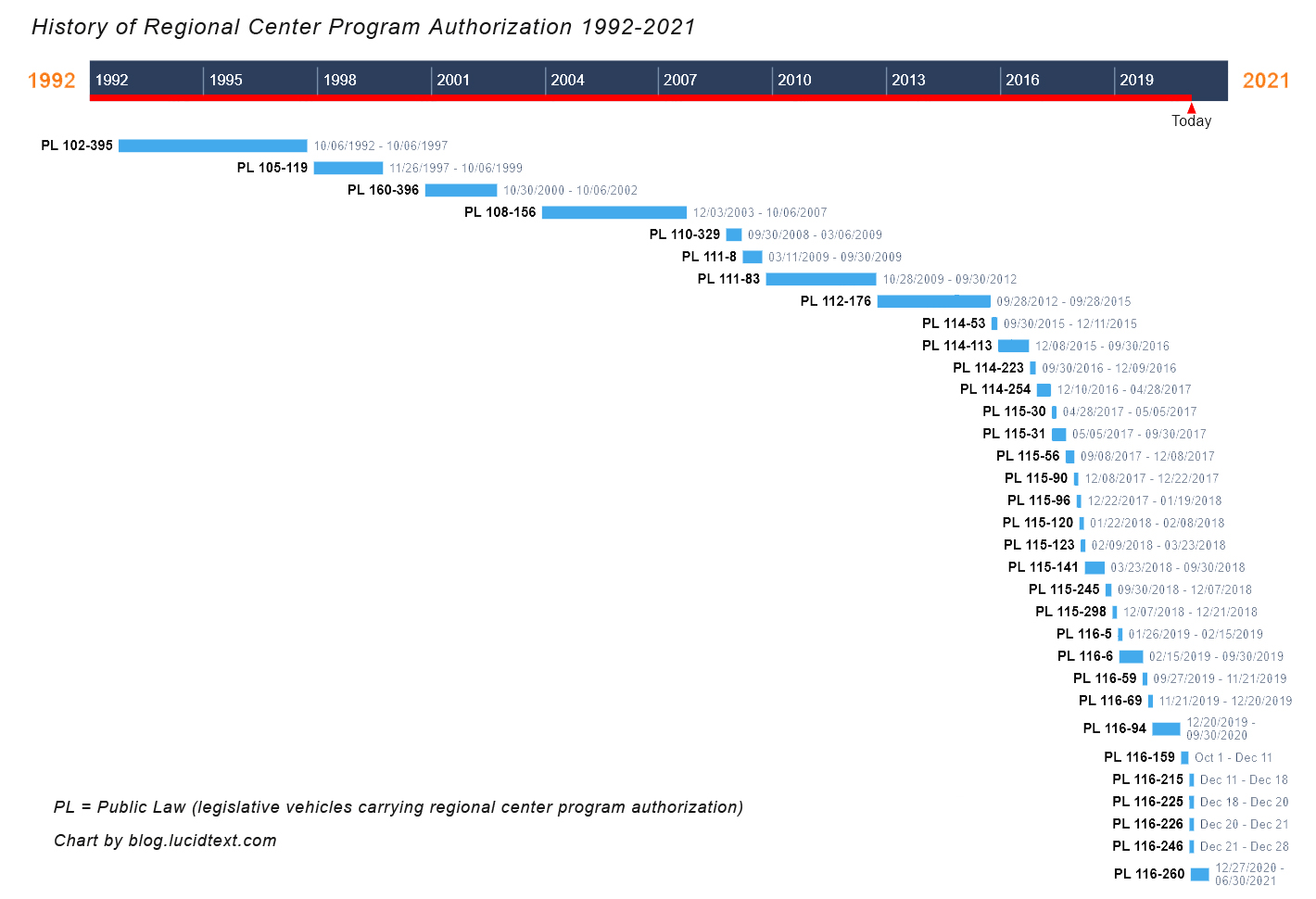
For a recent update on what’s happening with EB-5 legislation see “EB-5 Regional Center Program reauthorization: Will it happen this week?” (June 22, 2021) in Homeland Preparedness News. Senator Grassley has been still pushing to get a reauthorization bill to the finish line. People opposed to the Grassley bill would like to see that bill fail and a short-term extension – or least hope of a future short-term extension – instead. However, Senator Grassley says that he would rather see the program die than allow for such a short-term extension. The HPN article quotes Grassley staffer Taylor Foy: “Extending the program without the reforms ‘would be legislative malpractice,’ said Foy. ‘If they are not enacted by the end of the month, the program will die.’” Strong words, with little understanding or sympathy for the economic not to mention personal stakes involved. But disturbing, and I understand the frustration. The industry said “a short-term extension to give more time for legislation” in 2015, and again in 2016, and again in 2017, and again in 2018, and again in 2019, until 2020 when the removal of the regional center program from the appropriations process that had facilitated short-term extensions. The pattern of extensions since 2015 is clearly not sustainable. We are past time for stabilizing legislation.
The investor advocacy organization AIIA has published open letters to Senators Schumer, Grassley, and Leahy, calling on them to keep faith with past regional center program users. “With the reauthorization deadline looming and no sign of resolution of gridlock on this issue, AIIA would like to remind Congress about the importance of upholding the contract with existing immigrant investors.”
Meanwhile, the 2019 regulations that increased the EB-5 investment amount and changed TEA definitions have been vacated in court. This sends the matter back to current DHS leadership, which may choose to reinstate the regulation with the $900,000/$1.8M investment amount (and likely will, since Director Mayorkas already confirmed that he supports the 2019 regulation) and/or to Congress to include investment amounts and TEAs in future legislation (thus making the legislative battle even more wide-ranging and contentious than it is already). I’m watching the USCIS website for an announcement. While waiting for these things to happen, there maybe a limited window to make a $500,000 investment – in the case of the regional centers, an investment in reliance on an immigrant investor program that may offer no chance to immigrate. Not the easiest marketing pitch. But if the court win on regulations does prove effective for marketing, that will be great for U.S. businesses that desperately need funding, especially where offering documents allow businesses to keep and use the money regardless of whether or not the investors are practically able to pursue the immigration process. (Regional centers may consider using escrow to help share the risk.) Making an investment/filing I-526 locks funds into a private business, but those actions do not lock in a chance to get a visa from the government based on that investment. (I have a post coming soon on what does get “locked in” at various stages in the EB-5 process.) So it’s complicated, and the need for authorizing legislation continues.
Today, the US District Court for the Northern District of California ruled in favor of Behring Regional Center, vacating the 2019 EB-5 Modernization Rule. The court agreed that DHS had no authority to implement the 2019 Rule due to the unlawful appointments of the Acting DHS Secretary and Acting USCIS Director who were appointed during the Trump administration without confirmation by the Senate. The Court vacated the Rule and remanded the matter to DHS and it may take steps to reinstate the Final EB-5 Rule pursuant to Administrative Procedure Act’s rule-making process. DHS may also file an appeal and seek to stay the order while the appeal is pending. The current sunset date for the EB-5 Regional Center Program is June 30, 2021. Congress is already discussing various legislative proposals for EB-5 reform. With Behring’s legal victory, we fully anticipate final bills will increase the required investment amount. Our efforts are focused on achieving a long-term extension and meaningful EB-5 reform for a better and more sustainable EB-5 Program.
UPDATE: I will copy relevant articles here as they are posted.
The Investment Migration Report held a very substantive discussion with IIUSA Executive Director Aaron Grau on June 23 regarding the implications of the Bering case and reathorization deadeline. Recording here on Youtube.
EB5 Investment Coalition has decided to speak with the public, and holding a webinar on June 24 at 9 am EST. This is a chance to hear from the faction opposed to Senator Grassley’s legislation to reauthorize the regional center program, and how they see their efforts creating hope rather than spelling disaster for the future.
USCIS Updates Policies to Improve Immigration Services
Today USCIS announced policy updates “to clarify the criteria and circumstances for expedited processing; improve request for evidence (RFE) and notice of intent to deny (NOID) guidance; and increase the validity period for initial and renewal employment authorization documents (EADs) for certain noncitizens with pending adjustment of status applications.”
These actions are part of a series of planned improvements designed to modernize USCIS and “to eliminate policies that fail to promote access to the legal immigration system.” The USCIS press release quotes Acting USCIS Director Tracy Renaud: “USCIS is committed to promoting policies and procedures that ensure we operate in a fair, efficient, and humane manner that reflects America’s heritage as a land of opportunity for those who seek it.”
Yay! Looking forward to several more years of improvements like this!
AIIA Webinar Invitation
In debates over regional center program reauthorization, EB-5 legislation, and USCIS processing, EB-5 investors have had little voice and influence. A few investors are trying to change that, and have formed American Immigrant Investor Alliance, a non-profit organization with plans for investor-focused advocacy and community development activities. “AIIA hopes to provide investors a seat at the table with respect to the decisions that directly affect them. As investors, we believe our stories and our investments are the best representatives of the good that the EB-5 program brings to the United States.” Interested in this effort? The organizers are hosting an introductory webinar on Saturday, June 12 at 8 am PDT/11 am EDT to discuss goals and plans and invite participation. UPDATE: A recording of this excellent webinar is now available on YouTube.
Behring Companies Webinar Recording
On June 7, Behring Companies hosted a webinar covering topics including the Behring V Wolf et. al. lawsuit on the EB-5 regulations (including goals, arguments, and potential outcomes), EB-5 program reauthorization efforts, and reform priorities from a holistic perspective. Register to view the recording.
Know of other EB-5 advocacy events and activities that should be mentioned? Email me at suzanne@lucidtext.com
Another post with bits and pieces of news you should know in EB-5.
USCIS Leadership and Processing Improvements
Ur Mendoza Jaddou, the nominee for USCIS Director, made this statement to the Senate Judiciary Committee at her nomination hearing on May 19:
At the heart of a functioning immigration system is an agency that effectively processes immigration and naturalization applications under the law, like those of my family and so many others. This means that USCIS must process applications fairly, efficiently, and in a humane manner; be accessible, transparent, and accountable; and safeguard the integrity of the system; and ensure the security of the nation.
My most immediate responsibilities if confirmed will be to return the agency to firm solvency, resolve dramatically increasing processing times and backlogs, and utilize 21st century tools. I’ll work to ensure that USCIS retains the confidence of the American public as an agency able to fulfill its mission. In addition, I’ll work to ensure that the hardworking and dedicated men and women, my former colleagues at USCIS, have the resources, leadership, and support they need to carry out their roles without undue difficulty.
[Transcribed from Ms. Jaddou’s opening statement 1 hour and 23 minutes into the hearing video.]
Ms. Jaddou has significant experience working on immigration policy and she is very familiar with the operations of USCIS. Ms. Jaddou’s knowledge and experience would be indispensable in providing the critical leadership needed to stabilize the agency’s financial challenges, reduce its significant processing backlogs, and provide stakeholders with more consistency throughout the various adjudications processes it conducts every day. Throughout Ms. Jaddou’s public service, she has shown a keen understanding of how USCIS operations affect businesses across various industries. The Chamber is confident that she would continue to consider the views of the American business community on the issues that are critically important to the ability of many companies to meet their current and future workforce needs.
Ms. Jaddou presented herself well at the hearing, and did not get many questions. A couple Senators grilled her on the controversial issue of parole, and one asked about tackling petition backlogs. Regarding backlogs, she noted that she has a running start thanks to understanding all the small steps that go into creating processing times. I hope that she is confirmed soon! The Biden Administration has nice-sounding goals for restoring integrity to USCIS operations, and I’d love to see a few of them realized.
Visa Processing and Availability (Vietnam, China, FY2022 numbers)
Department of State Press Office has been doing a wonderful job with the YouTube live chats at https://www.youtube.com/user/TravelGov/videos In just a few minutes a month, Department of State reminds us that they have skilled, caring human beings ready to take and respond to public questions. Watch and learn, USCIS.
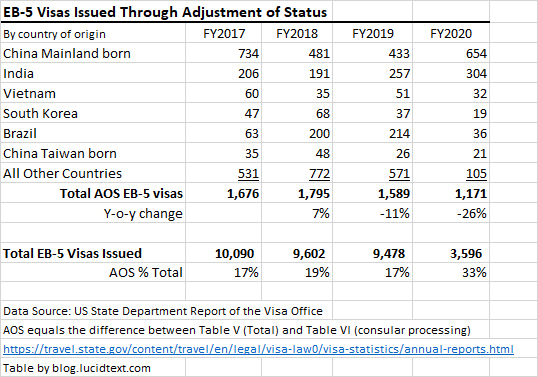
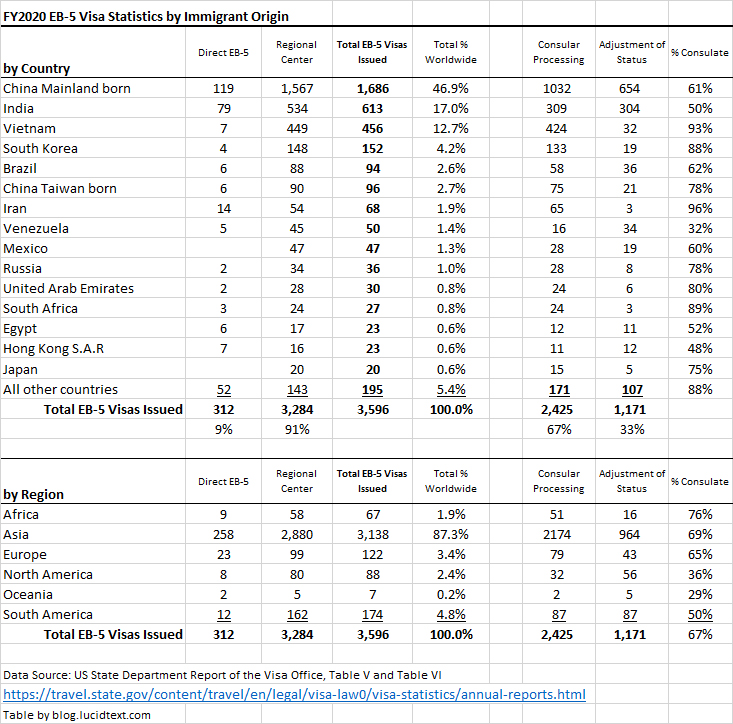
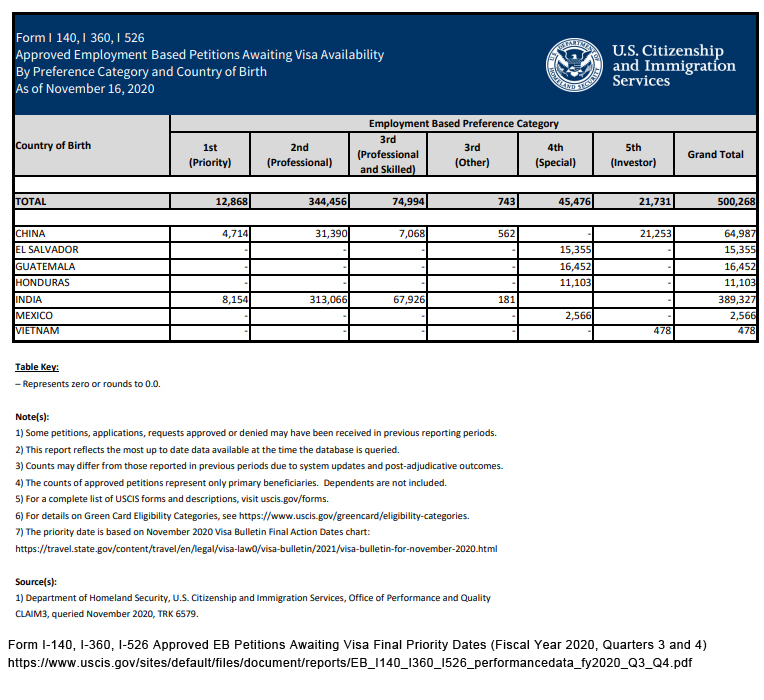
At the end of the June 2021 Visa Bulletin “Chat with Charlie” (minute 33) Charles Oppenheim mentioned “an excellent chance” that the Vietnam EB-5 Final Action Date will be “current” by September 2021. Current means that any Vietnamese who’s ready at the visa stage could proceed to final action then, regardless of filing date. Mr. Oppenheim did not give any background to this prediction, but we can identify two reasons: (1) slow I-526 processing limiting the number of Vietnamese who reach the visa stage, and (2) Vietnam’s excellent work in controlling COVID-19 and getting consular processing back on track. Judging by visa issuance so far, Vietnam may be the one country that may actually approach the 1,302 EB-5 visas technically available to each country in FY2021. According to statistics on monthly visa issuance, Vietnamese had received 541 EB-5 visas through consular processing as of April 2021. Ho Chi Minh City issued a heroic 320 EB-5 visas in March alone. If that kind of performance continues into next year, the estimated visa wait time for incoming Vietnam EB-5 applicants could be reduced from the expected 7-8 years to more like 5-6 years.
Guangzhou and Mumbai are still not doing well with EB-5. I count only 29 EB-5 visas issued to Indians and only 14 to Chinese through consular processing so far this year (October 2020 to April 2021). The consulates in China and India are issuing a small number of visas in all categories, and EB-5 sadly belongs to the “Tier 4” lowest level in Department of State’s priority list. The best hope for Chinese and Indian EB-5 applicants may be to catch up next year, when EB-5 will once again have additional visas available.
EB-5 visa availability in FY2022 will be increased by a share of the unused family-based visas that spill over from FY2021. In the “Chat with Charlie” video linked above, Mr. Oppenheim stated that he expected the FY2022 Employment-Based visa limit to be at least 290,000. That would mean EB-5 would get over 20,590 visas (7.1% of the EB total) and each country would get over 1,441 visas (7% of the EB-5 total). If consular processing is back to normal by then, and those extra visas could be issued, then India and China could at least counterbalance the losses in FY2021.
The June 2021 Visa Bulletin finally moved the China EB-5 Final Action Date from August 15, 2015 (where it’s been since last August) to September 15, 2015. In the “Chat with Charlie” linked above, Charles Oppenheim indicated that he expects to continue to move all EB dates aggressively, but mentioned China EB-5 as a specific exception to that rule. (For other EB categories, he predicted that the the “dates for filing” in the June 2021 visa bulletin will likely be the “final action dates” in the September 2021 visa bulletin). Department of State elaborated further in an AILA Liaison Committee Meeting on May 27, 2021. AILA had asked “2. Given that Guangzhou resumed IV processing on April 9th, how far does DOS expect the EB-5 final action dates to advance by the end of this fiscal year?” DOS responded: “The China EB-5 Final Action Date will be advanced based on estimates of visa availability under the FY 2021 EB-5 annual limit. Movement of the date is likely to be limited based on the large number of filings received during September 2015.”
EB-5 Regulations Litigation
I’ve avoided commenting on the litigation to invalidate the EB-5 Modernization Regulation – an effort that’s justified and that also risks derailing regional center program reauthorization efforts and being misrepresented to prospective investors. What makes an immigrant investor program attractive? One important factor: price. A more important factor: whether the program even offers a path to immigrate. That second factor is in question now, and must be resolved before the regulations can make a difference.
For expert analysis of what the litigation involves and could imply, see these articles:
Update: Behring Companies hosted a helpful webinar on June 7 to explain their goals and vision for the litigation, and expected outcomes. Recording available here.
Country Caps Legislation (EAGLE Act)
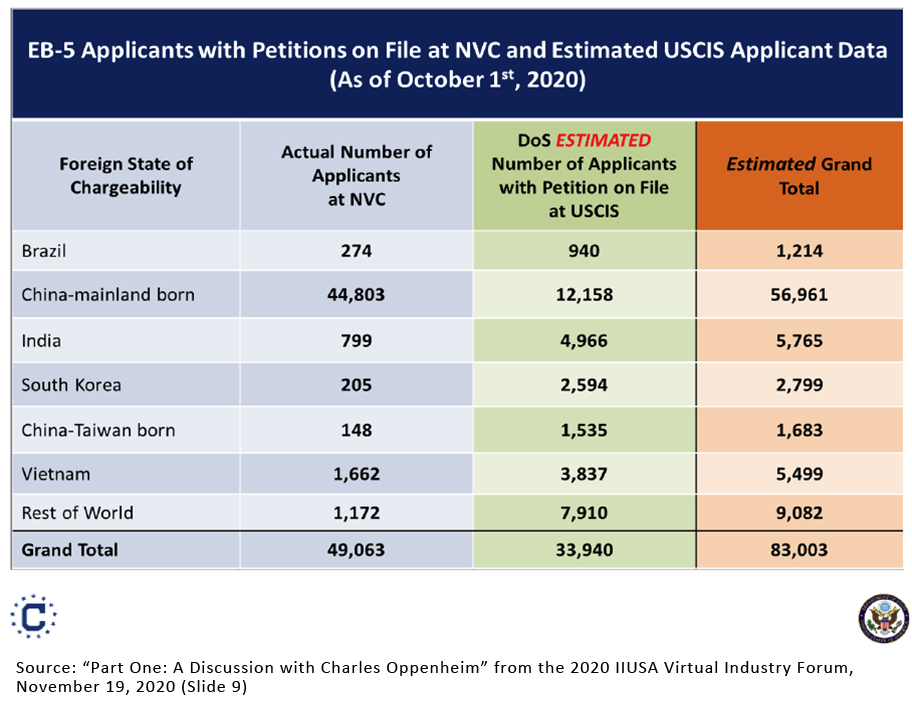
The country caps debate is now officially back on the table, as Rep. Zoe Lofgren has reintroduced the Fairness for Highskilled Immigrants Act, now called the EAGLE Act. The bill text reflects H.R.1044 from last Congress, and once again offers no transition period to protect in-process EB-5 investors, should the bill become law. (The proposed transition period and special provisions apply to EB-2 and EB-3 only, suggesting who’s paying for lobbying.) Country caps are what prevent high-demand countries from claiming all available visas in EB categories. If the EAGLE Act passed, then the EB-5 visa wait line would become simply first-come-first-served order, benefiting the tens of thousands of Chinese who have been waiting longest, and creating unexpected multi-wait times for applicants from most other countries. With over 80,000 people in the EB-5 wait line, a new investor from any country could expect to wait over 8 years for a visa. (I discussed the implications in this post.) Country caps legislation has been around for many years without getting passed. It managed to pass both House and Senate in last Congress, but didn’t end up on the President’s desk. We’ll see what happens this time around. Kamala Harris had co-sponsored the Fairness Act when she was a Senator.
Other Articles of Note
“The Corporate Rights of EB-5 Investors: How to Navigate the Legal Maze of Redeployment and Liquidation Once the EB-5 Investment is Repaid” by Vivian Zhu and Rogelio Carrasquillo May 2021 Regional Center Business Journal (p. 10)
I am once again a “Top 5 Business Plan Writer” in the EB5 Investors Magazine poll. A big thank you to my industry colleagues who have voted for me every year since 2016, and to clients who trust me with their business plans. I continue to enjoy the challenge of figuring out how to make EB-5 work for business.
The EB-5 Regional Center Program sunsets on June 30, 2021, unless Congress passes legislation to extend it. (I’ve been updating my Reauthorization Page with resources and suggested action items for this effort.) But still, even many people who want reauthorization hesitate to strongly support the legislative option on the table: Senator Grassley and Leahy’s S.831, and its House companion bill H.R.2901, sponsored by Rep. Stanton and with 13 co-sponsors so far. Why the hesitation?
There’s hesitation based on hope for X: X meaning an alternative to S.831/HR.2901. If you are a regional center, investor, or Congressperson who understands the economic, public policy, and personal stakes and wants the regional center program reauthorized, what’s in your best interest: (a) go all in to push now for S.831/HR.2901 (as IIUSA suggests), or (b) wait for X (as EB5IC suggests)?
Besides the risk of holding out for an alternative not yet available, let’s consider an important question: What is X? If there will be a future alternative to the Grassley bill, provided I wait long enough, what will it be, exactly? Whose interests will it represent? Will it avoid my problems with the Grassley bill, not create worse problems for me or my clients, have better politics to pass, and reward me for holding out for it?
Those wondering about options can and should pursue these questions. Although Alternative X is not on the table at the moment, it has existed and can be scrutinized. The great Grassley vs. Not-Grassley EB-5 debate has been actively on-going since before 2015, leaving an extensive paper trail at Congress.gov. We have the “good government” faction and the “holistic” faction. Both sides call what they want “reform,” but mean different things by that word. To Grassley, “reform” means regulating and directing EB-5. To the other side, “reform” means making EB-5 more accessible and usable. IIUSA currently supports the Grassley “good government” effort as the best and likely only path to long-term regional center program authorization. The “holistic” side has been associated with EB-5 Investment Coalition, Greenberg Traurig, U.S. Chamber of Commerce, and Senators such as Schumer and Cornyn whose constituents include the kind of big-city developers whose prolific EB-5 usage looks like abuse to Senator Grassley.
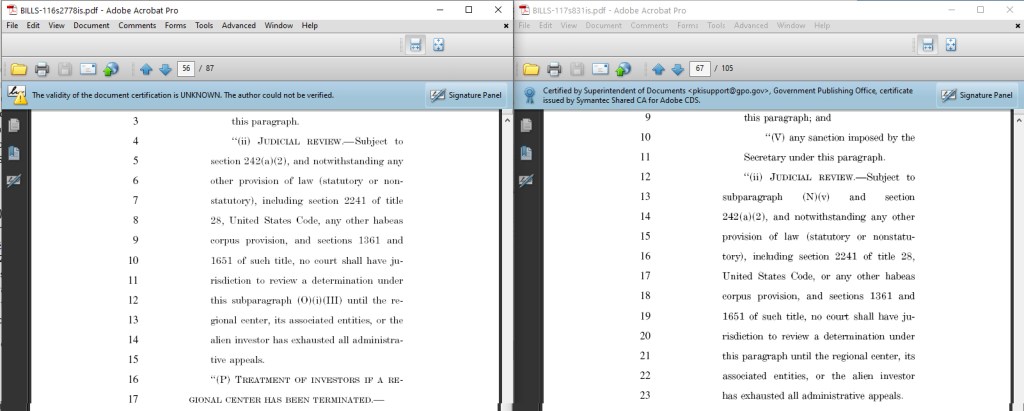
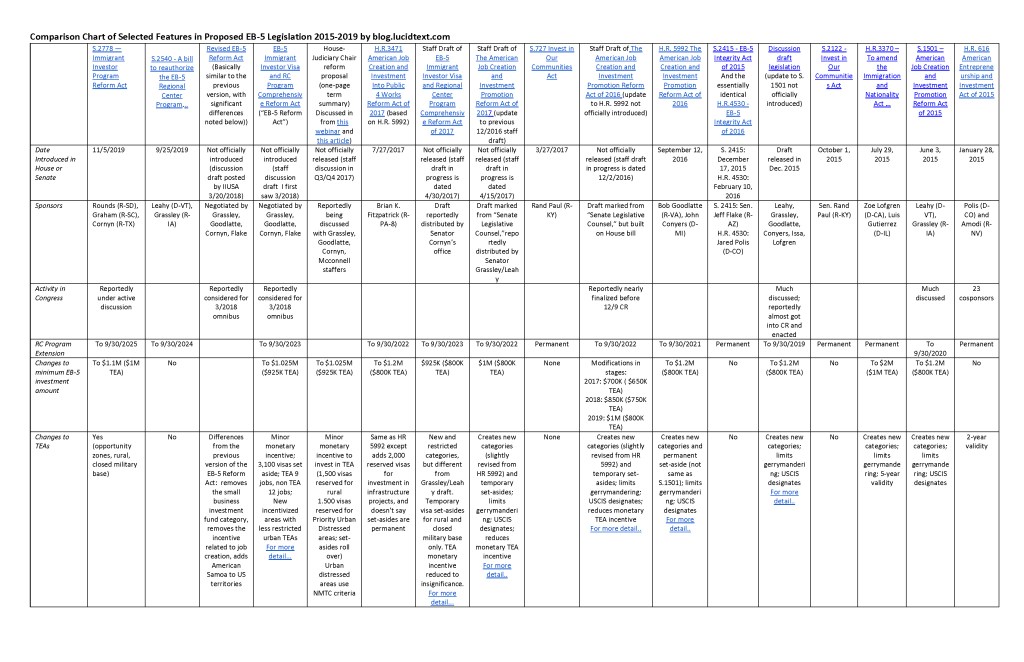
In 2019/2020, we had a Grassley/Leahy “good government” bill (S.2540), and also an alternative “holistic” bill (S.2778, introduced by Senator Rounds, co-sponsored by Senators Graham, Cornyn, and Schumer). For those holding out hope for a future alternative to Grassley, and looking for Schumer’s support, let’s scrutinize what the Holistic Faction previously negotiated in S.2778. You can pull up the text of S.2778 and S.831 at Congress.gov, and do a side-by-side comparison. (Keeping in mind that S.831 is current this Congress, and S.2778 is a bill from last Congress that might or might not be eventually updated and brought forward again.) A bill-to-bill comparison helps to look beyond the rhetoric, and think specifically about what has been offered by each side in the EB-5 debate. I highlight below a few key issues.
Comparison of the 2021 Grassley-backed legislation (S.831/HR.2901) with the most recent alternative legislation (the Schumer-backed S.2778 from 2019) across key areas
Limits on Judicial Review
The most broadly unpopular provisions in Grassley’s current S.831 are the limits on judicial review, and the requirement that petitioners exhaust administrative remedies (i.e. spend forever in the internal appeals process that almost always sides with USCIS) before suing USCIS over a denial or termination. EB-5 investors and service providers join in disliking these provisions. However, note that S.2778 included identical language on judicial review.I suppose that the judicial review limit has come from both sides because it’s probably the number one demand from USCIS to Congress. (USCIS has spent a lot of money recently being found wrong in court on EB-5 issues.).
Additional Fees
Another unpopular aspect of Grassley’s S.831: new fees that would further depress the market and particularly burden small regional centers. However, S.2778 proposed the same fees for regional centers and heavier fees for investors.
Fees in both S.2778 and S.831
Regional centers pay an annual fee of $20,000 (or $10,000 if the RC is non-profit or had under 21 investors)
Investors pay a $1,000 fee with each I-526 (called a Petition Fee or Integrity Fund Fee)
Monetary sanctions/fines up to 10% of total investor capital are authorized for non-compliant regional centers
Fees in S.2778 only
Investors pay a required $50,000 Program Improvement Fee with each I-526
I-924 applicants have the option to pay an additional $50,000 for premium processing (I-526 petitions with TEA investment are offered premium processing without fee)
I suppose that fees appear on all sides because fees are probably near the top of cash-strapped USCIS’s EB-5 legislation demand list for Congress. Also, the proposed regional center fees are not really a burden for any RCs prosperous enough to be lobbying, and could help eliminate their competitors. There’s no clear hope for an alternative when it comes to fees historically backed by all sides.
Reauthorization
Like S.831, S.2778 offered a 5-year extension to the Regional Center program. 5 years means people will need to stay at the negotiating table, because 5 years is not long enough to create program stability. Current EB-5 investor distress has informed the market that EB-5 immigration depends on regional center program authorization continuing on to the visa stage. New investors will hesitate to start a program that is at risk of expiring before it can deliver the promised return. If legislation says “Visas made available under subparagraph (A) shall be made available through September 30, 2025,” then the legislation will stay potent only so long as new regional center investors can expect to get visas before 9/30/2025 — i.e. not long, considering processing times. The market will soon be demanding a longer-term authorization.
Investment Amounts and TEAs
S.831 is silent on investment amounts and TEAs. The Holistic Faction is holding out for change in this area.
Senators Grassley and Leahy want to incentivize investment in rural and distressed areas, and they think that the November 2019 EB-5 Modernization Regulation already accomplishes this, with its $900,000 difference between TEA and non-TEA investment and TEA definitions. Therefore, they did not propose any investment amount or TEA changes in S.831. (They do not like the idea of EB-5 as a program for the very wealthy, but haven’t realized that it was not so, until the Regulation forced it to be so by doubling the EB-5 investment amount.)
The Holistic Faction wants to make EB-5 accessible, and seeks to vacate or legislate a replacement to the EB-5 Modernization Regulation. S.2778 proposed to reduce the TEA incentive to only $100,000 ($1.0M TEA; $1.1M non-TEA), and to redefine what can qualify as a TEA – including by incentivizing Opportunity Zone investments instead of high unemployment area investments. In 2019, Senator Schumer supported this proposal, which would have been good for New York. However, it happens that the S.2778 proposal would be bad for Schumer’s constituents in 2021, because COVID-battered New York City actually has significantly more high-unemployment area than Opportunity Zone area, and benefits under the existing TEA rules. IIUSA encourages New York constituents to point this out to their representatives. So I’m not sure what would be in the Holistic Faction’s future legislation with respect to investments/TEAs, if they introduced something. (Presumably they are not sure yet either, pending the outcome of regulations litigation.) But in any case, the investment amount and TEA incentives are moot if the regional center program lacks authorization to carry RC investors to the visa stage. From an investor perspective, $500,000 is just as much too high as $1.1 or $1.8 million, if for a low-interest equity investment with no reliable path to a visa. So Holistic Reform must prioritize long-term regional center authorization via legislation, before TEA or investment amount changes from any source or side can do regional centers any good.)
A spokesman for Senator Schumer told ABC in 2015, when the legislative battle we see today was already well underway: “Sen. Schumer supports reforms that will bring transparency and accountability to the EB-5 program, but strongly believes that the EB-5 program should continue to act as a catalyst for thousands upon thousands of jobs throughout New York.” A Schumer spokesman explained to the Wall Street Journal in 2017 that Schumer believes good projects in EB-5 “should rise to the top based on how many jobs they’ll create,” and that the government should not be trying to direct development to specific areas. What do you think? What will Congress and the Administration think, when it comes to having to pass bills? What message will Schumer want to send in 2021 about EB-5 reform, considering his donors and his image? Can we and he afford the optics of holding out for legislation that reduces TEA incentives very dramatically?
On the Grassley side, although S.831 does not change incentives to invest in certain areas, it does try to constrain the types of projects and investments that can use EB-5. Specifically, by restricting EB-5 investment in publicly-available bonds, and by requiring projects to have at least some economically-direct job creation impacts. Consider the rationale and impact of those restrictions, and the optics of resisting them.
Visa Backlog Provisions
High on the industry wish list for EB-5 legislation: visa relief. To regain viability and make additional economic contributions, EB-5 must have more visas. Today, over 80,000 people are already in line for EB-5 visas that can only be issued at a rate of about 10,000 a year. Country caps concentrate that backlog burden on the few countries that would normally drive EB-5 demand. That’s clearly a damper on program potential.
Grassley does not claim to offer visa relief. The Holistic Faction does hold out for visa relief. At least, that’s the rhetoric. The details are more ambiguous, if we look at what’s specifically in S.831 and S.2778.
Neither S.831 nor S.2778 offers additional visas to EB-5. (Additional visas seem to be a political impossibility, despite the need and potential reward. Even Biden’s generous U.S. Citizenship Act proposal was not generous to EB-5, proposing to reduce the EB-5 percent quota so that EB-5 would not benefit from a proposed increase to total EB visas.)
Both S.831 and S.2778 offer some provisions that would ease the visa backlog pain. Both offer “concurrent filing” of I-526 and I-485. S.831 offers most flexibility for petitioners to change course in the event of project and RC changes or problems that occur over the course of long wait times. S.2778 offered the best child status protection, providing that a child at the time of I-526 filing shall continue to be considered a child until removal of conditions.
Only S.2778 offered visa set-asides and a parole option. This is what the Holistic Faction calls visa relief. The offer also risks being called bait-and-switch.
The set-aside proposal is clever, if it’s effective. Let’s say I’m a regional center deploying EB-5 investment, and hoping to stay active in economic development. The longer my past investors wait for visas, the longer I can and must deploy their funds. In that sense limited visas benefit my efforts, since they create visa wait times that expand my time to use the EB-5 investment. However, limited visas are a problem for raising new capital, because I have nothing but wait times to offer my best prospects from high-demand countries. What I need is ideally to free up some visas to incentivize new EB-5 investment, while at the same time not reducing time under management for my existing EB-5 investment. Plus avoid the problem that politics do not allow adding additional visas for EB-5.
So what can be done? Why not go for the classic “rob Peter to pay Paul” strategy, removing visas from the pool available to past investors to offer them to new investors. This becomes possible with legislation for “set-asides,” proposing to take 30% of visas from the EB-5 quota, and reserve them for applicants making investments in newly-defined TEA areas. This could create a fast track around the backlog for new investors and incentivizes new EB-5 usage, with the profitable (for some) tradeoff of increasing time under management for redeployment funds, since past investors would progress more slowly with fewer annual visas available to the backlog. (Set-asides would primarily hurt the China backlog, which would see the “leftover visas” available to the oldest Chinese applicants (just over 4,000 in recent years, thanks to relatively low ROW demand) reduced by 3,000 annually.)
Before past investors cry about their deferred immigrant visa dreams, they can be comforted with the offer of a temporary, case-by-case non-immigrant option during their newly-extended wait: parole. “Parole” is a provision that can allow certain noncitizens to enter or remain in the U.S. for specific reasons, while not yet formally “admitted” to the U.S. (This CRS report goes into detail of what parole involves, why it’s been controversial, and how existing parole programs for special populations have worked.) Why should investors care about the receding EB-5 visa opportunity, if parole may allow them to still enter and stay temporarily in the U.S. without EB-5 visas, and possibly get work authorization? True, parole is temporary by definition — typically one year, with special parole programs offering two years (Haitian and Cuban programs) or at maximum five years (International Entrepreneur Program). True, parole means an option given to DHS, not a right necessarily granted to noncitizens, even when they qualify as part of a special population. (S.2778: DHS “may temporarily parole, in its discretion, under such conditions as the secretary may prescribe, on a case-by-case basis” and “may authorize” parolees to engage in employment, with “may” being the operative word. For reference, the CRS report linked above gives parole approval/denial statistics and DHS’s track record in actually implementing parole programs approved by Congress.) True, parole is ungenerous to spouses and children (in the IEP program, the spouse can only enter with the entrepreneur if he or she can independently argue significant public benefit.) But even a possible option for some EB-5 investors to enter the U.S. through parole for a short time is better than the status quo, which has no EB-5 parole option for anyone to ease wait times. Assuming that Congress could be convinced to give parole to EB-5 (it’s controversial even for Dreamers) and DHS agreed to grant it to many investors, why would the investors care about set-asides creating a longer wait for green cards and more distant EB-5 investment exit? They’re living in the U.S., at least for a couple years maybe, and maybe with their spouse — what more did they want? Maybe I can look my past investors in the eye and say “I support set-asides with parole; this is visa relief” and maybe the investors will look back and agree “Yes, that’s how it looks to us too. Thank you for being a good fiduciary. Supporting visa set-asides makes you and the industry look great. We’ll tell our friends and media how happy we are with the EB-5 deal.”
Speaking as Suzanne and not a hypothetical regional center, I see the visa set-aside proposal as the single greatest fault in Holistic Faction advocacy. I believe the best of people, and keep expecting advocates to say “Oh, I didn’t realize how bad this proposal is and looks in light of impact on backlogged applicants, but now I see and will not pursue set-asides anymore.” But that has not happened. I still hear set-asides mentioned by smart people as a top priority for holistic reform, and a prime reason to hold out for potential future legislation that includes set-asides. (Aside: it’s possible that set-aside language would actually neither hurt nor help anyone, if it were interpreted to not apply to new TEA investment but to simply duplicate the TEA set-aside that already exists in statute. The existing TEA set-aside makes no difference because it’s available to the backlog dominated by old TEA investment. If a mere duplication, then the Holistic Reform visa set-aside suggestion is not problematic, except as a meaningless red herring with no effect for or against visa relief or TEA incentive. But if it’s effective for new investment, then it’s paid for by backlog harm. If it offers a fast track to new investors, that means line-cutting around existing investors.)
Integrity Measures
Both the Grassley side and the Holistic Faction support integrity measures. S.831 and S.2778 differ in what they specifically offer, considering that Grassley prioritizes security and the Holistic Faction prioritizes usability. I’m not going to line everything up in this already overlong post, but you can make the comparison yourself. If there’s a restriction or requirement that you don’t like in S.831, check whether that language was also in S.2778. If you do like a protection offered in S.831, see whether S.2778 also offered that protection. [Update: I subsequently did this comparison myself; this Word doc has my notes FYI. Comparison shows that the two bills are actually very close when it comes to integrity measures, with S.831 having, if anything more limited language than S.2778 when it comes to most oversight requirements. The exception is that S.2778 excludes three integrity measures that are in S.831: making annual statements available to investors, fund administration, and regional center audits.]
For example, Aaron Grau of IIUSA mentions that S.831 opposition is coming in part from interests who do not like required disclosure of broker fees and conflicts of interest, and who do not want the S.831 prohibition on foreign government participation. However, note that S.2778 had similar language restricting involvement in EB-5 by foreign individuals and governments.
One significant difference is the account transparency/fund administration provision, which S.831 has and S.2778 did not. Fund administration and account transparency are powerful integrity measures from an investor and public policy perspective (directly addressing a common denominator in past problem deals), and also a significant hassle and expense for regional centers. Would an alternative bill with no fund admin/account transparency requirement be better, more likely to gain support, and worth holding out for? What about the requirement for regional center to make annual statements filed with USCIS also available to investors (a provision in S.831 and not S.2778)? That makes sense, right? How serious would integrity measures look, if they only involve making records available to opaque and sluggish USCIS?
Investor Benefits
Both the Grassley side and the Holistic Faction are primarily concerned with regional centers, and not necessarily going out of their way for immigrants. But each side has negotiated a few benefits. Both offer processing time improvements (S.831 by asking USCIS to adjust fees for efficient processing generally; S.2778 by asking for a premium processing option available for a fee and to TEA investments.) The best investor benefit in S.831 involves “treatment of good faith investors following program non-compliance” (with new flexibility to affiliate with different regional centers and NCEs if things go wrong, and not only in case of RC termination, as in S.2778). The best investor benefits exclusive to S.2778 were protection for children against age-out, and the possibility of parole. At the end of the day, no investor benefit is more important than regional center authorization, which determines whether or not regional center investors will be able to qualify for visas at all.
Conclusion
I aim to help with information, but cannot do much more than that. As one side or another suggests advocacy actions and opportunities, I include them on my Reauthorization Page. You can visit that page for ideas. If you know of relevant resources not mentioned on that page, please email me links and I will update. I want to be fair to all sides. The bottom line that must unite all efforts to some extent: no one benefits if we wake up on July 1, 2021 with a lapsed program, and uncertainty hanging over billions of dollars in deployed EB-5 investment. I believe that all sides are working to avoid that outcome. I hope that these efforts can be as thoughtful and informed as possible.
I’m sharing below a copy of my comment to USCIS, submitted yesterday in response to “Identifying Barriers Across U.S. Citizenship and Immigration Services (USCIS) Benefits and Services; Request for Public Input.” USCIS asked the public to suggest ways that USCIS “can reduce administrative and other barriers and burdens within its regulations and policies, including those that prevent foreign citizens from easily obtaining access to immigration services and benefits.” Where does one even start? In my comment, I tried to highlight EB-5 problems in context of specific USCIS questions and concerns, while suggesting achievable actions that I judge would help get at the root of those problems. (And I have a long list of other items to discuss shortly in forthcoming articles, as I get time free from business plan work to post more on this blog.)
TO: Tracy Renaud
FROM: Suzanne Lazicki, Lucid Professional Writing
SUBJECT: DHS Docket No. USCIS-2021-0004
DATE: May 19, 2021
1 Assessing Burdens
(2) Are there any USCIS regulations or processes that are not tailored to impose the least burden on society, consistent with achieving the regulatory objectives?
Problem: Are there any USCIS regulations or process from recent years that were tailored to impose the least burden on society? In her July 2019 Statement for the House Judiciary Committee, Sharvani Dalal-Dheini described her experience at USCIS.
Throughout most of my career at USCIS, any time new policies and procedures were being discussed, there was an informal, but almost automatic reflex to sincerely consider the operational impact it would have on adjudications and the overall effect it would have on the budget. … Things changed in 2017 when a new group of political leadership took the reins and were eager to get out new policies at any cost. As new policy measures were being discussed, we were told that “operational concerns don’t matter.” It became clear that operational, legal, and financial concerns were no longer co-equal voices at the table, but rather policy goals and vetting took the favored child status. [1]
Ms. Dalal-Dheini’s testimony gives many specific examples of burdensome policies and procedures initiated under the leadership attitude that “we are not a benefit agency, we are a vetting agency”[2] and “operational concerns don’t matter.” So long as leadership declines to count costs and considers barriers as a value, then burdens and barriers will proliferate.
Solution: Today, I suggest that the single most important change that new USCIS leadership can make is to say at every table: “we administer benefits” and “operational concerns do matter.” When leadership places a priority on efficiency as well as integrity, then specific efficiencies will naturally result. When leadership cares to count operational and financial burdens, then specific burdens will naturally tend to be noticed and reduced where appropriate.
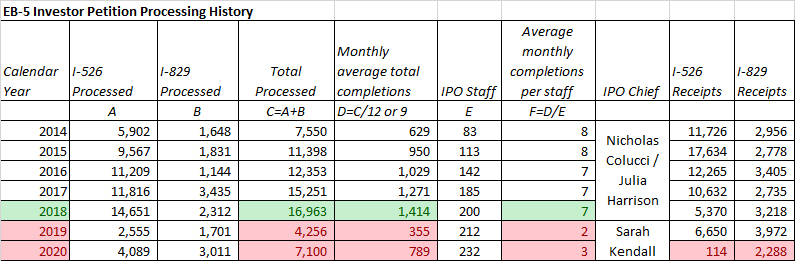
Example with Data: As an example, consider the performance of the USCIS Investor Program Office (IPO), and how productivity rose and fell as a function of leadership priorities.
Table 1. Performance History for EB-5 Forms (I-526 and I-829) at the Investor Program Office[3]
In her first year as IPO Chief, Sarah Kendall succeeded in making the Investor Program Office four times less productive than it had been previously, and processing times ballooned. In her second year, new EB-5 form filings fell to historic lows. Plummeting receipt and adjudication numbers reflect a variety of specific barriers and burdens implemented under her leadership, but fundamentally follow from the basic attitude discussed above — “we are a vetting agency” and “operational concerns don’t matter.” Sarah Kendall repeatedly emphasized during her tenure that “Program integrity is at the forefront of everything we do. IPO is continually fielding questions from Congress and others on performance in this area.”[4] She did not place a value on efficiency, and performance data shows the result. Today, the single best way to reduce barriers and burdens in EB-5 would be to put new leadership in place who will say “Integrity and efficiency are at the forefront of everything we do, and we are continually fielding questions about our operational effectiveness.”
2 Promoting Equity
(3) Are there USCIS regulations or processes that disproportionally burden disadvantaged, vulnerable, or marginalized communities?
Problem: Long USCIS processing times disproportionally harm the most vulnerable. This is obvious in theory: who suffers most from a long wait for a benefit? The one who most needs the benefit. It is also evident in practice.
Take the example of EB-5, where the processing time for I-924 Application for Regional Center has been posted at three to five years. Which kind of project can best afford to wait three years for USCIS review: the wealthy urban project that can proceed with or without EB-5 immigrant investors, or the project in a distressed area that depends on EB-5 to proceed? With unpredictable multi-year processing times for I-924 and I-526, EB-5 can hardly do what Congress intended: promote investment in vulnerable areas, in projects where economic impact and job creation are contingent on EB-5 investment, and thus on EB-5 processing. Instead, long processing times privilege the strongest projects best able to proceed without EB-5 and create jobs regardless of EB-5 delays.
Data Example: To confirm and quantify the disproportionate negative impact of long USCIS processing times in EB-5, USCIS could request the following data from the Investor Program Office: (1) trend in number of direct EB-5 vs. regional center I-526 filings (with direct EB-5 generally involving small business and individual entrepreneurs for whom long processing times present a particular barrier); (2) trend in the number of projects in first tier cities vs. small cities and rural areas (with small areas most dependent on the EB-5 investment and thus the timely processing); and (3) trend in the amount of EB-5 investment used to replace existing financing, rather than directly fund project costs. Anecdotally, I see ballooning EB-5 processing times correlate with a trend toward EB-5 investment seeking the large and fully-funded urban projects best able to weather USCIS processing delays. This pushes EB-5 from a job-creating to a mere capital-cost-reducing program, contradicting Congressional intent for EB-5.
Solution: USCIS should place a value on efficiency and well as integrity, realizing that long processing times are not equitable.
3 Data Sources
(6) Are there existing sources of data that USCIS can use to evaluate the post-promulgation effects of regulations and administrative burdens over time?
a. USCIS should analyze and learn from its own data as reported on the Immigration and Citizenship Data page.[5]
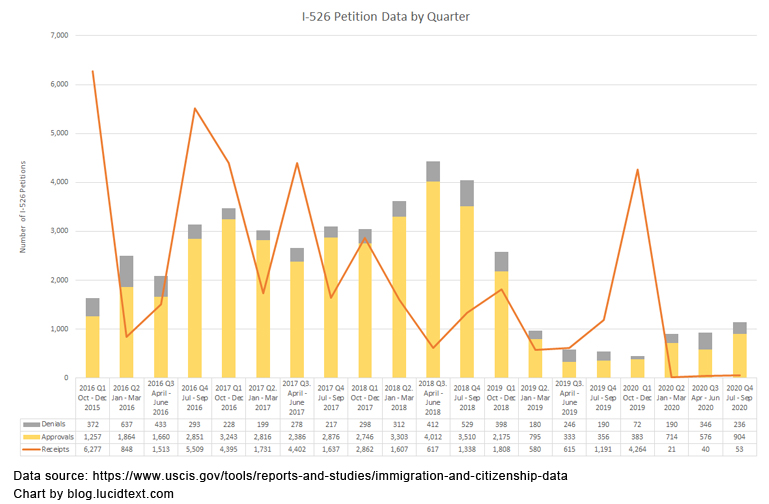
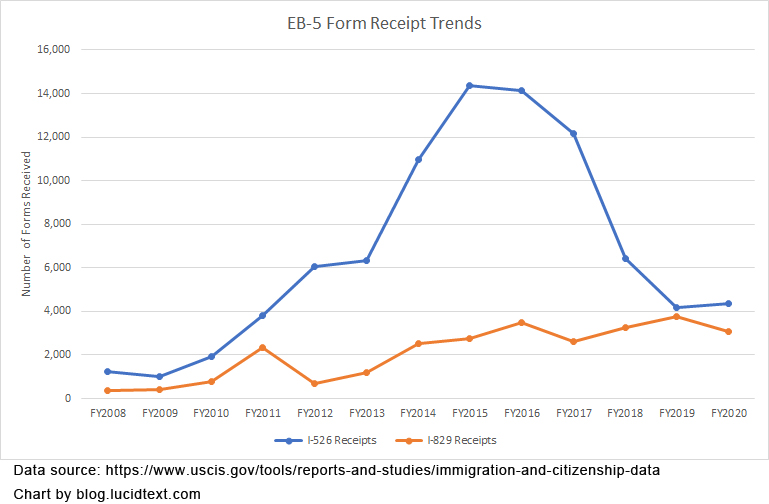
Receipt data: USCIS should regularly analyze trends in receipts for each Form type. Falling receipts means depressed demand, which likely reflects a barrier or burden. For example, data shows that I-526 receipts fell 98% following implementation of the EB-5 Modernization Regulation in November 2019 (comparing I-526 receipts in the three quarters before and after the regulation took effect). That Form receipt data point is obviously relevant to understanding the impact of the regulation on potential immigrants.
USCIS’s own receipt data is also critical when budgeting for Fee Rules. According to OMB Circular A-25, fees should be set “based upon the best available records of the agency.” But the 2019 Fee Rule relied on estimated “projected workload receipts” dramatically at odds with actual workload receipts as published on the USCIS Citizenship & Immigration Data page. For example, the 2019 Fee Rule had a “projected workload” of 14,000 I-526 receipts for FY2019/2020 even as USCIS had reported barely 5,000 I-526 receipts for FY2018/2019. This resulted in the 2019 Fee Rule massively overestimating future Form I-526 revenue, not to mention failing to account for funds needed to cover the burden of processing the large backlog of pending I-526 from previous years. Such oversights could have been rectified, had USCIS consulted its own data for form receipts and inventory.
Approval and denial data: USCIS should regularly analyze trends in adjudications (approvals plus denials) for each Form type. Falling adjudication volume reflects falling productivity at USCIS, which flags a barrier. For example, data shows that Investor Program Office productivity was 77% lower in FY2020 than in FY2018 despite staffing increases (comparing the number of approvals and denials of Form I-526, I-829, and I-924 between those fiscal years). That productivity data point flags management problems at IPO, and raises questions about new EB-5 policies and procedures that resulted in making adjudications three to four times more time-consuming than previously.
RFE data: USCIS should regularly analyze RFE trends for each form type. When an increasing percentage of cases are receiving an RFE, this flags a burden that can then be scrutinized. Educated by data, management can ask: why are more RFEs being issued? Have standards changed, and if so, how? Are the changes reasonable and operationally justifiable? Were the changes announced? Could the situation be improved by clarifying Form instructions or other guidance, so that petitioners know to provide correct and complete information upfront to avoid RFE?
Cost data: USCIS should examine trends in the amount of money it has spent defending against litigation. When constituents resort to suing USCIS, this signals frustration levels with barriers and burdens that need to be addressed. It also invites management reflection about how funds might be better used to address problems before they become lawsuits. For example, USCIS could reduce Mandamus litigation significantly by the simple expedient of improving the USCIS Processing Times Report. A confusing and misleading methodology and obviously unreasonable “case inquiry date” on the Processing Times Report create needless frustration and attracts lawsuits.
Data reporting: To the end of making its own data useful for management, USCIS should improve its data collection and reporting. The “All Forms Report” on the USCIS Immigration and Citizenship Data page may take the prize for Worst Data Presentation of All Time. The report makes every data point impossible to read without a magnifying glass, omits historical data needed to identify trends, and stymies Form-specific analysis. And yet this report is the only data source for many USCIS forms. Even Excel could take minutes to generate individual reports of USCIS form data, if USCIS valued data transparency and data-based oversight enough to generate readable and actionable reports.
b. USCIS should attend to existing public feedback about USCIS operations.
I recommend USCIS to review testimony presented at the House Judiciary Committee Hearing on “Policy Changes and Processing Delays at U.S. Citizenship and Immigration Services” held on July 16, 2019.[6] This hearing gathered detailed feedback from a wide array of constituencies on specific barriers and inefficiencies at USCIS, specific costs associated with those barriers, and suggested solutions. It is not clear that USCIS noted or responded to any of the excellent input offered at this hearing.
I recommend USCIS to review public comments made in response to USCIS Policy Manual updates.[7] We the public put great effort into providing detailed feedback on the practical impacts of policy changes, and no one even reads the Policy Manual feedback so far as we can tell.[8]
I recommend USCIS to review input provided to the CIS Ombudsman. The Ombudsman and the public expend considerable effort to identify and diagnose performance problems, and then USCIS does not respond.[9]
4 Form I-526 Inconsistency
Problem: The evidence requested in the Form I-526 and Form I-526 Instructions does not align with evidence checklists provided to adjudicators who review Form I-526. This inconsistency is evident to the public from (1) Requests for Evidence, which routinely quote standardized evidence lists not included in the Form I-526 or I-526 Instructions, and (2) materials from “Immigrant Investor Program Office Training May 8, 2019” (obtained via FOIA request) which instruct adjudicators to request evidence that the Form I-526 and Instructions do not request.
For example: no public-facing guidance requests I-526 petitioners to prepare source of funds documentation for non-EB-5 investors in the New Commercial Enterprise. This category of evidence is not mentioned in the Form I-526 Instructions, not in the Form I-526 Filing Tips or Suggested Order of Documentation for I-526 published on the USCIS website. The EB-5 regulations could justify requesting this category of evidence, but in practice USCIS evidence collection documents and guidance do not request it. (Possibly, because it’s obviously unreasonable to ask a petitioner to prove the source of funds for unrelated third parties who happen to have invested in the same project, and are not seeking immigration benefits.) But if an unreasonable information request exists, it should at least be published. No one benefits from lack of transparency upfront about required evidence. Petitioners cannot know to prepare evidence that USCIS does not request.
Solution: The May 2019 IPO Training discloses the existence of the following three internal “adjudication worksheets,” each of which is accompanied by an “instructional guide”: Form I-526 Worksheet; EB-5 Project Review Worksheet; Form I-526 Deference Worksheet. USCIS should review the content of those adjudicator worksheets and instructional guides, and identify discrepancies with the public I-526 Instructions, Filing Tips, and Suggested Order of Documentation. Then revise the internal and/or the public guidance and instructions as needed so that everyone is on the same page about what is required for I-526 adjudication.
5 Form I-924 Inefficiency
Problem: Form I-924 is problematic because it uses a single form, single fee, and single processing workflow for a variety of applications that are entirely different in their workload and processing needs: initial application regional center application; request for project review; required regional center amendment; optional regional center amendment. Regional centers are discouraged from sending optional updates to USCIS (e.g. new contact information) because such updates use the same form and thus involve the same $17,795 fee as a labor-intensive new application. Regional centers are discouraged from getting optional project review from USCIS – a step that’s extremely valuable for program integrity – because that project approval uses the same form and thus promises the same deadly 3-5-year processing time as an initial application.
Solution: Create separate forms, fees, and processing workflows for the separate processes currently combined in Form I-924.
6 Data Reporting: Country-Specific Demand Data
Problem: USCIS does not report country-specific demand data for numerically limited categories (i.e. receipt data for petitions in categories with limited visa availability).
Specific example of why this is a problem: EB-5 is a numerically limited category subject to country caps, with future backlogs and visa waits created by the number of people by country who start the process by filing Form I-526. Thus, preparing for backlogs and wait times requires data for the number of I-526 receipts by country. USCIS regularly collects and reports this data to Department of State for planning purposes, but has persistently not only neglected to but positively refused to share such data with the public. I-526 receipt data by country is not published on the USCIS Immigration and Citizenship Date Page. Furthermore, the Investor Program Office Customer Service has repeatedly declined to respond to public inquiries requesting this information[10], Freedom of Information Act Request soliciting this information have gone unanswered[11], and the one country-specific I-526 inventory report briefly provided by USCIS was subsequently deleted from the website[12].
Lacking visibility into I-526 receipt numbers by country, businesses and prospective EB-5 immigrants cannot predict or plan to avoid future backlogs and excessive visa wait times. The public is left with no visa backlog signal except the visa bulletin (which reports on past visa wait times rather than signaling future wait times), and periodic non-public industry event presentations from Department of State.
Lack of country-specific I-526 data reporting led to the quiet buildup of a decade-long EB-5 visa backlog before China-born prospective immigrants became aware of the problem, and were empowered to choose to avoid it. [13] This unfortunate history promises to repeat today for India, whose EB-5 backlog situation may be severe but is not yet publicized. U.S. businesses today are still recruiting EB-5 investor applicants from India and making business plans assuming a five-year investment horizon, looking at the Current visa bulletin. They are unable to account for the number of India I-526 filed with and pending at USCIS, because USCIS refuses to publish this information. This lack of transparency from USCIS is a major integrity problem and needless process barrier.
Solution (EB-5 example): Start publishing these two data reports regularly on the USCIS Immigration and Citizenship Data Page:
Essential: quarterly I-526 receipts country (top 8 countries + rest of world)
Ideally also: I-526 pending inventory itemized by country (top 8 countries + rest of world) and by month or quarter of filing date
Alternatively or additionally, publish the I-526 data report that the USCIS Investor Program Office already generates monthly and provides privately to Charles Oppenheim of Department of State for visa bulletin reference.
Publishing demand information will help to prevent pileup of expensive and painful backlogs by educating the public and facilitating self-regulation. Publishing visa demand data would conform to the project management best practice to “elevate the constraint” with respect to the visa limits that constrain immigration processes.
7 Data Reporting: USCIS Processing Times Report
Problem: The USCIS Processing Time Report[14] is confusing and creates costly frustration. It reports an “estimated time range” for each form, where the first month represents the median age of recently-adjudicated cases, and the second month represents the age of extreme outliers in recent adjudications (the 7% oldest cases)[15]. The second number – the age of extreme outliers – is then used to calculate a “case inquiry date” which limits who can use normal channels to inquire about case status. According to the stated method, only the low month in the “estimated time range” represents something like normal processing – i.e. the median age of recent adjudications. And yet, the report stipulates a case has to be older than 93% of cases recently adjudicated before the petitioner can even make a case inquiry.
Example of why this is a problem: According to the current USCIS Processing Times Report, the median processing time for recent non-China I-526 adjudications is less than 31 months, and yet a given petition cannot be considered “delayed” or make an inquiry unless it has waited over 49.5 months for adjudication. In April 2021, I-829 had a “case inquiry date” in the year 2000, meaning that no I-829 petitioner could even inquire about status unless he or she had already been waiting over 20 years for I-829 adjudication. These metrics are too-obviously unreasonable, create frustration, and lead petitioners who have above-average wait times yet barred from ordinary inquiries to jump to costly litigation. In EB-5, Mandamus litigation has become “the new normal”[16], creating needless expense for immigrants and USCIS.
Solution: Revise the USCIS Processing Times Report to calculate the “Case Inquiry Date” from the low end (median) rather than the high end (extreme outliers) of the “Estimated Time Range.” This will allow for reasonable inquiries, short of litigation.
To make the USCIS Processing Time Report less misleading, report an average as well as a median processing time.
[3] Data for I-526 and I-829 receipts and processed (approvals plus denials) from the USCIS Immigration and Citizenship Data page. Reported numbers of IPO staff from EB-5 stakeholder meetings and Congressional testimony.
[11] For example, I have been waiting for over a year so far for response to my FOIA request COW2020000203 submitted in March 2020 for country-specific I-526 data. EB-5 industry trade association IIUSA has made many FOIA requests for country-specific I-526 data that are still pending – for over three years, in some cases. https://iiusa.org/blog/iiusa-foia-information-court/
[13] Excess volume of I-526 filings from China apparently began in 2013, but not well-known until 2017 with the publication of the CIS Ombudsman Annual Report 2017, which reported that Chinese nationals “will likely wait 10 years or longer for their EB-5 immigrant visas due to oversubscription.” The China EB-5 market then regulated itself after 2017, thanks to this education, but too late for thousands of U.S. businesses and investors who had already made investment decisions in ignorance of decade-long wait times resulted from un-reported country-specific usage.
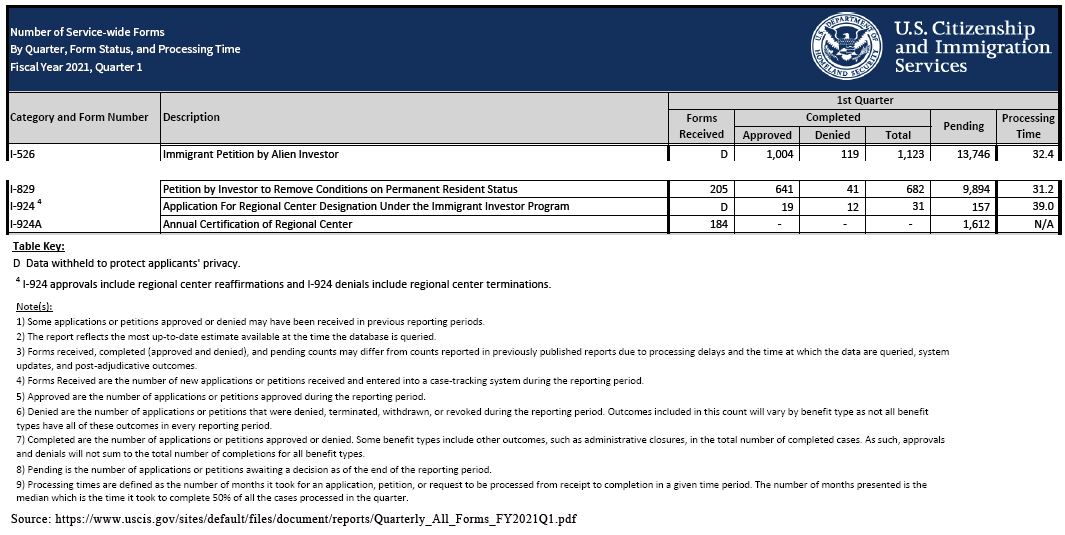
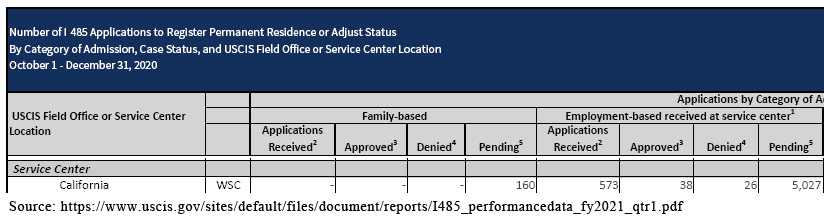
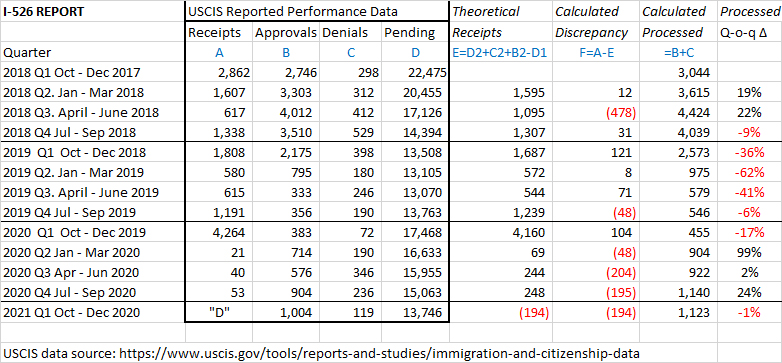
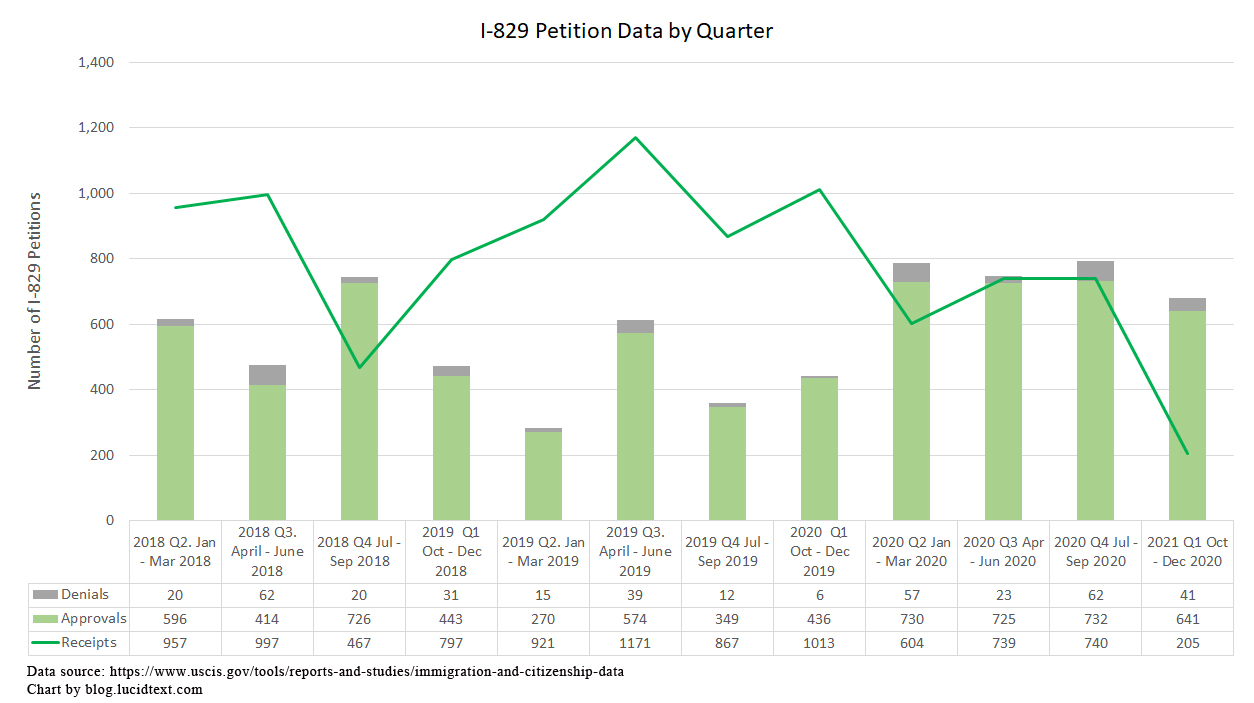
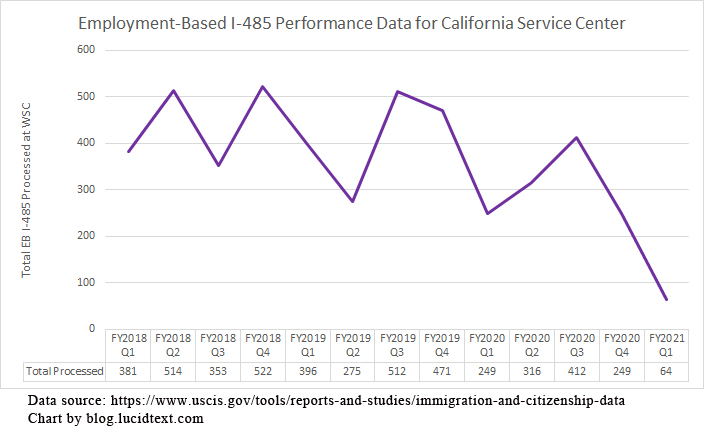
The USCIS Citizenship & Immigration Data page has published performance reports for FY2021 Q1 (October to December 2020), with data for EB-5 form receipts and adjudications. Since the full reports are formatted to be almost unreadable, I clipped out content most significant to EB-5 from the All Forms report and I-485 report. These summaries are followed by notes and charts that put the FY2021 data in context of previous reports.
General Comment
Overall, the numbers for October 2020 to December 2020 show low receipts, low productivity, and a faulty record-keeping system. But this time period represented dark pandemic days, and lingering Trump administration leadership on immigration. So I do not consider the period characteristic, or necessarily indicative for future performance. I am not ready to predict the current/future trends until I hear from new USCIS leadership, and start to see performance data for this year.
Report Format
For the first time, the All Forms performance report adds columns for total processed petitions, and processing times. That’s nice.
As with the annual report, the quarterly-report processing times are significantly lower than the median times reported day-by day for the same period. (For example the USCIS Processing Times Page reported median times for I-829 of 35 months in October, 36.5 months in November, and and 33 months in December, per my log of contemporary reports. And now this quarterly report states that 50% of I-829 processed October to December 2020 took less than 31.5 months to process.)
I-526Performance Data Notes
The I-526 data reported for FY2021 Q1 shows that USCIS struggles to count inventory, even after taking over three months to generate the report.
We don’t know how many I-526 were filed in Q1, because the report gives a letter “D” in place of I-526 receipts. The report code explains that “D” means “Data withheld to protect applicant’s privacy.” Another definition could be “Data withheld to disguise our counting errors.” In theory, last quarter’s period-end pending petitions plus this quarter’s receipts minus this quarter’s approvals and denials (which also includes withdrawals) should equal this quarter’s period-end pending petitions. If that equation gives a false result, then something’s wrong with USCIS data reporting. Doing this equation quarter by quarter (as I do in a table below), shows discrepancies every quarter. Using the equation to solve for receipts in FY2021, I see that “D” masks a negative number: -194 to be exact. EB-5 demand would plausibly have been low October to December, but can’t have been actually negative! So USCIS must have miscounted approvals/denials or pending in Q1, or possibly compensating for errors in previous quarters. This quarter’s I-526 report is not very helpful, except as additional ammunition for Mandamus lawyers demonstrating to judges that USCIS self-reporting is confusing at best and unreliable at worst.
I-829 Note
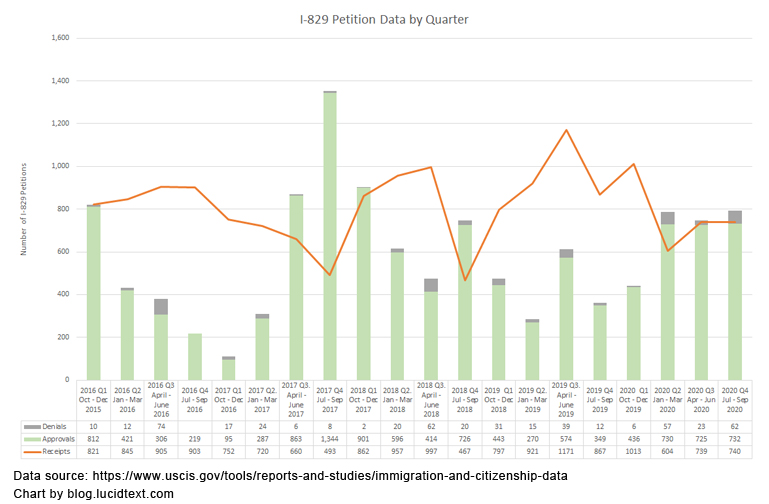
I-829 receipts were down significantly in FY2021 Q1, and calendar year 2020 overall. In theory, I-829 filings to remove conditions should be fairly steady, reflecting the steady pace of EB-5 visa issuance two years previously. When I-829 receipts fall, I worry that some disaster befell the cohort of EB-5 investors who entered the U.S. 21 months earlier. I want I-829 numbers to show success through to the EB-5 finish line. (Update: BOS InvestorVoice makes a good point in the comments: USCIS struggled in 2020 to issue I-829 receipt notices, with mutliple I-829 applicants reporting severe delays just to get the notice. That could explain low recorded receipt numbers even if I-829 submissions were in fact as high as ever.)
On the bright side, I-829 processing productivity only fell a little in Q1, and the approval rate remained high (94%).
Investor Program Office Productivity
Between Q3 and Q4 2020, IPO had exhibited an encouraging 16% increase in number of forms processed (I-526 plus I-829). Q1 FY2021 regressed again, with 7% fewer forms processed than the previous quarter. Sarah Kendall left IPO after November 2020 according to her LinkedIn page, so FY2021 Q1 represents the end of her direct influence. I warmly hope that future FY2021 reports will show the positive effect of new leadership at IPO (though Kendall still looms as USCIS Regional Director). IPO has so much room for productivity improvement, considering that they used to regularly process three times more forms with fewer staff than they have today.
I-485 Note
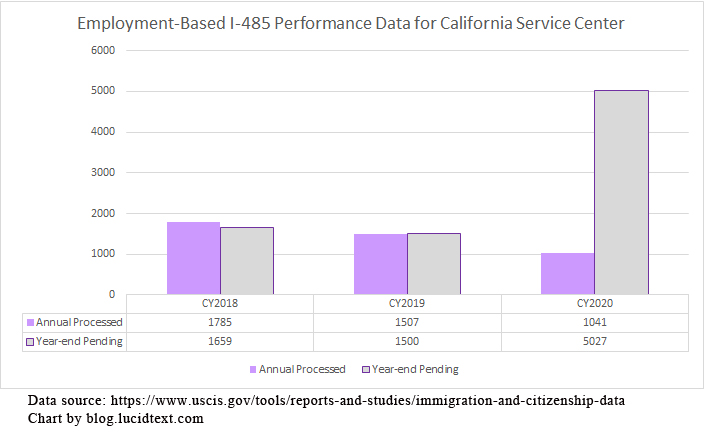
I do not usually report I-485 data because USCIS does not itemize EB-5-based I-485. The report just gives aggregate numbers for all EB category visas. However, this post highlights employment-based I-485 performance data specifically for the California Service Center, which I understand is responsible for most (all?) EB-5 I-485 decisions, and which is apparently having a meltdown. In FY2021 Q1, the California Service Center approved a record-low only 38 Employment-Based I-485 per the report (having previously averaged 300-400 EB approvals per quarter), and ended with a record-high backlog of 5,027 Employment-Based I-485 pending. Ms. Mendoza Jaddou, please hurry up and get confirmed as USCIS Director, and then find out what’s going on at the California Service Center. No one wants to see the processing times that will result if 5,000+ Employment-based I-485 continue to get processed at a rate of fewer than 100 forms per quarter. If indeed EB-5 I-485 are all ultimately forwarded to the California Service Center for adjudication, how about reconsidering that decision in light of recent performance? Too many EB-5 visas have been lost already.
Plug
Collecting and processing EB-5 data has become increasingly difficult and time-consuming. If my analysis helps you, please consider a PayPal contribution to support my work. Thank you!
I am not currently promoting my I-526 timing estimate service, due to limited recent information. After I see 2021 data and hear from new leadership at IPO, I will be better able to judge the current trend and make educated estimates about the future.
Today DHS published Request for Public Input: Identifying Barriers Across USCIS Benefits and Services. This request aims “to better understand and identify administrative barriers and burdens (including paperwork requirements, waiting time, and other obstacles) that impair the functions of the USCIS process and unnecessarily impede access to USCIS immigration benefits.” Thank you Secretary Mayorkas! Yes, we have input for you.
Click on the above link for instructions for how to submit effective comments. Note that the comment due date – originally written in error as today – has been updated to May 19, 2021. If anyone would like to hire me for EB-5-specific comment writing service, I am available and bring a successful track record. The Final Rules on the EB-5 Modernization Regulation and the 2019 USCIS Fee Rule both quote extensively from comments that I submitted on the proposed rules. My strategy is to be rigorous and draw on my massive repository of data and citations.
Reauthorization
The best news I have on the push for regional center program authorization is that EB-5 giant Robert Divine has published an article in EB5 Investors Magazine: “The problem with EB-5’s reliance on temporary legislation.” In just 600 unminced words, Mr. Divine explains the reauthorization situation and what’s at stake for investors, industry, and the country. If I were writing to my representative to press for reauthorization, I would attach Mr. Divine’s article as clear, honest, and authoritative background reference. If I shared anything on social media, I’d share this article as a call to action. And I’d like to give a standing ovation to this conclusion from the article:
Congress should at least provide that the regional center legislation in effect at the time an investor files Form I-526 will remain in place throughout those waits until the investor can remove conditions on permanent residence through adjudication of Form I-829. The United States is a country of laws designed to protect reasonable expectations. This nation should not be encouraging people to invest to create jobs for us without protecting the reasonable expectations of investors who take the risk of such investment.
I continue to update my Reauthorization page as I hear of news and resources. Most recently, I noted that the text of S.831 has finally been published at Congress.gov.
RFEs and Litigation
The April 2021 edition of EB5 Investors Magazine is generally rich in helpful articles. I particularly note my article, and multiple articles on recent trends in EB-5 litigation.
The Visa News page on the Department of State website includes several significant updates.
Apr 6, 2021 Visa Services Operating Status Update This post confirms that as of April 2021, EB-5 is still not a priority for interview scheduling. “Posts that process immigrant visa applications are prioritizing Immediate Relative family members of U.S. citizens, including intercountry adoptions, fiancé(e)s of U.S. citizens, and certain Special Immigrant Visa applications.”
“During CY 2020, the median time for an approved I-526 petition to reach NVC from USCIS was 126 days…. NVC does not have a way to proactively search USCIS systems for approved I-526 petitions that have not been electronically transferred to NVC.” (DOS here quantifies the problem of delays by USCIS in forwarding I-526 approvals to NVC, and suggests there’s not much DOS can do about the problem.)
“As of January 25, 2021, NVC’s queue of documentarily complete employment-based or family-sponsored cases (including family preference and immediate relative cases), with a visa number available, waiting for an immigrant visa interview is: Family-Sponsored: 312,782 cases; Employment: 11,504 cases; EB-5: 3,930 cases.” (That huge family-based number is alarming, because family cases are getting priority over employment cases as noted above. The EB-5 number is interesting, because it tells us how many consular cases are ready to go based on how far the visa bulletin has already moved. The total number of EB-5 cases registered on the immigrant waiting list at NVC, which includes those without visas available yet per the visa bulletin, is much higher of course.)
The May 2021 visa bulletin has announced another “Chats with Charlie” to take place on April 22, 2021 at 1:00 p.m. EST at https://www.youtube.com/user/TravelGov Questions can be emailed to VisaBulletin@state.gov ahead of the event with “Chat with Charlie Question” in the subject line. The previous visa bulletin live chat from March 17 was incredibly helpful and informative, and I’m looking forward to the April iteration.
Processing Time Report Update
The USCIS website has long had a page titled “Historical Average Processing Times” that I used to ignore because it reported a meaningless and misleading data point. Instead of reporting processing times, this “processing times” page used to report “average age of all petitions currently pending.” Average inventory age combines processed and unprocessed petitions, naturally falls with an influx of new receipts, and does not directly reflect on processing times. This misleading page was probably heavily referenced by people filing Mandamus complaints, because average inventory age is often less than processing times. And now, USCIS has finally gotten around to fixing the page.
Since March 31, 2021, the Historical Average page is now titled “Historical National Median Processing Time (in Months) for All USCIS Offices for Select Forms By Fiscal Year,” and uses a revised method. Instead of reporting average inventory age, the page now reports median age specifically of processed forms, consistent with the method used for the Case Processing Times page. “Processing times are defined as the number of months it took for an application, petition, or request to be processed from receipt to completion in a given time period. …The number of months presented is the median. It represents the time it took to complete 50% of the cases in a given time period.” This page provides median times across a full year, which are interesting when compared with median times reported monthly for those same years (as recorded in my on-going log). For example, the Historical Average page now reports a median I-526 processing time of 19 months across FY2019 adjudications, while monthly I-526 processing time reports from October 2018 to September 2019 indicated median times ranging from 20 to 27.5 months – never as low as 19 months. Hmmmmm….. After all, the revised Historical Average page continues to provide ammunition for Mandamus lawyers seeking to show that the monthly USCIS processing times reports are misleading. The annual averages also starkly illustrate that the I-526 visa availability approach, instituted in 2020, did not bring down the average age of adjudicated cases as intended by USCIS.
Historical National Median Processing Time (in Months) for All USCIS Officesfor Select Forms By Fiscal Year: Fiscal Year 2017 to 2021 (up to March 31, 2021)
The most compelling processing time evidence comes from individual experience. I appreciate EB-5 investors who share their experience and case status analysis in blog post comments. And I appreciate the suggestion for a single static place to collect these reports for common reference. I’ve made failed attempts at this in the past (including starting a forum that I didn’t have time to moderate, and setting up a Google form whose link no one can ever find). But I will continue to think how I can best facilitate info sharing. FYI, from my various information sources, November 2018 continues to be the filing date I most commonly see on I-526 decisions.
The IIUSA Leaders Advocacy Summit recordings are available for free. I recommend them for extensive primary-source information about what’s happening now with EB-5 legislation, and what we can do.
The panel “Capitol Hill Update and IIUSA Advocacy Strategy” features commentary from IIUSA’s lobbyists. They discuss the process that resulted in the currently-proposed Grassley/Leahy bill, potential hurdles, milestone goals for the coming weeks, and influencing key decision-makers in Congress. The lobbyists acknowledged that EB-5 legislation is unlikely to get floor time as a stand-alone bill, but will depend on getting sufficient endorsements, co-sponsors, and attention that key decision-makers can recognize its importance and popularity and agree to attach the EB-5 bill to other legislation.
The panel “Congressional Staff Roundtable” allows us to hear directly from the staff at Senator Grassley and Senator Leahy’s offices responsible for the proposed EB-5 legislation. They give interesting insights into their senator’s priorities and hopes for the bill, and practical considerations as the bill moves forward in the legislative process.
The panel “EB-5 Legislation Review” gives an expert-guided tour of the text of S.831. I was interested to hear the panelists’ insight on what is and isn’t an actual change from current practice/existing law, and what resulted from IIUSA negotiation or remains in place despite negotiation. At least, S.831 is an improvement on previous iterations of Grassley/Leahy EB-5 legislation. For people struggling for reasons to support S.831 for what it contains, not just what it represents, this panel’s in-depth analysis offers some help.
Other panels discuss media strategies and regional center reactions to the bill.
Hearing the IIUSA speakers struggle to present S.831 as a good bill reminds me of us last year trying to feel good about our presidential votes. S.831 is the Joe Biden and Donald Trump of legislation. Whatever happened that the choice came down to this? How many of us voted in last year’s election with a bitter taste, not for our candidate so much as from a calculation of alternatives? And that’s where I am with S.831. The bill is not well designed to accomplish its objective “to prevent fraud and to promote and reform foreign capital investment and job creation in American communities.” It does not address the factors that have depressed investment and stymied job creation. Its impractical reforms would help deter good use of the program (by making it exclusive to the few who can afford all the fees and red tape) and undermine USCIS accountability (by deferring judicial review) as much as deter fraud. S.831 will not make the regional center program work as intended — the truly needed changes will have to come in another bill after S.831 addresses the immediate reauthorization crisis. S.831 is only a stopgap, since a mere five-year authorization will not even cover the existing regional center backlog through the visa stage, much less provide needed stability for new investment in an environment of multi-year processing and visa waits. But I support S.831 because I must have some vote against the alternative, which is to allow the regional center program to lose authorization after June 2021. Supporting S.831 appears to be my only chance to vote against betraying the in-process EB-5 investor applicants who depend on on-going regional center program authorization to get visas, and to avoid undermining the projects deploying their billions in investment. And the negative way Grassley and Leahy frame S.831 – as a bill to solve problems and reduce risks, not as a bill to support immigrant investment – is plausibly the best way to make it uncontroversial in Congress and get reform+reauthorization a chance at passage.
Last Fall, I spent a moment with pen hovering over my presidential ballot, wondering if I could make myself feel better by writing in Joe Neguse. But I admitted that would be false comfort. And now too in the EB-5 legislation context, supporting a positive but nonviable option could be counterproductive. Consider the low probability of a significantly renegotiated S.831 (what we’ve got is already the fruit of six years of industry negotiation with Senators Grassley and Leahy), a bill that gives visa relief (who thinks that Schumer and Pelosi would dare be seen to help immigrant investors right now, while kids at the border, DACA, etc. remain unresolved?), a bill with investment amount/TEA changes (such a bill doesn’t exist yet, and would be a long shot if it did since the Biden Administration just ratified the regulations, and reducing the TEA incentive would look controversial to Congress), or another indefinite series of short-term extensions (an option that was already tenuous over the past six years, and which Congress apparently intentionally took off the table when it gave the RC program a new mid-year sunset date). I would love for someone to give me reason to hope for and way to support one of these alternatives. From my armchair, I do not see the realistic path around S.831 to get to reauthorization. But IIUSA, at least, sees alternatives in the path after S.831.
If my future business would be dead without RC program authorization, but equally dead if S.831 passes, why not gamble on holding out for a third alternative, however improbable? But gamblers must remember that someone else does have something to lose: tens of thousands of EB-5 investor families whose future immigration hopes depend on on-going regional center program authorization. S.831 is a bird in the hand that could protect them in the near-term, at least (and protect the projects that don’t want to be abruptly besieged now by tens of thousands of anxious/disappointed investors). We have a responsibility to these constituents — and should recognize that their public future success or failure affects our interest as well. Therefore, I have added my name to https://www.saveandcreatejobs.org/members, where it can be used by lobbyists to help create the impression of support and enthusiasm that the Grassley/Leahy reauthorization bill will need to pass. And I encourage other industry stakeholders to do the same. Ah, democracy.
Note that I continue to update my Reauthorization page and Washington Updates page on an on-going basis, to avoid cluttering the blog feed.
And finally, because this reminder can’t come too often, the last count (from Charles Oppenheim in November 2020) of EB-5 investors and family still at NVC or USCIS without visas yet. The tens of thousands of regional center investors in this count will not be a happy constituency if the regional center category becomes “unavailable” in the Visa Bulletin — which will happen automatically starting July 1, 2021 unless and until the regional center program is reauthorized.
All sections of the Department of State’s Report of the Visa Office 2020 are now available. In the past, I have analyzed reports of EB-5 visa issuance by country as an indicator of EB-5 visa demand. But for 2020, the numbers tell a story about visa processing constraints. The distribution of EB-5 visas issued in 2020 by country, type, and path does not reflect who wanted visas, but who was lucky to get visas despite massive COVID-19 restrictions and processing bottlenecks.
I think the headline in 2020 visa data is Adjustment of Status. The Report of the Visa Office reports total EB-5 visas issued (Table V) and EB-5 visas issued by consulates (Table VI). The difference shows the number of EB-5 visas issued to applicants using I-485 to adjust status in the U.S.. When consular processing nearly shut down back in March/April 2020 even as USCIS continued to operate, I had hoped that USCIS might pick up some slack, and process more EB-5 I-485 to help prevent loss of visa numbers. Now, looking at the data, I see that USCIS did complete a few more I-485 than usual for Chinese and Indians in 2020, but overall even fewer I-485 visas than in the previous three years.
I doubt that dropping I-485 visa numbers can be attributed to falling demand (Charles Oppenheim mentioned in the November 2020 IIUSA meeting that USCIS had approximately 2,500 I-485 pending for China-born applicants alone.) I am more inclined to blame conservative visa bulletin movement (for low China numbers) and glacial USCIS processing (for low numbers overall). EB-5 visa issuance has generally dipped over the past four years — and that not due to falling demand (backlogs are higher than ever) or reduced visa quotas (the visa limits were actually higher than average since FY2017). COVID-19 gets credit as the major constraint in 2020, but apparently it’s not the only depressing factor. (UPDATE: in today’s “Conversation with Charlie” on the Visa Bulletin, Charles Oppenheim confirmed that indeed, Department of State is not able to move the visa bulletin specifically to maximize adjustment of status during consular closures. Start listening at about minute 32 for discussion of China EB-5 visa movement. The webinar also mentioned that over 9,000 Chinese EB-5 applicants are already “ready to go” at the current final action date, and thus the date is unlikely to move “for the foreseeable future” — at least this fiscal year.)
Note also the multi-year trend in consular processing across all categories.
And now, for my usual table itemizing EB-5 visas issued to countries that received at least 20 visas during the year. But again, I would not make many conclusions from these numbers, which reflect more than anything the accident of which applicants happened to be lucky to get visa interviews in October 2019 to February 2020.
I have planned a series of educational articles to help support efforts to reauthorize the regional center program. Each article will tackle an area of misconception about what the regional center program involves and how it works. To begin: what does “indirect job creation” mean?
Key Features of Indirect Job Creation
Please note these critical and oft-misunderstood features of “indirect job creation” in the EB-5 context:
Indirect job creation is a defining characteristic of the regional center program, as distinct from the permanent “direct EB-5” program. (See Point 1 below for quotes from the statute and policy.)
The EB-5 definition of “indirect job” is NOT THE SAME as the economic model/common usage definition of “indirect job.” In its EB-5 definition, an indirect job is a job that resulted from an EB-5 investment, yet not a W-2 employee of the particular entity in which the EB-5 investor is an equity member. This definition comprises jobs that would be considered both direct and indirect from an economic perspective. For example, for an EB-5 investor in a hotel development, all construction workers and hotel employees at the hotel site are EB-5-defined “indirect jobs,” assuming that they’re on the payroll of various contractors and a hotel management company, not on the payroll of the investor-owned entity. By contrast, in the economic model definition, those construction workers and hotel employees would be defined as direct jobs for the hotel project, while indirect jobs would have a different meaning: employment in supplier industries. (See Point 2 below for additional discussion drawn from policy and a training for USCIS adjudicators.)
EB-5 indirect job creation explains why regional center and direct EB-5 are not interchangeable, such that over $20 billion dollars and over 80,000 in-process EB-5 applicants currently depend on the regional center program being reauthorized into the future. Nearly 100% of regional center investments are structured with an EB-5 new commercial enterprise (NCE) that invests in a job-creating entity (JCE). That degree of separation makes all verifiable JCE direct employees and other job creation by the investment project structurally “indirect” by the EB-5 definition, and thus only countable by investors with a regional center sponsor, under the regional center program. It doesn’t matter if you can go and talk to the employees at your project, or if an economist would count direct job creation by the project. Those jobs are still “indirect” by EB-5 definition and for EB-5 purposes, except as on the payroll of the NCE. (See Point 3 below for an example from an AAO decision, discussing why an investor who lost regional center sponsorship could not go on to qualify under the direct EB-5 program.)
Misconceptions about Indirect Job Creation
I’ve written this post before (for example back in 2015, when we were in the same square we’re still in today, facing a reauthorization deadline, a Grassley reform bill, and popular misconception about how EB-5 works). But here’s to trying again.
Senator Grassley has apparently remained under the mistaken impression that “indirect job” means an unreal and unverifiable job. (He worries that “None of the jobs created have to be ‘direct’ or verifiable jobs but rather are ‘indirect’ and based on estimates or economic modeling. Again, not knowing for sure if jobs are created.”) The Congressional Research Service report “EB-5 Immigrant Investor Visa” (January 26, 2021) appears to conflate the EB-5 definition and economic model definitions of “indirect job.” (Footnote 25: “Indirect jobs are held outside of the NCE but are created as a result of it. For example, they can include persons employed by the producers of materials/inputs for the immigrant investor’s enterprise.” The first sentence gives the EB-5 definition of an indirect job. The second sentence gives an example from the economic model definition of an indirect job.) Our Congressional representatives need to understand that “jobs created indirectly” in the EB-5 context indeed include the real people employed on site at projects receiving EB-5 investment, not just economic fictions or tangential impacts in supply industries.
And people may believe incorrectly: couldn’t regional center investors who have yet to get visas still go on to qualify under the permanent EB-5 program based on direct job creation? The investor might assume that a job should count as “direct” so long as it’s a real and verifiable employee on site at the project she funded – but that’s not how it works. In the EB-5 definition, the direct/indirect distinction is a matter of investment structure, not just of economic fact. The typical regional center investment structure (new commercial enterprise investing in a separate job-creating entity) makes all job creation “indirect” according to the EB-5 definition. Thus, loss of regional center program sponsorship would not only prevent regional center investors from counting economic model “indirect jobs,” but from any counting any jobs at all based on how regional center investments were structured. (This problem specifically applies to past investors who have not yet been admitted to conditional permanent residence. The regional center statute specifies that people who were already admitted under the regional center program (i.e. at the CPR or I-829 stage) can go on to count jobs created indirectly. If by chance the regional center program were allowed to expire, it’s possible that Congress would agree to pass new protections that would also cover past regional center investors who do not yet have conditional permanent residence.)
More Detail
Point 1: EB-5-defined indirect job creation is a defining characteristic of the regional center program.
The law that established the regional center program provides that:
the Attorney General shall permit aliens admitted under the pilot program described in this section to establish reasonable methodologies for determining the number of jobs created by the pilot program, including such jobs which are estimated to have been created indirectly…
The Regional Center Program is different from the direct job creation (stand-alone) model because it allows for the use of reasonable economic or statistical methodologies to demonstrate job creation. Reasonable methodologies are used, for example, to credit indirect (including induced) jobs to immigrant investors. Indirect jobs are jobs held outside the enterprise that receives immigrant investor capital.
Point 2: EB-5-defined “indirect job creation” is not the same as “indirect jobs” as defined by economists.
Direct jobs are those jobs that establish an employer-employee relationship between the new commercial enterprise and the persons it employs. Indirect jobs are those that are held outside of the new commercial enterprise but are created as a result of the new commercial enterprise. For example, indirect jobs can include, but are not limited to, those held by employees of the job-creating entity (when the job-creating entity is not the new commercial enterprise) as well as employees of producers of materials, equipment, or services used by the new commercial enterprise or job-creating entity.
By contrast, in the context of economic analysis, direct jobs are related to the specific industry, indirect jobs support that industry, and induced jobs result from employee spending in the community.
USCIS training for EB-5 adjudicators uses the words “legally direct” vs “economically direct” and “legally indirect” vs “economically indirect” to emphasize the distinction between terms as used by EB-5 legal authorities vs. economic models. (See “USCIS EB-5 Training Materials (Pre-Nov 2019)” p. 82-85 and 153)
Point 3: The structural nature of EB-5-defined indirect job creation makes regional center and direct EB-5 non-interchangeable.
In AUG032016_01B7203 Matter of J-C-, AAO explains why a petition filed as a regional center investment could not practically qualify as a direct investment. Without regional center sponsorship, the investor would lose the chance to count economically indirect jobs (which were needed in her case to reach the total job requirement) and also could not count economically direct jobs (which were created by a JCE not wholly owned by the NCE, and thus still “legally indirect” for EB-5 purposes.)
The Petitioner maintains that she should be able to pursue her immigrant investor visa even without being part a regional center that formed the basis of her initial Form I-526 petition. Specifically, she states a lack of the Regional Center involvement does not impact her eligibility because the project continues and will create a sufficient number of direct jobs within the two-year period.
…As explained below, for the Petitioner to continue to pursue an EB-5 visa as an individual investor independent of the prior Regional Center, she would need to demonstrate both the requisite direct job creation and that the JCE is a wholly-owned subsidiary of the NCE. The record does not currently reflect these conditions. Meeting these conditions would necessitate material changes and thus a new petition.
First, different rules apply to individual and regional center investments with respect to how qualifying jobs are tallied. The former Regional Center’s business plan included indirect job creation figures, which are not available to an individual investor without a regional center’s involvement. The Regional Center’s final business plan claimed 256.9 jobs, of which 202 were direct jobs. But, for the 24 foreign national investors to be able to proceed independently of the since-terminated Regional Center, the project(s) must create a minimum of 240 direct positions (10 per investor). The now defunct Regional Center’s business plan is short 38 direct jobs to support 24 independent foreign investors. As a result, the record does not establish that the Petitioner and her co-investors have met the direct job creation requirements.
Second, different rules apply to individual and regional center investments with respect to which entity must create the new jobs. For individual investors (not associated with a regional center), job creation must occur within a new commercial enterprise or within a wholly-owned subsidiary. The new commercial enterprise’s employees must provide “services or labor for the new commercial enterprise and [must receive] wages or other remuneration directly from the new commercial enterprise.” The Petitioner has not offered evidence that the JCE in this case is a wholly-owned subsidiary of the NCE. Thus, the Petitioner has not shown that the job creation will occur within the NCE or that the employees of the JCE meet the regulatory definition of employees. Proceeding without regional center involvement would require the NCE to absorb the JCE and make it a wholly-owned subsidiary. This activity would constitute a material change to the original petition.
This post briefly reviews a list of important EB-5 updates and resources that I’ve been collecting to highlight for you on this blog, but haven’t had time to address in detail.
USCIS Processing Updates
Ombudsman Meeting EB-5: On February 17, IIUSA met with the CIS Ombudsman’s Office to discuss issues and concerns with USCIS administration of the EB-5 program. The Ombusdman apparently did not tell IIUSA anything, but IIUSA delivered a very detailed and helpful document detailing EB-5 processing problems and policy issues (particularly with the recent Policy Manual update on redeployment). We hope that the Ombudsman will convey these concerns to USCIS.
USCIS Processing Times Report: I continue to log regular updates to the USCIS processing times report, and note that the reported times are increasing. I-526 has stayed about the same, but the latest report added 8 months to the median I-829 time, and 22 months to median I-924 time. That sadly does not signal the processing improvement I’ve been hoping for at IPO. But it’s possible that USCIS is not actually slowing down, but just backing up to deal with some older cases that had been left behind.
Actual I-526 processing times: As we know, the USCIS processing times report with its awkward methodology does not give a good sense of how far USCIS has actually progressed with form processing. I’m personally receiving individual reports of I-526 approvals for people who filed I-526 in September and October 2018. A clever reader with a program for mining the USCIS Case Status tool recently sent me his case status log as of February 16, 2021 for all I-526 filed in October, November, and December 2018. According to this interesting log, USCIS had taken at least some action as of 2/16/2021 on 63% of I-526 filed in September 2018, 23% of I-526 filed in October 2018, and 15% of I-526 filed in November 2018. Of the 1,577 I-526 receipt numbers my reader logged from this three-month period, 354 had been approved by 2/16/2021, 180 had an RFE pending, and 45 were waiting on decision after receipt of RFE response. The case status notes 15 petitions from this period that were voluntarily withdrawn, and a number that were rejected for a variety of reasons (no signature, incorrect fee, etc.) This three-month log does not suggest that USCIS is currently close to providing first-come-first-serve service for I-526 petitions.
I-829 Receipt Delays: A lawsuit is being prepared that will challenge the current months-long delay in the issuance of I-829 receipts. The representing law firm is currently seeking investors who want to be a part of this lawsuit.
USCIS issues from COVID-19 and budget problems: Two FOIA documents posted in the USCIS Electronic Reading Room give insight into processing issues at USCIS.
The file Employment Authorization Documents (EADs) and Permanent Resident Cards – Representative Spanberger shows correspondence from December 2020/January 2021 between USCIS and a Congressional representative regarding I-485 delays. The Congresswoman noted a backlog of 75,000 Employment Authorization Documents (EAD) and 50,000 green cards that built up at USCIS during the pandemic. She asked about the plan and resources needed to reduce this backlog, and to mitigate its effects. The USCIS response does not answer any of the Congresswoman’s three good questions. It mentions no plan beyond reusing biometrics in some cases. But I’m glad to see the questions being asked.
The file USCIS budget shortfall – Senator Cassidy includes correspondence from November/December 2020 between USCIS and two Senators who asked about the USCIS funding situation and adverse impacts on contracts and staffing. The correspondence reveals that even though the USCIS funding situation has improved, USCIS is still implementing cost-cutting measures that hamper operations. Specifically “USCIS implemented a 32% reduction to non-payroll expenses in FY 2021.” This cut meant reductions to contract scope and contractor resource/personnel levels (explaining why administrative and customer support functions are even worse than usual). USCIS anticipates that these cuts “will carry over into the next fiscal year and beyond, until enough resources are available to fully fund all necessary expenses.“ USCIS is a fee-funded agency responsible to plan for and set fees sufficient to cover resource requirements to provide acceptable service. And yet the USCIS letter seems to accept no responsibility for resource problems and resulting service failures. The Senators remind USCIS that the law has “language instructing the agency to submit a five-year plan for establishing electronic methods for acceptance, processing, and communication systems to eliminate bureaucracy and fraud.” In response, USCIS helplessly notes that it “expects delay in the adoption of new technologies and increased digitization” due to “the termination of some contracts and the restructuring of others” in connection with cost-cutting. There’s no mention of planning, except this sentence that passively treats resource constraints as a given: “USCIS is in the process of developing its five-year plan, which will consider resource constraints and their impact on each phase of the plan.” I look forward to when Secretary Mayorkas has time to look at what’s happening at USCIS. Ye have not because ye ask not, USCIS. (Or in the case of the last fee rule: Ye ask, and receive not, because ye ask amiss.)
Consulate and visa updates
Visa Bulletin Update: Note that the end of the February 2021 Visa Bulletin has a Section E “Visa Availability in the Coming Months” (i.e. through May 2021). This section indicates that “Employment Fifth” (EB-5) is expected to remain “Current” for most countries, with “no forward movement” for China and “up to three weeks” of forward movement for Vietnam final action dates.
The Monthly Immigrant Visa Issuance Statistics page on the DOS website shows just how few EB-5 visas have been issued at consulates this year. (For EB-5, search the PDF file for codes with “5” as the second digit.) From October 2020 through January 2021, I count this number of EB-5 visas issued through consular processing to countries at/near the limit: 0 to Chinese, 7 to Indians, and 32 to Vietnamese.
Visa Waiting List Update: The Annual Immigrant Visa Waiting List Report as of November 1, 2020 basically matches what we heard from Charles Oppenheim last November about the EB-5 backlog, but with one surprise for me. Hong Kong has a large number of pending EB-5 visa applicants: 767 applicants to be exact. In a normal year, that number would put Hong Kong up against the per-country visa limit and at risk of visa bulletin cut-off and wait times. The numerical limits are higher than usual this year, and consulates are constrained even without the visa bulletin, which averts the problem. But I wonder if, for the future, Hong Kong should go on Mr. Oppenheim’s watch list of countries poised to exceed the annual visa limit.
Litigation updates
In good news, my file of litigation wins by and for EB-5 investors is growing. Recent entries:
Our Delayed I-526 Plaintiffs Notch Their Biggest Win Yet in Gutta (February 16, 2021) Matt Galati discusses a 22-plaintiff mandamus action over I-526 adjudication delay. Once again, the court found that USCIS can’t just hide behind the USCIS processing times report as defense against charges of unreasonable delay.
I have started a new blog page Reauthorization to collect resources and updates for the effort to reauthorize the regional center program in advance of the June 30, 2021 deadline. I will update this page regularly as I hear of more events, advocacy opportunities, and (please soon I hope) legislation.
Last week, President Biden sent his immigration bill to Congress. The proposed U.S. Citizenship Act serves to open negotiations on immigration reform. Apparently no one thinks this bill will pass as-is, but it signals the administration’s priorities and presents a large collection of reform ideas that might go somewhere individually, if not together. While I wait for more lawyers to comment on the legislation, I read it myself and tried to think about EB-5 implications. I get the impression that the drafters have these priorities in this order: DACA, the southern border, family-based immigration, employment-based immigration for tech and health care workers, and a few thoughts for asylum seekers, refugees, students, and farm-workers. The bill hardly notes the existence of EB-5 immigrant investment (and doesn’t mention regional center program authorization). It does include provisions that would reshuffle visa numbers and visa availability, with positive and negative implications for EB-5 wait times. To assist in thinking about these legislative proposals, I’ve done two things.
I made a table that lists out in one column all the ideas I’ve heard of for statutory or administrative changes that could change EB-5 visa wait times. Then I searched the U.S. Citizenship Act for those provisions, and on finding them noted the detail and page number. This table helps to give an overview of what could conceivably change, and which specific changes the Administration is actively promoting now. See the base of this post.
I made an Excel sheet designed to help model the wait time impact of various possible legislative changes. (Link to download the file.) The model starts with the most recent Charles Oppenheim wait time analysis, which addresses the wait time outlook under status quo conditions for an EB-5 investor with a priority date of October 1, 2020. I took that analysis and broke it into component parts, which then facilitates switching out the values for various components and seeing what happens to the calculated wait time. The model shows that the single change with most EB-5 wait time relief for all countries and all priority dates would be to recognize that only EB-5 investors, not family members, get counted against the EB-5 visa quota. All EB-5 investors should unite to advocate for that change. (I can’t positively identify this provision in the U.S. Citizenship Act, but hear it is there. EB-5 applicants have tried to challenge EB-5 derivative-counting through the courts, but the litigation did not succeed — most recently Wang v. Blinken and previously in Wang v. Pompeo.) The bill’s proposed increase to the EB visa limit combined with decreased EB-5 share of the EB limit would have net zero EB-5 effect together, but could be very good or very bad if pursued separately. Removing the country caps on EB visas would reorganize the backlog without shortening it, meaning decreased wait times for some and increased times for others. Recaptured past EB visas would probably be cold comfort for EB-5, considering that EB-5 has only one year to try to get a share, and constrained by limited consulate and USCIS capacity to actually issue extra visas. My Excel model has limitations: it can only visualize the situation for a single priority date, and the backlog detail for that one date is limited to what Charles Oppenheim shared last November. But I think the model is still useful to model differences, and to help visualize how much or little wait time impact various changes could have.
Ideas for how to change EB-5 visa availability and wait times
Proposal included in the U.S. Citizenship Act
Page
Change the total employment-based (EB) visa allocation
Increases annual Employment-Based visa limit to 170,000 [currently it’s 140,000]
177
Change EB-5’s share of the EB visa limit
Decreases EB-5’s share of the annual EB visa limit to 5.85% [currently it’s 7.1%]
222
Recapture unused visas from previous years
Adds unused EB visa numbers from 1992-2020 to a fiscal year’s annual EB visa level [This would be over 100,000 visas, but I guess wouldn’t help EB-5 much since EB-5 would have only one year to try to claim them, and consulate/USCIS capacity is limited.]
177
Change who is subject to numerical limitations
Provides that beneficiaries of approved immigrant petitions with a priority date over 10 years before are no longer subject to numerical limits [Appears that this would cap EB-5 wait times at 10 years.]
220-221
Change the order of visa issuance
Eliminates the country cap on EB visas [This would shorten wait times for some and lengthen it for others by making visa issuance simply first-come-first-serve for everyone]
220
Change priority date retention options
Allows retaining priority date of earliest petition filed that was approvable when it was filed, regardless of the category of subsequent petitions [This is better than the PD protection currently available to EB-5 under the regulations]
203
Eliminate factors that deplete EB-5 visa availability
Eliminates Chinese Student Protection Act offset [But this moot, since the offset had already been satisfied as of 2020]
222
Count principals only, not family members, against the annual visa limits
Provides that “(I) Noncitizens described in section 203(d)” are exempt from direct numerical limitation. [This issue has also been pursued via litigation.]
220
Change how EB-5 shares in unused visas from previous years, and prevent EB-5 from permanently losing unused EB-5 numbers
I didn’t find this in the bill
Change the number of EB-5 visas available to pending applicants by creating new set-aside categories for incoming applicants
I didn’t find this in the bill [new set-asides would lengthen wait times for pending applicants]
Create a new non-immigrant visa category for people with approved I-526 to enter the U.S. on non-immigrant status while EB-5 petitions are pending
I didn’t find this in the bill
Permit concurrent filing of I-526 and I-485
I didn’t find this in the bill
Always permit filing I-485 based on Chart B
I didn’t find this in the bill
Grant parole and employment authorization for anyone with approved I-526
I didn’t find this in the bill
Reallocate visas from other categories (such as Diversity Visa lottery) to EB-5
I didn’t find this in the bill
Provide more protection for children against age-out
I didn’t find this in the bill for EB categories
Improve capacity and procedures at USCIS and consulates so that available visas actually get issued
2/17/2021 Update: Please visit my new Reauthorization Page, which collects resources and information for the advocacy effort.
The EB-5 regional center program is currently authorized through June 30, 2021. Reauthorization happened almost by default in recent years but cannot happen by default this year, since unexpectedly separated from the appropriations process. Reauthorization will require extraordinary action by industry (in education and advocacy) and Congress (in managing to act on EB-5 legislation).
If the regional center program permanently loses authorization, then the U.S. economy will lose a major engine for economic development and job creation, and all past regional center investors plus family who do not yet have conditional permanent residence (over 80,000 people) risk losing the chance for EB-5 visas, even as their funds were already taken and spent in the U.S. economy. Congress and the public are not well educated in either of these consequences. There is urgent work to do.
IIUSA has hosted a helpful webinar and published articles that addressed many of my EB-5 advocacy questions from last month. If you have a stake in the regional center program and questions about what’s going on with reauthorization and what you can do before June 2021, review this information:
According to IIUSA, the likely only path to reauthorization is a forthcoming “EB5 Reform and Integrity Act” to be introduced by Senator Grassley and Senator Leahy. Apparently we have a tiny window before this introduction to suggest “technical changes” to the language that a few people negotiated in secret last year. (With the secrecy being at Grassley/Leahy staff request, IIUSA leadership says.) Here is the language of the EB-5 Reform and Integrity Act disclosed last December, and a section by section summary of the bill. If you have a constructive suggestion for change to that language, be quick to make it known. (I assume it’s too late to address the overall weakness: that the bill targets the regional center program of 2015/2016, not the entirely different landscape that exists today. But the bill could be worse, and some detail fixes might make it more workable.)
I believe the message that supporting Grassley/Leahy’s ill-informed but at least motivated effort for “EB-5 reform” is simply the only option to get to regional center program authorization within the next few months. Back when billions of dollars were at stake in on-going/future raises, more people got involved with competing advocacy. Those motivating new dollars aren’t there anymore, in the post-regulations and post-retrogression landscape. Now lingering advocacy has to be mainly motivated by good faith — including good faith with past investors whose funds were already spent but who don’t have visas yet. It’s hard for me to imagine the old New York EB-5 advocacy faction hustling now just for the sake of good faith. And even if they did, it would be solitarily behind closed doors, judging by history, and not a factor in community efforts to make reauthorization happen. Once Grassley and Leahy introduce their EB-5 reform bill, I will support it as the only choice for the near-term reauthorization objective. If I become aware of any other choices, I will report on them. In the meantime, I have added my name to a new advocacy group that IIUSA has created: Coalition to Save and Create Jobs. Take a look at the site, and consider signing up. It’s a good concept, and anyone can join for free. (Paying to join IIUSA is also an option of course.) I will be delighted if this coalition succeeds in informing and organizing stakeholders for positive action. Time to compensate for the sad failures in association-building, education, and advocacy that lead us to today’s challenges.
I foresee a lot of volunteer labor in the coming weeks. (For the dire state of current Congressional education about EB-5, see this 2021 Congressional Research Service report. ) I am currently working on a white paper designed to highlight an overlooked talking point: the past responsibility implicated in regional center program authorization. Most people in Congress, including Senator Grassley, have not understood that EB-5 investments do not in fact “buy” green cards, and thus have not in fact resulted in visas yet for tens of thousands of people whose money was already invested and spent long ago, but who are still in-process immigration-wise and dependent on regional center program authorization to prove job creation. Surely Congress wants to avoid finding itself guilty of a fraud scheme that dangled possible visas as bait to invest in U.S. businesses and create U.S. jobs, only to — after successfully attracting billions of dollars and helping U.S. project finance and job creation through a recession – change the law to prevent the visa incentive from ever being granted. I will do my best to shine a light on that pitfall, to help Congress avoid it.
It’s also important to highlight the positive: what EB-5 has done and can do for future economic development and job creation. A dozen flashy old scandals still dominate EB-5 news and the program’s image – the boring reality about the majority of EB-5 projects is not told, and must be told. EB5 Investors Magazine started work last year on an EB5 Projects page, and I look forward to additional efforts in this vein.
EB-5 Form DataforFY2020 Q4 (July to September 2020)
Form
Received
Approved
Denied
Pending
I-526
53
904
236
15,063
I-829
740
732
62
10,304
I-924
D*
45
45
163
*Redacted in the report, but must be 129 since there were 124 I-924 pending at the end of Q3
The numbers are basically consistent with the previous quarter’s report, and with my expectations. I-526 and I-829 productivity improved again – by a hair. I-526 receipts remained low, as has been the case since the perfect storm of investment amount increase, lengthy wait times, economic upset, and COVID-19. Denial rates were lower than last quarter, though still higher than average. As usual, I’ve assembled charts below that put the numbers in historical context.
Mayorkas Nomination
The best news for future processing productivity and processing times is that Mr. Alejandro Mayorkas may be about to be approved as Secretary of Homeland Security. His nomination was advanced out of committee yesterday. When Mr. Mayorkas was director at USCIS (2009-2013), one of his goals was to build greater expertise, professionalism, and transparency into administration of the EB-5 program, and he pursued that goal with energy. Faced with problems in adjudication from lack of expertise in business and economics, he arranged for the EB-5 team to hire staff at a higher grade who would bring such expertise. Noting need for more coordination with other government agencies, including SEC and FBI for enforcement, he arranged to relocate the entire EB-5 team from California to Washington DC, creating the Investor Program Office. Noting the problem of undefined and untransparent requirements, he pushed publication of the first major EB-5 Policy Memo in 2013. Learning about the issue of inconsistent adjudications, he created a Discretion Review Board. EB-5 stakeholder engagements were quarterly under his watch, and he frequently participated personally to hear about stakeholder concerns. When members of Congress contacted USCIS about constituent problems with adjudication, Mr. Mayorkas paid attention to the inquiries and frequently got personally involved in addressing the inquiries, overruling and chiding adjudicators if necessary. All this wonderful and officious activity earned Mr. Mayorkas a large target on his back, and the Inspector General eventually wrote a report about three of the hundreds of cases in which he interfered – a report that we’ll never hear the end of, and which concluded that he was guilty of creating an appearance of favoritism. (I wrote about this in 2015.) But for those of us who want the EB-5 program to be administered with expertise, professionalism, and transparency, having Mr. Mayorkas at the top at DHS is great news. Just listen to these beautiful words from his nomination hearing on January 19, when he was explaining his approach to leadership at USCIS: “USCIS is an agency that adjudicates cases. That’s what it does. When I had authority and responsibility to fix problems, I fixed problems in the cases the agency handled. It is my job to become involved, to learn the problems that an agency confronts, to become involved in those problems, and to fix them, and that’s what I did.”
Not that Mr. Mayorkas will have much time for EB-5 specifically (indeed, EB-5 administration slipped somewhat back when he moved on from USCIS to become deputy DHS secretary). But at least he should set a positive tone from the top. Those plummeting downward lines that we see in the EB-5 adjudications chart above will eventually trend sharply upward again, I hope. I almost wish that Sarah Kendall were still in charge at IPO, so that in fairness she could have a chance to perform under leadership that instructed her to value efficiency, transparency, and order. I heavily criticized her tenure for decimating productivity at IPO and destroying stakeholder trust, but I believe that she may have been simply and competently pursuing the objectives she was instructed to accomplish.
(As a side note, thank you to everyone who contributed to my Ombudsman survey form! I summarized and submitted your input to IIUSA to bring to the attention of the CIS Ombudsman. I hope that these concerns will make it to an open ear in USCIS leadership.)
The report format is tough to interpret (I previously tried to explain it with pictures here.) In short, the report gives (A) a number of Chinese applicants who have approved I-526 but CANNOT move forward to final action based on the Visa Bulletin. That is not very helpful, because what we really want to know is (B) how many Chinese have approved I-526 plus CAN move forward to final action based on the Visa Bulletin.
I want to know (B), because that is a clue about when the visa bulletin will move again. If (B) is a small number, then the visa bulletin will need to move again soon to allow more people to join the group at the finish line, ready for final action. If (B) is a large number, greater than the number of visas available in the near-term, then final-stage applicants already exceed supply and the visa bulletin will not need to move again for awhile.
It occurred to me that the USCIS report is indirectly helpful, because (in the special case of China in 2020) we can infer (B) from the change over time in (A). Specifically, by the difference in numbers reported in the April 2020 and November 2020 reports.
The number of Chinese applicants who have approved I-526 but CANNOT move forward to final action (A) is increased over time by number of I-526 approvals, and decreased the number who CAN move to final action thanks to visa bulletin movement. The number of Chinese who have approved I-526 plus CAN move forward to final action based on the Visa Bulletin (B) is increased over time by applicants released by the visa bulletin, and decreased over time by applicants receiving visas. However, for China, half of those variables are near zero. There should be few-to-no incoming I-526 approvals since April 2020, because the I-526 visa availability approach that took effect in April 2020 limits adjudication of I-526 without visas available. Thus I think we can discount additions to (A) for China in 2020, and only look at subtractions. The consulate in Guangzhou has issued 0 EB-5 visas since March 2020, so I think we can almost discount subtractions from (B) and mainly look at additions. (The only Chinese visa completions since March 2020 have been from adjustment of status, and that number is low. Chinese apparently received only 489 visas through AOS in FY2020.)
Therefore, I conclude that the difference between the reported numbers of approved I-526 awaiting visa availability in April 2020 and in November 2020 about equals the number of principal applicants who were released to the visa stage by Visa Bulletin movement since April 2020, and still waiting there, with their families, for visas. Referring to the above tables: 23,511-21,253=2,258 approved I-526 (i.e. principal visa applicants). 2,258 principal applicants means about 6,136 total visa applicants. (Considering that for Chinese visas issued in FY2018, principals accounted for 36.8% of total applicants.) So I think we can conclude that there are at least over 6,000 Chinese applicants queued up for final action based on the current Visa Bulletin Final Action Date of August 15, 2015. As of November 2020, Charles Oppenheim was estimating that it might be practically possible to issue about 3,000 visas to China in FY2021. I’m guessing that picture isn’t any better today considering that the consulate in China still has no timeline for resuming EB-5 visa interviews, and USCIS remains slow. If there are already 6,000+ people queued up for only around 3,000 spaces, then that’s already a big crowd at the visa final action stage. The visa bulletin won’t need to move any time soon to increase the size of that crowd. Thus I doubt the Visa Bulletin Chart A date will move for China in FY2021 at all, unless a miracle makes the consulates/USCIS able to work double time and actually issue the over 10,000 visas theoretically available to China this year under the unusually high FY2021 EB-5 visa quota. As I said, though, this is all very complicated. I may well revise or refine this analysis in the future as I receive more information or corrections. And please share your insights!
(Note that I don’t attempt to interpret the Vietnam EB-5 numbers on this report, because there’s no way to guess how the Vietnam number was affected by incoming I-526 approvals vs. exits to the visa final action stage.)
Ombudsman’s Office meets with stakeholder communities to hear about their concerns and identify issues with USCIS programs and processing. The Ombudsman then uses this input to make recommendations to USCIS to fix systemic problems and improve the quality of their services.
In preparation for this meeting, IIUSA is collecting comments and feedback on areas of concern that industry would like to be addressed at the upcoming meeting. You can send your comments to info@iiusa.org no later than Wednesday, January 20. (Note that the CIS Ombudsman deals with USCIS specifically, not with consulates/Department of State and not with legislation.)
I am still thinking about my comments and questions, and invite you to help me. The CIS Ombudsman is most likely to note and act on problems that are systemic and widespread. So the strongest comments will be able to reference the specific experience of multiple witness. I made a Google Form designed to collect such experience, and I invite you to fill out the form with your input on processing issues encountered for I-526, I-485, I-829, etc.. This will save me the time of sorting through old blog comments to collect details from reader experience, and will help to shape and inform my thinking. (And of course, you can respond directly to IIUSA as well.) [Note: the form is now closed. Thank you to the 40 readers who submitted input. I summarized and used detail from your comments to craft the suggested questions I sent to IIUSA.]
Other Updates
Recent announcements on the USCIS News page may be relevant for some readers:
In my post Report on Nov 2020 IPO Non-Engagement, I pointed out that the November 11 EB-5 engagement presentation avoided addressing industry questions. I now see that on December 16, USCIS took a step to compensate by publishing EB-5 General Questions and Answers (updated Dec. 2020) on the EB-5 Resources page. This 7-page PDF selects a portion of questions asked (e.g. from IIUSA’s list), doesn’t necessarily answer them, and was published with no announcement in a place where even I took a month to notice it. But nevertheless, it’s seven pages of something like communication with the industry, and we rarely get even that much, so thank you USCIS. I appreciate this step!
Visit the USCIS website to review the full Q&A, which is indeed worth reading. The following is my biased summary of the Q&A content.
I-526
1. An I-526 expedite approval merely expedites assignment of the I-526, not adjudication time. USCIS cannot provide specific processing times for adjudication of an “expedited” I-526.
2. The Q&A tries to justify the practice of requesting I-829 evidence in the context of I-526 adjudication.
3. IPO assesses visa availability monthly.
4. I-526 workflows are adjusted monthly based on visa availability.
5. USCIS does not have or plan to develop technology that would allow I-526 petitioners to incorporate project-related documents submitted with a pending or approved I-924 (I-526 exemplar) rather than submit duplicative documents with each I-526. USCIS is “open to exploring ways to achieve efficiencies within our existing systems” but lacks budget to improve the systems. [Who did not use the fee rule process to request needed budget, I wonder.]
I-829
6. Read the Q&A for a detailed answer to this question: “What steps should a petitioner take to add an eligible derivative to a Form I-829?”
7. After denying an I-829 petition, USCIS will generally wait until after the initial motion period to issue a NTA with immigration court, but reserves the option to refer cases to ICE earlier.
8. Fraudulent activity in a project has a bearing on I-829 adjudication if it prevents satisfying all investment, sustainment, and job creation requirements for removing conditions.
9. I-829 receipt notices issued in July 2020 were not intended to extend CPR status, just to replace possibly missing notices.
Regional Centers
10. There is no timeframe for posting regional center termination letters since 2018, which are still “in the queue to be reviewed by USCIS FOIA specialists.” [So much for transparency. The entire unredacted immigration record for Kamala Harris’ mother was posted by FOIA within a month of Harris’ nomination, but it takes two years and counting to review regional center termination letters—a type of record previously cleared for routine release, and obviously serving an integrity purpose.]
11. “We will consider your request, but USCIS does not currently have plans to proactively publish regional center designation letters.”
12. USCIS imposes a duty for RCs to monitor and oversee investment activities, but declines to specify what this duty entails because “it is not possible to do a one-size-fits-all checklist.” [But such checklists must exist behind the scenes, unless USCIS is simply arbitrary and capricious in regional center terminations. Assuming that there’s some method and consistency to USCIS oversight, then USCIS must have some specific and defined criteria for what Regional Center monitoring, oversight, and activity look like in practice. And given that, why not come out and tell Regional Centers the criteria by which they will be judged?]
14. Since January 5, 2021, the newest Form I-924A version (dated 11/21/2019) must be used.
15. The Q&A states that in fact “there is no requirement that an approved regional center must have affiliated I-526s filed within a three-year period or lose designation.” [This contradicts the evidence of regional center termination letters that such a metric was applied in practice at least through 2018. But good to hear this statement, since the 3-year metric was particularly unfair and harmful for regional centers in distressed and rural areas.] The Q&A also clarifies that I-924 regional center processing times are not actually 5-8 years, though the USCIS Processing Times Page reported them as such until recently due to what’s now acknowledged as a reporting error.
16. Regarding interfiling of project status updates, the Q&A gives this helpful information: “Updates and other correspondence are received in our mail room. We keep the envelope or shipping label, we stamp the date we received the correspondence, and we insert the documents into their corresponding file(s). We randomly sample the work to ensure the documents were properly interfiled.”
IIUSA invites the public to join a free Government Affairs and Association Update on February 3, 2021. Promised topics include legislative updates, Grassley/Leahy integrity reform discussion, IIUSA USCIS Ombudsman Meeting recap, ongoing FOIA litigation, and how you can be an advocate. You can register here, and are invited to email questions in advance to info@iiusa.org. Thank you IIUSA! Take advantage of this opportunity, and convey your questions. My sacrifice before the camera this week was not in vain, I like to think, if it helped encourage this very welcome engagement. Those wondering about potential post-election changes may also appreciate Episode 18 of the KlaskoLaw podcast “2020 Post-Election Immigration Breakdown.”
As a reminder of where we’ve been, here’s the most recent update to my history of regional center program authorizations. The regional center program was established in 1992 and typically extended for several years at a time, until 2015. Since then, it’s been a bumpy ride thanks to the chaotic appropriations process, with funding bills and continuing resolutions extending government funding (and incidentally, associated immigration program authorizations) for a few months at a time. Now a new regional center program sunset date of June 30, 2021 separates the regional center program from the appropriations drama, and creates the challenge and opportunity of dealing individually with EB-5.
What would happen if Congress did not reauthorize the regional center program in time? The last time we seriously asked this question was back in 2012, when we were coming off a three-year authorization and depending on Congress for another long-term reauthorization. At a January 2012 stakeholder meeting, I noted this exchange: “A stakeholder asked what procedures might be employed in the event that Congress does not extend the EB-5 Regional Center program past its current sunset date of 09/30/2012. Rachel Ellis responded that this as a question that will just have to be addressed when and if it occurs, and that the Service does not have a response at this time.” After the May 1, 2012 stakeholder engagement, USCIS published a Q&A with a similarly vague answer to a question about how a regional center sunset might affect current and future applications and projects. “If Congress does not reauthorize the Immigrant Investor Pilot Program, all existing regional center designations will expire automatically. Following the sunset of the Immigrant Investor Pilot Program, USCIS will no longer possess authority to approve a regional center designation. USCIS will continue to monitor Congressional actions pertaining to the EB-5 Immigrant Investor program, and will keep stakeholders informed as new information becomes available.” I think the bottom line is that there’s no developed policy for a sunset because it’s just not possible to contemplate that a multi-billion dollar program would get abruptly terminated mid-stride with those billions of dollars and over 80,000 pre-CPR investors in the balance. Certainly regional centers and their lobbyists are motivated to do what it takes to avoid that eventuality, and politicians who like jobs and investment should be too. I could imagine a temporary lapse in authorization thanks to Congressional inefficiency, which would presumably play out like the temporary authorization lapses we’ve seen in connection with government shutdowns. Scroll to the bottom of my Washington Updates page to see further discussion. The regional center program strongly needs the stability of long-term if not permanent authorization, and has proven its value for economic development and job creation. I look forward to seeing long-term authorization accomplished this year.
I’m reminded of this EB-5 Legislation? post I wrote just over a year ago, reviewing what happened with EB-5 legislation between 2015 and 2019. The dynamics described in that post are still presumably at play as we look at a renewed legislative effort in 2021. But now a near-term deadline gives extra pressure and encouragement to actually cross the finish line.
2/17/2021 Update: Please visit my new Reauthorization Page, which collects resources that answer many of my questions below.
— Original Post —
On Wednesday January 6 at 2 pm EST, Carolyn Lee is hosting an EB-5 Outlook 2021 Webinar (register here) with guests Bill Gresser, Adam Greene, and me. Carolyn is Legislative Counsel to IIUSA, a 4-term Chair of the American Immigration Lawyers national EB-5 Committee, and industry godmother. Bill is Vice-Chair of IIUSA’s Board of Directors, and both Bill and Adam are former chairs of IIUSA’s Public Policy Committee and industry leaders. [1/5 update: Bill Gresser and Adam Greene no longer plan to join the webinar.] I am famous for asking questions.
This webinar aims to start 2021 right, with dialogue. I look forward to hearing perspectives, and to raising questions. So far I’ve prepared a list of questions regarding prospects for EB-5 legislation and regional center program authorization before the new sunset date of June 30, 2021. Of course a small panel speaking informally can’t possibly answer all these big questions, but any discussion is a good start. I hope that the discussion will grow, and that IIUSA/the industry will eventually speak to questions like these. (I may also volunteer my labor to ask questions on a larger scale — currently contemplating a conducting a survey to assess the range of regional center interests and concerns with respect to legislation and specific Grassley/Leahy proposals. Regional centers, contact me if you’d like to see this and have suggestions.) Meanwhile, feel free to add your questions re 2021 outlook to the comments on this post.
Suzanne’s questions regarding 2021 outlook for EB-5 legislation and regional center program authorization
Legislative activity coming soon…
Is there any chance of a “clean” regional center program extension beyond June 30, 2021, or will regional center program reauthorization certainly come with significant program changes?
Do you expect to see Grassley and Leahy reintroduce their EB-5 Reform and Integrity Act promptly in 2021?
Is it possible/probable that anyone else in the House or Senate might introduce EB-5 legislation shortly? If so, would such alternative legislation have a chance to proceed?
How much attention is EB-5 likely to get between now and June? Do you expect things like committee hearings and significant discussion around stand-alone EB-5 legislation, or is it more likely that RC program authorization would get tacked on to some other more important legislation? (And if so, what might that be?)
Regarding the Grassley/Leahy EB-5 Reform and Integrity Act…
What are the major concerns/barriers in Congress for the Grassley/Leahy bill?
What are the major questions/concerns in the industry for the Grassley/Leahy bill?
What has been done/will be done to identify and address those questions, concerns, and barriers?
To what extent is the Grassley/Leahy bill still open to negotiation?
If you think the Grassley/Leahy bill as-is represents the best possible option for regional center program authorization, what’s the reason for thinking that?
Interests and goals…
What are Grassley/Leahy trying to accomplish with the bill? Whom are they trying to benefit?
What have industry negotiators been trying to accomplish with legislation? For what priorities have they been advocating?
Is there any hope/plan/timeline to realize these items not in the Grassley/Leahy bill: More visas for EB-5; More marketable EB-5 investment amount/TEA definition
Options for participation, collaboration, and engagement…
How can a concerned regional center get a hearing for their input to EB-5 legislation?
Any options for concerned investors to assist or influence the process?
What can IIUSA do to identify and address concerns, and broaden involvement in and support for EB-5 legislation?
What needs to happen in the next few months to ensure that the regional center program gets extended?
Outlook for reauthorization…
Do you see any chance of the regional center program being allowed to sunset? If that happened, what would be the likely reason?
Do you see any chance of regional center program authorization being allowed to lapse for a time? If that happened, what would be the likely reason?
EB-5 legislation has been actively discussed since 2015, but not passed. What reason is there to hope for a result in the next six months?
As people involved in the process, what lessons have you learned from past legislative efforts that you intend to apply going forward?
The Consolidated Appropriations Act, 2021 passed the House and Senate yesterday (House amendment to the Senate amendment to H.R. 133). [Update: Finally signed by the President 12/27.] The EB-5 industry will note three significant points in this 5,593-page “Omnibus”:
No country cap change: The Omnibus does not include any version of the Fairness for High-skilled Immigrants Act, or any language that would change EB visa allocation or country caps. This was a close call. The next Congress will provide renewed opportunities to tackle the issue of excessive backlogs – hopefully with improved solutions that truly involve fairness for immigrants and wouldn’t simply retroactively reorder the visa wait lines. For now, we have more time to educate Congress and the industry on unintended EB-5 consequences, and how they might be mitigated. I’m preparing a quantitative analysis that looks at issue from the perspective of different countries at various points in the EB-5 wait line (not only considering timing for the end of the line, as others have done).
No EB-5 legislation: The Omnibus does not include the EB-5 Reform and Integrity Act of 2020, a belated and sadly little-noted attempt at EB-5 legislation. Neither of the co-sponsors, Senator Grassley and Senator Leahy, wrote about the legislative amendment on their websites. (So far I just found a nice mention from Rep. Brian Fitzpatrick.) I guess that few people in the EB-5 industry heeded the call to ask their Congressional reps to support the measure, considering that most of us didn’t even know it existed until a couple weeks ago and had no input into the content or process. The IIUSA Board of Directors had opportunity to deliberate on and decide to support the legislation, and made a brave but belated attempt to explain and sell the hard compromises to IIUSA members and other stakeholders. This bill was indeed an improvement on previous versions, but would have benefited from more broad-based involvement translating into wider buy-in and stronger support when opportunity arose for passage.
Change to regional center program authorization: The Omnibus extends regional center program authorization to June 30, 2021 – significantly, not to September 30, 2021, when the funding expires. (The extension is in Division O Title I Section 104, page 2,468: “Section 610(b) of the Departments of Commerce, Justice, and State, the Judiciary, and Related Agencies Appropriations Act, 1993 (8 U.S.C. 1153 note) shall be applied by substituting ‘‘June 30, 2021’’ for ‘‘September 30, 2015.’’ ) This move finally decouples regional center program authorization from government funding. That can be good, considering how fraught the appropriations process has been, and also bad, since RC program authorization loses the benefit of inertia. Now the continued authorization of the regional center program will apparently depend on managing standalone EB-5 legislation. If you’re a regional center, pause to eat some cookies and watch the kids open presents, and then talk to your trade association/lobbyists. Find out how you can support accomplishing legislation that will work for you, because the time is short and the stakes high. We now have a few months to do what we’ve been trying to do since 2015: get EB-5 legislation with long-term regional center program authorization and reforms that help protect and don’t kill the program. And assuming you are one of the majority of EB-5 users who’s not a fat cat and not a fraud, please also seek publicity. Good legislation depends on changes to the popular perception of EB-5, and a better understanding by Congress of who’s using the program and how.
In order to maintain credibility, the EB-5 program needs stability. U.S. business people using immigrant investment make business decisions and execute contracts that rely on dependable estimates for cost of capital and the time horizon and rules for deploying capital. Potential immigrants invest hundreds of thousands of dollars in reliance on dependable estimates for the potential return on that investment. EB-5 program costs, timeline, visa availability, eligibility rules, and very existence cannot be shrouded in uncertainty or subject to major volatility. 2020 has been tough, between no-notice retroactive Policy Manual updates and threatened retroactive legislative changes. The program requires better. I look forward to changes in USCIS, Congressional, and industry leadership in 2021 and a path to more stable footing for the EB-5 program.