USCIS EB-5 Communication Protocols

USCIS has added a new page called EB-5 Resources to the EB-5 section of its site. So far, the page posts training materials on “EB-5 Protocols” that deal with procedures for and strict limitations on stakeholder communication and senior intervention in adjudications. These protocols are necessary to preserve the appearance of integrity and fairness in adjudications (welcome) and to protect the dignity and power of midlevel civil servants, regardless of (in)competence (less welcome). Sir Humphrey Appleby would approve.

2015 Q3 Petition Processing

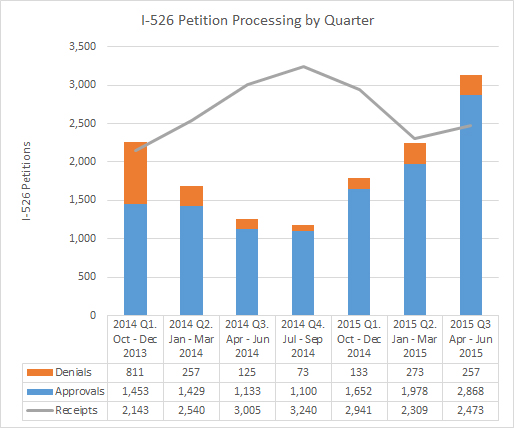
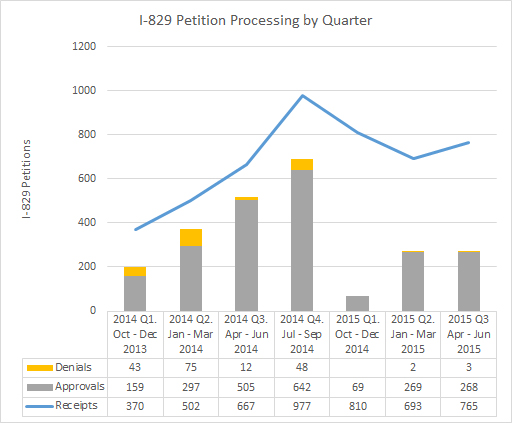
Because we’d all like to see some upward-trending lines for a change today, here are charts showing EB-5 petition processing statistics for the first three quarters of FY2015. The third quarter stats are not official yet, but I calculated them from numbers verbally reported by IPO Chief Nicholas Colucci at last week’s stakeholder engagement. (UPDATE: now they are official, and posted here by USCIS  here.) The improvement in I-526 processing volume is particularly significant and heartening.
Q32015I526 Q32015I829

We also learned from Mr. Colucci that I-924 submissions have spiked, with 252 receipts since the beginning of the fiscal year and about 55 filed in July alone.

The Q&A portion of the teleconference provided some interesting insights into the huge variation we see in processing times, with some approvals coming through in weeks and others dragging on for years. Julia Harrison admitted that a bunch of 2012 and 2013 cases had gotten out of order for various reasons, particularly in connection with the moves from the California Service Center and then between facilities in Washington D.C., and that USCIS was now prioritizing older cases that had fallen through the cracks. USCIS confirmed that they do have separate workflows for RC and non-RC cases, and that the direct EB-5 workflow has gotten much slower. This contradicts a rumor I’ve heard promoted that direct cases can expect faster processing than RC cases, but USCIS stated that they’re working hard to bridge the gap between the RC and direct workflows.
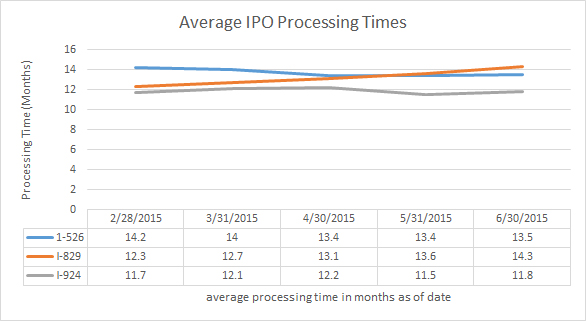
The chart of IPO processing times is not so pretty (and also not very informative, considering that the standard deviation seems to be 12 months), but here it is (based on times posted here).
IPOtimes

USCIS reminder not to use DHS Seal or Signature

From: U.S. Citizenship and Immigration Services [mailto:uscis@public.govdelivery.com]
Sent: Friday, August 14, 2015 12:30 PM
Subject: USCIS Message: Unauthorized Use of the DHS Seal

Dear Stakeholder,

USCIS would like to remind you that no one, including EB-5 regional centers, may use the official U.S. Department of Homeland Security (DHS) seal without first obtaining express written approval from the Secretary of DHS or the Secretary’s designee. The Secretary’s express written approval is also required to use the DHS seal coupled with the U.S. Citizenship and Immigration Services (USCIS) signature.

If an EB-5 regional center or related entity displays the DHS seal or USCIS signature on its website, electronic and printed forms, or promotional and marketing materials without express written approval, USCIS may refer the regional center or related entity to the Department of Justice or the Federal Trade Commission for further action.

If you use the DHS seal or USCIS signature without approval, you may be:

·        Improperly implying that the U.S. government is endorsing the regional center,

·        Inaccurately suggesting a special relationship with USCIS,

·        Engaging in unfair or deceptive trade practice under 15 U.S.C. §§ 45 and 52, and

·        Violating U.S. criminal statutes which protect the DHS seal and USCIS signature and which address the improper use of federal agencies’ seals, official badges, identification cards and other insignia. See 18 U.S.C. §§ 506, 701 and 1017.

Improper use of the DHS seal and USCIS signature can confuse the public and prevent them from being able to identify what communications are officially from DHS or USCIS. This negatively impacts DHS’ and USCIS’ ability to effectively communicate with the American public. Therefore, DHS only permits the use of the DHS seal and USCIS signature for very specific purposes.

For information on how to request approval to use the DHS seal, visit this DHS page.

Kind Regards,

USCIS Public Engagement Division

Please do not reply to this message. Contact us at Public.Engagement@uscis.dhs.gov or USCIS-IGAOutreach@uscis.dhs.gov with any questions.

8/13 Meeting Recording, GAO Report

In case you missed today’s EB-5 stakeholder meeting, here is a link to my recording. The recording sound quality is not my fault; that’s how it sounded on the phone too. (Also, Peng & Weber have typed up a transcript of part of the meeting.) UPDATE: USCIS has posted opening statements.

Here is a link to the Government Accountability Office’s newly-released report “Immigrant Investor Program: Additional Actions Needed to Better Assess Fraud Risks and Report Economic Benefits” (August 2015).

Both the meeting and the report give an interesting look into details of actions already taken to protect and improve EB-5 program integrity. Congress may be busy vacationing and not passing bills, but agencies are still making change happen. The meeting did not reveal much about the draft policy memo, except to show that USCIS is as much at sea as everyone else when it comes to the practicalities of applying an investment requirement that’s divorced from job creation, and thus divorced from the governing logic of the EB-5 program and existing guidance for the parameters of acceptable EB-5 investment. Apparently USCIS plans to add more detail and clarification to the final memo, but hasn’t yet figured out how to clarify the sustainment issue. Stakeholders were repeatedly invited to submit their suggestions. The GAO report is worth reading, being well researched and much more serious and thoughtful than the narrowly political and personal-grievance-fueled March 2015 OIG report.

New USCIS Position on RC Names

From: U.S. Citizenship and Immigration Services [mailto:uscis@public.govdelivery.com]
Sent: Tuesday, August 11, 2015 3:27 PM
Subject: USCIS Message: EB-5 Regional Centers Naming Conventions

Dear Stakeholder,

USCIS would like to remind you that EB-5 regional centers and related commercial enterprises should not contain the words “United States,” “U.S.,” “US” and “Federal” in their names. If you use these words in the name of your regional center or enterprise, you may falsely imply a relationship between the entity using the name, and USCIS, DHS and the U.S. government. Using such names on websites, promotional and other marketing materials could also be considered deceptive acts or practices and false advertisements, which may violate federal laws governing unfair trade and false advertisements. See 15 U.S.C. §§ 45 and 52.

If a regional center or related commercial enterprise has a questionable name, the Immigrant Investor Program Office (IPO) may refer it to the Federal Trade Commission for further action.

Additionally, use of the words “Federal” or “United States” in advertising by businesses engaged in the financial services sector may be a violation of 18 U.S.C. § 709, which prohibits false advertising or the misuse of names to indicate a federal agency. In this situation, IPO may refer regional centers and related commercial enterprises with questionable naming practices to the Department of Justice for further action.

Kind Regards,

USCIS Public Engagement Division

Please do not reply to this message. Contact us at Public.Engagement@uscis.dhs.gov or USCIS-IGAOutreach@uscis.dhs.gov with any questions.

The basics: investment+job creation (draft policy memo comment)

Reading the new draft EB-5 policy memo Guidance on the Job Creation Requirement and Sustainment of the Investment for EB-5 Adjudication of Form I-526 and Form I-829, I see why USCIS delayed the release for a year. The memo has good and bad points in the details, but I’ll leave those for the experts and just point out the big issue: that the memo is fundamentally out of sync with the basic logic of the EB-5 program.

The foundation and organizing principle of the EB-5 program is the nexus between investment and job creation. A petitioner doesn’t get EB-5 benefits just by committing $1,000,000 or just by creating 10+ jobs. Rather, EB-5 eligibility arises at the intersection between investment and job creation – when capital is made available for and results in job creation. Eligibility requirements for investment and job creation are intimately intertwined in the EB-5 regulations and precedent decisions: a qualifying investment is one that’s linked to qualifying job creation, and vice versa.

Astonishingly, the new draft policy memo decouples investment and job creation, and treats them without coherence as separate eligibility grounds independently affected by visa retrogression.

The memo was written to address the retrogression situation: the fact that unavailability of visas effectively adds years to the theoretical 2.5-year window that’s between an investor’s I-526 and I-829 (and accordingly to the window between investment and investor exit). We want the memo to tell us how that expanded timeframe affects EB-5 eligibility requirements.

The draft memo’s answer is that USCIS will not require jobs resulting from the investment to still be in existence at I-829, provided that they were created and sustained for 2+ years, but that USCIS will require the investment to be still deployed at I-829, even if it was sustained for 2+ years and resulted in the qualifying job creation. If the original business plan was accomplished before investors reach I-829, the draft memo says, then the new commercial enterprise must re-deploy the capital in a new “at risk” activity throughout the petitioner’s permanent residence period. (Note that “at risk” in EB-5-world means actually invested and not just promised (per 8 CFR 204.6(j)(2)), made available for purposes of job creation (per Matter of Izummi) and associated with the actual undertaking of business activity (per Matter of Ho).)

The new draft memo doesn’t just mean that investors can’t be paid back personally before they reach I-829 (we expected that), but that an EB-5-funded loan can’t be repaid to the new commercial enterprise unless the NCE promptly turns around and makes a new loan to another project – even though the new loan would have no nexus with the qualifying job creation. The memo states that “to the extent that all or some portion of the new commercial enterprise’s claim against the job-creating entity is repaid to the new commercial enterprise during the sustainment period, the new commercial enterprise must continue to deploy such repaid capital in an ‘at risk’ activity for the remainder of the sustainment period” and “the capital will not be considered ‘at risk’ if it is merely being held in the new commercial enterprise’s bank account or an escrow account during the sustainment period.”

Project companies will not complain about this draft memo because a business generally wants to redeploy capital and not let it sit around, and even better when that redeployment has no job creation or other EB-5 eligibility strings attached plus the investor exit can be unspecified upfront and extended indefinitely. But I don’t like to see theoretical mishmash, and I also feel for investors. If this draft becomes policy, then EB-5 offerings will have to say here is the project you’re investing in, but be aware that your funds may be redeployed in an unspecified number of other future projects that you can’t review now because we don’t know now what they will be – we just know that your capital is required to stay in circulation even after this business plan is accomplished and after your job creation requirements have been met until your immigration paperwork finally grinds to its conclusion.
New Draft EB-5 Policy Memo

From: U.S. Citizenship and Immigration Services [mailto:uscis@public.govdelivery.com]
Sent: Monday, August 10, 2015 10:43 AM
Subject: USCIS Message: Policy Memorandum, PM-602-0121

Dear Stakeholder,
USCIS has posted the following draft policy memorandum for your review:

Comment Process: Please email all comments to ope.feedback@uscis.dhs.gov by Tuesday, September 8, 2015. Please include the following to make your comments clear:
·        State the title of the relevant memo in the subject line of your message;
·        Refer to a specific portion of the memo;
·        Explain the reason for any recommended change; and
·        Include data, information, or authority that supports the recommendation.

For complete information on the comment process, visit the Feedback Opportunities section of www.uscis.gov.

If you are unable to access the memorandum through the links provided above, please do the following:

  1. Go to www.uscis.gov/outreach
  2. Select “Feedback Opportunities” on the left side of the page

Kind Regards,
USCIS Public Engagement Division

RC Reauthorization Status, New RCs

Reauthorization Status
The current authorization of the Regional Center program is set to expire after September 30, 2015, and timely reauthorization is looking doubtful what with our representatives being on vacation much of the time between now and then, and with none of the proposed/pending legislation looking advisable to pass without discussion and revision. What will happen on October 1 if Congress hasn’t acted in time? We also asked this question in 2012, last time the program was up for reauthorization, and got vague answers from USCIS (“This as a question that will just have to be addressed when and if it occurs, and the Service does not have a response at this time” was the message at the 1/23/2012 EB-5 stakeholder meeting. The 5/1/2012 EB-5 stakeholder meeting executive summary stated that all existing regional center designations would expire automatically and that USCIS would not approve new Regional Center designations, but did not comment on what would happen with Regional Center-associated investor petitions.). We’ll see what USCIS has to say in next week’s engagement (8/13/2015). In the meantime, advocacy groups (IIUSA, EB5 Coalition) are still pressing for timely action, and we may after all get a bill passed at around 11:58 pm on the 30th, as has happened before. Here are the proposals on the horizon, so far as I know.

    • S.1501 – American Job Creation and Investment Promotion Reform Act of 2015. Sponsored by Senator Leahy (D-VT) and Senator Grassley (R-IA). Introduced in the Senate on June 3, 2015, referred to committee, and much analyzed and largely panned since then by the EB-5 community. The bill’s good aspects – that it extends (by five years) and seeks to improve the Regional Center program and is sponsored by important people – seem outweighed by its problems – that its provisions would drastically redirect and severely curtail the scope of the RC program (discouraging large raises, large projects and urban development in favor of small EB-5-dominated projects in rural areas), and that it brands the RC program as a hotbed of corruption and proposes ham-fisted measures that wouldn’t necessarily forestall bad actors, who can be glibber than most in attesting virtue, but would place an unwieldly regulatory burden and risk on people actually trying to do things right. IIUSA reports that they continue to have close discussions with the bill’s drafters – and other relevant Senate offices – as alternative language is considered by the sponsoring offices.
    • H.R.3370 – To amend the Immigration and Nationality Act to promote innovation, investment, and research in the United States, and for other purposes. Sponsored by Representatives Zoe Lofgren (D-CA) and Luis Gutierrez (D-IL). Introduced in the House on July 29, 2015, and referred to committee. I think this is a pretty good bill (aside from being nearly unreadable in bill form – read Rep. Lofgren’s section summary first before you try the legislation itself or you’ll get confused). The bill proposes a couple new EB visa categories in Title I (I don’t see the proposed EB-6 category being used much, as VC risk/unpredictability and immigration aren’t a great mix, but in any case it wouldn’t take visas away from or otherwise affect the EB-5 program) and discusses the EB-5 Regional Center program in Title II (starting on p. 17). The bill would permanently authorize the RC program, double the qualifying EB-5 investment amount (which is a leap, but not unreasonable considering investor visa thresholds in other countries), open the possibility of doubling the annual EB-5 visa allocation, and make other changes that I think would generally improve the footing of the EB-5 program. The proposals regarding TEAs and job creation (p. 38-41) strike me as particularly well-considered and reasonable. The concurrent filing and premium processing provisions would be very popular (though with a fee of only $5000, I believe that 100% of EB-5 petitioners would go for premium processing, making the service impossible to deliver in practice). The proposals for improved program integrity in this bill look serious but largely reasonable and justifiable rather than punitive and alarmist, as in S.1501. I’m just concerned that this bill, like S.1501, charges USCIS to regulate – and holds RCs responsible for keeping in line – a constellation of people who we’d all like to see controlled but who are not necessarily amenable to control by either RCs or USCIS. USCIS is supposed to work with the FBI to conduct background checks of and Regional Centers may be heavily sanctioned based on the behavior of anyone who can be considered “involved” with a regional center or an associated commercial enterprise (i.e. “if he or she is the principal, representative, administrator, owner, officer, board member, manager, executive, general partner, fiduciary, marketer, promoter, director, or other similar position of substantial authority for the operations, management, or promotion of the regional center or associated commercial enterprise, respectively”). In practice, does this mean that FBI agents have to show up at the offices of licensed migration agents in China who happen to be sourcing investors for Regional Centers and say okay hands out everybody, we’re taking fingerprints? How will the Chinese government feel about the US coming in to lay down the law in a domain that it is concerned to regulate itself and to protect from foreign influence? Considering that most EB-5 offers are made entirely abroad, and often by independent third parties who owe first allegiance to their own local regulations, how would Regional Centers handle the requirement “to monitor and supervise all offers and sales of securities which are made by associated commercial enterprises to ensure compliance with the securities laws of the United States, and to maintain records, data, and information relating to all such offers and sales of securities”? Certainly the selling and investor recruitment process is a major challenge, complication and source of confusion and vulnerability for the EB-5 program and for Regional Centers and deserves to be addressed, but easier said than done.
    • H.R. 616 American Entrepreneurship and Investment Act of 2015. Sponsored by Representative Polis (D-CO) and Amodi (R-NV), and now with 22 co-sponsors. Introduced in the House January 28, 2015, referred to committee March 17, 2015. This bill proposes permanently authorizing the Regional Center program without overhauling it, and briefly suggests a few modest and generally-welcome clarifications and improvements. I don’t know why this bill hasn’t gained more traction – possibly because the general mood seems to be that the program needs some significant changes if it’s to be made permanent.
    • Rumor has it that Judiciary Committee Chairman Bob Goodlatte (R-VA) and Representative Darrel Issa (R-CA) plan to introduce legislation in early September that will be similar to their SKILLS Act (HR2131) proposal from last year, with some additions. As originally written, this bill proposed new EB-6 and EB-7 categories (defined differently from Lofgren’s), tweaked a bunch of visa categories, and had one line about the Regional Center program, proposing to make it permanent. The new version will reportedly include some additional EB-5 program changes, but less drastic than those in S.1501.

Carolyn Lee has assembled a handy bill comparison chart. See also Pat Hogan’s letter on the mood in Washington as of Sept. 2015.

New Regional Centers
Additions to the USCIS Regional Center List, 6/23/2015 to 8/3/2015

  • American Coast Regional Center (California)
  • EB-5 Impact Capital Regional Center, LLC (California and Nevada)
  • EB5 International, LLC (California): www.eb5international.com
  • EB5 Affiliate Network Washington, D.C. Regional Center, LLC (District of Columbia, Maryland, Virginia, West Virginia): eb5affiliatenetwork.com
  • Maryland Global Regional Center, LLC (District of Columbia, Maryland, Virginia, West Virginia): www.cgrc.info
  • Civitas Northern Florida Regional Center (Florida): www.civitascapital.com
  • EB5 Financing Management Company, LLC (Florida)
  • Civitas Illinois Regional Center (Illinois): www.civitascapital.com
  • EB5 Affiliate Network State of Hawaii Regional Center, LLC (Hawaii): eb5affiliatenetwork.com
  • Massachusetts Wealth and Happiness Regional Center, Inc. (Massachusetts)
  • EB5 Affiliate Network State of North Carolina Regional Center, LLC (North Carolina): eb5affiliatenetwork.com
  • Ocean Pacific Regional Center, LLC (Oregon)
  • Harmonia Regional Center, LLC (Texas): harmoniaeb5.com
  • Name Change: Gotham City Regional Center, LLC changed to Silverstein Properties Regional Center LLC (Connecticut, New Jersey, New York, Pennsylvania): silversteinrc.com

USCIS Website
I also note that USCIS has done a little revamp of the EB-5 section of its website, separating what used to be the main page into two pages, one about the EB-5 program and one about the EB-5 visa but still mysteriously (pointedly?) omitting the informational page that used to be there about the Regional Center program. They do slap a nice big forbidden icon on the link to the list of terminated Regional Centers, a list already with plenty of indignity for the subset of centers that landed there not by fault but by choosing not to continue with the program.