FY2015 I-526 and I-829 Statistics

USCIS has published Q4 2015 processing data for I-526 and I-829 petitions on its Immigration and Citizenship Data page.
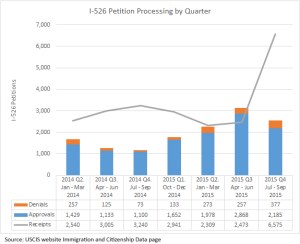
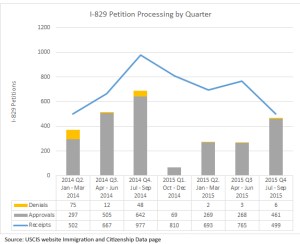
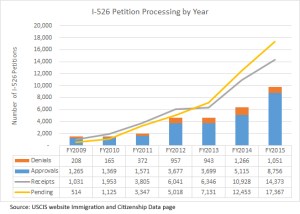
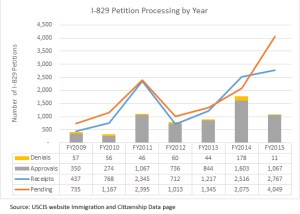
I’m copying below charts that I made from the data. For those who prefer words, here are a few points that I notice.

  • I-526: FY2015 saw a huge number of I-526 filings – over 14,000 receipts (with 46% filed in the fourth quarter in a surge prior to possible program changes). Assuming that only about 10,000 EB-5 visas can be issued in a year, and an average of 2.2 visas per investor I-526, then this year’s receipts alone will take up over three years-worth of available EB-5 visas. FY2015 ended with over 17,000 petitions pending, which would take up nearly four years of available EB-5 visas. USCIS has shown impressive year-on-year improvements in the number of I-526 petitions processed, up 32% in 2014 and 42% in 2015. USCIS even briefly caught up to the number of receipts in Q3 2015, but then got snowed under again with the blizzard of filings in Q4 2015.
  • I-829: A similar volume of I-829 petitions were filed in 2014 and 2015, but with very different distributions over the year (an increasing number of receipts by quarter in 2014 and decreasing number by quarter in 2015). Overall FY2015 had 10% fewer receipts than the previous year, but I don’t know whether to call a puzzling trend or just note seasonality. The IPO office at USCIS, which took over I-829 processing at the end of 2014, got a slow start but picked up speed and managed to process 467 I-829 petitions in Q4 2015. In all IPO processed over a thousand I-829s in FY2015, but ended the year with a backlog of over four thousand petitions. We hope that IPO picks up the pace so that the I-829 backlog alone doesn’t take four years to process.


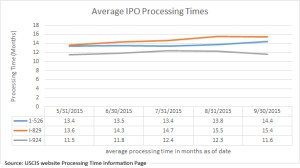
And because it’s topical, though I doubt the significance of these averages, here’s a chart with the latest update to IPO processing times.
IPOtimes

Legislative Update, Due Diligence, New I-485, New RCs

Legislative Update
We are now less than a month from December 12, when the Regional Center program will sunset if it doesn’t get another reauthorization. It’s possible that the program could get temporarily extended as part of the appropriations bill that also needs to get passed by December 11 (which would mean extension with no change through 9/30/2016), or there might be stand-alone legislation with some significant changes and reform as well as reauthorization, or our representatives might let the program lapse for a while because they haven’t worked out appropriate legislation in time but don’t want to see simple extension. Grassley, Corker, and Johnson sent a letter on 11/6 to Senate leadership saying that they oppose a straight reauthorization of the EB-5 Regional Center program in the anticipated appropriations bill that will cover fiscal year 2016, and advocate instead to continue the program together with measures to increase accountability and better guard against fraud and abuse. We wish they would hustle to formulate such measures. Grassley and Leahy have been quietly circulating a revised draft of S. 1501 (IIUSA has a copy, as do select real estate industry executives according to the Wall Street Journal Washington Wire blog). I’ve read the draft but decided not to comment here until it gets officially proposed. The new draft is significantly clarified and toned down from the original bill, though still a game-changer. But will passable legislation be proposed in time to make any difference? If only Washington worked more efficiently!

Due Diligence
I appreciated the article “EB-5 Due Diligence Matters” (November 3, 2015) by Douglas Hauer, John Nucci, and Peter Saparoff of Mintz Levin. The authors discuss the legal requirements for due diligence investigations and give practice pointers.

Form I-485 Update
USCIS has published new editions of the Form I-485, Application to Register Permanent Residence or Adjust Status and Supplements

New Regional Centers
Additions to the USCIS Regional Center List, 11/02/2015 to 11/12/2015

  • EB5 Capital Oregon Regional Center (Oregon, Washington): www.eb5capital.com
  • Empire Regional Center, LLC (New Jersey, New York)
  • Great Southern Regional Center (Georgia, South Carolina)
  • North Valley Regional Center (California)
  • Proficiency Regional Center LLC (California)

What is material change?

Summary
The EB-5 process allows limited leeway for change in documents or in reality. Ideally and in principle, all EB-5 petitioners fully demonstrate eligibility in their original I-526 documents, and investment projects go on to develop exactly as foreseen in the I-526 business plan. In real life, there are new circumstances and unforeseen events, not to mention mistakes and omissions, and change happens. This post discusses how and when change is (and is not) a problem in EB-5. (Last update: 01/2019)

Before I wade into details and examples, here’s a rough metric.

Q. What kind of changes can be a problem in EB-5?
— A. Material changes that affect decision-making.
Q. When are material changes a problem?
— A. While decision-making is in process.

And here’s where to find the official policy on material change: USCIS Policy Manual, 6 USCIS-PM G Chapter 4(C) and Chapter 5(C).

What are the principles behind the material change issue?

  • In visa petition proceedings, a petitioner must establish eligibility at the time of filing and that a petition cannot be approved if, after filing, the petitioner becomes eligible under a new set of facts or circumstances. See, e.g., Matter of Izummi, 22 I. & N. Dec. at 176
  • The petitioner must continue to be eligible for classification at the time of adjudication of the petition. 8 C.F.R. § 103.2(b)(1)
  • Form 1-829 approval is predicted by Form 1-526 approval and successful execution of the approved plan. Chang v.United States of America, 327 F. 3d 91 1 (9″ Cir. 2003) (Current policy now states that “USCIS does not deny petitions to remove conditions based solely on the failure to adhere to the business plan contained in the Form I-526 immigrant petition.” 6 USCIS-PM G Chapter 5(C))
  • Black’s Law Dictionary defines “material” as “having some logical connection with the consequential facts” and of “such a nature that knowledge of the item would affect a person’s decision-making process; significant; essential.”

What kind of change is material?

  • A change that’s part of an effort to make an apparently deficient petition conform to USCIS requirements
  • A change that reflects a substantial alteration in circumstances on which USCIS is relying in making its decision, and that would tend to influence the decision
  • A change that asserts eligibility under a materially different set of facts that did not exist when the immigrant first filed the petition
  • All elements of a petition can be subject to material change issues (including the business plan, offering documents, and evidence of investment and source of funds)

What kind of change is not material?

  • A change that affects facts not related to the immigrant investor’s eligibility
  • A change that occurs in accordance with a business plan, as a natural progression of the business

At what point is material change a problem?

  • Material changes are generally NOT acceptable during the period between a petitioner filing I-526 and receiving conditional permanent residence (CPR). This period includes both I-526 processing and the consular or adjustment of status process. If material changes occur in this period, the petitioner must go back to square one and file a new I-526 petition with the new scenario. (Filing a new I-526 is painful thanks to loss of priority date. That will change if USCIS finalizes priority date protections proposed in the  draft regulations posted 01/2017.) Redeployment policy creates one exception/qualification to material change policy. Switching investment projects (under certain conditions) before CPR is not considered “material” provided that investor capital is being redeployed after the initial deployment already met job creation requirements. (6 USCIS-PM G Chapter 4(C))
  • Material changes CAN be allowable during a petitioner’s conditional residence period (after the investor receives the EB-5 visa, and before removing conditions). USCIS will not deny an I-829 petition solely based on failure to adhere to the plan filed with the I-526 Petition. The I-829 petitioner should still demonstrate that he filed the Form I-526 plan in good faith with full intention to follow the plan outlined in the petition, and must still show that he meets the requirements for removal of conditions. USCIS is currently formulating new policy concerning the circumstances under which EB-5 funds might be removed from a project or moved from one project to another during the petitioner’s CPR period (draft memo). The more closely a petitioner adheres to the I-526 plan, the more he can rely on receiving deference to USCIS’s prior approval of that plan. (6 USCIS-PM G Chapter 5(C))
  • Material changes CAN be made between I-924/exemplar I-526 approval and actual I-526 filing. However, USCIS will not show deference (will re-adjudicate) when a new filing involves a different project from a previous approval, or the same previously approved project with material changes to the project plan.

Examples of material change (with fact pattern source in parentheses)

Changes judged to be material

  • A change made belatedly to correct a deficiency in the original filing (making an un-approvable petition approvable)
    • A petitioner filed Form I-526 in 1996 with a partnership agreement containing certain provisions. In 1997, USCIS issues a memorandum objecting to such provisions. The petitioner then files partnership agreement amendments to remove those provisions from his documents. (Matter of Izummi)
    • A petitioner filed a Form I-526 based on investment in a troubled business. When USCIS points out that the business does not qualify as troubled, the petitioner abandons the troubled business claim and substitutes a plan to create a new business instead. (Matter of Izummi)
    • A petitioner filed I-526 with a business plan and operating agreement that anticipated investment in and job creation by two NCE subsidiaries. In RFE, USCIS noted that one subsidiary was not wholly-owned and thus would not create eligible jobs. In response to RFE, the NCE revised the business plan and operating agreement to indicate that investment and job creation would be concentrated in the wholly-owned subsidiary. AAO agreed that this constituted an impermissible material change because made to cure deficiencies noted by USCIS in its RFE (MAR192019_01B7203.pdf)
    • A petitioner filed I-526 with documents including a provision that USCIS judged to be an impermissible debt arrangement. In response to NOID, the petitioner relinquished her rights under those provisions. USCIS found that although the waiver addressed the concerns, the new evidence presented a set of facts not established at the time of filing, and resulting in a material change to the original petition. (JUN252018_01B7203)
    • A petitioner filed a Form I-526 with documents foreseeing a return on investment that did not derive from the underlying investment. USCIS judged this did not qualify as investment at risk for the purpose of generating a return on that investment. In response to NOID, the petitioner submitted amended organizational documents. USCIS found that the amended documents remedied the deficiencies, but represented material change because they presented a set of facts not established at the time the petition was filed. (FEB282018_02B7203)
    • A petitioner filed a Form I-526 describing a loan model for direct investment, which would not qualify. In response to RFE, the petitioner modifies the structure to equity investment in a job-creating new commercial enterprise. (APR232014_01B7203)
    • A petitioner filed a Form I-526 associated with investment in a portfolio of projects. In response to RFE questioning aspects of this structure, the petitioner identifies one project within the portfolio as the target for her investment. (MAY172013_01B7203)
    • A petitioner filed a Form 1-526 in 2012 with a redemption clause. In April 2013, in response to RFE, the petitioner signs Agreement of Waiver to remove that clause (MAY272014_01B7203)
    • A petitioner filed a Form I-526 that does not indicate a management or policy-making role for the petitioner. An amended Operating Agreement filed in response to RFE identifies the petitioner as managing member of the NCE (Oct262009_01B7203)
    • A petitioner filed a Form I-526 in October 2012 for investment in a business that also depends on funds from other investors. In response to RFE, the petitioner provides letters of commitment for the additional investment, but the letters are dated after October 2012. (MAY272014_01B7203)
    • A petitioner filed a Form I-526 in October 2012 for investment in a project not yet underway. In response to RFE, the petitioner provides some evidence of business activity (land purchase, contracts made), but the documents are dated 2013. (MAY272014_01B7203)
    • A petitioner filed a Form 1-526 with a plan for an export business. In response to RFE pointing out deficiencies in the plan, the petitioner submits a new plan for the export business plus a restaurant. (SEP052013_02B7203)
    • A petitioner filed a Form I-526 with Operating Agreement provisions that suggest funds might not be at risk for job creation. When challenged, the petitioner files an amended Operating Agreement that removes the problematic provisions. (Feb182010_04B7203)
    • The petitioner files a Form I-526 on June 1, 2008, based on a $400,000 investment. In response to an RFE, the alien provides proof of the remaining required amount being invested on July 15, 2008. (2008 USCIS adjudicator training)
    • A petitioner filed a Form 1-526 with an arrangement for half of the capital to be paid back to him as a guaranteed return. In response to an RFE, he declares the arrangement null and void. (2008 USCIS adjudicator training)
  • A change that creates a new deficiency (making an approvable petition un-approveable)
    • A petitioner filed a Form I-526 associated with investment in a new commercial enterprise that wholly owns an employment-creating subsidiary. After filing, the subsidiary was no longer wholly owned by the NCE. (Jan072011_01B7203)
  • Changing fundamental aspects of the business plan, particularly those that affect determinations about EB-5 eligibility
    • The petitioner’s I-526 petition and documents subsequently provided to USCIS indicate a shift from focus on retail sales to retail and wholesale, to realty and investment. AAO/USCIS found these changes to be material because “The Petitioner has not explained how this change in business focus (e.g. from retail to realty and investment services) is a natural progression of the business. Further, such a modification in the nature of the NCE’s business activities would be ‘predictably capable of affecting’ our determination of whether the Petitioner will prospectively create the requisite qualifying jobs.” A change of structure in the Operating Agreement is also material. AAO was also concerned that the shift in business focus could be associated with location change, which would also be material. “A change in the location of the NCE would ‘have a tendency to influence’ or would be ‘predictably capable of affecting’  our determination of eligibility for immigrant investor purposes as the location of the investment determines the required capital investment threshold.” (MAY102016_02B7203 dismisses the original appeal, while APR262017_02B7203 dismisses the motion to reopen and reconsider)
    • A petitioner filed a Form 1-526 with a plan for a grocery store. Later, she adds a plan for a restaurant not mentioned in the original filing. (FEB162005_01B7204)
    • A petitioner filed a Form 1-526 for investment a Regional Center project that owns and will redevelop a property. Subsequently, the property is lost to foreclosure and has to be re-acquired with new financing. This temporarily puts the project in doubt and permanently changes development budget numbers used in the economic impact analysis. (Feb182010_04B7203)
    • A petitioner filed Form I-526 for a regional center-sponsored project. After I-526 approval, but before the investor receives a visa, the regional center is terminated. The project did create jobs, but in a job-creating entity separate from the new commercial enterprise (OK for regional centers, not OK for direct EB-5). Proceeding without regional center involvement would require the NCE to absorb the JCE and make it a wholly-owned subsidiary. This structural change would constitute a material change to the original petition. (JUL182016_01B7203)
  • Changing or losing regional center sponsor
    • If a regional center immigrant investor changes the regional center with which his or her immigrant petition is associated after filing the Form I-526 petition, the change constitutes a material change to the petition.  (Language added for the first time on 8/4/2018 to the Policy Manual 6 USCIS-PM G Chapter 4(C))
    • The termination of a regional center associated with a regional center immigrant investor’s Form I-526 petition constitutes a material change to the petition (Language added for the first time on 6/14/2017 to the Policy Manual 6 USCIS-PM G Chapter 4(C))
    • A Petitioner invested in a project whose regional center sponsor was terminated. The petitioner wished to continue to pursue an EB-5 visa as an individual investor independent of a regional center. USCIS found that this would lead to material changes. Outside the RC program, the petitioner would need to demonstrate both the requisite direct job creation and that the JCE is the wholly-owned subsidiary of the NCE. But meeting those conditions would necessitate material changes and thus a new petition, because having insufficient qualifying jobs is a material change, and requiring the NCE to absorb the JCE would be a material change. (AUG032016_01B7203).
    • A petitioner filed a Form I-526 associated with a project sponsored by a Regional Center. Before I-526 was approved, the Regional Center lost its designation. The petitioner then amended the petition based on investment in a project within a different Regional Center. (AUG062014_01B7203)

Changes judged NOT material

  • Changes to aspects of the petition that don’t significantly affect the petitioner’s eligibility one way or another (ie changes not made to correct deficiencies in the original filing; changes that alter aspects of the business not fundamental to the petitioner’s eligibility)
    • “If the organizational documents for a new commercial enterprise contain a liquidation provision, that does not otherwise constitute an impermissible debt arrangement, the documents may generally be amended to remove such a provision in order to allow the new commercial enterprise to continue to operate through the regional center immigrant investor’s period of conditional permanent residence. Such an amendment would generally not be considered a material change because facts related to the immigrant investor’s Form I-526 eligibility would not change.” (6 USCIS-PM G Chapter 4(C) “Material Change”.)
    • A petitioner filed Form I-526 with a business plan that anticipated that the NCE would provide shuttle and tour services, with auto accessories sale as a sideline (about 10% of business). A subsequent site visit found little evidence of shuttle/tour service and auto accessories sale accounting for far more than 10% of the business. But AAO found that “Merely shifting the percentages of the types of services the Petitioner said the NCE would offer is not, by itself, a sufficient basis to deny the petition.” (JUN302017_01B7203)
    • The petitioner files a Form 1-526 and invests $1,000,000 in a business that is planning to operate a Chinese restaurant. In the RFE, it is revealed that the business has decided to operate a Peruvian restaurant instead. This is not a material change. (2008 USCIS adjudicator training)   [However, the petitioner in JUL062017_01B7203 tried to cite this training material to support an argument that she hadn’t committed a material change in changing from a fast food franchise restaurant to catering service to full-service seafood restaurant with catering. AAO did not accept the argument, finding that “The NCE’s business plans two and three constitute a material change to the original one because they represent far more than a change in food styles. …in addition to the type of food, business plans two and three include changes to the NCE’s nature of business, services offered, location, start-up costs, and staffing needs. These changes are material and are made to correct a deficiency in the original submission”]
  • Changes that are more modification of than departure from the original (revised documents that have strong continuity with documents originally filed)
    • The petitioner files Form I-526 with a partnership agreement and investment agreement that are inconsistent with each other. He subsequently files a set of amendments to the partnership agreement specifically to iron out those inconsistencies. (Matter of Izummi)
    • The petitioner files a Form 1-526 based on a Regional Center project that involves a loan agreement. In response to RFE expressing concern about a closing date already passed, the petitioner submits a renegotiated loan agreement extending the date. (JUL192005_01B7203)
    • A pending Form I-526 does not contain redeployment language, and the investment documents are subsequently amended to allow redeployment. “If the further deployment of capital is within the scope of the new commercial enterprise’s business activities in existence at the time the Form I-526 petition was filed, and amendments to the investment documents do not materially alter the facts in existence at the time of filing, such amendments, when considered under the totality of the circumstances, could likely not be considered a material change.” (7/19/2017 Talking Points)
  • Other examples of changes not judged material
    • “For example, if at the time of filing the immigrant petition, no jobs have yet been created, but after approval of the immigrant petition and before the investor has obtained conditional permanent resident status, the investment in the new commercial enterprise results in the creation of 10 jobs in accordance with the investor’s business plan as filed, such a change would not be considered to be material.” (6 USCIS-PM G Chapter 4(C) “Material Change”.)
    • The petitioner files Form I-526 based on investment in two hair salons. These salons use the investment but end up going out of business after 1.5 years, before I-526 adjudication. The petitioner intends to make additional investment and open new salons in the same TEAs with a different management company and different staffing plan. This is not judged a material change. (AUG152017_01B7203)
    • A regional center filed an amendment/exemplar request that USCIS initially denied, in part based on impermissable material changes from previous filings. AAO disagreed. “While the location, the Borrower, and the JCE differ from the initial filing, these changes are permissible because the hospital project is substantively similar to the management structure, construction and development entities, and economic analysis in the original 2015 business plans’ proposed project, and moreover, these changes were not an attempt to remedy a deficient petition.” For example, the petitioner showed that a new JCE was formed in response to evolving business needs before a NOID was ever received from USCIS. However, the decision notes the difference in material change standards for I-924 vs. I-526, and leaves unclear whether such changes would also be non-material for investor petitions. (AUG152018_01K1610)

Conclusion: What should we then do?

  • Try to file I-526 documents that fully demonstrate the petitioner’s eligibility (because if anything essential to demonstrating eligibility is missing from the original filing, or if some provisions/conditions in the filing would make the petitioner ineligible, those issues may not be possible to fix without committing material change)
  • Put EB-5 investment in enterprises/projects that are able to proceed predictably according to plan, at least for the first few years while the investor is waiting for conditional permanent residence (because the investor can get derailed by material change if the project departs significantly from the business plan while USCIS/DOS are still in process of reviewing the investor’s documents). Where aspects of the business are subject to short-term change and variation from plan, explicitly foresee that in the business plan and offering documents.
  • Try to choose a stable regional center sponsor. If the regional center loses its designation, every path to salvaging investor petitions may be blocked by material change problems.
  • Between filing I-526 and receiving an EB-5 visa, be careful when answering challenges and providing new evidence to USCIS/DOS. Points to make to support the case that any changes are NOT material:
    • Facts related to investor eligibility did not change
    • Change was not an attempt to remedy a deficient petition
    • Change was not in response to challenge by USCIS (change pre-dated RFE/NOID)
    • Change occurred as part of “natural progression of the business” and “in response to evolving business needs”
    • Fact pattern is “substantively similar” to original filing
  • Relax a bit once investors have conditional permanent residence, since material change won’t automatically derail them now, but don’t relax too much. Keep USCIS apprised of major new developments, and retain evidence of good faith efforts to follow the original business plan.

Additional Reading

  • In its Comment on Proposed EB-5 Regulations (p. 6-10), AILA explains why USCIS should specify that “a change is material if, after filing, the change causes the exemplar or EB-5 petition to no longer satisfy the eligibility requirements … Any other change may be significant or insignificant, but is not material to the ultimate approvability of the petition.”
  • A Business Plan is Not a Statue — Impacts of Business Plan Changes (Nov 17, 2016) by H. Ronald Klasko likewise argues that “A material change should be a change that makes an approvable project un-approvable, or makes an un-approvable project approvable.”

Update on RC Renewal, Articles (Retrogression, SEC), New and Removed RCs

Legislative Update
Last week Congress passed a two-year budget deal that raises funding levels and suspends the debt limit until 2017. This accomplishment eases the way for the spending package that needs to passed by December 11 to keep the federal government funded. And it could be good news for the EB-5 Regional Center program, if RC program reauthorization could be folded into the appropriations bill as has happened in the past. But we hear that powerful voices in Congress want standalone legislation with changes and reform, not just another reauthorization, and we aren’t hearing of progress toward making that happen. A couple bills came out in October, but we haven’t seen substantial new contenders – no work product from the negotiations by Grassley, Leahy, Goodlatte, and Issa; no new version of the leading Senate bill S. 1501; and nothing that looks like it has a serious chance of satisfying enough interests to pass. (EB5 Coalition has a bill comparison chart summarizing current offerings.) I am happy to report that IIUSA has just come out with an EB-5 legislative compromise proposal based on consultation with a broad base of stakeholders plus assessment of what could fly on Capitol Hill. For details, see the announcement: IIUSA Delivers Compromise EB-5 Legislative Proposal to Congress. We hope to inspire our representatives to engage in some compromising of their own, and avoid an impasse that would let the Regional Center program expire on December 11.

Articles (China Retrogression, SEC Actions)

New and Terminated Regional Centers
Additions to the USCIS Regional Center List, 10/19/2015 to 11/02/2015

  • City Connections Regional Center LLC (California must be USCIS error, presumably should be Connecticut, New Jersey, New York, Pennsylvania): www.ccrceb5.com
  • Deictic Investment Group LLC (California)
  • MCFI Southern California / Arizona (Arizona, California): www.mcfiusa.com
  • South Atlantic Coast Regional Center LLC (Florida, Georgia, North Carolina, South Carolina)

Renamed:

  • California Golden Pacific Regional Center, LLC (former name U.S. Golden Pacific Regional Center, LLC) (California)

Additions to the list of Terminated Regional Centers

  • USA Lifestyles Regional Center (Maine) terminated 10/13/2015
  • Spring Hill Homes LP Regional Center (Texas) terminated 10/22/2015

I-924 options: What are actual and hypothetical projects? What does exemplar mean?

This post doesn’t break any news, but replaces an outdated post from 2011 that I notice has been getting a lot of traffic. (Most recently updated January 2017 based on the 11/2016 EB-5 Policy Manual chapter.)

Regional Center application project types and actual, hypothetical, and Exemplar business plans

USCIS Policy Manual, 6 USCIS-PM G (November 30, 2016) Chapter 3 summarizes the requirements for an application for regional center designation,

A regional center seeking to participate in the Regional Center Program must submit a proposal using the Application For Regional Center Under the Immigrant Investor Program (Form I-924).

USCIS may designate a regional center based on a general proposal for the promotion of economic growth, including increased export sales, improved regional productivity, job creation, or increased domestic capital investment. The statute further provides that a regional center shall have jurisdiction over a limited geographic area, which shall be described in the proposal and consistent with the purpose of concentrating pooled investment in defined economic zones.

In addition, the establishment of a regional center may be based on general predictions, contained in the proposal, concerning the kinds of commercial enterprises that will receive capital from immigrant investors, the jobs that will be created directly or indirectly as a result of such capital investments, and the other positive economic effects such capital investments will have on the area.

The Policy Manual goes on to explain that “the level of verifiable detail required for a Form I-924 to be approved and provided deference may vary depending on the nature of the application filing,” and provides three options for type of application filing: hypothetical, actual, and exemplar. Table 1 summarizes each type as defined at 6 USCIS-PM G Chapter 3(B).

i-924types

USCIS asks the applicant to label the project documents included in the I-924 application, identifying whether they are presented as hypothetical, actual, or examplar. One application may include a mix of project types, and USCIS may decide to re-classify and approve an “actual” project as “hypothetical” if it’s not sufficiently detailed.

The standard for actual/exemplar business plan content is clear and rigorous: the same “Matter-of-Ho-compliant” standard that applies to the I-526 business plan. The standard for hypothetical plans was not defined from 2013 to 2016, and appeared to be very low. The new Policy Manual introduced in November 2016, however, gives some positive guidance for hypothetical plan content.

General proposals and predictions may include a description of the project parameters, such as:

* Proposed project activities, industries, locations, and timelines;

* A general market analysis of the proposed job creating activities and explanation regarding how the proposed project activities are likely to promote economic growth and create jobs; and

* A description, along with supporting evidence, of the regional center principals’ relevant experience and expertise. (quoted from 6 USCIS-PM G Chapter 3(B))

A regional center applicant may classify its potential real project as “hypothetical” because it’s not sufficiently advanced for detailed description, or may submit business plans for projects that are purely hypothetical scenarios — just examples of the kind of thing the regional center might do. Hypothetical projects are relatively easy to write up, and applicants can apply for very expansive geographic areas by including many hypothetical projects in the application. My log of new regional center designations from 2013 to 2015 (based on RC designation letters) shows that about 85% of initial regional center designations have been based on hypothetical projects.  However, approval of “actual” or “exemplar” documents can be valuable, thanks to deference.  Once USCIS has granted an actual or exemplar approval in the I-924 context, it will not (generally) revisit those same documents when they appear in investor I-526 petitions. From 2013 to 2015, USCIS issued 122 letters formally approving actual projects that were filed with I-924 initial applications or amendment requests.

AAO decisions relating to 1-924 project issues

  • JUN272013_01B7203, DEC302013_01B7203, and FEB102014_02B7203 are examples of AAO decisions that require USCIS to reconsider I-526 denials that neglected to fully address deference to I-924 approvals. These decisions indicate that AAO (if not always USCIS) take the deference policy seriously.
  • A few AAO decisions indicate limits on what can be approved as a “hypothetical” plan.  FEB212014_01K1610 concludes that “While USCIS does not define the level of detail required for a general proposal, merely identifying the NAICS industry categories and the eventual input-output model without analyzing how the model would apply to a hypothetical project that falls under the industry categories is insufficient to meet the applicant’s burden within these proceedings.” In AUG222016_01K1610, AAO and USCIS refused to consider the actual, active project of another regional center, including the economic impact analysis, as the Applicant’s hypothetical project.
  • In JUL192013_01K1610, AAO withdrew a denial, finding that USCIS should not have required a proposal based on hypothetical projects to provide detail such as letters of intent from lenders, commitments from prospective partners, and extensive cost and location detail.

Finally, recall that an I-924 application for initial designation must include a business plan for the Regional Center itself in addition to the kind of project proposals described in this post. See the I-924 Instructions item #4 and #6 for ideas about what to include in a regional center operational plan. The AAO decision JUL092015_01K1610 discusses an application that was denied in part for failing to submit a sufficient operational plan.