Washington updates

The article Will EB-5 Survive? (February 23, 2017) in National Real Estate Investor reviews the current status of EB-5 politics.

[See also my more recent post on the 3/8 House Judiciary Committee hearing.]

USCIS EB-5 Training Materials (April 2015)

I just noticed that the FOIA Reading Room on the USCIS website contains a 458-page document with presentations used by IPO in April 2015 to train EB-5 adjudicators. I may be the last person to notice? In case not, I’ve sketched out a Table of Contents and highlights below. The presentations are dated (especially now that the 11/2016 Policy Manual has replaced the 5/2013 Policy Memo and other guidance referenced in this training), but still quite interesting, especially for the examples. Also, because some currently-active adjudicators were trained on this. I’m especially intrigued by the section starting on page 383, which describes a process and checklist used by IPO economists when reviewing regional center I-526 petitions.

Presentation Title Pages Select points of interest (with PDF page numbers)
Capital at Risk 1 – 37 Indebtedness Analysis (6-9), list of red flags for investment (17), comment on shielding risk (20), evidence of business activity (23), comment on construction reserves not at risk (24), examples of redemption agreements and guaranteed returns (25-26), examples of permissible and impermissible escrow conditions and holdback conditions (29-32)
Comprehensive Business Plan 38 – 56 Definition of credibility (47), list of expected supporting documents (48), explanation of labor division between economists and adjudicators in business plan review (50), reminder that IPO reviews the business plan for evidence of capital at risk, not only for job creation (52), list of problems common to business plans not prepared by Suzanne Lazicki (53)
Child Status Protection Act 57 – 76 Explains CSPA age calculation and its effect under visa retrogression
DHS Overview 77 – 99 Discusses coordination with other agencies  (95-96)
Direct Job Creation 100 – 130 Reminder to adjudicators to require evidence of any existing employment at the I-526 stage (121)
EB-5 Overview 131 – 184 Indication that I-924 and I-924A are adjudicated by IPO economists not adjudicators (165-166), stats on petitions received, approved, and denied  and visas issued from 2005 to 2014 (175-178)
Indirect Job Creation for Adjudicators 185 – 210 Clarifies that “economically direct jobs” are one of the three types of indirect job creation estimated by economic models (194); discusses of reasonable inputs (198, 203); comments on model-derived construction jobs (205) and tenant occupancy (206)
Introduction to Standalone I-526 Adjudication 211 – 247 Mainly just summarizes policy
IPO Overview 248 – 281 IPO organizational chart (263) and explanation of IPO roles and duties (264-276)
In-Depth Lawful Source of Capital Issues 282 – 338 Examples of unlawful means (291), examples of income evidence (301-305), how to analyze funds derived from real property (307-312), how to analyze shareholder loans as source of funds (313-315), how to analyze gifts as source of funds (322-325), OFAC and FinCEN
Formation of an NCE and Active Management 339 – 382 Examples of expansion to establish an NCE (350-351), active management example (356-358), ULPA limited partner powers in LP (359) and LLC (370)
Reviewing the Economist Due Diligence Summary 383 – 400 This entire section is extremely interesting, describing how IPO economists review regional center applications and regional center investor petitions. Immigration attorneys may want to pre-emptively structure their case summaries according to the economist checklist described in this presentation
Targeted Employment Area 401 – 423 Comments that state TEA designation letters are usually valid for one year from the date of the letter (414)
USCIS Overview 424 – 458 Just an organizational overview

Articles (Project Oversight, Redeployment, TEA Changes), RC list changes

EB-5 Articles

What to do if you suspect your EB-5 project is in trouble (February 17, 2017) by Catherine DeBono Holmes, Esq., Daniel B Lundy, Esq. and Jeffrey E. Brandlin, CPA, CIRA, CFF
This article gives practical advice for managers and investors in EB-5 investment funds. It offers a checklist of warning signs that an EB-5 project may be in trouble, defines a role for a construction monitor/accountant and lists tasks that person should accomplish, describes monitoring systems that should be in place, suggests steps for investors to take if they are not satisfied with monitoring and reporting, and begins to address the question of what EB-5 investors should do in case of a fraud enforcement action. I particularly recommend this article to EB-5 investors, as a reminder of what they can demand and what they should do after investment. EB-5 managers are not necessarily motivated to meet a high and expensive standard for oversight (a manager affiliated with the project owner may not see the need, an unaffiliated manager may prefer to keep at arms length from the project, and the odd bad actor lives on opacity). EB-5 investors, however, certainly benefit from exercising their rights to active and on-going due diligence. People drafting EB-5 legislation and regulations may also be interested in this article, as they consider appropriate requirements for EB-5 managers.

Standards and Guidelines for Redeployment of EB-5 Investment Funds – A White Paper (February 21, 2017) by Klasko Immigration Law Partners, LLP, Arnstein & Lehr LLP, Jeffer Mangels Butler & Mitchell LLP
This article steps into the grey area that USCIS has left by failing to finalize or replace its DRAFT guidance on the Job Creation Requirement and Sustainment of the Investment for EB-5 Adjudication of Form I-526 and Form I-829 (8/10/1015). At issue is the question of what EB-5 enterprises can do with EB-5 money considering that (1) an EB-5 investor’s funds are required to remain at risk in the enterprise throughout the investor’s conditional residence period, (2) visa backlogs mean that the investor might not be reaching the I-829 stage until up to 10 or more years following the initial investment, and (3) most EB-5 deals involve loans due to be repaid to the enterprise in less than 10 years. The draft guidance memo suggested that “to the extent that all or some portion of the new commercial enterprise’s claim against the job-creating entity is repaid to the new commercial enterprise during the sustainment period, the new commercial enterprise must continue to deploy such repaid capital in an ‘at risk’ activity for the remainder of the sustainment period” and “the capital will not be considered ‘at risk’ if it is merely being held in the new commercial enterprise’s bank account or an escrow account during the sustainment period.” Although this suggestion is questionable, and not final policy, it’s the only indication we have of USCIS’s thinking, and the authors of the above-linked article suggest practical ways to satisfy that standard for sustained investment. The authors explain why investment in publicly-traded or privately-held securities or real estate investment should comply with the “at risk” requirement, and they suggest guidelines for making such investments in a manner that complies with Federal securities laws and state law fiduciary obligations.

EB-5 Proposed Regulations: A Missed Opportunity, Next Steps for Reform (Rev. 2/14/17) by NYU Scholar-in-Residence Gary Friedland, Esq. and Professor Jeanne Calderon, Esq.
In this article, the authors once again address the sticky issue of EB-5 Targeted Employment Areas from an academic rather than industry perspective. They discuss TEA changes in proposed regulations and proposed legislation with reference to their database of EB-5 projects, which is dominated by the kind of large big-city projects that make poster children for TEA reformers. The EB-5 industry will not join the authors in lamenting that the draconian proposed regulations appear doomed by timing, but it should account for and consider effective response to the evidence that the authors present in support of TEA reform.

Regional Center List Changes
Additions to the USCIS Regional Center List, 02/04/2017 to 02/22/2017

  • Invest Guam Regional Center (Guam)
  • Universal Regional Center (California)
  • Discovery Northeast, LLC (New Jersey, New York, Pennsylvania)
  • Star EB5 Group (Connecticut, Delaware, New Jersey, New York, Pennsylvania)

Understanding USCIS Processing Time Reports–Updated

How long does USCIS take to process EB-5 petitions and applications? We have two sources of data relevant to the processing time question: the IPO Processing Time report, which indicates the filing date of petitions currently being processed, and the Forms Data Page, which gives data for the number of received, approved, denied, and pending petitions by quarter. The first source is helpful for past petitioners, while the second source can be better for current/prospective petitioners estimating future processing times.

IPO Processing Time Report
Every month, the USCIS Processing Time Information page updates a chart titled “Average Processing Times for Immigrant Investor Program Office” that looks like this.
chartWhat does this chart mean?
The single unambiguous function of this report is to indicate when petitioners may begin to complain. A stakeholder email from USCIS in January 2017 explained,

We post case processing times on our website as a guide for when to inquire (service request) about a pending case. For the last several years, we have posted case processing times using two different formats: For cases that were within our production goals, we listed processing times in weeks or months; For cases that were outside of our production goals, we listed processing times with a specific date.
Always refer to your I-797C, Notice of Action, and look for “receipt date” to determine when we accepted your case. If the receipt date on the USCIS Processing Times web page is after the date we have listed on your notice, you should expect to hear from us within 30 days. If after those 30 days, you have not heard from us, you may make an inquiry on your case. We recommend using our e-request tool for all case inquiries.

With this in mind, the table can be read to mean “As of November 30, 2016, we were processing at least some I-526 cases filed as of August 7, 2015. If your I-526 petition was filed before 8/7/2015 and you haven’t heard from us, you may start making inquiries.”

The processing report also allows a general conclusion that the I-526 processing time for investors with an August 2015 priority date was 16 months (November 30, 2016 – August 7, 2015 = 16 months).  (Though we know of people who filed I-526 in August 2015 and got earlier decisions or are still waiting, thanks to one or another exception to the first-come-first-served principle.)

The processing report indicates expected times for past petitioners up to a certain date. (I’ve logged processing times/dates for petitions from 2013 to 2015 in this spreadsheet.) The report does not say anything about the future. Since August 2015, IPO capacity has grown and EB-5 demand has grown even faster. The fact that an August 2015 petition had a 16-month processing time does not promise that a 2016 or 2017 petition will have the same time.

Petition Data
As a prospective EB-5 investor, or someone who filed I-526 in 2016 or 2017, I would look at form filing data to estimate future processing times. For example, see this chart of I-526 data from the USCIS Immigration Forms Data page:
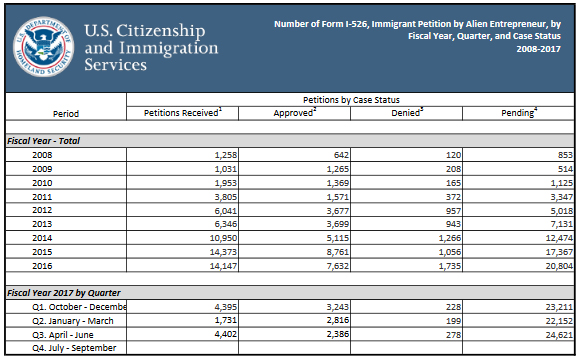
This report provides information commonly used in waiting line models: inventory (pending petitions in the system), arrival rate (petitions received) and flow rate (approved + denied petitions, aka completion rate or throughput).  For an example of how to use this data to make predictions with a simple waiting line model, see the Prediction tab of my I-526 times spreadsheet.

2019 UPDATE: I made an EB-5 Timing page to combine links to articles and resources related to petition processing and visa timing.

S.232 Update, SEC & Attorneys, RC list changes

S.232 Update
Senator Feinstein and Senator Grassley have finally published text for and issued a joint press release on the long-shot S.232 – A bill to terminate the EB-5 Visa Program. The statement from Senator Grassley clarifies what this piece of legislation is really about: “For years, I’ve worked with bipartisan colleagues in good faith to reform it. Unfortunately, despite its many flaws, EB-5 proponents are apparently content with the status quo, and that’s unacceptable. I was hoping that it would not come to this point, but absent serious efforts to bring about reforms, we need to take the necessary steps to wind down the program and completely mitigate fraud, abuse and threats to our security.” S.232 expresses frustration at the progress of EB-5 legislation and makes a hardball negotiating statement: “if you don’t respond to my concerns, here’s what could happen.” The proposal to eliminate EB-5 entirely must be too drastic to gain much support or pass into law, but we should still take the frustration seriously. I can understand why EB-5 industry advocates in Washington DC would settle on a “protect the status quo” platform, that being the path of least resistance to industry consensus, but we cannot afford a reputation for being unserious about reform. We should address each of the concerns that Feinstein and Grassley raise in their press release. We can clarify points that are factually wrong (EB-5 is not green card sale and does not avoid waiting lines, as Feinstein assumes), respond constructively to valid concerns (for example support effective protections in response to past instances of fraud, address questions raised by GAO and Commerce studies on job counts), and have the leadership to offer some considered concessions on the fundamentally divisive issues (such how the targeted employment area incentive should be used, what investment amounts should be). We must not leave oxygen for S.232, or give it excuse to become anything more than a negotiating threat.

SEC Issues for Attorneys
IIUSA has reposted 10 Observations from Reviewing Evidence in an SEC Civil Enforcement Action, an article with good advice for attorneys based on the author’s review of documentary evidence in a civil enforcement action brought by the SEC against an attorney for taking commissions as an unregistered broker-dealer.

RC List Changes
Additions to the USCIS Regional Center List, 12/06/2016 to 02/04/2017

  • Health and Welfare EB-5 Regional Center, LLC (New Jersey, Pennsylvania)

Additions to the list of Terminated Regional Centers:

  • Medical Investment in Texas Regional Center (Texas) Terminated 1/23/2017
  • Pacific Proton Therapy Regional Center, LLC (California) Terminated 1/26/2017