RC reauthorization to 9/30/2017, Trump statements on reform

The regional center program is now authorized, as part of fiscal year 2017 Appropriations legislation, through September 30, 2017. Updates as they happened:

  • 5/8/2017: In the wake of RC program reauthorization and the flap over an EB-5 project being promoted by the Kushner Companies, the White House has started issuing more EB-5 statements, which I’m collecting in this document.
  • 5/5/2017: President Trump has signed the omnibus appropriations bill H.R. 244 – Senate Amendments to HIRE Vets Act [Consolidated Appropriations Act, 2017]. The text still includes clean extension of the regional center program to September 30, 2017 (Title III, Section 542).
  • 5/1/2017: House Appropriations Committee press release: Comprehensive Government Funding Bill Released. The bill text includes this magic sentence on page 734: “SEC. 542. Section 610(b) of the Departments of Commerce, Justice, and State, the Judiciary, and Related Agencies Appropriations Act, 1993 (8 U.S.C. 1153 note) shall be applied by substituting ‘‘September 30, 2017’’ for ‘‘September 30, 2015’’. If passed, this will give simple extension of the Regional Center program authorization for the reminder of the fiscal year, with no other EB-5 program changes. (Section 610(b) of the Departments of Commerce, Justice, and State, the Judiciary, and Related Agencies Appropriations Act, 1993 (Public Law 102-395) established the regional center program, page 47.)  Even assuming the bill will pass as-is, this is not time to relax. Congress could still come out with new independent EB-5 legislation at any time — nothing says they have to wait til the last reauthorization minute to act. Senator Cornyn’s office circulated a new discussion draft of EB-5 legislation just this morning. I’ve entered summary details in my bill comparison chart,   and will add link to the full text as soon as someone posts the draft publicly.
  • 4/28/2017: H.J.Res. 99 – Joint Resolution making further continuing appropriations for fiscal year 2017, and for other purposes has been passed and signed into law, extending government funding and other provisions of Public Law 114–223 (including the regional center program) to May 5, 2017.
  • 4/27/2017: For the first time, I’ve noticed a statement from the Trump administration on EB-5. Washington Post says,
      • The White House issued a statement to The Washington Post this week saying that the Trump administration is weighing changes to the foreign investor visa program. “There are serious concerns held by the administration regarding the EB-5 visa program, in part because it is not being used as it was primarily intended,” said Michael Short, a White House spokesman. “The administration is continuing to evaluate reforms to the program, which we believe is in need of substantial repair.”

    (Update: additional statements linked above at the 5/8/2017 bullet point.)

  • 4/26/2017: House Appropriations Committee Press Release: “House Appropriations Chairman Rodney Frelinghuysen today introduced a short-term Continuing Resolution (CR) (H.J.Res. 99) to continue funding for federal programs and services until May 5, 2017. …The legislation continues policy and funding provisions included in currently enacted fiscal year 2016 Appropriations legislation.” Here is the text of the CR. It’s set for vote on 4/28.

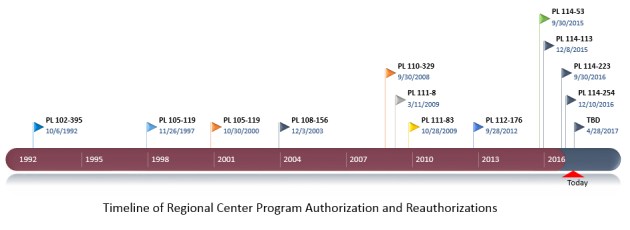
As a reminder, the history of recent regional center program reauthorizations:

  • 12/10/2016 – RC program is extended unchanged to 04/28/2017 as part of a continuing appropriations act (PL 114-254)
  • 9/29/2016 – RC program is extended unchanged to 12/09/2016 as part of a continuing appropriations act (PL 114-223)
  • 12/8/2015 – RC program is extended unchanged to 9/30/2016 as part of an appropriations act (PL 114-113)
  • 9/30/2015 – RC program is extended unchanged to 12/11/2015 as part of a continuing appropriations act (PL 114-53)
  • 9/28/2012 – RC program is extended (with one small change) to 9/30/2015 as part of immigration-related legislation (PL 112-176)
I-924 Webinar, Amendment Requirements

In case anyone would like to review it, here is a link to my audio recording and copies of the slides from today’s webinar on the revised Form I-924 Application for Regional Center Designation. (6/2017 UPDATE:You can now get the sound and slides together, as USCIS has posted a recording of the webinar.) The big news was a comment that the page for the March 3, 2017 EB-5 stakeholder meeting now contains remarks from Lori MacKenzie modifying what she had said at the meeting about geographic area amendments. My original blog post complained about this buried new policy posting, but shortly thereafter USCIS sent out a stakeholder email and posted a statement prominently on the EB-5 section of the USCIS website.

Update to EB-5 National Stakeholder Engagement Remarks: Regional Center Geographic Area Amendments and Form I- 526 Petition Eligibility
On March 3, 2017, USCIS held an EB-5 national stakeholder engagement.  This national engagement was part of our ongoing effort to enhance dialogue with our stakeholders in the EB-5 program.  Remarks from the EB-5 national stakeholder engagement are available here.

At the engagement, USCIS noted that a May 2013 policy memo had previously provided guidance that a formal amendment was not required to expand a regional center’s geographic area, and permitted concurrent filing Form I-526, Immigrant Petition by Alien Entrepreneur prior to approval of the geographic scope amendment.  The May 2013 guidance was superseded by the recent publication of the final  Form I-924 ,the Application for Regional Center Designation Under the Immigrant Investor Program and instructions.  The I-924 revisions included changes to the Form I-924 instructions and require that regional centers file a Form I-924 when seeking an expansion of their geographic area.  The revised Form I-924 became effective on December 23, 2016, following publication of the revisions in draft form in the Federal Register in May of 2016, and a period during which the public had the opportunity to comment.

During the engagement, USCIS addressed questions regarding how requests to change a regional center’s geographic area should be filed and the timing of such a filing.  Specifically, where a regional center has a filed and pending Form I-924 amendment requesting an expansion in geographic area, stakeholders  asked whether or not Form I-526 petitions may be filed prior to approval of the I-924 amendment, relying on such proposed expanded geography.  USCIS has reviewed stakeholder concerns raised during the engagement and has updated the engagement remarks to clarify how the agency is implementing the above policy. Specifically:

  • Where the regional center’s geographic area expansion request was submitted either through a Form I-924 amendment or Form I-526 petition filed prior to February 22, 2017 (the date on which use of the new Form I-924 became mandatory), and the request is ultimately approved, USCIS will continue to adjudicate additional Form I-526 petitions associated with investments in that area under the guidance reflected in the May 30, 2013 policy memo.
  • Any requests for geographic area expansion made on or after February 22, 2017 will be adjudicated under the current guidance; namely, a Form I-924 amendment must be filed, and approved, to expand the regional center’s geographic area.
  • For geographic area expansion requests made on or after February 22, 2017, the Form I-924 amendment must be approved before an I-526 petitioner may demonstrate eligibility at the time of filing his or her petition based on an investment in the expanded area. Form I-526 petitioners who believe they may be unable to demonstrate eligibility at the time of filing on this basis may wish to contact USCIS at ipostakeholderengagement@uscis.dhs.gov.

Sincerely,
USCIS Public Engagement

And here, since the I-924 Form and Instructions are apparently our new venue for policy guidance, is the official word on amendment requirements.

Quoted from the I-924 Instructions (version expiring 12/31/2018), page 1
Request an amendment to a previously approved regional center.
A. You must file an amendment to:
(1) Seek approval for any changes to the regional center’s name, ownership, or organizational structure, or any changes to the regional center’s administration that affect its oversight and reporting responsibilities, or to add or remove any of the regional center’s principals, immediately following the changed circumstances; or
(2) Change the geographic area of a regional center.
B. You may also file an amendment to:
(1) Change the industries of focus of the regional center;
(2) Add a new commercial enterprise associated with the regional center and/or seek a preliminary determination of EB-5 compliance for an exemplar Form I-526, Immigrant Petition by Entrepreneur, for that new commercial enterprise, before individual entrepreneurs file their petitions; or
(3) Notify USCIS of changes in the name, organizational structure or administration, capital investment instruments, or offering memoranda (including changes in the economic analysis and underlying business plan used to estimate job creation) for a previously added new commercial enterprise associated with the regional center.
NOTE: An I-924 amendment is not required to report changes of address, contact information, a change of duties among the regional center principals, changes to non-principal managing companies, contracting agents or similar changes, or information described in Item 2.B. above. The regional center must notify USCIS within 30 days of such changes. Notification of these changes can be made by sending an email to the EB-5 Program mailbox at: USCIS.ImmigrantInvestorProgram@dhs.gov. USCIS will review any changes submitted by email and may require or recommend, as appropriate, the regional center to file an I-924 Amendment.

“You must file an amendment to seek approval for….” sounds like it could be discretionary (i.e. you needn’t file an amendment if you’re not seeking approval for…), but apparently it isn’t. (Previously, IPO said that I-924 amendment was recommended to seek approval for management changes, with an option to just notify the IPO email box. No longer.) Today’s webinar slides restated the I-924 instructions as “You must file an amendment in case of…,” and the presenter said that the required amendment must not only be filed but also approved. (But approved “before what”? This point doesn’t go without saying. Before I-526s are filed? Before I-526s can be approved? Before the regional center can take any action at all? IPO needs to clarify the “before what” for each required type of amendment, and whether the requirement is to file or file plus wait for approval.)
Otherwise, today’s webinar mainly just read through the new Form I-924 content, pointing out changes for the benefit of people who hadn’t previously noted just how much the form changed, or implications of those changes. The audience asked few questions. USCIS emphasized two concerns behind Form I-924 revisions: vetting regional center principals and managers, and limiting geographic area. The revisions take effective steps toward the first objective, but make little difference to the second. Geographic area requests are limited only by imagination and chutzpah so long as USCIS continues to allow and even encourage applicants to base their requests on hypothetical/fictitious projects.

Goodlatte statement; IIUSA TEA Analysis

Two important new press releases:

  1. House Judiciary Committee Chairman Bob Goodlatte announces on behalf of House and Senate Judiciary Committee members that “Lawmakers Remain Committed to Good-Faith Talks to Reform Investor Visa Program Ahead of Expiration” (April 19, 2017)
  2. IIUSA announces First-Ever Comparative Analysis Report on EB-5 TEA Policy Reform (April 20, 2017). This very valuable report and mapping tool  takes a comprehensive look at the impact the different TEA policy proposals would have on the EB-5 Regional Center program at both a national and state-by-state level. For those of you who downloaded my TEA summary earlier, note that I erred in providing a link to an NMTC mapping tool based on old data. You should look instead at the IIUSA interactive mapping tool, which uses the dataset that would actually be required to determine TEA qualification under new proposals.

Meanwhile, a 4/19 post by Miller Mayer reports on a version of EB-5 reform legislation that I haven’t even seen, though Miller Mayer says “all major EB-5 industry representatives have agreed to this tentative compromise.”

Washington Updates (new draft bill), New Form I-526, RC list updates

Washington Updates
It’s still not clear what will happen in the next couple weeks before the next regional center program sunset date on April 28, and whether we’re likely to see EB-5 program changes first from legislation or from new regulations. In an advocacy update sent to members last week, IIUSA noted that the appropriations package to fund the government past April 28 is likely to be larger than a continuing resolution. Thus it could be a vehicle for EB-5 legislative reform, were any reform proposals ready. Right now there are three active bills – two that would terminate EB-5 entirely, and Rand Paul’s rosy wish list of improvements. Yesterday EB-5 Insights reported that the Senate Legislative Council is circulating another staff discussion draft of EB-5 reform legislation, and speculates that the RC program may get a short-term extension of a few weeks (with government funding) while Congress works out other appropriations details. I’ve added the staff draft dated 4/15/2017 to my Bill Comparison Table and updated my TEA Incentive Summary for reference. (5/11/2017 update: I’ve now revised the TEA Incentive Summary.) The new draft is basically the same document (with a few changes) as the 12/2/2016 staff discussion draft, which in turn was based on the Goodlatte/Conyers legislation from 09/2016. We shall see whether it goes anywhere this time around.

New Form I-526
There’s a new edition of the Form I-526, which everyone must use starting June 9, 2017. Wolfsdorf Rosenthal and EB-5 Insights discuss what’s new in this version of the form.

Petition Processing
The new IPO processing times report does not look good, with the “processing petitions as of date” date having regressed for every category (back almost a week for I-829, back nearly 3 weeks for I-526, and back nearly 5 weeks for I-924). If you’re new to this blog, here’s a link to a post with everything I know about interpreting processing time reports.
Also, a sharp-eyed reader pointed out to me that the number of pending I-526 petitions that USCIS reports every year does not, as one would expect, equal the number of pending petitions at previous year-end plus current-year receipts minus current-year approvals and denials. (The quarterly numbers don’t add up either.) Anyone know why this is so? If not, I’m submitting a question for the next stakeholder meeting.

Regional Center List Changes
Additions to the USCIS Regional Center List, 04/03/2017 to 04/17/2017

  • Atlas Regional Center, LLC (California)
  • Hawaiian Palms Regional Center (Hawaii)
  • Hope Investment Regional Center (California)
  • Washington Free Life (Washington)

New Terminations

  • Leaf Fischer Investment Group, LLC (Florida) Terminated 3/6/2017
  • Idaho Global Investment Center, LLC (Idaho) Terminated 3/6/2017
  • FreeMind Films Regional Center (California) Terminated 3/15/2017
  • Green Card Gateway Regional Center (Illinois) Terminated 3/30/2017
  • Florida Gateway Regional Center, LLC (Florida) Terminated 4/12/2017

Preventing fraud in EB-5 (CIIF investigation)

In his testimony before the House Judiciary Committee in February 2016, Investor Program Office Chief Nicholas Colucci discussed how much USCIS has done to improve its administration of the EB-5 program, with particular focus on adding resources to prevent the kind of fraud and abuse that can come with investment and immigration.

Over the past few years, USCIS has taken a number of steps to improve the administration of the EB-5 program. In 2013, USCIS realigned the EB-5 program into the Immigrant Investor Program Office, and relocated it from USCIS’ California Service Center, which adjudicates various immigration benefits, to Washington, D.C., with a Chief dedicated exclusively to EB-5 adjudications. As the United States Government Accountability Office (GAO) noted in its August 2015 report to Congressional requesters on the EB-5 program, this move was part of a restructuring to help USCIS better detect fraud. USCIS also created a Fraud Detection and National Security EB-5 Division (FDNS EB-5) and embedded its personnel within IPO to work alongside adjudications officers. Additionally, a dedicated team of attorneys from the USCIS Office of Chief Counsel advise on program-related legal matters. In staffing the IPO, USCIS has, and continues to invest in the specialties needed to manage the complex EB-5 caseload by hiring staff with expertise in economics, law, business, finance, securities and banking to review cases and to enhance consistency, timeliness, and integrity within the program….
USCIS has taken its responsibility to administer the EB-5 program very earnestly, through its specialized staffing devoted solely to this program and its extensive efforts to regulate the quickly growing regional center program. However, no agency can do this alone. The EB-5 program necessitates collaboration with several other agencies, and the establishment of IPO in Washington, D.C. allows USCIS to work closely with partners such as the U.S. Securities and Exchange Commission (SEC), with whom IPO shares a robust collaborative relationship. USCIS also works closely with its sister agency, U.S. Immigration and Customs Enforcement (ICE), as well as with the Federal Bureau of Investigation (FBI) and the U.S. Department of State, in support of our oversight of the EB-5 program.

Improvements have covered staffing, inter-agency collaborations, and improved processes for important functions such as vetting lawful source of investor funds (as further explained in follow-up testimony — see especially Question 15 in response to Senator Grassley and Question 5 in response to Dianne Feinstein.)

This week’s breaking news story Feds raid San Gabriel, Arcadia locations over visa-fraud scheme involving criminals on China’s most-wanted list reminds us why those improvements were so important. The case, as described in an Application for Search Warrant filed by an FBI investigator, indicates that USCIS approved I-526 petitions from 2009 to 2012 that (if FBI evidence is correct) should never have been approved — including cases that involved people who did not invest their own funds, people who were promptly refunded their investments, and three individuals listed on China’s most wanted list for financial crimes. The good news is that the net since 2013 seems to be holding. The warrant does not indicate that any investors named in the investigation have been able to to get permanent green cards (though several have had I-829 petitions on file since 2012, possibly pending this FBI investigation which seems to have started in 2013), and the post-2013 I-526 petitions discussed in the warrant are likewise pending. The investigation stands as evidence that people may try to get away with fraud and abuse — but not that they get away with it. Investors who may have been complicit have not successfully completed the immigration process, and the regional center principals have had the FBI at their heels (sometimes literally: “at approximately 11:13 a.m., observed TAT exit SUBJECT PREMISES #2’s front door and walk across the street, after which he talked to a gardener, and then returned and entered SP#2. At 11:45 a.m. observed TAT exit SP#2 and go to the mailbox in front of the residence and retrieve mail. At 12:13 p.m. observed TAT walking from SP#2 carrying a black-colored briefcase-sized soft bag in his hands. TAT then walked across the street.”) and are now facing formal fraud investigation. Dozens of good faith investors in CIIF offerings and anyone with CIIF who’s innocent of fraud are unfortunate collateral damage, and I wish for their sake that the FBI had worked more quickly. (Updates: Some investors have filed suit in civil court to try to get their money back, and Federal Prosecutors have filed civil complaints seeking asset forfeiture. Victoria Chan has pled guilty to fraud and money-laundering charges.)

FY2017 Q1 EB-5 Petition Processing Statistics

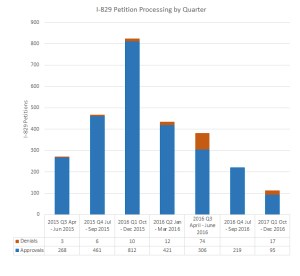
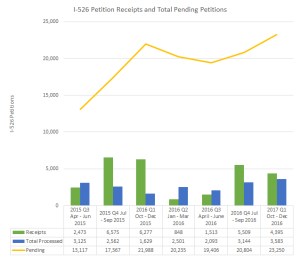
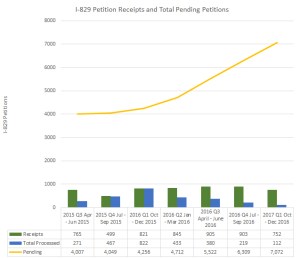
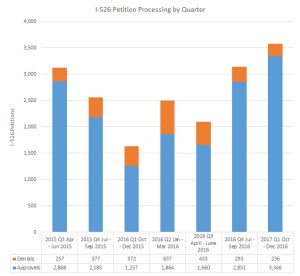
The USCIS Immigration and Citizenship Data page has been updated with numbers for I-526 and I-829 petitions received and processed in October to December 2016. The numbers show another dramatic improvement in I-526 processing, continuing free-fall in I-829 processing, and another unnatural surge in I-526 receipts. Denial rates remain low. When IPO previewed these numbers in the last stakeholder meeting, they said that I-829 adjudications will improve going forward with a new I-829 team.

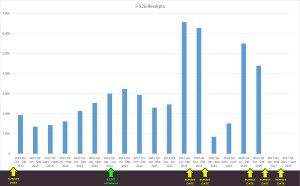
I’ve updated my summary charts with the FY2017 Q1 numbers, and also added a new chart pointing out how I-526 filing trends coincide with regional center program sunset dates. Legislators and USCIS have tended to speak as if recent EB-5 investor numbers reflect sustainable trends based on surging interest in the EB-5 program (and/or underpricing or aggressive marketing). My experience and what I read indicates that the surges are rather fueled by uncertainty about program changes, such that people who would otherwise have considered EB-5 years in the future are hustling all at once to make investments now while the program is still viable. That kind of demand is not sustainable. In fact it means that all else being equal we’ll see fewer investments in the future, because tomorrow’s demand is being pulled into today (and tomorrow’s visas are being claimed today). The increasing supply of EB-5 investment opportunities (particularly from a few mega-projects, the subject of a forthcoming post) play a role in the surges and backlog, but most of all I blame Congress for keeping the regional center program on edge by repeatedly promising and failing to act on EB-5.

4/26 USCIS Webinar on I-924

Note: The subtext to this webinar may be the storm over IPO’s claim that the revised Form I-924 justifies the new policy to require amendment approval for expanded geographic area prior to I-526 filing. However, the invite doesn’t solicit any advance comments or indicate whether the event will allow questions.

From: U.S. Citizenship and Immigration Services [mailto:uscis@public.govdelivery.com]
Sent: Wednesday, April 05, 2017 10:34 AM
Subject: USCIS Invitation: Form I-924, Application for Regional Center Designation Under the Immigrant Investor Program, 04/26/2017

Dear Stakeholder,

U.S. Citizenship and Immigration Services (USCIS) invites you to participate in a webinar on Wednesday, April 26, from 1 to 2 p.m. to discuss the Form I-924, Application for Regional Center Designation Under the Immigrant Investor Program. This webinar will discuss certain changes to the Dec. 23, 2016 edition of Form I-924.

Form I-924 is used by any economic unit, public or private, in the United States that is involved with promoting economic growth (including increased export sales, improved regional productivity, job creation, or increased domestic capital investment) to:

  1. Ask USCIS to be designated as a regional center under the Immigrant Investor Program; or
  2. Request an amendment to a previously approved regional center.

Form I-924 and its instructions are available at https://www.uscis.gov/i-924.

To Register:

Please email ipostakeholderengagement@uscis.dhs.gov with your full name and the name of your organization. Also, please place “I-924 Webinar” in the subject line. Once we process your registration, you will receive a confirmation email with additional details.

If you have any questions regarding the registration process, or if you have not received a confirmation email within two business days, please email us at the same address.

Note to Media: This engagement is not for press purposes. Please contact the USCIS Press Office at (202) 272-1200 for any media inquiries.

We look forward to engaging with you!

Washington updates, articles, RC list updates

Washington Updates

  • Legislation: Another piece of EB-5 legislation has been thrown into the ring – this one from Rand Paul: S.727 Invest in Our Communities Act. Dianne Feinstein made an extreme bargaining statement with S.232, which threatens to eliminate the EB-5 program entirely, and Rand Paul’s bill takes the opposite pole – offering to make the regional center program permanent with more visas for everyone, better processing times, more investor protections, reasonably limited integrity measures, and no changes to the investment amount or Targeted Employment Area incentive. I’ve entered S.727 in my bill comparison chart, but I guess it lacks sufficient compromise to gain traction (and the similar S.2122 from Mr. Paul in 2015 didn’t go anywhere) . I can’t guess what will happen between now and April 28, but am following what The Hill has to say about prospects for a continuing resolution or omnibus spending bill. UPDATE: An April 6, 2017 letter from Senators/Representatives Grassley, Leahy, Conyers, Goodlatte, and Feinstein encourages Congressional leadership not to extend the RC program on April 28 unless accompanied by reforms. (Then why don’t any of these people introduce reform legislation??)
  • Regulations: Recall the April 11 deadline if you want to comment on USCIS proposed EB-5 regulations USCIS 2016-0006 and USCIS-2016-0008. So far, 0006 (with proposed TEA and investment amount changes) has 54 comments and 0008 (the advance notice requesting feedback on regional center designation issues) just 11 comments.

Other Resources

  • Wolfsdorf Rosenthal and EB-5 Insights have posts about a new kind of source of funds RFE that requests SOF evidence for people transfering funds on behalf of an EB-5 investor.
  • Carolyn Lee discusses the newly-unveiled regional center compliance audit program.
  • A journalist called to ask me for the story behind the surge of regional center terminations in 2015 and 2016. In case anyone else is interested in this topic, here are the sources I sent him.

RC List
Additions to the USCIS Regional Center List, 03/01/2017 to 04/03/2017:

  • Coastline Regional Center (Washington)
  • Extell Utah Regional Center (Utah): eb5extell.com
  • Mainsail Florida Regional Center (Florida)

Removed from the list of terminated RCs, and restored to the list of approved RCs:

  • South Dakota International Business Institute (SDIBI) (South Dakota)

New Terminations:

  • San Gabriel Valley Regional Center (California) Terminated 3/15/2017
  • Washington Center for Foreign Investment, LLC (Maryland) Terminated 3/28/2017

By the way I work hard to keep my blog Regional Center List complete and consistent with information from USCIS, but the task is not easy and I welcome regional centers to correct my information.