RC Terminations, investor litigation victory, China trends, agent ethics, RC list changes

Regional Center Termination Reasons

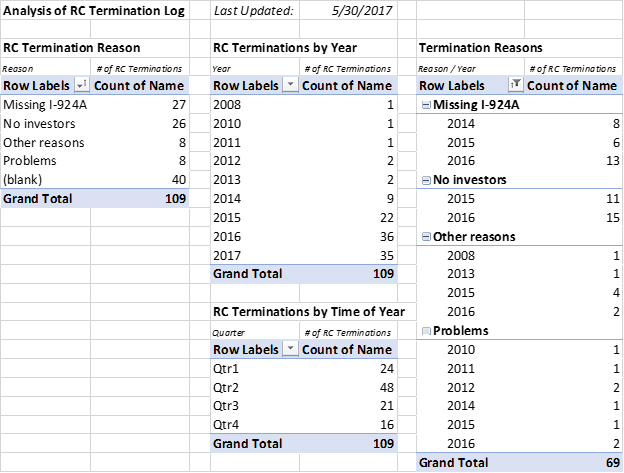
USCIS has terminated 109 regional centers over the past decade, and 23 regional centers in May 2017 alone. This month USCIS also initiated a page for Regional Center Termination Notices, with most notices up to November 2016 posted so far. The page explains that “USCIS will remain consistent and committed to transparency in the EB-5 program by proactively publishing Regional Center termination notices as they become available. This is an important step in assisting investors, the EB-5 industry, and the public to understand the reasons why a regional center has been terminated and what types of regional center activities may trigger the end of a regional center’s designation.”

I’ve started a Termination Log spreadsheet (also linked to my RC List page for ongoing reference) to correlate USCIS’s terminations list with its notices list, and facilitate analysis. Pivot table analysis of this log provides a quick overview of termination reasons (from the 69 termination notices posted so far) and timing.

In fact the termination notices are not very informative (most reference Notices of Intent to Terminate, which are not attached, for specific reasons), but we can generally learn that about 77% of RC terminations from 2008 through November 2016 occurred for one of two reasons: failure to file an I-924A annual report, or the fact that the I-924A report reflected inactivity (i.e. no investor petitions in three or more years). Just 12% (notices for eight regional centers) referenced problematic behavior by the regional center as a basis for termination. Other reasons include the regional center’s voluntary request to withdraw from the program. One letter dated July 13, 2016 explains “USCIS notes counsel’s request to withdraw from the program. The mechanism to end a regional center’s designation, whether initiated by the regional center or USCIS, is termination of the designation.” (This particular letter could’ve raised on-going FBI investigation as a termination issue, but that’s another story.) The Final Fee Rule published 10/24/2016 confirms that a regional center may elect to withdraw from the program, but does not offer an exit more dignified than termination. “A regional center may elect to withdraw from the program and request a termination of the regional center designation. The regional center must notify USCIS of such election in the form of a letter or as otherwise requested by USCIS. USCIS will notify the regional center of its decision regarding the withdrawal request in writing.This is a pity, as the terminated regional center list looks like a walk of shame, and I think voluntarily withdrawal should be treated differently from termination initiated by USCIS.

Legal Win for EB-5 Investors

Investors who think they’ve fallen victim to errors by USCIS will be interested in this long but ultimately successful battle by a group of EB-5 investors.

  • 2013: Twelve EB-5 investors file I-526 petitions based on investment in a regional center hospital project that sought to qualify as a troubled business
  • 2013-2015: USCIS denies the I-526 petitions, and then denies Motions to Reopen filed by the petitioners. The petitioners appeal the denials to the Administrative Appeals Office.
  • March to May 2016: AAO posts decisions dismissing appeal of I-526 denials (for example, MAR252016_02B7203)
  • April 2016: Four petitioners file civil action against USCIS in district court: Wei Gan v. USCIS
  • May 2017: USCIS and the plaintiffs resolve the case
  • May 2017: AAO posts decisions sustaining appeal of the previously-denied I-526s (For example, MAY182017_01B7203. Other May 18 2017 decisions sustain appeals for other investors in the same project)

Trends, Pitfalls, and Ethics in Working with Overseas Agents

China Market Demand Trends
Ronald Fieldstone reflects on a recent China trip in his post EB-5 Marketplace Measurement – China and Beyond (May 25, 2017). We’re reminded of the extent to which demand shapes supply in EB-5 investment.

Agent Marketing Claims
The Kushner Companies EB-5 roadshow in China continues to reverberate, with Senator Grassley mining it for yet another press release, this one calling for investigation of the Chinese agent involved, and its sales claims. (Grassley Seeks Investigation of Companies’ Promises of Green Cards 5/25/2017.) The regional center has protested to journalists that the senator’s allegations are baseless in this case, but all regional centers can take the reminder to double-check what their agents overseas are saying and posting online. Also keep in mind IIUSA’s best practices for engaging with sales intermediaries.

Ethics for US Lawyers Retained by Migration Agents
Lawyers who deal with overseas agents in EB-5 may be interested in a March 2017 Ethics Opinion by the New York State Bar Association. The opinion discusses conditions under which a lawyer may enter into an arrangement whereby a nonlawyer “foreign migration agent” hires the lawyer on behalf of the client and assists the lawyer in communicating with the client. Cyrus Mehta explores the matter further in his post EB-5 Green Card, Ethics and Trump (May 22, 2017).

DHS Director and EB-5

Lee Francis Cissna, President Trump’s nominee for Director of USCIS, committed to finalizing EB-5 reforms in his Senate Judiciary Committee hearing last week. In other words, new EB-5 regulations are still on the table. Mr. Cissna spent much of the past two years working for Senator Grassley on immigration issues, and reportedly wrote dozens of the letters sent under the senator’s name to Homeland Security officials. This does not bode well for his attitude to immigration generally or EB-5, though he made a nice statement at the hearing.

Regional Center List Changes

Additions to the USCIS Regional Center List, 05/08/2017 to 05/30/2017

  • Atlantic Casino & Entertainment Group Regional Center (Delaware, Maryland, New Jersey, Pennsylvania)
  • New York Immigration Regional Center (Connecticut, New Jersey, New York, Pennsylvania): www.goeb5nyc.com/
  • American Family Regional Center (Washington)

New Terminations

  • Dallas Regional Center (Texas) Terminated 5/22/2017
  • East Plumas County Regional Center, LLC (California) Terminated 5/22/2017
  • Immigration Funds LLC (former name United States Investors Regional Center) (Maine, Massachusetts, New Hampshire) Terminated 5/22/2017
  • Ohio Regional Center, LLC (Ohio) Terminated 5/21/2017
  • EB5 Express Regional Center (California) Terminated 5/18/2017
  • Arkansas Regional Economic Development Center, LLC (Arkansas, Oklahoma) Terminated 5/16/2017
  • Art District Los Angeles Regional Center, LLC (California) Terminated 5/16/2017 (this RC was removed from the terminated list and added back to the approved list on 6/19/2017)
  • The Z Global Corporation Regional Center (California) Terminated 5/16/2017
  • Mariana Stones Corporation Ltd. (Guam) Terminated 5/15/2017
  • NatureAll Co., Inc. EB-5 Regional Center Terminated 5/15/2017 (New Jersey)
  • USA Regional Center, LLC (California) Terminated 5/15/2017
  • Eight Islands Regional Center, LLC (Hawaii) Terminated 5/3/2017
  • Diamond City Montana EB-5 Regional Center, LLC (Montana) Terminated 5/10/2017
  • New York Pioneer Regional Center (New York) Terminated 5/3/2017
  • Optima Arizona Regional Center, LLC (Arizona) Terminated 5/3/2017
  • Puget Sound RC, LLC (Washington) Terminated 5/3/2017

New EB-5 Regulations: Comments Discussion

We’re waiting on the fate of draft EB-5 regulations published in the Federal Register in January 2017, with a public comment period that ended in April 2017. This post briefly reviews the proposed rules, considers the probability that they will be finalized any time soon, and distills insights from the 323 public comments that I’ve now read. The post is long because the topic is important. I expect EB-5 regulations to be finalized — in my lifetime, even — and the regulation comments include valuable contributions to the debate around EB5 program changes.

Content of Proposed Regulations

Future of Proposed Regulations

Final EB-5 regulations could take effect anywhere from 30 days from now (if a final rule were published today in the Federal Register) to never. (If you’re interested in how the process works, see A Guide to the Rulemaking Process prepared by the Office of the Federal Register.) Here are factors that I know of that could affect timing in this case.

  • DHS can be very slow. For example, the regulation dealing with EB-5 petitions approved 1995-1998 (RIN 1615-AA90) first appeared as a proposed rule in 2003, the Notice of Proposed Rulemaking was published in the October 2011 Federal Register, the public comment period closed in November 2011, and as of May 2017 the rule has not yet been finalized.
  • Most commenters on the NPRM reminded DHS that Congress has been working to deal with the very same issues through legislation, and that legislation should proceed regulations. Therefore regulations should be withdrawn or put on hold to allow Congress to act. Several speakers at the House Judiciary Committee Hearing on the NPRM supported the point that policy-making belongs to Congress, and it should act first.
  • On the other hand, no one at the House Hearing spoke in favor of cancelling the EB-5 regulations, even if they did come out under Obama, and four influential Congressmen behind EB-5 reform legislation (Goodlatte, Grassley, Conyers, and Leahy) collaborated to submit a comment on the NPRM strongly urging DHS to finalize it, at least with respect to minimum investment amounts. Senator Grassley personally encouraged DHS Secretary John Kelly in January to finalize the EB-5 regulations, and called on him again on May 11 to expedite the regulations. UPDATE: DHS Director nominee Lee Cissna committed on May 24 in his confirmation hearing to finalize EB-5 reform.
  • On May 8, the New York Times quoted a White House statement that the administration “is evaluating wholesale reform of the EB-5 program to ensure that the program is used as intended and that investment is being spread to all areas of the country.” Supporting drastic reform regulations could be a strategic move for President Trump: bombing the EB-5 program would conveniently show that he’s truly not in the pocket of any tangentially-related EB-5 promoters. On the other hand, the proposed regulations would inhibit job creation and impose excessive costs on business – points Trump has committed to avoid in regulations.
  • This Congress has so far officially introduced only one EB-5 bill, but we’ve seen a couple discussion drafts that might emerge as live legislative options.
  • The rule-making process requires DHS to review and respond to public comments. I took a long time just to read all the comments and write this post, and foresee that the final rule will be tough and time-consuming for DHS to write. If DHS takes the good feedback seriously, it will likely come up with another version that’s sufficiently different to justify a second posting and comment period.

Review of Public Comments

The 290 public comments on NPRM #0006 can be roughly divided as follows: brief personal pleas from EB-5 investors (61%), analysis and experience from EB-5 project people operating outside Tier I cities (14%), lengthy and sophisticated comments from the top few big-city regional centers and their surrogates (6%), brief comments on behalf of direct EB-5 projects (6%), feedback from immigration lawyers and other service providers (10%), rants about damn furriners (3%), and comments from Congress (0.3%). I summarize common themes in these groups, and then link to specific comments of interest.

Feedback from Congress

There is only one comment from Congress – a letter signed by Bob Goodlatte and John Conyers from the House and Charles Grassley and Patrick Leahy from the Senate – but I lead with this because it’s so significant and seems to have passed unremarked.  These Congressmen have spearheaded EB-5 reform legislation, and their comment reveals their good intentions and dangerous misunderstanding of how EB-5 works. They identify real problems but go very wrong in suggesting solutions.  We particularly need to respond to their counterproductive ideas about job creation and retroactivity. Clearly they haven’t realized that their suggestions would have the practical effect of gutting small, rural, and direct EB-5 projects while lining the pockets of mega-project developers with superfluous cash. (A post with more on this soon – and staffers if you’re reading this, please call me and I will explain.)  While most other public comments ask DHS to wait for Congress to act, these influential Congressmen “strongly urge” DHS to finalize EB-5 regulations, particularly with respect to minimum investment amounts, and also propose additional items that they’d like to see DHS address via regulation (visa set-asides for TEAS, limits on job creation, mandatory I-829 interviews, limits on regional center rental and sale, and limits on job counts).

Feedback from EB-5 Investors

The many comments from investors are generally short and sweet, bringing little data and evidence but a fair amount of appealing personal experience. The dominant message – repeated across most investor comments – is that EB-5 visa backlog problems need to be addressed before any other reforms can be meaningful. Investors from China express distress at finding themselves in a three-to-ten-year waiting line just to get conditional residence, depending on when they invested, and the many problems that flow from that – children aging out and separating families, the high risk of material change, the problem of asynchronous exit strategies, the difficulty of managing enterprises and overseeing investments from overseas, and so on.  Current investors don’t see the program remaining viable for new investment if the required minimum investment more than triples plus the backlog problems aren’t solved. Investors were also united in supporting (and suggesting ways to expand and strengthen) priority date protection, and opposing any retroactive application of new rules. Many proposed granting parole after I-526 filing, and allowing EB-5 investors who have waited more than two years since I-526 approval to file I-829 once a visa becomes available. The comments impressed me with the thought that EB-5 investors need an association that allows them to organize, collaborate, and advocate for their own interests. Past investors are important stakeholders, with distinct concerns and a strong interest in influencing debates around the future of the EB-5 program. But here they are represented by scattered 100-word comments with doubtful punctuation while regional center representatives present sharp 10,000-word essays bristling with footnotes. I see evidence of group coordination in some investor comments, and encourage people to contact me if they have any groups that they’d like publicized.

Feedback from Regional Centers and Project Developers

On the project side, nearly everyone opposes the DHS proposals regarding investment amount (a one-stage 180% increase to the standard investment amount and 270% increase to the TEA investment amount). Commenters argue that this abrupt and dramatic increase would quell demand, make the US investor visa program uncompetitive, reduce the total job creation and investment impact of the EB-5 program, be tough on small projects, and dampen the incentive to invest in a TEA. They make supply-demand arguments (suggesting that any inflation-based increase should be dated from 2008 or so when demand for the program took off, not from the 1990s when it was barely used), propose linking investment amount calculation to factors such as exchange value of the dollar and household income rather than merely considering the Consumer Price Index, encourage DHS to consider Congressional intent as expressed in recent proposed legislation, not just as expressed in 1992, point out the high risks that distinguish the US program from others, and advocate for a phased-in approach and protection for past investors and midstream offerings.

When it comes to Targeted Employment Areas definitions, and the incentive to invest in a TEA, big-city and small-city/rural regional centers part ways. Comments filed on behalf of the big urban regional centers advocate for large TEA areas based on commuting patterns (allowing for TEA projects located at a distance from where unemployed people live) and for a narrow differential between the TEA and non-TEA investment threshold (minimizing the TEA incentive). Comments filed on behalf of regional centers active outside of major cities were generally supportive of TEA changes proposed by the regulations (which would require TEA projects to locate in/very near high-employment areas) and advocate for a meaningful TEA incentive/investment differential. For example Related New York City Metro Regional Center suggests that TEAs should allow for unlimited combinations of areas within an MSA (and with no requirement that the constituent areas be contiguous), and that TEA investment should be only $50,000 cheaper than non-TEA investment. By contrast, Pine State Regional Center (Arkansas, Missouri, Tennessee) supports restricting TEA definitions and significantly incentivizing TEA investment (for example taking the $800,000/$1.2M investment levels proposed last year in legislation, which would be a $400,000 differential).  The two points of view were approximately balanced in comments on the regulations (with more voices on the small/rural side and stronger voices on the large urban side), though I note that the big players are winning lobbying (each successive draft of proposed legislation has progressively bargained down the investment differential/incentive to invest in a TEA).

Nearly every commenter (except for a couple thinkers who have never experienced USCIS processing) agrees that DHS absolutely must not enter the business of issuing case-by-case TEA determinations. USCIS designations would be needless assuming that TEA requirements are clarified and codified, senseless considering USCIS’s (lack of) expertise, and disastrous considering USCIS’s existing workload and processing times. These arguments were made very strongly, many times. If the final rule persists in assigning TEA designation to USCIS rather than creating an automated process or giving unambiguous guidelines to state agencies, then we’ll know that DHS just didn’t read the comments. I hope that Congressional staffers working on EB-5 would read these comments as well, for the case against individualized TEA designation by USCIS is extremely clear and compelling.

Many of the EB-5 industry commenters joined investors in arguing for I-526 priority date protection, for measures that would ease the visa backlog by not counting derivatives or recapturing unused visas, for protecting investors who already filed under old rules, and for palliative measures in light of the backlog such as parole after I-526 approval and age-out protection and priority date protection.

The ANPRM #0008, being a just preliminary notice, got little attention and feedback – sadly, because it did ask important questions. Comments that were submitted particularly focused on the proposal to require exemplar approval prior to I-526 filing (granting that this is a good idea only if the processing time can be short, and unworkable otherwise).

A sampling of noteworthy comments

The public comments are useful to help understand what DHS sees as it prepares a final rule, and also as a source for ideas worth discussing and support for arguments that you may want to make yourself. I’ve assembled a short list of comments that make particularly interesting or characteristic points, or that make points in a particularly effective way, with compelling language and evidence.

  • The case for TEA rules that don’t disadvantage urban projects: Jeffrey Carr (gives rationale for TEAs based on commuting patterns, unlimited areas within MSAs, census block groups, and NMTC criteria), EB-5 Investment Coalition (proposes a “9-Step Process” to designate areas that include “Residence Tracts” linked to “Workplace Tracts”), Angelique Brunner and David Morris (propose expanding provision to encompass existing government-designated economic development zones).
  • The case for TEA rules that significantly incentivize projects outside prosperous urban areas: Urban Manufacturing Alliance and  Mount Snow (for distressed urban and rural areas), Invest Atlanta (economic development agency perspective), Gary Friedland (considering the purpose to stimulate investment in undercapitalized areas), IIUSA (for fairness to a broad base of EB-5 users)
  • The case for a different approach to calculating EB-5 investment amount increases: Auray Capital (considers data on currency exchange rates, competitor programs, market threats, and the population of potential investors), Jim Nail, AISA (points out why an inflation-correction approach, if used, should calculate from the TEA investment amount), Centurion American Development (consider investment risk and return, and costs to the regional center), Suman Guduru (too high would discourage startups and entrepreneurs), Deputy Mayor of Columbus, Indiana (too high would discourage investment in small cities),  Alexandre Carvalho (too high would discourage investors).
  • The case against delegating TEA designation to USCIS: Nearly every comment, but for example Elliot Winer and Kimberly Atteberry (technical reasons); Stetson Law and Chanticleer Holdings (positive benefits of state involvement)
  • The case for broadening I-526 priority date protections: Green and Spiegel and AILA and Penny Zhang (for priority date protection not only contingent on I-526 approval),  Meisheng King (for the option of assigning priority date to children), Golden Southern Chicken (priority date protection would allow for better business decisions), Fei Zhiqiang (priority date protection would free investors to act on suspicions of malfeasance)
  • The case against priority date protections: US Chamber of Commerce (could encourage investors to abandon projects that no longer qualify as TEAs), Pacific ProPartners (would further swell the visa waiting line and undermine forecasts)
  • The case for taking EB-5 visa backlog problems seriously: ZeMing Gao and Shiting Yi  (and for those unfamiliar with the backlog problems, here’s my blog post with as much as I know)
  • The case that DHS has and should use the power to modify EB-5 visa availability: EB-5 Investment Coalition (the arguments for eliminating derivatives from the visa count and recapturing unused visas)
  • The case for and against making EB-5 program changes retroactive: Goodlatte/Grassley/Conyers/Leahy (for retroactive application), Fragomen (against). Industry response would have been stronger had we realized retroactivity could even be on the table for regulations. I will write more in response to the comment from Congress, and hope others will as well. Many investor comments speak against retroactivity, but without marshaling sources and evidence.
  • The case for a revised material change policy: American Immigration Lawyers Association (EB-5 material change policy as currently stated can make an EB-5 petition un-approvable even though it was eligible at the time of filing and remains eligible after an interim material change. AILA digs into the law and proposes a more appropriate material change rule that would only focus on changes that involve EB-5 credibility requirements, and only on changes that make a petition ineligible. The argument seems sensible and could solve severe current problems in EB-5 adjudication. I hope more people read, discuss, and promote it.)
  • The case against requiring exemplar approval without a strictly-controlled processing time: Suzanne Lazicki (explaining the process and timing issues), Jillian O-Brien (providing examples). It’s so important for USCIS to understand the practical difference between a requirement to file and a requirement to file plus wait for approval.
  • Thoughts on designation, monitoring, and oversight requirements for regional centers: EB5 Securities Roundtable and Citizen for Responsible Regulation
EB-5 Primer

The media is still full of EB-5 stories, but many reports struggle to explain EB-5. Are we selling citizenship? Is this a cash-for-visas program? Why would a luxury project by celebrity New York developers get to benefit from immigrant investment?

Strictly speaking, EB-5 is not a visa-for-cash program but a visa-for-employment program. The “EB” in EB-5 stands for Employment Based. While some countries do sell citizenship, Congress took care to set up the US program differently. An EB-5 investor can get conditional permanent residence for making a qualifying investment that will result in creation of at least 10 jobs, and may eventually get a permanent green card if the investor sustains the investment and can go on to demonstrate that jobs were in fact created. Cash alone does not win EB-5 status.

Another distinctive feature of the US investor visa program is that it involves private sector investment, not government-sponsored or government-controlled investment opportunities. The prospective immigrant is free to choose to invest in anything from an Iowa farm to a New Jersey skyscraper, and may apply for a visa if job creation and other requirements can be met. Senator Grassley would like the EB-5 investor to chose the Iowa farm, and the investor might prefer it as well if the government bore the risk and responsibility for the choice and replaced market forces in underwriting the investment’s success. The government makes no such offer, however, and the investor is left to decide which private investment opportunity is most suitable. The government influences application of immigrant investor capital in two ways: by defining requirements for EB-5 eligibility, and by offering incentives. An eligible EB-5 investment must be at-risk investment of a certain amount in a for-profit enterprise that creates a certain number and kind of jobs, among other requirements, and the “Targeted Employment Area” incentive with reduced investment was designed to reward investment in high-unemployment and rural areas.

Some observers are concerned that the TEA incentive hasn’t functioned as intended, and that EB-5 investor capital is benefiting the wrong places and the wrong people. Others worry that the investment and job creation requirements need to be more robust to realize Congressional intent. EB-5 reform legislation targets these issues, as do proposed regulations from DHS. And to quote a White House spokesman, the administration “is evaluating wholesale reform of the EB-5 program to ensure that the program is used as intended and that investment is being spread to all areas of the country.”

For additional reading, see my post with comparison of investor immigration programs worldwide based on a Migration Policy Institute report, and my summary of TEA incentive proposals in proposed regulations and legislation (now significantly revised and expanded, and I welcome additional corrections).

EB-5 in the news (Kushner Cos in China, SEC in Idaho, visa dates, Ombudsman, RC terminations)

Now that we’ve celebrated the good news of regional center program extension to September 30, 2017, here’s some concerning news to keep in focus as well.

  • The regional center program was barely extended – just another few months added. The program desperately needs stability – preferably the stability of a permanent program, and at least the stability we used to have of three-to-five year extensions. These tiny months-long jumps reflect deferred decision-making, not necessarily votes in the program’s favor. We need Congress to take positive action on EB-5 — something it hasn’t done since 2012.
  • Big-city mega-projects are a minority of EB-5 offerings but claim a large number EB-5 investors, and their prominence in the news is not helpful when Congress and the public need to see how EB-5 is also working to help undercapitalized areas. This weekend, media from the Washington Post, the Wall Street Journal, the New York Times, and The Guardian to NPR and Vox.com are reporting hot stories from journalists who persevered in observing an EB-5 roadshow being put on in China by the Kushner Companies. It hardly matters if the backers are completely innocent of influence peddling – indeed, they ought be innocent, because everyone is likely to just assume and act on the assumption that they’re guilty, regardless of what they do or say. Prospective investors are likely to assume without being told that the Kushner EB-5 project promoters can leverage access to power at the highest level, making the offering very attractive, and EB-5 critics will be just as eager to jump to the same conclusion, making the offering very dangerous politically. Senator Grassley, Senator Leahy, and Senator Feinstein at least are going to have a field day. (Updates: Feinstein and Leahy have a letter out to the White House Counsel, Grassley has written a letter to John Kelly, Leahy, Conyers, and Lofgren have written a letter to the Kushner Companies, and the White House has started issuing statements.) Some of my relatives even called me today, questioning my involvement in EB-5 after reading the news. I’m proud of my personal experience with many small businesses that launched thanks to EB-5 investment, with investors who sacrificed to invest and have persevered on a difficult and lengthy path to US residence, and with entrepreneurs who’ve brought so much more to the US than their money. Such stories rarely make the news, however. In reviewing statistics on EB-5 filings for the Notice of Proposed Rulemaking, DHS indicated that regional center projects in FY2013-2015 included 15 investors on average, while non-regional center investments had two investors on average (NPRM footnote 58). That’s just an average, but reflects the EB-5 world I have known best. But mega-projects, though few in number, are increasingly making a big splash in a small pond. The Kushner project reportedly seeks to raise $150M from 300 investors, which means it could claim nearly 10% of available EB-5 visas for a year assuming an average of three visas per investor. The 27 mega-projects summarized by NYU researchers in a March 2016 article would use up over three years of EB-5 visa numbers by themselves, if fully funded. New York City Regional Center recently announced its 1000th I-829 approval, with permanent residence for over 2,750 individuals and conditional permanent residence for an additional 5,200 investors and family members  – nearly 8,000 visas facilitated by a single regional center. This big-fish phenomenon is something to grapple with as we contemplate the future of the EB-5 program.
  • Investors understandably gravitate to major-league capitalists when the SEC keeps showing up amateur capitalists. The SEC has announced another EB-5 case, this one involving Serofim Muroff, associated entities through which he allegedly misappropriated funds, and an administrative assistant/bookkeeper charged with facilitating the misappropriation. Here is a link to the SEC press release and complaint.  The woes of Idaho State Regional Center are not new (various lawsuits have been ongoing), but this SEC case looks distinctive to me in the way it applies securities laws to the EB-5 context, and I look forward to expert analysis.  (UPDATE: see McKee and Ahrenholz: SEC Flexes Enforcement Muscle in EB-5 Action.) The handful of EB-5 cases brought so far by the SEC have common themes that should be targeted by industry best practices and integrity measures in new EB-5 legislation.
  • The news from Charlie Oppenheim during the IIUSA EB-5 Washington, D.C. Conference was predictably sobering. Mr. Oppenheim anticipates that the cutoff date for China-born investors will have advanced only to June or July 2014 by the end of this fiscal year, and to September or October 2014 by the end of next fiscal year. Considering the I-526 filing surges that have happened since 2014, this trend  is not going to get prettier, absent legislation to change visa numbers. Mr. Oppenheim also noted that Vietnam could trigger the per-country limit and become subject to a cutoff date in 2019 or 2020. The small-pond phenomenon (only about 10,000 visas available annually for investors plus family members, and 7% per-country limit when the cap is reached) is another important issue for Congress to address as it contemplates the future of the EB-5 program.
  • President Trump, who has yet to exhibit any warm fuzzies to EB-5, despite what the Washington Post may suspect, has appointed a new CIS Ombudsman known for being anti-immigration generally and anti-EB-5 in particular.  My only question is whether Julie Kirchner’s probable bad intentions are any more likely to be effective than good intentions expressed by previous Ombudsman.
  • Meanwhile, USCIS continues to approve new regional centers while terminating others for failure to promote economic growth.

Regional Center List Changes
Additions to the USCIS Regional Center List, 04/17/2017 to 05/08/2017.

  • First American Redevelopment Regional Center (California)

New Terminations:

  • North American Center for Foreign Investments, LLC (California) Terminated May 1, 2017
  • Westgate Orlando Regional Center, LLC (Florida) Terminated May 1, 2017
  • New York Green Hotel Regional Center LLC (Connecticut, New Jersey, New York) Terminated May 1, 2017
  • DRC Capital Partners, LLC (Arizona) Terminated May 1, 2017
  • E&W Lake Tahoe Regional Center LLC (California) Terminated May 1, 2017
  • ACIC Management, Inc. Regional Center (Washington) Terminated May 1, 2017
  • PetroSam, LLC (Texas) Terminated May 1, 2017
  • Alaska Gold & Mining Regional Center, LLC (Alaska) Terminated April 21, 2017 Liberty West Regional Center (Arizona, California) Terminated April 19, 2017