AAO Decisions (termination, exemplar approval, bridge financing), Other Updates, RC List Changes

AAO Decisions

The Administrative Appeals Office continues to issue non-precedent decisions on appeals of denied EB-5 petitions and applications. The cases give insight into recent USCIS thinking on sensitive topics: material change, deference to prior approvals, regional center oversight responsibilities, regional center activity requirements, bridge financing, and evidentiary requirements.

  • MAY032018_01K1610 (Matter of L-V-E-I, LLC) dismisses the appeal of a regional center that USCIS terminated for inactivity. The applicant successfully demonstrated that its principals have remained actively engaged in seeking EB-5 projects, have been carefully reviewing potential proposals, and have participated in EB-5 conferences and networking. However, the applicant has not received any capital from EB-5 investors since its designation in 2011, and has not offered documentation confirming any currently-active EB-5 projects. AAO concluded that “in light of the above positive and negative indicators, the Applicant has not established that, on balance, it is continuing to promote economic growth.”
  • APR032018_01K1610 (Matter of A-G-R-C, LLC) and APR022018_01K1610 (Matter of W-F-R-C, LLC) sustain the appeals of two regional centers seeking exemplar approval for a project. USCIS cited multiple reasons for denying the exemplar requests, but the core concern seems to have been discomfort with the involvement of two regional centers in the same project (with a portion of EB-5 investors in the project sponsored by one regional center, and remaining investors by the other regional center). However, AAO countered that “The record included a sponsorship agreement that contained sufficient detail to explain how responsibilities and investors would be allocated amongst the two RCs.” AAO went on to determine that USCIS made several mistakes in its denial:
    • USCIS cited Form I-924A information in the denial, but “neither the regulations nor the form instructions predicate the adjudication of an amendment to a regional center’s designation upon a demonstration of consistency or accuracy in its own Form I-924A filings or in relation to those of another regional center.”
    • When USCIS determined that funds were not at risk in the JCE, it erroneously identified the JCE as the project DBA, which is just a name, not an entity.
    • USCIS concluded that EB-5 funds were not spent to develop the project because its site visit inspectors did not see construction underway, but AAO accepted that “applicant has provided permits and records indicating that the project has undertaken meaningful business activity.”
    • USCIS questioned the terms of non-EB-5 capital commitment, but AAO found that “Funds provided from sources other than EB-5 investors are not subject to the at-risk requirements in the regs.”
    • USCIS “opined that it was unlikely that NCE would raise the total amount of required foreign investor capital. He does not cite any evidence in the record to support this contention, nor do the regulations require the Applicant to demonstrate this ability.”
    • AAO agreed that the applicant overcame USCIS concerns about working capital as an input to the economic model, and inflation affecting the revenue estimate.

These cases reflect inconsistencies in EB-5 adjudications. USCIS denied exemplar I-526 amendment requests after having already approved eight investor I-526 petitions with the same project and documents (not to mention having reviewed the project in context of an initial regional center approval). Apparently, deference in EB-5 only goes one way: from exemplar to I-526, not the reverse. We wish that an approved actual I-526 petition could serve as de facto exemplar for future petitions involving the same project, but apparently it does not.

  • APR252018_01K1610 Matter of E-B-F-N-Y concerns a regional center whose amendment request for exemplar project approval was denied, based in part on a bridge financing arrangement. AAO agreed with USCIS and dismissed the appeal. The bridge financing arrangement was found to be unacceptable because the funds were made available to an entity other than the JCE entity, and therefore “The record does not show that the EB-5 capital would go towards the construction that the Applicant claims would provide the job creation required for foreign investors, violating the holding of Mauer of lzummi and the USCIS policy on bridge financing.” Moreover the arrangement did not qualify because it was not sufficiently “temporary,” since the loan in which the investors participate is a construction-to-perm loan that will eventually be considered permanent financing. The applicant attempted to clarify matters by providing new loan agreements, but AAO countered that “the Applicant’s introduction on appeal of new loan documents between the NCE and the JCE may constitute an impermissible material change.” USCIS’s emerging and as yet undeclared new policy on bridge financing has major implications for many EB-5 offerings. For additional discussion, see: A tide change in EB-5 bridge financing policy (April 23, 2018) by Kristal Ozmun and Adam Schaye and EB-5 Bridge Financing: A Study of Market-Driven Applications & Definitions (April 2018) by David Hirson, Nima Korpivaara, Phuong Le
  • APR242018_01B7203 (Matter of H-T-B-) concerns a regional center investor petition that was denied based on problems with the business plan: specifically, failure to link the plan to reality. USCIS doubted the project’s job creation potential because the plan was not grounded in evidence such as supply contracts, lease agreements, construction bids, permits, loan agreements, or analysis of competitors. Lacking such evidence, the plan was not considered comprehensive, credible, or  “any more reliable than hopeful speculation.” This is why the business plans I write bristle with footnotes citing verifiable sources.
  • MAY032018_01B7203 (Matter of Z-Y-) and MAY032018_02B7203 (Matter of W-W-) deny direct EB-5 petitioners who apparently had not read EB-5 policy.  USCIS/AAO remind them of longstanding rules: direct EB-5 investment and job creation must be in a single enterprise (the JCE must be the same entity as the NCE, or its wholly-owned subsidiary), part-time positions cannot be combined to create full-time positions, qualifying investment must be a contribution of capital directly from the investor personally, and job preservation claims require documenting the pre-investment financial condition and employment records of a business that meets the policy definition of “troubled.”  (FYI my Direct EB-5 FAQ page summarizes policy specific to direct EB-5.)

Other Updates

Regional Center List Changes
Meanwhile, I have hard work to update my regional center list as USCIS continues to designate and (mostly) terminate regional centers. 76 regional centers have been terminated so far in 2018, presumably mostly for inactivity. (But we don’t know for sure, since USCIS hasn’t updated the Termination Notices page since 2016.)

Additions to the USCIS Regional Center List, 04/10/2018 to 05/25/2018

  • Auric Ventures International Regional Center (Connecticut, New Jersey, New York, Pennsylvania): www.eb5rc.org
  • Formosa Gardens Regional Center, LLC (Florida)
  • Greystone EB5 Northwest RC (Oregon, Washington): www.greystoneeb5.com
  • Greystone EB5 West RC LLC (California, Nevada): www.greystoneeb5.com
  • K-Stone LLC (Connecticut, New Jersey, New York, Pennsylvania)
  • LD Capital SE Regional Center, LLC (Alabama, Georgia, Tennessee): ldcbtusa.com/regional-centers/
  • Midwest Investment Fund, LLC (Indiana, Kentucky, Ohio)
  • My Life California and Nevada, LLC (California, Nevada)
  • Pan Enterprises Regional Center (California)
  • Seattle Tacoma Area Regional Center, LLC (Washington)
  • Strategic Capital Regional Center, LLC (Connecticut, New Jersey, New York)
  • Te-Enterprise LLC (Texas)
  • Texas Expanse, LLC (Texas)
  • Utah Global Investments, LLC (Utah): utahglobalinvestments.com

Regional Center Terminations, 04/10/2018 to 05/25/2018

  • Silver State Regional Center LLC (Nevada) Terminated 4/11/2018
  • LIGTT Regional Center (Louisiana, Mississippi) 4/18/2018 Terminated
  • Commonweaith of Puerto Rico Regional Center Corporation (Puerto Rico) Terminated 4/25/2018
  • SAA Cedisus EB-5 Projects – SW Indiana Regional Center, LLC (Indiana) Terminated 4/18/2018
  • Art District Los Angeles Regional Center Terminated, LLC Terminated 4/16/2018(California) Terminated
  • SPG Regional Center, LLC (California) Terminated 4/26/2018
  • Global America Regional Center (California) Terminated 4/27/2018
  • California Bond Finance Regional Center, LLC (California) Terminated 4/12/2018
  • Colorado Growth Fund, LLC (Colorado) Terminated 5/15/2018
  • Home Paradise Texas Regional Center, LLC (Oklahoma, Texas) Terminated 4/17/2018
  • Global Century (Houston) (Texas) Terminated 4/12/2018
  • American International Venture Fund – Oregon, LLC (Oregon) Terminated 4/19/2018
  • Central California Regional Center, LLC (California) Terminated 4/13/2018
  • ADC Colorado Regional Center, LLC (Colorado) Terminated 5/1/2018
  • East Coast Renewable Regional Center, LLC (New Jersey) Terminated 4/9/2018
  • Midwest Regional Center, Inc. (Kentucky) Terminated 4/5/2018
  • Ohio Lakeside Regional Investment Center (Ohio) Terminated 5/1/2018
  • TBC Washington DC Area Regional Center, LLC (District of Columbia, Maryland, Virginia, West Virginia) Terminated
  • American General Realty Advisors Regional Center (California) Terminated 4/20/2018
  • Liongate Regional Center, LLC (Washington) Terminated 4/27/2018
  • Altura Regional Center, LLC (California) Terminated 4/9/2018
  • Florida East Coast EB5 Regional Center LLC (former name United States Growth Fund, LLC) (Florida) Terminated 4/10/2018
  • Cornerstone Regional Center, Inc. (Alabama, Florida) Terminated 4/6/2018
  • New England Center for Business Development, LLC (Maine) Terminated 5/9/2018
  • Reside in America Puerto Rico, LLC (Puerto Rico) Terminated 5/1/2018
  • Greystone EB5 Southeast Regional Center LLC (former name Greystone Florida Regional Center LLC) (Florida) Terminated 4/13/2018
  • Washington Foreign Investment Management Group, LLC (Washington) Terminated 4/26/2018
  • QueensFort Capital Texas Regional Center, LLC (Texas) Terminated 4/27/2018
  • Landy Resources Management, LLC (North Dakota) Terminated 5/1/2018
  • Encore S. CA RC, LLC (California) Terminated 4/18/2018
  • One World Development Fund, Inc. (Texas) Terminated 4/12/2018
  • Encore Boston RC, LLC (Massachusetts) Terminated 4/18/2018
  • Pacific Northwest Regional Center (Washington) Terminated 4/5/2018
  • North Atlantic Regional Center, LLC (New Jersey, New York, Pennsylvania) Terminated 5/1/2018
  • Tacoma EB 5 Regional Center (Washington) Terminated 5/2/2018
  • Collegiate Regional Center LLC d/b/a Texas Collegiate Regional Center (Texas) Terminated 5/15/2018
  • QueensFort Capital California Regional Center, LLC (California) Terminated 4/12/2018
  • Ark of the Ozarks LLC (Arkansas) Terminated 4/5/2018
  • Energize-ECI EB-5 Visa Regional Center (Indiana) Terminated 5/9/2018
  • Iowa Department of Economic Development (IDED) (Iowa) Terminated 4/19/2018
  • 5 Starr Regional Center LLC (Oklahoma) Terminated 4/5/2018
  • South Dakota International Business Institute (SDIBI) (South Dakota) Terminated 5/11/2018
  • Regional Economic Development & Investment Group (California) Terminated 4/5/2018
  • New Energy Horizons Regional Center (California) Terminated 4/12/2018
  • Liberty EB5 Regional Center (Pennsylvania) Terminated 5/1/2018
  • American YiYo Regional Center (Georgia) Terminated 4/12/2018
  • Encore Washington/Oregon Regional Center, LLC (Oregon, Washington) Terminated 4/18/2018
  • Amaxi Regional Center, LLC (California) Terminated 5/1/2018

How Long Does I-526 Take? (III)

2020 UPDATE: I-526 timing factors have changed since this post was published in May 2018. For updates, please see:

— Original Post —

This post combines, updates, and replaces my two previous posts on I-526 processing times. I’ve divided the post into six sections:

How much time does USCIS take to process an I-526 petition? The short answer: usually between 3 and 33 months. The rest of this post provides the long answer.

Interpreting Official USCIS Processing Time Information

USCIS addresses the processing time question on the EB-5 filing tips page:

How long does USCIS take to process a Form I-526 petition?
For current estimates, see USCIS Processing Time Information. However, processing times can vary depending on the circumstances of each case. These include factors such as the time it takes to complete a background check and whether we need to request additional evidence.

Since, March 23, 2018, the USCIS Processing Time Information page for I-526 has looked like this:

The report claims that “We generally process cases in the order we receive them,” and provides two pieces of information: an estimated time range, and a case inquiry date.

  • What “Estimated time range” means:  This month range gives a theoretical average processing time and an upper limit. The lower number (25 months) is an average that’s calculated by dividing the number of I-526 petitions pending at IPO by the average number of petitions that IPO has been processing in a month. The higher number (32.5 months) is “generally” the lower number multiplied by 1.3. Cases that take longer than 32.5 months to process have exceeded an arbitrary “upper limit” for “normal” processing times, and considered outliers. The month range provides a reasonable theoretical estimate for I-526 processing times. However, we have no evidence that the dates broadly reflect the actual ages of cases currently being adjudicated at IPO. Quite the contrary, in fact, as discussed below. (Source of my interpretation: USCIS’s More Info page, which says that we “continue to use our old method to calculate processing times” for non-pilot forms such as I-526, combined with an Office of Inspector General report exposing the “old method” for calculating processing times in the I-485 context, and corroborated by reproducing USCIS’s presumed time range calculation using public data on I-526 pending petitions and volume of adjudications.)From March 23, 2018 to May 18, 2018, the Processing Time Information Report Estimated Time Range for I-526 has remained unchanged: 25 to 32.5 months. Since the Estimated Time Range appears to be a broad theoretical calculation, not dependent on fluctuating reality, I expect it to remain unchanged in the report indefinitely, regardless of what’s happening on the ground at IPO. [Update: on 5/31/2018, the report was updated to show 20-25.5 month range for I-526.]
  • What “Case inquiry date” means: As the Processing Time Information page explains,

    We have posted a Case Inquiry Date … to show when you can inquire about your case. If your receipt date is before the Case Inquiry Date, you can submit an “outside normal processing time” service request online.

    From March 23, 2018 to May 18, 2018, the Case Inquiry Date for I-526 has remained constant: today’s date minus 971 days. (I spot check the webpage periodically, and log the reports in my IPO Times file.) The webpage claims that the report gets updated “around the 15th of each month,” but that has not been true yet.

    Like the Estimated Time Range, the Case Inquiry Date appears to be merely theoretical and functional. It’s more-or-less simply the upper end of the Estimated Time Range, converted from a month into a calendar date. It does not claim to be the date of cases that IPO is processing now. It’s just the cut-off date that IPO has set for complaints – and naturally IPO would choose to put that date back as far as possible. If you want to estimate when you may start to complain, add 971 days to your priority date. But your I-526 will get a decision before that date, unless it’s an outlier. And I predict that variable currently set at 971 will be adjusted downward eventually, assuming that IPO continues to improve processing speed. [Update: on 5/31/2018, the report was updated to show I-526 case inquiry date of 761 days ago, rather than 971 days ago]

Predicting Average Processing Times

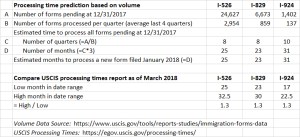
Average processing time is theoretically a function of inventory (number of pending petitions) and flow rate (rate at which IPO approves and denies petitions). You can get the input data for this equation from the USCIS Immigration and Citizenship Data page, which posts quarterly reports for I-526 and other forms. My I-526 Time spreadsheet turns the quarterly data into a prediction model that estimates average processing times as a function of petition volume at different points in time (with some assumptions about future trends). The last quarterly report indicated 24,627 I-526 pending at IPO in December 2017 and an average of 2,954 petitions processed per quarter over the last four quarters. 24,627/2,954 = 8.3 quarters to process the pending petitions (estimated average). So an I-526 petition filed in January 2018 would be theoretically likely to wait 8.3 quarters (25 months) for processing, other factors being equal. That’s consistent with the Processing Times Information page, which starts the Estimated Time Range at 25 months. But unequal reality leads to some petitions being processed more quickly.

Understanding Variation in Processing Times

Here’s what IPO has said about I-526 time variation (summarized from communications copied in my log of IPO communications on processing times).

  • DHS estimates that the average Form I-526 gets 6.5 hours of touch time.  That means an adjudicator spends less than a day handling the case —  the remaining (and most variable) processing time is queue time and time spent waiting for additional evidence or supervisory approval.
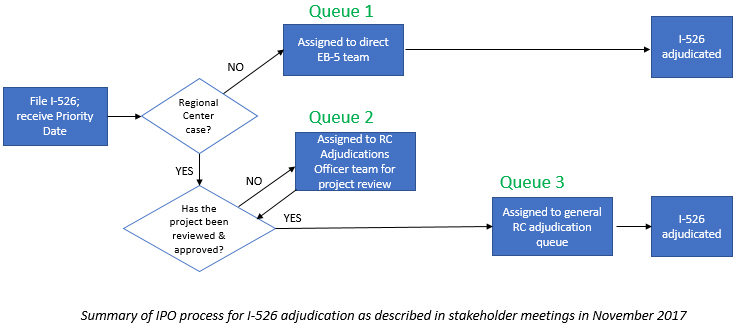
  • IPO has at least three queues going for I-526 petitions: (1) a queue for direct EB-5 petitions; (2) a queue for regional center petitions based on investment in projects that haven’t yet been reviewed; (3) a queue for regional center petitions based on investment in projects that have Exemplar I-526 approval or previous I-526 approvals.  The following chart illustrates my understanding of IPO Deputy Chief Julia Harrison’s description of the process.

    IPO indicates that each queue has dedicated staff working on it. Petitions within each queue are ordered by earliest filing date. A regional center petition for a project not previously reviewed must wait in Queue 2 (for project-specific adjudication) and then again in Queue 3 (for investor-specific adjudication). RC petitions for previously-approved projects advance straight to Queue 3. IPO encourages communication between team leaders on the Queue 1 and Queue 2/3 side to ensure that direct and RC petitions filed at the same time move forward concurrently. With this complex process, it’s unsurprising that IPO appears far from its intention to process cases more-or-less in the order in which they are received.
  • Factors that can speed I-526 processing per IPO:
    • Investing in a project with an approved Exemplar and/or previously-approved I-526
    • Having a clear, high-quality petition (this is important when evidence requests and supervisory approval are the major variables — besides queue time — in overall processing time)
    • Having an approved expedite request (this shortens the queue time, not the adjudicator touch time).
  • Factors that can slow I-526 processing per IPO:
    • Having a petition that’s poor-quality, unclear, problematic, or otherwise inspires IPO to request additional evidence
    • Filing with/after a surge of other people who filed poor-quality petitions
  • Factors that don’t affect I-526 processing time per IPO:
    • The investor’s nationality. (IPO does not currently sort petitions by nationality. There is no hold-up for China-born petitioners at the I-526 stage, as there is at the visa stage. However, IPO asks whether they should change that — considering that fast I-526 approval doesn’t help China-born investors facing a long visa wait regardless. Also, stats show that I-526 denial rates are much higher for some countries than others, which makes me suspect that IPO finds some countries’ source of funds and background checks more challenging than others – which could naturally be associated with longer processing times. So even if the process is FCFS for all nationalities, it’s probably not FIFO for all nationalities.)
    • Whether the petition is for a direct or regional center investment. (IPO claims that they try to move direct and RC petitions forward concurrently. However there may be some regional center advantage in practice since direct petitions are often the first in a project and cannot take advantage of Exemplar approval.)
    • Project size. (IPO reports that they do not privilege petitions for big projects with many investors. But some anecdotal evidence suggests otherwise.)
    • TEA status. (Some legislative reform proposals have suggested offering quicker processing to petitions based on investment in a Targeted Employment Area, but IPO does not report having any such policy now.)

Expedited Processing
EB-5 forms, like other immigration forms, can apply for and benefit from expedited processing under certain limited conditions. Expedited processing reduces the time a form takes to reach an adjudicator’s desk. It does not reduce the time to adjudicate the petition, and does not reduce the visa wait time for petitioners from countries with a cut-off date.

Individual Processing Time Experience

Individual processing time variation means that some people wait longer than the theoretical average 25 months for I-526 approval, while others receive approval much more quickly.

My best evidence for faster-than-average approval is priority dates for pending visa applications. If all I-526 take 2 years to process, then Department of State should have been receiving applications in 2017 from people who filed I-526 in 2015. In fact, as of October 2017 Department of State reported having over 1,500 pending visa applications based on I-526 petitions filed in 2016 and 2017. Assuming an average 3 visa applications per approved petition, that reflects about 500 I-526 petitions approved and advanced to the next stage within a year of filing. And the DOS report only mentioned pending applications for five countries, not counting all applications for the year. I-485 inventory statistics likewise show many pending status adjustment applications with recent priority dates.

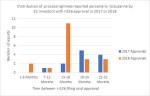
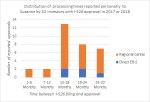
I set up a Google Form to collect reports of processing time experience from individual investors. (Entries still welcome!) In the very limited sample of entries so far (which appear in this Google Sheet), I-526 approvals in 2017/2018 that were reported to me had an average processing time of 19 months, with standard deviation of 7 months. The following tables summarize results reported in my Form so far.

Resources for Investors

Additional Note

My series of timing posts is missing an important piece: analysis of the steps and time factors (for countries with no cut-off date yet) between receiving the Form I-797, Approval Notice for the I-526 and claiming an EB-5 visa number. Especially Indians are trying to calculate: if I can count on receiving I-526 adjudication in the next few weeks, can I count on getting allocated a visa number in the advance of the Visa Bulletin giving a cut-off date for India? The point at which the visa number actually gets allocated, and the factors/timing between I-526 approval and that point, vary between I-485 and consular processing, and I don’t understand it all yet. But potential investors should include this in discussions with counsel, because delays can be considerable for consular processing anyway. I’m hearing reports of USCIS taking  8+ months just to forward I-526 approvals to the National Visa Center. Ironically, it seems that the faster USCIS adjudicates I-526, the more it drags its feet on advancing that approval to the next stage. But this is a developing situation, and I have limited examples. Here is my background reading list so far FYI. Please email me any additional helpful articles and current timing information.

UPDATE: I’ve added a EB-5 Timing page to collect links to all data and posts related to EB-5 visa availability, visa allocation, and wait times.

5/15 Policy Manual Update (tenant occupancy)

Update: for more in-depth analysis, see USCIS Evicts Tenant Occupancy Job Counting from EB-5 by Robert C. Divine, Baker Donelson Bearman, Caldwell & Berkowitz, PC and R.I.P. Tenant Occupancy Jobs? An Economist’s Perspective By Jeffrey B. Carr, Economic & Policy Resources, Inc.

–ORIGINAL POST–

USCIS has made another revision to the EB-5 section of the USCIS Policy Manual, this time to rescind its former guidance on counting jobs associated with tenants in a new building funded by EB-5 investment. Now, the tenant occupancy policy formerly in 6 USCIS-PM G Chapter 2 (D) Section 6 has been deleted and replaced with a section in which USCIS explains why the previous policy was wrong. Old policy in a nutshell: We concede the possibility of demonstrating acceptable nexus between investment and tenant job creation, under certain very restricted conditions. New policy in a nutshell: there is no acceptable nexus between investment and tenant job creation. In other words, what was previously only effectively nearly impossible is now definitively impossible, officially.

FYI this document compares the deleted section with the new section. Once again, I copied the 5/15/2018 PM in its entirety into a new document, and used Word’s Compare function to confirm that nothing else changed between the 5/15 and 5/2 versions of Volume 6 Part G. And indeed, no other significant changes. FYI, here’s my folder with all distinct versions of 6 USCIS-PM G.

I don’t know whether to laugh or cry about this change. We’ve been desperately, urgently waiting and begging for clear policy on redeployment, among other issues, and they spend time fiddling with tenant occupancy? How many people have even tried counting tenant jobs since 2013? How is this an issue now? Last year I deleted a bunch of old tenant occupancy-related posts and most of my informational page on the TO question because I thought it had become irrelevant. If indeed TO is not involved in any recent or current offerings, then USCIS is guilty of shameful waste of time. Or if by chance any recent/current offerings do involve TO, relying on guidance that’s been consistent since 2012, then shame on USCIS for sending out a Policy Alert today literally saying that the policy is rescinded as of yesterday.

The new PM language on tenant occupancy states that “a direct financial connection between the EB-5 capital investment and the job creation is necessary to determine a sufficient nexus between the two.” I wonder what USCIS thinks “direct financial connection” means exactly, and the implications beyond tenant occupancy.

Apparently we get until May 29 to comment on the policy change, though it’s effective as of May 15.

On the bright side, two EB-5 policy updates in a month! It’s nice to see the policy process moving. I could just wish for better updates.

Also, FYI there is a change to Volume 7 on adjustment of status that can affect EB-5 among other visa categories.


Regulations Update (8/2018?)

The OMB Spring 2018 Unified Agenda has been published, with new estimated dates on action for EB-5 regulations.

  • Estimated Final Action in August 2018 for RIN 1615-AC07 (EB-5 Immigrant Investor Program Modernization), which proposed investment amount and TEA changes. (The Fall 2017 Agenda had previously anticipated Final Action in February 2018.)
  • Estimated Notice of Proposed Rule-making in March 2019 for RIN 1615-AC11 (EB-5 Immigrant Investor Regional Center Program), which dealt with regional center designation and the exemplar approval process. (The Fall 2017 Agenda had previously anticipated NPRM in October 2018.)

It remains to be seen whether these new estimated action dates will be more reliable than previous deadlines. RIN 1615-AC07 is currently a Proposed Rule at Step 7 in the Rulemaking Process, and is not yet listed by the OMB as a Regulatory Action Currently Under Review for Department of Homeland Security.

[6/19 UPDATE: USCIS Director L. Francis Cissna testified at a Senate Judiciary Committee hearing on EB-5 regarding the regulations that “USCIS is currently reviewing the comments and moving forward in the regulatory process with both of these items as expeditiously as possible.” This means that the regs have not in fact advanced as far as we’d thought. When asked whether he thought the regs could be finalized before the 9/30/2018 regional center program sunset date, Mr. Cissna said he didn’t know but that would be “hard to pull off.”]

Speaking at the IIUSA conference on April 27, Kathy Nuebel Kovarik of the USCIS Office of Policy and Strategy “reinforced her department’s position that they will try to get EB-5 regulatory reform done this year, as indicated on the Unified Regulatory Agenda.” This came on the heels of a letter sent by Senators Grassley, Goodlatte, and Leahy to DHS urging the administration to finalize regulations (repeating calls previously made in 2015 and again in 2016 and again in 2017). This week, IIUSA sent an open letter to USCIS encouraging the agency to finalize the proposed EB-5 regulation, but with lower investment amounts ($1 million, or $800,000 in a TEA) than previously suggested. However, the forces against finalizing the regulations remain strong (administrative inertia, and the many stakeholders opposed to the proposed changes). We shall see what happens.

The OMB notices indicate that IPO has hired a new Chief of Policy (Edie Pearson), which is good to know.

FYI, my May 2017 post New EB-5 Regulations: Comments Discussion reviews the proposed regulations and industry response.

5/2 Policy Manual Update (CPR while I-829 pending)

The following new section has been added to the USCIS Policy Manual Vol. 6 Part G, Chapter 5:

D. Extension of Conditional Permanent Residence While Form I-829 is Pending
USCIS automatically extends the conditional permanent resident status of an immigrant investor and certain dependents for 1 year upon receipt of a properly filed Form I-829. [13] The receipt notice along with the immigrant’s permanent resident card provides documentation for travel, employment, or other situations in which evidence of conditional permanent resident status is required.

Within 30 days of the expiration of the automatic 1-year extension, or after expiration, a conditional permanent resident with a pending Form I-829 may take his or her receipt notice to the nearest USCIS field office and receive documentation showing his or her status for travel, employment, or other purposes.

In such a case, an officer confirms the immigrant’s status and provides the relevant documentation. USCIS continues to extend the conditional permanent resident status until the Form I-829 is adjudicated.

An immigrant investor whose Form I-829 has been denied may seek review of the denial in removal proceedings. [14] USCIS issues the immigrant a temporary Form I-551 until an order of removal becomes administratively final. An order of removal is administratively final if the decision is not appealed or, if appealed, when the appeal is dismissed by the Board of Immigration Appeals.

USCIS announced the addition this morning with a Policy Alert on Documentation of Conditional Permanent Resident Status for Immigrant Investors with a Pending Form I-829. The agency solicits stakeholder comments through May 15, 2018 using the procedure described on the Policy Comment page. (Scroll past the tables for instructions.)

Because I love my readers and don’t like relying on online documents, I painstakingly copied all of today’s version of the EB-5 Policy Manual chapter into a Word document, now added to my folder of Policy Manual versions. Word’s document comparison function indicates that Chapter 5 Part D is indeed the only significant change from previous versions, although there are minor unflagged tweaks in other sections (e.g. changing “See Form I-829, Petition by Entrepreneur to Remove Conditions on Permanent Resident Status” to “See Petition by Entrepreneur to Remove Conditions on Permanent Resident Status (Form I-829).”

Update: Robert Divine has published a helpful article explaining the context of this Policy Manual addition: May 2 Policy Manual Update: One Small Step for I-829 Filers; Some Giant Leaps Left for USCIS to Take

FY2018 Q1 EB-5 Form Processing Statistics

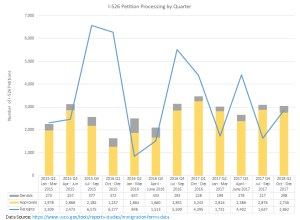
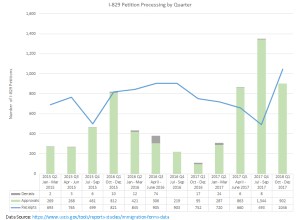
USCIS has updated its Immigration and Citizenship Data page with statistics on EB-5 forms received, processed and pending in the first quarter of FY2018 (October to December 2017). Form I-526 and I-829 are in the Employment Based subsection, and (I belatedly realize) Form I-924 is in the Forms subsection in the “All Forms Report.” (The row title is labeled “I-924/924A” for some quarters’ reports and just “I-924” in others, but it’s evident from the numbers that the data is for I-924 only, not including I-924A. I assume the row comprises initial applications and amendments.) This processing volume information provides the best picture we have of the progress and prospects for IPO processing.

My charts below summarize FY2018 Q1 data compared with previous quarters, and highlight trends. A few notes:

  • IPO processed fewer forms overall in FY2018 Q1 than in the previous quarter. The volume of I-526 and I-924 processed stayed about the same on average over the past few quarters, while I-829 volume leapt and then tumbled. I had hoped for a more positive growth trend, and was disappointed.
  • However, annual numbers trend in a positive direction, with IPO improving processing volume every year, and annual adjudications growing at a slightly faster rate than annual receipts.
  • I-526 and I-924 receipt numbers continue to correlate with regional center program sunset dates, but with smaller and smaller surges.
  • I-829 receipts increased last quarter as expected following the mysterious dips in previous quarters.
  • I-924 adjudication has been remarkable for number of denials.
  • IPO ended December 2017 with about twice as many pending I-526 and I-829 as it’s proven able to process in a year, and nearly three times as many I-924. So if we estimate processing times by dividing inventory by flow rate, that yields a 2-year processing time estimate for I-526 and I-829, and three-year estimate for I-924. That volume-based estimate matches exactly with the base month that USCIS posts on its new Processing Time Information page for I-526 and I-829, which makes me think they’re using the same equation. USCIS’s processing time estimate for I-924 is much lower, however. Maybe they plan to dramatically increase volume of I-924 adjudication, or disappear some of the pending backlog?
  • FY2018 Q1 showed fewer I-526 adjudications and more I-526 receipts than I’d expected, so I recalculated my I-526 time prediction model accordingly.

Now that I’ve chosen to spend so much time sweating over Excel and Photoshop and injuring my eyes to make this post better than it needs to be, and as helpful as possible to you, I shall recopy my Paypal plug below. (Thank you to the 26 readers who contributed to the blog since I opened the option last month.)

Benefit from this blog? Please support the effort behind it. As the EB-5 industry changes, your contribution can help preserve this space for conscientious and freely-available EB-5 reporting. Contributions go to Lucid Professional Writing, a for-profit business, to fund work on this blog. Thank you!