Constructive IIUSA response to bridge finance and other challenges

During the Q&A period at the EB-5 stakeholder meeting on November, 7, 2017, caller Carolyn Lee questioned IPO Deputy Chief Julia Harrison about recent adjudication of the bridge financing policy.

[transcription of time 01:01:27 – 01:10:11]
Ms. Lee: …We are concerned because we have been seeing what we think is a pattern of adjudications where qualifying bridge finance structures structured under the current written policy manual appear to be found to not qualify. …This comment is directed to urge you to please ensure that your examiners are trained on this policy, and are applying it correctly, because we have seen some very troubling NOIDs in this respect.

Ms. Harrison: Yes, thanks for that. I appreciate that you’re getting NOIDs that … there’s always going to be times when maybe we don’t agree. That happens. But if you are seeing something where you feel we may have messed up, follow the standard protocols to do the formal response. You can send an email to our customer service box and say we would appreciate it if the leadership team would take a look at this. It’s really hard for us… I mean I could take that back and have conversations with my team and say “Are you guys having some challenges with bridge financing? Have we done something different?” And they would all say “no.” Right, because they’re doing what they think is the right thing to do. And maybe they are. But it’s really hard for me to really kind of take a look into that unless you send me some examples. So I don’t want you guys to all flood me. Don’t go crazy. But, if you have a couple that you think are good examples of where you think we’ve gone astray – I’m not saying I’m going to agree with you, but I’m going to have some conversations with my team.  Please, though, do not take that as instruction to not follow the formal process.

Ms. Lee: Absolutely. Can we take that as an invitation to some sort of dialogue on these very complex issues?

Ms. Harrison: We can’t do that. We can’t go crazy. We can’t have a dialogue. [Laughs] We don’t want to violate any of the FACA rules. But, I will take a look at it and discuss with my team.

Finally after seven months, the industry has followed up on this exchange with a letter from IIUSA to USCIS regarding Major Issues Facing the EB-5 Industry. The letter starts by reopening the possibility of dialogue by addressing what FACA does and does not prohibit, and goes on to analyze six specific bridge financing challenges, as well problems associated with processing delays, third party guarantees, project financing structures, site visits, and redeployment.

This letter exemplifies what we should do regularly: respond constructively to misunderstandings at IPO with solid and documented clarifications based on our collective knowledge and resources. If examiners at IPO know little about bridge financing beyond what’s in Black’s Law Dictionary, and make incorrect determinations accordingly, that’s partly our fault. They have tough jobs and can’t be expert in every area of law and finance. The industry does have a comprehensive array of expertise, if only we organized to share it. IIUSA was late drafting this letter, and even later involving industry, but the product is solid. Anyone struggling with challenges to financing agreements and structures can use and build on this letter’s in-depth analysis. And I hope USCIS listens to the important points about processing delays, site visit missteps, and ambiguity around redeployment.

Senate Judiciary Committee hearing on EB-5

The Senate website now has video of of today’s Judiciary Committee hearing on EB-5, as well as a statement from Senator Grassley and written testimony from USCIS Director L. Francis Cissna. I’ve uploaded my recording, and transcribed below the major news from the hearing: that EB-5 regulations are not actually close to being finalized, and the reason is not conspiracy but honest ineptitude. Hanlon’s Razor proves right again. I should’ve known better than to repeat rumors attributing delays to interference. It’s so plausible that, as Cissna says, CIS would be still reviewing public comments, slowed by a complex process and competing demands.

I listened to the hearing for hints that anyone plans to do anything about EB-5, and noted few such hints. The Democrats on the committee sent the message that they care about immigration law/policy that hurts children, and can’t be bothered about immigrant investment right now. Most did not even mention EB-5 in their statements or questions, instead changing the subject to undocumented migrants, and the administration’s zero tolerance policy and resulting family separations. Two senators (Feinstein and Durban) called for a kind of action — termination — but didn’t actually talk about EB-5. They discussed a mythical program that allows people to “buy their way to the front of the line” and purchase legal status as a commodity, apparently simply ignorant of basic facts: that EB-5 investors enter the back of a long waiting line with no premium processing option and must put capital at risk but can only acquire status based on job creation, not money. Senator Cornyn was the one person who spoke as if he might still have EB-5 legislation in mind. Senator Grassley granted the necessity of legislation, but complained about how he’d been stymied in the past and focused on calling for regulations (which “can probably do better than legislation”), attacking Director Cissna for not having finalized regs yet. Grassley definitely seemed to be trying to pass the buck on EB-5 program changes from Congress to USCIS. Cissna, meanwhile, tried to pass the buck back, telling the committee that he doubted his department could finalize regs before September 30, and urging Congress to either manage legislative reforms or let the program expire. Meanwhile, it wasn’t clear that anyone present really grasped what’s in the EB-5 modernization regulations, or how the regulations or the last legislative proposal would affect the real world of EB-5. I appreciate that at least Grassley and Cissna tried to do their homework, but clearly still operating with some basic misconceptions that won’t help yield good law or policy. Sigh. So much education remains to be done in EB-5. If our lawmakers and regulators do not know what’s mostly right or what’s actually wrong with EB-5, how can they direct it effectively?

On the positive side, Director Cissna’s testimony clarifies that EB-5 does not operate the way it did 25 years ago. The department has made major strides in its efforts to administer the program, particularly in the past couple years. Mr. Cissna reviews operational enhancements that have been implemented, even without reform legislation or regulations.

Transcript of a Q&A between Chairman Grassley and Director Cissna (starting at minute 47:30 of the Judiciary Committee hearing)

Grassley: In your written testimony, you say that the department is still, still, reviewing comments, but you plan to move forward as expeditiously as possible. Those last four words are yours. Do you have a sense of when the EB-5 Modernization regulations will be finalized, and how quick is “as expeditiously as possible.”

Cissna: It’s not soon enough. I want those regs out as quick as humanly possible. And from the moment I got sworn in back in October, I have been pushing and pushing and pushing for those regs to be completed. There is a process that all regs have to go through, often very lengthy, and I’ve been doing everything I can, from where I sit, since October to ensure those regs get out very fast.

Grassley: Are you getting the help of the Secretary?

Cissna: Yes. The Secretary is aware of the urgency of this and she is committed to getting the regs–       ….

Grassley: Do you anticipate the Modernization regulations being finalized before the expiration of the Regional Center program September 30?

Cissna: I don’t know. That would be hard to pull off. I think it might be tight.

Grassley: More time, hmm?

Cissna: I think so.

Grassley: Have you or Secretary Nielsen received political pressure from anyone to delay or halt the Modernization regulations?

Cissna: No. That I can say with certainty. No one’s been pushing us or telling us to drag our feet or delay this reg in any way.

Grassley: If anyone ever does that, will you tell this Committee?

Cissna: Oh yeah.

Grassley: If the Modernization regulation is not finalized before the expiration of the Regional Center program, do you support letting the program expire?

Cissna: I believe that if the program is not fixed in a way that addresses all these problems that we’re going to talk about today then yes, I think that it should expire.

I-526 and EB-5 visa wait times; country-specific effects of potential changes

I’ve written separately about I-526 processing time and the EB-5 visa wait time, but find that people get confused about how those times interact. How does I-526 processing time affect the total time to get an EB-5 visa? From what point do we calculate the visa wait? What factors and potential changes could compress or expand the full process from priority date to green card for people from different countries?  This post addresses such questions.
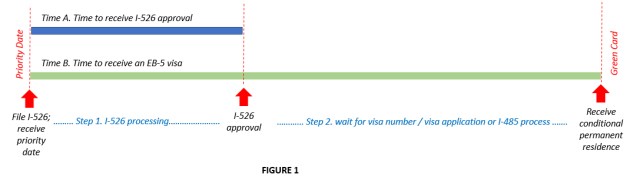
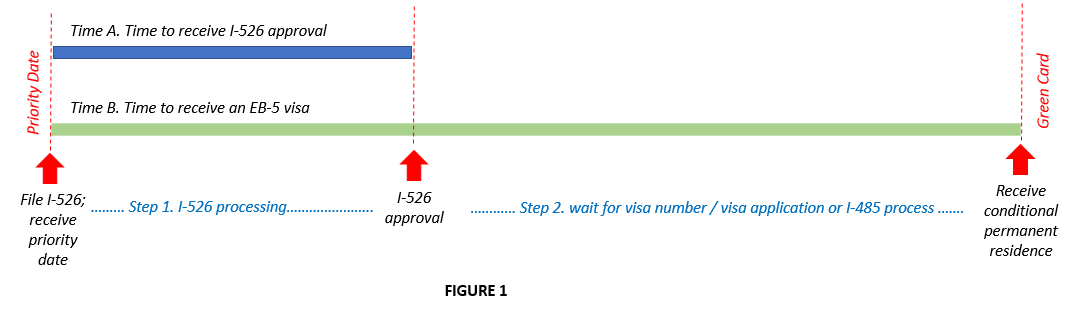
Note that the path to conditional permanent residence has two separate, sequential steps (Step 1 and Step 2 in Figure 1), but we usually calculate timing for each step from the same starting point (Time A and Time B in Figure 1).  An immigrant investor’s priority date – the date that USCIS received his I-526 petition – marks his place in line for I-526 processing (which is first-come-first-served in principle) and also his place in line for a visa. An investor must wait for I-526 approval before he can take the next step and submit a visa application or file for status adjustment.  But once he gets to the visa application stage (Step 2), his place in the queue for a visa doesn’t depend on the date he finished Step 1 (I-526 approval) but on the date he started Step 1 (I-526 receipt). This is so because anyone who files I-526 is effectively putting herself in the visa queue, even though she hasn’t progressed yet to the point of being qualified to file the visa application or I-485.  INA 203(e)(1) stipulates that available EB-5 visas are issued to eligible immigrants in the order in which the immigrant petition was filed. So when Charlie Oppenheim at the Department of State Office of Visa Controls estimates a two-year wait time for Country A, he is talking about two years from priority date to visa availability, not two years from I-526 approval.  To estimate wait times for new applicants today, it’s necessary count both chickens (documentarily-qualified applicants currently ready to file for a visa) and eggs (people who have filed I-526 petitions that may eventually hatch and yield visa applications). Therefore, with reference to Figure 1:

  • For an investor of any nationality, Time B is, at minimum, longer than Time A, because an investor isn’t qualified to apply for a visa until after I-526 approval.
  • For investors from countries without excessive demand, Time A can be the major factor determining the length of Time B. I-526 processing times have tended to be lengthy for all countries (averaging around 2 years). But once having received I-526 approval, the investor from a country with no cut-off date will have a visa number available right away and can progress straight to the visa application or status adjustment process to claim that visa. Only investors from countries over or near the annual per-country limit need to worry about waiting years for a visa number, making Time B very much longer than Time A.
  • For an investor from a country exceeding the annual 7% per-country limit, Time A becomes relatively insignificant (personally) because Time B will be long regardless of the individual’s Time A. As a Chinese investor, I may not care about the timing of I-526 approval if  have a decade to wait for conditional permanent residence regardless. The visa queue is ordered by priority date, not date of I-526 approval, so an expedite in Time A doesn’t expedite Time B for investors from significantly oversubscribed countries.
  • Because the visa waiting line technically starts with priority date, we have to look at I-526 receipts, not just I-526 approvals or current visa applications, to estimate Time B. Prospective Indian investors may wonder why there’s already an informal visa wait time estimate for Indians filing today, even though India shows as current in the Visa Bulletin. That’s because today’s Visa Bulletin just reflects what’s currently happening in Step 2. The prospective investor needs to predict how the Visa Bulletin will look in the future, when he can progress to Step 2. And that future Visa Bulletin will depend on what’s happening in Step 1 now, and the volume and nationality of people entering the system and receiving priority dates.

How long is Time B, for various countries? The latest rough estimates (as of April 2018) suggest the following time between priority date and visa availability for new investors from different countries filing today: China, 15 years; Vietnam, 6 years; India, 5 years; Brazil and South Korea (and maybe Taiwan), 2 years. (Update: see estimates as of October 2018 here.) Times for everyone else are just based on estimated petition processing times, assuming no wait for a visa number. (There’s a potentially significant time factor between visa availability and actually getting a conditional green card, depending on how busy the appropriate consulate or service center happens to be, but this time is so variable that I haven’t tried to account for it in my Time B calculation.)

Many factors could change the estimates for Time B, or cause the reality to be longer or shorter for people of various nationalities who have entered the EB-5 process.

Possible Change: USCIS improves I-526 processing, increasing volume of adjudications and reducing I-526 processing times.

  • Likelihood of this change: High. IPO processed 30% more I-526 in FY2017 than FY2016, and hopes to continue to improve performance
  • Impact of this change, if it occurs:
    • China: Negative effect. More approved I-526 means more approvals for countries other than China, which means more visa applications from outside China and fewer leftover visas available to the China backlog. Fewer leftover visas annually means longer Time B for Chinese investors.
    • Vietnam, India, Brazil, S. Korea, Taiwan: Mixed effect. These countries are or will be too new in the backlogged category to compete for leftover visas in any case (since China has enough older backlogged applicants to claim all leftover visas for years). An increased volume of rest-of-the-world applicants may not hurt countries that can’t expect more than their personal allotment of 700 visas a year regardless. However, more and faster I-526 approvals could mean that India, Brazil, and possibly South Korea and Taiwan get cut-off dates sooner than expected. (Charlie Oppenheim knows that they’re already probably oversubscribed, based on counting eggs, but he doesn’t set cut-off dates until the eggs actually hatch into chickens, i.e. until immigrant investor petitioners are documentarily qualified to apply for a visa.)
    • Rest of the world (any countries well below 250 investors per year): Positive effect. So long as a country doesn’t risk generating over 700 visa applications in a year, its investors can only benefit from improved I-526 processing time/volume. With no hold-up to wait for a visa number, short Time A means short Time B.

Possible Change: Legislation removes the per-country numerical limit for the EB-5 category, such that individual countries aren’t limited to 7% of EB-5 visas when the category is oversubscribed.

  • Likelihood of this change: Possible. Border Security and Immigration Reform Act of 2018 (H.R. 6136), the compromise immigration legislation just introduced by House GOP leadership, proposes this change in Sec. 2102 (page 192).
  • Impact of this change, if it occurs:
    • China: Positive effect. With no per-country limit, the visa waiting line would simply be in order by priority date. Having been held back with cut-off dates for years, Chinese applicants have the oldest priority dates in the system. Thus, with no per-country limit, the huge pool of backlogged China-born investors would move to the front of the line for visas. Based on the number of old Chinese applications in the system, they could take 100% of available visas for the next 2-3 years, and be on equal footing with contemporary applicants from other countries thereafter. Time B for a China-born investor with priority date from 2014-2016 would decrease dramatically. Time B still wouldn’t be short for a China-born investor filing today (about 9+ years unless many previous applicants drop out, as they might), but that’s much better than the current estimate of about 15 years.
    • Vietnam, and any soon-to-be oversubscribed countries (India, Brazil, etc.): Negative effect. The per-country limit means that each backlogged country can expect to get at least about 700 visas annually. Without the per-country limit, all more recent applicants would find themselves in line behind tens of thousands of China-born applicants with earlier priority dates. Time B (currently estimated at 5+ years for new investors from Vietnam/India and 2+ years for Brazil/South Korea) would likely expand to 9+ years for all new investors regardless of country, in absence of per-country limits.
    • Rest of the world: Negative effect. The per-country limit currently protects low-volume countries from the effects of excess demand for EB-5 visas. Even with a decade of current/potential visa applications already in the system, new applicants from low-volume countries can expect a visa promptly because high-volume countries get held back. With no country-specific limits, new investors would join a line that’s about a decade long without regard to nationality.

 Possible Change: Legislation increases the number of EB-5 visas available annually.

  • Likelihood of this change: Possible. We need this change so badly, and advocacy dollars should focus on this issue. But I haven’t seen EB-5 visa number increases in any recent legislative proposals – not even in H.R. 6136, which proposes additional visa numbers for every EB category except EB-5.
  • Impact of this change, if it occurs: Positive for all past and future EB-5 investors from all countries.

Possible Change: Legislation or regulations implement higher minimum investment amounts that significantly depress new demand for EB-5. (Or other factors significantly depress new demand: e.g. investors in potentially-high-volume countries get discouraged by wait times, the U.S. becomes a less attractive destination for immigration or investment, EB-5 becomes a less attractive financing option for U.S. companies.)

  • Likelihood of this change: High. All legislative and regulatory proposals include higher investment amounts. The most imminent proposal – regulations possibly on schedule to be finalized in August 2018 – have investment amounts high enough to kill demand almost entirely, many EB-5 promoters say. Even if investment amounts do not increase, or increase only moderately, EB-5 has plenty of challenges and complications with potential to moderate future demand.
  • Impact of this change, if it occurs:
    • China: Positive effect. Fewer incoming immigrant investors means less competition from rest-of-the-world for available visa numbers
    • Vietnam, and any other high-demand countries: Positive effect. Reduced demand reduces risk for investors already in the system that their countries will become or stay oversubscribed.
    • Rest of the world: Neutral. Low future demand does not improve wait times for people already in the system from countries with no cut-off date.

Possible Change: Demand for EB-5 grows, and countries besides China produce a sufficiently high volume of EB-5 petitions to exceed the per-country limit.

  • Likelihood of this change: Fairly high. The Department of State already predicts cut-off dates in the next couple years for five to six countries in addition to China. And media reports indicate aggressive EB-5 promotion outside of China, particularly in India and Brazil.
  • Impact of this change, if it occurs:
    • China: Positive effect. Time B for China-born applicants depends primarily on the number of visas leftover each year from the “rest of the world” with no cut-off date. As soon as another country exceeds the per-country limit and gets a cut-off date, it’s removed from and reduces the size of that “rest of the world” pool, thus leaving more visas on the table for older China-born applicants.
    • Vietnam, and any other countries to be oversubscribed: Negative effect. Time B expands dramatically for a country as soon as it’s oversubscribed. Vietnam and subsequent countries don’t benefit the way China does from each additional country to get a cut-off date, because these countries don’t have applicants old enough to compete with China for visas leftover from the rest of the world.
    • Rest of the world: Positive effect. Each additional country to get a cut-off date reduces competition for available visa numbers.

Possible Change: Demand for EB-5 diversifies, with more investors coming from outside China, but spread out so that few individual countries exceed the per-country limit.

  • Likelihood of this change: Moderate. It’s much easier to raise a lot of EB-5 money from one country than from many countries, so concentration has been the rule to date in EB-5. But data has suggested a trend toward diversification.
  • Impact of this change, if it occurs:
    • China: Negative effect. Time B for China-born applicants depends primarily on the number of visas leftover each year from the “rest of the world” with no cut-off date. As that “rest of the world” pool grows, visa availability for China shrinks, and wait times grow.
    • Vietnam, and any other countries to be oversubscribed: Neutral effect. They aren’t competing for “rest of the world” visas anyway, thanks to China’s earlier priority dates.
    • Rest of the world: Negative effect. Each new applicant with no cut-off date increases competition for available visa numbers.

Possible Change: People already in line for an EB-5 visa despair about Time B and withdraw in large numbers from the EB-5 process. (Or other attrition factors come into play: more petitions get denied, more projects fail, more deaths and divorces occur, children age out or don’t get born.)

  • Likelihood of this change: Moderate. On the one hand, current wait time estimates are devastating for some investors (especially, China-born investors in the past couple years), undermining their immigration objectives and their investment projects. This could precipitate voluntary withdrawal, not to mention attrition from children growing up and more time for divorce and death and project failure. On the other hand, EB-5 investments are major and real at-risk investments, committed regardless of the immigration process. Giving up is not easy. Also, many people do not read my blog and are not well-informed about timing issues.
  • Impact of this change, if it occurs:
    • China: Positive effect for some. Each China-born applicant who withdraws from the process reduces the time that more recent China-born applicants have to wait for a visa.
    • Vietnam, and any other countries to be oversubscribed: Mixed effect. Mass exodus of past investors would reduce competition for available visas, but also involve collateral damage to the EB-5 program as a whole (in terms of public relations and damage to companies deploying EB-5 investment, not to mention the human cost for the prospective immigrants involved).
    • Rest of the world: Mixed effect. Countries without cut-off dates do not compete with the backlog anyway, so reducing the backlog has little effect on timing for these countries. But large-scale failure of previous EB-5 applications would damage the EB-5 program as a whole.

Other related posts:
AILA/IIUSA Forum Updates (Kendall, Oppenheim, visa availability) November 5, 2018
Visa Numbers (FY2018 Q3 and conference update) July 27, 2018
How Long Does I-526 Take? (III) May 18, 2018
Visa Numbers (China, Vietnam, India, Brazil, S. Korea, Taiwan) April 23, 2018
EB-5 Visa Waiting Line and Visa Allocation April 8, 2018
EB-5 Timing Issues and Visa Wait: Process and Data October 13, 2017

Benefit from this blog? Please support the effort behind it. As the EB-5 industry changes, your contribution can help preserve this space for conscientious and freely-available EB-5 reporting. Contributions go to Lucid Professional Writing, a for-profit business, to fund work on this blog. Thank you!

Senate hearing, legislation, I-829 receipt notices (updated)

Senate Hearing

Mark your calendars for 10 am EST Tuesday, June 19, when Chairman Grassley will host a Senate Judiciary Committee hearing with the provocative title Citizenship for Sale: Oversight of the EB-5 Investor Visa Program. So far the only announced witness is USCIS Director L. Francis Cissna. As background for the hearing, I recommend my 2015 post Immigrant investor program comparison, which explains how EB-5 fits in the continua of investor visa programs around the world, and the risks and challenges for government oversight inherent in the fact that it’s specifically not a “citizenship for sale” program.

Legislation

The House will reportedly vote next week on immigration legislation: Bob Goodlatte’s H.R. 4760 Securing America’s Future Act, and another to-be-announced bill dealing at minimum with DACA and border security. H.R. 4760 as written would not affect EB-5. (It covers DACA, border security, family reunification, and diversity visas, and proposes reallocating diversity visas to reduce backlogs in EB-1, EB-2, and EB-3 only.) The second bill (available in discussion draft) would affect EB-5 by removing the per-country limit on visa numbers for the EB-5 category. (This would be good news for backlogged China and bad news for all other countries, which would then share the burden of oversubscription equally with China.) In an apparent slight to EB-5, the discussion draft bill would increase total visa numbers for every EB category except EB-5.

I-829 Notices

And a nice email (followed up by another email with qualifications) for people facing long I-829 waits.

From: U.S. Citizenship and Immigration Services <uscis@public.govdelivery.com>
Sent: Tuesday, June 12, 2018 9:02 AM
Subject: Update to Form I-797 Receipt Notices for Form I-751 and Form I-829

As of June 11, 2018, petitioners who file Form I-751, Petition to Remove Conditions on Residence, or Form I-829, Petition by Entrepreneur to Remove Conditions on Permanent Resident Status, will receive a Form I-797 receipt notice that can be presented with their Form I-551, Permanent Resident Card, as evidence of continued status for 18 months past the expiration date on their Permanent Resident Card.

We are making the change from 12 to 18 months because current processing times for Form I-751 and Form I-829 have increased over the past year.

Additionally, we will issue new Form I-797 receipt notices to eligible conditional permanent residents whose Form I-751 or I-829 was still pending as of June 11, 2018. Those Form I-797 receipt notices will also serve as evidence of continued status for 18 months past the expiration date on petitioner’s Permanent Resident Card.

As a reminder, conditional permanent residents who plan to be outside of the United States for a year or more should apply for a reentry permit by filing Form I-131, Application for Travel Document, before leaving the country. Read more information on our Green Card webpage.

To learn more, visit our website.

From: U.S. Citizenship and Immigration Services <uscis@public.govdelivery.com>
Sent: Wednesday, June 13, 2018 10:21 AM
Subject: Form I-751 Data Entry Delay at California Service Center

USCIS’ California Service Center (CSC) is experiencing a delay in initial data entry for Form I-751, Petition to Remove Conditions on Residence. Since initial data entry has to be completed before a receipt notice can be issued, some petitioners and their dependents may experience a delay in receiving a receipt notice for a Form I-751 submitted to the CSC.

If you submitted a Form I-751 to the CSC in May 2018 and you have not received a receipt notice, do not file a duplicate Form I-751 unless you have received a rejection notice or have been instructed to do so by the CSC.

The CSC is working to complete data entry of these petitions by the end of June 2018, and will issue another web alert once initial data entry has returned to normal. Petitioners will receive a receipt notice once their data is entered into USCIS systems.

If your 2-year green card has expired, you should call the USCIS Contact Center at 1-800-375-5283 (TTY for people with hearing or speech disabilities: 1-800-767-1833). The USCIS Contact Center will setup an appointment for you and any eligible dependents at your local field office. If possible, bring evidence that you sent your Form I-751 via USPS or courier service, such as FedEx.

For more information, visit our website.

Processing Report, Terminations, Regulations, RC List Changes

Processing Time Report Update

The processing times reports for EB-5 forms were updated on May 31, 2018 with new Estimated Time Ranges and new variables for calculating the Case Inquiry Date. Until this update, the reports had been constant since March 23, 2018.

Form I-526 Processing Time:
* Estimated Time Range changed to 20-25.5 months (previous report: 25-32.5 months)
* Case Inquiry Date changed to today’s date minus 761 days (previous report used -971 days)

Form I-829 Processing Time:
* Estimated Time Range changed to 29-37.5 months (previous report: 23-30 months)
* Case Inquiry Date changed to today’s date minus 1,121 days (previous report used -893 days)

Form I-924 Processing Time:
* Estimated Time Range changed to 19.5-25 months (previous report: 17-22.5 months)
* Case Inquiry Date changed to today’s date minus 746 days (previous report used -663 days)

My theory, supported by an informed-sounding blog commenter, is that USCIS recalculated the time ranges based on a dramatic drop in I-526 receipts and dramatic rise in I-829 receipts over the past few months. (The Immigration Data page has not yet been updated with FY2018 Q2 or Q3 data, so I’m not sure.) Alternatively, IPO might have decided to reallocate resources away from I-829 to I-526 adjudication, or the I-526 team might be on fire while the I-829 team struggles with something.

But it’s tough to interpret these reports. A processing time estimate could be either (1) forward-looking, “the average time it will take a petition filed today to get adjudicated” or (2) backward-looking, “the average time that petitions being processed today have been waiting.” It can’t be both because 1 and 2 are very different numbers, thanks to dramatic fluctuations in receipt numbers and changing processing capacity over time. But we don’t know which we’re getting with the USCIS processing time report. The “Case Inquiry Date” would logically be backward-looking, while the “Estimated Time Range” is forward-looking if, as I suspect, it’s calculated by dividing currently-pending petitions by current average rate of adjudication. But the report says that the Case Inquiry Date is based on the Estimated Time Range. But calculating a backward-looking estimate from a forward-looking estimate would be nonsense. So I don’t know what to think. (For everything else I know/don’t know about processing times, refer back to the post How Long Does I-526 Take? (III))

Considering the ambiguity (and the fact that the report, however it’s calculated, can evidently suddenly change by six months or more), better not rely on USCIS processing time information for major decision-making. Just one thing is clear: EB-5 petition processing times are too long, and fuel a number of the political and integrity threats that face EB-5 today.

Regional Center Terminations

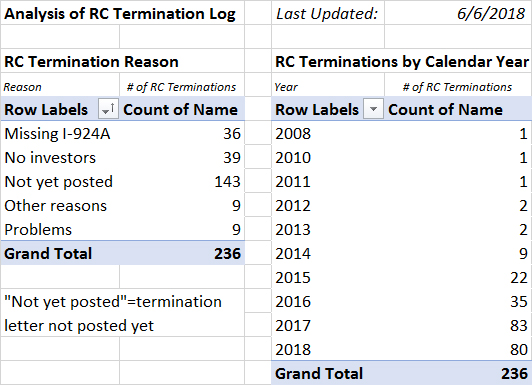
The USCIS website has been updated with some additional termination notices for regional centers terminated through May 2017. I added the letters to my Termination Log, summarized in the following table.

The recent termination letters mainly cite failure to file a Form I-924A annual report and/or inactivity (i.e. no EB-5 investors in the last 3-5 years) as reasons for termination. They rarely mention derogatory evidence as a reason.

Examples:

Regulations

The indefatigable Senator Grassley continues to nip at the heels of the EB-5 regulations. Today he sent a letter to President Trump with this complaint: “As I mentioned to you yesterday afternoon, certain EB-5 interest groups are telling investors they have ‘bought off the White House’ and that your Administration will never allow the EB-5 regulations to take effect. These comments are very disturbing, and undermine the American people’s faith in your ability to restore integrity to our immigration system.” Earlier this week he sent a letter to DHS urging “It is past time for your Department to publish the modernization rules. I have received reports that certain industry groups believe the White House will never allow the regulations to go into effect. Please confirm or deny this allegation, provide my office with an update on the status of these rules, and any impediments to their finalization.” (FYI I don’t know to which”certain industry group” Senator Grassley refers. To the extent that I’ve observed questionable marketing around the regulations, it’s people trying to hustle prospects into investing now by claiming that the possible August 2018 date for final action on regulations is actually a hard and firm August 2018 deadline to invest under current rules — while omitting to mention that final action date doesn’t mean effective date, and the OMB Unified Agenda dates are not guaranteed.)

I used to read between the lines of Senator Grassley’s legislative proposals that he wished to make EB-5 safe, legal, and rare, but now he seems ready to settle for just making it rare. Because the proposed EB-5 regulations (at least, the RIN: 1615-AC07 possibly on schedule to be finalized in August) do not in fact address the integrity or security concerns that the Senator raises in his letters; their major impact would be to dampen demand by increasing investment amounts.

I keep watching the OMB website to see when/whether the EB-5 regulations progress to the OMB review stage, but that hasn’t happened yet. Any status changes will be recorded on my Washington Updates page.

Regional Center List Changes

Additions to the USCIS Regional Center List, 05/25/2018 to 06/05/2018

  • 900 Regional Center LLC (Hawaii)
  • American Lending Center Arizona, LLC (Arizona): usa-rc.com
  • Birmingham Alabama Regional Center, LLC (Alabama)
  • Discovery California, LLC (California)
  • Gladstone Regional Center, LLC (California)
  • Golden Gateway Regional Center LLC (California)
  • Napa Valley Regional Center (California)
  • Northeast EB5 Regional Center, LLC (District of Columbia, Maryland, New Jersey, New York, Pennsylvania)
  • Principal Regional Center, LLC (Washington)
  • Southeast EB5 Regional Center, LLC (Alabama, Florida, Georgia, Louisiana, Mississippi)
  • West Coast EB5 Regional Center, LLC (California, Oregon, Washington)

New Terminations:

  • Encore Wash D.C. RC, LLC (District of Columbia, Maryland, Virginia) Terminated 5/25/2018
  • Colorado Headwaters RC, LLC (Colorado) Terminated 5/24/2018
  • Faustus Capital LLC (California) Terminated 5/24/2018
  • Marianas EB5 Regional Center (Commonwealth of Northern Marianas Islands) Terminated 5/29/2018