Interpreting the Visa Bulletin

The monthly visa bulletin guides who can apply for and receive visas.  The visa bulletin can be confusing, because it gives information about sequence for a process that is not strictly sequential. It’s easy to misinterpret the swift movement of EB-5 final action dates, for example. This post discusses the June 2020 visa bulletin and then, as an alternate/additional approach to the question, discusses how priority does and does not work in context of a couple simplified analogies.

Visa Bulletin Example

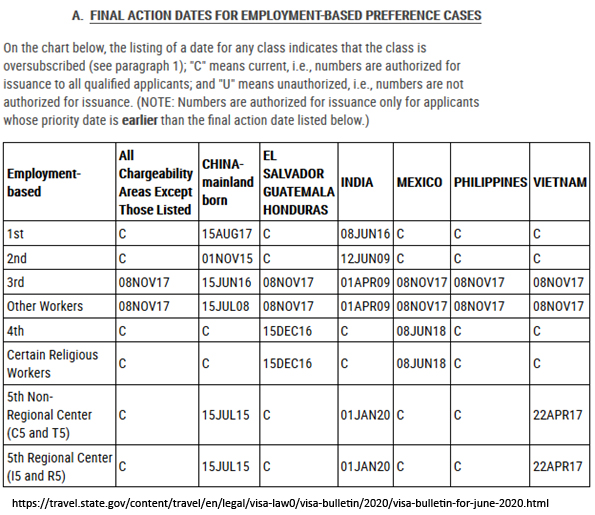
Consider the June 2020 Visa Bulletin Chart A Final Action Dates.
Interpretation

  • EB-5 is the 5th Employment-based preference. There are separate rows for non-regional center (direct) and regional center EB-5, because these categories get treated differently in case the regional center program authorization lapses. Otherwise, these two rows will be identical to each other each month.
  • The letter “C” means that visa numbers are currently authorized for issuance to all qualified applicants, regardless of when they filed petitions. For EB-5, all countries except China, Vietnam, and India are current for now.
  • The 15Jul15 final action date for China EB-5 means that qualified China-born visa applicants who filed I-526 BEFORE (but not on or after) July 15, 2015 may now proceed to finish the process to get conditional green cards. The 10Jan20 final action date for India EB-5 means that qualified India-born visa applicants who filed I-526 before January 10, 2020 may now move forward to receive visas. The final action dates mark the cut-off for visa availability.
  • The final action date indicates the qualified applicants who MAY move forward – not necessarily those who CAN move forward.  As it happens, all applicants outside the U.S., regardless of priority date and qualification, are currently prevented from getting visas by the fact that consulates are sheltering in place and not giving visa interviews.  At the moment, the population of people who CAN move forward is practically limited to qualified applicants able to finish the visa process through adjustment of status in the U.S. Department of State would take this practical limitation into account, when defining the final action date-barrier for visa availability. The dates in the June 2020 visa bulletin presumably do not account for the inventory of visa applicants pending at the National Visa Center, since those applicants aren’t practically able to demand visas in June. When it’s possible to temporarily discount many pending applicants, it’s possible to move the final action date quickly to accommodate the few applicants who are practically able to claim visas.
  • Even without a pandemic, the final action date does not mean that everyone who filed I-526 before that date can proceed to get visas now. The key word is “qualified” applicants – meaning people who already have I-526 approval and have active and complete visa applications on file. If someone from India filed I-526 in 2019, that person can only proceed to final action in June 2020 if qualified at the visa stage. If still waiting for I-526 approval or visa document review, that person is not eligible yet to claim a visa regardless of the visa bulletin.
  • The final action date in the visa bulletin does not mean that most people who filed petitions before that date already have visas. Department of State issues visas in order by priority date, but processing at USCIS may not be sequential. We know that hundreds of Indians with 2018 and 2017 priority dates (and even some 2016 PD) are still waiting at USCIS for I-526 approval. So when the Visa Bulletin has a January 1, 2020 final action date for India, that can’t mean that most India priority dates from 2019 and earlier are already through the system. It just means that earlier priority dates aren’t yet able to claim visas (thanks, USCIS processing delays and COVID-19), and thus had to be temporarily skipped over for visa issuance. When those earlier PD do reach the point of being able to claim visas, the visa bulletin final action date will need to retrogress (move back in time) to accommodate them.  By contrast, the numbers suggest that few I-526 filed before July 2015 should still be pending at USCIS. So the July 2015 final action date for China could indeed reflect the actual progress of China visa issuance, not just the accident of who’s currently positioned to claim a visa. Knowing who’s in line at different stages, I’m certain that the India final action date will retrogress significantly in future visa bulletins. It’s possible that the China and Vietnam date movement might just slow down rather than moving back in time.

Hypothetical Examples

Basically, the key to understanding the visa bulletin is understanding the extent to which the EB-5 process is and is not sequential by priority date. To that end, I’ve made a couple simplified hypothetical scenarios, with pictures. The first scenario reflects how some people assume the EB-5 process works. The second scenario is more analogous to how it really works.

In hypothetical Scenario A:

  • Each person receives a priority number when entering the “File Petition” door.
  • People wait in line in order of priority number, and proceed in this order to and through the “Get visa” door.
  • Three people per month are allowed go through the Get Visa door.
  • The bulletin over the Get Visa door is updated monthly to post the priority number of the first person who can’t fit through the door that month.
  • When the bulletin posts #4, that means number 1, 2, and 3 may go through the Get Visa door.
  • Considering the queue and how it moves sequentially at a rate of three/month, we can confidently predict the following future bulletin updates: Month 2: #7, Month 3: #10, Month 4: #13.
  • The person with #9 can confidently predict that his turn to get a visa will come no earlier and no later than 9/3=3 months.
  • Scenario A shows a process that’s predictable because strictly sequential from beginning to end. In that sense, it differs from the EB-5 process.
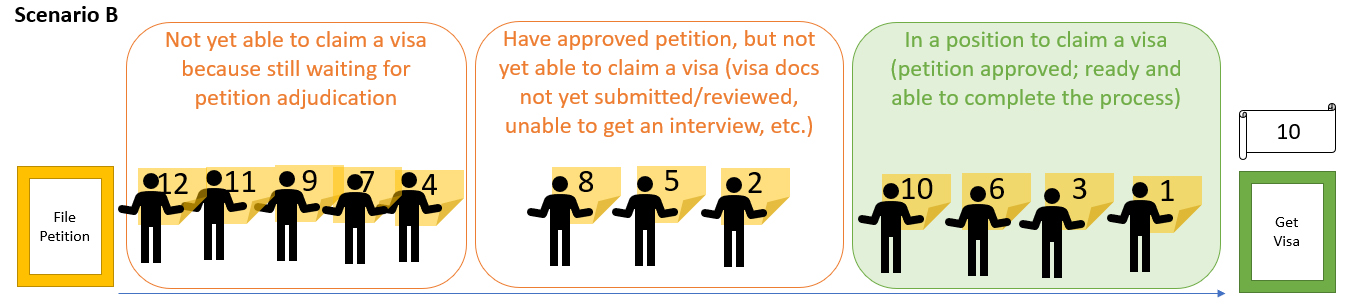
In hypothetical Scenario B:

  • The same rules apply as in Scenario A, except that the process includes multiple stages, and only strictly organized by priority number in the last stage.
  • The queue is mixed in Scenario B due to the first stage, which does not necessarily respect priority numbers. Some petitions are unreasonably delayed here, while others were apparently advanced out-of-order from stage one to the later stage.
  • In Scenario B, the bulletin over the Get Visa door only considers people in the final stage – in a position to claim visas — when posting who gets through that month.
  • The bulletin in Scenario B currently posts “10,” because 10 happens to be the first eligible number not possible to accommodate under the three/month limit. Posting #10 allows eligible 1, 3, and 6 through the green door. It does not allow 2, 4, 5, 7, 8, or 9 through the door, because those numbers happen to be still stuck at ineligible stages. (If those numbers had all been in the eligible stage, then the bulletin would’ve posted #4.). If it happens that 2, 4, 5, 7, and 8 reach the final stage by next month, then the next month’s bulletin will “retrogress” to #7, the earliest number not possible to accommodate under the three/month limit.
  • The person holding #9 has a complex visa wait time calculation. His future turn at the Get Visa door isn’t simply a function of being #9 in queue that moves at a rate of three per month, since the first stage mixed the queue. His turn isn’t now, despite the #10 posted in the current bulletin, because he’s not yet at the stage of being able to claim a visa. It may or may not be his turn once he does reach the eligible visa stage: it depends on who’s at various stages, and when they are able to reach the final stage. We can see that six other people with lower numbers are still in the queue as well. They’re not yet recognized by the bulletin since they’re also not eligible yet, but will be eventually.
  • The priority numbers create order within the visa stage, but not necessarily before that. The more people are concentrated in the final stage, the more order and predictability in the process. The more people are stuck in the first stage, the more potential for disorder and unpredictability.
  • Scenario B is relatively comparable to how priority dates function in the EB-5 process.

Bonus Features

For those about to make a comment asking about visa timing for a specific situation, please see my timing consultation page. Timing estimates are tough, as evident in this post. My consultations are rooted in my attempt to quantify (by piecing together sporadic reports from USCIS and Department of State) the current breakdown of the EB-5 backlog by country, priority date, and process stage. Having this picture in view, we can think about the timing outlook for someone at a given place in that backlog.

The following images show sides from Charles Oppenheim’s visa presentation at the 2018 AILA & IIUSA EB-5 Industry Forum October 29–30, 2018 Chicago, IL. These slides illustrate how EB-5 cases can get mixed up in practice, instead of proceeding in date order from the I-526 stage to the visa stages.

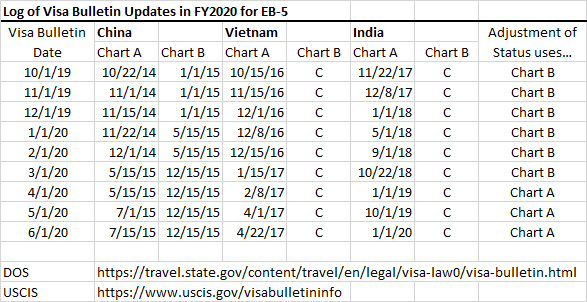
And finally, a log of visa bulletin updates so far in FY2020, illustrating how EB-5 dates have moved this year.
EB-5 Impact of COVID-19 (processing, eligibility, visa numbers)

EB-5 Processing at USCIS under COVID-19

USCIS has continued to process Form I-526, I-485, and I-829 during the pandemic, since this processing generally does not involve public contact. Domestic USCIS offices that were closed to the public are now slated to re-open on or after June 4, and USCIS continues to offer deadline extensions for RFE and NOID notices issued between March 1 and July 1 (per the latest update to the USCIS Response to COVID-19 page). No EB-5 form processing data has been published yet for 2020, but individual reports suggest a steady flow of EB-5 decisions throughout 2020.

Possibly the most important COVID-19 impact for EB-5 processing involves lawyers. In 2019, the Investor Program Office at USCIS simply dropped the ball on adjudications, becoming FOUR TIMES less productive than previous years, and they got away with it. But in 2020, EB-5 lawyers have little to do and few ways to make money except to convince EB-5 investors to file Mandamus and APA actions to sue USCIS to do its job. With unreasonable delay being so blatant in EB-5, especially in the wake of the 2019 processing meltdown, USCIS does not have a good defense against these suits except to finally adjudicate petitions. The logical defensive strategy for IPO now would be to buckle down and work as hard as they can to clear the delayed backlog that’s inviting and justifying the blizzard of lawsuits. And that may indeed be what’s happening. In the meantime, I have an article forthcoming on the USCIS processing times reports, and my Timing Estimates service is up.

COVID-19 and EB-5 Eligibility

A pandemic presents obvious challenges for immigration that depends on sustained investment and job creation. I’ll write more about this as time permits, but a few timely articles:

COVID-19 and EB-5 Visa Availability

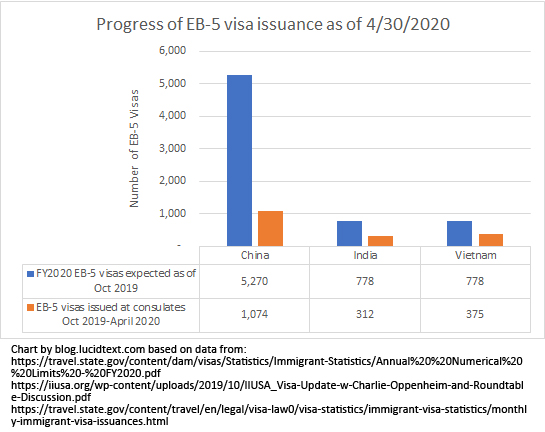
The pandemic has effectively stopped EB-5 visas from being issued through consular processing. Department of State cancelled “all routine immigrant and nonimmigrant visa appointments as of March 20, 2020,” and the DOS News page has yet to announce any timeline to resume routine visa services worldwide. Individual consulates also make no promises. The consulate in Guangzhou is silent regarding services. The consulate in Ho Chi Minh City announced May 26 that it will resume some regular services but for American citizens only starting June 1, with no promise for when visa appointments will resume. As of May 25, the embassy and consulates in India are still indefinitely closed to the public for routine consular services. There’s no executive order blocking EB-5 visas, but the lack of visa appointments has created a barrier in practice.

In October 2019, Department of State announced that it had 11,112 EB-5 visas available for FY2020, of which India and Vietnam could expect 778 visas each, and an estimated 5,270 could be leftover for China. DOS normally issues available visas gradually over the course of the year, about a quarter per quarter. But the actual pace of visa issuance has been slow with consulate closures, according to monthly reports of visas issued abroad.

What will happen to the EB-5 visa numbers currently not being issued at consulates? A few possibilities:

  1. Visa numbers can go to applicants who are already in the U.S. and able to complete the process through I-485 adjustment of status. We don’t know how many applicants are currently in this category, because USCIS stopped publishing data on number of pending I-485. However, historically few EB-5 visas have been claimed through status adjustment. In FY2019, the figures for EB-5 adjustment of status were: China, 433 visas; India, 257 visas; Vietnam, 52 visas. (And in FY2018: China, 481; India, 191; Vietnam, 35.) The Visa Bulletin provides one clue to visa demand. If Department of State can see many people ready to claim a visa, then the Visa Bulletin Final Action Date advances slowly to regulate that demand. If few people are in a position to claim visas, then the FAD must advance rapidly to maximize visa issuance. In 2020, the FAD has advanced extremely rapidly for India, and somewhat rapidly for Vietnam and China. This suggests that the I-485 backlog is small and/or mainly composed of recent priority dates.
  2. Consulates might resume routine visa services soon enough, and work hard enough scheduling appointments, that they can catch up with visa issuance before FY2020 ends on September 30, 2020.
  3. If consulates aren’t able to resume visa services soon and there aren’t enough EB-5 applicants in the U.S., then DOS might not manage to issue 11,112 EB-5 visas in FY2020. Any unused visas would then roll over to EB-1 next year. (That loss might be counterbalanced by the roll-over to EB categories of family-based visas that couldn’t be issued in FY2020.)

IIUSA Webinar with Charles Oppenheim on 6/16

In recent years, IIUSA Conferences in the Spring and Fall have featured presentations from Charlie Oppenheim, Chief of the Visa Control and Reporting Division at the U.S. Department of State. I look forward to these presentations for valuable updates on number of EB-5 visas issued, the current size of the backlog, and updated estimates for EB-5 visa wait times and visa bulletin movement.

This pandemic Spring, IIUSA can’t hold a conference, consulates have paused visa services, the Visa Bulletin is jumping wildly to accommodate the few EB-5 applicants lucky to be in a position to claim visas, and visa availability has become a wide-open question. In the midst of all this, Mr. Oppenheim has still kindly consented to join a live webinar with IIUSA to address industry questions about EB-5 visa availability.  Register here for the webinar on June 16 at 1 PM EST. Mr. Oppenheim will only be able to discuss visa availability in general terms, rather then providing data and predictions, because even Department of State can’t say at this point what is happening and will happen with EB-5 visa numbers and visa processing. But I appreciate the willingness to engage with the public, and share as much as possible.


Unleashing the economic and job creation benefit of EB-5

Washington has been busy considering how to use immigration policy as a tool in midst of the current COVID-19 crisis. The flurry of immigration-related activity includes:

So far EB-5 has not been harmed, except by threats. EB-5 might benefit indirectly next year from measures that prevent visas from being issued in other categories this year. But EB-5 has not yet been targeted for any benefit. Why? Our administration and legislators are tinkering with immigration policy for the express purpose of protecting jobs for U.S. workers and promoting economic growth. The EB-5 category exists “to stimulate the U.S. economy through job creation and capital investment.” Surely EB-5 is exactly what we need to encourage now?

EB-5 could and should be a potent tool to support our recovery, but faces political and administrative challenges.

The U.S economy and labor markets obviously benefit from a program that incentivizes foreign investors to invest in capital-starved U.S. business that will create jobs for U.S. workers. But politicians get more short-term benefit from talking points than from facts. Immigrant investment does not fit Republican rhetoric, which currently depends on painting immigration as an economic and social threat – the visible scapegoat needed to distract from the frustratingly invisible real foe of COVID-19. Immigrant investment does not fit Democratic rhetoric, which avoids being seen to side with business interests and wants to be seen supporting the most vulnerable first. Who wants to talk about immigrants who do not take jobs but create them, who aren’t to be seen limping across the border but shopping at Nordstrom, who come from success, who support business and developers, and who arrive flush with tax dollars to give? EB-5 investors are a practical help to everyone and politically awkward for all sides.

The EB-5 program would get more recognition and support if people realized what it is and does. American entrepreneurs get capital to enable them to open businesses and complete projects. The foreign investors get visas only if those ventures create jobs for U.S. workers. Most American entrepreneurs are honest. Many EB-5 projects involve small businesses and most employ vulnerable workers. EB-5 investors come from around the world, and tend to be upper middle class professionals. EB-5 uses a tiny percentage of total visas. The visas cannot be bought at any price, only granted in exchange for job creation. But who knows this? One headline out of a hundred tells that story. Most headlines instead shriek these words: fraud, scandal, buy-a-visa, pay-to-play, super-rich, Manhattan, China. Out of many thousands of EB-5 projects, the 20 with salacious features get covered. Where headlines lead, our government representatives follow. EB-5 can only thrive if the industry gets much better at education and public relations, showing a true picture of the program that legislators can afford to come out and support.

To achieve Congressional intent, the EB-5 program needs to be administered in a way that promotes job creation and capital investment. The regional center program needs to be available in geographies around the country, especially rural and distressed urban areas with naturally low investment activity. Applications for new projects need to be vetted promptly, to create opportunity for new projects to raise capital and discourage misuse. Investor petitions need predictable and timely treatment, so foreign investors will trust the program. At the moment, the Investor Program Office at USCIS is doing precisely the opposite at every point. IPO is busy eliminating opportunity for rural and distressed areas by making robust investment pipeline and frequent activity the bar for regional center designation. IPO posts a 4-6 year processing time to vet new regional center projects, and has been taking nearly 3 years to get around to reviewing investor petitions. Such administration is obviously not conducive to attracting capital investment to good projects, creating new jobs, or facilitating timely contribution to the country’s urgent economic needs. EB-5 can only thrive if USCIS remembers that it’s administering an investment-based program that involves the fate of U.S. business and jobs, not simply an immigration program.

To create economic benefit for America, EB-5 needs to be used. To be used, it needs to be attractive. Currently the U.S. investor visa has less availability with more trouble and expense than alternative visas in other countries. This makes it a tough sell for U.S. entrepreneurs trying to find investors to help launch and save businesses. EB-5 could become more attractive if Congress made more visas available to EB-5, walked back the regulatory change to triple the investment threshold, and forced USCIS to start administering the program with integrity and efficiency. Congress could take steps to do all this if they felt the need – just as they’re now proposing immigration interventions, including visa recapture and processing improvements, to help retain foreign health care workers. Congress realizes that America needs health care workers for COVID recovery. When will it realize that America could use investment and job creation for economic recovery, and treat EB-5 accordingly? Probably, when we finally successfully convey that that is, in fact, what EB-5 can offer. This story must be urgently told, by everyone who can tell it. Otherwise, EB-5 may get folded into the blind effort to scapegoat employment-based immigration in general.

UPDATES:

  • EB5 Investors Magazine is launching a special feature to showcase how the EB-5 visa program has provided a positive impact. Please share how your completed EB-5 projects have had a beneficial effect.
  • IIUSA invites EB-5 users to add signatures to this support letter to Congress, and to submit op-eds with stories of EB-5 success.

In other news, the latest IIUSA Regional Center Business Journal is worth the effort to read, with substantial and timely content. I particularly appreciated the articles on TEAs, EB-5 visa numbers, I-526 processing order, and installment investments.