Perspectives on the EB-5 visa queue (new I-526 approval report)

The wait time for an EB-5 visa depends on the number of people in line, and the rate at which the line moves. Both factors are complicated and can be tough to pin down. We’ve recently received significant new information related to each factor. This post attempts to put the new information in context. (Note: this post only concerns people interested in EB-5 timing for China, Vietnam, and India.)

The EB-5 queue normally moves at a rate of about 10,000 applicants per year, with about 700 per country, but this can vary. I recently wrote a guest post explaining How EB-5 Visa Numbers Will Increase in FY 2021. I have another post in progress to discuss visa availability and the movement of the EB-5 visa queue for China specifically, in light of recent developments.

The queue size question is complicated by spotty data and multiple stages. The following image illustrates three ways subdivide the EB-5 queue, when trying to calculate it. If you don’t have time to read the whole post, at least spend time gazing at this image, and see how it puts available queue data in context.

Perspective A looks at the queue in terms of stages between USCIS and Department of State.  Visa Control Office Chief Charles Oppenheim uses this perspective when making EB-5 wait time estimates. But Mr. Oppenheim calculates from two of the four variables in this picture. His wait time estimates count pending I-526 and pending applicants at the National Visa Center, and disregard the population segments for which he lacks data: people with approved I-526 but no visa application yet, and people with pending I-485. If those segments are small, then omitting them doesn’t matter much to wait time estimates. Historically, I-485 numbers have been indeed been very small (though Indians might change that going forward). The population of people between I-526 and visa application might be significant, particularly for China.

Perspective B reflects an alternate way to subdivide the EB-5 queue along the lines of before/after I-526 approval, and before/after visa availability. This perspective has come into focus because USCIS just started to publish data for a key variable: number of approved I-526 waiting for visa availability. I still can’t complete the calculation, because there’s only data for two of three segments for Perspective B. But the new data is tantalizing, because it overlaps with the major unknown from Perspective A.  The population of people with I-526 approval and no visa application on file yet (unknown) is a subset of the population of people with I-526 approval and waiting for visa availability (now reported).

So let’s look at these new data reports from USCIS, and think about what the numbers mean in context.  The following screen shots show reports as of November 2019 and April 2020.

Notes:

  • China report: In October 2019, there were 27,251 Chinese investors with I-526 approval and priority dates more recent than November 1, 2014 (the final action date in the November 2019 visa bulletin). In April 2020, there were 23,511 Chinese investors with I-526 approval and priority dates more recent than May 15, 2015 (the final action date in the April 2020 visa bulletin). Some inferences from these reports:
    • By moving the China final action date from November 2014 to May 2015 this year, Department of State apparently made a minimum of more 3,740 Chinese principal applicants eligible to claim visas. A decrease to the number of Chinese waiting for visa availability means an increase to the number of Chinese with visas available. (This doesn’t consider the number of visas actually issued, or the number of incoming I-526 approvals.)
    • USCIS reports 23,511 Chinese investors were awaiting visa availability as of April 2020. That number is principals only, not family members. Assuming a historical ratio of 2.7 visas per principal for China, that means about 23,511*2.7=63,889 future Chinese visa applicants at the stage of having I-526 approval, but not yet able to proceed to final action in the visa process. Charles Oppenheim reported that in June 2020, there were 42,575 EB-5 visa applications on file for China. The visa applications would include some people with visas available according to the visa bulletin Chart A, and some who are still awaiting final action. So the population represented by 42,575 overlaps with the population represented by 63,889. But the difference between 42,575 and 63,889 gives a hint about the number of Chinese with I-526 approval who may not have visa applications on file. In other words, a hint about the size of the population omitted from Department of State EB-5 queue estimates for China.
  • India report: In October 2019, there were 189 Indian investors with I-526 approval and priority dates more recent than December 8, 2017 (the final action date in the November 2019 visa bulletin). In April 2020, there were 51 Indian investors with I-526 approval and priority dates more recent than January 1, 2019 (the final action date in the April 2020 visa bulletin). Some inferences from these reports:
    • USCIS is slow. By April 2020, there apparently had been only 51 approvals for Indian I-526 filed in 2019 and later.
    • Department of State has apparently made India current for final action because it sees only a few Indians with approved I-526 waiting for visa availability. 51 principals would be about 124 visa applications, considering the typical applicant/principal ratio for India. Department of State still has over 200 visas available for Indians this year.
    • The number of Indian investors waiting for visa availability dropped between November 2019 and April 2020. That drop means an increase in the number of Indian investors who have visas immediately available to them (and suggests that there have been few incoming I-526 approvals on Indian petitions filed since December 2017).
  • Vietnam report: In October 2019, there were 491 Vietnamese investors with I-526 approval and priority dates more recent than November 15, 2016 (the final action date in the November 2019 visa bulletin). In April 2020, there were 443 Vietnamese investors with I-526 approval and priority dates more recent than February 8, 2017 (the final action date in the April 2020 visa bulletin). Some inferences from these reports:
    • The number of people waiting for visa availability is increased by new I-526 approvals, and decreased by visa bulletin movement that makes visas available to more people. For Vietnam, these two factors approximately balanced each other between November 2019 and April 2020, since the size of the waiting pool hardly changed. Either there were many I-526 approvals and many people became eligible for final action during that period, or few incoming I-526 approvals and few exits to the final action stage.
    • The numbers help explain why the Visa Bulletin has moved more slowly for Vietnam than for India. In April 2020, Department of State could see only 51 Indian investors ready with I-526 approval but as yet unable to claim visas, but 443 similarly-placed investors from Vietnam. 51 Indian investors plus family could all fit into this year’s visa limit, so the visa bulletin may as well become current to let them all through. By contrast, 443 Vietnamese investors would require more than one year’s visa quota, so the visa bulletin must continue to use final action dates to gradually channel that pool into the final action stage.

When confronted with a data point about the EB-5 visa queue, it’s necessary to put that data point in context, considering which segment of the queue it represents. The new USCIS report gives data for the segment of people with approved I-526 plus still waiting for visa availability. The total queue for EB-5 conditional residence includes two other segments: people with pending I-526, and people with approved I-526 plus visa availability. So according to USCIS data, the EB-5 queue of investors as of April 2020 equals about 17,500 I-526 pending plus 24,005 approved I-526 still waiting for visa availability plus an unknown number of approved I-526 now eligible for final action. As adjusted by the addition of family members, of course.

Perspective A and B are both limited by lack of data for a major population segment. I tend to favor Perspective C, which makes queue calculations simply from I-526 filing data, to avoid unknowns about where people currently fall in the process.
FY2020 Q2 EB-5 Form Processing Data

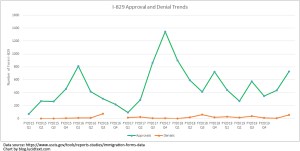
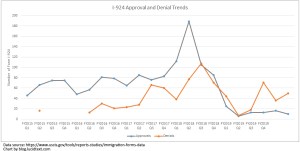
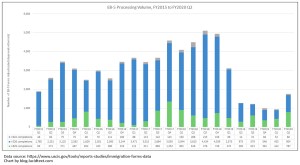
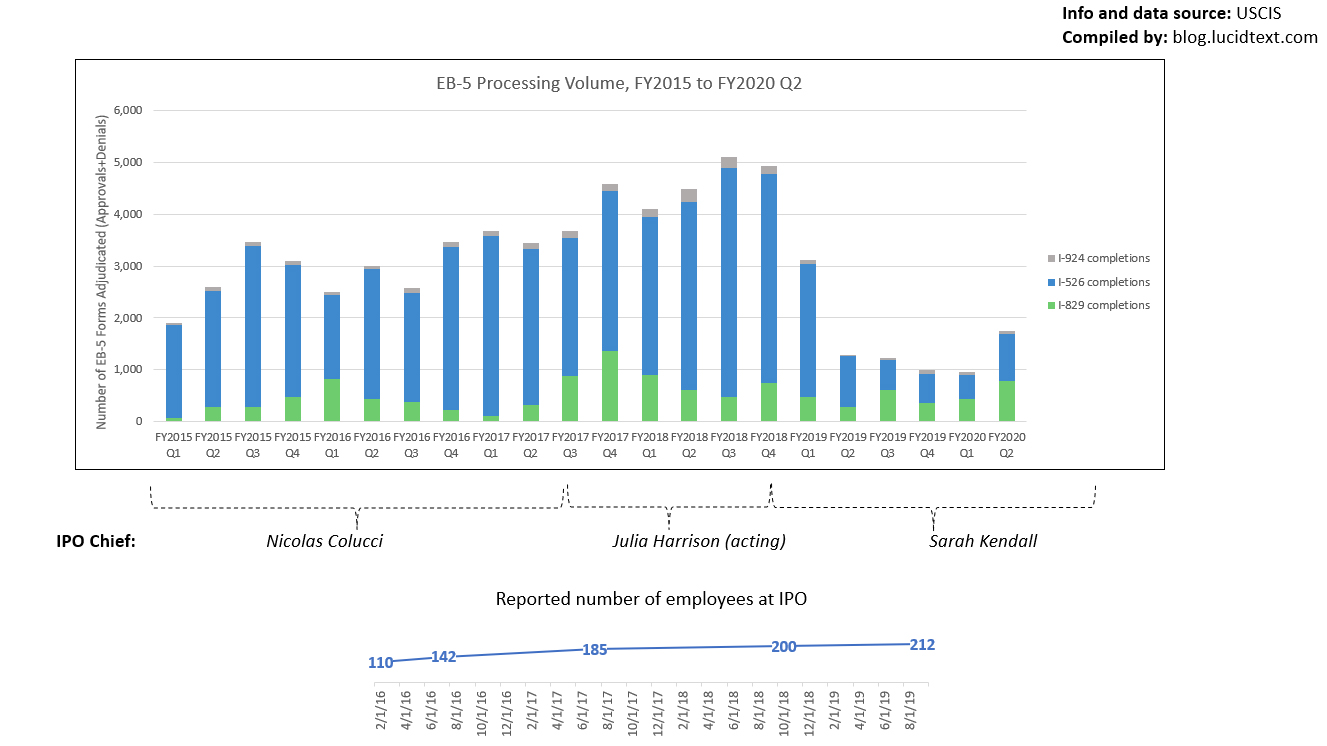
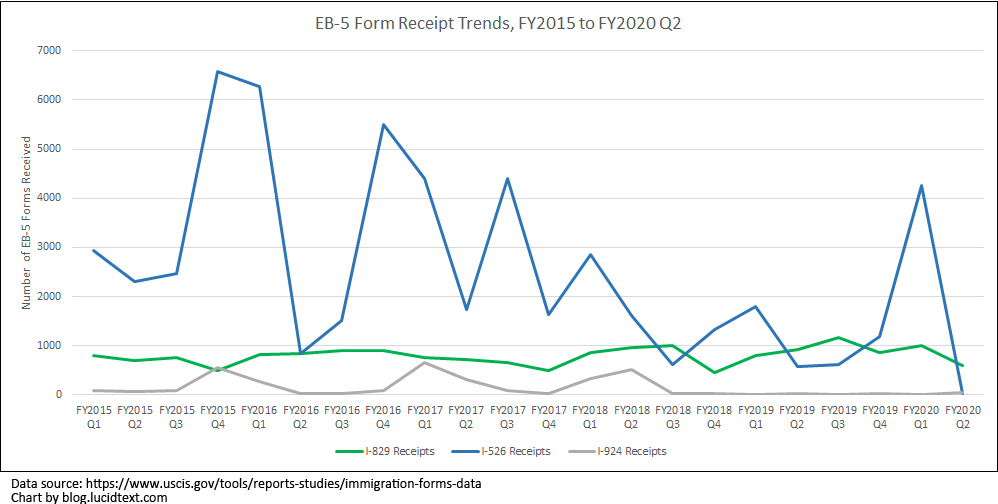
USCIS has published the All Forms report for FY2020 Q2 (January to March 2020), including entries for EB-5 forms I-526, I-829, and I-924. I look forward to these quarterly reports on the USCIS Immigration and Citizenship Data page because they provide information about EB-5 demand trends (receipts), processing trends (number of approvals and denials), and backlog trends (number of pending petitions).

FY2020 Q2 Data        
Form Receipts Approvals Denials Pending
I-526 21 714 190 16,633
I-829 604 730 57 10,309
I-924 48 10 50 137

IPO Chief Sarah Kendall had indicated at the March 2020 EB-5 stakeholder engagement that “With a lot of the infrastructure development now behind us, IPO is better situated to improve productivity. In fact, preliminary data for February shows a step in the right direction.” Now we can see that indeed, completion rates improved significantly. IPO processed almost twice as many I-526 and I-829 in FY2020 Q2 as in FY2020 Q1. That’s a most welcome update. The productivity in FY2020 Q2 is still three times lower than it was in 2018 with the same staff, so still not a recovery. But “a step in the right direction,” certainly. If IPO can manage more such steps in Q3 and Q4, I will start praising IPO Chief Sarah Kendall instead of pointing out inexcusable mismanagement of resources.

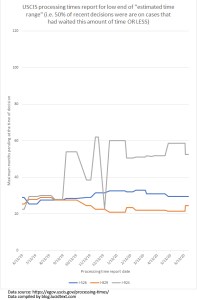
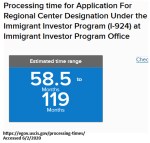
There were just over a handful of I-526 and I-924 receipts in January to March 2020 (21 I-526, and about 48 I-924). That’s no surprise. I would not expect many I-526 filings immediately after a deadline that nearly doubled the minimum investment amount. And I would not expect many I-924 filings considering that USCIS has essentially stopped processing I-924, as indicated by both the volume report (only 10 approvals in three months) and the processing times report (which gives an “estimated time range” for I-924 processing of 53 to 99 months).

Low receipt numbers are part of a trend throughout USCIS, and  help explain why the agency is now complaining to Congress about budget trouble. It turns out, measures to discourage immigration can result in falling revenue from immigrant fees. USCIS faces a reckoning from having operated on the Ponzi principle: depending on incoming fee revenue from new petitioners to pay for adjudicating a large backlog of forms whose fees were already spent without performance. I am heartened to see that at least in 2020, IPO did not use plummeting fees as an excuse to reduce productivity. In 2019, the coincidence of EB-5 receipt and adjudication numbers had me wondering whether IPO had decided to process only as many forms as justified by incoming fee revenue. I’m happy to see FY2020 Q2 firmly contradict that suspicion.

Denial rates remain comparatively high for Form I-526, but lower than in 2019. And it’s unclear whether IPO is actually denying more I-526 than usual, or just approving fewer than usual. Form I-924 denial rates remain astronomical – but no surprise, considering that most Form I-924 just request pre-approval for proposed investment projects. When I-924 processing times extend to four to eight years, the typical proposed project will no longer even exist by the time USCIS gets around to reviewing the application. Significant room for improvement in this area.

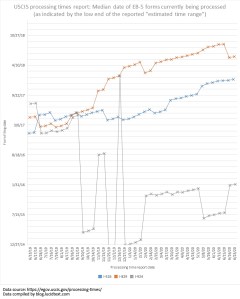
The charts below put FY2020 Q2 data in context of previous reports. I also included charts of recent processing times reports for reference and comparison. My timing consultation service remains available to people who want the numbers explained and interpreted as applied to their specific circumstances. So far I can only offer this service for I-526, because I have quite a bit of I-526 data available. I hope that I-829 processing will become more transparent in the future.

6/16 Oppenheim webinar updates (visa number usage and estimate, processing, retrogression)

I appreciated IIUSA’s June 16 webinar A Discussion With Charlie Oppenheim: Chief, Visa Control and Reporting Division, U.S. Department of State. IIUSA has a recording available for purchase, and it’s worth the price. Mr. Oppenheim spoke for 45 minutes and answered many questions in detail. Well-informed IIUSA panelists followed up with another 45 minutes of interesting and helpful discussion about how they are adjusting to current conditions.

Here are a few highlights from Mr. Oppenheim’s remarks. (6/22 UPDATE: See also the analysis published on the IIUSA blog by panelist Cletus Weber: “Highlights and Analysis of June 16, 2020 IIUSA Presentation on Visa Numbers, COVID-19, etc.”)

Consular processing and COVID-19

Department of State has been discussing when and how consulates can get back to full operations, but there are no decisions or forecasts at this point. It remains a “wait and see game.” Mr. Oppenheim expects that there will not be a “one size fits all” approach, but that different overseas posts will be coming back online at different times and with different capacities. The DOS website remains the best source for updates going forward (https://travel.state.gov/content/travel/en/News/visas-news.html and https://www.usembassy.gov/). Meanwhile, however, the National Visa Center remains operational. Applicants are encouraged to proceed as far as they can at NVC, so that they’ll be ready to go as soon as consulates can give interviews.

FY2020 Visa Usage

Mr. Oppenheim did not have exact numbers available, but estimated that over 4,500 EB-5 visas have been issued in FY2020 to date. (With 11,111 EB-5 visas authorized for this year, that could mean over 6,000 EB-5 visas would have to be issued in the next four months to maximize the FY2020 visa limit.) Mr. Oppenheim said that there is still potential for FY2020 numbers to be utilized if oversees posts open soon. USCIS does not allow Mr. Oppenheim to say how many I-485 are pending for EB-5, but he disclosed that they “don’t have a lot,” and that he’s “not sure there are enough I-485 out there to maximize visa usage this year.”

Based on the information Mr. Oppenheim provided, it appears likely that China will lose EB-5 visa numbers this year. China was expected to have over 5,000 EB-5 visas in FY2020, but in fact just over 1,000 visas were issued in Guangzhou before interviews stopped in February. Mr. Oppenheim said in the webinar that the July 2020 visa bulletin makes about 400 Chinese eligible for final action through adjustment of status, and about 3,000 Chinese eligible through consular processing. But he does not think Guangzhou could handle that many visa interviews this year even if it reopened tomorrow. (For reference, in the three years that I’ve logged monthly EB-5 visas from Guangzhou, the high was 781 visas issued in December 2017.)

Meanwhile, India has already used “well over 500 numbers, possibly 550 or more” for FY2020 (out of 778 visas expected under the quota), partly thanks to rapid movement of the visa bulletin. Mr. Oppenheim made India current for final action in the July 2020 visa bulletin, and expects India to remain current through the end of the fiscal year. (That must mean that he does not see many India I-485 pending or forthcoming, and/or is not optimistic about the number of visa interviews that can be scheduled in India this year.  If Mr. Oppenheim did foresee well over 250 Indians ready to claim a visa by September, then India would not be current for final action in the visa bulletin.)

Mr. Oppenheim did not mention how many visas have been issued to Vietnam so far in FY2020. He said that the visa bulletin dates for Vietnam would likely move “consistent with those moves through the end of the fiscal year” (referencing recent visa bulletin movement for Vietnam) but did not further explain that statement.

Mr. Oppenheim encouraged people to become documentarily qualified as soon as they can, so that they’ll be ready to go immediately when consulates can resume interviews. That means responding promptly when notified by NVC to assemble and submit documents. He said that overall, over half of people eligible to become documentarily qualified and pay fees have not done so. The more people are ready to claim a visa, the better chance of maximizing visa number usage this year.

FY2021 Visa Availability

On the bright side, EB-5 visa number loss in FY2020 is likely to be at least offset and possibly far exceeded by gain in numbers in FY2021. Mr. Oppenheim estimates that the EB visa limit, normally around 140,000, will be “at bare minimum” over 200,000 in in FY2021, and probably “well in excess” of 200,000. EB-5 gets 7.1% of total EB visas, so that means the EB-5 visa limit in FY2021 will at least be over 14,200 – and probably significantly over. This will happen because unused family-based visas from one year roll over into employment-based categories the next year. And consulate closures mean that many family-based visa numbers are going unused this year. I have a separate post coming on this topic, to explain the minimum and maximum benefit to EB-5 from unused FB visas in FY2020, and the potential impact on EB-5 wait times.

Mr. Oppenheim confirmed that the offset from the Chinese Student Protection Act will be completely satisfied in FY2020. So in FY2021, China will have the same EB-5 visa rights as other countries – i.e. 7% of the total limit, plus access to leftover visas according to priority date order. Since the number of leftover visas in FY2021 is likely to be very large, and Chinese have the oldest priority dates, FY2021 should be a good year for China EB-5.

Visa Bulletin Movement and Retrogression

Mr. Oppenheim spoke extensively about the thinking behind visa bulletin movement, and surprised me by indicating that he does not expect EB-5 retrogression. I haven’t figured out how this is possible for India in particular, considering the backlog and how visa bulletin dates have jumped in 2020, but Mr. Oppenheim made the statements strongly and repeatedly.  He described the visa bulletin date movements this year as “measured,” “not just moved for the sake of movement,” and “trying to avoid retrogression.” He aims to avoid a situation where people get qualified only to see time-sensitive documents expire. When specifically pressed on India, he said that “I don’t think that India is facing a retrogression in the foreseeable future” and “I think the previous wait time [estimate from October 2019] has dropped significantly for somebody that would be filing today.” This considers the possibility that a number of Indian applicants on file at NVC might be able to receive visas this year, and the increased visa quota next year.

I’m still trying to think this through, considering what we’ve been previously told about backlogs. But I credit Mr. Oppenheim’s predictions, because he has much more data than we do. He clarified that USCIS and IPO report to him monthly on processing status, including how many petitions they have at various stages of processing, and how many they are working on. (Why, IPO, do you persistently refuse to provide such reports to the public, even as you claim to stand for integrity?) Meanwhile, the National Visa Center gives monthly updates on the number of applicants who have become qualified and could potentially be scheduled for interviews.

Mr. Oppenheim acknowledged the remote possibility that all countries could become current for EB-5 final action in the visa bulletin in FY2021, for a period of time. This could happen in the first half of FY2021, if consulates remain closed into the new fiscal year, if there were a sufficient number of status adjustment cases to justify the movement, and if the system had the capacity to accommodate the resulting demand.

Other

Mr. Oppenheim clarified that absent change to U.S. immigration law, Hong Kong will continue to be treated as a separate country for the purpose of U.S. visa issuance.

Mr. Oppenheim conveyed mixed messages about IPO productivity. IPO itself has not yet published any processing data for 2020, so we’re left to guess whether their current I-526 completion rates are more like 2019 (horrible) or 2018 (great). Mr. Oppenheim, who does have recent information on volume of I-526 approvals, said that IPO has been “deciding petitions at a rapid pace” and “forwarding petitions at high volume.” He particularly noted a large number of I-526 approvals for Chinese – which must mean that many China I-526 were assigned for adjudication before the new visa availability approach took effect as of April 1, 2020. That all sounds promising. On the other hand, Mr. Oppenheim provided updated information about the NVC backlog that does not clearly reflect many people advancing from I-526 to the visa stage. The following chart compares the number of cases at the National Visa Center between October 1, 2019 and June 1, 2020.

Country Number of EB-5 applicants at NVC as of 10/1/2019 Number of EB-5 applicants at NVC as of 6/1/2020 Difference
Brazil 212 204 (8)
China Mainland 35,264 42,575 7,311
India 607 677 70
South Korea 221 193 (28)
China Taiwan 101 112 11
Vietnam 1,771 1,550 (221)
Rest of World 1,011 1,070 59
Grand Total 39,187 46,381 7,194
Total for countries other than China 3,923 3,806 (117)

The numbers show that only China has seen a significant net increase this fiscal year in EB-5 visa applicants at NVC. Mr. Oppenheim credited this increase to IPO productivity. However, the increase could also be explained by the fact that the visa bulletin has moved to allow many more Chinese to file documents, even as the consulate has not been issuing visas. For the rest of the world, incoming visa applicants have not been sufficient even to counterbalance the few EB-5 visas issued this year. If IPO were doing its job to adjudicate petitions, we should see more visa applicants. There is a lag between I-526 approval and becoming qualified at NVC, and some approved I-526 go on to status adjustment rather than to NVC. So there’s room for hope that IPO has indeed performed well recently, and I-526 approval numbers just aren’t reflected yet in visa applicant numbers. But Mr. Oppenheim hedged about the amount of visa demand he expected to make it out of USCIS. “I’ve had to temper my expectations with the immigration service because they are under certain processing constraints.”

Interpreting Processing Times Reports

And now, to demystify the USCIS Check Case Processing Times page, which as of today gives these processing times reports for EB-5 forms.

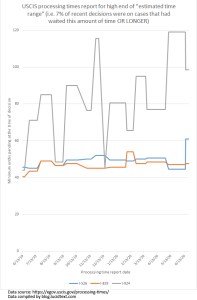
I’ve written a guest article for LCR Capital on Interpreting the USCIS processing times report. The article examines the disconnect between the content and application of the report, and goes in-depth on the following questions:

  • Does the USCIS Check Case Processing Times Page reflect the way that USCIS currently processes petitions?
  • Does the “estimated time range” on the Check Case Processing Times Page refer to the age of petitions that USCIS is processing now?
  • Does the “receipt date for case inquiry” define the limit between normal processing and unreasonable delay?
  • Why does the “receipt date for case inquiry” move so erratically, and sometimes retrogress?
  • Why are the “historical average” processing times reported by USCIS so different from the reported “estimated time range” for processing?
  • How can I estimate the processing time for my petition?

I wrote the article to give clarity and well-researched ammunition to people who may be discouraged and blocked by the USCIS processing times report, but should not be. My article addresses this core conflict:

  • USCIS uses the processing times report to create expectations about “normal processing,” and to shut down inquiries.
  • If you look at what the reported times represent, they in fact define abnormal and delayed processing.

For example, 29.5 months for I-526 indicates, specifically, that 50% of I-526 recently processed had been pending less than 29.5 months. So if my I-526 has been pending for 30 months, the report tells me that I’m being left behind – that over half of recent decisions were on cases younger than mine. And yet some people – including IPO, if I inquire – will blindly treat 29.5 months as the starting point for normal processing, not as the marker it is for delayed processing. Meanwhile, 44.5 months reportedly represents the 93rd percentile of delay in recently-adjudicated cases – by definition, an extreme outlier. Why should we accept the USCIS position that a petitioner doesn’t have a right to inquire unless and until he or she is an extreme outlier?

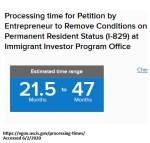
Or take the appalling 58.5-119 month “estimated time range” reported for Form I-924. How many regional centers have been discouraged by that report from even trying to file Form I-924, despite the importance of that form for project review and program integrity? And yet the report does not actually indicate that I-924 filed now will wait a long time. The processing times report does not claim to report future wait times, average recent wait times, or the age of the inventory. The report merely reflects the fact that half of petitions recently processed happen to have been waiting a long time. At last report, there were only 149 Form I-924 still pending at USCIS. In 2018, USCIS processed that many I-924 every quarter. Who then accepts the current estimated time range of 5-10 years as any reflection on normal processing?

For full discussion, see my article Interpreting the USCIS processing times report.

Bonus Features

Comparing Report and Reality: The following chart illustrates the processing reality for one quarter for which we have happen to have comprehensive data: October to December 2018. The USCIS processing times report during that quarter gave an estimated time range of 20.6 to 26.5 months for I-526 processing. Meanwhile, we now know that most I-526 processed in that period had been pending 10 to 15 months. And the chart shows the reality behind the USCIS claim: “We generally process cases in the order we receive them.”

Country-Specific Processing: When USCIS implemented the new visa availability approach to I-526 processing, they promised that the processing times report would be updated to reflect the new reality. The new approach took effect April 1, 2020, and the report has still not been revised as of June 2020. It still states “We generally process cases in the order we receive them,” and the time estimates have not been updated appreciably since March. While the report has never been a guide to future processing times, it’s particularly unhelpful now that it’s unmoored from the new reality of country-specific I-526 processing times. My I-526 processing time consultation service attempts to provide the service that USCIS should give, but does not. I approach the visa availability impact by piecing together data from different sources to estimate the current composition of the I-526 backlog by country and priority date. Having this picture in view, I then pick out the portions of the inventory that may be sidelined or fast-tracked by the visa availability approach, considering visa availability predictions, and consider the timing outlook in terms of light of volume trends.


Cooperating to share experience and support the program

Thank you to EB5 Investors Magazine for launching an initiative to showcase positive EB-5 stories. Regional Centers and project companies, please make this effort succeed by taking time to reach out and contribute information about your completed EB-5 projects. The airwaves desperately need stories of real-life experience with EB-5 success. Otherwise, the conversation and our reputation will continue to be defined by the few projects that make the news for bad reasons.

Showcase the positive impact the EB-5 program has had in America
EB5 Investors Magazine is launching a special feature to showcase how the EB-5 visa program has provided a positive impact across the nation by creating American jobs while stimulating our economy.

Please share how your completed EB-5 projects have had a beneficial effect on America. Details of your completed EB-5 projects will be used in material to promote the success and economic impact of the EB-5 program!
Let’s show our policy makers, industry influencers, interested EB-5 program participants and everyday Americans how much investment and jobs the EB-5 program creates!

Click here to share your EB-5 project details!

IIUSA has also emerged with calls to action to support the industry.

  • The IIUSA Public Policy Committee, of which I am a part, is preparing to engage with USCIS on the topic of unreasonable adjudication practices. To this end, we are collecting examples of recent Requests for Evidence and Notices of Intent to Deny that reflect new adjudication trends and make unreasonable requests. Do you have examples? If so, please redact personal information out of the RFE or NOID, and email to education@iiusa.org. The committee will use these examples to inform a robust response. (https://twitter.com/EB5IIUSA/status/1262832809162530819)
  • IIUSA is calling on all EB-5 stakeholders, economic development professionals, and businesses around the country to sign a public letter of support. The letter, addressed to members of Congress, highlights the economic benefits of EB-5 investment, including job creation and retention for U.S. workers and local economic development.
  • IIUSA offers a template to assist stakeholders in submitting op-eds to their local publications.