I appreciated IIUSA’s June 16 webinar A Discussion With Charlie Oppenheim: Chief, Visa Control and Reporting Division, U.S. Department of State. IIUSA has a recording available for purchase, and it’s worth the price. Mr. Oppenheim spoke for 45 minutes and answered many questions in detail. Well-informed IIUSA panelists followed up with another 45 minutes of interesting and helpful discussion about how they are adjusting to current conditions.
Here are a few highlights from Mr. Oppenheim’s remarks. (6/22 UPDATE: See also the analysis published on the IIUSA blog by panelist Cletus Weber: “Highlights and Analysis of June 16, 2020 IIUSA Presentation on Visa Numbers, COVID-19, etc.”)
Consular processing and COVID-19
Department of State has been discussing when and how consulates can get back to full operations, but there are no decisions or forecasts at this point. It remains a “wait and see game.” Mr. Oppenheim expects that there will not be a “one size fits all” approach, but that different overseas posts will be coming back online at different times and with different capacities. The DOS website remains the best source for updates going forward (https://travel.state.gov/content/travel/en/News/visas-news.html and https://www.usembassy.gov/). Meanwhile, however, the National Visa Center remains operational. Applicants are encouraged to proceed as far as they can at NVC, so that they’ll be ready to go as soon as consulates can give interviews.
FY2020 Visa Usage
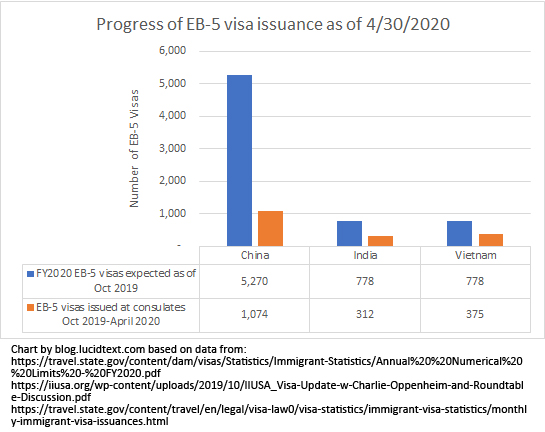
Mr. Oppenheim did not have exact numbers available, but estimated that over 4,500 EB-5 visas have been issued in FY2020 to date. (With 11,111 EB-5 visas authorized for this year, that could mean over 6,000 EB-5 visas would have to be issued in the next four months to maximize the FY2020 visa limit.) Mr. Oppenheim said that there is still potential for FY2020 numbers to be utilized if oversees posts open soon. USCIS does not allow Mr. Oppenheim to say how many I-485 are pending for EB-5, but he disclosed that they “don’t have a lot,” and that he’s “not sure there are enough I-485 out there to maximize visa usage this year.”
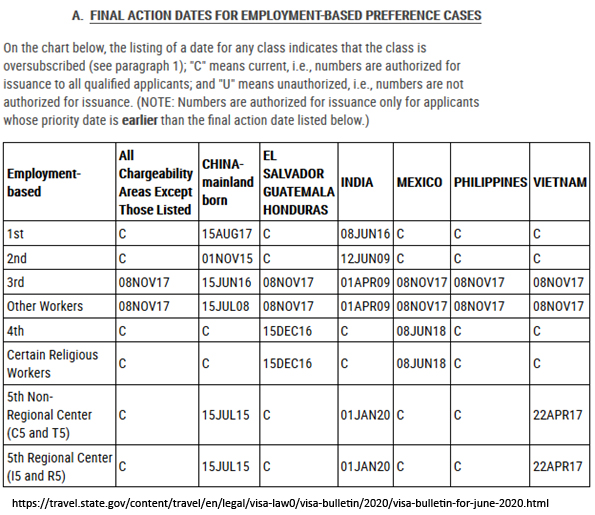
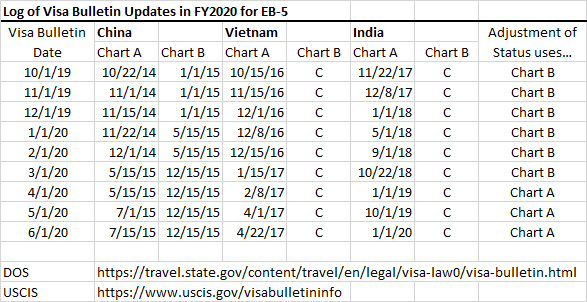
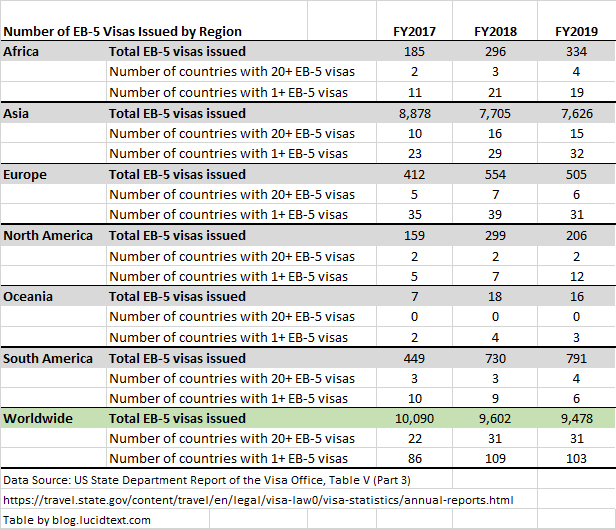
Based on the information Mr. Oppenheim provided, it appears likely that China will lose EB-5 visa numbers this year. China was expected to have over 5,000 EB-5 visas in FY2020, but in fact just over 1,000 visas were issued in Guangzhou before interviews stopped in February. Mr. Oppenheim said in the webinar that the July 2020 visa bulletin makes about 400 Chinese eligible for final action through adjustment of status, and about 3,000 Chinese eligible through consular processing. But he does not think Guangzhou could handle that many visa interviews this year even if it reopened tomorrow. (For reference, in the three years that I’ve logged monthly EB-5 visas from Guangzhou, the high was 781 visas issued in December 2017.)
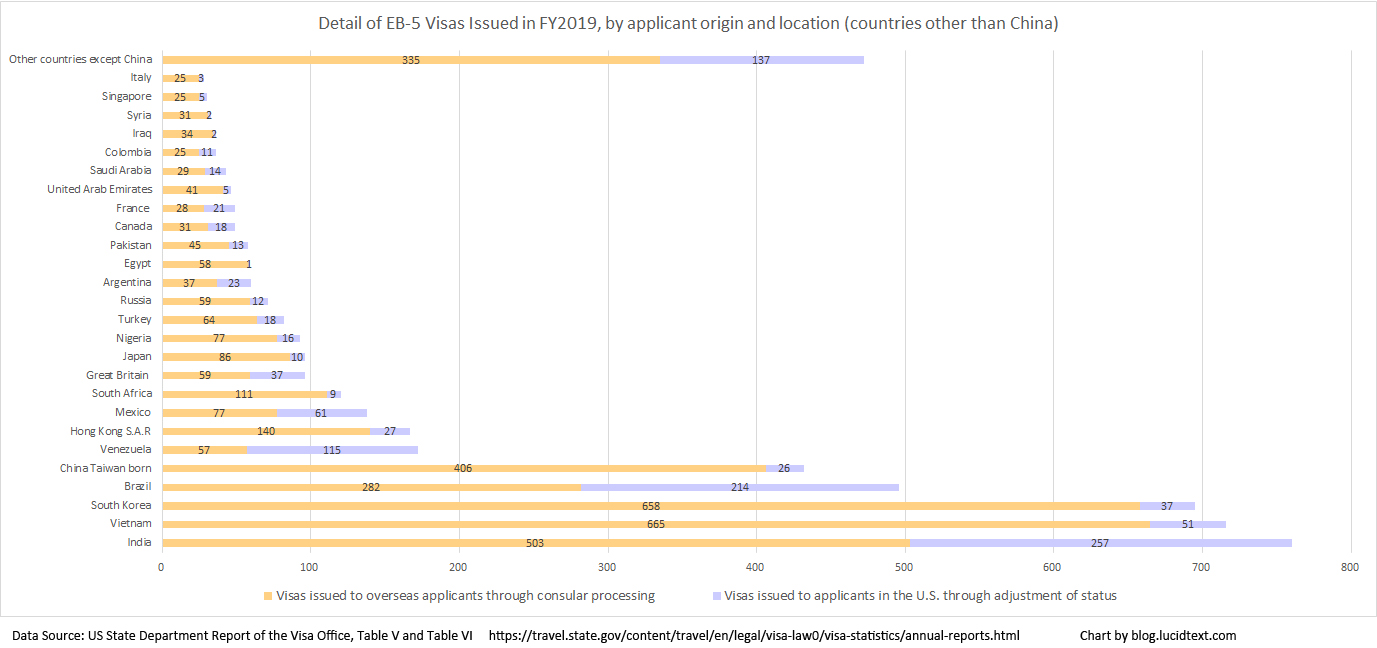
Meanwhile, India has already used “well over 500 numbers, possibly 550 or more” for FY2020 (out of 778 visas expected under the quota), partly thanks to rapid movement of the visa bulletin. Mr. Oppenheim made India current for final action in the July 2020 visa bulletin, and expects India to remain current through the end of the fiscal year. (That must mean that he does not see many India I-485 pending or forthcoming, and/or is not optimistic about the number of visa interviews that can be scheduled in India this year. If Mr. Oppenheim did foresee well over 250 Indians ready to claim a visa by September, then India would not be current for final action in the visa bulletin.)
Mr. Oppenheim did not mention how many visas have been issued to Vietnam so far in FY2020. He said that the visa bulletin dates for Vietnam would likely move “consistent with those moves through the end of the fiscal year” (referencing recent visa bulletin movement for Vietnam) but did not further explain that statement.
Mr. Oppenheim encouraged people to become documentarily qualified as soon as they can, so that they’ll be ready to go immediately when consulates can resume interviews. That means responding promptly when notified by NVC to assemble and submit documents. He said that overall, over half of people eligible to become documentarily qualified and pay fees have not done so. The more people are ready to claim a visa, the better chance of maximizing visa number usage this year.
FY2021 Visa Availability
On the bright side, EB-5 visa number loss in FY2020 is likely to be at least offset and possibly far exceeded by gain in numbers in FY2021. Mr. Oppenheim estimates that the EB visa limit, normally around 140,000, will be “at bare minimum” over 200,000 in in FY2021, and probably “well in excess” of 200,000. EB-5 gets 7.1% of total EB visas, so that means the EB-5 visa limit in FY2021 will at least be over 14,200 – and probably significantly over. This will happen because unused family-based visas from one year roll over into employment-based categories the next year. And consulate closures mean that many family-based visa numbers are going unused this year. I have a separate post coming on this topic, to explain the minimum and maximum benefit to EB-5 from unused FB visas in FY2020, and the potential impact on EB-5 wait times.
Mr. Oppenheim confirmed that the offset from the Chinese Student Protection Act will be completely satisfied in FY2020. So in FY2021, China will have the same EB-5 visa rights as other countries – i.e. 7% of the total limit, plus access to leftover visas according to priority date order. Since the number of leftover visas in FY2021 is likely to be very large, and Chinese have the oldest priority dates, FY2021 should be a good year for China EB-5.
Visa Bulletin Movement and Retrogression
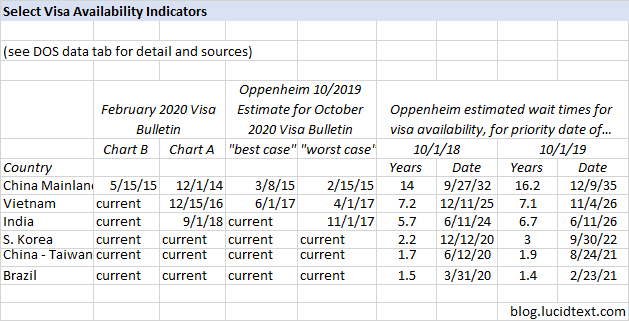
Mr. Oppenheim spoke extensively about the thinking behind visa bulletin movement, and surprised me by indicating that he does not expect EB-5 retrogression. I haven’t figured out how this is possible for India in particular, considering the backlog and how visa bulletin dates have jumped in 2020, but Mr. Oppenheim made the statements strongly and repeatedly. He described the visa bulletin date movements this year as “measured,” “not just moved for the sake of movement,” and “trying to avoid retrogression.” He aims to avoid a situation where people get qualified only to see time-sensitive documents expire. When specifically pressed on India, he said that “I don’t think that India is facing a retrogression in the foreseeable future” and “I think the previous wait time [estimate from October 2019] has dropped significantly for somebody that would be filing today.” This considers the possibility that a number of Indian applicants on file at NVC might be able to receive visas this year, and the increased visa quota next year.
I’m still trying to think this through, considering what we’ve been previously told about backlogs. But I credit Mr. Oppenheim’s predictions, because he has much more data than we do. He clarified that USCIS and IPO report to him monthly on processing status, including how many petitions they have at various stages of processing, and how many they are working on. (Why, IPO, do you persistently refuse to provide such reports to the public, even as you claim to stand for integrity?) Meanwhile, the National Visa Center gives monthly updates on the number of applicants who have become qualified and could potentially be scheduled for interviews.
Mr. Oppenheim acknowledged the remote possibility that all countries could become current for EB-5 final action in the visa bulletin in FY2021, for a period of time. This could happen in the first half of FY2021, if consulates remain closed into the new fiscal year, if there were a sufficient number of status adjustment cases to justify the movement, and if the system had the capacity to accommodate the resulting demand.
Other
Mr. Oppenheim clarified that absent change to U.S. immigration law, Hong Kong will continue to be treated as a separate country for the purpose of U.S. visa issuance.
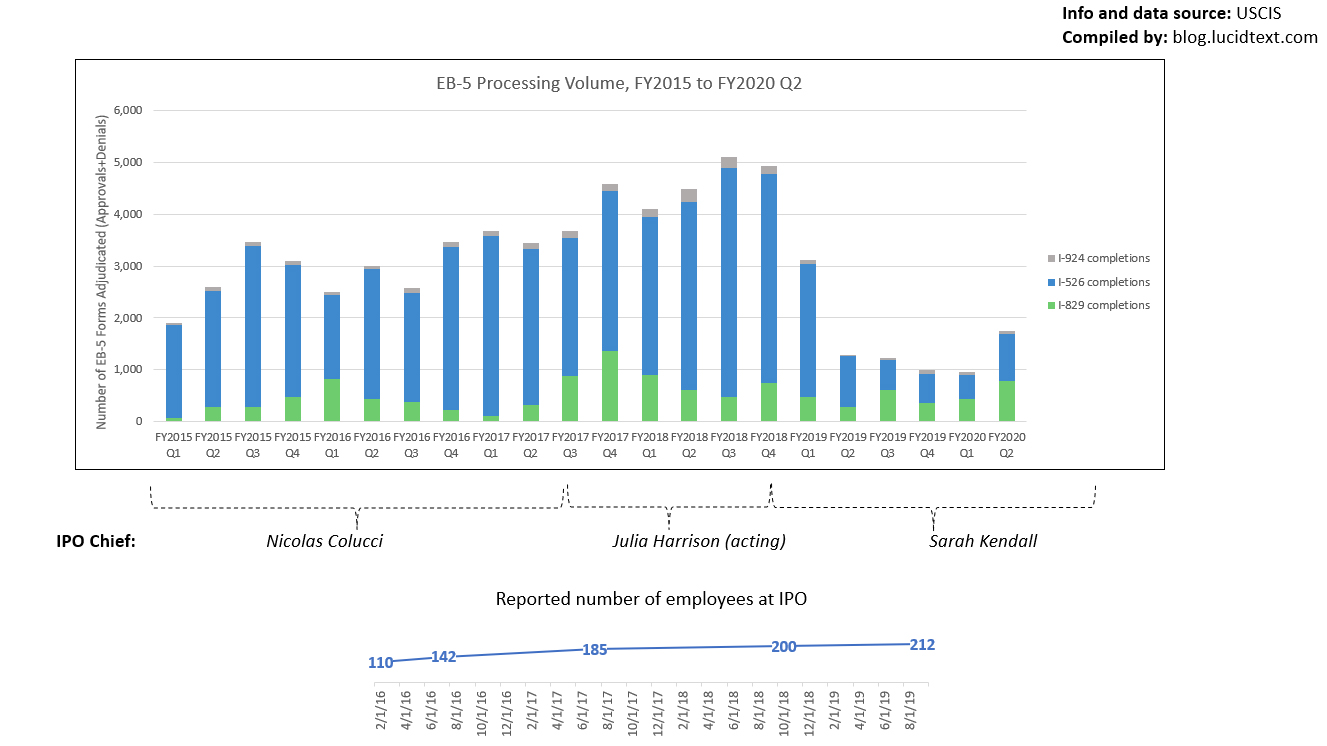
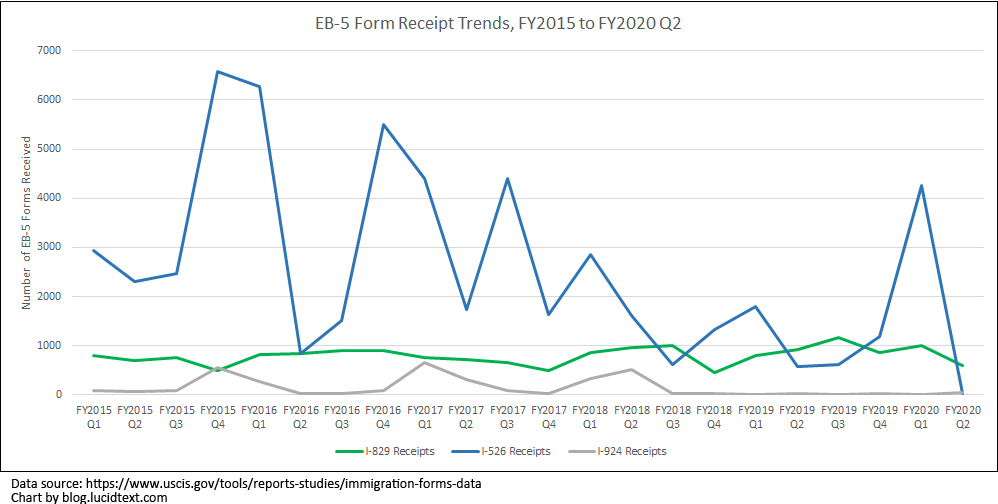
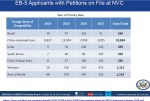
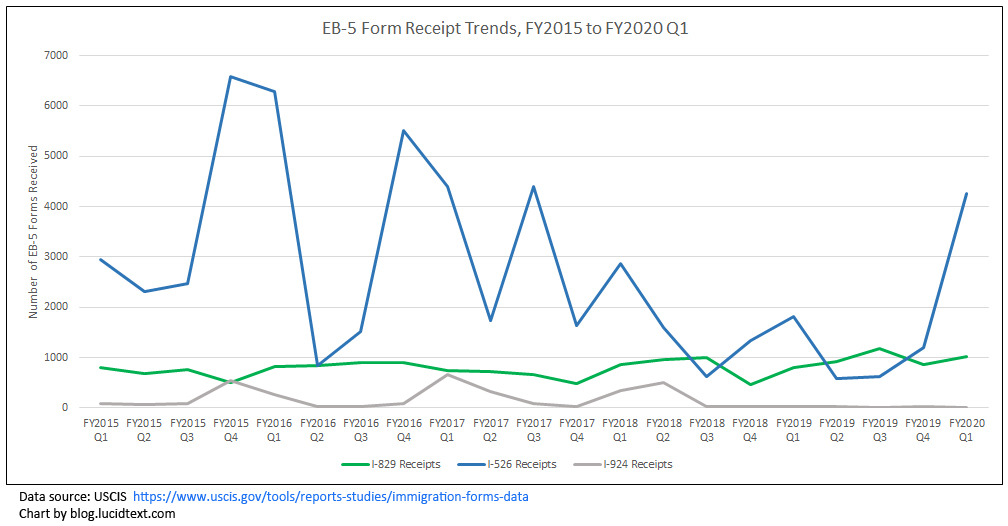
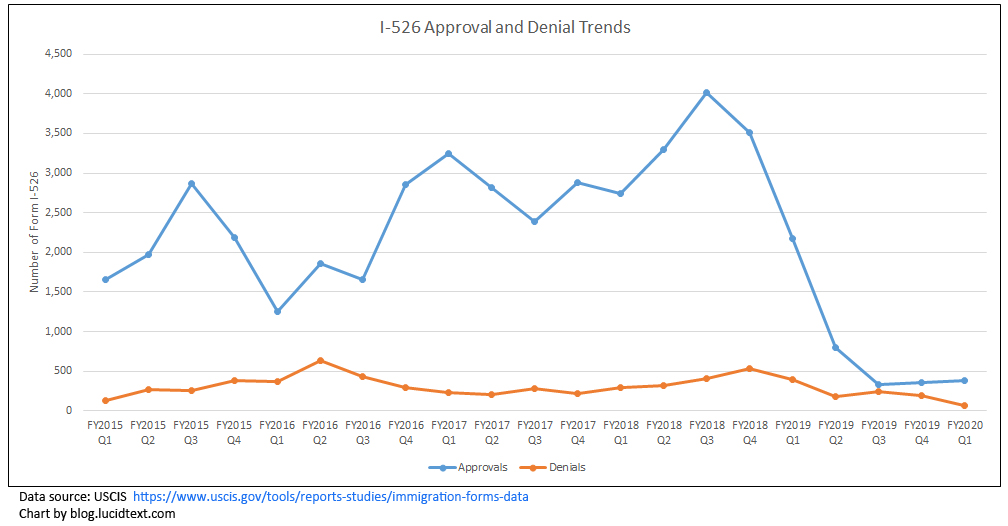
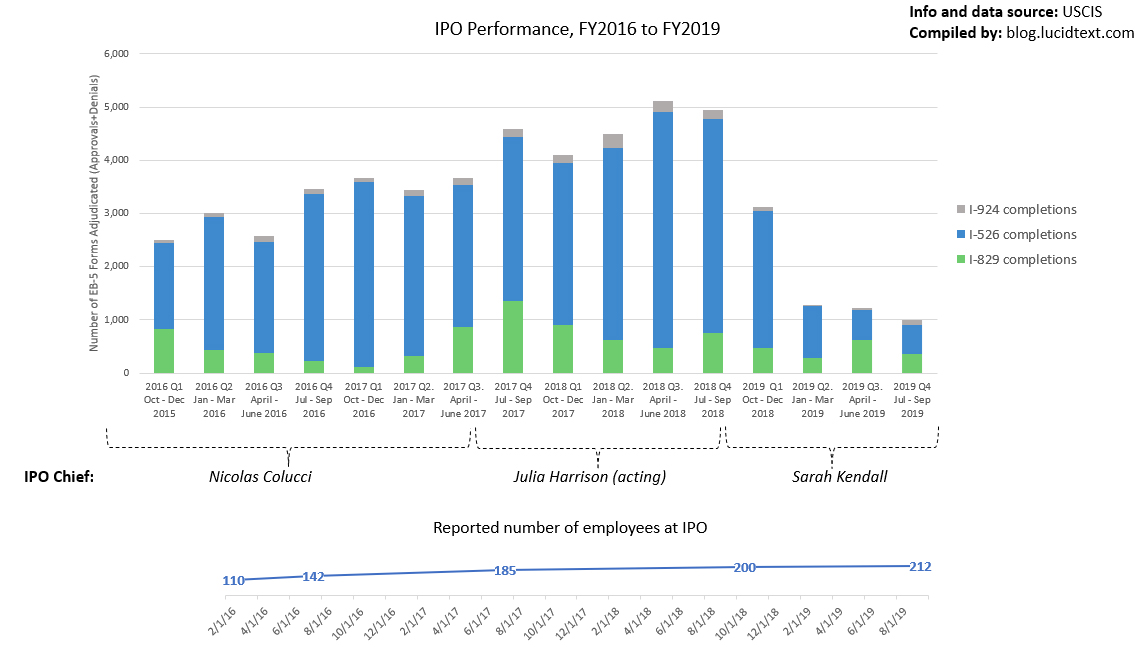
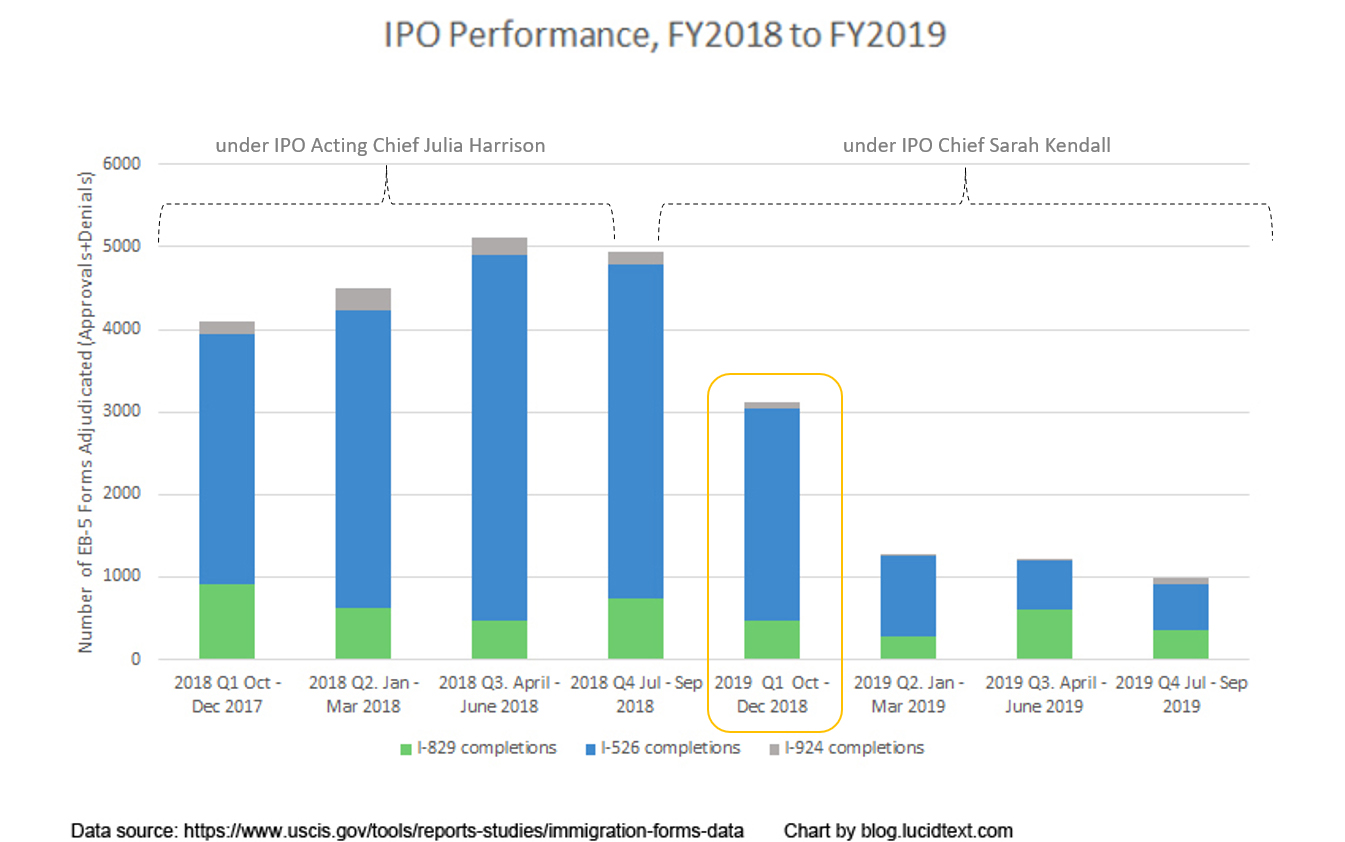
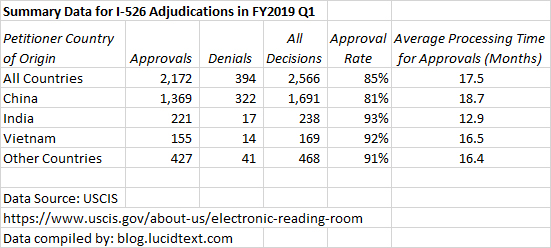
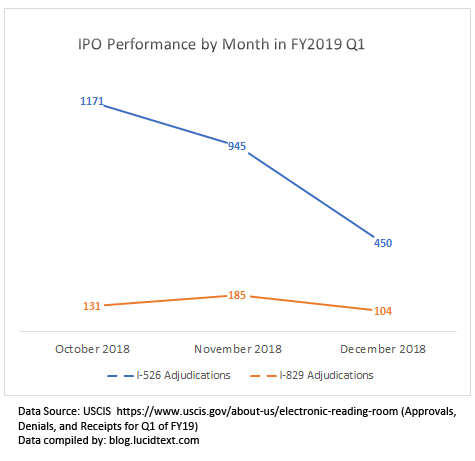
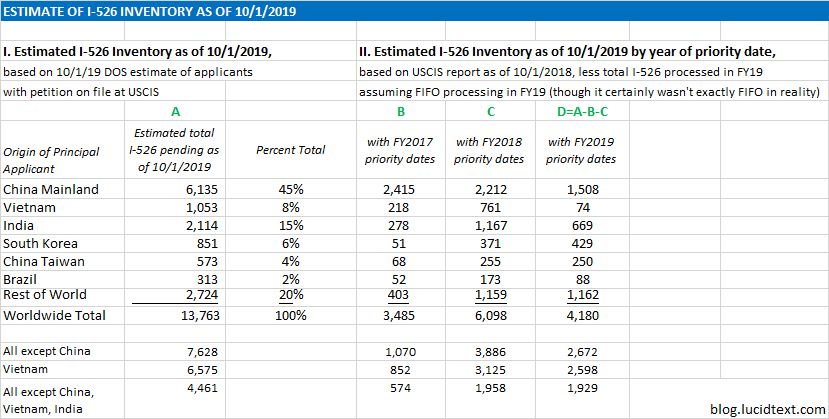
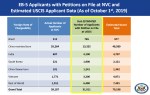
Mr. Oppenheim conveyed mixed messages about IPO productivity. IPO itself has not yet published any processing data for 2020, so we’re left to guess whether their current I-526 completion rates are more like 2019 (horrible) or 2018 (great). Mr. Oppenheim, who does have recent information on volume of I-526 approvals, said that IPO has been “deciding petitions at a rapid pace” and “forwarding petitions at high volume.” He particularly noted a large number of I-526 approvals for Chinese – which must mean that many China I-526 were assigned for adjudication before the new visa availability approach took effect as of April 1, 2020. That all sounds promising. On the other hand, Mr. Oppenheim provided updated information about the NVC backlog that does not clearly reflect many people advancing from I-526 to the visa stage. The following chart compares the number of cases at the National Visa Center between October 1, 2019 and June 1, 2020.
| Country |
Number of EB-5 applicants at NVC as of 10/1/2019 |
Number of EB-5 applicants at NVC as of 6/1/2020 |
Difference |
| Brazil |
212 |
204 |
(8) |
| China Mainland |
35,264 |
42,575 |
7,311 |
| India |
607 |
677 |
70 |
| South Korea |
221 |
193 |
(28) |
| China Taiwan |
101 |
112 |
11 |
| Vietnam |
1,771 |
1,550 |
(221) |
| Rest of World |
1,011 |
1,070 |
59 |
| Grand Total |
39,187 |
46,381 |
7,194 |
| Total for countries other than China |
3,923 |
3,806 |
(117) |
The numbers show that only China has seen a significant net increase this fiscal year in EB-5 visa applicants at NVC. Mr. Oppenheim credited this increase to IPO productivity. However, the increase could also be explained by the fact that the visa bulletin has moved to allow many more Chinese to file documents, even as the consulate has not been issuing visas. For the rest of the world, incoming visa applicants have not been sufficient even to counterbalance the few EB-5 visas issued this year. If IPO were doing its job to adjudicate petitions, we should see more visa applicants. There is a lag between I-526 approval and becoming qualified at NVC, and some approved I-526 go on to status adjustment rather than to NVC. So there’s room for hope that IPO has indeed performed well recently, and I-526 approval numbers just aren’t reflected yet in visa applicant numbers. But Mr. Oppenheim hedged about the amount of visa demand he expected to make it out of USCIS. “I’ve had to temper my expectations with the immigration service because they are under certain processing constraints.”



















 EB-5 Updates