Comments on the new Form I-956 Application for Regional Center

As of this week “EB-5 2.0” has officially launched, with a new regional center program authorized since May 14, 2022. Now that 60 days have passed since enactment, the EB-5 Reform and Integrity Act of 2022 (“RIA”) has taken full effect. New regional center I-526 still cannot be filed, and none of the USCIS EB-5 pages or policies or petitions have yet been updated with the rules now in effect. But one EB-5 2.0 process is moving: entities can begin to apply for new regional center designation.

On Friday, USCIS published Form I-956 Application for Regional Center Designation and the associated Form I-956H Bona Fides of Persons Involved with Regional Center Program on the USCIS website Forms section.

Form I-956 asks open-ended questions, and provides minimal instructions. I-956 requests less evidence than the previous I-924 Application for Regional Center – whether intentionally or not, it’s hard to tell. I foresee that 100% of Form I-956 submissions will receive a Request for Evidence, given the minimal instructions. Until we start seeing RFEs from USCIS, we need to guess at how USCIS interprets new regional center designation requirements. I wonder if USCIS has drafted the Form I-956 worksheet for adjudicators, and what’s on that worksheet. If only USCIS would tell the public what’s on its adjudication checklists, then we might make submissions correct and complete the first time. The guess-question-clarification process is inefficient, and the regional center program does not have years to waste.

Top Takeaways from Form I-956 Application for Regional Center

  1. What’s New: I-956 and I-956H are almost entirely language copied straight from the RIA text, without interpretation or comment. The I-956 instructions offer one item of additional guidance: “The description [of policies and procedures] may include, but is not limited to, the regional center’s policies and procedures regarding internal controls, risk management and assessment, governance, and fraud detection and/or deterrence. Documentation may include, but is not limited to, Policy Manuals and Standard Operating Procedures.” I-956 offers no comment on what USCIS considers to be the specific “applicable laws” and “program requirements” for which applicants should provide policies and procedures.
  2. Evidence Required: Form I-956 specifies little required evidence. While the old Form I-924 Application for Regional Center had a seven-point list of “evidence you must submit,” Form I-956 has mostly open-ended questions, and says ”may provide” more often than “must submit.”  An applicant following the letter of the I-956 instructions (and interpreting “should” as closer to “may” than “must”) could technically submit I-956 with the form blanks completed but no exhibits whatsoever beyond copies of the Form I-956H for persons involved. As an applicant I’d be tempted to go for a minimal initial filing, considering that I can hardly avoid an RFE in any case, given the vague and minimal instructions provided upfront.
  3. RC History: Form I-956 implies that USCIS has no interest in and attaches no relevance to the applicant’s previous history of regional center designation. I-956 asks only forward-looking questions. I-956 gives no space to provide information about any prior regional center designation, good or bad history of promoting economic growth as a previously-designed regional center, previously-approved geographic scope, in-progress EB-5 projects, or EB-5 funds currently under management.  There’s no indication in I-956 that USCIS has any plan to link designation and investors under the new law with designation and investors under the old law. The I-924 had required disclosing the applicant’s previous regional center termination and denial history, and prohibited use of names that duplicated pre-existing RC names, but the I-956 lacks even this.
  4. Geographic Area: Form I-956 is less specific than I-924 about regional center geographic area and economic impact. I-956 says generally “You should provide evidence that the regional center’s pooled investment will have a substantive economic impact on the proposed geographic area,” and asks for “reasonable predictions” supported by economic impact analysis. But it does not define “substantive impact” or request project-specific basis for predictions. By contrast, Form I-924 required the applicant to base economic impact analysis on business plan inputs, and to show “that the boundaries of the regional center are reasonable based on evidence that the proposed area is contributing significantly to the supply chain and labor pool of the proposed new commercial enterprises.” Either USCIS was careless in writing I-956, or it now has a looser/more open-ended standard than before for geographic area requests. It may be that by separating regional center designation from NCE/project approvals, USCIS has blocked itself from demanding project-specific grounding for regional center impact claims. If that’s the case, surely all applicants will submit theoretic cases for sprawling multi-state geographies.
  5. Organizational Evidence: The “who are you” questions in Form I-956 are limited to identifying the legal name of the regional center entity and the identities of persons involved with the regional center. Unlike I-924, Form I-956 does not specifically request the regional center’s formation documents, Operating Agreement, or management agreements. I-956H requests personal identity detail needed to check for law/rule violations, but not any of the business experience or professional track record detail that a banker or investor would want to know about persons involved.  This may or may not be an oversight.
  6. Business Plans: The “what will you do” questions in Form I-956 are limited to compliance policies and theoretic economic impact predictions. I-956 does not specifically ask the applicant for any kind of business plan, either for regional center operations or to support economic activity projections. (By contrast, I-924 required an Operational Plan and Plan of Promotion to describe how the regional center would operate and support its operations, and project business plans to provide reasonable real-world inputs to support impact analysis. The I-956 silence on business planning may or may not be an oversight. Surely such detail should still be relevant for designation.)
  7. Further Guidance: The I-956 instructions promise that “The approval notice will provide information about the responsibilities and obligations of your USCIS designated regional center. It will also list the evidence to submit in support of regional center-associated individual EB-5 petitions, as well as details on the reporting and oversight requirements for regional centers.” Why not disclose the approval notice template upfront, USCIS, so that applicants can shape their plans around these requirements?
  8. NCE Approval Form: The Form I-956H Instructions reveal that USCIS has chosen a name for the yet-to-be-published project approval form that needs to be filed before regional center investors can start filing I-526. The application for NCE approval will be called Form I-956F. (In the old days, applicants could file for regional center designation and exemplar project approval at the same time using the same I-924, but now the process has two separate and consecutive forms.)
  9. Timing: I foresee significant processing times for Form I-956 (given the back-and-forth that will result from the open-ended questions and minimal instructions), and for I-956H (given the number of agencies that USCIS will need to coordinate with to perform security checks). I will be pleasantly surprised if the first new regional center gets designated before 2023, and astonished if all I-956 filed in the next few weeks get adjudicated before 2025. [Update: The May 18 Declaration of Alissa Emmel in the Behring lawsuit states that: “IPO … as of this date has received approximately 8 applications. …While every application will be reviewed on a case-by-case basis, IPO aims for its processing times on Form I-956 applications to meet or exceed the statutory goal of 180 days.”] I very much hope that the first applicants to receive RFEs will be public-spirited and share the RFEs with the rest of the community. The more guidance we can extract from USCIS, the more we’ll be able to improve application quality and speed up the adjudication process for everyone.
  10.  Caution: Historically, an EB-5 document requirement will spark a cottage industry of chancers who smell profit in producing documents with the right title on a nice cover and any old filler shoved under the cover. Thus the proliferation of shoddy economic impact reports, business plans, and offering documents in EB-5.  I suggest, look closely at anyone who offers to relieve you of thousands of dollars in exchange for documents with covers that that say “Policy Manuals” and “Standard Operating Procedures.” If there isn’t an EB-5-experienced securities attorney involved in drafting and signing off on the content, consider only paying what the cover is worth. USCIS adjudicators may have little way to judge compliance policies but by the cover, and might possibly just rubber stamp whatever gets submitted. But even better for regional center applicants to invest in solid content, especially in the sensitive area of securities compliance.
5/25 USCIS EB-5 Feedback Invite

I’m copying below an invitation from USCIS to participate in another EB-5 listening session. The invitation asks some excellent questions, but oddly — considering the engagement’s stated purpose — no questions specifically related to implementation of the EB-5 Reform and Integrity Act of 2022, or the rulemaking required by the Act. The invitation also offers no way to answer the questions, except to call in to the engagement. If USCIS is serious about getting solid feedback, it should provide a path for written answers.

From: U.S. Citizenship and Immigration Services <uscis@public.govdelivery.com>
Sent: May 17, 2022 8:09 AM
Subject: Listening Session: EB-5 Reform and Integrity Act of 2022 Rulemaking

EB-5 Reform and Integrity Act of 2022 Rulemaking Listening Session

Wednesday, May 25 | 2 – 3 p.m. Eastern 

U.S. Citizenship and Immigration Services (USCIS) invites you to participate in a listening session on Wednesday, May 25, 2022, from 2 to 3 p.m. Eastern. The listening session is for stakeholders to provide individual input on rulemaking related to the implementation of the EB-5 Reform and Integrity Act of 2022. USCIS is committed to public engagement and sessions such as these provide us with valuable feedback as we work to improve our programs.

Questions for consideration: Although we are interested in overall feedback about the EB-5 program, we would also appreciate your input on the following questions:

1. Evidence
a. Are there evidentiary requirements for Form I-526 filings in the existing regulations that should be simplified or modernized? We invite specific estimates of these burdens and potential effects of these simplifications.

2. Definitions
a. Are there undefined or other ambiguous terms in the existing regulations or statute that DHS should define or clarify through rulemaking?
b. Should we keep the “troubled business” definition in the existing regulations (8 CFR 204.6(e), 204.6(h)(3), and 204.6(j)(4)(ii))? If we keep the definition, should we revise it and, if so, how?
c. Should we keep the definition of “new” for a commercial enterprise in the existing regulations? Is there an alternative approach for what should be considered “new” (for example, a more recent cutoff date or a particular period for determining whether a commercial enterprise is “new”)?

3. General
a. Are there other processes or requirements in the existing regulations or statute that DHS should clarify or further develop through rulemaking? For example:
• The process we will use to designate and communicate high unemployment areas.
• Factors we should consider in determining if a regional center’s geographic area is “limited.”
• How construction jobs for less than two years will be calculated.
• Are the expansion and restructuring requirements in the existing regulations still relevant?

To Register:

1. Visit our registration page

2. You will be asked to sign up for updates or to access your subscriber preferences, please enter your email address and select “Submit”

3. Select “Subscriber Preferences”

4. Select the “Questions” tab

5. Complete the questions and select “Submit.”

Once we process your registration, you will receive a confirmation email with additional details.

If you have any questions, or if you have not received a confirmation email within three business days, please email us at public.engagement@uscis.dhs.gov.

To request a disability accommodation to participate in this engagement, email us at  public.engagement@uscis.dhs.gov by 4 p.m. EST on May 20, 2022.

USCIS Processing Times Webpage Redesign

From: ProcessingTimesFeedback <ProcessingTimesFeedback@uscis.dhs.gov>
Sent: May 11, 2022 5:18 PM
To: Suzanne Lazicki <suzanne@lucidtext.com>
Subject: RE: USCIS Processing Times Webpage Redesign Webinar

Excellent feedback!

Thank you,

USCIS

From: Suzanne Lazicki <suzanne@lucidtext.com>
Sent: May 11, 2022 4:54 PM
To: ‘ProcessingTimesFeedback@uscis.dhs.gov’ <ProcessingTimesFeedback@uscis.dhs.gov>
Subject: USCIS Processing Times Webpage Redesign Webinar

Thank you for the opportunity to provide feedback for the USCIS Processing Times Webpage Redesign Webinar to be held on May 12, 2022. I appreciated the announcement on May 5 that USCIS is Simplifying, Improving Communication of Case Processing Data. I would like to point out the following issues that make the new processing times report design not clear, not transparent, not meaningful, and not helpful.

  1. The https://egov.uscis.gov/processing-times/ page now reports a number that is apparently arbitrary. What is relevant about 80%? Why not report the median age of recent completions? (The USCIS historical processing times report gives the median, which is logically more indicative of “normal” and “average” processing.) Why not the first and third quartile? (That would at least be meaningful statistically.) Why not 93%? (Significant if the threshold for case inquiry.) What possible justification/explanation is there for choosing to report 80% on this page? Unless explained, it would appear the USCIS chose 80% to 1) cover up the major deviations from FIFO processing that had been exposed by the previous “estimated time range” method, 2) prevent petitioner inquiries by not reporting median or average processing, and 3) confuse and disguise the derivation of the Case Inquiry Date, which is not calculated from the 80% month.  I suggest that this page would be more meaningful if it reported the median (or even better, the median and the average) age of recently-adjudicated cases. The number of months used to calculate the Case Inquiry Date should also be disclosed.
  2. The https://egov.uscis.gov/processing-times/ page is not clear or transparent about the Case Inquiry Date – the single most important piece of information on the page. The “get inquiry date” tool on this page uses a month multiplier that is not disclosed, and is not equal to the 80% month reported on the page. The page vaguely says “we only allow inquiries for cases that are well outside the processing time listed above.”  To be transparent, this page needs to state “93% of recent adjudications were completed within ___ months,” and then explain that this number of months is used to calculate the case inquiry date.
  3. The case inquiry date and answer to the question “When can I ask about my case” are both unreasonable.   To protect USCIS from Mandamus litigation (which must be much more expensive to the agency than individual inquiries), the processing times report needs to define a reasonable boundary for “normal” processing. Outside the 93rd percentile is too-obviously a boundary for extreme outliers, not a definition of what’s normal – especially given the well-documented spread of processing times. For example, for Form I-829, the historical times page gives a median of 41.5 months in 2022, and the I-829 Case Inquiry Date is calculated at 64.8 months. What judge will believe that a I-829 petitioner should have to wait 15 months longer than the median processing time to even inquire about case status? The 64.8-month case inquiry boundary in the processing times report is too-blatantly unreasonable, and appears to be arbitrarily set to prevent inquires.
  4. Strictly speaking, the processing times report simply and only reports past performance. But the USCIS Report and More Info pages do not speak strictly, but as if the past performance numbers were true for all time and predictive for the future.
    1. “We display case processing times for select forms and locations to let you know how long it generally takes to process benefit requests.” This sentence conflates “how long it has recently taken” with “how long it generally takes.” This conflation is false and misleading, implying a status quo where none exists. USCIS has a history of large processing time fluctuations, and actively plans on processing time changes going forward. The sentence had better be “We display case processing times for select forms and locations to let you know how long it has recently taken to process benefit requests.”
    2. “80% of cases are completed within”  This language is misleading, when in fact the number only represents “the amount of time it took us to complete 80% of adjudicated cases over the last six months.” At minimum, the verb “are” should be replaced with “were” or “have been.” Or could replace “80% of cases are completed within”  with “80% of recent adjudications completed were within”
    3. “The earliest you can submit questions is _____. Please do not contact us before this date.” This statement has two problems: it directly uses past performance to predict future results, and it implies that the date given in the sentence is a firm barrier not subject to constant change. The sentence copies the time it took to complete 93% of adjudications over the past six months and pastes it into the future, which is only meaningful if USCIS plans for no improvements over past performance. But USCIS does plan improvements, so the prediction is not meaningful. And it is not even a prediction, given that a petitioner consulting the page from month to month will see the “earliest you can submit questions” sentence populated with ever-changing dates that fluctuate forward and backward in time depending on recent adjudications. To make the sentence transparent and meaningful, better to say something like “You may not submit questions until your case has been pending longer than __% of recent adjudications. If your receipt date is before _______, you may submit questions.” It’s meaningless to give a sentence that predicts a future date, if the given date is not actually intended or usable as a prediction.
  5. USCIS announced new cycle time goals on March 29, 2022 for multiple forms. If USCIS is serious about making progress toward these cycle time goals, and willing to be transparent and responsible to the public, USCIS should regularly publish current cycle times for those forms.

4/29 USCIS Q&A and Listening Session Report

On Friday April 29, USCIS offered a first installment of guidance on implementation of the EB-5 Reform and Integrity Act of 2022.

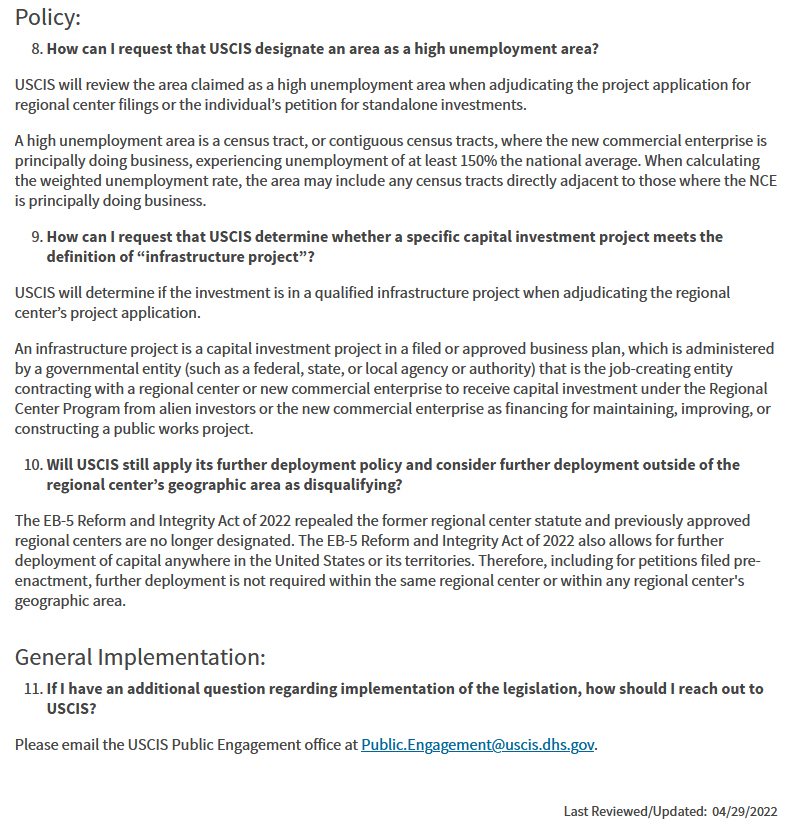
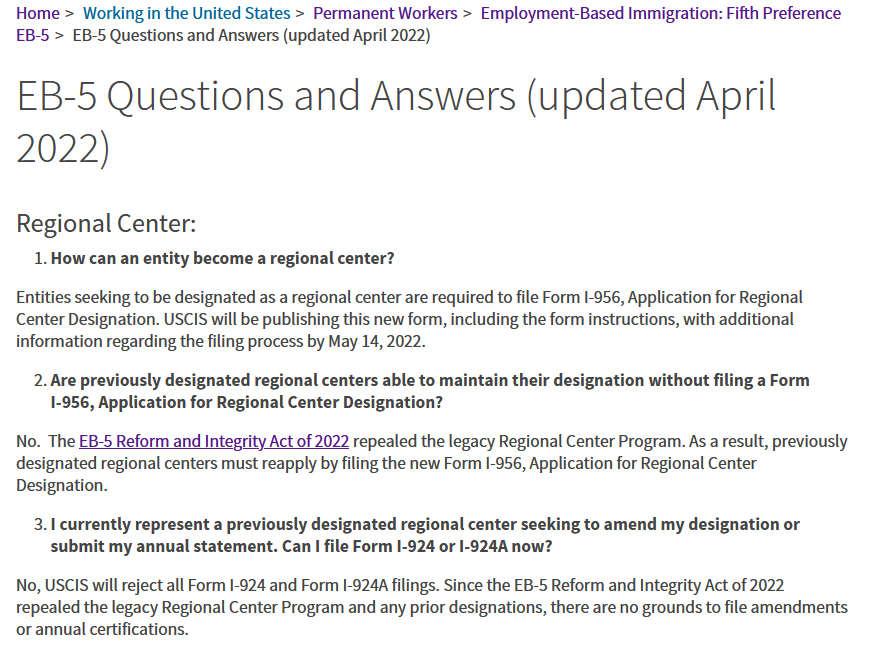
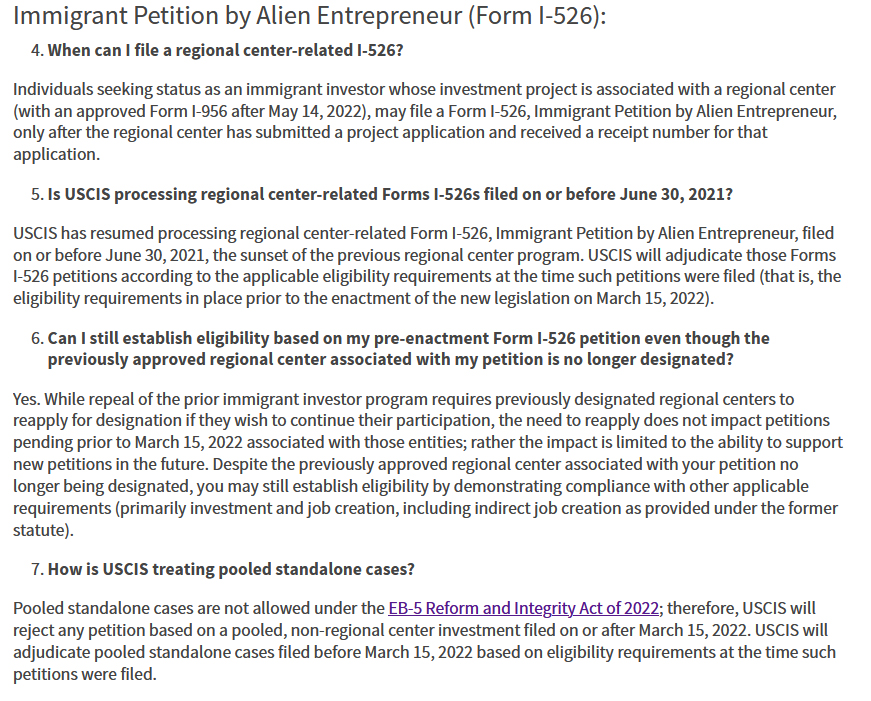
USCIS published EB-5 Questions and Answers (updated April 2022) on the USCIS EB-5 Resources page. I’m copying images as of April 29 here for historical reference, but consult the USCIS site to read the latest version.

USCIS held the USCIS EB–5 Reform and Integrity Act of 2022 Listening Session on April 29. 5/10 UPDATE: Here is a transcript of prepared remarks from the USCIS speakers. Here is my recording of the event. Time index:

  • During the first five minutes of the listening session, USCIS Director Ur Jaddou provided opening remarks. My recording sadly does not include this intro, thanks to my apparent inability to read call-in instructions. From the portion I heard, it seems that Director Jaddou provided a “big picture” perspective of changes and improvements at USCIS, covering the points about agency-wide performance and goals that she made in her April 6 testimony to the House Committee on Appropriations (which is worth reading). She did not have significant EB-5-specific input (that I heard), but it was nice of her to be on the call. I applaud her goals and accomplishments so far at USCIS, and her seriousness about challenges.
  • My recording starts with the EB-5-specific portion of the call.
    • New Investor Program Office Chief Alissa Emmel introduced herself and talked about the new law (minute 0-5), and processing times (5-9).
    • A Policy Analyst with USCIS Office of Policy and Strategy discussed upcoming policy manual revisions and regulations. (minute 9-11)
    • An Adjudication Officer with USCIS Service Center Operations confirmed that I-485 processing for regional center petitions has resumed. He incidentally dropped the revelation that “over 4,000” regional center I-485 were already pending before July 1, 2021. (minute 11-13)
    • A Visa Policy Analyst with State Department Bureau of Consular Affairs Office of Visa Services Field Operations confirmed that RC-associated visa processing has resumed as of April 2022. (minute 13-16)
    • From minute 16 of my recording, the call consists of stakeholders making comments and asking questions, and USCIS responding with thanks for the input (but not any answers).

The headline news is that new regional center I-526 cannot be filed starting with the new regional center program authorization on May 14, 2022.  Instead, investor filings will need to wait until after USCIS designates individual regional centers under the new program; i.e. wait for new RC application forms to be not only filed but also approved. USCIS did not estimate a time for this process. (For reference, the previous RC application form, I-924, had a median processing time from 19 to 22 months between 2017 and 2021. The most I-924 approvals that USCIS ever managed in one month was about 40, back in 2018. Since 2019, the average was more like 15 per month. Based on new law requirements, the new RC application will have less offering-specific and project-specific content than I-924, but more compliance content and more security checks. The processing workload will depend on how many of the previously-designated 632 regional centers decide to apply for new designation. I guess that at least most of the 344 RC that were committed enough to file I-924A even during the RC program expiration will apply.)

A second headline, which I doubt that USCIS thought through: USCIS now claims no jurisdiction over the entities that were formerly designated as regional centers, and that are still handling billions of dollars of EB-5 investment. The written Q&A states that USCIS will no longer require these entities to file annual reports about what they are doing with those billions of dollars, or to file amendments when they change plans or ownership. Unless and until they choose to apply for new designation, the entities holding pre-enactment EB-5 investment are now apparently exempt from the new EB-5 integrity measures, and also from such oversight as USCIS used to provide for regional centers. This follows from USCIS’s interpretation that “regional centers previously designated under section 610 are no longer authorized,” and thus no longer have any status for USCIS to regulate. But I doubt this was intended. I understand the rationale to make regional centers demonstrate compliance with the new law before raising new investment (and to buy more time for USCIS to figure out how to implement the new law). I doubt USCIS thought about the negative integrity side effects of cancelling the only status that allowed USCIS to monitor or dictate to pre-existing regional centers. “USCIS abrogates oversight of entities currently deploying $27 billion dollars in immigrant investment.” This is a true and shocking headline, unless USCIS scrambles to make some clarifications on the status of formerly-designated regional centers.

The written Q&A and the listening session provide welcome clarity about grandfathering of regional center investor petitions. Regional Center I-526, I-485, and visa applications are already being processed as of April 2022. Pre-enactment I-526 are judged “according to the applicable eligibility requirements at the time such petitions were filed,” and with opportunity to demonstrate eligibility “despite the previously approved regional center associated with your petition no longer being designated.”

In the listening session, we heard for the first time from new IPO Chief Alissa Emmel, a career civil servant who was appointed to her position in September 2021 after having previously worked at IPO as an economist starting in 2013, and managing the IPO Compliance Division since 2017. On the call she sounded upbeat, relaxed, and unworried about the challenges of performance improvement or law implementation. She stated one firm plan for EB-5 law implementation: to publish a form and instructions for a new Form I-956, Application for Regional Center Designation, by May 14, 2022. If she has other implementation plans yet, she did not articulate them. No mention of a timeline for publishing the new project approval form or revising Form I-526 or I-829, no mention of processing time targets for regional center application adjudications, and no mention of plans for training adjudicators in the new law. If IPO has started tackling the major challenge of assessment metrics for new regional center compliance plans – a task that will presumably require coordination with the SEC and other outside experts – Chief Emmel didn’t mention it. I came to the call prepared with sympathy for the enormous burden that law implementation puts on USCIS, and for how harassed and panicky the USCIS staff would sound as they grappled with that burden, and with the intense time pressure. But I did not get a chance to deploy my sympathy. I couldn’t tell that much grappling has yet been undertaken or foreseen, or that much pressure has yet been felt.  

The call included a Policy Analyst with USCIS Office of Policy and Strategy, who spoke to the need for new policy and regulations. She divulged one plan: “to hold another engagement in late May to gather individual feedback from impacted stakeholders on those areas or topics from the legislation that require rule-making or other sub-regulatory policy considerations.” And she expressed one specific “hope”: to roll out substantive policy manual revisions “over the next few months.” She also noted that “USCIS fully intends to follow appropriate rule-making procedures for implementing regulatory changes, which is by no means a quick process.” As background, the current EB-5 policy originated with a three-year process (with a policy memo drafted in 2011 and finalized in 2013), redeployment policy took three years (promised in 2014, draft released in 2015, published as policy in 2017), and the EB-5 Modernization regulation emerged over three years (promised in 2016, Notice of Proposed Rulemaking in 2017, Final Rule in 2019). With that background, to rewrite all EB-5 policy based on the RIA in a matter of months will be a herculean task. I would love USCIS to manage this; we badly need speed so that investor I-526 can be filed based on known guidance as soon as possible! But the Policy Analyst on Friday’s call did not sound stressed, as I’d expect she would be if herculean efforts were underway. She announced without audible shame what her office has done in 1.5 months so far: added a one-sentence “alert” to the Policy Manual (without deleting or revising the two other contradictory alerts), and archived one of the five Policy Manual chapters already made obsolete by the new law.

Regarding processing, Chief Emmel stated that “I want you to know that we are taking critical steps to reduce processing times for I-526s and I-829s, knowing that this goal will take some time to achieve for the reasons I’m about to discuss.” The steps cited were to resume regional center I-526 processing (“one of our predominant adjudication goals for our I-526 staff is to work through the large volume of I-526 petitions that were in process pre-sunset”), and to increase staffing levels (Emmel did not offer specifics, but I see that USAJobs.gov has listed two open positions at IPO).  Chief Emmel expects that improved processing will take “time to achieve” because “it is important to note that in addition to adjudicating cases, IPO requires the time and subject-matter expertise of our adjudication staff to address other necessary efforts including implementation of the new legislation, litigation responses, FOIA requests, public inquiries, and others.” IPO processed over a 1,000 I-525 per month under Julia Harrison’s leadership, around 300 per month under Sarah Kendall, and 20 per month under Alissa Emmel in her first quarter at the helm. In Chief Emmel’s words on Friday, I heard positive intent to achieve incremental improvement over recent performance. I did not hear a plan for the exponential improvement that would be required to regain past performance levels or achieve new processing time targets in the foreseeable future. I listened closely for a sense of whether Chief Emmel intends to change the culture of IPO, which since 2019 has taken a time-is-no-object extreme-vetting approach to EB-5 adjudications, with gratuitously lengthy and hostile RFEs, high denial rates, and low completion rates. Chief Emmel spoke about the EB-5 program and investors in very positive terms, and she repeated the new service-oriented USCIS mission statement promising “fairness, integrity, and respect for all we serve.” She then went on to say that “for our office, what that means is to accurately and efficiently adjudicate petitions and applications, as well as safeguard the integrity of our nation’s immigration system through our efforts to combat fraud, protect national security and pubic safety, and maximize our law enforcement, intelligence community, and other federal agency partnerships.” Other than the word “efficiently,” those are still Stephen Miller/Sarah Kendall-era enforcement-centric talking points. I am still waiting for a changing tide in EB-5 adjudications, and to see efficiency, fairness, and respect treated as integrity issues by the Investor Program Office.