I-485 update (FY2025 EB-5 visas, February 2026 I-485 inventory, AOS Memo)
June 5, 2026 1 Comment
This post shares new data and resources relevant to the discussion around status adjustment in EB-5.
EB-5 Visas and Status Adjustment in FY2025 (Annual Report)
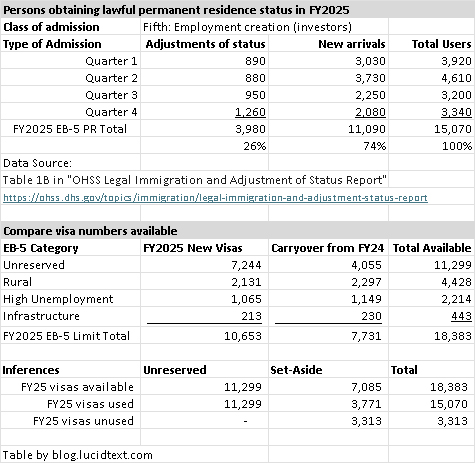
The newly-published OHSS Legal Immigration and Adjustment of Status Report for FY2025 gives a first official accounting of total visa usage last fiscal year. (Thank you D.H. for the heads-up.) The report shows that nearly 4,000 EB-5 applicants received visas in 2025 via status adjustment. The data has a typical pattern, with AOS numbers escalating at year-end to help pick up the slack of visas not being issued by consulates. “New arrivals” are not exactly equivalent to consular visas issued, but it appears that FY2025 ended with fairly good EB-5 volumes overall — maybe even using half of the available Set-aside numbers for the year. FY2025 had unusually high limits thanks to rollovers and carryovers, as does FY2026.
Status Adjustment in FY2026 (data through February)
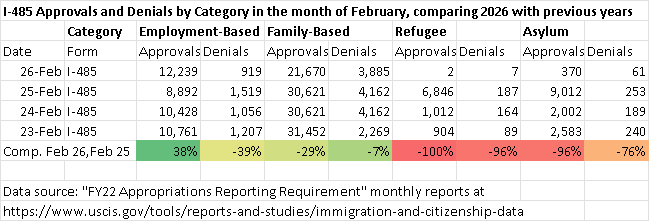
The USCIS Immigration and Citizenship Data page has two new reports with I-485 detail through February 2026. I opened up the Pending Applications for Employment-Based Preference Categories as of February 3, 2026 report and the FY22 Appropriations Reporting Requirement – Application Processing Data for February 2026 report with these questions in mind: was USCIS cracking down on status adjustment applications even before the scary AOS memo? Does data support the suspicion that the Administration mainly has refugees, asylum seekers, and family in the crosshairs of its AOS policy, and less inclined to harass employment-based adjustment applicants such as worthy EB-5 investors?
I see that in February 2026, USCIS kept up an historical level of I-485 approvals for employment-based cases, while family-based volumes were much lower than in previous years and refugee and asylum adjustments were near zero. So at least within the month of February, this looks like possibly less hatred for employment-based applicants (or their origins) as compared with other categories.(The pattern may change since today’s court decision.)
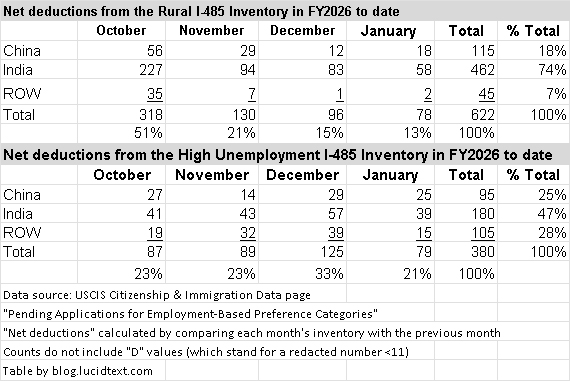
Moving over to data extracted from the pending I-485 reports, I note that EB-5 adjustments have been slowing down a bit across FY2026 year-to-date – at least for set-aside visas. In the near term, before the Visa Bulletin starts setting limits, I-485 for Rural-investing India-born applicants have continued to get disproportionate attention. (In the following table, “net deductions” is the number I get from taking one month’s inventory by priority date, and subtracting the previous month’s inventory by priority date. The figure roughly corresponds to number of people who may have gotten I-485 decisions that month.)
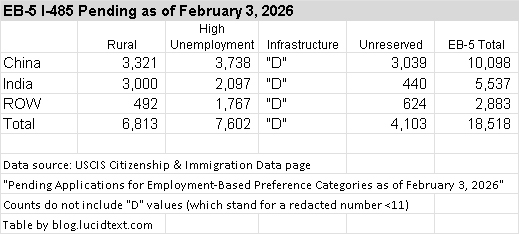
The February 2026 I-485 inventory report shows over 18,000 pending EB-5 applicants who are depending on status adjustment for their visas. This is the population to protect, as the industry seeks clarity on the new USCIS Adjustment of Status policy memo.
USCIS AOS Memo
I’ll give a summary of what I hear from commentary on the new Adjustment of Status policy memo from USCIS. It seems that the memo does not, as the scary initial press release had tried to suggest, effectively abolish adjustment of status. The memo does imply that officers should maximize their discretion to hassle immigrants and deny adjustment requests. The legality and practical implementation of the memo are in question, so neither best-case nor worst-case interpretations are sure or reliable at this point.
Bottom line: immigrants now know what they already knew before: that they are in a hostile environment where it is essential to dot every i and cross every t, avoid any grey areas as to what’s allowed, avoid relying on interim benefits, avoid free speech, avoid counting on the faith and credit of the U.S. government, emphasize being on the right side of prevailing socioeconomic and racial-cultural prejudices, and finally pray fervently that petitions end up on the desk of an individual prepared to exercise discretion fairly. Maybe the government will bother to implement the AOS memo broadly and consistently, with negative effect. But I doubt it – seems more likely to come down to a wide range of neutral-to-negative case-by-case impacts depending on individual discretion.
Here are a few sources that I appreciated so far:
- IIUSA’s webinar with Joey Barnett, John Pratt, and Ron Klasko on USCIS Adjustment of Status Policy Memorandum Update (June 4, 2026)
- The article New Era of USCIS Adjustment Adjudications: What EB-5 Investors Need to Know (May 27, 2026) by WR Immigration. (And while you’re on this site, note also an important heads-up for China: Urgent Notice to All Chinese EB-5 Investors: Increased USCIS Scrutiny of Applicants Connected to Certain Chinese Technology Companies)
- The webinar by Carolyn Lee PLLC on the Policy Memo
- A LinkedIn comment about AOS Memo implementation by Michael Valverde (who until recently served as Associate Director of Operations at USCIS).
Discover more from EB-5 Updates
Subscribe to get the latest posts sent to your email.


march/april 485 data seems to suggest that they have really slowed down