New EB-5 regulations proposed to implement RIA (preliminary notes on what’s new)
July 2, 2026 4 Comments
Big news: The Department of Homeland Security has published a Notice of Proposed Rulemaking (NPRM) to implement the EB-5 Reform and Integrity Act of 2022. See “EB-5 Reform and Integrity Act of 2022; Ensuring the Integrity of the EB-5 Program; Automatic Revocation of Petitions for Immigrant Classification” (RIN 1615-AC94), published in the Federal Register as of July 2, 2026.
DHS is finally disclosing how it interprets the law enacted four years ago, and its ideas for further implementation.
I do not know when and if this proposed rule will ever become final and take effect. The proposal will first have to get through the public comment period (open until August 31, 2026), and could be blocked by litigation or superseded by another new law. But regardless, the proposed regulations are interesting today because they provide a window onto current DHS thinking about EB-5 requirements.
The proposed rule (A) suggests potential changes that might take effect in the future, and also (B) articulates how DHS has understood and implemented RIA since 2022. One challenge in reading the proposed rule is trying to distinguish between A and B. USCIS has not previously publicized or explained every aspect of its existing practice, and the proposed rule does not always flag what DHS considers to be new and prospective. The distinction is important, because today’s projects and investors are already subject to current implementation and interpretations of RIA.
This post shares some preliminary results of my engagement so far with the NPRM. Here is the process I followed:
- I read the proposed rule, exposing all its 107,340 words to my tender human synapses bent by 16 years of reading and reporting on EB-5 policy. As warned by the rule’s cost analysis, a single read-through takes almost nine hours. Top questions in mind as I read: what’s new here, and who is affected and when?
- I assigned Claude AI to act as my legal assistant, and fed it the full text of the NPRM plus the full text of the EB-5 Reform and Integrity Act of 2022, the existing EB-5 regulations, the USCIS Policy Manual EB-5 chapters, and current EB-5 form instructions. My starting prompt after explaining context: “I want to understand how far the 2026 proposed rule goes beyond simply implementing the 2022 law, or simply updating the existing regulation to mirror the 2022 statutory language. I want to identify new requirements or interpretations that are introduced in/suggested by the 2026 regulation, beyond what is included in the law and existing policy or regulations. I also want to understand the applicability of new requirements and interpretations.”
- AI started generating a “what’s new” analysis, which we then discussed and probed and revised until I ran out of credits and time to burn. I am sharing the current 26-page draft of this analysis, for what it’s worth. For me, this process and AI’s rough work product are a valuable launch point for further thinking (which will in turn, no doubt, shortly make the draft analysis obsolete).
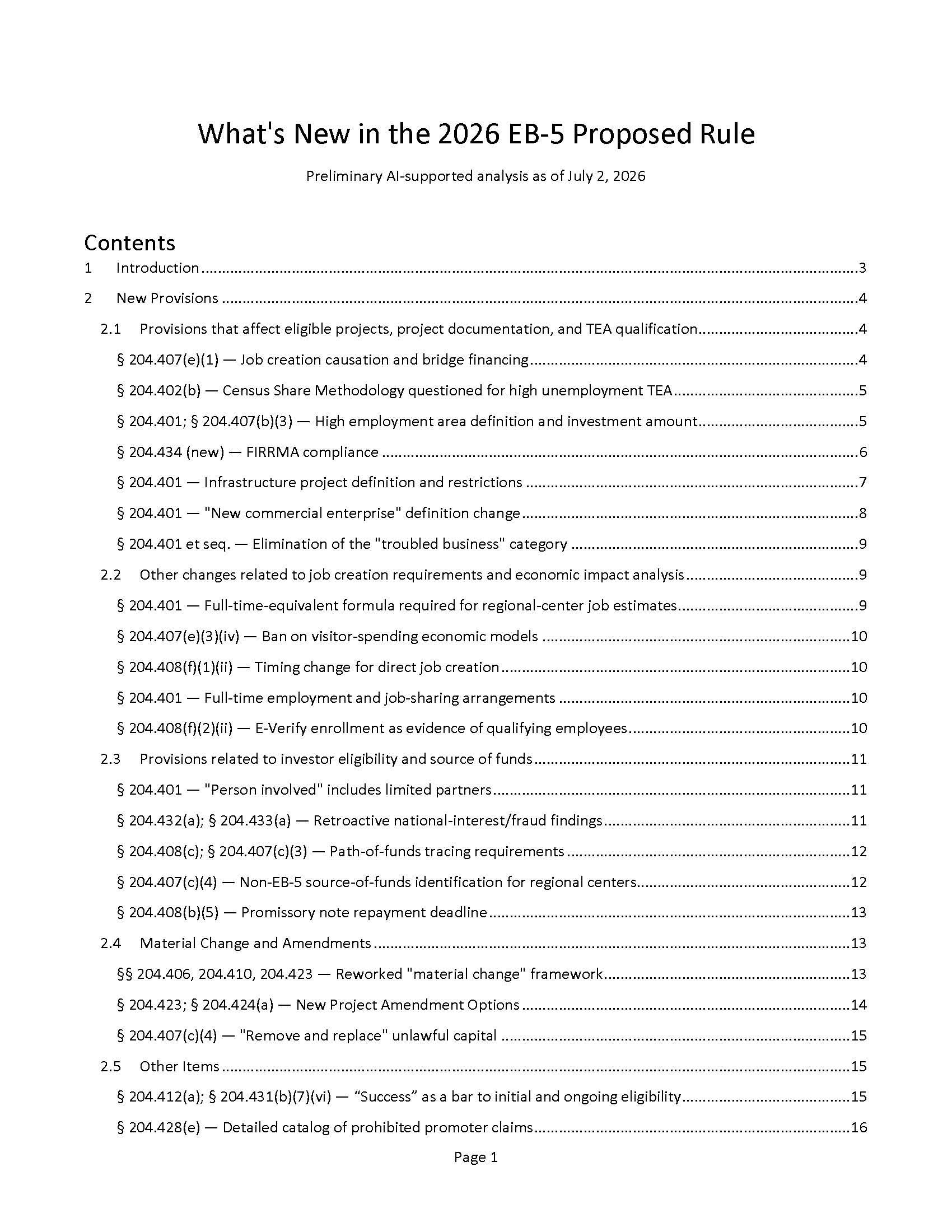
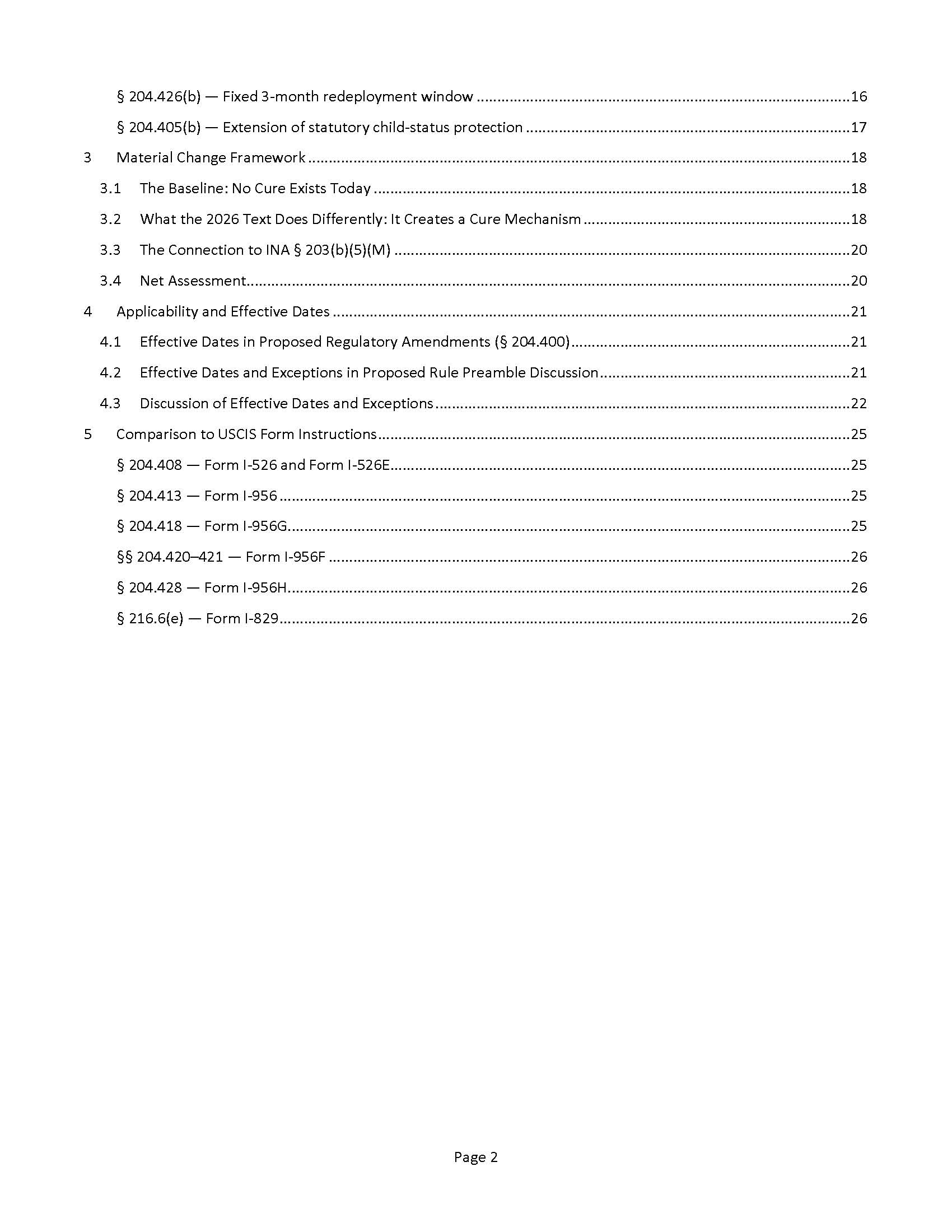
In the text of this post, I will flag a few matters in the proposed rule that seemed particularly significant to me at first read. (See the draft linked above for more in-depth analysis and many other points of note.)
- Consistency: The preamble discussion section in the NPRM is not entirely consistent with the language actually included in the proposed regulations section of the NRPM. Conflicts and omissions each way add to the fun of figuring out what DHS means, and potential impact of a final rule.
- National security concerns: The proposed rule requires compliance by every regional center, NCE, job-creating entity, and investor with the Foreign Investment Risk Review Modernization Act of 2018 (FIRRMA). A compliant regional center “may not divulge controlled materials or information that poses risk to the U.S. national interest to regional center investors.” Whatever that means exactly, and however the burden can be balanced with securities compliance. The FIRRMA requirement applies to “all designated regional centers, regardless of designation date” according to the proposed regulations section on applicability (§ 204.400). By mentioning FIRRMA in the regulations, DHS may well believe that it’s not proposing anything but simply noting down an existing requirement that already applies to regional centers and investors.
- Infrastructure: Relatedly, the proposed rule introduces nuances for infrastructure projects, including identification of specific sectors that DHS “generally expects” to qualify in the infrastructure category, and also a list of infrastructure sectors that DHS is concerned might involve national interest disclosure risks with EB-5 investment. This discussion in the proposed rule preamble deserves attention, in case it reflects thinking that already influences infrastructure project adjudication.
- High Unemployment TEA Methodology: The proposed rule indicates that DHS (or at least, the person who wrote the preamble discussion) is uncomfortable with one of the two major and long-established methods for high unemployment TEA analysis: census share. To quote from the preamble: “USCIS previously allowed a combination of U.S. Department of Labor Local Area Unemployment Statistics (LAUS) and ACS data, commonly referred to as a ‘Census Share Methodology. ‘ This methodology does not generally produce statistically valid unbiased estimates at the census-tract level. Consequently, the combination of LAUS and ACS data would not be accepted under proposed program requirements with regard to consistency between the unemployment rate and the census-tract-level data.” Thankfully, the discussion acknowledges the change from long-accepted practice, and invites public comment as to what ought to be accepted. I also note that the actual proposed text of the new regulations does not specifically mention census share in the relevant section (8 CFR 204.402(b)), so the methodology would not be explicitly prohibited even were the rule finalized as-is. But I would still go out of the way to address the concern and justify the method if I were filing I-956F or I-526 today that depended on Census Share methodology. Now that I know what DHS is thinking.
- Bridge Financing: Another shocker: “DHS is proposing in this rule to eliminate the use of bridge financing repaid from EB-5 investment capital as a basis to demonstrate job creation in the EB-5program. See proposed 8 CFR 204.407(e)(1)” Thankfully, the proposed rule explicitly recognizes that eliminating bridge financing would be a change from existing policy and practice, so today’s projects and investors should not be retroactively affected if the proposed rule gets finalized as-is. But certainly, this provision would have major industry impact, if it ever did take effect.
- Expansion of “Persons Involved”:EB-5 would also be thrown into confusion if DHS ultimately finalized the proposed rule to extend the definition of “persons involved” with “substantive authority” to include limited partners and generally anyone with as little as “input”-level involvement with business decisions — including EB-5 investors. This would be troublesome for EB-5 investors (who would have to file bona fides applications and be credited with partial responsibility for decisions that they have practically no power to influence as passive investors), and also for regional centers and issuers (who would have to figure out exit strategies for any EB-5 investors ultimately found ineligible, though their money has already been invested and spent).
- Material Change: And now my top pick for positive surprise: the proposed rule suggests major liberalization for the material change policy, and many new options for EB-5 projects and investors to retain eligibility despite changed circumstances. Again, this involves an obvious and major shift from existing law and policy and DHS practice, so it won’t become reality unless and until a rule gets finalized. But this could have such a significant positive effect, if realized!
- Incidental insights: I’ll save numbers for another post, but the proposed rule discussion divulges many interesting operational details along the way, including data for current and proposed staffing levels at IPO and numbers and outcomes for audits and site visits to date.
- The previously-linked draft analysis covers many additional points of note, and delves into more detail.
- My 26-page analysis also highlights only a fraction of NPRM points that could be significant. For a different list of highlights, see Robert Divine’s article USCIS Implements 2022 EB-5 Law with Proposed Regulations (July 2, 2026).
If you benefit from this work, consider supporting the blog. I have set up a Stripe link for payments to Suzanne Lazicki at Lucid Professional Writing LLC. Thank you to those who have sent contributions over the years to help keep the analysis going, with no advertising or paywall.
Discover more from EB-5 Updates
Subscribe to get the latest posts sent to your email.


Are we positive that the bridge financing rule will not apply to post RIA I-829 petitions that are already pending?
See the PDF linked to my post for a detailed look at the NPRM language around effective dates. In short, post-RIA I-829 should be protected from retroactive application of a bridge financing change per the rule prologue discussion of effective dates. But despite the expressed intent to apply the rule prospectively following finalization as a default (with certain exceptions), the exact text of the proposed regulation is simply written to apply the entire regulation to all post-RIA priority dates (despite the regulations including changes such as the bridge financing change that do not follow from RIA). I’m sure that many comments to the NPRM will focus on this disconnect, hopefully leading to correction in the final rule language.
hi Suzanne,
Are we certain that the bridge financing rule will not apply to post-RIA investors whose Project 956F has been approved and who have already received approval of their I-526E and CGC, but haven’t or will not file their I-829 petitions until next year?
The answer to any question that starts “are we positive…” is not a quick answer in EB-5, unfortunately. The most vulnerable situations for retroactive application are when a new policy/preference fills in what was previously a blank in existing guidance. But the bridge financing situation does not involve a blank — the existing Policy Manual when you filed I-526E specifically allowed job-counting bridge financing under certain conditions. (https://www.uscis.gov/policy-manual/volume-6-part-g-chapter-2) So a new policy disallowing bridge financing arrangements would unambiguously change the previous policy, and such changes normally come with before/after application protections indexed to policy effective dates and I-526E filing dates. But things can get complicated. I could write another 3,000 word article explaining the history of such changes and potential nuances — only I get no thanks for such efforts. See also what I wrote in this article and the attached PDF regarding the ambiguity around effective dates in this proposed rule.