CIS Ombudsman EB-5 Engagement (Oct. 30)

In more good news for future EB-5 process improvements, the CIS Ombudsman has focused attention on the EB-5 program. The CIS Ombudsman’s mission is to “assist individuals and employers in resolving problems experienced when seeking immigration benefits from USCIS; identify trends and areas in which individuals and employers have problems dealing with USCIS; and recommend changes in USCIS’ administrative practices to mitigate problems and enhance processes.” Having recently met with IIUSA, AILA, and AIIA about EB-5, the CIS Ombudsman now invites all EB-5 stakeholders to The CIS Ombudsman’s Webinar Series: Engagement with USCIS on the EB-5 Immigrant Investor Program on Monday, October 30, 2023, from 2 to 3 p.m. Eastern Time.

UPDATE: Here is my recording of the CIS Ombusdman webinar, featuring Ombudsman Chief of Staff Gary Merson asking questions of IPO Chief Alissa Emmel. The discussion covered treatment of pre-RIA investors following regional center termination, policy for the investment sustainment period, and a variety of questions and filing tips. The discussion seemed to show that Mr. Merson had listened intelligently to stakeholder concerns, and that Ms. Emmel was making good faith attempt to engage with and not just deflect the questions. The Ombudsman will be publishing remarks and Q&A from the call, and I’ll link those documents here as soon as I see them.

Complete USCIS Policy Manual EB-5 Update

On October 26, 2023, the USCIS Policy Manual EB-5 section (Volume 6 Part G) received its first complete update since the EB-5 Reform and Integrity Act of 2022 (RIA) was enacted 18 months ago. I have been waiting eagerly for RIA changes to be translated into policy, or at least discussed in one place for ease of reference, and welcome the policy manual update.

Until yesterday, the Policy Manual featured a mix of current content (Chapters 1-2, updated in October 2022), and outdated content (Chapters 3-6, not revised since July 2021, before the law change). As of today, the entire USCIS Policy Manual EB-5 section has been brought up to date, with three chapters significantly revised, two all-new chapters added, and one chapter deleted.

Here’s my summary of the changes, together with links to document comparisons that redline differences between the October 26, 2023 version and the previous October 2022/July 2021 versions. (I typically do a document comparison of the whole volume, but compared individual sections in this case because USCIS reorganized the chapters. For reference, here is the folder I keep of all Policy Manual iterations.)

Summary of the October 26, 2023 update to the USCIS Policy Manual Vol. 6 Part G

Chapter 1 Purpose and Background and Chapter 2 Eligibility Requirements

  • These chapters were previously updated on October 7, 2022 in response to RIA, and the October 26, 2023 version is nearly unchanged. (Here for reference is my Chapter 1-2 redline, showing the minor tweaks between the 10/2022 and 10/2023 versions.)

Chapter 3: Immigrant Petition Adjudication

Chapter 4: Regional Center Applications

  • This new chapter has extensive revisions to the previous Chapter 3 on Regional Center Designation. See my redline of changes.

Chapter 5: Project Applications

  • The Project Applications chapter is all-new to the Policy Manual, and covers eligibility, documents and evidence, adjudication, and amendments to I-956F Applications for Approval of an Investment in a Commercial Enterprise. The content has some overlap with Chapter 2 on Eligibility Requirements.

Chapter 6: Direct and Third Party Promoters

  • The Promoters chapter is all-new to the Policy Manual, and rehearses I-956K requirements. (The previous Chapter 6, on the topic of deference, has been deleted from the Policy Manual, but much of its content folded into the I-526 chapter.)

Chapter 7: Removal of Conditions

  • This new chapter has minor revisions to the previous Chapter 5 on I-829 adjudication. See my redline of changes.

I haven’t had time yet to read everything in detail, but I expect to be surprised less by what is there (more quoting the law and forms than interpreting the law, at first glance) than by what isn’t there (which will take some time and thought to identify).

Top things I learned from the October 11, 2023 EB-5 Questions and Answers from USCIS

Since the EB-5 Reform and Integrity Act of 2022 (RIA) was enacted, stakeholders have had urgent open questions about the status and treatment of pre-RIA investors and regional centers, and about how to interpret RIA provisions related to the investment period and redeployment.

In the April 25, 2023 EB-5 stakeholder engagement, IPO Chief Alyssa Emmel said: “While we’re unable to discuss the regional center operations and investment period topics today, please rest assured that USCIS is engaged in ongoing efforts at the immigrant investor program office and across the agency to ensure that when we do have updates, we’re equipped to provide the EB-5 stakeholder community with clear guidance.Now we have a substantial first installment of that promised guidance, with the EB-5 Questions and Answers (updated Oct. 2023), published on the USCIS website on October 11, 2023.

I appreciate that this Q&A engages with stakeholder questions, and dares to provide some interpretation. I can tell that whoever wrote the Q&A read the feedback on regional center operations and investment period sent to USCIS in advance of that April meeting, including from IIUSA and AIIA. And the Q&A sticks its head out to provide specific some guidance, not only giving safe cop-out responses that rephrase what we already know – a brave move, considering that any new interpretation is going to displease someone and probably inspire litigation.

I also appreciate the spirit of the Q&A, which expresses an intent to protect both regional centers and investors from adverse retroactive impacts from the new law. To my welcome surprise, the Q&A seems to be trying to say “we care, and here’s our best effort to be clear, generous, and fair and to avoid harming anyone.” Or to give an actual quote from the Q&A: “After a consideration of reliance interests and potential retroactive impacts, we believe the interpretations and guidance explained above provide flexibility and lessen the burdens on EB-5 entities.” It’s important to account for that spirit and expressed intent as we respond to any interpretations that we find to be unclear, ungenerous, unfair, retroactive, or burdensome in fact.

Here are my top takeaways the Q&A.

  1. Grandfathering: The Q&A suggests that USCIS broadly interprets the investor grandfathering provision in RIA Section 105(c), such that it not only protects future investors from expiring legislation (the literal language of the law), but also protects pre-RIA investors from retroactive impacts of RIA. (The Q&A interprets this to be the spirit of the law with reference to Senator Grassley’s quote: “the bill allows petitions filed by immigrant investors under the old pilot program to continue to be adjudicated under the law as it existed when they were filed.”) I am not sure how far this will apply in practice, but delighted to see the intent by USCIS to be generous and fair with grandfathering for pre-RIA investors.
  2. Good faith investors: USCIS interprets the RIA provision for “treatment of good faith investors following program noncompliance” (INA 203(b)(5)(M)) to apply to pre-RIA investors. This surprises me, and I’m trying to think whether it’s good news.  For investors with regional center or project problems, pre-RIA policy had the disadvantage of no change options for pre-green card investors, but the advantage of protections and flexibility during Conditional Permanent Residence. Subsection M offers change options, but they’re fraught, and subsection M presupposes no protection from CPR status. More analysis to come once I’ve had more chance to consider and discuss this. (See also Robert Divine’s analysis.) One major concession that USCIS already makes in the Q&A, in attempt to make the subsection M recourse more usable, is to change the deadline for investor action following a regional center termination or NCE debarment.
  3. Regional Center Termination Impact: The Q&A expresses USCIS intent to mark out a path to eligibility for pre-RIA investors in terminated regional centers, which is good news for regional centers. In my previous post on the Integrity Fee and I-956G, I concluded that regional centers would be forced into expensive compliance just for the sake of protecting past investors, regardless of their own EB-5 activity or plans. If USCIS does offer investors a viable option to support eligibility apart from regional center sponsorship, then otherwise inactive regional centers face much less pressure. (I say “if,” because so far I’m more sure of the USCIS intent than the practical outcome. But I’m cautiously optimistic.)
  4. Regional Center Termination Likelihood: USCIS expects that “there is a large volume of investors that could be affected by terminations of previously designated regional centers based solely on noncompliance with certain new administrative requirements added by the RIA” considering that “Before March 15, 2022, there were 632 regional centers and as of June 30, 2023, we have received only 357 Form I-956, Application for Regional Center Designation, applications or amendments for previously designated regional centers, and only 250 of previously designated regional centers have paid the Integrity Fund Fee.” So, again, it’s good to hear that “We interpret the RIA in a manner we hope permits good faith investors of terminated regional centers to retain their eligibility.” (Also, I note that USCIS has yet to officially say whether filing I-956 is an administrative requirement for a regional center that wishes to avoid termination.)
  5. Status of Previously-Approved Regional Centers: USCIS states a position that the new RIA provisions and requirements apply equally to all regional centers, regardless of whether the regional center was designated before or after RIA, and regardless of whether the regional center intends to promote new projects for new investors under RIA. This has been the subject much litigation over the past year.
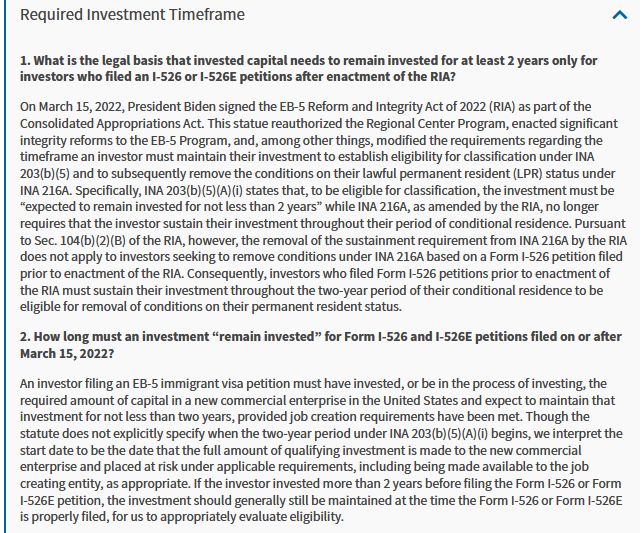
  6. Investment Period: USCIS confirms its interpretation that RIA does change the minimum investment period for post-RIA investors. Instead of being required to sustain their investment throughout the period of conditional permanent residence (the pre-RIA law), investors who filed I-526 or I-526E post-RIA are expected to maintain investment at least two years from the time that investment was made available to the job-creating entity (plus at least until I-526 filing, and at least until the job creation requirement is satisfied). I would’ve expected USCIS to also say that the investment at least needs to be sustained until the I-526 is adjudicated, but no – USCIS agrees that post-RIA investors could theoretically have return of capital even before I-526 approval so long as they met the two-year investment and job creation requirements. As before, the USCIS-required investment period is only a minimum – the Q&A reminds us that USCIS does not control the maximum time that EB-5 investment can be held. Post-RIA investors are also still subject to the redeployment requirement — but decoupling the investment period from unpredictably-long immigration times almost eliminates redeployment risk. The investment period change will have a seismic effect on the industry, and will no doubt be targeted by litigation. (Again, see Robert Divine’s analysis.)
  7. Redeployment: The Q&A focuses on RIA interpretation and does not address other longstanding questions around redeployment for pre-RIA investors, such as whether the “at risk” requirement actually justifies/forces serial investments decoupled from any job creation requirement. The Q&A does convey some sympathy when it recognizes “the burden on the investor to keep their investment in place for an extended period, due to circumstances beyond the investor’s or the NCE’s control, such as visa backlogs or other such circumstances.” The redeployment conversation will continue, drawn by the established reliance by regional centers on redeployment policy and the rebellion by investors against that policy.
  8. Practical questions: The Q&A answers some technical questions and provides filing tips for a number of EB-5 forms. (Robert Divine’s analysis also covers this nicely.)

USCIS posts Q&A addressing many EB-5 questions

Today USCIS published a page of EB-5 Questions and Answers (updated Oct. 2023), with the most extensive guidance to date on USCIS interpretation of the EB-5 Reform and Integrity Act. For historical reference, here are images as the Q&A posted on October 11, 2023, in case the content is subsequently challenged and revised.

USCIS Provides Additional Guidance (sustainment, termination)

UPDATE: This post now copies the version of the USCIS email sent out at 11:30, which seems to be a correction to the email sent at 10:45. This content is also now posted in the USCIS Newsroom.

From: U.S. Citizenship and Immigration Services <uscis@public.govdelivery.com>
Sent: Wednesday, October 11, 2023 11:39 AM
Subject: USCIS Guidance: EB-5 Reform and Integrity Act of 2022

USCIS Guidance: EB-5 Reform and Integrity Act of 2022

On Oct. 11, we issued additional guidance on our interpretation of changes to the EB-5 Immigrant Investor Program in the Immigration and Nationality Act (INA) made by the EB-5 Reform and Integrity Act of 2022 (RIA).

This guidance clarifies the required investment timeframe for EB-5 investors who file Form I-526, Immigrant Petition by Standalone Investor, or Form I-526E, Immigrant Petition by Regional Center Investor, on or after enactment of the RIA (March 15, 2022), as outlined in the RIA. This guidance also clarifies our interpretation of INA 203(b)(5)(M), regarding investors who are associated with a terminated regional center.

Background
On March 15, 2022, President Biden signed the RIA as part of the Consolidated Appropriations Act. Among other things, the RIA modified the required investment timeframes for investors who file petitions for classification Form I-526, Immigrant Petition by Standalone Investor, or Form I-526E, Immigrant Petition by Regional Center Investor, after enactment and to subsequently remove the conditions on their lawful permanent resident status. The RIA also added other provisions to the INA permitting good faith investors to maintain eligibility in the event their regional center is terminated.

For investors seeking to remove conditions on their permanent resident status under INA 216A based on an EB-5 immigrant visa petition filed on or after enactment of the RIA (post-RIA investors), the RIA removed the requirement that the investor must sustain their investment throughout their conditional residence.

The RIA also modified INA 203(b)(5)(A)(i) (the general requirement for classification to invest or be actively in the process of investing the requisite amount of capital in a new commercial enterprise) by adding new language that the investment required by INA 203(b)(5)(A)(i) must be expected to remain invested for at least two years.

Key Points
Because these changes made by the RIA, investors filing petitions for classification after enactment of the RIA no longer need to sustain their investment throughout their conditional residence, which may be many years in the future and dependent on factors outside the investor’s control, such as visa availability.

Instead, the INA now requires only that the investment must be expected to remain invested for at least two years, provided job creation requirements have been met. Although the statute does not explicitly specify when the two-year period under INA 203(b)(5)(A)(i) begins, we interpret the start date as the date the requisite amount of qualifying investment is made and believe this interpretation is consistent with the statutory language. In other words, we will use the date the investment was contributed to the new commercial enterprise and placed at risk in accordance with applicable requirements, including being made available to the job-creating entity. If invested more than two years before filing the I-526 or I-526E petition, the investment should still remain at the time the I-526 or I-526E is properly filed so we can appropriately evaluate eligibility.

Before enactment of the RIA, the termination of a regional center would have been considered a material change to eligibility for investors who had not yet obtained conditional permanent resident status and, consequently, would likely have resulted in denial or revocation of associated investor petitions. The RIA added a new provision at INA 203(b)(5)(M) that permits good faith investors associated with terminated regional centers to retain eligibility in certain circumstances. Because the statute does not explicitly specify whether it applies only to post-RIA investors or also to pre-RIA investors, we are providing guidance on how we interpret this new provision for pre-RIA investors upon regional center termination:

  • We interpret INA 203(b)(5)(M) to apply to pre-RIA investors associated with a terminated regional center (or debarred new commercial enterprise or job-creating entity). However, rather than strictly applying the notification timeframes at INA 203(b)(5)(M)(ii) and (iii)(I), we will extend the deadline for pre-RIA investors to respond to a regional center termination notification until the agency adjudicates their Form I-526 petition. If needed, we may issue a Request for Evidence or Notice of Intent to Deny for the investor to establish continued eligibility.
  • We may use the procedural flexibilities provided under INA 203(b)(5)(M) to extend the response deadline of 180 days for notices of continued eligibility. The extension will decrease the likelihood of operational burdens and expand the intent of the statute to permit good faith investors of terminated regional centers to retain their eligibility.
  • When a regional center is terminated for purely administrative noncompliance, we may determine that the termination would generally not adversely affect a pre-RIA investor’s basic eligibility under INA 203(b)(5) (including the ability to continue to claim indirect jobs), because their investment and resulting job creation would likely remain undisturbed.
  • We may choose not to extend applicable response deadlines when a regional center is terminated for substantive reasons that may affect continued eligibility of their associated investors.

More Information
For more information on the EB-5 Immigrant Investor Program or USCIS, please visit uscis.gov or follow us on Twitter, Instagram, YouTube, Facebook, and LinkedIn.

Integrity Fees and I-956G Annual Report in 2023 (Who really has to file, and why)

10/11/2023 UPDATE: USCIS has now published a Q&A that discusses the impact on investors of regional center termination, beginning with the statement that “Given the large volume of investors that could be affected by terminations of previously designated regional centers based solely on noncompliance with certain new administrative requirements added by the RIA, such as paying the annual Integrity Fund fee, we interpret the RIA in a manner we hope permits good faith investors of terminated regional centers to retain their eligibility.” Please refer to the USCIS Q&A before reading my post, which I will need to revise as time permits.

[ORIGINAL POST]

Since the EB-5 Reform and Integrity Act (RIA) passed in March 2022, there’s been some confusion and dispute about how RIA applies to regional centers and EB-5 investments that pre-date RIA. After all, RIA creates new rules and procedures primarily for capital raising activities. How do these reasonably apply to regional centers with no post-RIA capital raising activities? Do regional centers that were designated and investments made pre-RIA get any different treatment post-RIA?

After a year and half of conflicting notices on the USCIS website, industry comments, litigation, and other bits and pieces of guidance (more on that below), one point has become clear: USCIS expects every regional center without distinction to pay the annual Integrity Fee of $10,000 or $20,000 and to file the I-956G Annual Report. In 2023, every regional center must pay two years of Integrity Fees (for both FY2023 and FY2024) and also file I-956G, or else be terminated in 2024.

If a regional center has no post-RIA project plans anyway, why jump these expensive hoops and why care about termination? But the regional center’s past investors must care. An EB-5 investor’s continued eligibility depends on having a regional center sponsor in good standing throughout the investor’s EB-5 process, however long that process may take. According to INA 203(b)(5)(M), a regional center termination will be followed by denials, revocations, and conditional permanent residence status terminations for all of the regional center’s past investors, unless the investors can manage to affiliate with another regional center. (Separate article coming shortly on this topic.) [UPDATE: the 10/11 USCIS Q&A contradicts this point.]

Here are the instructions, followed by the background of ambiguities and arguments around these requirements.

  • Regional Center Integrity Fee: The latest USCIS “Alert” on Integrity Fee payments, published on September 29, 2023, can be found here: https://www.uscis.gov/IntegrityFund. The Alert acknowledges that “information about the due dates and penalties might not have been clear” but gives another chance for payment with the bold-face warning that “we will take steps to terminate any regional center that, on or before Dec. 30, 2023, has not paid the required EB-5 Integrity Fund fees for FY 2023 and FY 2024. NOTE: We will reject Integrity Fund fee payments for FY 2023 and FY 2024 we receive after Dec. 30, 2023, including those made in response to a Notice of Intent to Terminate.” (To avoid the FY2024 late fee, pay before October 31, 2023.) 
  • Regional Center Annual Report: The latest I-956G annual report form, dated as of July 2023, can be found here https://www.uscis.gov/i-956g. Unlike the initial I-956G edition of July 2022, which asked for reporting specific to post-RIA NCEs (I-956F), the current form explicitly covers pre-RIA activity and NCEs. It asks the regional center to report on “each capital investment project undertaken by such NCE with active EB-5 investors (i.e. those who are seeking classification under INA 203(b)(5) or who have obtained conditional permanent resident status and not yet filed for removal of conditions),” and to provide data not only for recent activity but “over the lifespan of the project.”

In theory, RIA’s new rules should apply prospectively, not retroactively, but it’s complicated. Regional centers with only pre-RIA capital raises are still asked to grapple with Form I-956G and its questions about compliance with new rules for post-RIA capital raises. Regional centers with no new capital raises are still asked to pay $10,000 or $20,000 every year to fund oversight for new capital raises. EB-5 investors who started the process pre-RIA are still dependent on their sponsor’s ongoing eligibility post-RIA.

How did we get here, and what arguments have been made along the way?

Initially, USCIS interpreted RIA as creating a new regional center program and terminating the previous program — meaning a clear break between past and future. Under that interpretation, pre-RIA regional centers were no longer designated and had no grounds to file annual certifications or amendments (according to the April 2022 Q&A on the USCIS website), while pre-RIA investors were protected as a function of the protections around expiring legislation. But Behring Regional Center filed suit to challenge that interpretation, instead fighting for continuity between pre-RIA and post-RIA regional center designation. The litigation ended in August 2022 with a Settlement Agreement in Behring’s favor. The Settlement specified that “previously approved regional centers sponsoring new projects or new investors under the Integrity Act will comply with all the requirements of the Integrity Act” and “if a previously approved regional center fails to file a Form I-956 application or amendment by December 29, 2022, it may no longer engage in any activities under the Integrity Act, including sponsoring I-526E visa petitions or the development of new projects.” Sadly, the Settlement Agreement was silent on the question of what happened to previously approved regional centers NOT sponsoring new projects or new investors under the Integrity Act, but merely needing to stay designated for the sake of past investor eligibility.

USCIS told Behring plaintiffs on October 14, 2022 that “USCIS has not determined what will happen to regional centers that choose not to file Form I-956. Specifically, it has not decided whether such regional centers will be terminated, whether they will have to file I-956H, whether they will have to file annual statements, or whether any of the RIA requirements apply to them.”

On December 23, 2022, USCIS published an “Alert” on the website (which remains on the site to this day), that “Dec. 29, 2022, is no longer the deadline to file Form I-956, Application for Regional Center Designation, amendments, as required by the Behring Settlement, and Form I-956G, Regional Center Annual Statement. USCIS is extending this deadline until we publish guidance that clarifies the requirements of these forms.”

Also in December 2022, USCIS slipped a file called I-956-001 NEW 60-Day Public Comment Response Matrix 20221207 among the Federal Register supplementary documents for Form I-956. This deeply buried file is the most extensive available Q&A on the various I-956 forms, with 126 responses by USCIS to public comments. For example, Q&A #90 addresses a comment by Ron Klasko who suggested “that a regional center that wishes to continue to exist solely to meet its contractual and fiduciary obligations relating to pre-RIA projects, but does not intend to file form I-956 to sponsor new post-RIA projects, should not be required to file Form I-956G, which requests information and references forms that do not apply to these regional centers.” USCIS did not take this fine point, but simply responded to Klasko that “Each approved regional center must file Form I-526G.” Q&A #51 addresses a I-956G comment from AILA arguing that “regional centers designated prior to the RIA that still choose to operate under the RIA are not required to provide data for fiscal years prior to the RIA passage.” USCIS disagreed in its response: “The statute does not distinguish between capital invested before or enactment of the RIA (EB-5 Reform and Integrity Act of 2022) for purposes of reporting under INA 203(b)(5)(G).” (AILA then shot back with a follow-up letter arguing in detail that some I-956G questions retroactively apply RIA requirements, and why that’s wrong, but AILA’s suggested changes to I-956G still did not make it into the revised form.)

In January 2023, USCIS announced a stakeholder meeting where “We will discuss issues related to regional center operations,” including “those who do not wish to solicit investments for new projects under the RIA.” USCIS received so much written feedback that they first delayed the meeting, to give more time to review all the feedback, and then cut the meeting agenda.  As IPO Chief Alyssa Emmel said in the April 25th meeting: “While we’re unable to discuss the regional center operations and investment period topics today, please rest assured that USCIS is engaged in ongoing efforts at the immigrant investor program office and across the agency to ensure that when we do have updates, we’re equipped to provide the EB-5 stakeholder community with clear guidance.

In meeting with the Behring plaintiffs on May 1, 2023, USCIS reiterated that “Form I-956 and I-956G filing date deadlines still not set. These deadlines continue to be pushed back until the agency publishes guidance clarifying the requirements of these forms.”

The promised “guidance that clarifies the requirements of these forms” has not yet been published, so far as I know.  But I believe that I-956G, at least, nevertheless has a real deadline for all regional centers in December 2023, and that the Integrity Fee requirement is being applied to all regional centers this year without exception. I believe this from the latest fee and form instructions, and because USCIS has yet to grant the rationales for making any exceptions. [10/11 UPDATE: the new USCIS Q&A is part of the promised guidance.]

Everyone agrees that regional centers designated and active under the new law must tick all the compliance boxes under the new law, including filing I-956G annual reports and paying the Integrity Fee. The open question has been over which compliance boxes reasonably apply to regional centers that were designated under the old law and not taking any more investors under the new law. But so far, USCIS has not entertained that question because it has not granted any distinction between types of regional centers. This comes out in USCIS response to litigation. In Sunshine State Reg’l Ctr., Inc. v. Jaddou (23-cv-60795), “Plaintiff alleges that the Act distinguished between those Regional Centers created before the Act was passed, ‘Legacy-Regional Centers,’ and those after the Act was passed, ‘RIA-Regional Centers.’” But both USCIS and ultimately the judge disagreed. To quote the Opinion of May 30, 2023, “Plaintiff has not shown that it is likely to succeed on the argument that the statute unambiguously distinguishes between Regional Centers created before and after the Act for purposes of the Integrity Fund Fee.” In Gulf States Regional Center, LLC v. USCIS (2:2023cv01354), “Gulf States attempts to distinguish between the phrases ‘each regional center designated under subparagraph (E)’ and ‘any regional center’ used throughout the RIA,” (the logic that I also used in my February 2023 suggestion to USCIS about fairly applying RIA requirements).  But USCIS disagreed (as of Doc 49-1 filed 9/13/2023) that “subparagraph (E) is not limited to regional centers approved after the RIA’s enactment, but governs all regional centers in existence, regardless of their time of designation.” At least in litigation, USCIS has not entertained any ground of distinction that would allow treating regional centers differently depending on the time of designation and whether or not they choose to raise new EB-5 investment under RIA. Did the Behring Settlement force this position? Anyway, it seems to be the reality.

Back in October 2022, USCIS said it had then “not determined what will happen to regional centers that choose not to file Form I-956” to sponsor new projects and investors under RIA, including “whether such regional centers will be terminated, whether they will have to file I-956H, whether they will have to file annual statements, or whether any of the RIA requirements apply to them.” USCIS has not yet published a revision to this statement as of October 6, 2023. But based on the above sources, I gather that USCIS has, at least, firmly decided that the requirement to file I-956G and pay the Integrity Fee apply universally this year — and prepared to terminate regional centers that do not comply. Regional centers should prepare accordingly for Integrity Fee(s) due by the end of this month and annual reports due by the end of December. (And let me know if there are other court cases or buried sources of USCIS guidance that I should cite in this post.) [UPDATE: See EB-5 Questions and Answers as of October 11, 2023.]