Just a reminder to sign up for this week’s IIUSA webinar New EB-5 Data and Emerging Trends on I-526/E Filings, Adjudications, and Processing Times on Wednesday October 2 at 12 ET. We’ll discuss findings from the project undertaken by Li Lee with leadership from Christine Chen and eleven regional center operators to collect and analyze data on actual I-526E and I-956F processing times (report now available here). We’ll also present critical new TEA backlog information that IIUSA just received in response to a FOIA request spearheaded by Brandon Meyer (report now available here). How full are the queues for EB-5 visas? At what rates are the queues advancing, and in what order? The new data provides essential intel for regional centers and project companies considering their future offerings and markets, and for prospective and current investors concerned about timing.
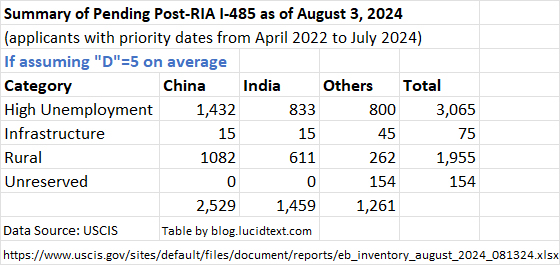
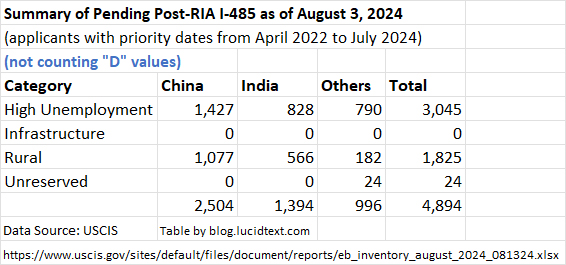
And now another important data drop, as USCIS has added all EB-5 Set-Aside categories for the first time to the report of pending employment-based I-485 published monthly at the USCIS Immigration and Citizenship Data page.
Pending Applications for Employment-Based Preference Categories as of August 3, 2024 (XLSX, 109.41 KB) is wonderfully timely, providing comprehensive I-485 inventory data just a few weeks old. The report now lists pending EB-5 I-485 inventory itemized according to visa category (Unreserved, High Unemployment, Rural, Infrastructure), petitioner priority date (month year), and petitioner country of chargeability (China, India, Mexico, Philippines, or Rest of World). I-485 can now be filed concurrently with I-526/I-526E, so this report is effectively another view into I-526/I-526E receipts by country and TEA category. It’s limited to the portion of investors who are in the USA pursuing status adjustment, not including demand from abroad, but has the advantage of being very recent, and updated monthly.
The August I-485 report reflects late-breaking EB-5 TEA demand trends, and shows continued strong demand for rural TEA investments. (9/20 UPDATE: The chart originally posted here showed a more dramatic trend that resulted not from reality, but from the fact that I made an error in copying and pasting from one spreadsheet to another. Thanks to a vigilant reader who checked my work and found the error!)
The August I-485 report surprised me by recording some petitions in the Infrastructure category. The exact numbers are small, redacted with a “D” (meaning <11) in every month they appear. But still interesting, as I had thought that the Infrastructure category wasn’t being used at all. It’s also interesting to compare the reported I-485 inventory (which includes principals plus family) with our latest data for I-526/I-526E filings through early 2024.
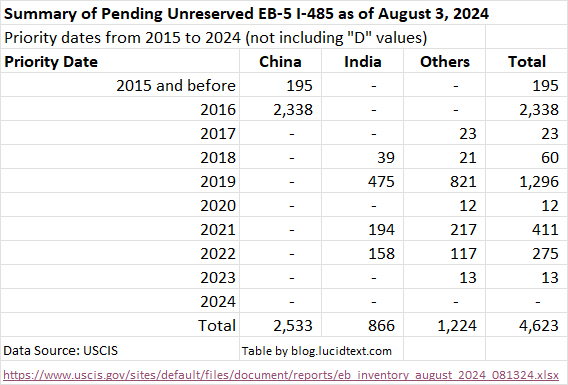
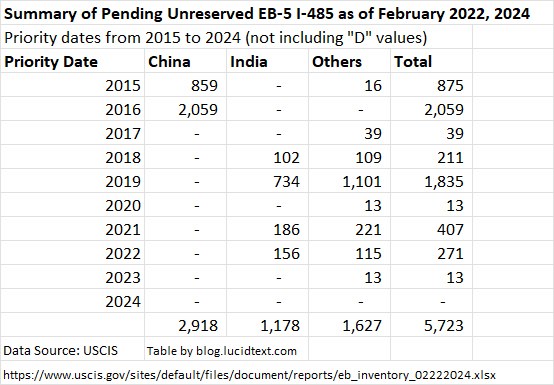
The August I-485 report includes data for EB-5 Unreserved, which is interesting to compare with past reports, to get a sense of who exited the inventory by getting visas over time. (While keeping in mind that the pending inventory is not only reduced by visa issuance, but also expanded as new applicants file I-485.)
I’ve been tracking the monthly I-485 reports since February 2024 (when this report format was first introduced), and have seen USCIS struggle with how to report the EB-5 numbers. The February report only recorded EB-5 priority dates through 2022, the April report had 2023 and 2024 priority dates but only for ROW and all categorized as Unreserved, the May-to-July reports added a lump row for Set-Asides, and August finally figured things out and has data individually recorded for each TEA category and country. The monthly I-485 pending inventory is a very valuable report, and I look forward to tracking ongoing updates.
As I prepared Monday’s post on the Visa Bulletin, I looked at the number 9,158. This number represents 9,158 Chinese investors plus family who contributed at least $500,000 per family in 2014/2015 for the chance to qualify for an EB-5 visa. The Visa Bulletin showed “C” – no restriction – for China EB-5 through 2014 into the first half of 2015 (only beginning to establish cut-off dates in May 2015, and even then only implying a two-year wait with a 2013 date). How many of those people realized that they’d still be here a decade later, visa-less, a statistic on the 2024 NVC waiting list? Visa availability problems were predictable in retrospect, considering the 25,000 I-526 filed in 2014/2015, but we didn’t talk much about pipeline visa demand in those days. In honor of everyone taken sadly by surprise, and hoping not to repeat that history, we are more careful now to track and report not only the visa-stage demand reported in the visa bulletin, but also on pipeline demand coming up from I-526/I-526E filings.
I’m happy to report another important addition to the treasury of I-526/I-526E receipt data, with detail on visa category and petitioner county as needed for visa pipeline analysis. This dataset is courtesy of the efficient Joey Barnett of WR Immigration, who managed to extract a record-quick Freedom of Information Act response from USCIS, and immediately and generously made the full record available to the public. The data is published in a blog post here: “Exclusive New EB-5 Filing Data on Rural v. High Unemployment Area Demand as of April 2024!” You’re invited to join Joey Barnett and Charlie Oppenheim in discussing the data during the next edition of The Bulletin – Chatting with Charlie: EB-5 Investor Outlook on September 26, 2024.
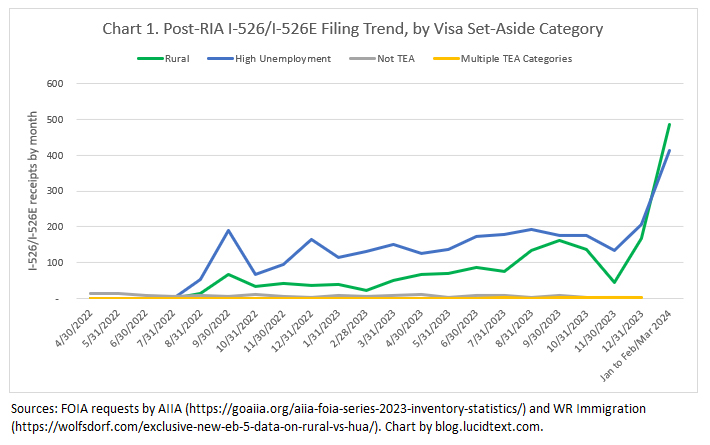
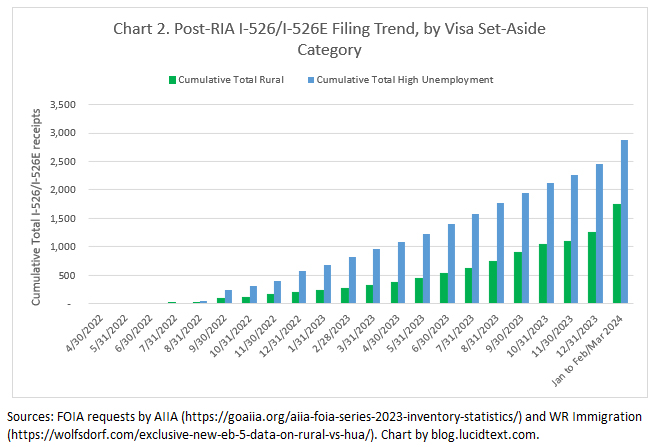
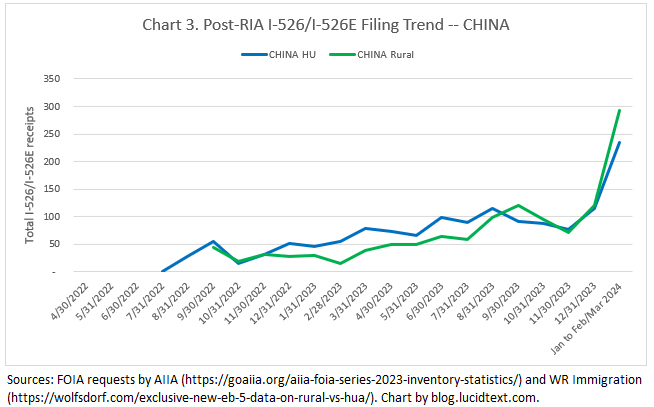
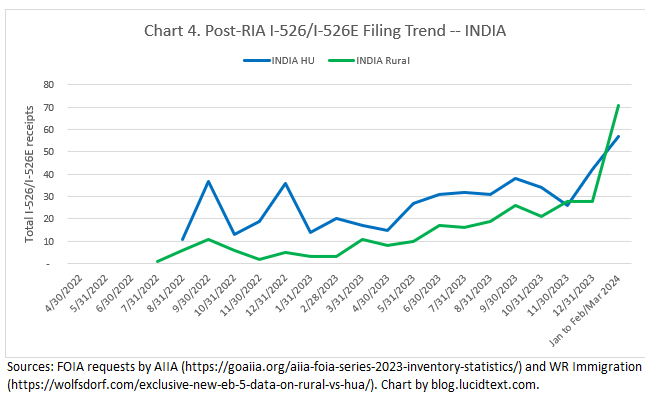
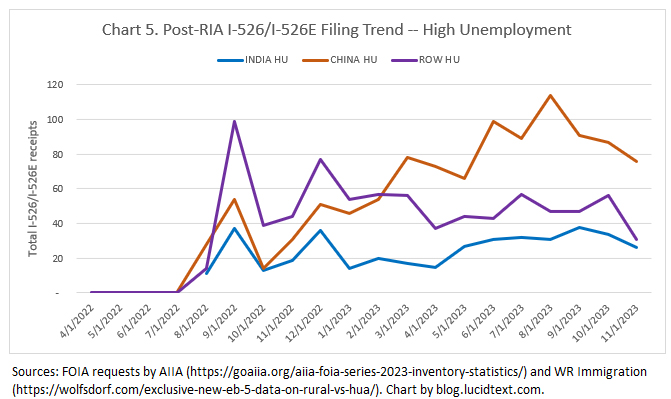
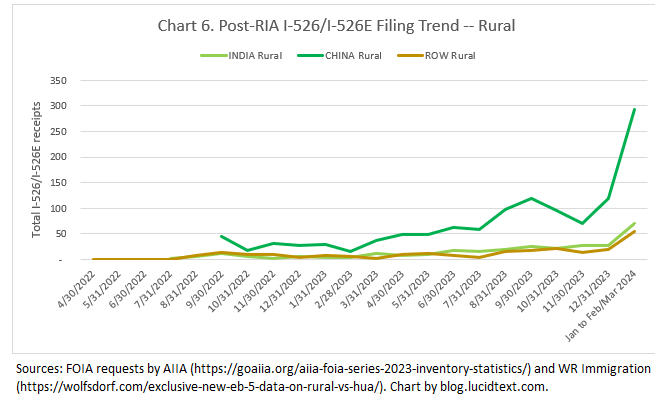
Prior to the WR Immigration FOIA request, the most recent publicly-available TEA-and-country-specific data was from AIIA FOIA Series: Updated I-526E Inventory Statistics for 2023. The AIIA FOIA data was monthly through the end of 2023, and highlighted a handful of high-demand countries. The WR Immigration FOIA data is annual, but extends through the first part of 2024 and lists results for every single petitioner country.
The comprehensive county-specific detail in the WR Immigration FOIA provides interesting material for the question “where are regional centers finding EB-5 investors these days?” I see that AIIA already has a post up from this angle.
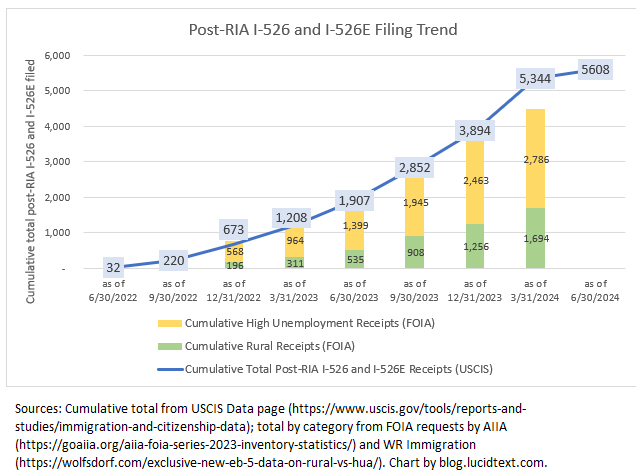
For backlog analysis, the WR Immigration FOIA is critical because it covers at least part of the great filing surge of Q2 2024, when 1,879 I-526 and I-526E were filed. We’ve needed to know where those 1,879 people came from, and where they invested, to help get a handle on potential TEA and country-specific backlogs. And now we have more information about it.
It’s tricky to date FOIA responses, because USCIS only reports the date that they queried the database, leaving us to guess how up-to-date the database was at that point. The WR Immigration FOIA is dated as of April 18, 2024. Comparing the FOIA totals with the totals that USCIS ended up officially reporting, we can conclude that the WR Immigration FOIA report captures cases filed through about February/mid-March 2024.
I’ll let charts tell the story of what happened during the recorded part of the March 2024 filing surge, including how Rural demand surged ahead for the first time (particularly thanks to China), while High Unemployment demand dipped but remained sufficiently strong to continue to dominate the cumulative inventory. (The charts combine AIIA’s FOIA data for 2022-2023 with WR Immigration’s FOIA for 2024.)
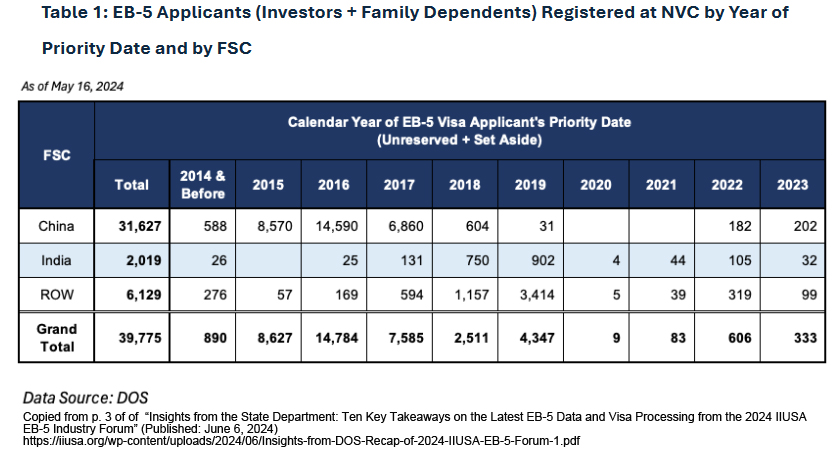
And finally, here’s the table that highlights my concern in the data: what’s going to happen to these data points when they’re people with families approaching the visa window?
For a rough estimate of future visa demand from the I-526 pipeline, I conservatively multiply the I-526 receipts by 2. This underestimates typical family sizes, but considers the possibility of denials and other attrition. And then I look at estimated cumulative visa demand and future visa supply and think about the balance.
FY2025 is carryover year, with extra visas available. What would happen in the best-processing case/worst-visa-case scenario that the entire pipeline of investors filing I-526 up to March 2024 reached the visa stage in FY2025? Looking at the numbers, I see that they would find enough rural but not enough high unemployment visas to accommodate them. In that case, FY2025 would end with Visa Bulletin cut-off dates for high unemployment, and a backlog going into FY2026 without the promise of carryover from unused HU visas. In real life, slow I-526E processing looks likely to continue to slow-walk the backlog (as it has been slow-walked to date) such that FY2025 doesn’t get sufficient applicants to max out FY2025 visas. In that case, the visa bulletin would not move yet in FY2025, and FY2026 would also have extra visas. In that case, the pipeline that had built by early 2024 would be getting visas in 2026 and years beyond.
If I were an investor from China or India, I would look not only at the China or India pipeline, but also at ROW (meaning applicants from the “rest of world”). ROW is important, because the number of annual visas available to me, as an applicant subject to country cap, is equal to 7% PLUS a share of any visas not absorbed by ROW. Every one ROW visa issued is one fewer visa that might be available to my country over the country cap. The ROW pipeline is also a target for people wondering if it’s possible to diffuse demand pressure from TEA set-aside categories. (But notice that High Unemployment shows enough demand from China and India alone to absorb 2+ years of visas even if they were the only applicants, even if 100% of the documented ROW HU pipeline left the HU category and chose to receive Unreserved visas instead.)
Still have questions about what the numbers mean? Note that the FAQ I just finished addresses topics such as which countries are affected by country cap limits and retrogression, how applicants may choose a TEA or Unreserved category, and how annual EB-5 visa availability gets calculated.
A project I’ve been working on for the past few months is now live: “Essential EB-5 Visa Allocation Questions and Answers.” My dream has been to put together an FAQ that tackles the basic questions that confuse discussions about EB-5 visas – addressing which EB-5 categories are available and to whom, how visas get allocated and when, how country caps work, what retrogression is and whom it affects, what choices applicants can make about visa allocation, and how EB-5 visa supply works.
My goal was not to compile off-the-cuff responses, but to create a solid work of reference where short answers would each be followed by a robust reference section with links to places where the topic has been addressed in the law, USCIS policy and guidance, USCIS or DOS Q&A or stakeholder meetings, litigation, etc. If you read an answer and think “but that’s not what I heard from X,” you’ll be able to scroll to the base of the post and follow the reference links, see where I found the information presented, and draw your own informed conclusions. If you read an answer and think “ok I understand A but this raises a question about B,” you can follow the cross references to read other related Q&A.
The current content of the Q&A is dated as of August 2024. I look forward to making this a dynamic resource, with updates as new guidance and data emerge over time.
This project required a lot of work, first in expanding and reviewing the research I’ve been collecting over my years in EB-5, then in striving to distill this background into a basic Q&A format. I was able to complete the work thanks to finding a patron who shared the vision. CanAm commissioned the FAQ, reviewed it, and has now published it as a PDF whitepaper, plus divided into individual website postings for convenient reference, and with a Chinese translation. In a world full of sales-y clickbait, I’m thankful to find someone willing to invest in what I want to write – content that’s not necessarily fun or profitable, but carefully informative and aiming for the common good.
Here follows a quick quiz, which you can take to help judge whether you already know and agree with everything in the Q&A, or will benefit from following the links and checking out my references:
True or false: TEA investors with 2021 priority dates can receive TEA set-aside visas.
True or false: TEA investors with 2023 priority dates can only receive TEA set-aside visas.
True or false: Direct EB-5 investors have access to different visas with different timing from regional center investors.
True or false: No one country can get more than 7% of EB-5 High Unemployment or >7% of EB-5 Rural visas.
True or false: High EB-5 demand means that Taiwan and South Korea may have visa bulletin cut-off dates in the future.
True or false: Visa applicants from low-demand countries with no country cap can never experience visa bulletin retrogression and visa wait times.
True or false: Filing I-485 locks in access to an EB-5 visa as of the time of filing I-485.
True or false: EB-5 is likely to have many more than 10,000 visas in most future years, thanks to rollover and carryover.
True or false: The time of choosing an EB-5 investment and filing I-526E is the only point at which the EB-5 investor can participate in visa allocation decisions.
The correct answer to each of these questions is “false.” Surprised? Check out the FAQ to read more! And if you still have questions after reviewing the FAQ, or think of Q that should be added, reach out to CanAm or me to discuss further. We want to make this as useful as possible to the community, to help put everyone on the same page with solid background for talking about EB-5 visas.
October begins a new fiscal year, with a new stock of visas available to EB-5 applicants. The October 2024 Visa Bulletin includes significant movement for EB-5 dates for China and India. To understand this movement, it’s necessary to look at the dates in context of what they represent – visa applicants with priority dates.
Does a final action date of July 15, 2016 for China mean that most Chinese EB-5 applicants with priority dates earlier than July 2016 can expect visas shortly? Does a final action date of January 1, 2022 for India mean that most India-born EB-5 investors with priority dates in 2021 and earlier can expect visas shortly? Looking at the number of applicants in progress compared with FY2025 visa availability, the answer is “maybe” for China, and “no, certainly not” for India.
First, consider the supply of Unreserved visas available to allocate this year. The precise numerical limit has yet to be announced (it will eventually appear here), but FY2025 will have at least the base allocation of 140,000*0.071*0.68=6,759 new-issue Unreserved EB-5 visas, plus an additional 4,000+ visas thanks to carryover from a portion of Reserved visas not used in FY2024. (That is, unless the IIUSA lawsuit succeeds in challenging the carryover law. See slide 18 here for additional analysis.) So, we’re potentially looking at around 11,000 Unreserved visas available in FY2025, of which India can expect about 7% (770), and China with its old priority dates can expect 7% plus what’s leftover after India and as many ROW visas as consulates can manage to issue. I guess that at least 4,000 to 5,000 Unreserved visas will end up being available to China in the coming year.
And now let’s consider the Unreserved applicants lined up for FY2025 visas. Potential applicants can be in multiple places – still with I-526 pending, with I-526 approval but waiting for NVC transfer, with pending I-485, and/or registered at the National Visa Center for consular processing. But let’s just look in one place – at applicants registered at NVC as of May 2024, according to a chart provided by Department of State and included on p. 3 of “Insights from the State Department: Ten Key Takeaways on the Latest EB-5 Data and Visa Processing from the 2024 IIUSA EB-5 Industry Forum” (Published: June 6, 2024).
The following sections consider what this table means for India Unreserved, China Unreserved, and 5th Set Aside in the Visa Bulletin.
India — EB-5 Visa Applicants vs Visa Bulletin Dates
Table 1 above has a stark message for India: 1,834 applicants with 2019 and earlier priority dates were still waiting at NVC for Unreserved EB-5 visas as of May 2024 – and that’s only at NVC, not counting 1,000+ Indians waiting for I-485 status adjustment as of April 2024, or potential applicants waiting for I-526 approval and NVC transfer. (Note: there is potentially significant overlap between the I-485 list and both the NVC list and the pending I-526 list.)
The crowd of Indian applicants reported by DOS in May certainly did not just disappear between May 2024 and today. Some registered applicants may have given up or switched categories by this time, but it’s improbable that they suddenly all got tired of waiting and gave up en masse. 2018 and 2019 priority dates are not that old, and a number only became qualified recently given I-526 approval timing. 1,800+ Indian applicants could not have received visas in the last months of FY2024. (As of May, DOS reported having already issued 864 of the approximately 995 visas available to India in FY2024 under the country cap.) Therefore, it’s likely that at least 1,700 India-born applicants with 2019 and earlier priority dates are still waiting today. With likely fewer than 800 Unreserved visas available to India in FY2024, Department of State can’t realistically get even close to allocating visas even all qualified Indian applicants NVC with 2019 and earlier priority dates this year, much less be able to move on to 2020 and 2021.
I can’t guess what the October 2024 visa bulletin DOES mean for India. What could it mean, except that DOS made a typo, or for some reason anticipates issuing a few lucky visas out of priority date order? The typical reason for moving Visa Bulletin dates — to “stimulate demand” i.e. push USCIS to adjudicate more petitions or potential applicants to submit documents — wouldn’t make sense here since NVC reports already having plenty of applicants. What we can see, from pending applicant data, is that the October 2024 Visa Bulletin cannot possibly mean a message that the pre-December 2020 India backlog is clear, or that the majority of 2020 and 2021 India priority dates can expect EB-5 visas soon.
EB-5 visa issuance to India has been confused by the fact of non-FIFO I-526 processing. Some Indians with 2019 priority dates have visas already, while others are still stuck waiting for I-526 approvals or transfer to NVC. The India backlog is also complicated by surges – for example of all I-526 filed by Indians in 2019, 50% were filed in the single month of November 2019. No wonder Department of State struggles to maintain queue discipline for India EB-5. For Indian applicants trying to think through the “where am I in the queue” question, I recommend a dataset recently shared with me by a blog reader, and copied starting in Row 467 of the Pre-RIA Demand tab in the Excel sheet I keep linked to the top of the EB-5 Timing page. My reader used FOIA to request an accounting of pending and approved status for I-526 filed by Indians between January 1, 2017 and April 1, 2022. Looking at this report, you can see the pattern of demand over those months, and see also how I-526 processing – approving a few in each month while leaving others behind – can have resulted in date confusion at the visa stage.
China — EB-5 Visa Applicants vs Visa Bulletin Dates
Table 1 above shows that the National Visa Center still has a significant number of China-born applicants with 2015 priority dates, and sufficient applicants with 2016 dates to absorb years-worth of visas. Demand in 2015 and 2016 came in surges, so I took an extra step to divide the China inventory by quarter. The following table shows a quarterly estimate created by taking the proportions for worldwide I-526 receipts reported by quarter in 2015 and 2016, and applying those proportions to data by fiscal or calendar year for China I-526 receipts and China NVC inventory. I included I-526 receipt numbers, as background for the number of Chinese who started the process. (Based on I-526 inventory status and recent denial rates, I will guess that most Chinese applicants with 2015 and 2016 priority dates who are ever going to reach the visa stage are registered at NVC and/or on pending I-485 by now.) The table includes information on pending I-485, which USCIS reports by month of priority date.
Priority Date
Total I-526 Receipts from China-born investors
China-born applicants registered at NVC as of May 2024
Pending I-485 for China-born applicants as of April 2024
Before 2015
588
85
2015 Q2 Jan – Mar 2015
1,570
1,167
23
2015 Q3 April – June 2015
1,682
1,250
36
2015 Q4 Jul – Sep 2015
4,471
3,323
162
2016 Q1 Oct – Dec 2015
3,808
2,830
319
2016 Q2 Jan – Mar 2016
391
546
103
2016 Q3 April – June 2016
1,415
1,976
332
2016 Q4 Jul – Sep 2016
5,334
7,447
1,165
2017 Q1 Oct – Dec 2016
3,310
4,621
778
Total with priority dates prior to January 2016
9,158
625
Total with priority dates prior to June 2016
11,680
1,060
Total with priority dates prior to January 2017
23,748
3,003
Looking at the distribution by quarter, I notice the surge of demand from July to December 2015, followed by smaller crowd from January to June 2016, followed by another big surge in July to September 2016 (the last big peak, as we now know). No wonder the Visa Bulletin spent years in late 2015, but now foresees a leap through the first half of 2016, and then slow again through the second half of 2016.
Looking at the large number of total applicants as of mid-2024 with priority dates prior to January 2017, I can see why Department of State had no need to advance Chart B Dates for Filing to encourage even more applicant filings in those dates. It makes sense that the October 2024 Visa Bulletin retrogressed Chart B to prevent even more additions to that already-large crowd.
I see that as of May 2024, there were around 12,000 China-born applicants ready to go with priority dates before July 2016. Could Department of State think it’s possible to get anywhere near applicant #12,000 by the end of the coming fiscal year? It’s just conceivable they might get close, considering that China-born applicants may have gotten another 3,000+ visas June-September 2024, that China-born applicants could have access to 5,000 or so visas in FY2025, and that high-volume drop-out rates and denials among old 2015 priority dates are plausible. On the other hand, if all those applicants recorded at the National Visa Center and on pending I-485 in mid-2024 do indeed represent active applications from people still able and willing to claim visas, then it will take several years to issue visas to everyone with pre-July 2016 priority dates. In that case, neither Chart A nor Chart B would need to move again for China any time soon.
The major “what if” factor for China Unreserved at this point is the volume and pace of demand for Unreserved visas from the Rest of the World, since this directly constrains the supply of visas every year to China. For more data, see the Pre-RIA Demand tab in the Key EB-5 Backlog Data file, which I keep linked to the top of my EB-5 Timing page and update regularly. And keep an eye on the discussion about whether post-RIA Rest of the World applicants should be encouraged to select Unreserved visas rather than the set aside visas for which they also qualify.
Post-RIA EB-5 Visa Applicants vs Visa Bulletin Dates
The October 2024 Visa Bulletin still has “C” across the board in the 5th Set Aside categories, meaning no priority date restriction yet on who can get final action or file I-485. Again, this is a function of the number of applicants ready to go at the visa stage. Scroll back up to Table 1 at the top of this post, and see that <1,000 applicants were registered at NVC with 2022 or later priority dates as of May 2024. That’s not sufficient applicants to get anywhere near absorbing the 4,000+ rural visas and 2,000+ high unemployment visas that were available in FY2024 and will be available in FY2025, even if all were rural or high unemployment applicants. And the inventory of qualified post-RIA visa applicants likely isn’t much greater now, considering the low volume of I-526E approvals since May. When will the Visa Bulletin change for 5th Set Aside categories? The answer depends on USCIS, and when USCIS can manage to advance more applicants to the visa stage by approving more I-526E.
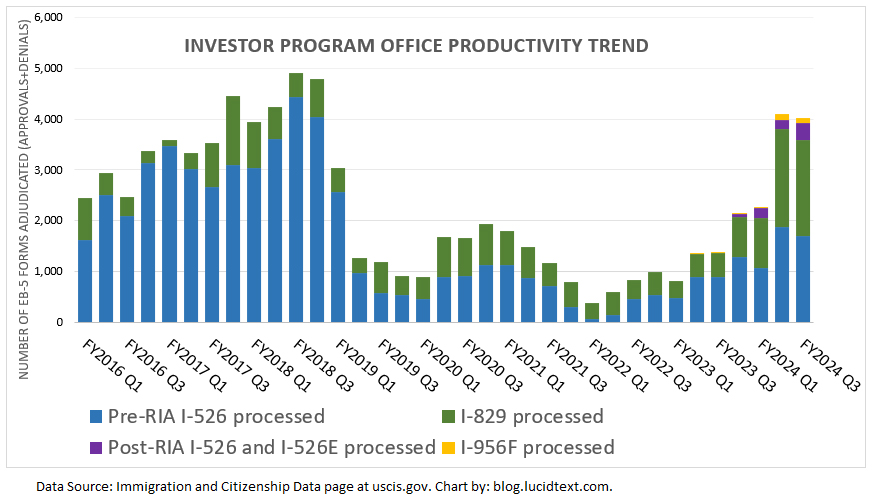
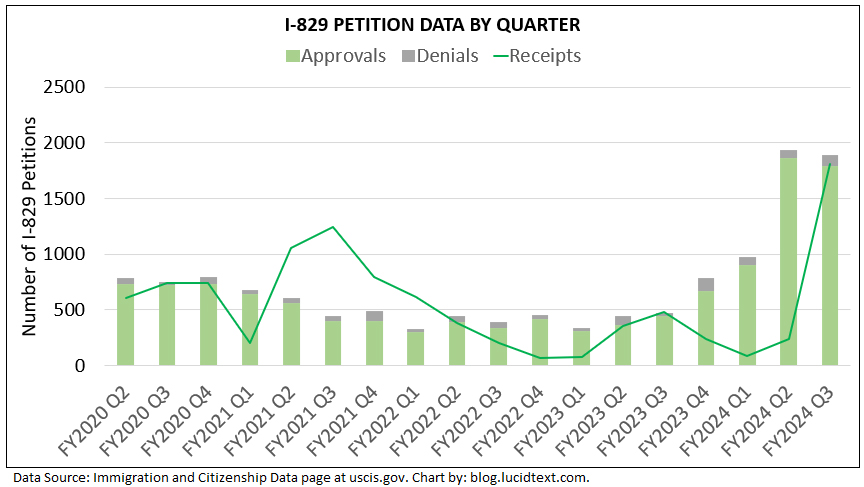
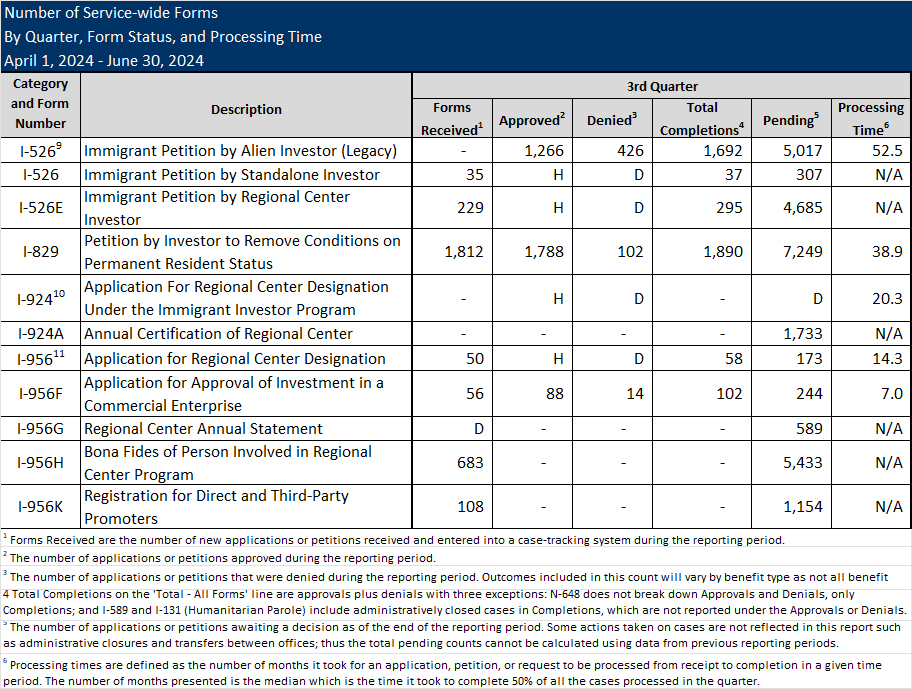
FY2024 Q3 data shows minimal movement for post-RIA I-526/I-526E petitions, and continuing high processing volume and backlog reduction for pre-RIA I-526 and I-829. Receipts fell in Q3, especially for I-526E, but not as much as I expected after the April 1 USCIS form fee increase.
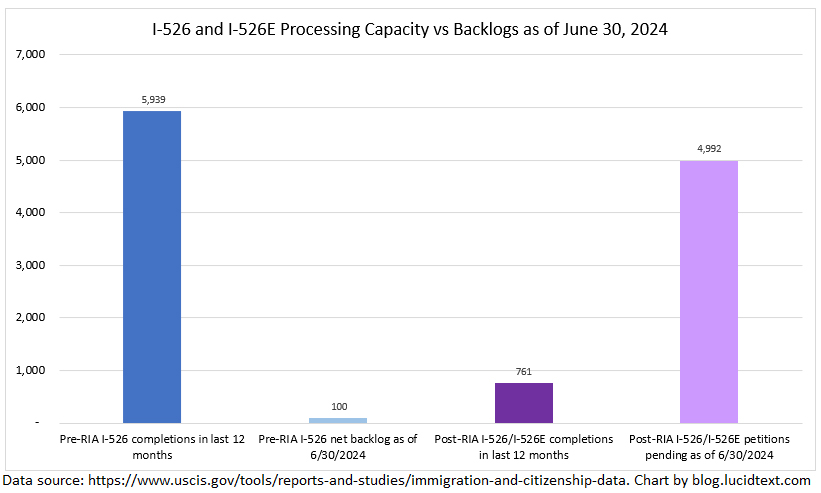
USCIS has worked aggressively in 2024 to clear the inventory of pending pre-RIA forms. By June, USCIS was down to a net backlog of only 100 I-526 petitions, and had reduced the I-829 net backlog to 5,000. (“Net Backlog is Gross Backlog minus any customer induced delays (i.e. RFE, intent to deny, etc.) and visa unavailable cases.”) It is likely that as of today, USCIS has already at least assigned nearly every pre-RIA I-526, except for I-526 from Chinese investors who don’t have visas available. If recent volumes continue, every I-526 and I-829 pending today will have been processed before June 2025. Kudos to IPO staff and Chief Alissa Emmel for making this happen! Meanwhile FY2025 visa bulletins will be interesting, as Department of State works to match FY25 visas to the influx of new Unreserved applicants from I-526 approvals.
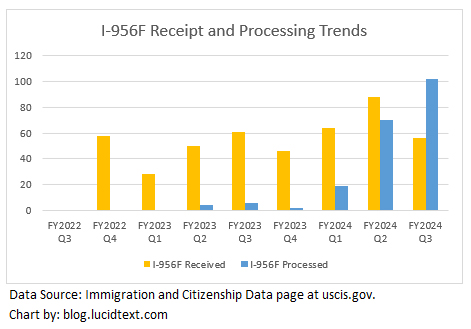
Processing activity for post-RIA investor petitions picked up slightly in Q3, but is still extremely low in context of the I-526E backlog and the number of reserved visas waiting for applicants. Two factors give me hope for a major boost to I-526E processing numbers coming soon: the uptick in I-956F processing in Q3 (with I-956F approval being precursor to I-526E approval), and the fact that the disappearance of the I-526 backlog is about to free up major adjudicator capacity that might be moved to I-526E processing. USCIS processed nearly 6,000 I-526 in the past 12 months, and such productivity would quickly decimate the I-526E backlog. I’m optimistic that USCIS/Department of State will at least be able to issue all Reserved visas available in FY2026, considering the processing potential. However, low processing volumes to date may mean that some FY2025 Reserved visas will go unissued for lack of qualified applicants advanced in time.
And a few other points of interest. Both I-526 and I-829 denial rates were down in Q3, to 25% and 5% respectively. A handful of I-526E denials were reported for the first time in Q3 — and I expect to see more soon, considering that USCIS denied 25 I-956F project applications so far this year. The number of I-956 regional center application filings hardly dropped in Q3, despite the massive filing fee increase. And apparently USCIS approved one I-924 in Q3. Mysterious!
I’ve copied below charts to highlight salient features and trends, as well as updating my Processing Data page and Key EB5 Backlog Data excel file. And heads-up for additional data and analysis coming in the next few weeks.
USCIS still does not report I-526E processing times, but IIUSA has stepped into the gap and worked with regional centers to collect and analyze a large database of anecdotal evidence for actual I-526E and I-956F processing times. I’ve been assisting Lee Li with this important project, and look forward to the results to be released shortly. You’re invited to join us for a webinar on October 2, 2024 on “New Data and Emerging Trends: I-526/I-526E Filings, Adjudications, and Processing Times”
AIIA continues the critical effort to extract information from USCIS on the breakdown of post-RIA I-526 and I-526E filings by TEA category and applicant country of birth, to help keep a pulse on potential visa backlogs. They hope for a response next month to the FOIA request covering the filing surge in January to March 2024. (Currently, we only have data through December 2023.)
I’ve been working on a major project to research and write FAQ covering questions about EB-5 visa availability and allocation. The 26 short articles that comprise this project will be published next week – look for an announcement and links here next week Tuesday.
On the visa front, Department of State announced that it succeeded in issuing all EB-5 Unreserved visas available for FY2024 – good news for pre-RIA investors, and particularly for long-suffering Chinese investors who were able to pick up a large number of FY24 visas thanks to the productive consulate in Guangzhou. I will write separately about the visa outlook for FY2025 (which is unfortunately currently subject to litigation, as discussed by IIUSA and AIIA).








 EB-5 Updates