FY2024 Q3 EB-5 Form Processing Data
September 9, 2024 24 Comments
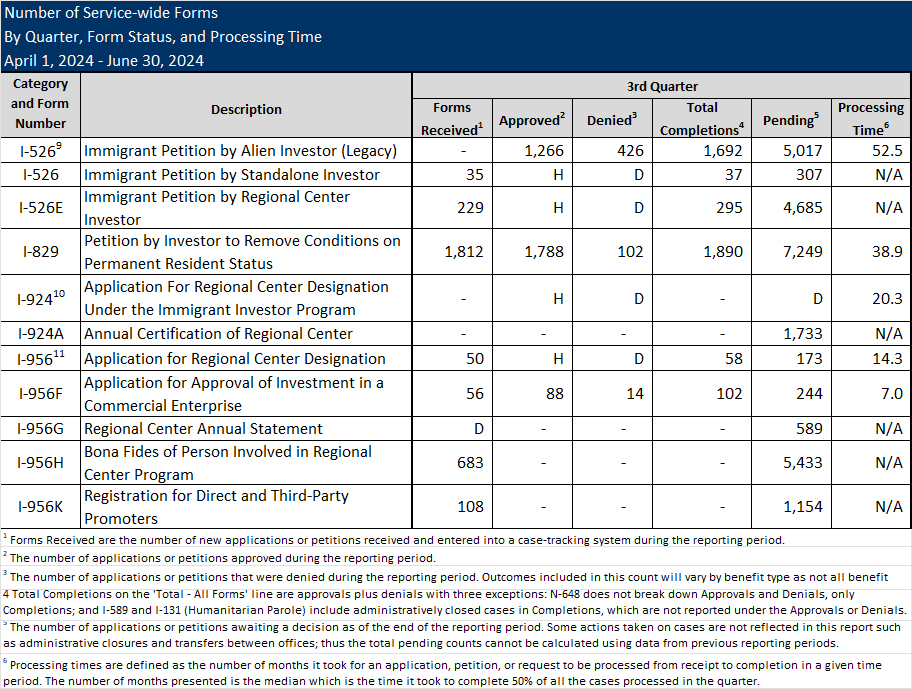
The USCIS Immigration and Citizenship Data page has published performance data for FY2024 Q3 (April 1, 2024 to June 30, 2024), including for EB-5 forms I-526, I-526E, I-829, and the various form I-956s. I regularly consult the All USCIS Application and Petition Form Types report, the Net Backlog and Frontlog report, and the Approved EB Petitions Awaiting Visa Final Priority Dates report.
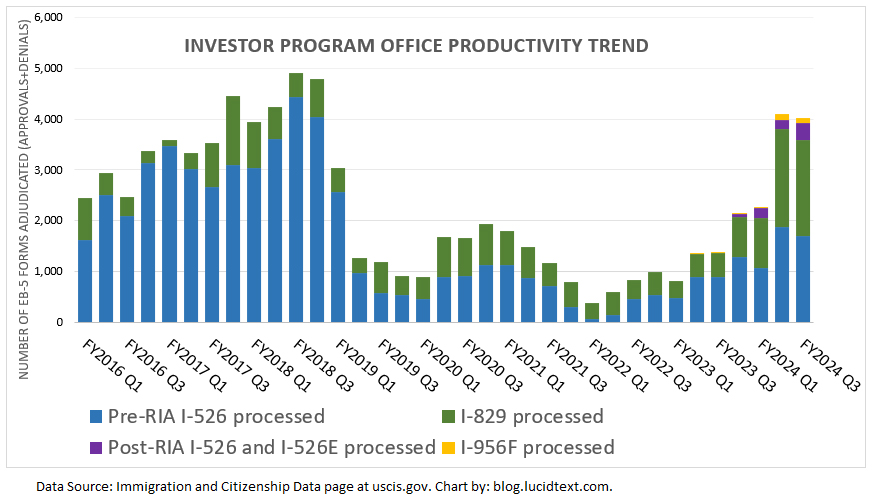
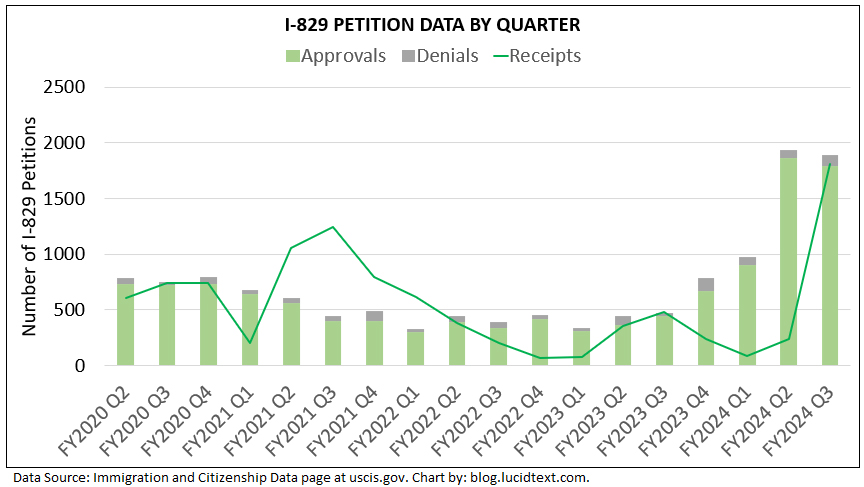
FY2024 Q3 data shows minimal movement for post-RIA I-526/I-526E petitions, and continuing high processing volume and backlog reduction for pre-RIA I-526 and I-829. Receipts fell in Q3, especially for I-526E, but not as much as I expected after the April 1 USCIS form fee increase.
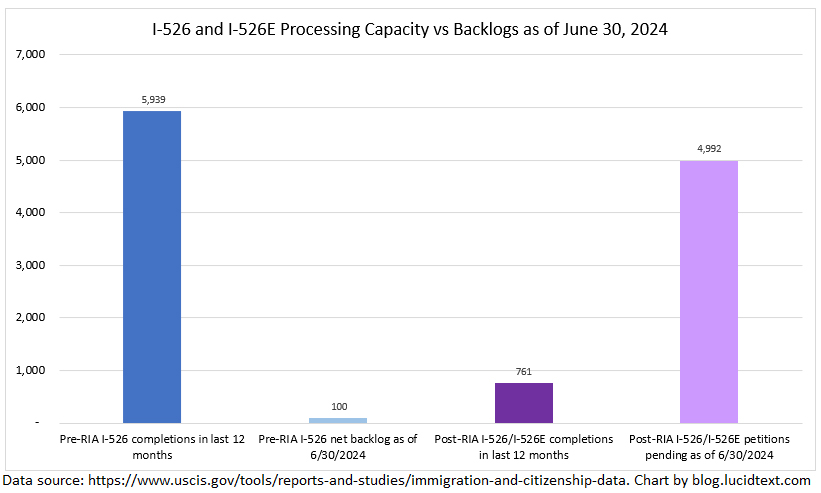
USCIS has worked aggressively in 2024 to clear the inventory of pending pre-RIA forms. By June, USCIS was down to a net backlog of only 100 I-526 petitions, and had reduced the I-829 net backlog to 5,000. (“Net Backlog is Gross Backlog minus any customer induced delays (i.e. RFE, intent to deny, etc.) and visa unavailable cases.”) It is likely that as of today, USCIS has already at least assigned nearly every pre-RIA I-526, except for I-526 from Chinese investors who don’t have visas available. If recent volumes continue, every I-526 and I-829 pending today will have been processed before June 2025. Kudos to IPO staff and Chief Alissa Emmel for making this happen! Meanwhile FY2025 visa bulletins will be interesting, as Department of State works to match FY25 visas to the influx of new Unreserved applicants from I-526 approvals.
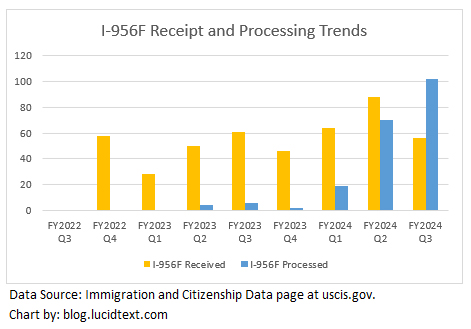
Processing activity for post-RIA investor petitions picked up slightly in Q3, but is still extremely low in context of the I-526E backlog and the number of reserved visas waiting for applicants. Two factors give me hope for a major boost to I-526E processing numbers coming soon: the uptick in I-956F processing in Q3 (with I-956F approval being precursor to I-526E approval), and the fact that the disappearance of the I-526 backlog is about to free up major adjudicator capacity that might be moved to I-526E processing. USCIS processed nearly 6,000 I-526 in the past 12 months, and such productivity would quickly decimate the I-526E backlog. I’m optimistic that USCIS/Department of State will at least be able to issue all Reserved visas available in FY2026, considering the processing potential. However, low processing volumes to date may mean that some FY2025 Reserved visas will go unissued for lack of qualified applicants advanced in time.
And a few other points of interest. Both I-526 and I-829 denial rates were down in Q3, to 25% and 5% respectively. A handful of I-526E denials were reported for the first time in Q3 — and I expect to see more soon, considering that USCIS denied 25 I-956F project applications so far this year. The number of I-956 regional center application filings hardly dropped in Q3, despite the massive filing fee increase. And apparently USCIS approved one I-924 in Q3. Mysterious!
I’ve copied below charts to highlight salient features and trends, as well as updating my Processing Data page and Key EB5 Backlog Data excel file. And heads-up for additional data and analysis coming in the next few weeks.
- USCIS still does not report I-526E processing times, but IIUSA has stepped into the gap and worked with regional centers to collect and analyze a large database of anecdotal evidence for actual I-526E and I-956F processing times. I’ve been assisting Lee Li with this important project, and look forward to the results to be released shortly. You’re invited to join us for a webinar on October 2, 2024 on “New Data and Emerging Trends: I-526/I-526E Filings, Adjudications, and Processing Times”
- AIIA continues the critical effort to extract information from USCIS on the breakdown of post-RIA I-526 and I-526E filings by TEA category and applicant country of birth, to help keep a pulse on potential visa backlogs. They hope for a response next month to the FOIA request covering the filing surge in January to March 2024. (Currently, we only have data through December 2023.)
- I’ve been working on a major project to research and write FAQ covering questions about EB-5 visa availability and allocation. The 26 short articles that comprise this project will be published next week – look for an announcement and links here next week Tuesday.
On the visa front, Department of State announced that it succeeded in issuing all EB-5 Unreserved visas available for FY2024 – good news for pre-RIA investors, and particularly for long-suffering Chinese investors who were able to pick up a large number of FY24 visas thanks to the productive consulate in Guangzhou. I will write separately about the visa outlook for FY2025 (which is unfortunately currently subject to litigation, as discussed by IIUSA and AIIA).





Discover more from EB-5 Updates
Subscribe to get the latest posts sent to your email.


According to the first graph and the pending 526E application total, USCIS seems to have processed approximately 1,000 applications, either approving or rejecting them. This volume should be sufficient to utilize most of the leftover visas from the previous year, should USCIS choose to do so.
is above a correct assumption?
I count 761 total I-526/I-526E processed through June 2024. DOS reported 939 EB-5 applicants with 2022 and 2023 priority dates pending at NVC as of May 2024, but only a handful of reserved visas issued at that point. With these numbers, I’m doubtful about the total 2,000+ high unemployment visas and 4,000+ rural visas being used in FY2025, though I agree that the carryover portion could be used in FY2025 at least for high unemployment. Unless the transfer of adjudicator resources to post-RIA happens quickly, and prioritizes high unemployment as well as rural.
Hi Suzanne,
Thank you for all the work you do. Do you think there is some sort policy by DOS to not issue reserved visas for FY2024? IIUSA posted a document a few months back with Dr. Henley saying there was over 300 post-RIA petitions at NVC, and this was back in May. It seems as though they definitely could have used a few reserved visas this year had they wanted to. And yet based on the latest data on State’s website, it seems not a single reserved visa was issued this fiscal year through the consulates.
The visa process takes time — I don’t believe in a policy decision not to issue reserved visas in FY2024. The recap of that meeting with Dr. Hanley mentions “the latest data indicates that, on average, it takes 150-250 days (or approximately 5-8 months) from when an EB-5 case is created at the NVC to when an EB-5 visa number is finally materialized at the consulate office (i.e. interview scheduled).” I also haven’t seen any reserved visas issued through consular processing, though Dr. Hanley said in May that one had been scheduled in Guangzhou. He also mentioned that 13 Rural and 4 HUA visas had been issued through status adjustment at that point.
Click to access Insights-from-DOS-Recap-of-2024-IIUSA-EB-5-Forum-1.pdf
That’s a good point. Also worth mentioning how some consulates are terrible at scheduling interviews. For example Rio where I will be processing went almost a full year without issuing any EB5 visas, and it’s not due to a lack of demand. I’m sure it’s not the only consulate that does this too.
Thank you so much, Suzanne. As a pre-RIA investor (PD 2016), I have been following your blog since 2017. I was surprised to find out that IIUSA has filed such a ridiculous lawsuit to protect RCs’ interests. I don’t believe that plaintiff has any chance to win the case, as their interpretation of RIA is non-sense… but what is your take on this?
Without filing fees from post-RIA investors and regional centers, the IPO has no budget for their adjudicators to process any pre-RIA petitions. From this perspective, the reserved visas in exchange for this benefit is quite reasonable by RIA.
I like the one IIUSA lawsuit argument that visas once marked as “Reserved” should stay with EB-5 and not be lost to EB-1 even after carryover over to Unreserved. I see how that argument makes sense according to the law, and could have benefited everyone in EB-5 this year if Department of State hadn’t made it moot by managing to issue all of the Unreserved visas available to EB-5 applicants.
I don’t know what to say about the second argument: that Department of State should not follow the carryover law in FY2025, and that extra F25 visa numbers should be kept away from the EB-5 Unreserved pool and retained in the EB-5 Reserved pool — despite the fact that Unreserved has a crowd of qualified applicants in FY25 who need the extra visas and Reserved doesn’t yet thanks to slow USCIS processing. Plus this is not the most attractive sales pitch for prospective investors: “I sued these visas away from my past investors so I could offer them to you.” The industry is really in a tough place with respect to visa availability, and naturally going after any possible solutions. If only we could find better solutions than “robbing Peter to pay Paul” or “rearranging deck chairs on the Titanic.” But anyway the law looks clear about how visa carryover from EB-5 Reserved to EB-5 Unreserved is supposed to work, so I don’t worry about this lawsuit actually changing the implementation.
Thank you so much, Suzanne for all the work and help to EB5 community.
Please help with following =
Question 1 = Request your help to understand the connection between A2 and B4.
Question 2 = will it be appropriate to say that 526 (Legacy) applicants are going to get their 526 approval and visas much earlier than Post RIA (Non Rural – High unemployment project applicants).
Request your insights / guidance on above two aspects⬆
To clarify, the “Post RIA Demand Trend” slide includes only I-526 and I-526E that were filed “post RIA” — meaning after March 15, 2022. When USCIS reports “Legacy” I-526, this means pre-RIA I-526 filed prior to March 15, 2022. The sum of pending Legacy I-526, post-RIA I-526, and I-526E is indeed about 10,000. But I usually consider pre-RIA I-526 and post-RIA I-526/I-526E separately, because they are processed in different workflows at USCIS and will mostly be competing for different visas.
If pre-RIA and post-RIA applicants were all competing for the same EB-5 visas based on priority date priority only, then pre-RIA applicants would indeed get visas first. As it is, EB-5 is effectively divided into a bunch of different queues considering the TEA set-aside categories and country-specific treatment. Priority date is not the only visa allocation factor. For each queue, the timing calculation is “number of people ahead of me in this queue” divided by “visas per year available to this queue.” The difference between Unreserved and High Unemployment, for example, is the question of whether it’s better to be one of many applicants for many visas, or fewer applicants for fewer visas. And also “am I at the head of this queue or at the back of this queue?”
For example, based on demand distribution and relative supply between the Unreserved and High Unemployment queues, I’d expect the Chinese Unreserved applicant with a late 2016 priority date to get a visa after the Chinese High Unemployment applicant with a 2022 priority date, but before a Chinese High Unemployment applicant with a 2024 priority date. This is complicated to think about, but you might find that Excel file I set up helpful. And I discuss visa allocation factors in detail in the FAQ that will be published next week.
Hi Suzanne,
Thanks for your guidance.
In summary
PreRIA pending I-526 are apox 5000 = Visa available are 68% of 10000 = 6800 approximately.
PostRIA pending I-526E + I-526 are apox 4500. = Visa available are 32% of 10000 = 3200 approximately.
Will it be correct to interpret that new applicants in Non Rural projects will have longer wait times than PreRIA pending I-526 applicants?
Please help / confirm.
You asked: “Will it be correct to interpret that new applicants in Non Rural projects will have longer wait times than PreRIA pending I-526 applicants?”
I wonder if you mean: “Will the person who files I-526E today for a High Unemployment project receive a visa later than the last pre-RIA applicant from the same country receives a visa?” I would say that the answer is likely “yes” considering the pipeline at this point, but not certain considering the mutability of underlying factors. (This response focuses on the comparative wait time from today, not individual wait times from the time of each applicant’s priority date.)
Pre-RIA petition PD Oct, 2018, Taiwan born, still waiting for adjudication 😦
If I were you, I would talk to your lawyer about contacting the Investor Program Office customer service mailbox to inquire about this I-526. Most October 2018 I-526 were processed in 2019-2023, and no action on yours makes me wonder if they lost the file (this can happen) or if there’s some problem you should know about. (You might also want to check on the status of any other EB-5 investors in the same project, and if there’s any litigation affecting the project.)
Hi Suzanne,Priority date-5th January 2022 Country of chargeability India .How likely is it that PRE RIA I526 would be adjudicated by end of 2024.Thanks
It looks likely to me based on the recent numbers for processing volume as compared with pending inventory, as reported in this post. At least, I would expect the I-526 to be assigned. Extraordinary factors can sometimes lengthen the touch time.
Hi Suzanne, I’m a standalone investor with priority date of 14th March 2022 and Country of chargeability is India. Still waiting to hear from USCIS so I assume that my application is one of 100 I-526 applications in the Net Backlog. Am I right in my assumption ?
Your assumption should be correct. USCIS has said that they defer to Visa Bulletin Chart B to set the line for I-526 processing based on visa availability, so your I-526 is eligible on that score. And no USCIS notice yet means there’s no customer-induced delay.
Hi Suzanne,
Thank you for your insights! They are, as always, very useful!
While reviewing the numbers myself, I noticed two inconsistencies:
The statistical discrepancy of more than 1,000 petitions in both the pre-RIA and post-RIA categories seems quite significant to me. Am I missing something?
Your feedback would be greatly appreciated!
Apologies, the discrepancy is only in the post-RIA petitions, as the first point includes both pre-RIA and post-RIA petitions.
It’s nice to have company in puzzling over why last quarter-end pending plus this quarter receipts minus this quarter processed hardly ever equals this quarter-end pending. I think I’ve finally figured out that petitions filed in the last few days of a period get included in that quarter’s receipt count but not in that quarter-end pending count. These reporting discrepancies even out on an annual basis, but they can be dramatic in the quarterly reports especially after filing surges. In this case, the Q2-Q3 reporting discrepancy counterbalances the Q1-Q2 discrepancy. Mysteries remain though. The current count of total pending post-RIA I-526/I-526E is 145 higher than the sum of reported receipts to date minus the sum of reported processed to date.
Thank you! At least I’m not alone in being puzzled by this question. It wasn’t as obvious in previous reports, or maybe I just didn’t pay enough attention. However, in the last few quarters, the discrepancies for I-526 and I-526E post-RIA petitions have become impossible to ignore. I hope the Q4 report will clarify things!
We are almost at the end of this quarter (Jul-Sep).
By the end of the previous quarter, the pre-RIA net backlog was 100, the gross backlog was 5000.
One would expect the post-RIA backlog to have begun processing this quarter (Jul-Sep).
Are attorneys seeing such progress this quarter (anecdotally, with RFEs/approvals/denials), at a rate that is normal and much higher than the post-RIA rate we have seen till now?
Pingback: Courts Rule Against Regional Centers on Visa Rollover Lawsuit - American Immigrant Investor Alliance