Background to the October 2024 Visa Bulletin (who can get EB-5 visas in FY2025?)
September 16, 2024 1 Comment
October begins a new fiscal year, with a new stock of visas available to EB-5 applicants. The October 2024 Visa Bulletin includes significant movement for EB-5 dates for China and India. To understand this movement, it’s necessary to look at the dates in context of what they represent – visa applicants with priority dates.
Does a final action date of July 15, 2016 for China mean that most Chinese EB-5 applicants with priority dates earlier than July 2016 can expect visas shortly? Does a final action date of January 1, 2022 for India mean that most India-born EB-5 investors with priority dates in 2021 and earlier can expect visas shortly? Looking at the number of applicants in progress compared with FY2025 visa availability, the answer is “maybe” for China, and “no, certainly not” for India.
First, consider the supply of Unreserved visas available to allocate this year. The precise numerical limit has yet to be announced (it will eventually appear here), but FY2025 will have at least the base allocation of 140,000*0.071*0.68=6,759 new-issue Unreserved EB-5 visas, plus an additional 4,000+ visas thanks to carryover from a portion of Reserved visas not used in FY2024. (That is, unless the IIUSA lawsuit succeeds in challenging the carryover law. See slide 18 here for additional analysis.) So, we’re potentially looking at around 11,000 Unreserved visas available in FY2025, of which India can expect about 7% (770), and China with its old priority dates can expect 7% plus what’s leftover after India and as many ROW visas as consulates can manage to issue. I guess that at least 4,000 to 5,000 Unreserved visas will end up being available to China in the coming year.
And now let’s consider the Unreserved applicants lined up for FY2025 visas. Potential applicants can be in multiple places – still with I-526 pending, with I-526 approval but waiting for NVC transfer, with pending I-485, and/or registered at the National Visa Center for consular processing. But let’s just look in one place – at applicants registered at NVC as of May 2024, according to a chart provided by Department of State and included on p. 3 of “Insights from the State Department: Ten Key Takeaways on the Latest EB-5 Data and Visa Processing from the 2024 IIUSA EB-5 Industry Forum” (Published: June 6, 2024).
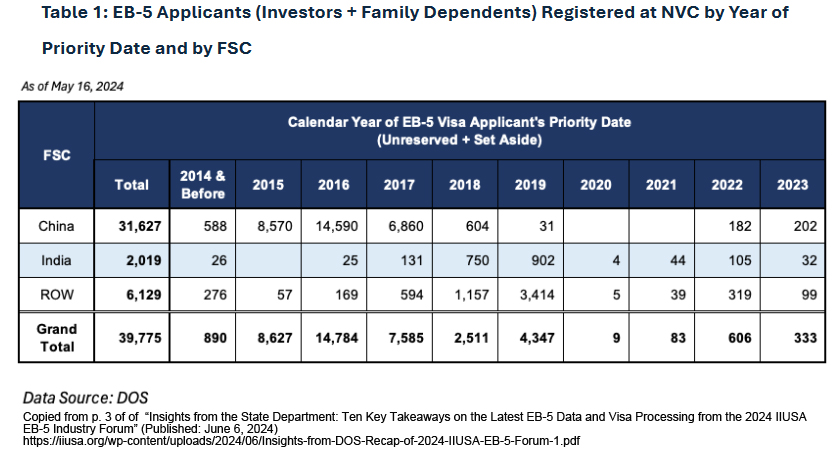
The following sections consider what this table means for India Unreserved, China Unreserved, and 5th Set Aside in the Visa Bulletin.
India — EB-5 Visa Applicants vs Visa Bulletin Dates
Table 1 above has a stark message for India: 1,834 applicants with 2019 and earlier priority dates were still waiting at NVC for Unreserved EB-5 visas as of May 2024 – and that’s only at NVC, not counting 1,000+ Indians waiting for I-485 status adjustment as of April 2024, or potential applicants waiting for I-526 approval and NVC transfer. (Note: there is potentially significant overlap between the I-485 list and both the NVC list and the pending I-526 list.)
The crowd of Indian applicants reported by DOS in May certainly did not just disappear between May 2024 and today. Some registered applicants may have given up or switched categories by this time, but it’s improbable that they suddenly all got tired of waiting and gave up en masse. 2018 and 2019 priority dates are not that old, and a number only became qualified recently given I-526 approval timing. 1,800+ Indian applicants could not have received visas in the last months of FY2024. (As of May, DOS reported having already issued 864 of the approximately 995 visas available to India in FY2024 under the country cap.) Therefore, it’s likely that at least 1,700 India-born applicants with 2019 and earlier priority dates are still waiting today. With likely fewer than 800 Unreserved visas available to India in FY2024, Department of State can’t realistically get even close to allocating visas even all qualified Indian applicants NVC with 2019 and earlier priority dates this year, much less be able to move on to 2020 and 2021.
I can’t guess what the October 2024 visa bulletin DOES mean for India. What could it mean, except that DOS made a typo, or for some reason anticipates issuing a few lucky visas out of priority date order? The typical reason for moving Visa Bulletin dates — to “stimulate demand” i.e. push USCIS to adjudicate more petitions or potential applicants to submit documents — wouldn’t make sense here since NVC reports already having plenty of applicants. What we can see, from pending applicant data, is that the October 2024 Visa Bulletin cannot possibly mean a message that the pre-December 2020 India backlog is clear, or that the majority of 2020 and 2021 India priority dates can expect EB-5 visas soon.
EB-5 visa issuance to India has been confused by the fact of non-FIFO I-526 processing. Some Indians with 2019 priority dates have visas already, while others are still stuck waiting for I-526 approvals or transfer to NVC. The India backlog is also complicated by surges – for example of all I-526 filed by Indians in 2019, 50% were filed in the single month of November 2019. No wonder Department of State struggles to maintain queue discipline for India EB-5. For Indian applicants trying to think through the “where am I in the queue” question, I recommend a dataset recently shared with me by a blog reader, and copied starting in Row 467 of the Pre-RIA Demand tab in the Excel sheet I keep linked to the top of the EB-5 Timing page. My reader used FOIA to request an accounting of pending and approved status for I-526 filed by Indians between January 1, 2017 and April 1, 2022. Looking at this report, you can see the pattern of demand over those months, and see also how I-526 processing – approving a few in each month while leaving others behind – can have resulted in date confusion at the visa stage.
China — EB-5 Visa Applicants vs Visa Bulletin Dates
Table 1 above shows that the National Visa Center still has a significant number of China-born applicants with 2015 priority dates, and sufficient applicants with 2016 dates to absorb years-worth of visas. Demand in 2015 and 2016 came in surges, so I took an extra step to divide the China inventory by quarter. The following table shows a quarterly estimate created by taking the proportions for worldwide I-526 receipts reported by quarter in 2015 and 2016, and applying those proportions to data by fiscal or calendar year for China I-526 receipts and China NVC inventory. I included I-526 receipt numbers, as background for the number of Chinese who started the process. (Based on I-526 inventory status and recent denial rates, I will guess that most Chinese applicants with 2015 and 2016 priority dates who are ever going to reach the visa stage are registered at NVC and/or on pending I-485 by now.) The table includes information on pending I-485, which USCIS reports by month of priority date.
| Priority Date | Total I-526 Receipts from China-born investors | China-born applicants registered at NVC as of May 2024 | Pending I-485 for China-born applicants as of April 2024 |
| Before 2015 | 588 | 85 | |
| 2015 Q2 Jan – Mar 2015 | 1,570 | 1,167 | 23 |
| 2015 Q3 April – June 2015 | 1,682 | 1,250 | 36 |
| 2015 Q4 Jul – Sep 2015 | 4,471 | 3,323 | 162 |
| 2016 Q1 Oct – Dec 2015 | 3,808 | 2,830 | 319 |
| 2016 Q2 Jan – Mar 2016 | 391 | 546 | 103 |
| 2016 Q3 April – June 2016 | 1,415 | 1,976 | 332 |
| 2016 Q4 Jul – Sep 2016 | 5,334 | 7,447 | 1,165 |
| 2017 Q1 Oct – Dec 2016 | 3,310 | 4,621 | 778 |
| Total with priority dates prior to January 2016 | 9,158 | 625 | |
| Total with priority dates prior to June 2016 | 11,680 | 1,060 | |
| Total with priority dates prior to January 2017 | 23,748 | 3,003 |
Looking at the distribution by quarter, I notice the surge of demand from July to December 2015, followed by smaller crowd from January to June 2016, followed by another big surge in July to September 2016 (the last big peak, as we now know). No wonder the Visa Bulletin spent years in late 2015, but now foresees a leap through the first half of 2016, and then slow again through the second half of 2016.
Looking at the large number of total applicants as of mid-2024 with priority dates prior to January 2017, I can see why Department of State had no need to advance Chart B Dates for Filing to encourage even more applicant filings in those dates. It makes sense that the October 2024 Visa Bulletin retrogressed Chart B to prevent even more additions to that already-large crowd.
I see that as of May 2024, there were around 12,000 China-born applicants ready to go with priority dates before July 2016. Could Department of State think it’s possible to get anywhere near applicant #12,000 by the end of the coming fiscal year? It’s just conceivable they might get close, considering that China-born applicants may have gotten another 3,000+ visas June-September 2024, that China-born applicants could have access to 5,000 or so visas in FY2025, and that high-volume drop-out rates and denials among old 2015 priority dates are plausible. On the other hand, if all those applicants recorded at the National Visa Center and on pending I-485 in mid-2024 do indeed represent active applications from people still able and willing to claim visas, then it will take several years to issue visas to everyone with pre-July 2016 priority dates. In that case, neither Chart A nor Chart B would need to move again for China any time soon.
The major “what if” factor for China Unreserved at this point is the volume and pace of demand for Unreserved visas from the Rest of the World, since this directly constrains the supply of visas every year to China. For more data, see the Pre-RIA Demand tab in the Key EB-5 Backlog Data file, which I keep linked to the top of my EB-5 Timing page and update regularly. And keep an eye on the discussion about whether post-RIA Rest of the World applicants should be encouraged to select Unreserved visas rather than the set aside visas for which they also qualify.
Post-RIA EB-5 Visa Applicants vs Visa Bulletin Dates
The October 2024 Visa Bulletin still has “C” across the board in the 5th Set Aside categories, meaning no priority date restriction yet on who can get final action or file I-485. Again, this is a function of the number of applicants ready to go at the visa stage. Scroll back up to Table 1 at the top of this post, and see that <1,000 applicants were registered at NVC with 2022 or later priority dates as of May 2024. That’s not sufficient applicants to get anywhere near absorbing the 4,000+ rural visas and 2,000+ high unemployment visas that were available in FY2024 and will be available in FY2025, even if all were rural or high unemployment applicants. And the inventory of qualified post-RIA visa applicants likely isn’t much greater now, considering the low volume of I-526E approvals since May. When will the Visa Bulletin change for 5th Set Aside categories? The answer depends on USCIS, and when USCIS can manage to advance more applicants to the visa stage by approving more I-526E.
Discover more from EB-5 Updates
Subscribe to get the latest posts sent to your email.
 EB-5 Updates
Hi, Based on Oct Stats for India – Rural Post RIA PD 02/20, how long it will take i526E to be approved ?